OpenAI has just revealed a new "intelligence processor" chip for AI servers made in partnership with Broadcom. The chip, called Jalapeño, is designed to power current and future large language models, according to an announcement on Wednesday.
Jalapeño is an ASIC (Application-Specific Integrated Circuit), meaning it's designed for a specific purpose: AI inference. With AI inference, models process a user's request to run an agent like Codex or offer a response from ChatGPT, while AI training involves a model consuming vast amounts of data to inform its responses.
Netflix, A24, Focus Features, and Warner Bros.' Clockwork have all reportedly decided to pass on picking up Artificial- director Luca Guadagnino's new biographical drama about OpenAI cofounder / CEO Sam Altman - for distribution deals. And while Neon and Mubi are still said to be interested in the film, this situation makes it seem like Hollywood no longer has the courage to tell critical stories about Big Tech.
Does a thought-experiment about US ascendancy in the technology say as much about AI jitters as it does about the reality?
It’s 2031 and the US and China are about to tear Europe into pieces.
The US ploughed vast sums into datacentres and the EU did not. China built robots and Europe did not. American companies “restructured” their workflows around AI and fired people, while EU workers went on long lunch breaks and handed over administrative tasks to the AI model Claude.
Luca Guadagnino's film about OpenAI CEO Sam Altman, Artificial, has reportedly been dropped by Amazon MGM.
The film, which stars Andrew Garfield and covers the rollercoaster five days in 2023 spanning Altman's termination and reinstatement as CEO, had been in the works for about a year. The cast also includes A Complete Unknown actress Monica Barbaro as OpenAI CTO Mira Murati, Ike Barinholtz as Elon Musk, and Anora's Yura Borisov as OpenAI chief scientist Ilya Sutskever.
In a statement to Deadline, the studio said it believes the movie "will be better served if it were released by a different studio and is working closely with the filmmak …
Five months after returning to OpenAI, Barret Zoph - the company's head of enterprise AI sales - has departed, The Verge has learned.
Zoph returned to OpenAI in mid-January after a stint as co-founder and CTO of Thinking Machines Lab, the competing AI company founded by former OpenAI CTO Mira Murati. Shortly after Zoph returned to OpenAI, the company said he would lead its push into enterprise - a significant role at OpenAI, since in recent months it had vowed to stop chasing so-called "side quests" and focus on key revenue drivers like enterprise and coding ahead of its planned IPO.
OpenAI confirmed to The Verge that Zoph will be depart …
OpenAI is bulking up before its IPO, landing Transformer co-inventor Noam Shazeer from Google DeepMind and former Trump AI policy official Dean Ball in the same week.
Bernie Sanders has unveiled an aggressive plan to transfer trillions from leading AI firms to the public, and, to the likely horror of AI firms, it goes even further than expected to give Americans more control over the AI industry.
Sanders shared a summary of his legislation with AP News. If passed, the law would create a sovereign wealth fund “financed through a one-time 50 percent tax on the stock of the largest AI companies,” AP News reported. Any AI firm that does $200 million in annual AI sales would be subject to the tax, as would any new firm once it reaches that revenue level.
In total, Sanders estimated the fund could be worth $7 trillion, generating “hundreds of billions of dollars annually in direct payments to Americans and programs such as health care, education and housing,” AP News reported. Each American would likely receive more than $1,000 annually in 5 percent annual dividends, Sanders estimated.
Tokenmaxxing was the hottest trend in Silicon Valley earlier this year, with CEOs encouraging employees to push AI usage as far as it would go. Then the bill came due. Uber reportedly blew through its annual AI budget in a few months, some companies cut Claude licenses for parts of their org, and Meta killed its internal leaderboard. This tension between […]
As OpenAI files SEC paperwork ahead of an expected initial public stock offering, newly leaked financial documents show a company with quickly growing revenues that are currently being overwhelmed by even larger expenses.
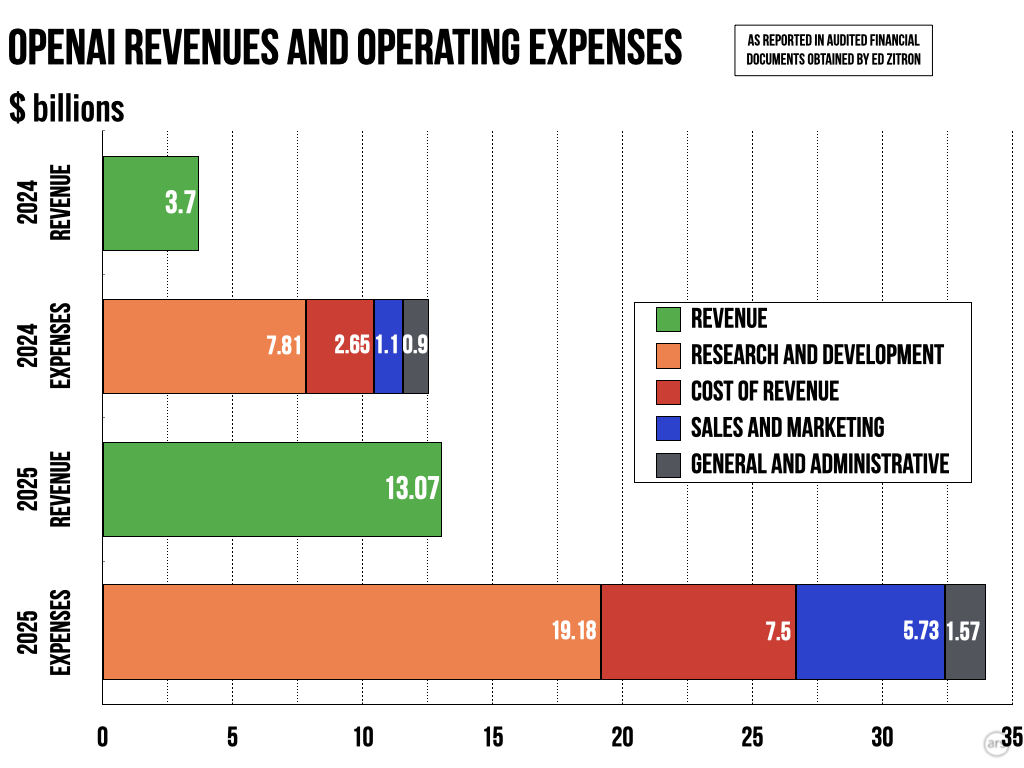
The audited financial statements, obtained by independent journalist Ed Zitron, show OpenAI's reported revenue growing from $3.7 billion in 2024 to $13.07 billion in 2025. The Financial Times, which reviewed the same documents, writes that the company's monthly revenues had grown to nearly $2 billion by the end of 2025, suggesting that its ongoing revenue rates continued to grow throughout the year.
R&D expenses alone still easily outpace OpenAI's quickly growing revenues.
Credit:
Ars Technica
But the company's fast-growing revenues are still dwarfed by its even more significant expenses. OpenAI's total revenues in both of the last two years were outpaced by research and development alone, which grew from a $7.81 billion line item in 2024 to a massive $19.18 billion cost in 2025. Those numbers seem to reflect the significant costs OpenAI incurred in training new models and include $10.59 billion in R&D costs paid to Microsoft alone in 2025.

 Login








 R&D expenses alone still easily outpace OpenAI's quickly growing revenues.
Credit:
Ars Technica