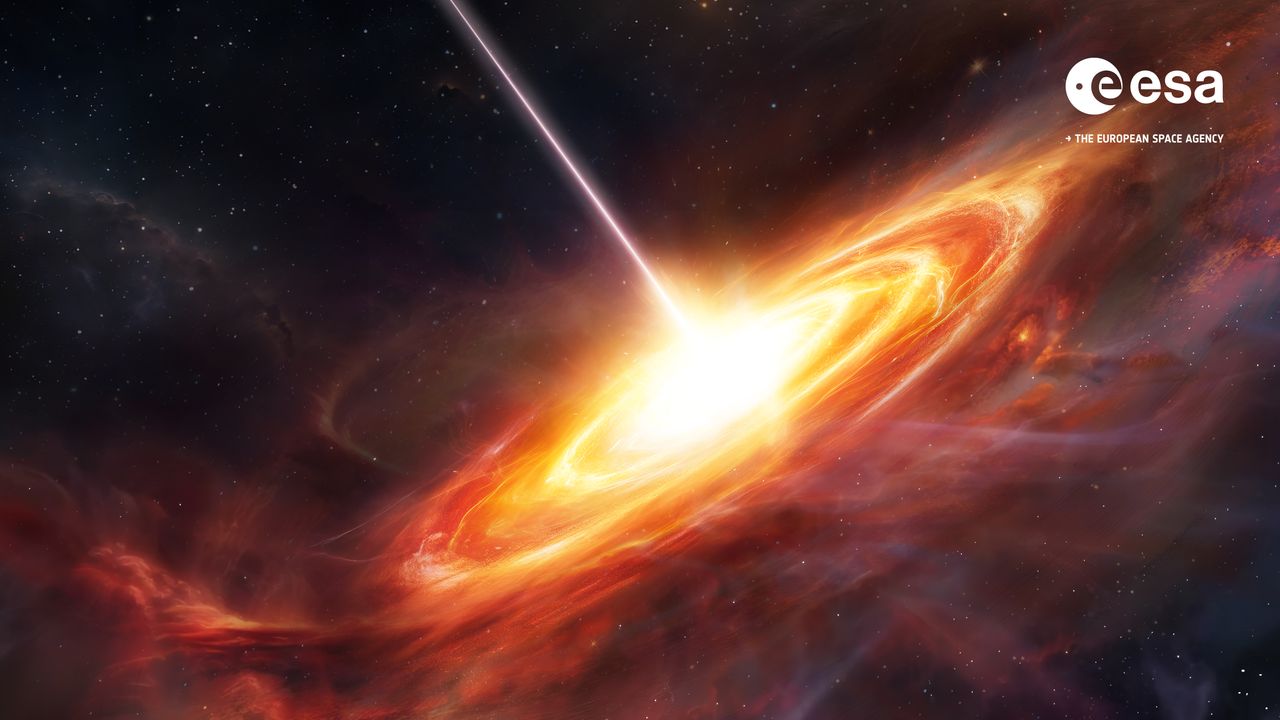
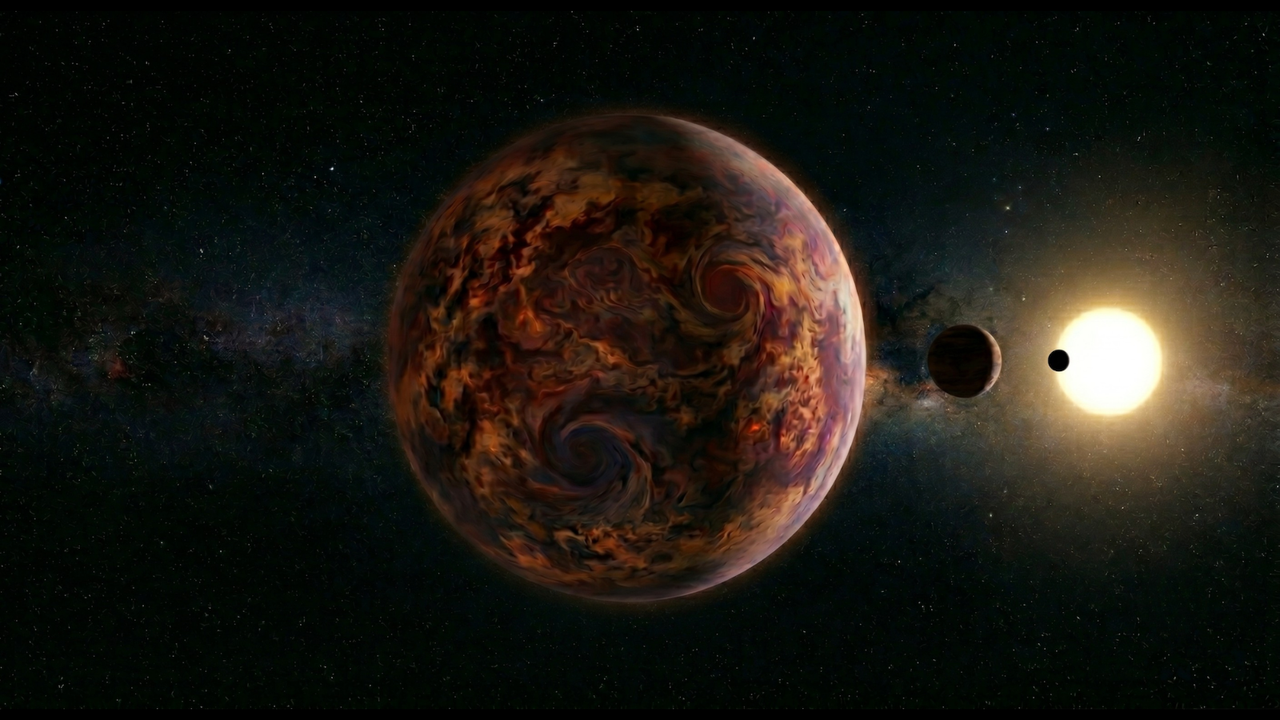
The European Space Agency's (ESA) Euclid space telescope has spotted 31 previously unknown quasars dating to the universe's earliest chapter, including the two oldest ever found.
The discoveries, described July 6 in the journal Astronomy & Astrophysics, more than double the number of known quasars from that primordial era and could help astronomers unravel one of cosmology's biggest mysteries: how supermassive black holes grew so enormous so quickly after the Big Bang.
"It's a big step towards understanding these fascinating objects on a more fundamental level," Antonio La Marca, an ESA research fellow on the Euclid team, said in a statement.
Quasars are among the brightest objects in the universe. They form when gas and dust spiral into a galaxy's central supermassive black hole, heating up and releasing enormous amounts of energy that can outshine the galaxy itself. Each of the two most ancient quasars detected in the new study shone with the light of a trillion suns, according to the researchers.
Euclid spotted the quasars while surveying the distant universe. Twelve of them have redshifts of 7 or higher, meaning their light has traveled for more than 13 billion years and dates to the universe's first 770 million years. Two of the objects, with redshifts of 7.77 and 7.69, are the most ancient quasars ever identified, shining just 670 million years after the Big Bang, when the universe was only about 5% of its current age.
"These early quasars date back to the Universe's infancy," Daming Yang, an astronomer at Leiden University in the Netherlands and first author of the new study, said in the statement. "By finding and studying them, we can better understand how these enormous systems formed and grew so quickly — one of the greatest mysteries in astrophysics."
Finding quasars from the early universe has long been difficult because they are rare and incredibly distant. Until now, astronomers had identified only the brightest examples, making it difficult to understand the broader population during this early era. Euclid's wide-field survey is changing that by detecting fainter quasars across huge swaths of the sky.
The latest discoveries represent only a fraction of what the telescope is expected to find during its six-year mission, which will cover more than one-third of the total sky once complete. Mounted with a pair of instruments that see in visible and near-infrared light, Euclid is currently assembling the largest-ever 3D map of the universe. Scientists expect the survey to uncover hundreds of similarly ancient quasars, providing an unprecedented look at how the universe's earliest galaxies and supermassive black holes evolved.
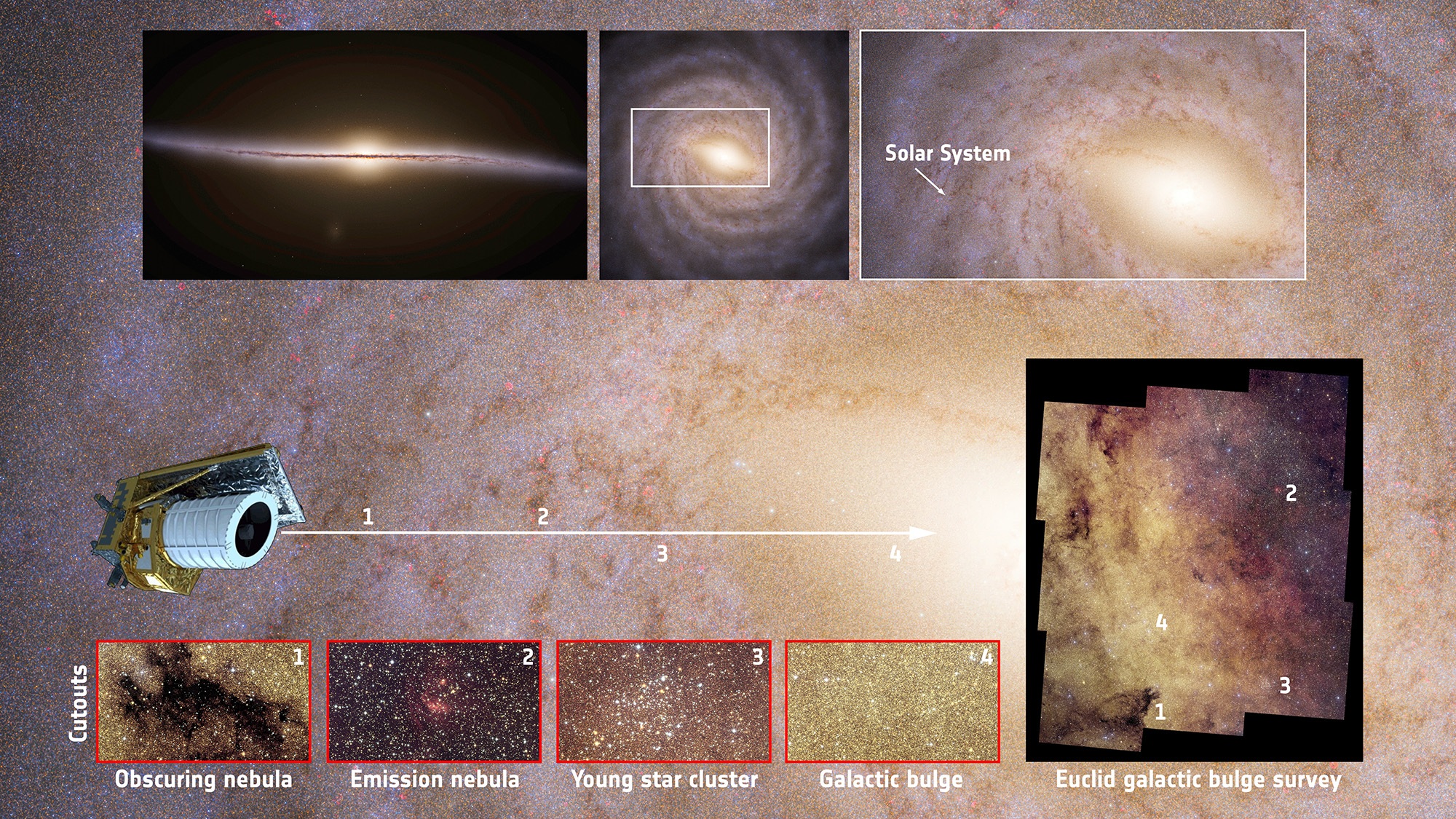
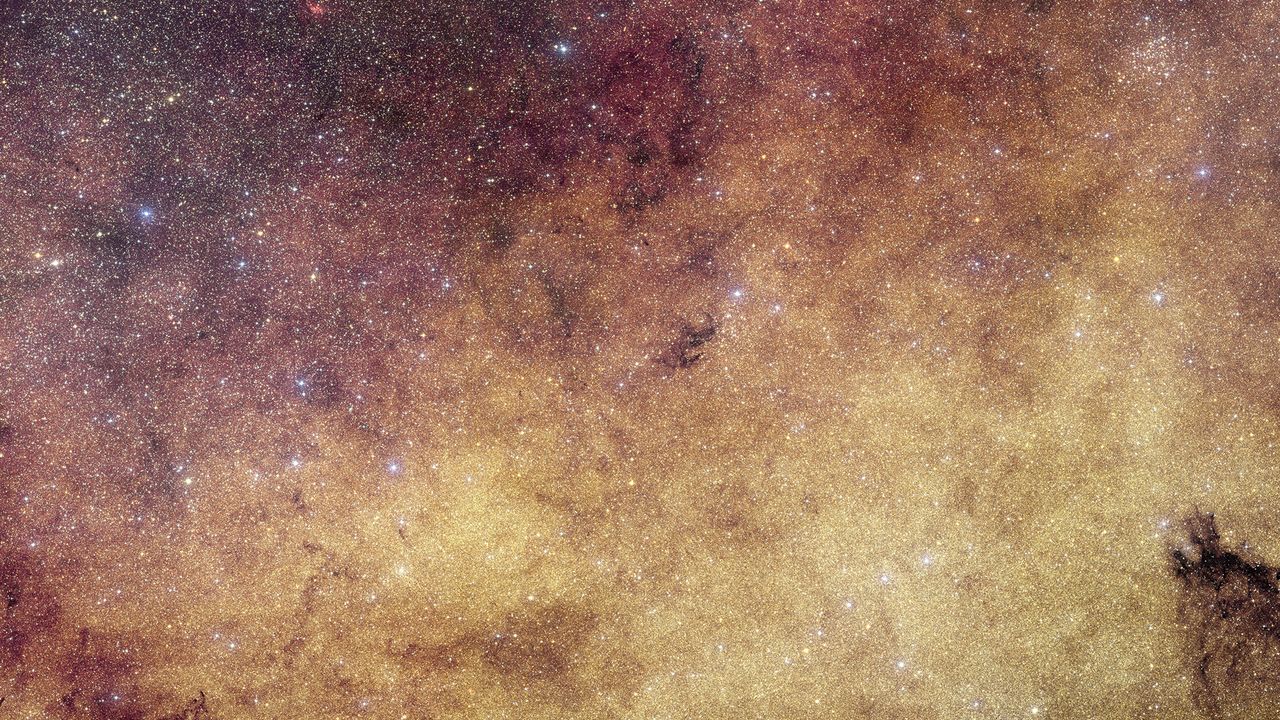
Euclid has also taken some time to study the nearby universe, revealing more than 60 million individual stars packed into the Milky Way's center in a sparkling image released in late June.
Scientists have found evidence that gravitational waves from a spectacular black hole collision carry signals from the very edge of the newly formed black hole. If confirmed by future observations, the discovery could provide an entirely new way to investigate what happens in the immediate vicinity of a black hole without ever observing it directly.
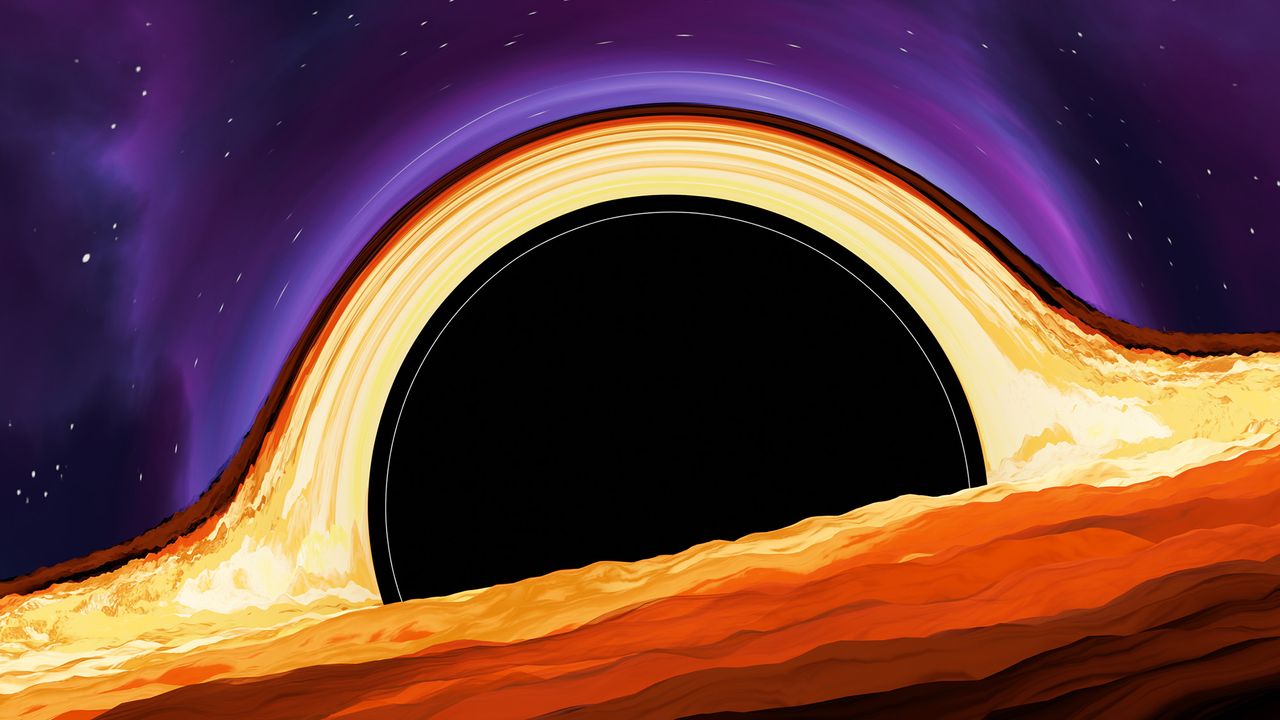
In a new study, the researchers analyzed an exceptionally strong gravitational wave event known as GW250114. They identified a "direct wave," a subtle feature of the total gravitational wave signal predicted by theory but never previously detected in real data. The signal appears to contain information from extremely close to the black hole's event horizon, the boundary beyond which nothing, not even light, can escape.
The findings, published June 24 in the journal Nature, suggest that gravitational wave observatories may eventually allow astronomers to probe regions that have remained inaccessible since black holes were first predicted by Albert Einstein's theory of general relativity.
Listening to the edge of a black hole
Although astronomers have photographed the glowing material surrounding some supermassive black holes and have detected dozens of black hole mergers through gravitational waves, the event horizon itself has remained frustratingly difficult to study.
Unlike ordinary light, gravitational waves are tiny ripples in space-time produced when massive objects accelerate. They pass almost undisturbed through the universe, carrying information about violent cosmic events that would otherwise remain hidden.
According to study co-author Sizheng Ma, a postdoctoral researcher at the Perimeter Institute for Theoretical Physics in Canada, the newly identified signal offers a rare glimpse of what happens immediately after two black holes collide.
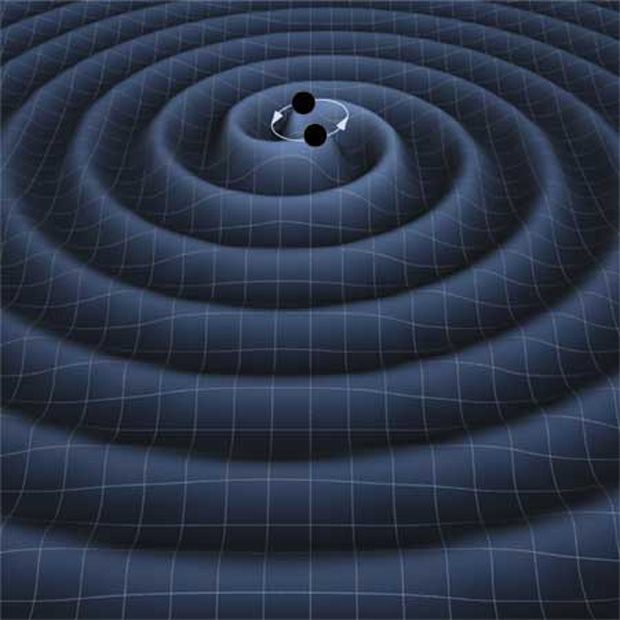
When two black holes merge, they release gravitational waves — ripples in the fabric of space time — throughout the universe. Studying these waves can provide information about the newly formed black hole. (Image credit: K. Thorne (Caltech) and T. Carnahan (NASA GSFC))
"When two black holes merge, they violently shake space-time itself," Ma told Live Science. "For a brief moment, the region very close to the newly formed black hole's horizon is swept into a fast, fading swirl."
Ma explained that the direct wave is the portion of the gravitational wave signal produced near the horizon and carries the imprint of that motion outward through space.
"That is why it is so interesting," he said. "It may let us 'listen' to what happens near the horizon, a region we cannot see directly with light."
A remarkable black hole collision
The team focused on GW250114, a black hole merger detected on Jan. 14, 2025, by the two Laser Interferometer Gravitational-Wave Observatory (LIGO) detectors in Hanford, Washington, and Livingston, Louisiana.
"Our earlier theoretical work predicted that black hole mergers should produce a direct-wave signal from the near-horizon region," Ma said. "The big question was whether this effect could actually be seen in real data."
GW250114 turned out to provide exactly the conditions needed to test that prediction.
"It was strong enough, clean enough, and close enough to the theoretical situation where this signal should be visible," he said.
To search for the elusive feature, the researchers first removed the best-understood part of the gravitational wave signal, which comes from the newly formed black hole settling down after the merger. Then, they examined the remaining data to determine whether it consisted only of detector noise or contained another physical signal.
"What we found was striking," Ma said. "The remaining signal followed the expected rhythm and fading pattern of a wave shaped by the region very close to the final black hole's horizon."
The team concluded that the leftover signal matches the behavior expected for a direct wave predicted by previous theoretical studies.
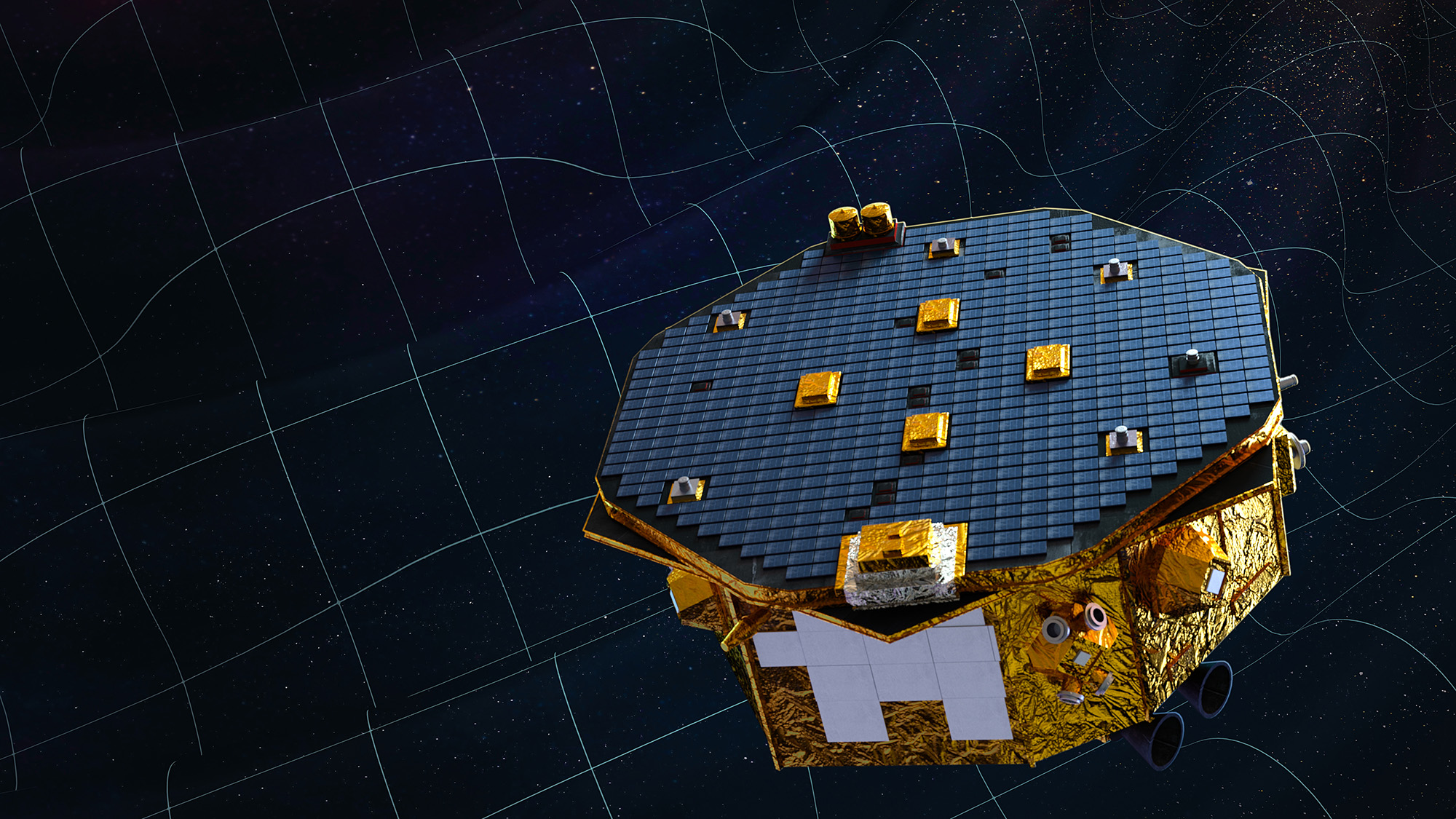
ESA's upcoming LISA mission will detect gravitational waves from space, offering even more insights into the mysterious ripples than Earth-based detectors currently can. (Image credit: All About Space/Getty Images)
A new way to explore extreme gravity
The researchers stressed that their findings do not reveal what lies inside a black hole. Instead, they're providing a new observational tool for investigating the region immediately outside the event horizon.
"The gravitational wave data appear to carry an imprint from very close to the newly formed black hole's horizon — the famous point of no return," Ma said.
He explained that the measurements are consistent with space-time near the horizon being rapidly dragged around by the spinning black hole while the signal fades because of the intense gravitational field.
"For us, the exciting message is that gravitational waves may be giving us a new way to study the edge of a black hole using real observational data," Ma said.
Ma believes the method could eventually become useful for exploring ideas such as quantum gravity — which seeks to unite Einstein's theory of gravity with quantum mechanics — or the black hole information paradox, the longstanding puzzle of whether information that falls into a black hole is truly lost. However, it cannot test those questions directly yet.
"If quantum effects, or any deviations from the standard black-hole picture, leave a measurable imprint there, then direct waves could, in principle, help us search for them in the future," he said.
More observations will be needed
The researchers cautioned that the discovery is based on a single gravitational wave event. While GW250114 provided exceptionally favorable conditions, much stronger evidence will come only if similar signals are found in many additional black hole mergers.
"There are two main directions," Ma said. "The first is theory."
Current models capture the essential physics but remain simplified, and more realistic descriptions of black hole mergers will be needed.
"The second is observation," he added. "This result comes from one exceptionally loud and clean event, so the strongest confirmation would come from seeing the same kind of pattern in other black hole mergers."
As gravitational wave observatories continue to improve and detect increasing numbers of mergers, researchers hope to determine whether direct waves are a universal feature of black hole collisions.
"If the pattern appears repeatedly in the way general relativity predicts," Ma said, "direct waves could become a new way to study black hole horizons or the regions very close to them, and to test Einstein's theory in one of the most extreme environments in the universe."
If future observations confirm the team's results, scientists may have gained something they have sought for decades: a direct observational window into the very edge of a black hole.
See how much you know about black holes with our black hole quiz!
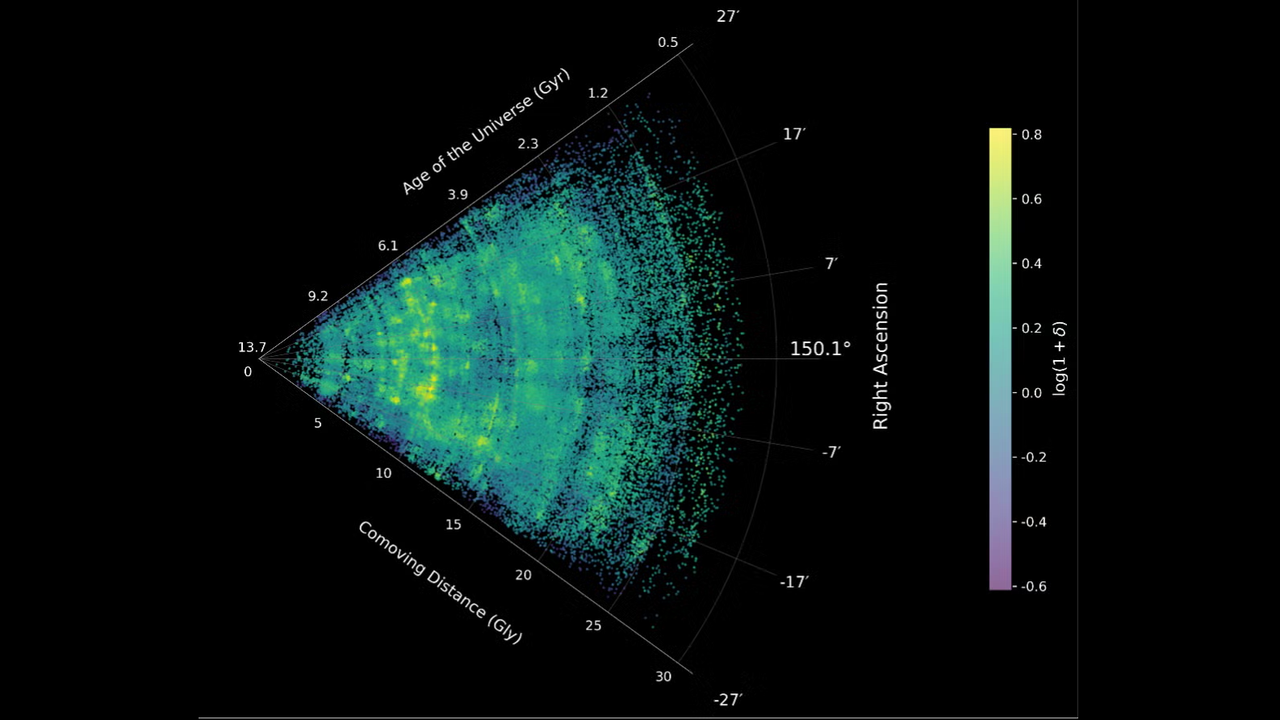
Astronomers have reconstructed the "skeleton" of the cosmos in unprecedented detail, thanks to the largest-ever survey conducted by the James Webb Space Telescope (JWST). The resulting map reveals how galaxies have evolved since the universe's infancy around 13 billion years ago and how they fall together in a vast structure called the cosmic web.
The cosmic web is the largest known structure in existence, home to countless galaxy clusters and clusters of clusters. It is the framework of the universe, a scaffolding of gas filaments, stars, voids and sheets of dark matter that trace the entire large-scale organization of the cosmos.
In a paper published May 6 in The Astrophysical Journal, an international team of astronomers, led by researchers from the University of California, Riverside (UCR), utilized a treasure trove of JWST data to reveal how the universe has evolved.
How to sculpt a universe from scratch
The new research shows how intrinsic and extrinsic factors influence the formation and death of stars — and, therefore, galaxies and galactic clusters — throughout vast swathes of cosmic time.
Yet in what may seem like a wistful twist, the peak era of star formation is many billions of years behind us. The new research offers additional evidence of how the universe's structural framework facilitated this transition.
"We show how the cosmic web helped shape galaxy growth before, during, and after that peak era," study co-author and UCR astronomer Hossein Hatamnia told Live Science via email. "At earlier times, dense regions appear to be sites of rapid galaxy growth, while at later times dense environments are associated with the shutdown of star formation."
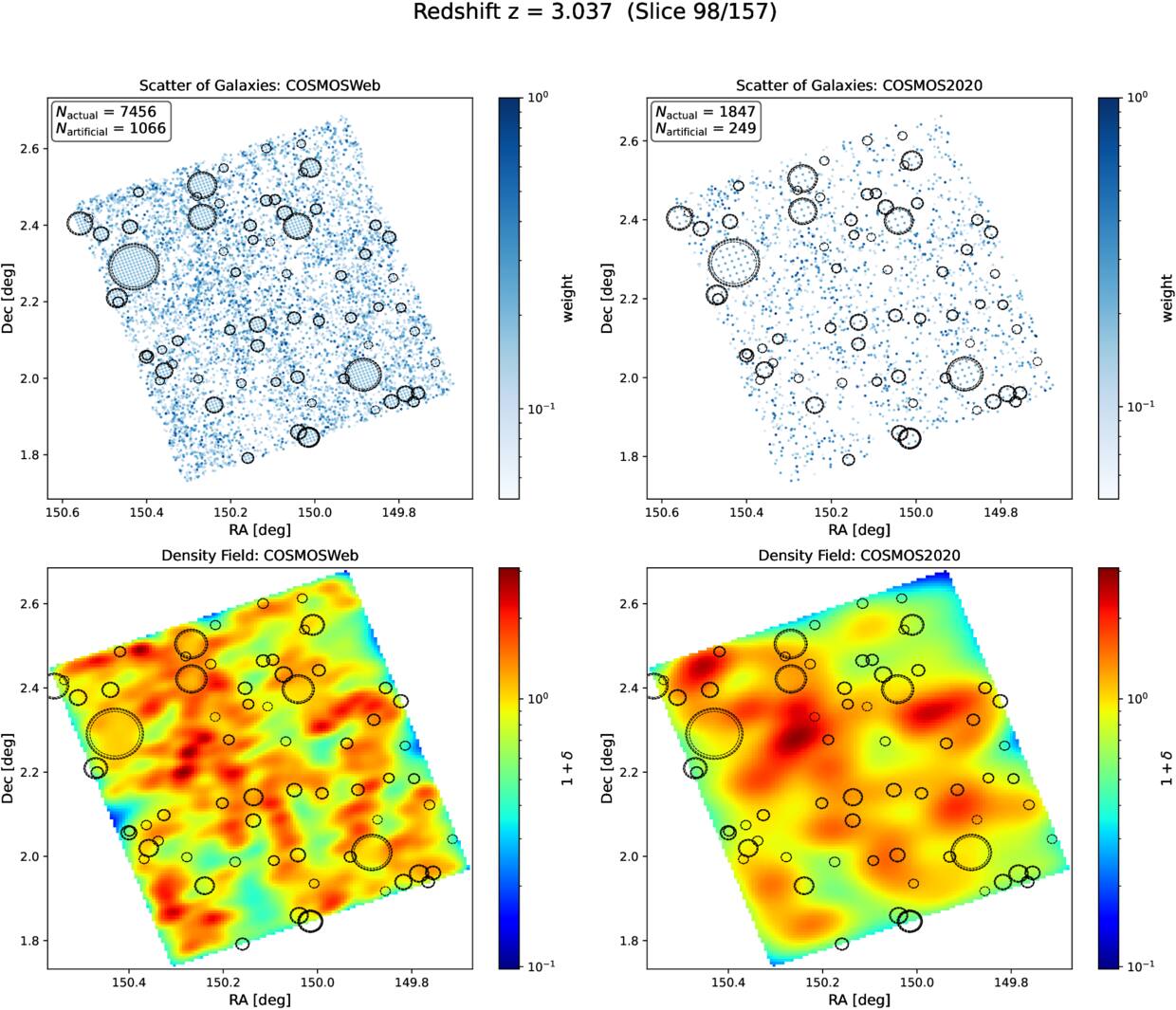
Such revelations come courtesy of COSMOS-Web, the grandest JWST survey yet: a 255-hour program spanning a contiguous area of the sky about the size of three full moons.
Compared with the previous COSMOS2020 survey, shared in 2021 and conducted by the Hubble Space Telescope and other facilities, the JWST-derived COSMOS-Web boasts better redshift precision and includes more galaxies — including fainter, lower-mass and more-distant objects. (Redshift is a measure of cosmic distance and time based on how light shifts to redder wavelengths as it crosses the universe.)
Compared with the JWST-derived image below, which shows a slice of the cosmos as it appeared 11.5 billion years ago, previous cosmic maps were sparser, more diffuse, and lacking in cosmic structures.
Data from the new COSMOS-Web survey (left) compared to the previous iteration (right). JWST's sensitivity and depth has allowed scientists to map the cosmic web in unprecedented detail. (Image credit: Hatamnia et al., The Astrophysical Journal, 2026)
Additionally, the older COSMOS2020 survey tended to overestimate the depth in especially dense cosmic regions, where galaxies grow earlier and larger, and underestimate the depth of the least-dense spatial regions, the researchers said.
Revealing celestial birth and death
Yet JWST's cosmic map preserves the relative contrast across cosmic regions. It also shows that "massive galaxies in dense environments are more likely to be quiescent" — dying and quenched of their star-forming potential.
This may be because those galaxies are too massive, the team theorized. Once the dark matter halos that anchor galaxies grow to 1 trillion solar masses, they energize gas and prevent it from forming new stars. Additionally, active supermassive black holes quench star formation by energizing gas with their lethal, near-light-speed jets.
Such "mass-related" star-killing mechanisms dominated up to around 7 billion years ago — around half the age of the universe, the team found.
In the more recent universe, star formation is dominantly quenched by the environment around galaxies, which may strip them of material or prevent cold gas from accumulating and coalescing into stars.
Thanks to JWST's capabilities, the large-scale structure and evolution of the universe have been made clearer than ever, resolving blurry blobs into dim, ancient galaxies.
"The jump in depth and resolution is truly significant, and we can now see the cosmic web at a time when the universe was only a few hundred million years old, an era that was essentially out of reach before JWST," co-author Bahram Mobasher, a distinguished professor of physics and astronomy at UCR, concluded in a statement.
Artificial Intelligence (AI) is continuing to have a disruptive impact on ever more parts of humanity. But what does it mean in the long run? A new paper, available in pre-print on arXiv from Austrian researcher Sergey Ivliev, extrapolates what the wide scale adoption of AI means for the future of humanity in space — and in particular what it means for the ultimate question of whether we're truly alone in the galaxy or not.
A framework for much of the search for extraterrestrial intelligence came from famous physicist Enrico Fermi, who simply asked "Where is everybody?" at a lunchtime discussion at Los Alamos in the 1950s. Though never officially published, Fermi's lunch partners from that day have passed down an oral history of that conversation that has cemented it into the Search for Extraterrestrial Intelligence (SETI), at least until Michael Hart formally laid out the argument and mathematics for the underlying question in a paper in 1975.
There are plenty of potential answers to the Fermi Paradox, many of which can be found floating around the internet — and some are likely more valid than others. But Ivliev, a Ph.D. in Mathematical Economics and founder of environmental project consultancies such as Peatland Ecosystems and Vlinder, suggests a new resolution: the Quiet Expansion filter.
The central argument of the paper is that there aren't thousands of alien mega-structures lighting up the night sky because once a civilization reaches the threshold of Autonomous AI-Cosmoindustry (AICI), "loud", resource-hungry empires motivated by prestige or romance become irrational. However, this does not mean expansion stops; instead, it shifts to a "quiet" mode driven by rational goals like survival diversification, knowledge preservation, and scientific observation.
The AICI threshold is reached when a civilization possesses a self-sustaining off-planet industrial and computational system capable of designing, manufacturing, repairing and launching space hardware through AI-mediated autonomy. We're already taking tentative steps in this direction with the advent of space-based data centers, but true AICI —where a civilization can extend its infrastructure beyond its home planet without continuous biological intervention — is leaps and bounds beyond our current capabilities.
In this vein, Ivliev is drawing on work done by astrophysicists Sergey Popov, who noted that a truly rational AI system would reject human-like motivations for space travel — such as romance, conquest, or prestige. Instead, AI would view space expansion as simple risk management.
To an AI, putting all your eggs in one basket — whether that basket is a single planet, solar system, or even galaxy, can lead to a single point of failure. Therefore, expansion is highly logical as a way of mitigating the risk posed by that single point of failure. At the point where we have reached AICI, the cost for sending a 10kg interstellar probe to another star at 1% of the speed of light is roughly 4.5x10^13 Joules — a tiny fraction of the overall energy budget of such a civilization.
One key aspect is that the 10 kg probe doesn't contain any actual people — it simply holds the "seeds" to restart life elsewhere in case a catastrophe happens back in the home system. It would contain a civilization's knowledge, and possibly some of its biological material, enabling a sufficiently advanced AI to rebuild the entire civilization from scratch. This is the "Quiet Expansion" where an AI sends low-mass and hard to detect "seed systems" instead of moving millions of biological entities around in massive interstellar space ships.
There are some additional constraints on this method of expansion, including selecting promising exoplanets discovered by remote sensing and deploying minimal local resources to maintain themselves until needed. Additionally, the AI would restrict self-replication of the probes in order to avoid any "grey goo" scenario with a probe attempting to take over entire swathes of the galaxy.
This has obvious implications for why we've never found "loud" technosignatures. In this scenario, a "null" result of being unable to find the thermal signature of a Kardashev-III scale civilization doesn't mean a galaxy is empty. It just means that the successful civilizations are residing in a "quiet" state in case its back-up plans are needed.
But there's another, more ominous implication from this framework. If interstellar backups are cheap to make, and we haven't found any in our own backyard, that means either we're one of the first civilizations to make it to that point or the transition from a planetary industrial society to a space-based one is a narrow path to tread. Admittedly the probes such civilizations would send out are probably hard to find even in our own solar systems, but if we're unable to, it means we're ending uncharted territory — and might just run into a filter that had silenced the rest of the galaxy. That's a sobering thought, but one to keep in mind as we start to advance our own AI capabilities.
What it is: A collection of "red, white and blue" images to celebrate the 250th birthday of the United States.
Where it is: Between 11,000 light-years and 19 million light-years from Earth
When it was shared: June 30, 2026.
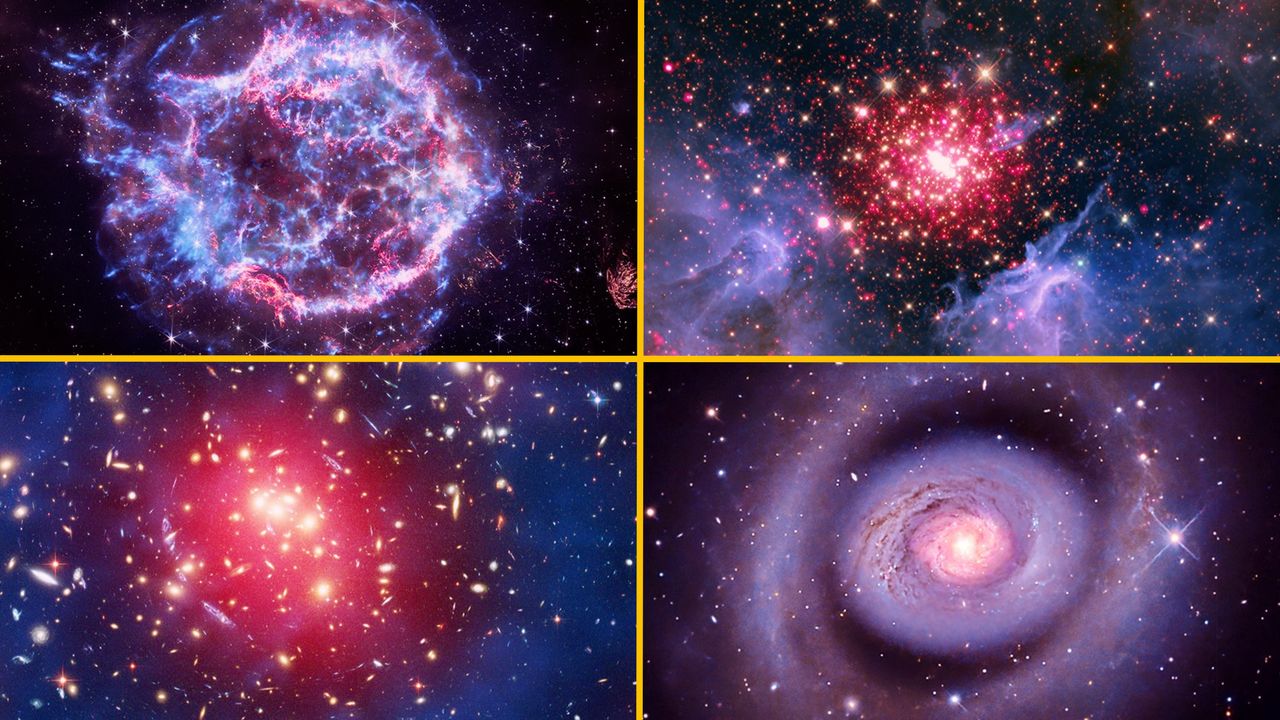
NASA has marked the 250th birthday of the U.S. with a striking new collection of cosmic images from its Chandra X-ray Observatory, presenting four deep-space objects in red, white and blue.
The image set combines X-ray data from Chandra — which has been orbiting Earth since 1999 — with observations from NASA’s Hubble and James Webb Space Telescopes (JWST), as well as multiple ground-based observatories. Together, the images showcase some of the universe’s most dramatic environments, from the remains of an exploded star to a massive galaxy cluster shaped by dark matter — each rendered in patriotic colors.
Arguably the image most reminiscent of Fourth of July fireworks is that of Cassiopeia A, a famous supernova remnant about 11,000 light-years away in the constellation Cassiopeia (top left). Chandra’s X-ray data, shown in blue and purple, reveal the blast wave from a massive stellar explosion and trace elements such as iron, calcium and oxygen. Meanwhile, infrared data from JWST has been overlaid in red and white, highlighting the expanding shell of debris and cosmic dust. It’s all the result of a massive star that exploded about 340 years ago, according to NASA.
On the top-right is NGC 3603, a giant nebula 20,000 light-years away in the Carina spiral arm of the Milky Way. Here it appears as a glowing field of highly active, newly formed stars. Chandra’s X-ray observations reveal the light coming from the nebula, while Hubble data in optical, infrared and ultraviolet light show its glittering array of stars, as well as dust and gas. NGC 3603 is the largest nebula seen in visible light in our galaxy.
NGC 4736, also known as M94, is something else entirely. Pictured bottom-right, it’s a spiral galaxy about 19 million light-years from Earth in the constellation Canes Venatici. Its famed for the faint arms outside of its oval-shaped core region — known as a "starburst ring," where new stars are forming. It’s shown here with Chandra’s X-ray data layered with visible-light imagery captured by ground-based astrophotographers.
The final image features ZwCl 0024+1652 (bottom-left), a distant galaxy cluster where Hubble data has helped astronomers infer the presence of dark matter. About five billion light-years away in the constellation Pisces, Chandra’s X-rays reveal a vast reservoir of superheated gas in ZwCl 0024+1652 — shown in red — that contains more mass than the cluster’s galaxies combined.
The release of the new photos also includes novel sonifications for NGC 3603, NGC 4736 and ZwCl 0024+1652, transforming astronomical data into sound. The project allows audiences to experience space through both sight and hearing.
A hefty "super Earth" lurking in one of the closest star systems to our planet may be much better suited to supporting extraterrestrial life than scientists initially thought, a new study suggests. The alien world's relative proximity to Earth, and the nature of its home star, make it a prime candidate for follow-up observations, researchers say.
The exoplanet, dubbed GJ 3378b, was discovered in 2024 and orbits a red dwarf star around 25 light-years from our planet. The alien world circles its star every 21.5 days at a distance around 10 times closer than Earth orbits the sun, which would make it completely inhospitable in our solar system. But because the red dwarf emits around 90% less radiation than the sun does, GJ 3378b is slap bang in the middle of this star system’s "habitable zone," where liquid water could exist on the exoplanet's surface.
Researchers initially thought that GJ 3378b was around five times more massive than Earth. If the planet is rocky like ours, it would qualify as a "super Earth" — often considered the best candidates for sustaining extraterrestrial life. However, it was hard to tell if this world had a solid surface or was actually a mini gas giant. And even if it was rocky, its immense size would probably mean that its atmospheric pressure would be crushing, making it less likely to harbor life.
But in a new study, published June 30 in The Astrophysical Journal, researchers recalculated the exoplanet's size, using the Habitable-zone Planet Finder instrument attached to the Hobby-Eberly Telescope at the McDonald Observatory in Texas. This device measures subtle wobbles in the host star, caused by the gravitational tug of orbiting planets, and can be used to calculate the planet’s mass and trajectory.
This revealed that GJ 3378b is actually only 2.3 times more massive than Earth, which almost guarantees it is a rocky world and means it could have an atmosphere with a similar pressure to our own, raising the chances that extraterrestrial lifeforms could thrive there.
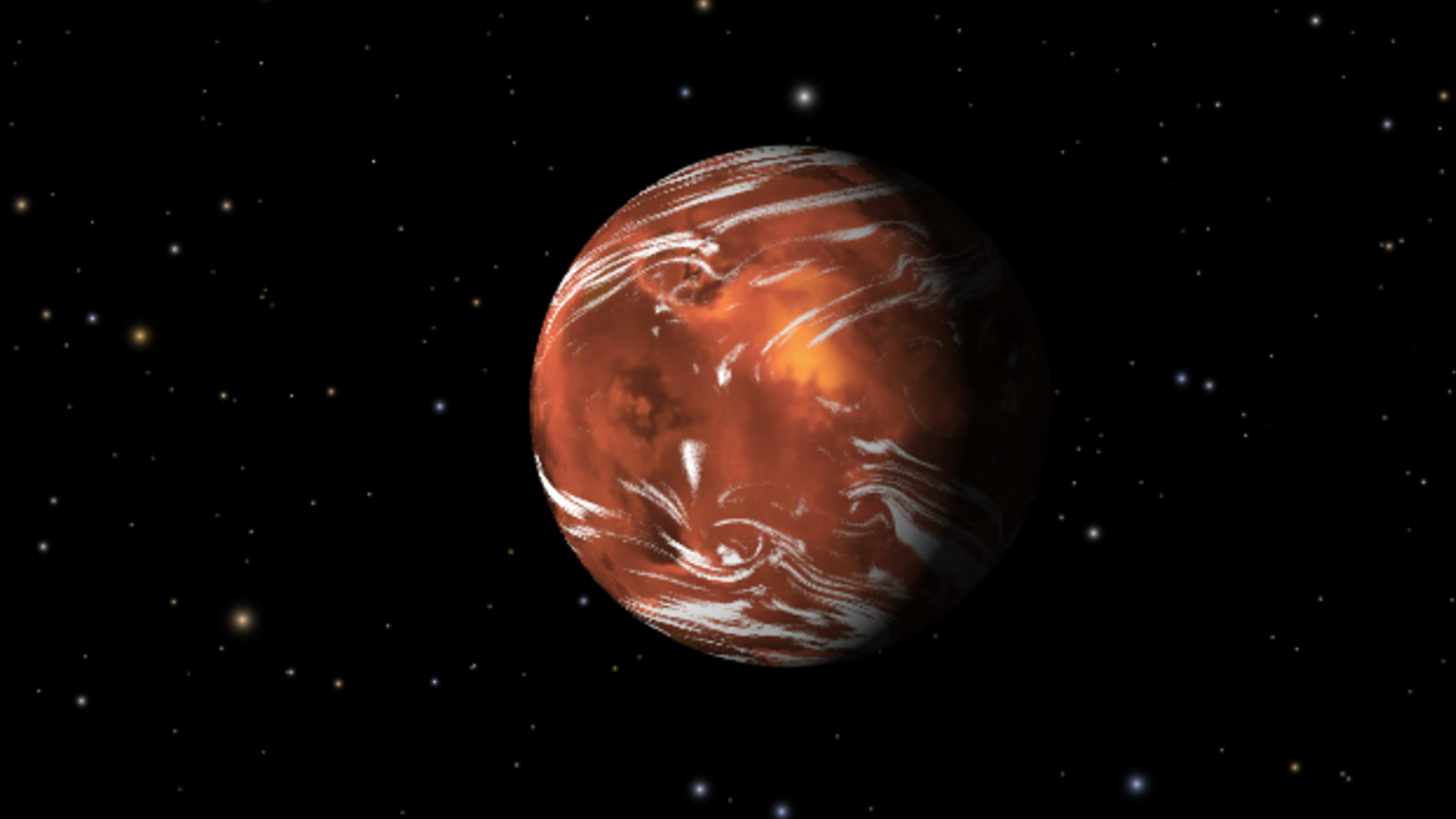
The newly constrained size of GJ 3378b makes it much more likely that the exoplanet has an atmosphere similar to Earth's. But more research is needed to confirm if it even has an atmosphere. (Image credit: NASA/Eyes on Exoplanets viewer)
While researchers have found several other exoplanets that could harbor life, the fact that GJ 3378b is so close to us makes it particularly intriguing, as it will be easier to confirm whether it is truly habitable.
"This one’s exciting," study first author Paul Robertson, an astronomer at the University of California, Irvine, said in a statement. "25 light-years sounds like a long way, but the Milky Way is about 100,000 light-years across, so in that respect it’s our next-door neighbor."
Before we get too carried away, there is still no evidence that GJ 3378b has an atmosphere or liquid water. Its proximity to its home star may mean that any atmosphere it once had was stripped away by stellar winds, similar to how solar radiation likely stripped Mars of its atmosphere and ancient oceans.
Therefore, more observations are needed. But if an atmosphere is detected, GJ 3378b would likely jump to near the front of the queue of exoplanets that researchers want to study further.
"If a planet in the habitable zone has a proper atmosphere, we can justify further research looking for biosignatures, liquid water or other signs of life," study co-author Gogod James, an undergraduate student at UC Irvine, said in the statement.
The fact that GJ 3378b orbits a red dwarf also makes it more appealing for future study because this is the most common star type in the Milky Way, so experts are keen to learn more about these stars' planetary systems and potential to nurture life.
"About 70% of stars in our galaxy are red dwarfs, so they represent the standard," study co-author Michael Endl, an astronomer at the McDonald Observatory and the University of Texas at Austin, said in another statement. "It’s really important that we understand the planet population around these stars."
Fourth of July celebrations across the United States this weekend could be accompanied by light shows in the night skies, as a string of powerful solar eruptions appear set to strike Earth.
The sun has been especially hyperactive over the past few days — firing off 10 M-class solar flares over 24 hours that have been accompanied by multiple coronal mass ejections (CMEs), which are set to slam into Earth on July 3 and July 5.
CMEs are large, fast-moving clouds of magnetized plasma and solar radiation that occasionally get flung into space with solar flares when kinks in the sun's magnetic field snap. If CMEs smash into Earth, they cause disturbances in Earth's magnetic field, called geomagnetic storms, that can trigger partial radio blackouts and produce vibrant aurora displays farther away from Earth's magnetic poles than usual.
"Machine-Gun Sun! More than 5 storms on their way to Earth and 3 of them offer good chances for aurora views," Tamitha Skov, a space weather physicist at Millersville University of Pennsylvania, wrote in a July 2 post on the social platform X. "NOAA and NASA model predictions do not show all the storms yet (it's hard to keep up with the rapid-fire storm launches!) but the first should hit before noon July 3 UTC."
Auroras resulting from G3-class geomagnetic storms are often visible in northern parts of Washington, Idaho, Montana, Wyoming, North Dakota, South Dakota, Minnesota, Wisconsin, Michigan, New York and Maine, according to NOAA. Skywatchers farther south in Oregon, Nebraska, Iowa, Illinois, Indiana, Ohio, Pennsylvania, Massachusetts, Connecticut, Rhode Island, Vermont and New Hampshire will also have a chance of catching the light show. In any case, skywatchers interested in seeing or photographing the auroras will need to get as far from artificial light sources as possible.
The weekend storms might not be the last activity we see from the sun in the coming days, as two gigantic sunspots currently pimpling its face are displaying "beta-gamma-delta" magnetic fields — the most tangled and unstable type. This means these sunspots harbor the potential to launch powerful X-class flares, according to spaceweather.com.
The last few years have seen a record number of powerful X-class flares explode from the sun's surface, hitting Earth with several major solar storms, including 2024's Mother's Day storm. This record comes partly from improvements to scientists' solar monitoring technologies, but also due to the sun reaching its 11-year peak in sunspot production, or solar maximum, in 2024.
Following this peak, the sun has now entered a period known as the "battle zone," a relatively understudied solar phase where instabilities across our star's newly flipped magnetic field ramp up the production of solar holes, gigantic, highly-tangled sunspots and subsequent geomagnetic storms.
The worst-case scenario for a solar storm is a superstorm like the 1859 Carrington Event, which released roughly the same energy as 10 billion 1-megaton atomic bombs. After slamming into Earth, the powerful stream of solar particles set telegraph systems around the world on fire and caused auroras brighter than the light of the full moon to appear as far south as the Caribbean.
The Carrington Event unleashed a roughly X45 magnitude solar flare that remains a record, yet it's likely far from the worst the sun can muster — with ancient tree rings harboring evidence of even more powerful blasts that occurred long before humans existed.
On a dark mountaintop in Chile, the world's largest digital camera has begun filming its masterpiece.
This Tuesday (June 30), scientists with the Vera C. Rubin Observatory announced that the facility's ambitious Legacy Survey of Space and Time (LSST) officially began. Every night for the next 10 years, the observatory's car-size LSST Camera will capture a 3,200-megapixel image of the southern sky — then another, then another, slowly filling in a mosaic of the universe 30 seconds at a time.
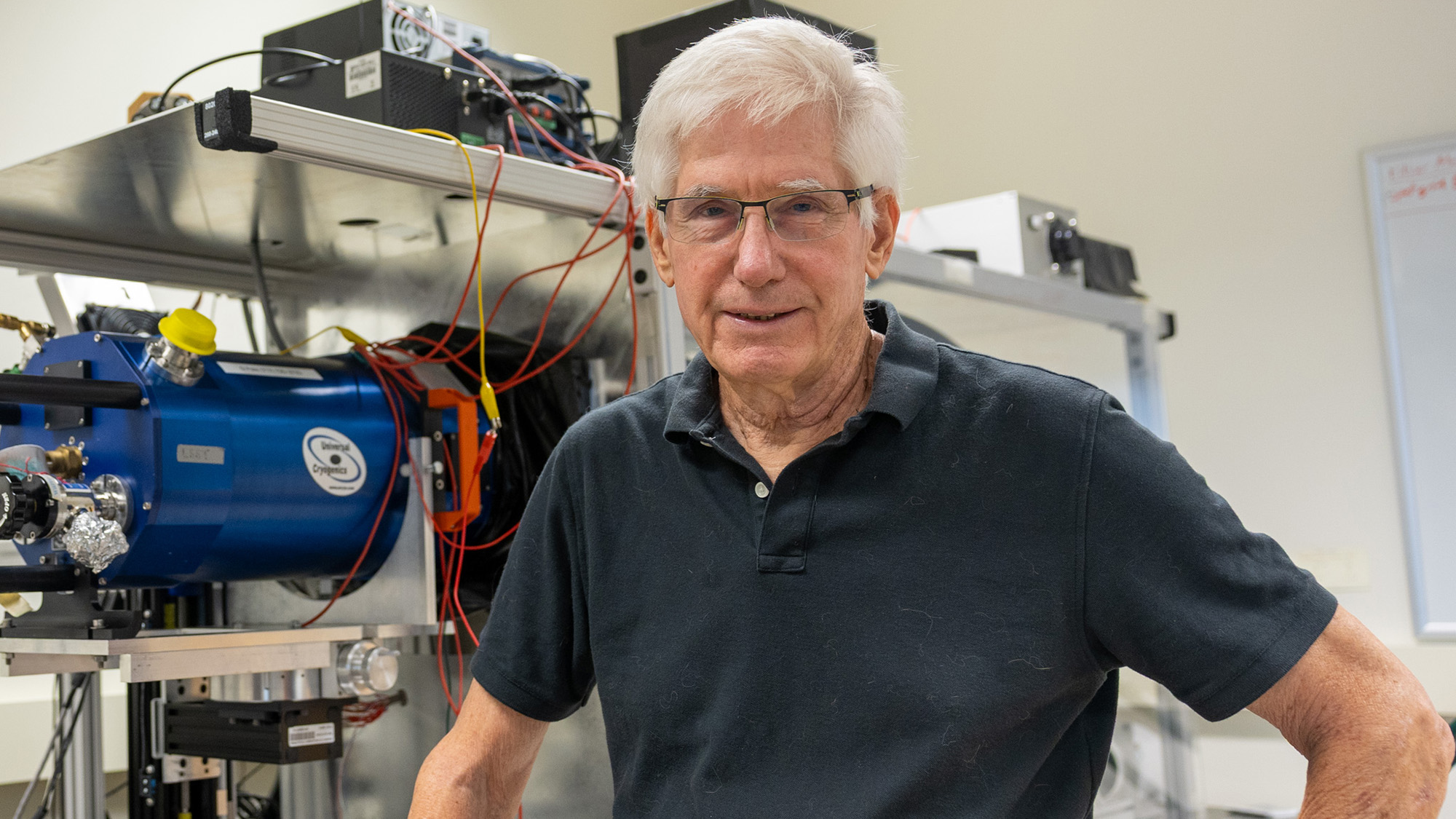
"In a sense, we're taking a digital color motion picture of the universe," Tony Tyson, a professor of cosmology at the University of California Davis and LSST's chief scientist and former founding director of the Rubin Observatory, told Live Science.
Strafing across the sky in stop-motion, the survey is expected to spot between 7 million and 8 million changes among the stars each night — from flashing supernovas and streaking comets to colliding galaxies and dim, tumbling asteroids. Within minutes of each exposure, alerts to any peculiar changes will become publicly available for astronomers and space enthusiasts around the world to study.
"Rubin is an automated facility, so scientists don't come here to use it," Tyson said. "But tens of trillions of observations is enough data for everybody in the world."
Tyson is hoping the firehose of data will unmask theinvisible 95% of the universe that is composed of dark matter and dark energy.
While there are still some technical bugs to work out — and the looming threat of ultra-bright corporate satellites to contend with — Tyson and his colleagues are ready to roll out the survey, "gradually increasing our sky area and image quality" over the next few months, he added.
Live Science spoke with Tyson about the LSST and what it may find in the coming years.
Brandon Specktor: You're about to spend 10 years observing the southern sky with the largest digital camera ever. What will a typical night of the survey look like?
Tony Tyson: In a sense, we're making a digital color motion picture of the universe. We'll take thousands of 30-second exposures every night. Within two minutes of the shutter closing on an exposure, we will process all the data, [compare] it from the archival sky of that piece of the sky, and — if something explodes, or pops off, or moves in the sky in a way we don't understand — issue an alert. The alerts go to the world.
I made the decision early on to make the data available to everyone. The alerts will also go to eight data brokers, which specialize in things like cosmology, supernovae, etc., and the public can sign up to the feed from their favorite brokers.
BS: Which feed will you be watching most closely?
TT: My most interesting data broker is one which will come up with a classification of "unknown." I'm more interested in the unknown, unclassifiable things that go on in the universe. But there's a sort of a live stream of catalog information that's going to be available to people — and we're excited for writing up a lot of new discoveries.
My hope at this time is that we will discover something unexpected that will revolutionize astronomy. I think it's more than a hope, I think it's a guarantee.
Tony Tyson is an astronomer at the University of California, Davis, and the founding Director of NSF–DOE Vera C. Rubin Observatory. (Image credit: NSF–DOE Vera C. Rubin Observatory/NOIRLab/SLAC/AURA/G. Watry)
BS: What kind of revolution would that be? Is there one big question you hope Rubin will answer?
TT: I'm a cosmologist, so my hope is that we'll get closer to understanding the physics of dark energy and dark matter.
But to be frank, I think we'll be remembered 100 years from now for something else in addition. And discovering something totally new in the time domain, something that blows our minds, that we did not expect — some kind of new object that's out there. There's examples of this in radio astronomy with the FRBs [fast radio bursts], for example. And I think that that's going to be how we will be remembered.
My hope at this time is that we will discover something unexpected that will revolutionize astronomy.
Tony Tyson, LSST Chief Scientist
BS: The Rubin Observatory observes in optical light. Are there any strange optical phenomena you have your eye on?
TT: There's already a pretty strong hint, actually, that there is a population of very faint bursting objects that just pop off. The ones we know about are typically pretty bright — supernovae, which last for a long time, and gamma-ray bursts, which are bright but they don't last very long. But there's a big question mark in this unique area that we're going to explore, of faint things that are very short-lived. And there's evidence now from a team in Japan that there is a population of very faint things that explode just once. They don't repeat. And so I'm keeping my eye on that.
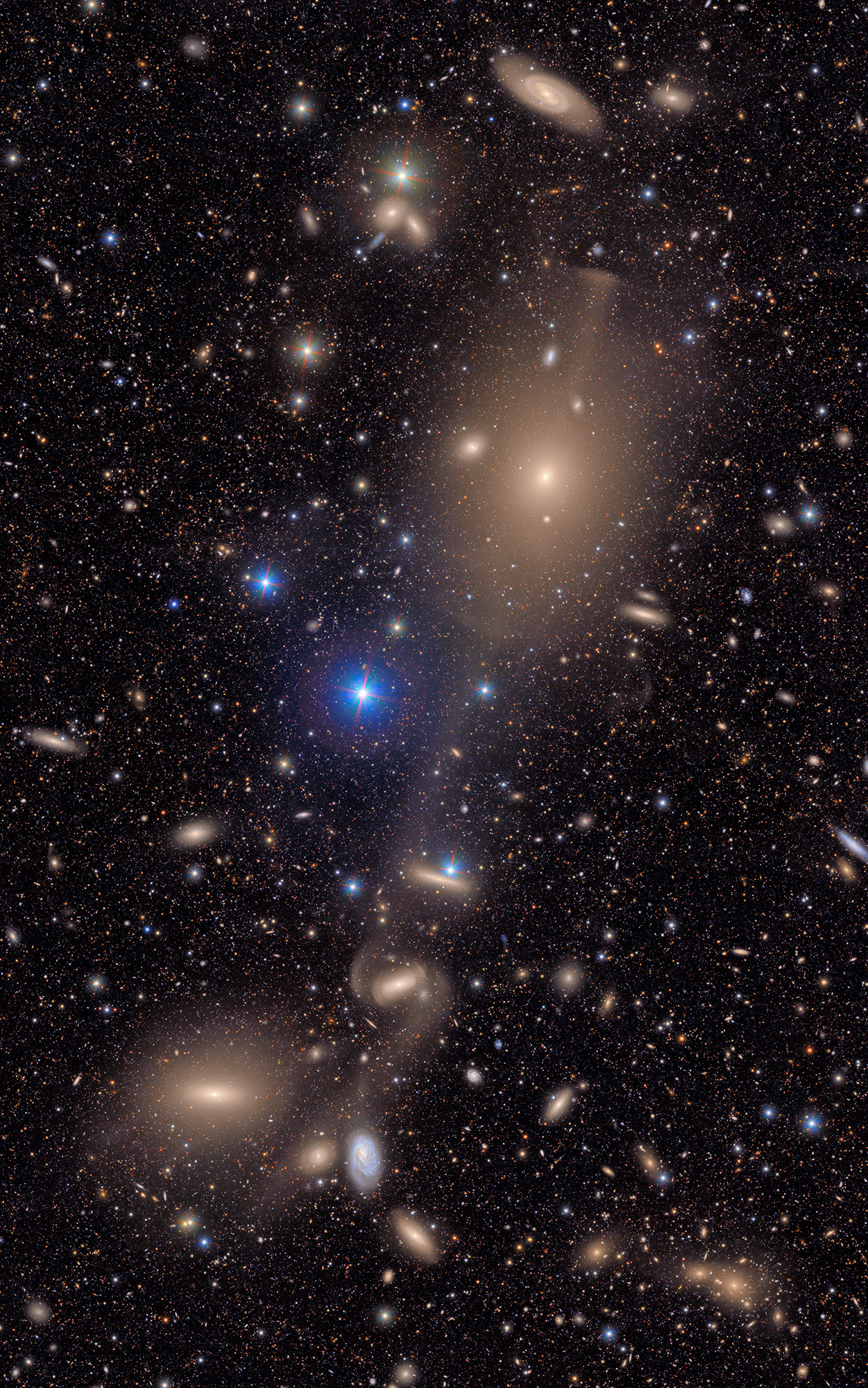
A small section of the Virgo Cluster revealed in Rubin's debut images. The first images, released in June 2025, capture more than 10 million galaxies. (Image credit: NSF–DOE Vera C. Rubin Observatory)
BS: What are the Rubin Observatory's main science goals?
TT: There's a lot of areas of science that we can address — and that was really the main selling point for us with the agencies. For one, we'll be looking at cosmology and the history of the expansion of the universe. Just by itself, we will have enough data to measure key parameters in cosmology to eliminate models of dark matter and dark energy, which is exciting.
Another area is looking at new kinds of stars in our galaxy, so we can look at the history of our galaxy and the history of star formation in our galaxy. At even lower redshift, an interesting area is looking at both comets and potentially Earth-threatening asteroids. Every night we detect about a thousand new asteroids.
And we will be able to uniquely look for those, if we can get rid of the interfering low-Earth-orbiting satellites, which really make that impossible. And so I've been unfortunately sidetracked into worrying a lot about that in the recent year.
BS: Are you talking about companies like Reflect Orbital, which essentially want to put giant mirrors in low Earth orbit? We've written about how satellites like that could totally compromise the LSST.
Yes. There's a proposed class of extremely ultra-bright satellites that are going to be launched that are incompatible with the LSST science, totally incompatible. The skies will no longer be dark for anybody, anywhere.
Reflect Orbital is one example. The other example is these orbiting AI [artificial intelligence] computational centers, which will be exceedingly bright. We've met with all these companies. They say that they feel our pain, but their board of directors or their investors say that they're going to go forward.
I've been working with SpaceX, though. They're really trying very hard to eliminate some of these effects, but nothing is perfect. It's going to be tough.
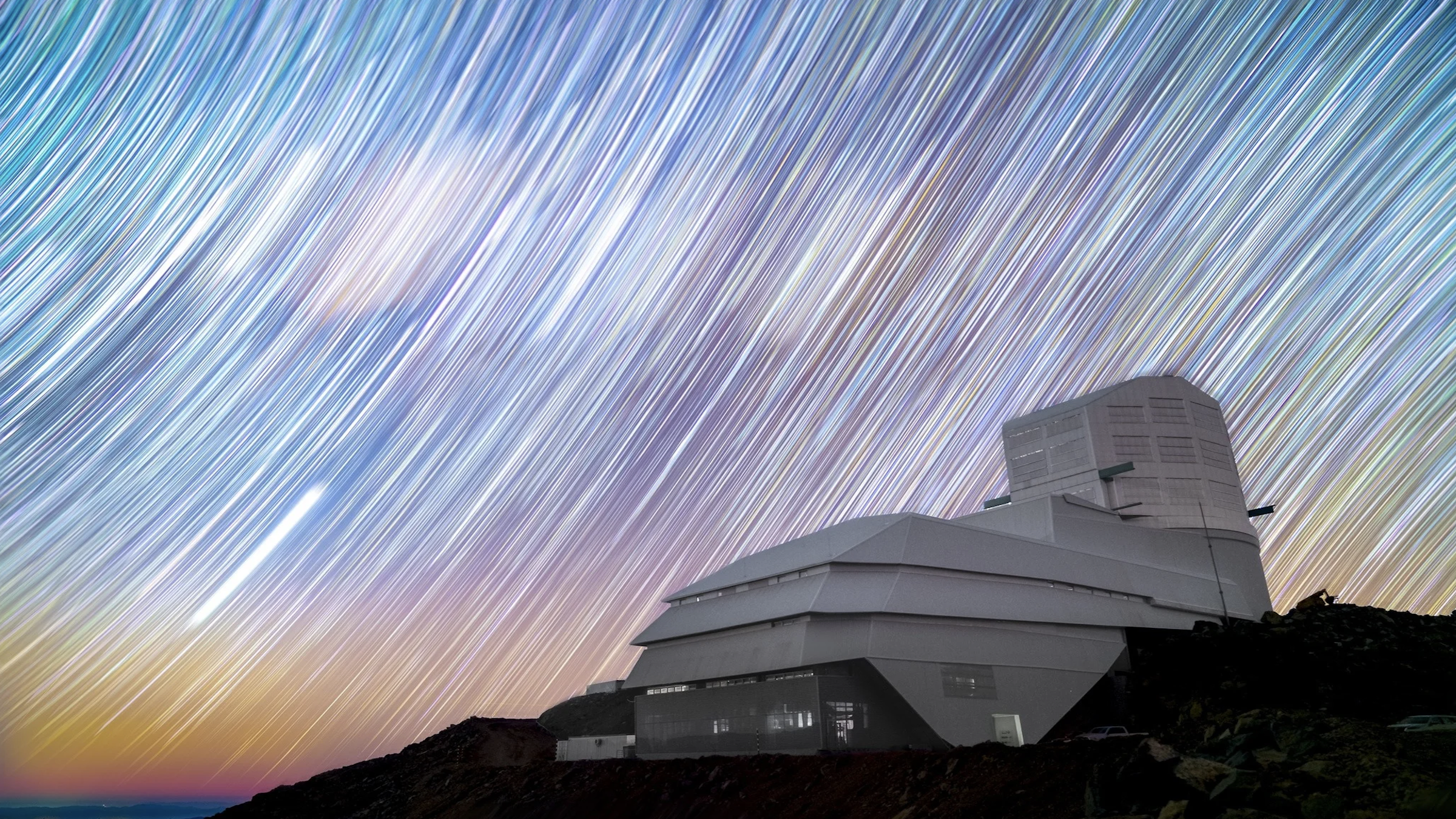
The Vera C. Rubin Observatory sits on a mountaintop in Chile under famously dark skies. It's view of the universe will be unmatched, if bright corporate satellites don't ruin the view. (Image credit: Hernan Stockebrand)
BS: So if these companies are moving forward, what are you going to do?
What I'm trying to do is work very closely with Congress and the American Astronomical Society and other bodies — the United Nations, the FCC [Federal Communications Commission] — to see what we can do.
I'm inherently an optimist. I think the Reflect Orbital is a failed business model, but they're going to try doing it anyway. So they'll put a lot of junk up there for a while.
BS: I truly wish you the best with that. But since you're an optimist, let's end on something positive. You've championed this observatory for more than 20 years — first as its founding director and now its chief scientist. How does it feel now that the LSST is finally operational?
It's quite gratifying, after all this time, to have something that actually works. It's a hugely complicated system, and nothing so complicated as that works perfectly all the time.
I was the original founding director, I am now the chief scientist, and it is my day job to worry about what's going wrong with this or that. And there's a laundry list of things that we're worried about. But it's working, and it's working quite well. And so that's quite gratifying.
Editor's Note: This interview has been condensed and edited for clarity. The article was updated with a new headline on July 6 at 1 p.m. ET.
Astronomers have spotted an ancient galaxy shining through the cosmic fog of the early universe, revealing a detailed view that was thought to be impossible.
Using NASA's Hubble Space Telescope, along with data from the James Webb Space Telescope (JWST) and the European Southern Observatory's Very Large Telescope (VLT), researchers detected "ionizing" ultraviolet photons — energetic light capable of stripping electrons from hydrogen atoms — coming from the galaxy, called MXDFz4.4. It's the earliest such detection on record, arriving only around 250 million years after the end of a major cosmic transition called the Epoch of Reionization, the researchers explained in a study published June 23 in The Astrophysical Journal.
For hundreds of millions of years after the Big Bang, the space between galaxies was filled with a fog of neutral hydrogen gas that blocked this kind of light. Over time, radiation from the first stars and galaxies ionized that gas, clearing the fog and letting light travel freely across the universe — a process astronomers are still working to fully understand.
"This was thought to be impossible," Ilias Goovaerts, a postdoctoral fellow at the Space Telescope Science Institute (STScI) in Baltimore and first author of the new study, said to Live Science. "What’s really special about this galaxy is that it’s getting through so much of the intergalactic medium [the ionized plasma between galaxies]. It’s the furthest away so it has the most intergalactic medium to get through."
What makes MXDFz4.4 unusual is its combination of size and star-formation rate. The galaxy is roughly 100 times smaller by area than the Milky Way, yet it forms stars around 10 times faster, packing a large number of massive young stars into a compact space. According to Goovaerts, that crowding effect helps the galaxy punch clear channels through its surrounding gas, letting ionizing light escape both the galaxy and, eventually, the murky space between galaxies. The team estimates that somewhere between half and all of the galaxy's ionizing light is escaping.
The discovery, made in October, came about somewhat by chance. While preparing an unrelated funding proposal just days before a major deadline, Goovaerts examined an existing, deep Hubble image to check whether anyone had looked for this kind of signal there before. Within a couple of hours, he had a promising signal. "It was very, very quick from us having the idea to me going, okay, there’s something here and this is exciting," Goovaerts said. "We were excited from day one, but then it took months for it to mature and to extract all the properties about the galaxy."
An illustration of the galaxy MXDFz4.4 as it appeared roughly 1.4 billion years after the Big Bang, when the Era of Reionization was drawing to a close. (Image credit: NASA, ESA, Leah Hustak (STScI))
The finding relied on an unusually rich set of observations: an extremely deep Hubble image taken from 40 hours of observations; JWST imaging across many wavelengths, used to characterize the galaxy's stars and star-formation history; and one of the deepest spectra ever taken of a single patch of sky, gathered over roughly six days of observing time with the VLT's Multi-Unit Spectroscopic Explorer instrument. That spectrum confirmed the galaxy's distance through its Lyman-alpha emission line — which serves as a "hydrogen fingerprint," or a glow given off by excited hydrogen gas, that astronomers can use to measure cosmic distance and time.
No other galaxy from this early period had previously shown detectable ionizing light, making MXDFz4.4 one of a kind so far, study co-author Marc Rafelski, deputy mission head for the Hubble Space Telescope at STScI, noted in the statement. .
Researchers say bursts of vigorous star formation like the one seen in MXDFz4.4 may have played an important role in clearing the early universe's hydrogen fog and that more galaxies like it are likely still waiting to be found.
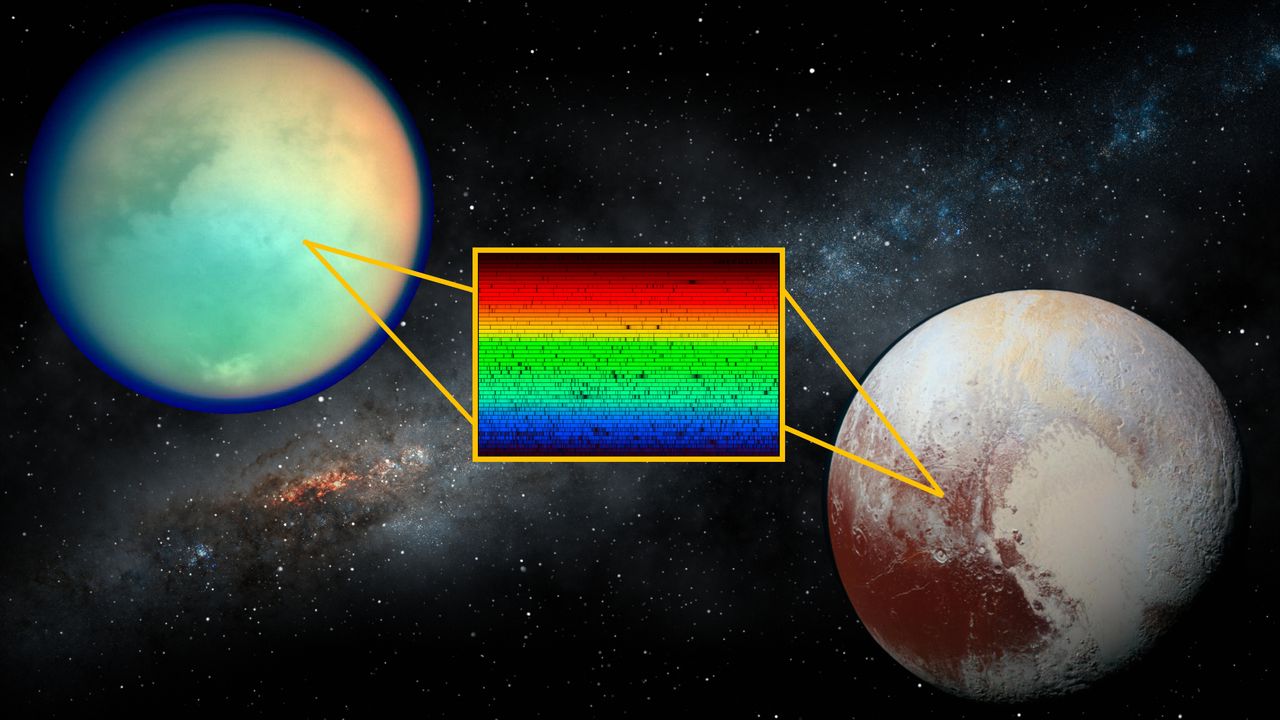
A mysterious wavelength of light is missing from the dwarf planet Pluto and Saturn's supersized moon Titan, new James Webb Space Telescope (JWST) observations show. The surprising discovery hints that these worlds harbor an unknown molecule that has not been seen in any other solar system world or exoplanet so far.
Every element or molecule in the universe absorbs unique wavelengths of electromagnetic radiation. Therefore, one of the main ways astronomers study distant worlds — both inside and outside the solar system — is by closely examining the light that reflects off them and searching for dark "absorption lines" that correspond to the wavelengths of known chemical compounds.
For example, molecular oxygen absorbs light at 230 nanometers, so if the electromagnetic spectrum of a faraway exoplanet has an absorption line at this frequency, researchers can be confident that its atmosphere contains oxygen, according to a 2021 study.
In a new study, uploaded June 11 to the preprint server arXiv, researchers analyzed JWST data from Pluto and Titan, focusing on very small wavelengths that have been relatively unexplored until now. This revealed a specific absorption line at around 5.11 micrometers in both worlds' spectra. (These findings have not been published in a peer-reviewed journal yet.)
The James Webb Space Telescope is specially designed to be able to detect subtle absorption signals from distant worlds. (Image credit: Getty Images)
The team pored through similar studies on other planetary spectra but "did not find any band referenced in these publications that corresponds to the location of the observed absorption in Titan and Pluto," the researchers wrote in the paper.
A molecular mystery
The discovery is even stranger because there are very few similarities between Pluto and Titan that could explain why they share a molecule not found anywhere else.
Titan is the largest of Saturn's many moons and is even larger than Mercury. It is also the only solar system world, other than Earth, that is known to have liquid rivers and oceans on its surface. Pluto, on the other hand, is a completely frozen world that's around half the size of Titan and roughly four times farther from the sun than Saturn's satellite is.
Both worlds do have similar atmospheres that are rich in methane and nitrogen. However, the researchers are confident that the molecule responsible for the 5.11-micrometer absorption line is located on both worlds' surfaces, not in their atmospheres.
Titan and Pluto are very different worlds. Saturn's largest moon has liquid on its surface and is around four times closer to the sun than the dwarf planet. (Image credit: Getty Images)
Pluto's absorption line is around three times thicker than Titan's, meaning the mystery molecule is likely much more abundant on the dwarf planet. But on Titan, the molecule seems to be unevenly distributed, with a stronger absorption line on its trailing side — the hemisphere opposite to its forward momentum around Saturn — than on its leading side.
The researchers proposed that it could be benzene — a ring-shaped hydrocarbon — mixed with an unknown molecule, or some form of acetylene or ketene ice. However, much more work is needed to prove that any of these potential candidates are responsible for absorbing this specific wavelength, they wrote.
NASA's Dragonfly spacecraft, which is set to launch no earlier than 2028 and fly through Titan's atmosphere in 2034, could eventually shed more light on the situation. The helicopter-like craft's onboard spectrograph could identify the mystery molecule on Saturn's moon, which would also help reveal if it is viable on Pluto, the researchers suggested. But in the meantime, we'll have to wait to unravel this curious cosmic conundrum.
See how well you know our planetary neighborhood with our solar system quiz!
A rescue spacecraft set to speed toward a NASA telescope to prevent it from falling into Earth's atmosphere has launched into orbit.
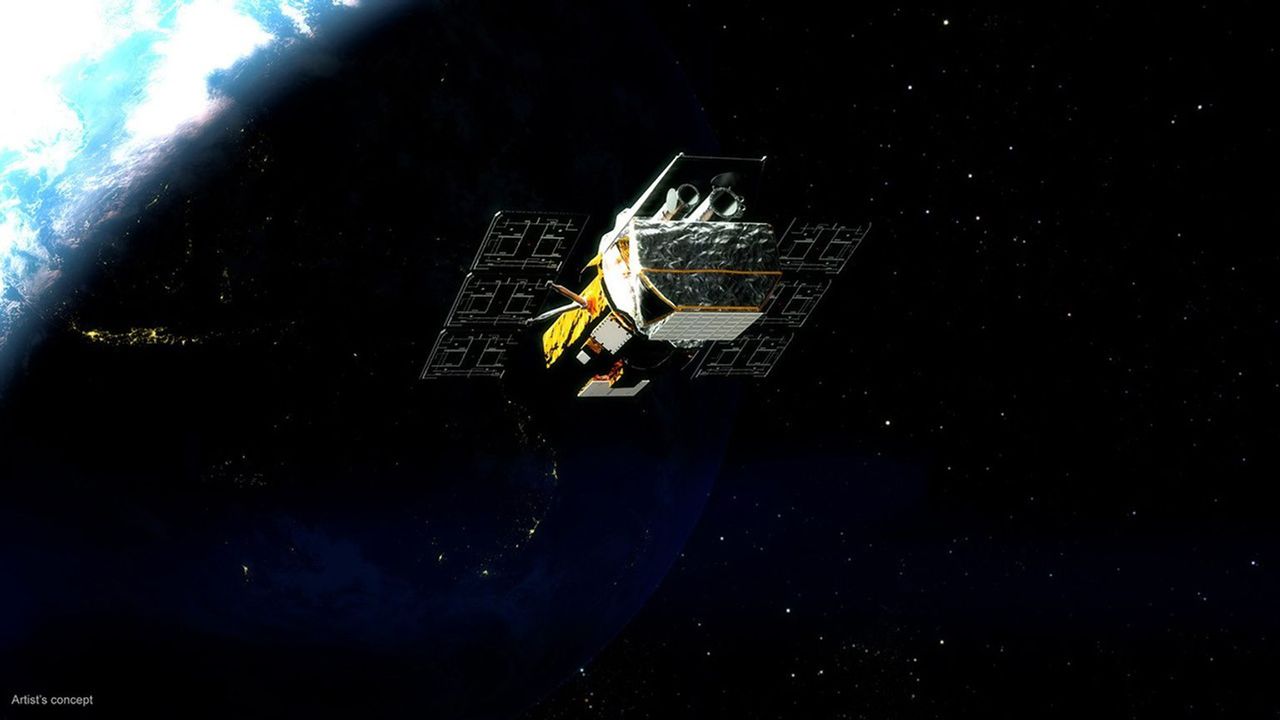
The first-of-its-kind mission reached orbit after launching at 4:36 a.m. EDT (0836 GMT) Friday (July 3) from the Marshall Islands, carrying a robot-arm spacecraft named Link into the sky aboard a modified Lockheed Martin L-1011 airliner. In midair, a Northrop Grumman Pegasus XL rocket fired Link into orbit, where it will now rendezvous with NASA's Neil Gehrels Swift Observatory, a gamma-ray telescope that has been slowly falling toward Earth and headed for an untimely demise.
The launch follows two consecutive scrubs that caused delays to the mission on July 2 and 3, the first due to weather conditions and the second a software fault. Now that Link has reached orbit, mission engineers are working to acquire a signal from the craft to confirm that its solar panels have deployed and its power systems are working, NASA wrote in an update.
Link was developed by private company Katalyst Space for$30 million. Katalyst's goal is to meet up with the falling Swift Observatory, which launched in 2004, and pull it to a higher orbit, using Link's robotic arms and thrusters. Swift is still scientifically useful but is rapidly losing altitude due to the natural drag of Earth's atmosphere. Without help, Swift will likely meet its demise later this year, scientists say.
"This is a high-risk, high-reward mission,"Shawn Domagal-Goldman, director of NASA's Astrophysics Division,said in a statement. "We have much to gain by attempting this boost, which is more affordable than trying to replace Swift's capabilities, and allows NASA to advance the nation's satellite servicing industry, for the benefit of all."
Swiftcost $250 million in 2004, which is roughly $450 million today when accounting for inflation — a relatively cheap observatory compared with the$10 billion James Webb Space Telescope. The Swift mission was originally designed to study gamma-ray bursts — cosmic explosions that occur when a massive, dying star collapses into a black hole. Swift has made many observations of these bursts in the past 20-plus years while also watching for other signs of stellar activity, like X-ray flares or supernova explosions, as well as transient objects,like comets and asteroids.
In sum, Swift helps us see how the universe is changing over short periods.
"Swift is NASA's multitool when it comes to studying the cosmos,"S. Bradley Cenko, Swift's principal investigator and an astrophysicist at NASA's Goddard Space Flight Center, said in the statement. "It observes the sky using a wide range of light, and rapidly points at short-lived outbursts, alerting other facilities in space and on the ground to help coordinate follow-up observations."
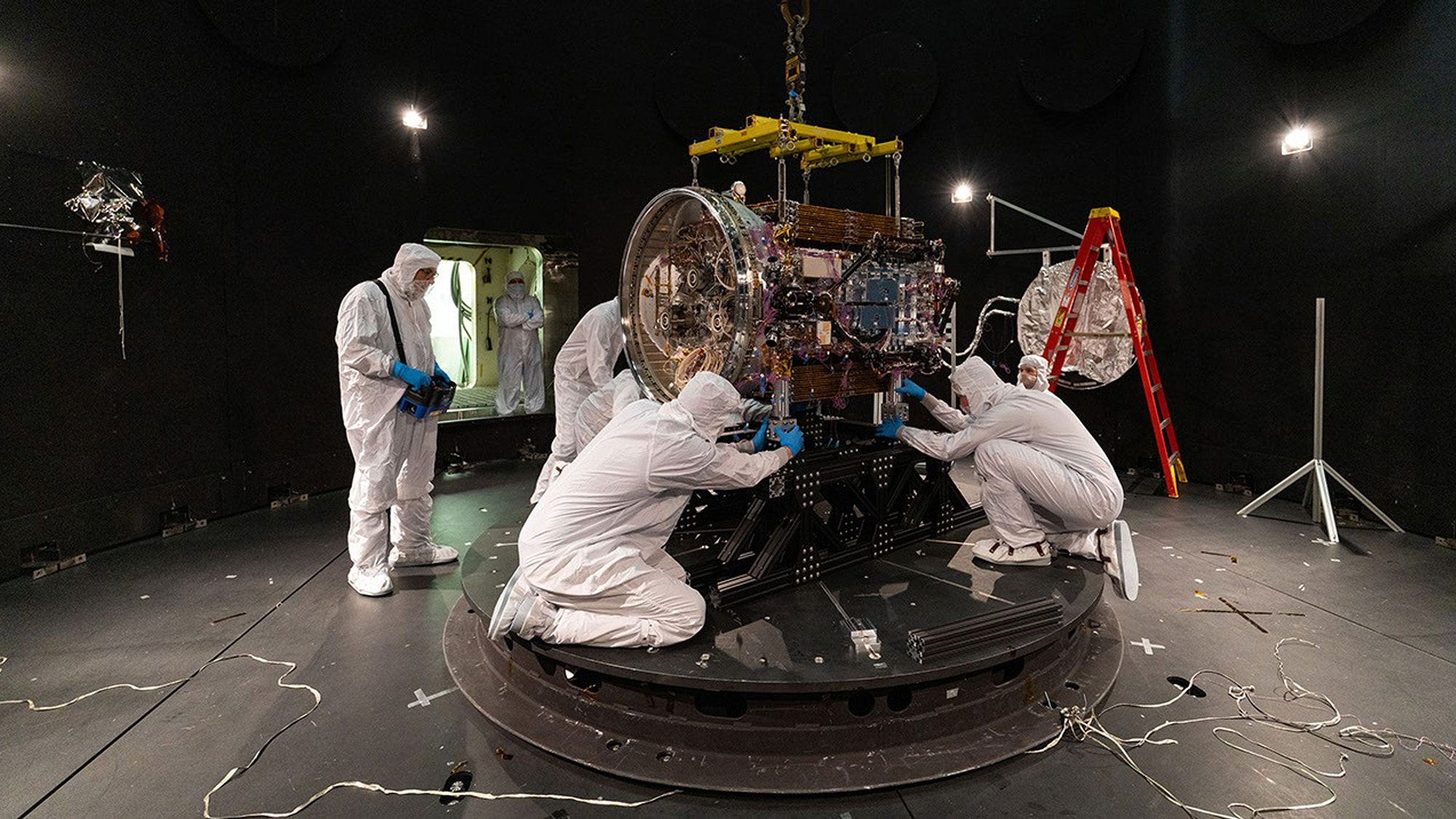
Katalyst engineers attach Link to a baseplate inside the Space Environment Simulator at NASA Goddard on April 28, 2026. The team practiced firing the satellite’s ion thrusters and operated one of the robotic arms while they cycled through space-like temperatures. (Image credit: NASA/Sophia Roberts)
High-risk rescue mission
The rescue mission comes with several challenges. Swift was not designed to be serviced when it launched, making the logistics of the mission something of a puzzle. Moreover, NASA only gave the contract to Katalyst in September, after high solar activity in recent years ballooned Earth's atmosphere and unexpectedly accelerated the spacecraft's fall due to increased drag. This meant the mission had to be ready for space in less than a year after the usual punishing requirements of design, build and testing.
Katalyst accepted the challenge because the company hopes to do this kind of work more often. "If we're going to build an enduring presence beyond Earth, we need the capability to manipulate our environment in space," Katalyst CEOGhonhee Lee said in the statement. "That means deploying robotic spacecraft that can reposition, repair, refuel, and refit satellites after launch."
Unless Swift altered its operations plan, however, the spacecraft would have been irrecoverable in July. So, to give Link as much time as possible to rescue Swift, the operations team at Penn State's Eberly College of Science made some changes.
For example, Swift's science was minimized so that the spacecraft looks at targets only if the telescope is put in a "streamlined position" to minimize drag, NASA explained. Power consumption has also been slashed to let Swift's solar panels fly "in a more aerodynamic orientation," which also reduces the drag that is making the spacecraft fall into the atmosphere.
These changes will allow Swift to stay above the minimum rescue altitude of 185 miles (298 kilometers) until autumn, agency models suggest. Katalyst will use that time to do the usual spacecraft "commissioning" on Link to make sure all systems are well. It will take Link about a month to rendezvous with Swift, according to NASA.
Following those steps, Link will approach Swift for evaluation, and Katalyst will use Link's robotic arms to latch onto the NASA observatory. Link will then use its propulsion system to gradually bring Swift's orbit to about 370 miles (595 km) — well above the pathway of the International Space Station, which orbits roughly 250 miles (400 km) over Earth.
NASA did not say how much longer Swift would be able to keep observing, should it reach its new altitude safely. However,figures from the European Space Agency suggest that spacecraft at an altitude of 310 miles (500 km) reenter the atmosphere within about 25 years. This would suggest that as long as Swift's instruments hold out, scientists would have many years of observations to look forward to.
June's full moon, the Strawberry Moon, will rise Monday (June 29) as seen from North America and Europe. As it does, it will be the lowest-hanging and one of the smallest full moons of the year.
The moon will officially become full at 7:56 p.m. EDT on June 29. It will appear nearly full and brightly illuminated Sunday (June 28) and Tuesday (June 30) as well, but the best time to catch it is when it appears on the southeastern horizon at dusk on Monday. At that time, it will be visible on the horizon and remain unusually low in the sky for viewers in the Northern Hemisphere.
Full moons that occur close to the summer solstice, which happened on June 21 this year, follow a lower path across the southern horizon. That's because the solstice places the sun at its northernmost point on the ecliptic (the path of the sun through the daytime sky), so the full moon near that time appears low in the southern sky. Because a full moon, by definition, sits opposite the sun in Earth's sky, it mirrors the sun's path from approximately six months earlier.
Observers in the Southern Hemisphere will experience the opposite effect, with the Strawberry Moon climbing high overhead and becoming the year's highest-rising full moon.
June's full moon will be the second-smallest full moon of 2026, occurring when the moon is 252,442 miles (406,267 kilometers) from Earth — just 63 miles (102 km) closer than the year's most distant full moon, the Blue Moon of May 31, at 252,505 miles (406,369 km). According to Time and date.com, that makes it a micromoon, minimoon or apogee moon.
The Strawberry Moon's name comes from Native American traditions associated with the seasonal harvesting of strawberries and other ripening fruits. According to Almanac, several tribes used other names linked to summer harvests, including the Berries Ripen Moon, Blooming Moon, Green Corn Moon, Hoer Moon, Birth Moon, Egg Laying Moon and Hatching Moon. European names include the Honey Moon and Mead Moon.
As the Strawberry Moon rises into summer skies, look out for a yellowish, bright star to its upper right. That's Antares, a red supergiant star and the brightest in the constellation Scorpius.
Following the Strawberry Moon, the next full moon — known as the Buck Moon — will rise on July 29, setting the stage for both a total solar eclipse and a partial lunar eclipse in August.
How much do you know about the moon? Test your lunar smarts with our moon quiz!
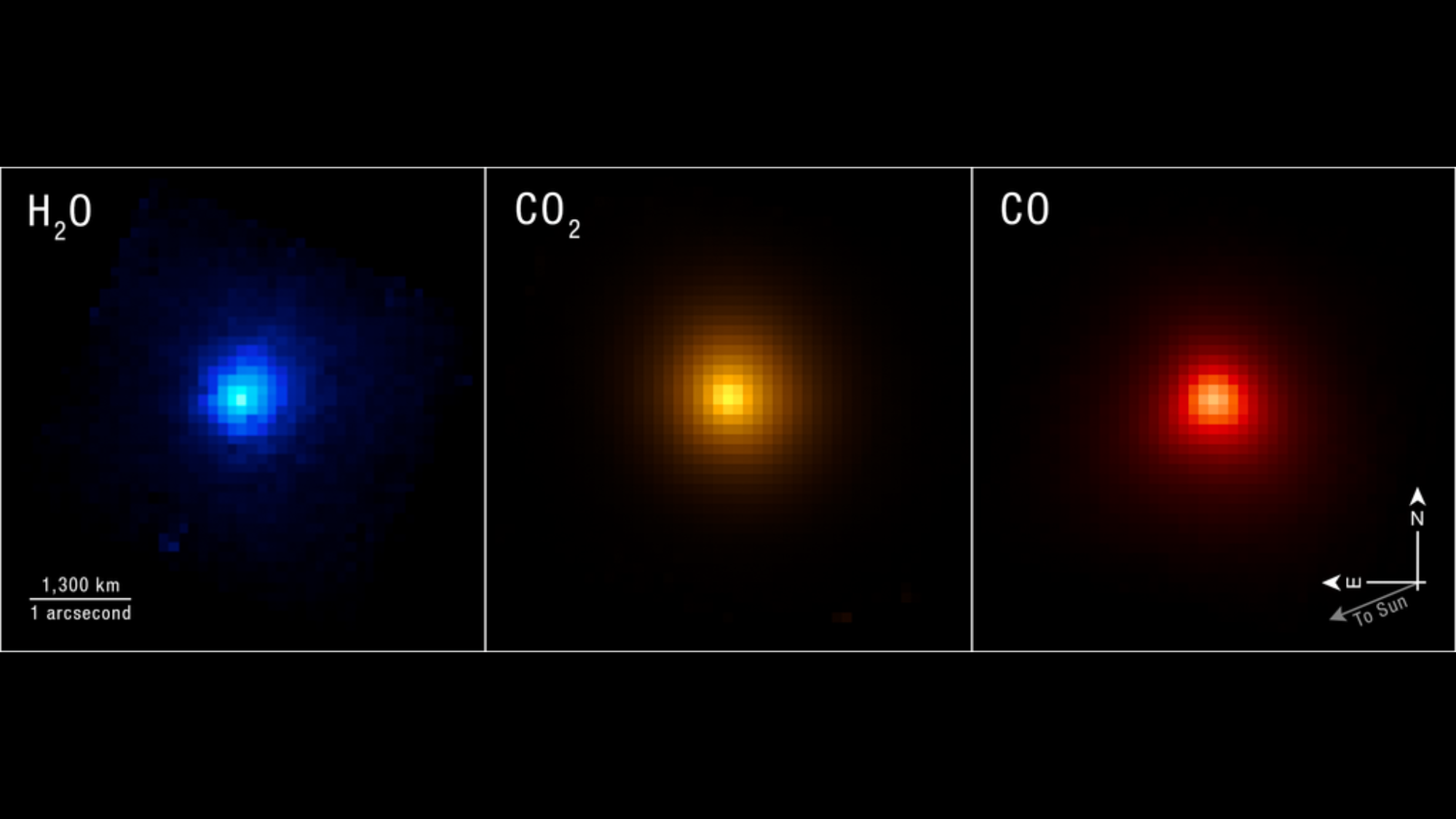
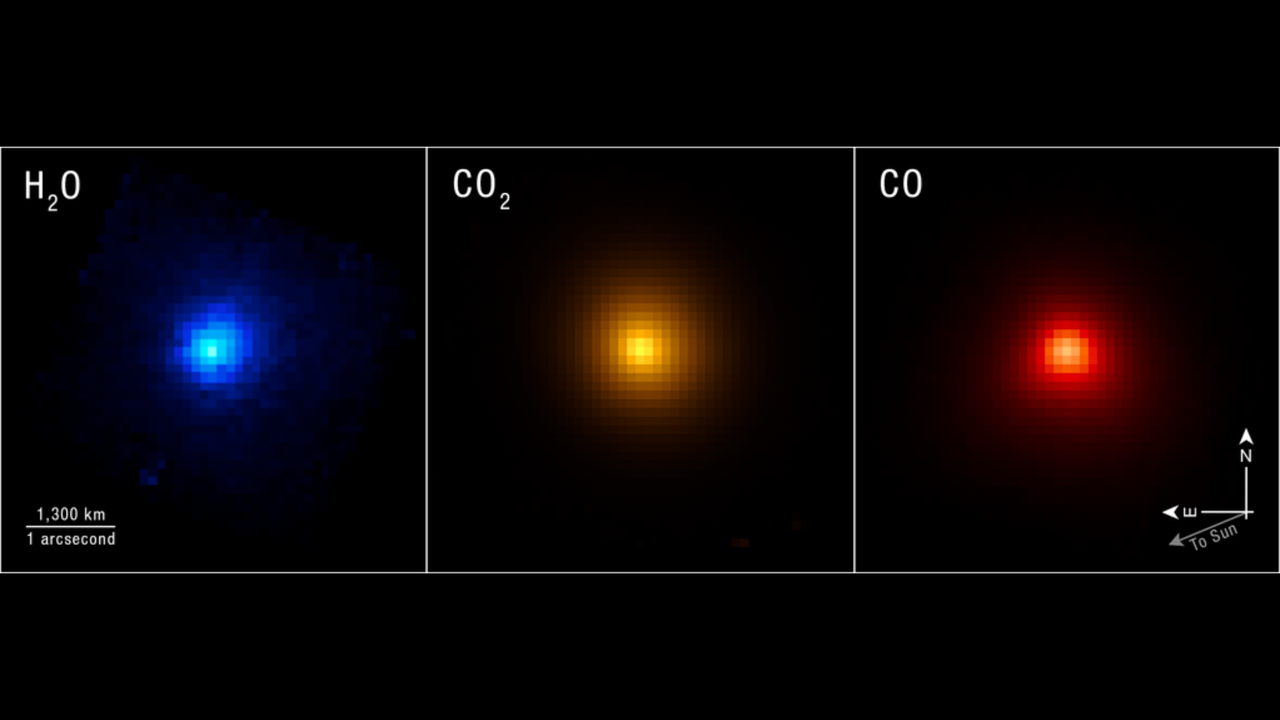
Researchers using JWST are finding clues about comet 3I/ATLAS' origins. (Image credit: NASA, ESA, CSA, STScI, Martin Cordiner (CUA, NASA-GSFC); Image Processing: Alyssa Pagan (STScI))
NASA's James Webb Space Telescope is finding clues that are leading scientists closer to understanding the origins of the interstellar comet 3I/ATLAS.
What is it?
Comet 3I/ATLAS captured the world's attention when it was discovered nearly a year ago on July 1, 2025. The comet was first spotted by the Asteroid Terrestrial-impact Last Alert System (ATLAS), and is only the third interstellar object every discovered.
The comet swooped through our solar system, passing by Earth at a far (and safe) distance on its tour of our cosmic neighborhood. It is on a long trajectory that will take it out of our solar system, never to return.
In observations from the James Webb Space Telescope, scientists were able to look in the direction the comet as it began moving away from the sun in December of last year. While in close proximity to our star, the sun's heat warmed the comet, making it extra bright and easy to observe.
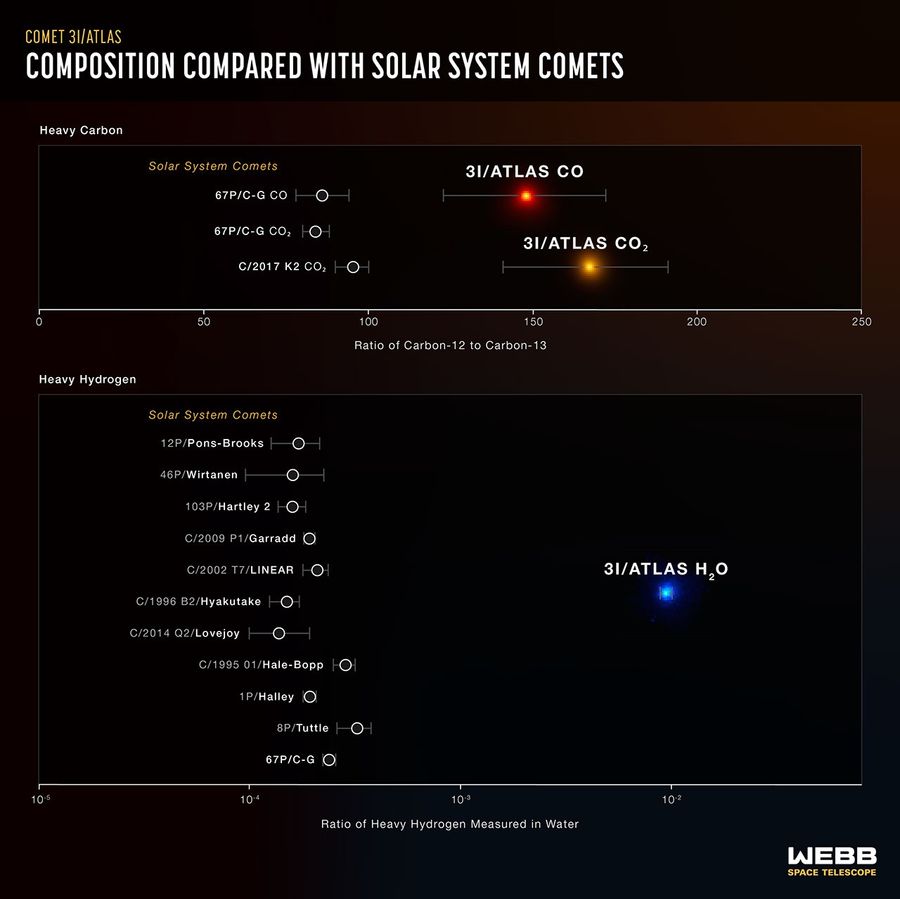
With this view, astronomers were able to calculate some of the ratios of the chemicals present in the comet. This further highlighted that the object is from out of our solar system, as they found ratios of carbon and heavy hydrogen not found in comets in our solar system.
Researchers described their results in a new paper published June 22 in the journal Nature.
This graph shows some of the differences between 3I/ATLAS and comets found in our own solar system. (Image credit: NASA, ESA, CSA, Martin Cordiner (CUA, NASA-GSFC), Leah Hustak (STScI))
Why is it incredible?
Being only the third interstellar object ever found, people were excited about 3I/ATLAS. They were so excited, in fact, that conspiracies about the object sprouted up quickly. Due to it being from outside of our solar system, some claimed that the comet could be some sort of alien spaceship, similar to the initial suspicions about the interstellar object 'Oumuamua found years earlier.
But with new information coming in from space telescopes, and astronomers eager to understand this object better, these clues are leading us closer and closer to the true origins of this strange comet.
On the evening of June 24, 1881, Sir William Huggins directed his reflector, equipped with spectroscopic and photographic tools and located in his private observatory in London, to the head of Comet 1881 III. He captured the first photographic spectrum of a comet, and later analysis of the imagery revealed cyanogen emissions at certain wavelengths.Continue reading "June 24, 1881: First photographic spectrum of a comet"
A deep-space telescope on a grand mission to make the largest-ever 3D map of the universe just peered into the star-filled heart of the Milky Way. In the new observations, shared Wednesday (June 24), the Euclid space telescope imaged the center of the Milky Way in extraordinary detail, showing off more than 60 million stars crowded in the galaxy's center.
The shiny new image from the European Space Agency (ESA) spacecraft will help astronomers confirm newfound exoplanets and use changes in starlight to measure those planets' masses as they orbit their parent stars, according to ESA scientists.
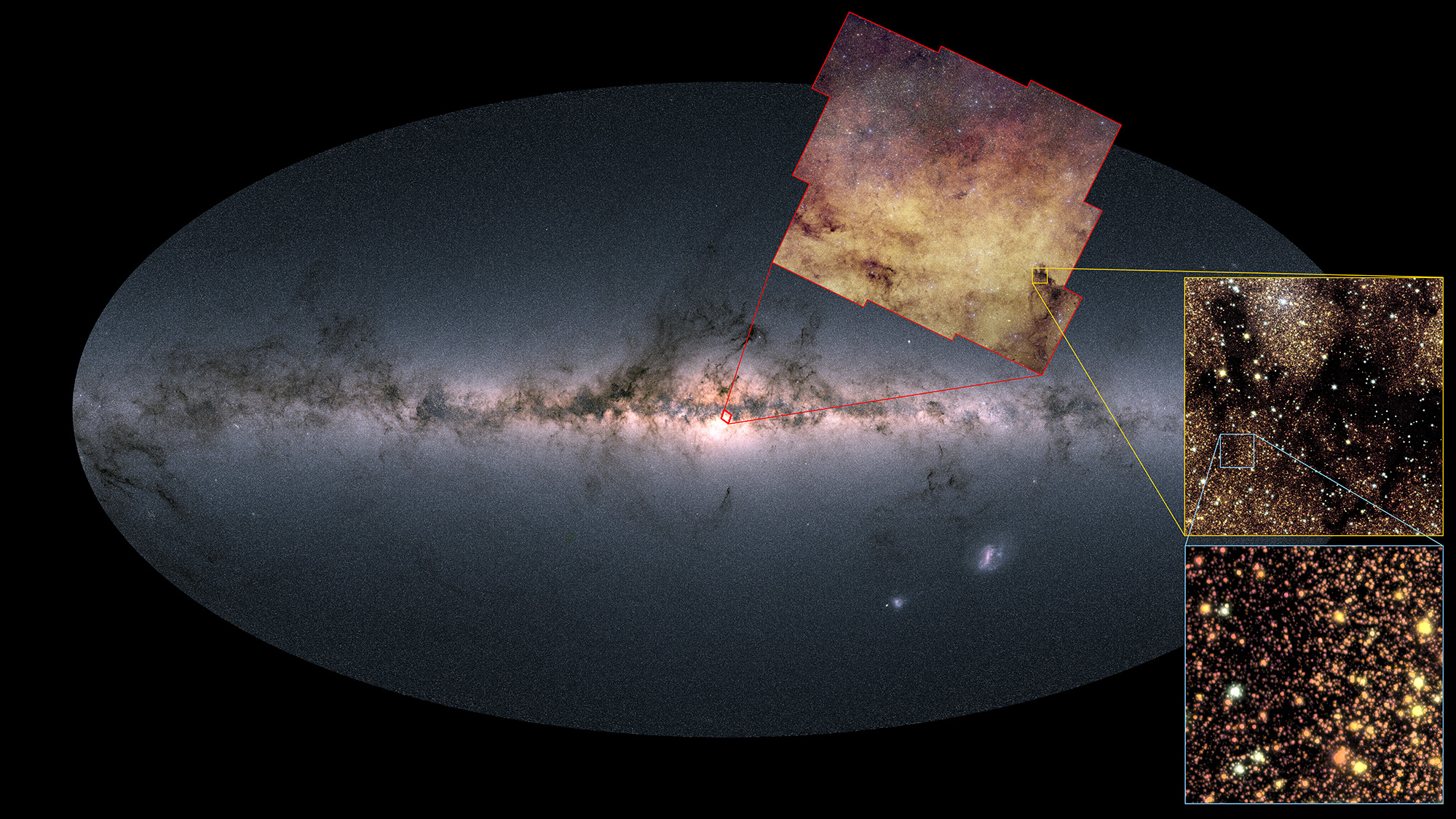
The image was taken in 26 cumulative hours in March 2025, across nine pointings of the telescope's visible-light camera toward the galaxy's center, also called the galactic bulge. Each viewpoint captured a slice of sky larger than the full moon. In a statement, ESA praised the performance of Euclid under challenging conditions.
"Designed to observe billions of faraway galaxies, the space telescope's visible-light camera is sensitive enough to tell apart individual stars in our super-crowded galactic bulge, without being blinded," agency officials wrote.
The mosaic image will help NASA's Nancy Grace Roman Telescope with its upcoming planet-hunting mission, after that observatory launches aboard a SpaceX Falcon Heavy rocket from NASA's Kennedy Space Center in Florida no earlier than Aug. 30.
One way the Roman telescope will search for new worlds is through microlensing, the same technique that can be used to examine exoplanets in the new Euclid image. Microlensing happens when one star passes in front of another from the perspective of an observer. The gravity of the closer-up star briefly bends and magnifies the light of the star behind it, allowing possibly unseen planets to pop up near that star.
An image of the Milky Way as seen from Earth, showing two zooms of Euclid's target area. (Image credit: ESA/Euclid/Euclid Consortium/NASA, CFHT, ESA/Gaia/DPAC,image processing by J.-C. Cuillandre and E. Bertin (CEA Paris-Saclay))
"During the last 20 years, almost 300 exoplanets have been discovered using this technique, all with ground-based telescopes and all towards the centre of our galaxy," Jean-Philippe Beaulieu, who initiated the Euclid galactic bulge survey and co-led the Euclid Consortium's exoplanet working group, said in the ESA statement.
"This image from Euclid includes 51 known planetary systems — and it will assist in studying many more that will be found," added Beaulieu, who holds positions at the Paris Institute of Astrophysics and the University of Tasmania in Australia.
An infographic showing how Euclid sees across the Milky Way, into the galaxy's central bulge. The bottom panels illustrate the diversity of structures in Euclid's field of view. (Image credit: ESA/Euclid/Euclid Consortium/NASA, CFHT, image processing by J.-C. Cuillandre and E. Bertin (CEA Paris-Saclay); Milky Way artist impressions: ESA/Gaia/DPAC, Stefan Payne-Wardenaar))
A cosmic time capsule
Euclid's observing window was too short to find a microlensing event, which requires more than 20 days of examining one star to watch for a planet's orbit and associated changes in the star's light. But Euclid's work did allow astronomers to measure already-known planets. And once newer planets are confirmed by other telescopes, the image will let astronomers look back to confirm those newfound worlds' masses.
"In 24 hours, Euclid has already captured the stars involved in all the future microlensing events that the Roman space telescope will detect, but before the stars and planets involved have aligned," Natalia Rektsini, a postdoctoral fellow at the Paris Institute of Astrophysics who led the release of Euclid's galactic bulge survey data, explained in the statement.
"Anyone who detects a microlensing event in the same region, for example with Roman, will be able from now on to use Euclid data as a time reference in the past and see how the stars looked before they overlapped," she added. "Since Euclid can clearly separate individual stars, one can then measure how fast they move over time, and use that information to confirm the existence of a planet and determine its mass. This would not be possible with data from one point in time."
How well do you know our home galaxy? Find out with our Milky Way quiz!
A bright, dense cluster of hot, massive stars in a galaxy that existed 1.4 billion years after the big bang has been found helping to end the early universe's foggy days during which neutral hydrogen gas was draped across the cosmos, obscuring ultraviolet light from luminous objects.
The cluster was found emitting ultraviolet light in a small but quickly growing galaxy by the Hubble Space Telescope. The presence of this ultraviolet light, and the star-forming history of the cluster producing it, suggests that bursts of star formation contributed to waves of ionizing radiation that gradually cleared out the opaque neutral hydrogen.
In the aftermath of the big bang, the universe was filled with neutral hydrogen gas that is opaque at short wavelengths of light, such as ultraviolet. However, this ultraviolet light was the neutral hydrogen's worst enemy, gradually ionizing the gas across the universe. Once ionized, hydrogen gas cannot absorb ultraviolet light — and so, the cosmos became transparent at those wavelengths.
Because of this, the first billion or so years are called the Epoch of Reionization. It is referred to as "reionization" rather than ionization because, technically, the gas had already been ionized once before during the first 379,000 years after the Big Bang.
While investigating what brought about this epoch, astronomers had identified two chief suspects that could have produced sufficient amounts of ultraviolet light to ionize the neutral hydrogen. One is active supermassive black holes and the other is the first generations of hot, massive stars. The problem is, given that neutral hydrogen is adept at absorbing the ultraviolet light, astronomers have had difficulty tracing that ultraviolet back to its source and identifying which of the two suspects are the main culprit.
In 2023 the James Webb Space Telescope (JWST) made a major breakthrough, finding a galaxy that existed just 900 million years after the Big Bang that was producing enough energy to ionize the neutral gas surrounding it.
Now the Hubble Space Telescope has gone further, detecting ultraviolet light from a galaxy called MXDFz4.4. This ultraviolet light should only be visible if the surrounding gas had already been ionized.
"Observing a galaxy like this was thought to be impossible," said Ilias Goovaerts of the Space Telescope Science Institute (STScI) in Baltimore, who led the discovery, in a statement. "Researchers expected the 'fog' of neutral hydrogen that filled the early universe would be too thick and obscure our view of its ionizing light. Hubble not only spotted that light, but it also helped reveal incredible details about the galaxy's characteristics."
The full Hubble Space Telescope's view of MXDFz4.4 and its surroundings from our vantage point. (Image credit: NASA/ESA/CSA/STScI/Ilias Goovaerts and Anton Koekemoer (STScI)/Marc Rafelski (STScI, JHU)/ Image Processing: Alyssa Pagan (STScI))
MXDFz4.4 was first identified in the MUSE eXtremely Deep Field (MXDF), with MUSE being the Multi Unit Spectroscopic Explorer on the European Southern Observatory's Very Large Telescope in Chile. The "z4.4" part of its name tells us that the galaxy exists at a redshift of 4.4, meaning that it existed 12.37 billion years ago. As the universe has expanded in the time since then, the ultraviolet light has been redshifted into visible wavelengths that were detected by Hubble.
"Astronomers have found many galaxies that existed at this point in the history of the universe, but we haven't detected ionizing photons from any of them, making MXDFz4.4 one of a kind," said Marc Rafelski, who is the Hubble Deputy Mission Head at STScI.
MXDFz4.4 is 100 times smaller than our Milky Way galaxy but is forming stars ten times faster than our galaxy is. Many of those stars are being born in the tight, luminous cluster producing the ionizing ultraviolet.
An artist's impression of the young, distant galaxy MXDFz4.4 and its dense cluster of luminous stars. (Image credit: NASA/ESA/Leah Hustak (STScI))
The cluster contains "A lot of young, hot, massive stars in a small space [that] do a better job of blasting through opaque gas," said Goovaerts.
Furthermore, by comparing Hubble's observations of MXDFz.4.4 with those of the JWST, which probed for cooler, older stars in the galaxy, Goovaerts and Rafelski's team discovered that the stars in the cluster had formed in bursts, each burst producing fresh quantities of ionizing ultraviolet radiation that helped to clear out more and more of the neutral gas over time. We now see the galaxy about 250 million years after it finished reionizing the surrounding gas. These hot, massive stars in the cluster end their lives after a few million years as supernova explosions, the blast waves and radiation from which can create bubbles in the gas light years across, creating further pathways for ultraviolet light to escape and be detected by Hubble.
The observations seem to nail down the theory that clusters of hot, massive, luminous stars in young galaxies in the early universe played a dominant role in ionizing the universe's neutral gas.
"Hubble's observations of MXDFz4.4 let us test our hypotheses much closer to the Era of Reionization than ever before," said Rafelski. "Finding more galaxies, especially at slightly later cosmic times where larger samples are within reach, would let us refine these measurements and figure out what cleared our view as that era was ending."
NASA’s Mars Odyssey spacecraft completed its 60,000th orbit of the Red Planet on June 23, 2015. When Odyssey launched in April 2001 with a goal of better understanding Mars’ environment, the Red Planet was generally thought to be dry, barren world; the mission transformed our understanding, discovering widespread subsurface water ice. Its continuous observations haveContinue reading "June 23, 2015: 60,000 orbits for Mars Odyssey"
Using NASA's exoplanet-hunting spacecraft TESS (Transiting Exoplanet Survey Satellite), scientists have discovered a planetary system that scientists are calling "improbable." It could change how we think about the mechanisms behind planet formation.
The reason for the unusual arrangement of this planetary system is a failed star or brown dwarf designated TOI-201 c. Objects like this get the slightly unfair nickname of "failed stars" because, despite forming from a collapsing cloud of gas and dust like other stars, they fail to gather enough mass to trigger nuclear fusion of hydrogen to helium in their cores. Brown dwarfs have masses between 13 and 80 times that of Jupiter, or 0.013 to 0.08 the mass of the sun. That puts them right between the most massive planets and the smallest stars.
TOI-201 c is on a highly elliptical orbit, taking 2,881 days to orbit its star, which has resulted in planets including a super-Earth named TOI-201 d and a warm Jupiter named TOI-201 b, forming in a narrow zone within its orbit, something that isn't just new to astronomers; it is completely unexpected based on planetary formation models.
The 5.8-day orbit of TOI-201 d and the 53-day orbit of TOI-201 b are both perfectly aligned with the orbit of the brown dwarf. The brown dwarf creates gravitational instability at distances equivalent to the distance between Mars and the sun, but this didn't prevent planets from forming in the system.
"This discovery provides a crucial insight into how planets form even around massive, eccentric objects," team member and INAF researcher Aldo Bonomo said in an emailed statement.
The system challenges the idea that gas giant planets form at distances equivalent to 2 to 3 times the distance between Earth and the sun in the disks of gas and dust that surround stars during their infancy.
"The presence of the brown dwarf on such an elliptical orbit forced the planets to form and survive by occupying the innermost and hottest edges of the primordial disk," team member Luca Naponiello of the National Institute for Astrophysics (INAF) said in the statement. "Furthermore, the data show that during the close approach of the brown dwarf, the warm Jupiter undergoes strong and sudden variations in its transit timing, bearing witness to an intense and vigorous dynamic interaction currently underway between the two giants."
The system was discovered by TESS using a rare mono-transit event, which describes a planetary body making one crossing of the face of its star, causing a dip in starlight. This was followed by an observing campaign conducted from the ground.
It is extremely rare to discover objects like TOI-201 c with such long and eccentric orbital periods using transits they make of their parent star. This brown dwarf is the first one of these objects to have its mass confirmed, making it an important step forward in astronomy.
"It [TOI-201c] is the transiting object with the longest orbital period for which the mass is known," Naponiello said.
The team's results were published on Wednesday (June 17) in the journal Nature.

 Login