❌

Reading view

'Let's not fool the public': Why moon art should be more realistic in the Artemis age

GOLDEN, Colorado — The moon is in need of good and accurate artists!

As NASA's Artemis program hits its stride, and in a few years "reboots" our moon with a human presence, there's an urgent need to guard against artistic misrepresentations of the lunar landscape, experts say.

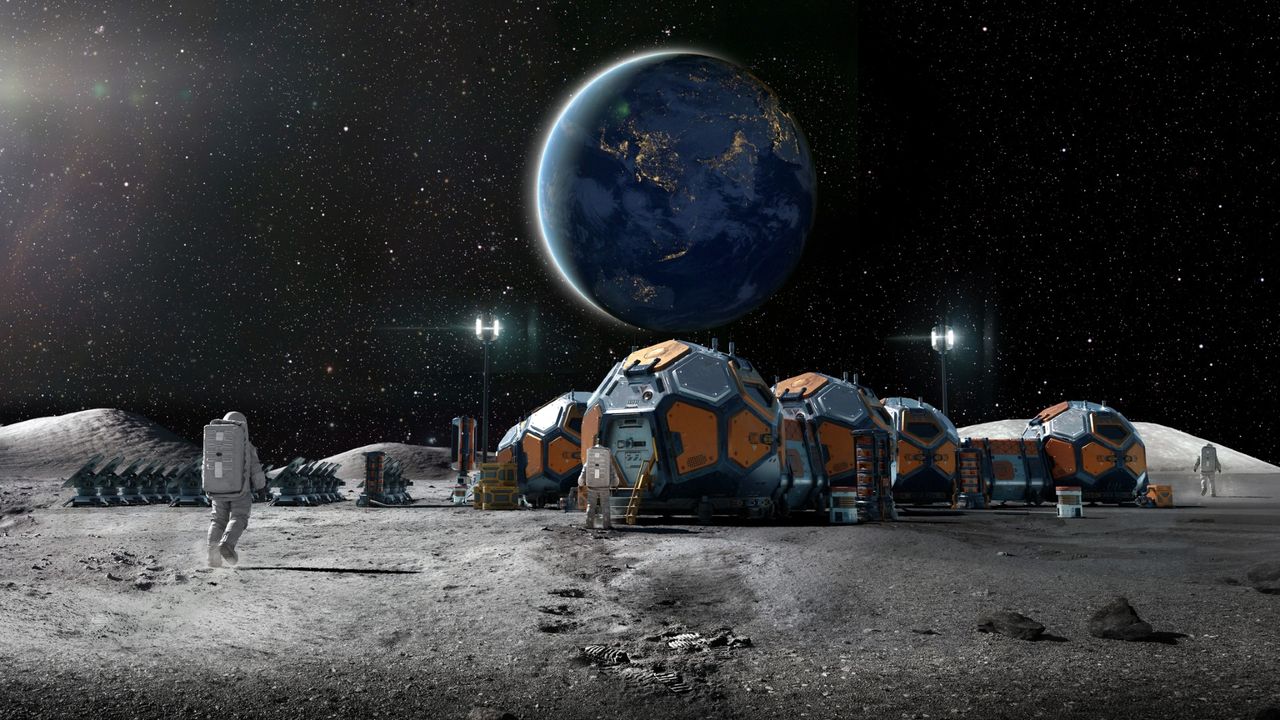
We've all seen those alluring lunar renderings of vehicles and astronauts bounding about while setting up equipment and putting in place a moon base.

illustration of four astronauts in white spacesuits working on the moon

What's wrong with this picture? Missing in this artwork are small craters, dust, dirty equipment and dirty astronauts. (Image credit: NASA)

Reality versus depictions

"We are telling the public the moon is easy — it is not!"

That's the matter-of-fact warning from Daniel Britt, the Pegasus Professor of Astronomy and Planetary Sciences in the Department of Physics at the University of Central Florida. He's also the director of the Center for Lunar and Asteroid Surface Science.

Britt spoke about and showcased artists' misconceptions during a "reality versus depictions of the lunar surface" talk here at a Space Resources Roundtable, held from June 2 to June 5 on the campus of the Colorado School of Mines.

"I wish I could say that engineers and managers know better, but they don't. We are training a generation of engineers to not worry about terrain. If the artists are getting it wrong, it is our fault. Let's stop fooling ourselves," Britt said.

Well versed in what the lunar surface truly offers, Britt scolded a number of arty accounts of lunar territory promulgated by both NASA and commercial space ventures. He spotlighted what's wrong with those pictures — for starters, small craters and ever-present lunar dust, along with dirty astronauts, dirty equipment and dirty habitats.

two photos of a dusty astronaut in a white spacesuits. in the right-hand picture he has his helmet off and is inside his spacecraft

Dusting off past moonwalker experiences reveals a dusty future on the moon. (Image credit: NASA/Daniel Britt)

Facts of life

A flat, dustless moon is not the one we are sending Artemis astronauts to, said Britt. Crews will experience coarse terrain, pervasive dust, and a surface unlike anything here on Earth. These are the facts of life on the moon, he said.

The Apollo moon-landing missions learned this first hand. But those astronauts explored equatorial areas. The Artemis program is targeting the lunar south polar region, which will be tough to deal with thanks to the low angle of the sun.

"When you look into the sun, it will be blasting into your face. But at least you'll see the shadow of that crater you are about to trip into," said Britt. "But looking down-sun, you won't see diddly squat."

"There's need to stop deluding ourselves," Britt told Space.com, advocating the creation of a 1-to-10 scoring system for lunar art, with prizes for the worst and best visualizations

"What I want to do is land on the moon way safer and easier," he added, "so you need to ask yourself what's missing from these depictions. We are training the public to think this is easy."
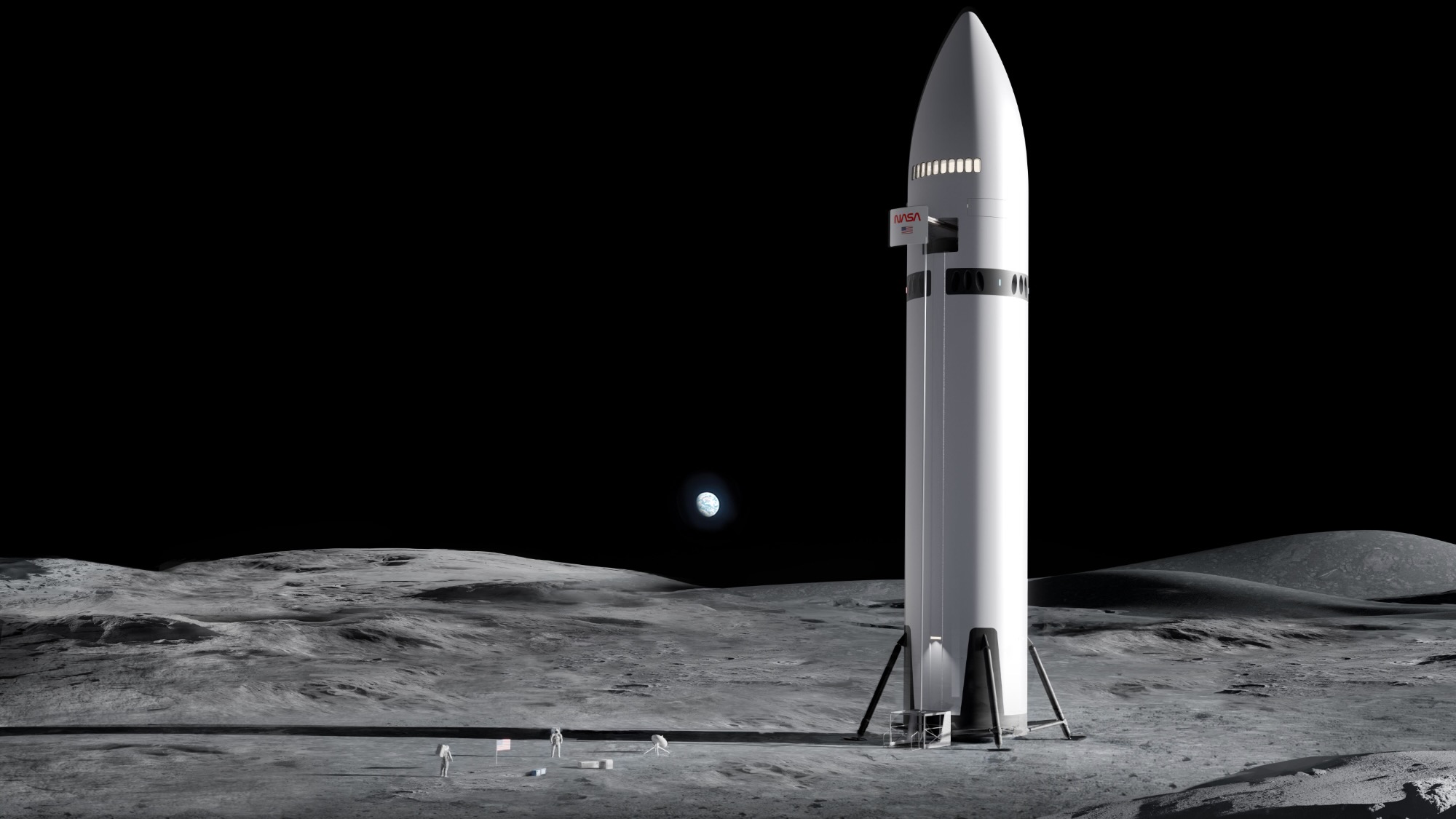
illustration of a very tall white spacecraft on the moon, with earth in the background

No dust, almost no small craters, no tipping problems. (Image credit: SpaceX)

False impression

To support his concern, Britt spotlighted both Apollo moonwalker-taken imagery and the scenery as projected by artists, be it using paint brush or artificial intelligence-guided computer work.

"The sun angle washes out the rough terrain. Almost all the pictures taken from the surface give the very false impression of a flat, gentle terrain," Britt said. "The reality is that the lunar surface is heavily cratered, rough, very dusty and covered in regolith."

Most Apollo surface images were taken "down-sun" because looking "up-sun" was hard. "This leaves a very false impression of a flat moon with gentle terrain," Britt said.

illustration of a large white spacecraft on the moon with two astronauts in white spacesuits on the ground nearby

Why should we care about artist's misconceptions? Because they create false impressions that lunar landings are easier than they actually are. (Image credit: Blue Origin)

Tilt problems

Apollo was pretty lucky, Britt said, observing that several of the six human moon landings experienced tilt problems. For instance, Apollo 14 experienced a 7-degree tilt on landing, and Apollo 15 had an 11-degree tilt on touchdown.

Apollo 11 had to dodge a boulder field. Apollo 12 and Apollo 16 landed on the edge of big craters. "Even small craters can be meters deep," said Britt, recalling problems encountered by astronauts on their descent to the moon.

"The dust went as far as I could see in any direction and completely obliterated craters and anything else … I couldn't tell what was underneath me," astronaut Pete Conrad said during an Apollo 12 debriefing. "I knew I was in a generally good area, and I was just going to have to bite the bullet and land, because I couldn't tell whether there was a crater down there or not."

Similarly, Apollo 16 commander John Young said: "I couldn't judge slope out the window worth a hoot, and that's the truth. Even down low. The ground looks flat, but I'm sure it would look flat if it had been a 6-8 degree slope, too. I don't see any way around that."

photo of a white and gold spacecraft tilting on the edge of a small crater on the moon

Landing on "flat" places on the moon is a dicey situation. This Apollo 15 image shows the 11-degree tilt experienced by that mission during touchdown. (Image credit: NASA)

Getting it wrong

A flat, crater-free, dustless moon is a staple of imagery issued by NASA, the European Space Agency, other space agencies, and even private space firms, said Britt.

"Yes, these are artists' impressions," Britt said, "but somebody is telling the artists what to draw. I love the idea of landing and operating on a moon without dust, small craters, and rough terrain. However, we see the misconception of a flat, gentle moon everywhere."

"Commercial providers are just as bad. No dust, almost no small craters, no tipping problems. Yes, these are artists' impressions, and they are getting it wrong," said Britt. "NASA knows better. All these people should know better, but don't. Let's not fool the public. We owe them better data."
  •  

This Curious Moon Rock Preserves Evidence of Ancient Impacts Across Three Worlds


The ancient history of our planet’s impact events is coming into focus, thanks to researchers who have triangulated similarly aged impacts on Earth, the Moon, and the asteroid 4 Vesta in a new study.

The lunar meteorite NWA 12593 correlates not only with impact events observed across three locations in our solar system but also contains evidence of three separate impact events that occurred at different times.

The findings, revealed in a recent paper published in Geology, show that scientists are using this new impact data to fill in the volatile early-Earth period when life began.

Early Earth Impacts

The Archean period, roughly 4 to 2.5 billion years ago, was a consequential time from which our earliest fossil records date, corresponding to around 3.5 billion years ago. Researchers believe that life likely first arose at this time, yet it may have faced adversity from bombardment by space rocks between 3.2 and 3.5 billion years ago, although scientists disagree on how intense this impact activity was.

Our planet’s geological activity eventually destroys evidence of the ancient past through erosion, subduction, and burial, continually reshaping the surface. Yet those early years are essential to understanding the origins of water, atmospheres, and life on Earth. 

“On Earth, the first fossil evidence of life shows up around 3.5 billion years ago, meaning that life is emerging and evolving before then. The question that we often have, even going back further, is what was the impact record when life was emerging?” said lead author Carolyn Crow, a planetary scientist at the University of Colorado Boulder.

“It is important for understanding how life is taking hold, how life is emerging,” Crow added. “The cadence of these catastrophic events is an important part of the equation.”

A Neighbor Remembers

While Earth’s surface is constantly renewed by geological processes, our nearest significant neighbor, the Moon, is much more stable, retaining its geological record for longer periods. Because of this, lunar meteorites provide a resource for scientists to understand the impact of Earth and the inner solar system by matching them to known impacts on our planet and in the asteroid belt.

For the recent study, the team focused on a lunar meteorite discovered in northwest Africa, designated NWA 12593, and identified three separate impact events in a single sample. 

Radiometric dating traced the oldest to 3.5 million years ago, intriguingly close to the time of the earliest known fossils. Extraordinary in power, this impact produced the mineral zirconia by melting the lunar surface into a lava-like flow. Without the precise laboratory conditions required to produce stable cubic zirconia, only traces of mineral remained in the sample.

According to the team, the first impact aligns with previously known impact events on Earth, and the fourth-largest object in the asteroid belt, 4 Vesta. It’s extremely rare to find such corresponding evidence between three bodies, providing important data on this time of frequent collisions.

“It’s not very common, which is why we’re very excited about it,” says Crow. “It’s pretty rare to have all three records line up like this.”

Later Impacts

Evidence of later impacts included breccia composed of large, angular, broken mineral fragments cemented together. The team believes the breccia resulted from a second impact that struck the melt sheet formed by the first.

“Breccias are similar to what you would see if you went and chipped out a chunk of concrete. You would see all these little rocks, and then it’s fused together by the cement,” says Crow. “But the meteorite is fused together by the impact process. You get all these chunks of different kinds of rocks that the impact hit into. These all get mixed up, and then it gets fused together like your concrete sidewalk.”

As for the third impact, the evidence for this is the meteorite’s mere presence on Earth; an event that occurred some time after the first would have ejected the lunar breccia, the researchers say, allowing it to eventually land on our planet.

In total, the sample reveals an intriguing impact history, preserving a record of bombardment that provides solid evidence for a flurry of activity in the inner solar system during a violent chapter in the early history of our Solar System.

The paper, “Three-Body Evidence of Ca. 3.7 Ga to 3.2 Ga Bombardment Across the Inner Solar System,” appeared in Geology on May 12, 2026.

Ryan Whalen covers science and technology for The Debrief. He holds an MA in History and a Master of Library and Information Science with a certificate in Data Science. He can be contacted at ryan@thedebrief.org, and follow him on Twitter @mdntwvlf.

  •  

Why does one side of the Moon have a lot of craters, while the other does not?

Why does one side of the Moon have a lot of craters, while the other side does not? Stephen LogesBrooksville, Florida When the first photos of the Moon’s farside were obtained, people usually expressed the difference between the back and the front in terms of “more craters on the back.” It might be better toContinue reading "Why does one side of the Moon have a lot of craters, while the other does not?"

The post Why does one side of the Moon have a lot of craters, while the other does not? appeared first on Astronomy Magazine.

  •  

How NASA plans to build a Moon Base

NASA announced new contracts for the rovers and landers that will lay the groundwork for the agency’s proposed $30-billion Moon Base — some of which they plan to launch as soon as this fall — during a May 26 press conference. The announcement offered the most detailed look yet into the Moon Base plan NASAContinue reading "How NASA plans to build a Moon Base"

The post How NASA plans to build a Moon Base appeared first on Astronomy Magazine.

  •  

What Happened to Earth’s Rings?

The existence of evidence for Earth’s past equatorial ring, shown by impact craters, raises questions about its loss. Modeling its effects on Earth's rotation presents challenges. However, current findings indicate minor impacts on day length, with significant stability in the Earth-Moon system over 10,000 years.

  •  

June 2, 1966: Surveyor 1 lands on the Moon

About 63 hours after its launch, Surveyor 1 landed on the Moon on June 2, 1966. The 2,200-pound (998 kilograms) craft touched down inside a 62-mile (100 kilometers) crater north of Flamsteed Crater in Oceanus Procellarum, or the Ocean of Storms. Surveyor 1 took more than 11,000 photos, and measured the Moon’s temperature and theContinue reading "June 2, 1966: Surveyor 1 lands on the Moon"

The post June 2, 1966: Surveyor 1 lands on the Moon appeared first on Astronomy Magazine.

  •  

What is a Blue Moon? When’s the next one?

Blue Moons are known for the folklore surrounding their appearance in the skies. But the real thing has less to do with its color and more with the timing of the year’s Full Moons. The next Blue Moon is May 20, 2027. It will be a seasonal Blue Moon; here’s what that is: There areContinue reading "What is a Blue Moon? When’s the next one?"

The post What is a Blue Moon? When’s the next one? appeared first on Astronomy Magazine.

  •  

2026 Full Moon calendar: When to see the Full Moon and phases

The phenomenon of a Full Moon arises when our planet, Earth, is precisely sandwiched between the Sun and the Moon. This alignment ensures the entire side of the Moon that faces us gleams under sunlight. Thanks to the Moon’s orbit around Earth, the angle of sunlight hitting the lunar surface and being reflected back toContinue reading "2026 Full Moon calendar: When to see the Full Moon and phases"

The post 2026 Full Moon calendar: When to see the Full Moon and phases appeared first on Astronomy Magazine.

  •  
❌