In a groundbreaking discovery that broadens our understanding of marine life communication, researchers at Oregon State University have identified a novel chemical signaling mechanism among bat rays (Myliobatis californica) that warns conspecifics of looming threats. This chemical disturbance cue, previously documented only in bony fish, now emerges as a key anti-predator strategy in cartilaginous fishes—specifically rays—revealing a layer of behavioral complexity that challenges long-held assumptions about elasmobranch social interactions.
Dr. Joshua Bowman, leading the study from OSU’s Big Fish Lab, devised an elegant experimental setup employing three isolated tanks interconnected through water flow but segregated visually and acoustically to eliminate confounding sensory influences. Each tank housed an individual bat ray, with one designated as the “signaler” and the other two as “receivers.” By simulating predatory pressure through a gentle chase of the signaler ray, the experimenters induced a natural defensive response while ensuring no physical harm.
Strikingly, within mere seconds of the signaler tank’s water being directed towards the receiver tanks, the bat rays in these isolated environments exhibited marked behavioral shifts characterized by increased swimming speed and evasive maneuvers. These responses mimic a flight reaction, confirming the transfer of a chemical alarm cue through the aquatic medium—a sensory pathway previously undocumented in cartilaginous species.
This discovery bears profound implications for understanding elasmobranch ecology and survival strategies. Bat rays, along with sharks and skates, belong to a class of cartilaginous fishes characterized by their distinct evolutionary lineage and physiology. These findings suggest sophisticated intraspecies chemical communication channels functioning as early-warning systems against predation risks, potentially reshaping our perception of their behavioral ecology.
Moreover, the research carries significance beyond bat rays. Whites sharks, apex predators renowned for their fearsome reputation, are known to exhibit avoidance behaviors when orcas, their potential predators, are nearby. Yet, these sharks often do not have direct visual contact with orcas. This study’s insights into chemical alarm signaling hint at unseen communication mechanisms that might underlie such evasive behavior, opening new avenues for exploration into shark sensory biology and their interactions within the marine predator-prey network.
The experiment’s methodological rigor enhances the credibility of these findings. By isolating variables—eliminating acoustic and visual cues—the team conclusively linked behavioral changes to chemical signals. High-resolution overhead video recordings captured nuanced shifts in locomotion dynamics, quantitatively analyzing the rays’ rapid swimming velocity increases immediately following exposure to the alarm chemicals. These data underscore a robust flight response triggered solely by chemical disturbance cues.
While the precise chemical compound or combination responsible for the alarm signaling remains unidentified, the study establishes a foundation for future biochemical and molecular investigations. Identifying the molecular structure of the alarm cue could unlock transformative understandings of elasmobranch chemical ecology, potentially informing conservation strategies and offering biomarkers for monitoring stress responses in marine populations.
Importantly, the research foregrounds broader ecological and ethical considerations. The evolutionary origin of these chemical disturbance cues underscores their critical role in survival and natural behavior modulation. Human interactions—whether through scientific research, fisheries, or recreational activities—may inadvertently trigger stress dissemination across populations via such chemical signals, amplifying disturbance impacts beyond the initially affected individual.
The OSU Big Fish Lab, recognized as a leading shark research facility on the U.S. West Coast, continues to spearhead innovative studies uncovering the intricate lives of marine cartilaginous fishes. This collaboration, involving co-authors Jamie Cornelius and Mauricio Cantor, integrates expertise spanning marine ecology, physiology, and animal behavior, thereby enhancing multidisciplinary perspectives crucial to advancing marine science frontiers.
By employing bat rays as a proxy for studying elusive white shark behavior, the researchers circumvent logistical challenges inherent to large predator studies. Bat rays’ accessibility and manageable size provide an ethical and practical model to dissect communication modalities applicable across related species, ensuring experimental feasibility while preserving ecological validity.
This study, recently published in the Journal of Experimental Zoology Part A: Ecological and Integrative Physiology, represents a significant milestone in marine biology. It not only documents, for the first time, chemically mediated disturbance cues in cartilaginous fishes but also stimulates critical reflection on the sensory worlds of sharks and rays, organisms whose behavioral sophistication may be far richer than previously appreciated.
Collectively, these findings herald a paradigm shift in our understanding of underwater communication networks. They remind us that aquatic ecosystems host complex, often hidden, language systems integral to species survival. As we deepen our inquiry into these chemical dialogues, we unlock new insights essential for protecting marine biodiversity in a rapidly changing ocean environment.
Subject of Research: Animals
Article Title: Behavioral Evidence for a Chemical Disturbance Cue in Bat Rays (Myliobatis californica)
News Publication Date: 10-Jun-2026
Web References: http://dx.doi.org/10.1002/jez.70102
References: Journal of Experimental Zoology Part A: Ecological and Integrative Physiology
Keywords: chemical disturbance cue, bat rays, cartilaginous fish, elasmobranchs, shark behavior, marine communication, anti-predator strategy, predator-prey interactions, aquatic chemical signaling, flight response, marine ecology, behavioral study

 Login

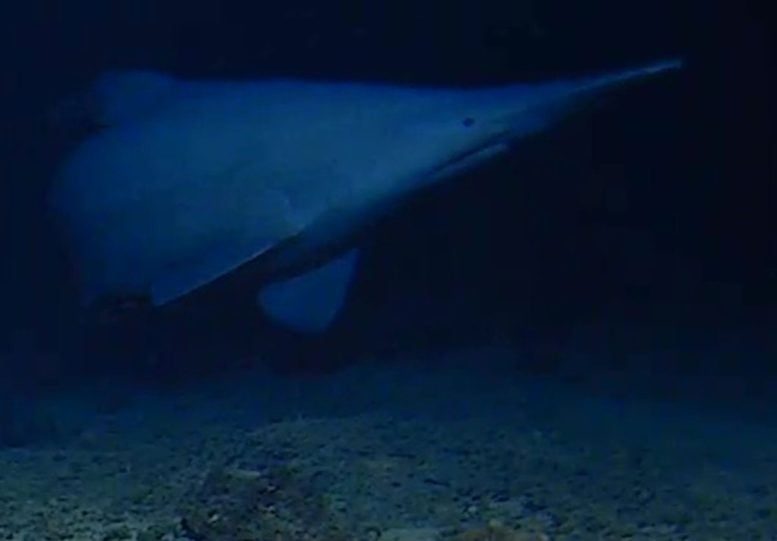 Scientists have reported the first-ever live observations of the elusive goblin shark in its natural deep-sea habitat, capturing footage at two remote locations in the Central Pacific. Few sharks are as strange—or as elusive—as the goblin shark. With its elongated snout, protrusible jaws, and ancient lineage stretching back nearly 125 million years, the deep-sea predator [...]