❌

Reading view

Datacentres are a ticking timebomb. We must make sure AI’s benefits outweigh the costs | Nicki Hutley

They suck up energy and water, and blast out heat. Just who is better off from all this investment – aside from tech bros?

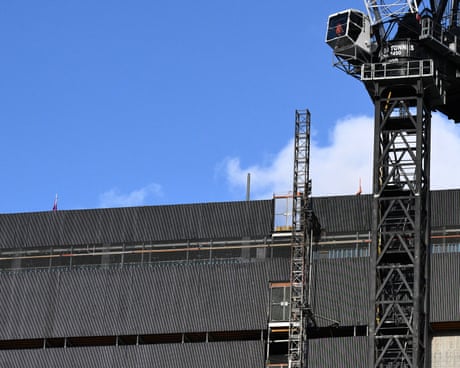
The two great existential threats of our time – the climate crisis and AI – come hurtling together in the explosion of datacentres across Australia and around the world.

You can hardly avoid hearing about them these days, either with awed reverence of the promised benefits to humankind or with fear and anger given the implications for the climate, inflation, jobs and even housing affordability.

Continue reading...

© Photograph: Jono Searle/AAP
© Photograph: Jono Searle/AAP

© Photograph: Jono Searle/AAP

  •  

Stymied datacentre projects threaten global AI revolution

Large-scale datacentre projects around the world are being challenged or cancelled, as infrastructure’s energy demands ramp up

Datacentre planning proposals face all kinds of hurdles, from securing energy supply to high construction costs. But the 2,000 acre Prince William Digital Gateway site in the US state of Virginia had another problem: its proximity to a Civil War battlefield.

“If the development is allowed to proceed, the solemn nature of this historic site would become marred by sitting in the shadow of the monstrous datacentres, along with their associated electrical infrastructure,” said one legal brief against the plans.

Continue reading...

© Photograph: Horst Friedrichs/Alamy

© Photograph: Horst Friedrichs/Alamy

© Photograph: Horst Friedrichs/Alamy

  •  

Scotland could freeze datacentre projects in challenge to UK’s AI strategy

Scottish government to consider SNP national council motion for moratorium on all new datacentres

The Scottish government is about to consider a sweeping moratorium on building new datacentres, putting a key plank of the UK’s AI strategy at risk.

Last Sunday the Scottish National party (SNP)’s national council passed a motion to freeze all new datacentres in Scotland. That motion has been sent to the Scottish government to consider.

Continue reading...

© Photograph: Ken Jack/Getty Images

© Photograph: Ken Jack/Getty Images

© Photograph: Ken Jack/Getty Images

  •  

‘It’s smoke and mirrors’: hope turns to fear in Scottish village chosen for AI datacentre

Suspicions grow in Lanarkshire that local people have been misled on supposed benefits of the huge development

The promise was that a Scottish community would be transformed by massive investment and empowered to chase “the jobs of the future”. Instead, local people in Lanarkshire fear they may have to sell their properties and lose green belt land because of the errors of a badly planned AI datacentre complex, even as those jobs and investments never arrive.

Late last year, representatives of Oakes Energy Services began to knock on doors in Newarthill, a village east of Glasgow. In letters reviewed by the Guardian, they invited residents to individual meetings. They told them about plans for a solar farm, say local people, and made offers: free solar panels, tree planting, or even cash for their properties.

Continue reading...

© Photograph: Murdo MacLeod/The Guardian

© Photograph: Murdo MacLeod/The Guardian

© Photograph: Murdo MacLeod/The Guardian

  •  

Revealed: landmark Scottish AI project has no prospect of meeting renewables promise

Exclusive: Government and developers privately acknowledged Lanarkshire datacentre site had power provision ‘issue’

A landmark AI development billed as delivering jobs and prosperity has misrepresented its plans to channel a nuclear reactor’s worth of power to a site in rural Scotland, a Guardian investigation has found.

When it was announced in January, the government promised that an £8.2bn AI datacentre complex in Lanarkshire – built by the US firm CoreWeave and the Scottish company DataVita – would be powered entirely from on-site renewables and built by 2030.

Continue reading...

© Composite: Guardian Design/Reuters

© Composite: Guardian Design/Reuters

© Composite: Guardian Design/Reuters

  •  

What are Britain’s AI growth zones and are the plans feasible or ‘complete bunk’?

Lanarkshire datacentre run by renewables and creating thousands of jobs not achievable by 2030, Guardian investigation finds

The Guardian has examined government plans to build Britain’s AI infrastructure for the future, finding some of these to be, in the words of one source, at best unclear and at worst “complete bunk”.

The plans in question are for AI growth zones, which are supposed to be regions where the government supports companies to build massive AI datacentre complexes, of 500MW or greater. These could be bigger than any now operating in the UK.

Continue reading...

© Photograph: Sergio Azenha/Alamy

© Photograph: Sergio Azenha/Alamy

© Photograph: Sergio Azenha/Alamy

  •  

We can live without AI, but can we live without clean water? | Letters

Readers respond to an article about Erin Brockovich’s battle against datacentres and voice their fears for the environment

What are the benefits obtained from AI’s massive use of electricity and water (‘We’re up against forces that have all the money in the world’: Erin Brockovich on her battle against AI datacentres, 29 June)? Analysis shows that the top four uses of AI are “therapy/companionship”, “technical assistance and troubleshooting”, “fun and nonsense”, and “fan fiction and storytelling”.

AI use for therapy, and due to loneliness, appears not to reduce loneliness. AI provides affirmation, but at the expense of reducing the social skills needed to interact in the real world. Teachers report that students’ use of AI reduces their capacity for critical thinking.

Continue reading...

© Photograph: Canadian Press/Shutterstock

© Photograph: Canadian Press/Shutterstock

© Photograph: Canadian Press/Shutterstock

  •  

A viral doomsday scenario aims to shake Europe out of its AI complacency

Does a thought-experiment about US ascendancy in the technology say as much about AI jitters as it does about the reality?

It’s 2031 and the US and China are about to tear Europe into pieces.

The US ploughed vast sums into datacentres and the EU did not. China built robots and Europe did not. American companies “restructured” their workflows around AI and fired people, while EU workers went on long lunch breaks and handed over administrative tasks to the AI model Claude.

Continue reading...

© Photograph: Hannibal Hanschke/EPA

© Photograph: Hannibal Hanschke/EPA

© Photograph: Hannibal Hanschke/EPA

  •  

Labor to set terms for datacentre and AI growth as it vows not to repeat mistakes of resources boom

Assistant minister agrees concerns over resource usage are legitimate but argues Australia cannot ignore ‘consequential’ economic wave

Australia should learn from the mistakes of the resources boom and set the terms for the AI and datacentres boom, the assistant minister for the digital economy, Andrew Charlton says.

Growth in datacentres has exploded in the past two years, Charlton told the Sydney Institute on Wednesday night, with 44 projects in the pipeline in New South Wales alone seeking 11GW of capacity on the electricity grid.

Continue reading...

© Photograph: Bloomberg/Getty Images

© Photograph: Bloomberg/Getty Images

© Photograph: Bloomberg/Getty Images

  •  

World’s first wind-powered underwater datacentre starts operating in China

Datacentre off Shanghai coast uses less power and water than land-based equivalent

The world’s first wind-powered underwater datacentre has started operations off the coast of Shanghai, as China presses forwards with solutions for energy challenges created by the country’s artificial intelligence boom.

The Shanghai Lingang undersea datacentre demonstration project, which launched in May, has a capacity of 24 megawatts. It is a joint effort between HiCloud Technology and China Communications Construction, a state-owned company.

Continue reading...

© Photograph: AFP/Getty Images

© Photograph: AFP/Getty Images

© Photograph: AFP/Getty Images

  •  

If Australian data centres are going to power the AI revolution, we deserve a fair return | David Pocock

We cannot afford to make the same mistake as we did with gas. If tech companies are going to use our land, energy and water for AI, they must pay their fair share of tax

Over the past few months, tens of thousands of Australians have emailed their local MP calling for a 25% tax on gas exports. More than 2,200 people have even chipped in their own money to fund billboards promoting the idea.

Why?

Continue reading...

© Photograph: Lukas Coch/AAP

© Photograph: Lukas Coch/AAP

© Photograph: Lukas Coch/AAP

  •  

I asked AI for help with DIY. It told me to build a subfloor on rotting stumps, but also taught me valuable lessons | Myke Bartlett

Nothing does more for your ego than realising you can make a better decision than a bot with all of human knowledge at its digital fingertips

I am not, by nature, an early adopter. There comes a point in our lives where change becomes more irritating than exciting and, I suspect, I reached it sooner than most. But when a workplace recently tasked me with exploring practical applications for AI, I spotted an opportunity to cast off my luddite inclinations.

It turned out AI was very good at mimicking most of the things I could already do. Irrespective of quality, it could churn out articles, reports, presentations, fiction, even podcasts with stammering hosts. That was no use to me. What I wanted help with was all the stuff I was useless at. There was an obvious target: DIY.

Continue reading...

© Photograph: Neustockimages/Getty Images

© Photograph: Neustockimages/Getty Images

© Photograph: Neustockimages/Getty Images

  •  

‘Happiness is not just about GDP’: ambitious plan or utopia?

Some will question its credibility – but the alternative future to the one imagined in the Global Justice Report is far more bleak

In our increasingly dystopian world, who wouldn’t want to at least be open to a utopian antidote? The Global Justice Report, published on Thursday, outlines how to build a prosperous, equitable world within safe planetary boundaries. It’s a push from the modern eco-socialist left in a global battle for ideas that will shape the future.

Based on past social achievements and future energy transformation, it indicates that the overwhelming majority of people on the planet could, by the end of the century, work less and earn more – while keeping temperatures down and avoiding much of the current destruction of nature. It is an ambitious, comprehensive and upbeat plan, and a stronger argument around which to build a political campaign than abstract goals of net zero or decarbonisation.

Continue reading...

© Photograph: Emmanuel Croset/AFP/Getty Images

© Photograph: Emmanuel Croset/AFP/Getty Images

© Photograph: Emmanuel Croset/AFP/Getty Images

  •  

In first, California city overwhelmingly votes to permanently ban datacenters

While many US city councils have passed moratoriums, Monterey Park is first where residents have voted on a ban

Residents in Monterey Park, California, became the first in the US to vote on a permanent ban on datacenters on Tuesday, and early results indicate a resounding victory for the prohibition.

While many cities and counties have already passed temporary or indefinite moratoriums via their local governments, Monterey Park would be the first to do so through a ballot initiative.

Continue reading...

© Photograph: Steven Kung

© Photograph: Steven Kung

© Photograph: Steven Kung

  •  

‘Hidden datacentre tax’ costing Irish households millions, report says

Datacentres used 22% of country’s electricity last year, pushing up household bills, study suggests

Energy demand by datacentres in Ireland has added hundreds of euros to household electricity bills in a pattern that could be replicated across Europe, according to a report.

Ireland’s growing number of datacentres last year used 22% of the country’s electricity, more than all urban homes combined, according to the Central Statistics Office. The equivalent figure in the US and UK is 6%.

Continue reading...

© Photograph: Sergio Azenha/Alamy

© Photograph: Sergio Azenha/Alamy

© Photograph: Sergio Azenha/Alamy

  •  

A Louisiana state senator helped secure Meta’s largest datacenter. Then he sold the land beside it

Jay Morris denies experts’ claims that he violated ethics rules over land deals near the site of Meta’s Hyperion datacenter

This story is from Floodlight, a non-profit newsroom that investigates the powers stalling climate action

For more than two years, John “Jay” Morris, a Louisiana state senator, helped pave the way for Meta to build one of the world’s largest datacenters, called Hyperion, in Richland Parish.

Continue reading...

© Photograph: Jay Marcano/Gulf States Newsroom

© Photograph: Jay Marcano/Gulf States Newsroom

© Photograph: Jay Marcano/Gulf States Newsroom

  •  
❌