Plantas são seres estacionários, mas isso não quer dizer que sejam passivos. "Não é como se qualquer organismo pudesse fazer o que quiser com ela. Ela está parada, mas não é indefesa", diz Marcelo Campos, professor da Universidade Federal de Mato Grosso (UFMT).
Leia mais (06/24/2026 - 10h00)
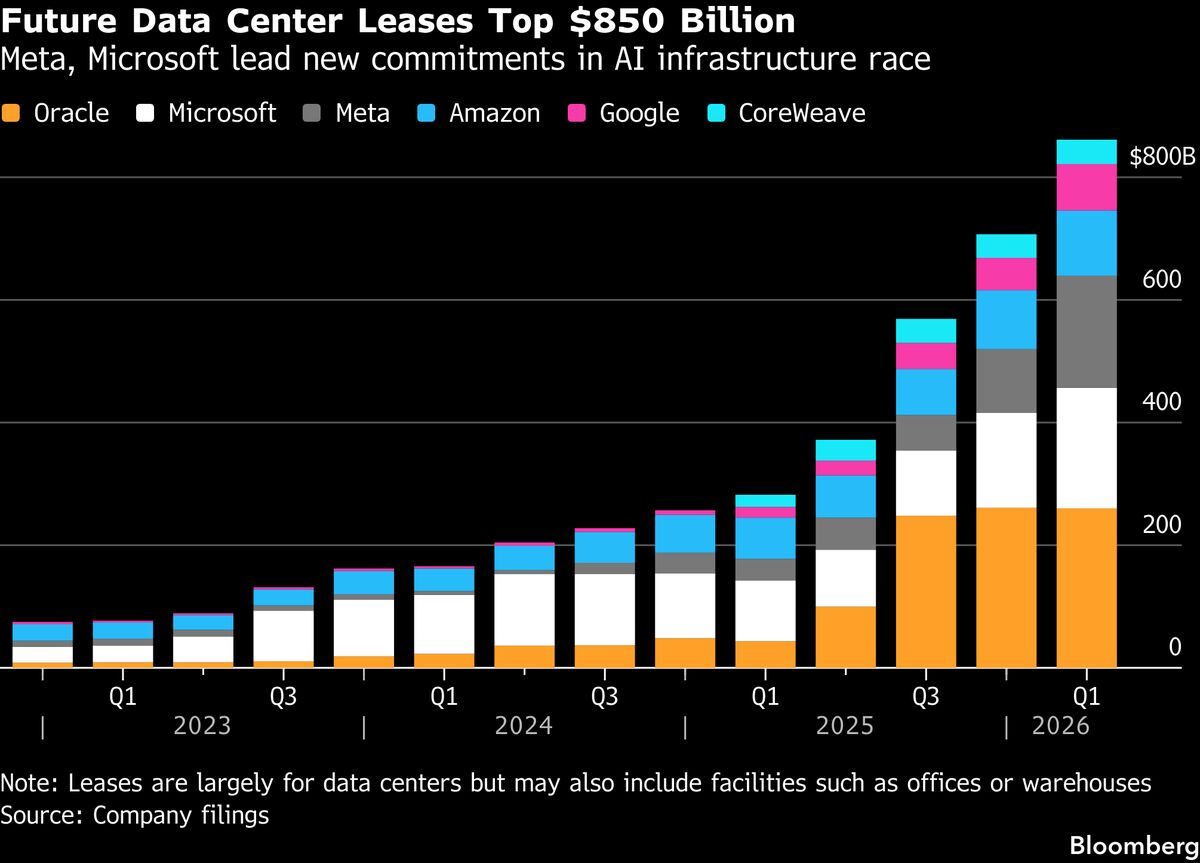
Meta Platforms Inc. and Microsoft Corp. each committed tens of billions of dollars in additional data center leases in their most recent quarters, adding to the massive sums the industry is spending on artificial intelligence.
ABC is urging viewers to write to the Federal Communications Commission and tell it to stop trying to "control who is allowed to appear" on The View. An ABC commercial that started airing yesterday asked viewers to submit responses to the FCC's call for public comment on whether the talk show is a “bona fide news interview program.”
"The View has welcomed your favorite guests and covered the issues you care about for nearly 30 years," ABC's ad said. "Now, the FCC wants to control who is allowed on the show. Viewers, use your voice. Tell the FCC to let the viewers decide."
For decades, the FCC has classified late-night and daytime entertainment talk shows as bona fide news for the purposes of their interview segments. This makes the shows exempt from the equal-time rule, which requires equal opportunities for opposing political candidates on non-news programming.
Polymarket paid dozens of social media users to film themselves making fake bets for a promotion that aimed to convince people they can strike it rich on the prediction market, according to a Wall Street Journal investigation published on Saturday.
"In its push to draw users to its unregulated platform, Polymarket has flooded social media with videos like [George] Makihara’s, which appear genuine at first glance," the article said. "In reality, Polymarket built near-perfect copies of its website, then instructed creators to make simulated trades on those dummy sites and hide that they were being paid by Polymarket."
Makihara, a college student, posted a video in January "that showed him winning $100,000 on a wager that President Trump would publicly say the word 'McDonald's' that month." But trade data showed that no one on Polymarket won such a bet in January, according to the Journal. This was one of 145 bets that Makihara appeared to place on Polymarket between January and May, but all of those bets were fake, the article said.
DERBY, Australia — While Spanish sailors packed in dirt to stabilize the bottom of ships sailing from the Americas in the 16th century, they were unaware that they were also helping tiny stowaways aboard. Research suggests that tropical fire ants sailed across the Pacific Ocean, joining Europeans over the centuries as they landed and colonized landmasses across the world. Then, in the early 2000s, tropical fire ants (Solenopsis geminata) were detected on Melville Island in the Tiwi Islands, a picturesque archipelago off the coast of Darwin, the capital of Australia’s Northern Territory. Here, they were able to flourish, according to researchers, and have since become naturalized in parts of the Australian tropics while dominating the environment, eating small mammals, and potentially deterring nesting birds. “The ants have a huge impact on native birds and animals on the Tiwi Islands,” said Stanley Tipungwuti, a ranger on the islands where most identify as Aboriginal or Torres Strait Islander. But after two decades of effort, and the work of the Tiwi Ranger team, tropical fire ants are deemed no more on Merville Island: In 2025, the species was completely eradicated, according to Ben Hoffmann, who was part of the eradication program from its inception. That same year, the Tiwi Island Rangers received the Territory Indigenous Natural Resource Management Award in Darwin for their efforts. The Tiwi Rangers were the 2025 winners of the Territory NRM Indigenous Natural Resource Management Award. Image by the Territory Natural Resource Management Award, supplied by Tiwi Resources. Hoffmann, principal research…This article was originally published on Mongabay
California state regulators say AT&T lied to the Federal Communications Commission in an attempt to shut off its old copper phone network without providing an adequate replacement.
"AT&T asserts that California seeks to prohibit or hinder wireline carriers from discontinuing copper facilities and investing in fiber," said a June 15 filing by the state of California and the California Public Utilities Commission. "Indeed, AT&T has been making this argument for years. It is not and has never been true."
As we reported last month, AT&T sued California over the state’s refusal to let it stop providing phone service to all potential customers in its wireline network territory. AT&T also petitioned the Federal Communications Commission to declare that California cannot enforce its rules and to let AT&T stop providing service to about 199,000 phone customers.
The Pakistan Genome Resource compiles biobank data from 173,303 individuals with high familial relatedness, broadening the catalogue of human genetic variation and establishing a population-specific genomic reference for Pakistan.
A supramolecular strategy, in which uniform, dynamic nanopores are constructed, overcomes the limitations of limited structural control, mechanical fragility or demanding synthesis in nanoporous anion-conducting membranes, providing a versatile tool for molecularly engineering transport pathways.
The Trump administration is trying to help Elon Musk's xAI Corp. beat a Clean Air Act lawsuit filed by the National Association for the Advancement of Colored People (NAACP). The US said the NAACP lawsuit threatens an xAI data center that powers Grok systems needed by the military.
The NAACP sued xAI and subsidiary MZX Tech in April, alleging that they violated the Clean Air Act by operating 27 gas turbines without an air permit in Southaven, Mississippi. The number of unpermitted turbines rose to 57 by mid-May and there were plans to install two more, the NAACP said in a June 12 filing.
"Defendants’ Colossus Gas Plant powers xAI’s nearby Colossus 2 data center, which in turn powers the chatbot 'Grok,'" the lawsuit said. The gas turbines have fueled both health concerns and noise complaints.
When the US Department of Justice approved Paramount Skydance's proposed acquisition of Warner Bros. Discovery on Friday, a DOJ press release said "a rigorous eight-month investigation led by the [Antitrust] Division’s career staff" showed that the $111 billion deal would not harm competition or American consumers.
But according to The Wall Street Journal, the DOJ career lawyers who led that investigation "were leaning toward recommending a lawsuit challenging it on the grounds that the combination of the two movie studios would be anticompetitive and violate antitrust law." DOJ senior leaders closed the investigation "before career staffers who were concerned about the acquisition had an opportunity to object, according to people familiar with the matter," the WSJ reported.
Commenting on the report that the decision to allow the deal surprised staff investigators, Sen. Elizabeth Warren (D-Mass.) wrote that "the American people need to know if this merger was approved as a political favor. This reeks of corruption."
A ruling by Brazil’s Supreme Court has given new momentum to one of the most controversial infrastructure projects in the Brazilian Amazon: The Ferrogrão railway. The plan is to link Sinop, in the grain-producing state of Mato Grosso, to the port of Miritituba in Pará, a key commodity export hub on the Tapajós River. Conceived by the agribusiness sector to reduce grain transportation costs, Ferrogrão is a priority project for President Luiz Inácio Lula da Silva’s administration, despite warnings about its potential impacts on Indigenous territories and protected forests in an Amazon region already under significant socio-environmental pressure. In May, the justices upheld a 2017 law that removed 862 hectares (2,130 acres) from Jamanxim National Park, a conservation unit located in Pará state, to allow Ferrogrão to pass through the protected area. The initiative had been challenged on the grounds that Brazil’s Federal Constitution requires a formal law to reduce the size of protected areas, rather than the conversion into law of a provisional measure issued by the executive branch. “The STF decision does not give the green light to the Ferrogrão project, which still must undergo environmental studies and the licensing process,” said Alice Dandara de Assis Correia, an attorney at Instituto Socioambiental (ISA), a nonprofit that advocates for environmental and Indigenous rights. “But the courts have ruled that specially protected areas can be altered through an expedited process, an extremely dangerous shortcut that could pave the way for Congress to approve similar changes in other protected areas facing…This article was originally published on Mongabay
COLOMBO — The mist-covered tea estates, forest patches and mountain valleys of Sri Lanka’s hill country support some of the country’s most important leopard populations outside protected areas. Yet the same landscapes have emerged as the deadliest places for the threatened big cats of Sri Lanka. A new study analyzing 17 years of leopard mortality records has found that nearly 40% of recorded leopard deaths occurred within a single district of Sri Lanka’s Central Highlands, the tea-growing Nuwara Eliya, which accounts for only 4.4% of the species’ estimated range. The study, published in Wildlife Letters, documented 164 human-caused leopard deaths between 2008 and 2024. Most of the victims were adult males, with adults accounting for 87.3% of deaths, out of which 68.4% males made up 68.4% of that adult population. With fewer than 1,000 mature leopards believed to remain in Sri Lanka, deaths of adult leopards are raising concerns for the species’ long-term survival, as deaths of breeding-age individuals, even modest increases in adult mortality, can have significant impacts, said Sanjaya Weerakkody, lead author of the study and a postdoctoral fellow at Xishuangbanna Tropical Botanical Garden. The majority of recorded deaths were of males, also problematic as the males maintain large territories overlapping with multiple females, which could lead to destabilize local populations, Weerakkody told Mongabay. A rare image of a mating leopard pair captured by a camera trap in the tea fields of Sri Lanka’s Central Highlands highlights that the human-dominated hill country tea landscape is habitat for Sri…This article was originally published on Mongabay
COLOMBO — Sri Lanka banned the purchase and use of single-use plastic water bottles in all government institutions effective May 31, under a new government circular that targets reduction of wasteful plastic consumption within the state sector. The move is the latest in a long line of attempts by the island nation to reduce plastic pollution — a crisis that clogs waterways, pollutes beaches, harms marine life, and overwhelms the country’s fragile waste management systems. But environmentalists say the real question is not whether Sri Lanka can announce another ban, but whether it can be enforced. The new directive applies to public institutions and is expected to reduce the routine use of disposable plastic water bottles during government meetings, events, offices and official functions. Authorities are encouraging reusable alternatives and better drinking water infrastructure within public institutions, says Kapila Rajapaksha, the director-general of the Central Environmental Authority (CEA), the state agency mandated to address plastic pollution. Sri Lanka’s plastic problem is growing exponentially. The National Plastic Waste Inventory (NPWI) published in 2024 has estimated the island’s municipal plastic waste generation to be approximately 250,000 metric tons per year. Sri Lanka recycles only about 27,000 metric tons of plastic waste annually, roughly 11% of total plastic waste generated. An estimated 68,000 metric tons, or 27% of plastic waste, remain uncollected and are often burned, buried or illegally dumped. Approximately 101,000 metric tons or 41% of the plastics go unaccounted from the waste management system during collection, transport, sorting and disposal. According…This article was originally published on Mongabay
PORT HUGHES, Australia — Situated midway along the Great Southern Reef that spans Australia’s southern coastline, the waters off Port Hughes typically teem with life. The coastal hamlet northwest of Adelaide plays host to a multitude of coral, bivalve and fish species. But in late March, the largest and longest harmful algal bloom (HAB) in Australian history arrived to Port Hughes, depleting its waters’ rich biodiversity. The bloom had first appeared elsewhere off the state of South Australia’s coast a year earlier, causing eye and skin irritation and respiratory symptoms among beachgoers. Then, along with waves of acrid-smelling sea foam, scores of dead marine animals began washing ashore. In Port Hughes, the HAB’s impacts were most visible below the surface. The town’s wooden jetty had previously been one of the most consistent locations in South Australia to observe temperate species, said Stefan Andrews, co-founder of the Great Southern Reef Foundation, a conservation advocacy group. But by mid-April, when Mongabay joined Andrews on a dive, the site was drab compared with vibrant photographs taken in February and March. Under the jetty, sponges and corals that had previously adorned its pylons in a brilliantly hued mosaic appeared colorless. Apart from a short-headed seahorse (Hippocampus breviceps) — a “sign of hope,” Andrews called it — little life was visible in the murky waters. The reef, he said, had become quieter, lacking the sounds of snapping shrimp and other creatures that once played in the underwater soundtrack. “There’s a sense of loss when you…This article was originally published on Mongabay
As offshore wind farms expand rapidly in the global renewable energy transition, scientists are studying how these large marine infrastructure projects affect ecosystems beneath the waves. Research from Wageningen University & Research in the Netherlands suggests that offshore wind may bring both risks and benefits for sharks and rays, known collectively as Elasmobranchii, which are highly sensitive to electromagnetic fields (EMFs). A six-year project called “Elasmopower” examined how EMFs from subsea power cables in offshore wind farms affect bottom-dwelling sharks and rays. These species depend on natural electric and magnetic fields for key behaviors such as navigation, prey detection, habitat use and long-distance movement, particularly in low-visibility environments. The studies conducted as part of the Elasmopower project have been published in four papers, with three additional papers currently undergoing peer review. Sharks and rays have specialized electroreceptors called ampullae of Lorenzini. The jelly-filled sensory canals around the head and snout can detect even extremely weak EMFs from prey and predators, water movement, and the Earth’s geomagnetic field, Erwin Winter, a scientist at Wageningen, told Mongabay. This system is central to hunting and orientation, making Elasmobranchii especially relevant for studying EMF exposure from offshore energy infrastructure, Winter added. Erwin Winter, a researcher with the Elasmopower project, presented findings on offshore wind, electromagnetic fields and bottom-dwelling sharks and rays at the Sharks International 2026 conference in Colombo, Sri Lanka, in May. Image by Malaka Rodrigo for Mongabay. During a presentation on a summary of the Elasmopower research at the Sharks International 2026…This article was originally published on Mongabay
A non-canonical metabolic route for spermine synthesis mediated by ALDH18A1 limits iron availability and lipid peroxidation in hepatocellular carcinoma.
Centromeric DNA repeat insertions and CENP-A chromatin assembly are identified as genomic signatures that preserve telomere integrity in ALT cancer cells.
Global soil mineral data from orbital spectroscopy reduce uncertainty in dust’s solar radiative impact and improve estimates of Earth’s energy imbalance, according to analyses integrating high-resolution soil composition into Earth system models.
Nour Haydar speaks with Christopher Knaus about the BHP files – the cache of internal documents leaked to the Guardian and the ABC’s Four Corners – which show that the world’s biggest miner has war-gamed ways to massively delay decarbonisation
Additional audio in this episode was sourced by Financial Times Live

 Login