Login

'One of the oldest gravestones of a free Black person in America' discovered in Boston
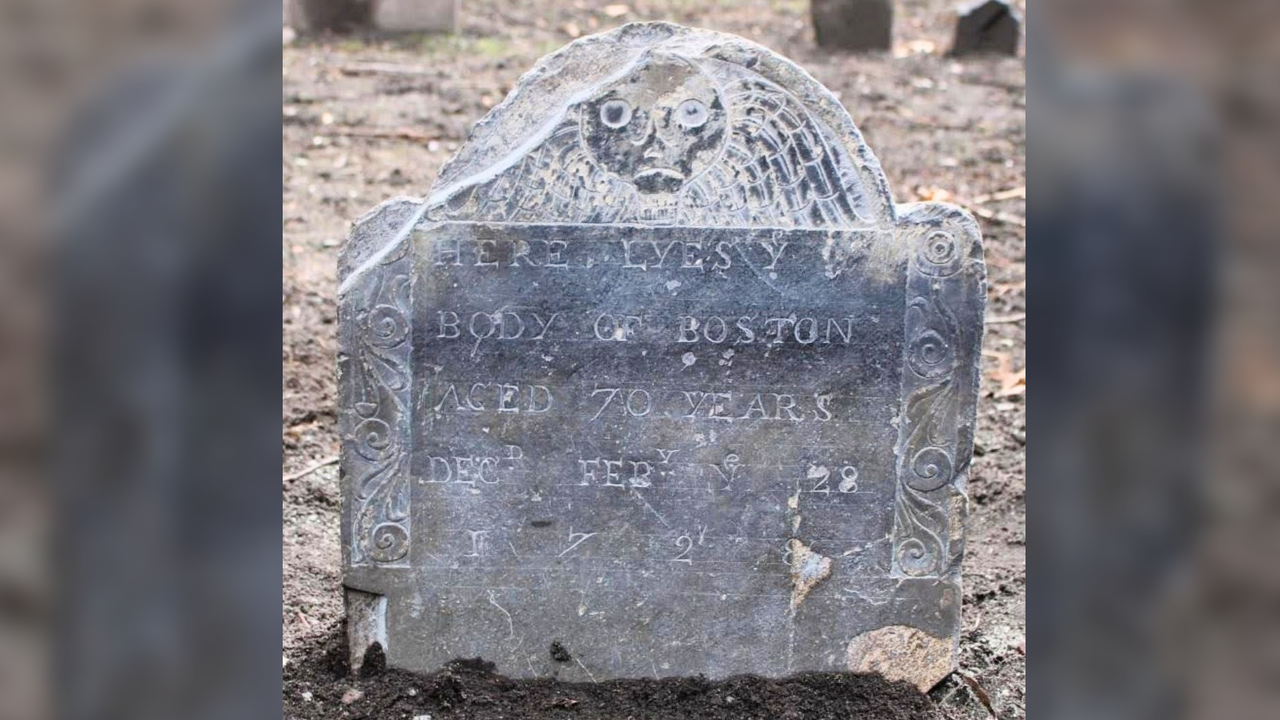
A team of conservationists has discovered and restored the tombstone of Sebastian, a formerly enslaved man who died free in 1729.
"That discovery is likely one of the oldest gravestones of a free Black person in America," Michelle Wu, the mayor of Boston, said in a July 4 speech. "It's been there all along. We just had to go look and share the story."
The stone marker is inscribed with Sebastian's chosen name, Boston, and features an image common in 17th- and early 18th-century tombstones in New England: the death's head. The symbol includes a stylized skull flanked by wings, which were possibly intended to symbolize spiritual resurrection.
On the tombstone, a simple, five-line inscription reads:
Original Inscription
HERE LYES Ye
BODY OF BOSTON
AGED 70 YEARS
DECD FEBY Ye 28
1728
Modern English
HERE LIES THE
BODY OF BOSTON
AGED 70 YEARS
DECEASED FEBRUARY THE 28
1728
In 18th-century American writing, the word "the" was often abbreviated with a Y-shaped letter form called a "thorn" representing the "th" sound. Tombstones also frequently abbreviated "deceased" and the month. Somewhat confusingly, before 1752, the American colonies regularly used the Julian calendar, as did Britain, in which the new year started on March 25. Boston's year of death is listed on the tombstone as 1728, but his February 28 death was actually in 1729 in our modern Gregorian calendar.
Kelly Thomas, the director of the Historic Burying Grounds Initiative for the Boston Parks and Recreation Department, told WBZ News Radio that she identified the gravestone during a restoration project at the Granary Burying Ground, the city's third-oldest cemetery. Established in 1660, the cemetery includes over 5,000 graves, including the final resting places of Declaration of Independence signers Samuel Adams and John Hancock; the U.S. Revolutionary War officer Paul Revere; and Crispus Attucks, a sailor of mixed African and Indigenous ancestry who is thought to be the first American killed in the Boston Massacre.
"I was reviewing the photos of headstones, and then I noticed that the stone only had one name," rather than a first and last name, Thomas told WBZ News Radio, suggesting that Boston was either enslaved or free when he died. Based on a search of historical records, Thomas determined that Boston's enslaved name was Sebastian and that he also went by Bastian.
- 'It's a huge deal': Archaeologists discover second cannonball from the Battle of the Alamo, and it was likely fired by Texans
- 8-year-old African American boy from Colonial Maryland found buried with white Colonists, and it's unclear if he was enslaved
- Lost Indigenous settlements described by Jamestown colonist John Smith finally found
A surprising amount of information was recorded about Boston and his wife, Jane Lake. In 1701, they had their daughter, also named Jane, baptized at First Church in Boston, where they regularly attended worship services. But while the two were married with children, they were also both enslaved and lived in different households, historian Gloria Whiting wrote in a 2016 study.
Boston was likely freed in the early 18th century, some time after the 1702 death of John Waite, who had held him in slavery. By 1708, a list of free Black people included the name Boston, and he had gained a reputation in the city as a hardworking handyman, according to Whiting's study. He had been freed for roughly 30 years when he died in 1729 and was well-known enough to have an obituary published for him in the New-England Weekly Journal, a rare occurrence for enslaved or freed Black people in colonial America.
Wu also said that, in recent weeks, archaeologists in Boston had discovered musket balls and gun flints from the infamous Battle of Bunker Hill that took place on June 17, 1775. The battle was fought by British Crown forces and New England troops in the first stage of the American Revolutionary War.
See if you know what these mysterious artifacts are with our archaeological fragments quiz!