❌

Reading view

Three-armed kitchen robot cuts raw salmon with 95% touch-sensing accuracy

Industrial robots have mastered many repetitive tasks, but preparing sashimi remains a surprisingly difficult challenge. A piece of raw salmon rarely stays where it is placed. The fish deforms during handling, making it difficult for machines to deliver consistent cuts.

Researchers in Norway have developed a robotic system that can prepare sashimi with minimal human involvement. The machine tackles a task that has long challenged robots because raw fish constantly changes shape during handling.

The project highlights a broader goal in robotics. Engineers want machines to work with soft materials that do not behave predictably. Success in that area could benefit industries ranging from food processing to healthcare.

Built for delicate tasks

The research team at the Norwegian University of Science and Technology designed Sashimi-Bot around three robotic arms. Each arm performs a specific role. One arm stabilizes and positions the salmon before cutting begins. Another handles a chef’s knife. A third arm uses chopsticks to transfer finished slices onto a tray.

Getting the fish into the correct position proved critical. A salmon loin can shift during handling, which affects cut quality. To address that issue, the researchers trained the robot in a virtual environment. The system relied on deep reinforcement learning, an AI technique that improves performance through repeated practice. During the simulation, the robot tested countless movements and gradually learned how to arrange the fish for slicing. The researchers then transferred that knowledge to the physical robot without additional training on real salmon.

Giving the knife touch

Cutting introduced another obstacle. The robot needed to know exactly when the blade reached the cutting board. That task becomes more difficult because the knife sits inside a soft robotic gripper. Small variations in the grip can affect the blade’s position during a cut.

To solve the problem, the team equipped the system with a GelSight tactile sensor. The device uses a soft gel surface and an internal camera to detect pressure changes. Those measurements provide information similar to a sense of touch.

Researchers trained the sensing system using more than 12,000 data samples collected during 157 cutting motions. The resulting model detected contact with the cutting board with 95% accuracy. It also achieved 99% precision during testing. That feedback allowed the robot to adjust its cutting motion before driving the blade too deeply into the board.

Performance on salmon

The team evaluated Sashimi-Bot using real salmon loins. During testing, the robot produced 34 slices ranging from 6 to 16 millimeters thick. Some pieces adhered to the knife after cutting, a common issue when working with raw fish. The robot successfully recovered all six of those slices directly from the blade.

Most of the remaining pieces reached the serving tray without issue. The system successfully transferred 26 of 28 slices left on the cutting board. Only two failed transfers occurred, both involving extremely thin pieces that slipped from the chopsticks.

The study was published in the journal npj Robotics.

  •  

New plasma process converts wet coffee grounds into fuel in just 90 seconds

Scientists have demonstrated a new plasma-based process that converts wet coffee waste into high-performance biochar without any pre-drying treatment. The technology could address one of the biggest challenges in biomass recycling while creating a valuable source of renewable fuel.

Developed by researchers at the Korea Institute of Geoscience and Mineral Resources (KIGAM), the system converts moisture-rich coffee grounds into carbon-rich biochar in less than two minutes. The resulting material delivers an energy content comparable to anthracite coal, offering a potential pathway for turning difficult waste streams into useful resources. Researchers believe the technology could help reduce waste disposal costs while expanding opportunities for decentralized waste-to-energy systems.

Moisture becomes an asset

High moisture content has long complicated efforts to recover energy from organic waste. Most biomass conversion technologies require a separate drying stage before processing, increasing costs and energy use.

The KIGAM team designed its Flame Plasma Pyrolysis system to eliminate that requirement. The process uses plasma flames generated through the combustion of liquefied petroleum gas and compressed air. Those flames reach temperatures between approximately 1,470°F and 1,650°F, allowing the system to process wet biomass directly.

Instead of hindering conversion, moisture helps drive the process. As water trapped inside coffee particles rapidly turns into steam, pressure builds and creates microscopic explosions. Researchers describe the phenomenon as a “popcorn effect.” The bursts break apart the biomass structure, increase porosity, and accelerate carbonization. Under optimized conditions, the system achieved complete conversion in just 90 seconds.

Fuel performance rivals coal

The resulting biochar delivered a heating value of 29.0 MJ/kg, roughly 33% higher than untreated coffee grounds. Researchers said the material performs similarly to anthracite coal. The treatment also nearly tripled fixed carbon content, increasing it from 15.6% to 46.2%. At the same time, it completely removed sulfur compounds, helping prevent sulfur dioxide emissions during combustion.

Researchers observed another significant improvement in the material’s structure. Its specific surface area increased dramatically, creating a highly porous carbon product. Those characteristics could make the biochar useful beyond fuel applications. Potential uses include activated carbon production, filtration systems, and industrial adsorption materials. The process also generated minimal smoke and tar compared with conventional biomass treatment methods.

Faster route to resource recovery

Speed is one of the technology’s key advantages. Hydrothermal carbonization systems often require one to six hours to process biomass, while torrefaction can take 30 minutes or longer. Flame Plasma Pyrolysis completes the conversion in less than two minutes. Researchers said the system also reduces energy demand by using combustion-generated plasma rather than electricity-intensive plasma devices.

Although the study focused on spent coffee grounds, the team believes the technology could process other high-moisture waste streams, including food waste, sewage sludge, and agricultural residues. Lead author Dr. Taejun Park said the technology offers a new way to view organic waste. Instead of treating it as a disposal problem, industries could use it as a source of energy and valuable carbon materials. The team plans to expand the process to additional waste types and continue optimizing it for commercial-scale deployment.

The study is published in the journal Chemical Engineering Journal.

  •  

HALEU deal strengthens fuel supply for five Ohio advanced reactors

A planned advanced nuclear energy campus in Ohio has taken a major step toward securing reactor fuel, one of the industry’s most critical resources. Oklo and Centrus have signed a letter of intent that could provide enough domestically produced high-assay low-enriched uranium (HALEU) to support up to five Aurora reactors for several years. The fuel would come from Centrus’ enrichment facility in Pike County, Ohio, with deliveries expected to begin in 2029.

The agreement addresses a growing challenge for the advanced nuclear sector. While several next-generation reactor designs continue to move toward commercialization, access to U.S.-produced HALEU remains limited. Developers and fuel suppliers have increasingly sought long-term agreements to reduce uncertainty around future reactor deployments.

Securing reactor fuel

Under the proposed arrangement, Centrus would supply fuel for Oklo’s planned 1.2-gigawatt clean energy campus in southern Ohio. The agreement could also include advance payments that support future fuel production and strengthen supply certainty for the project.

The deal links fuel production with a specific reactor deployment strategy. Industry leaders have repeatedly identified fuel availability as one of the biggest hurdles facing advanced nuclear development in the United States.

Earlier this year, Oklo announced a power agreement with Meta that included prepayment provisions designed to support project development. The latest fuel arrangement follows a similar approach by connecting future customer demand with long-term fuel supply planning.

Jacob DeWitte, Oklo’s co-founder and chief executive, said the agreement brings together several key elements needed for advanced nuclear deployment, including fuel, power generation and customer demand. He added that southern Ohio’s nuclear expertise and skilled workforce position the region to support future reactor construction.

Ohio nuclear ecosystem

The agreement also highlights the growing role of southern Ohio in the domestic nuclear supply chain. Centrus continues to expand enrichment operations in Pike County as demand for advanced reactor fuel grows. The company plans to combine private investment with previously announced federal support aimed at increasing domestic HALEU production capacity.

Industry officials view enrichment as a strategic capability because many advanced reactor designs require HALEU fuel. Expanding U.S. production could reduce dependence on foreign sources while supporting a new generation of nuclear power plants.

Amir Vexler, president and chief executive of Centrus, described the agreement as an important step toward establishing a reliable fuel supply for next-generation reactors. He said connecting domestic fuel production with advanced reactor deployment could help create a stronger foundation for future nuclear growth in the United States.

Supporting Aurora deployment

Alongside the fuel agreement, Oklo has signed a memorandum of understanding with Kiewit Nuclear Solutions to support engineering, procurement, and construction planning for its initial Aurora reactor deployments.

Oklo’s Aurora reactors use liquid-metal cooling and require relatively little water compared with conventional nuclear plants. The reactors are designed to provide reliable carbon-free electricity under a build-own-operate model.

If the project moves forward as planned, it could demonstrate how fuel suppliers, reactor developers and infrastructure partners can work together to accelerate advanced nuclear deployment in the United States.

  •  

US-backed Ward 250 nuclear reactor achieves criticality under DOE program in Utah

The United States has reached another milestone in its push to bring advanced nuclear technology from the drawing board to deployment. Valar Atomics announced that its Ward 250 reactor successfully achieved fueled criticality during testing at the Utah San Rafael Energy Lab in Emery County, Utah. The achievement means the reactor can now sustain a controlled nuclear chain reaction, a key step before any reactor can begin generating electricity.

The test also marks a notable first for the Department of Energy’s Reactor Pilot Program. Ward 250 became the first reactor authorized under the program to reach criticality outside a national laboratory, highlighting the government’s effort to accelerate commercial reactor development. Federal officials described the milestone as another sign that advanced nuclear projects are moving from concept to reality at a faster pace than in previous decades.

Racing toward deployment

The Ward 250 reactor is the second advanced reactor expected to reach criticality under goals established by President Donald Trump’s May 2025 executive order. The order called for multiple advanced reactor demonstrations to achieve criticality before July 4, 2026. Earlier this month, Antares Nuclear reached the same milestone with its Mark-0 reactor at Idaho National Laboratory. Together, the projects represent some of the fastest-moving reactor demonstrations currently underway in the United States.

Moments ago, Valar Atomics took Ward 250 critical for the first time. This fulfills President Trump’s EO 14301, which called for 3 advanced reactors to go critical by July 4th.

This is our second criticality as a company, and an important step toward our goal of power by July 4. pic.twitter.com/ZNVgKSarfV

— Isaiah Taylor – making nuclear reactors (@isaiah_p_taylor) June 18, 2026

Energy Secretary Chris Wright said the achievement reflects growing momentum across the domestic nuclear sector. “Today marks another historic moment for America’s nuclear renaissance,” Wright said.

He pointed to several recent accomplishments, including the first airlift of a small reactor aboard a U.S. military C-17 aircraft. Wright said such milestones demonstrate how quickly advanced nuclear technologies are progressing under current federal initiatives.

Built in nine months

Valar Atomics completed the reactor project in less than a year. According to founder and CEO Isaiah Taylor, the site was empty nine months ago. “Today, there’s a critical reactor on it, built and operated by the Valar team,” Taylor said.

The company developed Ward 250 as a power-producing reactor rather than a laboratory experiment. Achieving criticality confirms that the design can sustain the nuclear reactions required for future energy production.

Taylor credited support from the Department of Energy, Utah state officials, local communities, and project partners for helping the company meet its development goals.

New path for reactors

The Department of Energy launched the Reactor Pilot Program to shorten development timelines for first-of-a-kind advanced reactors. The initiative uses existing DOE authority to authorize reactor demonstrations while developers continue working toward commercial licensing pathways.

Officials view the program as a way to reduce barriers that have historically slowed nuclear innovation in the United States. Building on the program’s early progress, the Department recently introduced the Nuclear Energy Launch Pad. The effort aims to further accelerate testing, validation, and deployment of advanced reactor technologies.

The Reactor Pilot Program ultimately seeks to bring at least three advanced reactor concepts to criticality outside national laboratories. Federal officials believe the approach can help restore U.S. leadership in nuclear energy while expanding access to reliable, around-the-clock power generation.

  •  

US Navy tests dual-use laser that beams power and counters drone threats in one system

The U.S. Naval Research Laboratory (NRL) has demonstrated a laser system that can both transmit power wirelessly and defend against aerial threats, marking a significant step toward more flexible battlefield energy solutions.

The test showed that a single directed-energy platform can perform two critical military functions without requiring separate equipment. Researchers beamed power across an airfield to a remote location and then quickly switched the same system to engage a simulated drone threat.

The demonstration received support from the Office of the Under Secretary of War for Acquisition and Sustainment and the Operational Energy Capability Improvement Fund. NRL worked alongside Boeing, the Army’s DEVCOM Ground Vehicle Systems Center, and stakeholders from the Navy, Marine Corps, and Army.

The project aims to reduce dependence on fuel-based power systems while expanding the operational capabilities of deployed forces.

Power without fuel

During the demonstration, a trailer-mounted laser transmitted energy from a standard military vehicle to specialized receivers positioned at a distant site. The setup delivered power without physical cables or traditional fuel logistics.

Researchers focused on practical battlefield conditions rather than controlled laboratory environments. The team conducted testing in harsh weather, including strong winds and heavy snowfall.

According to NRL Electrical Engineer Alex Grede, the goal was to evaluate how the technology could function during real military operations. “We demonstrated that the same laser used to beam power remotely can immediately transition to counter a drone threat,” Grede said.

The ability to deliver power over distance could eventually help military units operate in remote locations with fewer fuel convoys and generators.

Built for the field

Unlike previous power-beaming demonstrations that took place under ideal conditions, the NRL team deliberately exposed the system to environmental challenges.

Researchers continued collecting data even as visibility deteriorated during severe winter weather. The results will help engineers refine the technology for future deployments. NRL Research Physicist Justin Lorentzen said realistic testing provides valuable information that laboratory experiments cannot replicate.

The team wants to understand how atmospheric interference affects performance. That data will guide future improvements and increase reliability in operational settings.

Engineers also demonstrated field maintainability during the event. The team repaired a critical component on-site and quickly returned the system to operation.

Lt. Cmdr. Brian Di Salvo, NRL Radar Division military deputy, said military systems must remain simple to operate and easy to repair. He noted that both qualities are essential for deployment in demanding environments.

Expanding military applications

The laser platform used during the test already serves the U.S. Marine Corps in directed-energy roles. Researchers integrated it with high-efficiency solar receivers and mobile vehicle power sources to create a distributed energy network.

Army requirements helped shape many aspects of the field demonstration. Officials see strong potential for expeditionary missions where reducing fuel consumption can improve both logistics and survivability.

Grede said collaboration across military branches could accelerate adoption of the technology. While NRL continues development for naval applications, the Army could become one of the first services to field the capability.

The next phase will place the system directly in front of Marines, Soldiers, and Sailors. Researchers plan to gather operational feedback and refine the technology based on how troops would use it in the field.

The effort forms part of NRL’s broader push to develop scalable directed-energy systems that strengthen battlefield resilience and extend the reach of U.S. forces.

  •  

Sanders bills AI companies for $7T public fund, aims $1,000 payments for US citizens

Sen. Bernie Sanders has unveiled a proposal that would give Americans a direct financial stake in the country’s booming artificial intelligence industry. The Vermont independent introduced legislation Thursday that would create a national sovereign wealth fund tied to major AI companies. Under the proposal, the federal government would hold a 50% ownership stake in qualifying AI firms and distribute annual payments to U.S. citizens.

Sanders argues that today’s AI systems rely heavily on content, knowledge, and creative works produced by generations of people. Because AI companies benefit from that collective human output, he says the public should share in the industry’s financial gains. The legislation, called the American AI Sovereign Wealth Fund Act, comes as lawmakers debate how to regulate AI and address concerns about wealth concentration in the technology sector.

Public stake in AI

The proposal would apply to AI companies generating more than $200 million in annual revenue. Those firms would become subject to a system that grants the public a significant ownership interest through a federally managed investment fund. Sanders estimates the fund could reach a value of roughly $7 trillion based on current valuations of leading U.S. AI developers.

The future of AI must not be decided behind closed doors by billionaires seeking to maximize their power and profit.

It should be decided by the American people.

That's why I'm introducing the American AI Sovereign Wealth Fund Act. pic.twitter.com/sbC0YMT90f

— Sen. Bernie Sanders (@SenSanders) June 18, 2026

The senator says the structure would allow Americans to benefit directly from one of the fastest-growing industries in the economy. He projects that citizens could initially receive annual payments of around $1,000. Those payouts could increase as the AI sector expands.

Speaking to reporters, Sanders said the payments would likely grow if AI companies continue generating larger profits. He also suggested future revenue could help support public priorities such as healthcare, education, and housing.

Collective value argument

At the center of the proposal is Sanders’ belief that AI companies derive value from information created by society as a whole. The legislation argues that AI models train on vast amounts of human-created material, including books, journalism, software code, scientific research, artwork, videos, and other forms of knowledge.

Sanders contends that a small group of technology executives now captures most of the economic benefits generated from those resources. Supporters of the measure compare AI to publicly owned natural resources. In that view, companies extracting value from a shared asset should return a portion of that wealth to the public.

Model draws from funds

The bill takes inspiration from sovereign wealth funds already operating across the United States and around the world. States such as Texas and New Mexico have long used investment funds supported by natural resource revenues to finance public programs, particularly education. Dozens of countries, including Norway, China, and the United Arab Emirates, also operate sovereign wealth funds that manage public assets and investments.

If Congress approves the legislation, a seven-member independent commission would oversee the fund. The president would nominate commissioners, while the Senate would confirm them.

The commission would represent public interests in qualifying AI companies and manage the government’s ownership stake. While the proposal faces significant political hurdles, it adds a new dimension to the growing debate over who should benefit from the economic gains created by artificial intelligence.

  •  

US Air Force deploys Hivemind software to enable autonomous multi-aircraft combat

Shield AI has secured a U.S. Air Force production contract to deploy its Hivemind autonomy software as part of the service’s Collaborative Combat Aircraft (CCA) program, marking a key step in the military’s effort to field autonomous wingmen alongside crewed fighters.

The award reflects the Air Force’s effort to build a common autonomy software foundation that can be integrated across multiple Collaborative Combat Aircraft designs instead of being developed for a single platform. Officials believe that approach can accelerate upgrades, lower integration costs, and allow new capabilities to reach operational units faster.

Shield AI’s Hivemind software will support the Air Force’s vision for autonomous aircraft that can operate in coordination with human pilots while handling increasingly complex missions.

Software-centric autonomy strategy

The Air Force has adopted a software-first model for its future autonomous fleet. Under this framework, mission autonomy software can evolve independently from the aircraft carrying it.

That separation allows developers to introduce new capabilities without redesigning airframes or modifying platform-specific hardware. The approach also enables the service to evaluate autonomy solutions on their own merits while preserving competition across the broader CCA ecosystem.

Christian Gutierrez, senior vice president of Hivemind at Shield AI, said mission autonomy will play a central role in future airpower operations. “The Air Force’s approach enables faster innovation, rapid capability deployment, and greater operational advantage for the warfighter,” Gutierrez said.

He added that Shield AI plans to continue working closely with the service to deliver collaborative autonomy capabilities at scale.

Multi-aircraft teaming focus

Under the production contract, Shield AI will concentrate on collaborative combat behaviors involving multiple autonomous aircraft operating together under human supervision. The company aims to reduce operator workload while enabling larger groups of unmanned systems to coordinate actions during missions.

Such capabilities could become increasingly important as the Air Force expands its use of autonomous platforms in contested environments. Rather than simply following predetermined routes, Hivemind allows unmanned aircraft to adapt to changing conditions.

The software can adjust flight paths, react to emerging threats, coordinate with nearby aircraft, and support mission objectives without constant operator input. The company says the platform is designed to function as a digital pilot, helping autonomous systems make decisions in real time while remaining part of a broader human-machine team.

Expanding CCA development

The latest award builds on Shield AI’s existing involvement in the Air Force’s CCA efforts. Earlier this year, the company earned selection as a mission autonomy provider during the program’s Technology Maturation and Risk Reduction phase. That work continues alongside the new production effort.

Hivemind is currently flying aboard Anduril’s YFQ-44A aircraft, one of the platforms supporting ongoing CCA development activities. The Air Force views collaborative combat aircraft as a cornerstone of its future force structure.

By pairing autonomous aircraft with crewed fighters, the service hopes to increase combat capacity, extend operational reach, and provide commanders with more flexible options during future conflicts. As development advances, software platforms such as Hivemind are expected to play a critical role in determining how effectively autonomous aircraft operate alongside human pilots.

  •  

America’s most advanced metal 3D printer uses 12 lasers to mass-produce rocket frames

Divergent Technologies has unveiled a new industrial metal 3D printer and announced a major manufacturing expansion in Southern California, moves that the company says will significantly increase production capacity for defense and commercial customers.

The California-based manufacturer introduced the Monolith One, a large-format metal additive manufacturing system developed specifically for high-volume production. At the same time, the company revealed plans for a new 430,000-square-foot facility in Long Beach, California, where dozens of the machines will support future manufacturing programs.

Built for production

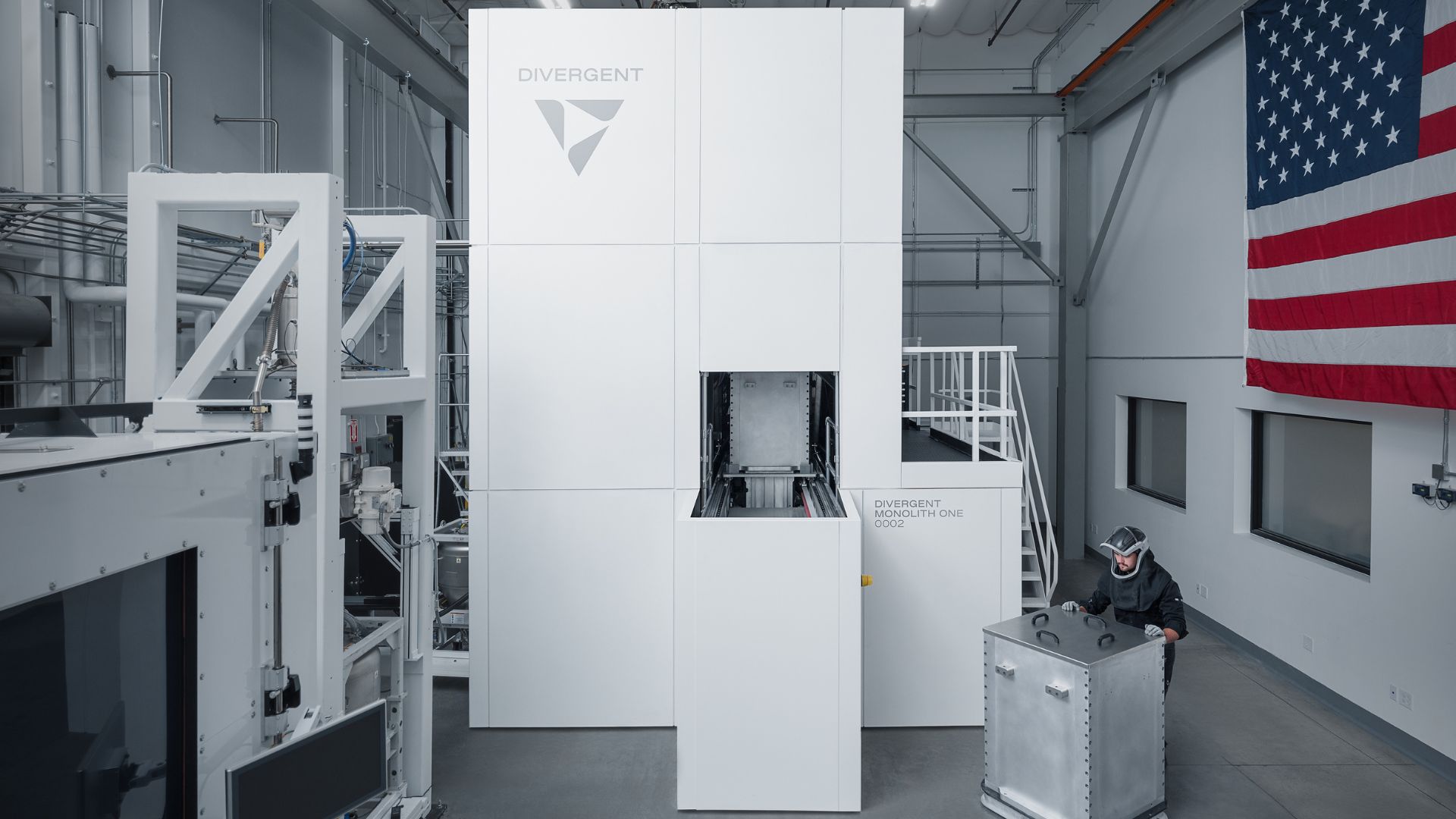
Unlike many metal 3D printers designed primarily for prototyping, Monolith One targets continuous industrial manufacturing. The machine stands more than eight meters tall and incorporates 12 high-powered lasers that deliver a combined 24 kilowatts of output.

Divergent designed the system over a 28-month period using lessons learned from more than a decade of additive manufacturing operations. The company developed the printer exclusively for use within its own manufacturing ecosystem rather than for commercial sale.

The machine supports a wide range of industrial alloys, including aluminum, steel, titanium, and nickel-based materials. It also offers a larger build chamber than many existing systems, allowing engineers to manufacture bigger and more complex structures in a single print.

According to Divergent, the printer can roughly double production throughput compared with current-generation equipment. The system also incorporates automated powder handling, thermal management controls, and optical monitoring technologies designed to improve consistency and reduce downtime.

Chief Technology Officer Brian Erhartic said the company built the printer specifically to improve manufacturing efficiency and quality. He added that integrating the machine directly into Divergent’s production platform helped unlock higher performance across multiple stages of manufacturing.

Factory expansion plans

Divergent currently operates six Monolith One printers at its headquarters in Torrance, California. The company plans to install an additional 64 systems at its new Long Beach facility over the next two years.

Divergent’s second factory in Long Beach, CA. Credit – Divergent Technologies, Inc.

Once fully operational, the site will support production of tens of thousands of munition airframes annually. It will also have the capacity to manufacture hundreds of thousands of critical metal components for aerospace and defense programs.

The expansion comes as defense contractors seek faster production methods and more resilient domestic supply chains. Traditional manufacturing processes often require lengthy lead times for complex hardware, particularly in aerospace applications.

Divergent says its software-driven manufacturing approach reduces those timelines from months to weeks or even days in some cases. The company supplies structures and components for several major defense and aerospace organizations, including Lockheed Martin, RTX, and CoAspire.

Chief Executive Officer Lukas Czinger said the new printer reflects years of operational experience gained from delivering production hardware to both defense and commercial customers. He noted that the company manufactures the systems domestically and sources key components through a U.S.-based supply chain.

As production ramps up at the Long Beach facility, Divergent expects the new manufacturing capacity to support growing demand for mission-critical hardware while strengthening domestic industrial capabilities.

  •  

Australia tests backpack-sized counter-drone system deployable in under two minutes

Australia is accelerating efforts to protect frontline troops from the growing threat of small drones, awarding a contract to defense technology firm OpenWorks under the Australian Defence Force’s Land 156 counter-drone program.

The company will supply its Vision Guard intelligent optics system for evaluation as part of the ADF’s AU$1.3 billion initiative to strengthen defenses against uncrewed aerial systems (UAS). Military planners intend to use the compact platform as an early-warning capability for dismounted soldiers operating in contested environments.

The move reflects a broader shift among Western militaries toward distributed counter-drone systems. Recent conflicts have highlighted how inexpensive commercial and military-grade drones can threaten troops far from traditional air defense coverage.

Frontline use

OpenWorks designed Vision Guard to give soldiers rapid situational awareness without adding significant weight to their equipment. The system combines panoramic surveillance with artificial intelligence-driven detection software to identify and track small drones at extended distances.

Operators can deploy the system in less than two minutes, allowing units to establish surveillance positions quickly. OpenWorks says troops can carry the core equipment and supporting sensors inside a standard military backpack.

The platform supports multiple sensor configurations. Users can integrate active and passive detection technologies, including radar and acoustic sensors, depending on mission requirements. OpenWorks’ software then fuses data from those sensors to improve detection accuracy and reduce operator workload.

The company developed the system with strict size, weight, and power requirements in mind. That approach allows small units to operate independently while maintaining awareness of nearby aerial threats.

AI-powered drone detection

At the center of Vision Guard is OpenWorks’ proprietary artificial intelligence engine. The software analyzes incoming sensor data and automatically classifies potential threats. The system focuses on detecting and identifying Class 1 drones, which are among the smallest categories of military and commercial unmanned aircraft.

Despite their size, these drones have become a persistent battlefield challenge because they are inexpensive, difficult to detect, and increasingly capable. By providing early warning, Vision Guard aims to give troops additional time to respond before a drone can conduct surveillance or deliver an attack.

Defense organizations across Europe and the United States have already tested or deployed the technology. The system also participated in Project Vanaheim, a joint U.K.-U.S. experimentation effort that examined future approaches to interoperable counter-drone operations.

Growing counter-drone demand

The Australian contract comes as militaries worldwide increase investment in layered counter-UAS networks. Rather than relying solely on large strategic assets, defense planners increasingly seek portable systems that can move with frontline forces.

James Cross, chief commercial officer at OpenWorks, said the company recognizes the responsibility associated with supporting the Australian military’s modernization efforts. He described Vision Guard as a compact system designed to improve situational awareness for dispersed units. Cross added that OpenWorks is proud to support Australia’s efforts to strengthen counter-drone capabilities.

As drone threats continue to evolve, defense programs such as Land 156 are expected to play a key role in shaping the next generation of battlefield surveillance and force protection technologies.

  •  

New ‘electronic nose’ uses 16 gas sensors to detect food spoilage and allergens

Food spoilage remains difficult to detect before it becomes a health risk. Consumers often rely on appearance and smell other than expiry dates to judge whether products are still safe to eat, despite the limitations of those methods.

Researchers at the University of California, Berkeley, have developed a sensor system designed to provide a more objective assessment. The technology combines miniature gas sensors with machine-learning software to identify chemical signatures associated with food spoilage and common allergens.

The researchers believe the system could eventually support smart appliances and food monitoring tools that help consumers make safer decisions about what they eat.

Digital scent recognition

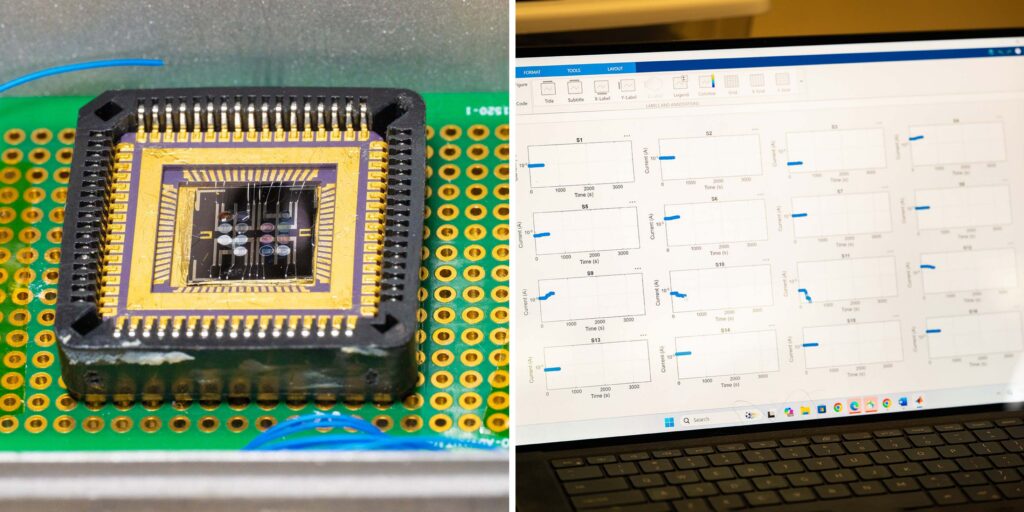
The device contains 16 microscopic gas sensors, each designed to respond differently to airborne chemical compounds. Together, the sensors create distinct response patterns when exposed to different foods.

The electronic nose uses 16 gas-sensitive materials that react to different airborne molecules. Credit – UC Berkeley

Lead author Carla Bassil, a doctoral student in electrical engineering and computer sciences at UC Berkeley, described the system as a set of digital taste buds. Each sensor converts chemical interactions into electrical signals, allowing the device to generate a unique signature for specific foods.

Researchers then trained machine-learning models to recognize those signatures. The team tested the system on strawberries, blueberries, bananas, walnuts, hazelnuts, cashews, and peanuts. It also learned to distinguish between fresh and spoiled samples of milk, eggs, and raw chicken.

“The idea is that we can use the relative selectivity of the gas sensors, paired with the pattern recognition abilities of machine learning,” Bassil said. By combining sensor data with artificial intelligence, the system can identify food-related chemical fingerprints more consistently than human smell alone.

Allergen detection potential

The study also highlighted the technology’s ability to detect allergen-containing foods. During testing, the electronic nose identified as little as 0.05 grams of walnut material, roughly one-hundredth of an average shelled walnut. That level of sensitivity could support future food safety applications for people with severe allergies.

Researchers caution that the device has not yet been tested in more complex settings. Future evaluations will examine how well it performs when allergens are mixed with other foods or when multiple food odors are present at the same time.

The spoilage experiments focused on chicken, milk, and eggs left at room temperature for 24 and 48 hours. The system successfully differentiated between fresh and deteriorated samples by analyzing changes in the gases they released.

Carbon nanotube design

Electronic noses have existed for decades, but manufacturing multiple sensing materials on a single chip has remained a significant challenge. Bassil’s team addressed that problem by using carbon nanotubes instead of conventional metal-oxide materials. The nanotubes form extremely thin conductive layers with large surface areas, making them highly sensitive to chemical compounds at room temperature.

Operating without high temperatures also allowed the researchers to use a wider range of sensing materials, including polymers that might degrade under heat. The design further simplified manufacturing by enabling different sensing materials to be deposited in a single fabrication step.

Although the current study focused on laboratory testing, Bassil has already developed a portable version that connects to an iPhone application. Future work will focus on improving reliability and evaluating the system in real-world environments.

Ali Javey, Berkeley’s Lam Research Distinguished Chair in Semiconductor Processing, served as the study’s senior author. Researchers from Berkeley and the Korea Advanced Institute of Science and Technology also contributed to the project.

The study is published in the journal Science Advances.

  •  

New US project targets high-density electricity from Cold War-era nuclear waste

Morgan State University and its partners have secured a $3.37 million contract from the Defense Advanced Research Projects Agency (DARPA) to develop a new class of nuclear-powered energy systems that could operate for decades without refueling.

The project, known as SYMPHONEE, aims to convert energy released by radioactive decay directly into electricity. Researchers believe the technology could provide reliable power for applications where batteries and conventional power systems struggle, including space missions, underwater infrastructure, remote sensors, and military platforms.

Morgan State leads the effort alongside Northrop Grumman, Pacific Northwest National Laboratory (PNNL), Project Omega, Applied Research Associates (ARA), and Widetronix. The work falls under DARPA’s Rads to Watts program, which seeks to advance compact power systems with higher energy output and longer lifespans.

Turning waste into power

At the heart of the project is a radiovoltaic device that uses radioisotopes such as Strontium-90 to generate electricity. Unlike traditional batteries, these systems draw energy from radioactive decay and can continue operating for years with minimal maintenance.

The team plans to combine advanced semiconductor materials with beta-emitting isotopes to improve both performance and durability. Researchers also intend to use isotopes recovered from recycled nuclear fuel and legacy nuclear waste streams. Professor Michael Spencer, the project’s technical lead at Morgan State University, said the team is working to expand the limits of radiovoltaic technology.

“Our team is pushing the boundaries of radiovoltaic technology,” Spencer said. “By integrating advanced materials, device engineering, and nuclear science, we are laying the foundation for a new generation of persistent power systems.” The researchers will conduct much of the device development and testing at PNNL, where they aim to improve radiation tolerance while maintaining efficiency.

Focus on power density

DARPA’s program focuses heavily on power density, a key measure that determines how much electrical power a system can generate relative to its weight. Higher power density could make radiovoltaic systems more practical for missions where size, weight, and maintenance requirements remain critical constraints.

Early modeling suggests the technology could meet or exceed program targets for both specific power and energy density. If successful, the systems could unlock new capabilities for long-duration operations in remote and harsh environments. Project Omega CEO Stafford Sheehan said the effort could transform materials once considered waste into valuable energy resources.

“Our mission is to turn what has historically been treated as waste into a strategic energy asset,” Sheehan said. He added that the technology could reduce the need for frequent battery replacement in critical systems.

Defense and space potential

Northrop Grumman will contribute expertise in microelectronics, radiation effects, modeling, and system survivability. The company plans to use advanced computing tools to accelerate design work and evaluate performance under demanding conditions. According to Northrop Grumman, the technology could support future defense systems that require dependable power in locations where traditional energy sources cannot operate effectively.

The SYMPHONEE project reflects growing interest in compact nuclear energy technologies that can deliver continuous power over extended periods. If the team achieves its goals, the program could help establish a new generation of long-life energy systems for defense, aerospace, and industrial applications.

  •  

Hadron patents integral pressurized-water reactor to fit Halo systems in one vessel

Hadron Energy has cleared an early milestone in its effort to commercialize small-scale nuclear power in the United States. The advanced nuclear technology company announced that the U.S. Patent and Trademark Office has published its first patent application, placing the engineering framework behind its Halo Micro-Modular Reactor into the public domain.

The patent publication marks the company’s first major intellectual property filing and provides a detailed look at the reactor design Hadron plans to advance through the U.S. licensing process. The application, published on May 7, outlines the technology behind the Halo reactor, a compact nuclear system designed to deliver 10 megawatts of electricity.

Company founder and CEO Samuel Gibson, Chief Nuclear Officer Ross Ridenoure, Christopher R. Neal, and Andrew M. Ward are listed as inventors on the application.

Integrated reactor design

The application details an integral pressurized-water reactor, a compact design that houses key nuclear systems within a single pressure vessel rather than across multiple structures.

Traditional nuclear plants typically rely on large external pipes to connect these systems. Hadron’s approach removes much of that complexity by housing them within one unit.

According to the application, the design could simplify transportation, installation, and maintenance. It also removes the large external coolant piping associated with conventional reactors.

The patent describes reactor configurations capable of producing between 6 and 60 megawatts of thermal energy. Electrical output ranges from 2 to 20 megawatts. Hadron’s flagship Halo configuration targets 10 megawatts of electricity generation.

Built for transportation

The application also focuses heavily on manufacturability and deployment. Engineers designed the reactor vessel in sections connected through circumferential flanges. This approach allows the company to assemble and test the reactor before shipping it to a project site.

Hadron says the design supports transportation by conventional road networks and even certain air transport systems. The company views transportability as a key advantage for remote locations and industrial customers that require reliable power.

The reactor uses Low-Enriched Uranium Plus fuel. Hadron selected the fuel to support multi-year operating cycles while leveraging existing domestic fuel supply infrastructure.

The filing also outlines passive safety features intended to keep the reactor core cooled for extended periods without alternating-current power under design-basis conditions.

Licensing push continues

The patent publication arrives as Hadron advances regulatory work with the U.S. Nuclear Regulatory Commission. Recently, NRC staff accepted the company’s Quality Assurance Program Description. Hadron also submitted its Principal Design Criteria white paper to regulators, another step in the licensing process.

Gibson said the patent publication establishes the technical foundation of the Halo reactor and begins what the company expects to become a broader intellectual property portfolio. He added that the filing reflects years of engineering work and supports Hadron’s long-term commercialization strategy.

Hadron intends to market Halo as a transportable source of carbon-free electricity for sites that lack reliable grid access. The company ultimately hopes to become the first developer to bring a licensed light-water microreactor to market in the United States.

While significant regulatory hurdles remain, the newly published patent offers the clearest public view yet of the technology Hadron plans to use in pursuit of that goal.

  •  

JetZero secures North Carolina’s largest $4.7B incentive deal for 50% fuel-cut Z4 jets

Zero has started building its first aircraft factory in North Carolina, betting that an unconventional airplane design can reshape commercial aviation while bringing thousands of jobs to the state. The startup broke ground on a 8 million square foot manufacturing and assembly campus in Greensboro, where it plans to produce its blended-wing Z4 passenger jet.

The project comes with $4.7 billion in planned investment and support from what North Carolina officials say is the largest incentive package ever awarded to a startup. The company expects the facility to create 14,500 jobs over the next decade, adding momentum to North Carolina’s push to establish itself as a major aerospace manufacturing hub.

JetZero aircraft factory

Different aircraft design

Unlike traditional tube-and-wing airliners, JetZero’s Z4 uses a blended-wing body design that merges the fuselage and wings into a single structure. The aircraft is designed to carry about 250 passengers over distances of up to 5,000 nautical miles. JetZero claims the design could reduce fuel consumption by as much as 50 percent compared with today’s commercial jets.

If those targets hold up in service, the aircraft could help airlines lower operating costs and reduce emissions without requiring major changes to airport infrastructure. JetZero has not yet brought the Z4 into commercial service.

The company remains in the development phase as it works toward certification and future production. The startup has previously attracted attention from both commercial and defense sectors seeking more efficient aircraft designs. North Carolina Governor Josh Stein described the investment as a major economic win for the state, pointing to its potential to transform the Piedmont Triad region through new jobs and manufacturing activity.

Digital manufacturing

JetZero also plans to build the Greensboro facility differently from traditional aircraft plants. The company will use digital design platforms from Siemens and Deloitte to create a virtual model of the factory before construction advances further.

Engineers can simulate assembly lines, test workflows, and identify bottlenecks before equipment reaches the shop floor. JetZero says the approach could shorten development timelines and make the plant easier to adapt as production expands.

Industry analysts increasingly view digital twins and AI-assisted manufacturing as critical tools for aerospace companies facing pressure to boost output while controlling costs. Major manufacturers have invested heavily in such technologies to streamline production and avoid costly delays. The approach could also help JetZero scale operations more efficiently if demand for the Z4 materializes.

Beyond commercial aviation

The Greensboro plant could eventually support more than passenger aircraft production. JetZero is developing military versions of its blended-wing platform, including tanker and transport variants. The company says the design could allow refueling aircraft to carry greater payloads or operate over longer distances than conventional alternatives.

The defense applications could broaden the startup’s revenue opportunities at a time when military planners are exploring more efficient aircraft concepts. Construction has already begun at the site, while hiring is expected to ramp up gradually over the coming years.

For North Carolina, the project represents another attempt to attract high-value manufacturing jobs. For JetZero, it is a high-stakes effort to prove that a radically different aircraft design can move beyond prototypes and into commercial production.

JetZero aircraft factory
  •  

New RapidStriker system uses 360-degree vision and automated fire to neutralize drones

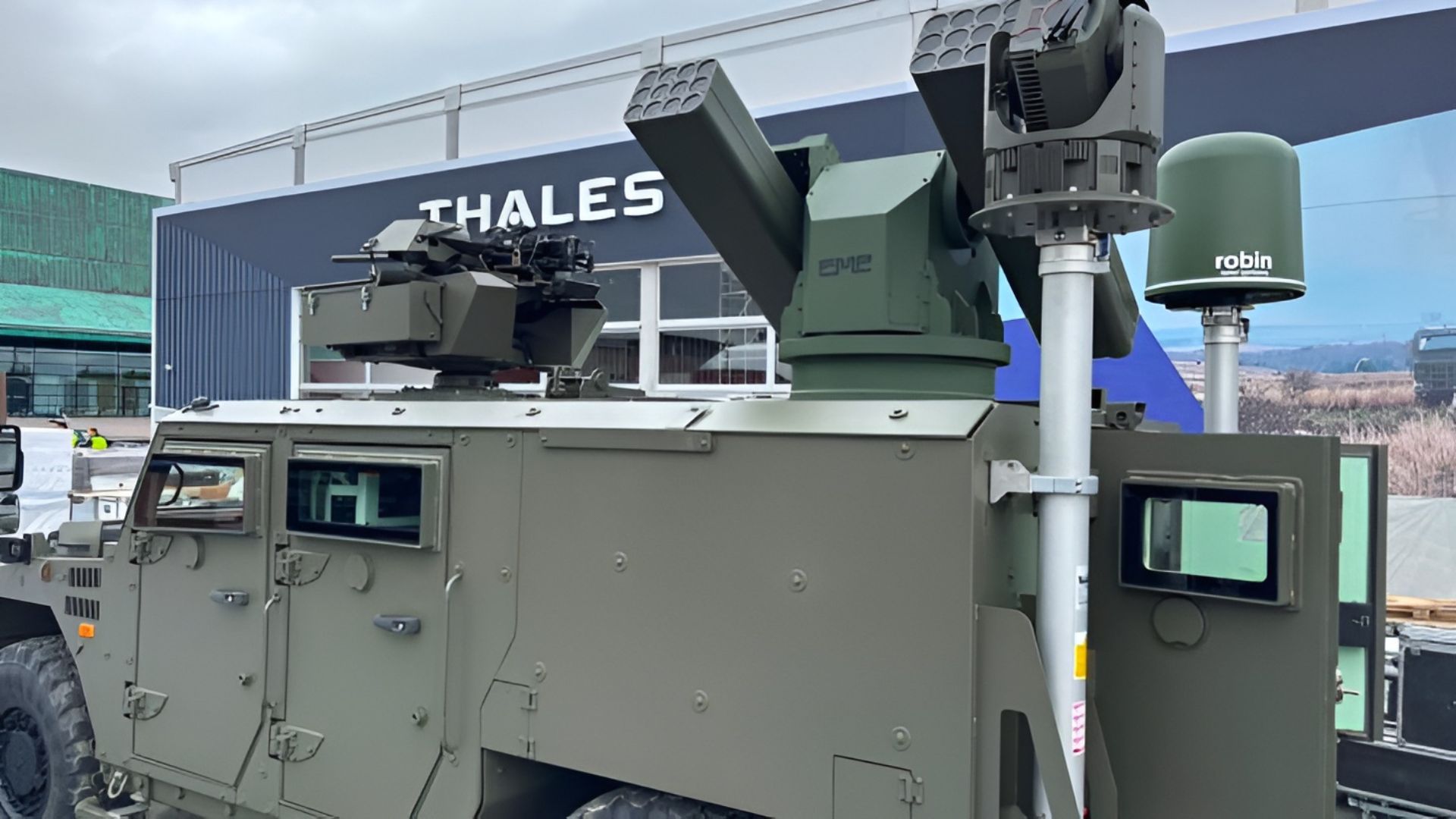
As militaries scramble to adapt to the rapid spread of battlefield drones, Thales has unveiled RapidStriker, a mobile air defense system designed to hunt and destroy aerial threats within seconds. Introduced at the Eurosatory defense exhibition in France, the new capability combines sensors, automated fire control and multiple weapon options in a package built to move alongside frontline forces.

RapidStriker can engage more than just drones. The system also provides protection against low-flying helicopters operating close to frontline forces.

Countering drone surge

Rather than relying on a single weapon, RapidStriker gives operators several ways to engage a target. The system pairs its sensors with automated fire control before cueing the most suitable effector for the mission.

Operators can deploy guided or unguided 68 mm and 70 mm rockets. Small-caliber cannons and remotely operated munitions can also be integrated depending on operational needs.

According to Thales, RapidStriker can identify a threat within seconds of detection before maintaining a track and initiating an engagement sequence. The heavy use of automation reduces the burden on crews during high-pressure situations.

That speed has become increasingly important as armed forces confront swarms of inexpensive drones designed to overwhelm conventional defenses. The rocket systems add another layer of flexibility. Beyond counter-drone missions, they support precision strikes against ground targets and provide saturation fire when troops require broader area effects.

Bushmaster upgrade

Thales designed RapidStriker to work across multiple combat vehicles instead of confining it to a dedicated platform. At Eurosatory, the company demonstrated the capability aboard the newly unveiled Bushmaster 5.6 utility vehicle from Thales Australia.

Bushmaster Mulga variant. Credit – Thales

Known as the Mulga variant, the latest Bushmaster builds on a platform already proven in combat. The vehicle can accept different mission packages based on customer requirements. One operator may prioritize surveillance equipment, while another may choose missile launchers or electronic warfare payloads.

The redesign also introduces a left-hand-drive configuration aimed at overseas buyers. Thales says the upgraded Bushmaster better reflects the realities of modern warfare, where adaptability often matters as much as protection.

Bigger network

RapidStriker was developed to plug into wider air defense architectures rather than function as a standalone asset. The company says the system remains fully compatible with SkyDefender, Thales’ integrated air and missile defense network. That interoperability allows commanders to share information across multiple assets and build a more complete picture of the battlespace.

“With RapidStriker, Thales takes a decisive step forward in the fight against drones,” Julien Assoun, vice president of Vehicles and Tactical Systems at Thales, said in a statement. He said the company moved from concept to delivery within months to address urgent operational demands. The resulting system can also be adapted for use across a broad range of combat vehicles.

RapidStriker marks the latest addition to Thales’ expanding counter-drone portfolio. Earlier at Eurosatory, the company introduced a next-generation 70mm laser-guided rocket developed specifically for anti-drone missions. Together, the launches signal a growing emphasis on affordable defenses against threats that increasingly define today’s battlefield.

  •  

Belgium unveils low-cost laser-guided rocket with proximity sensor for drone hunts

Countering small drones has become as much a financial challenge as a military one. Armed forces increasingly find themselves using costly interceptors against targets that are cheap to build and easy to deploy. Thales says its newest guided rocket was developed to restore that balance.

The company has unveiled the LGR275 Proxy, a 70mm laser-guided rocket designed specifically to intercept small unmanned aerial systems. Unlike traditional air defense interceptors, the new weapon aims to bring down drones without imposing unsustainable costs on military budgets.

Designed for drone hunts

At the heart of the LGR275 Proxy is a proximity sensor designed to improve engagements against aerial targets, adding a new capability to Thales’ established 70mm guided rocket family.

Instead of relying solely on direct impact, the sensor increases the chances of neutralizing fast-moving drones by triggering the rocket at the optimal moment. Thales paired the sensor with a military-grade warhead engineered to engage smaller airborne threats.

The result is a weapon designed to strike a balance between effectiveness and affordability. Modern militaries often deploy expensive missiles against low-cost drones. That mismatch can drain inventories and stretch defense spending during prolonged operations. Thales says the LGR275 Proxy addresses that problem by offering a more economical interception option.

The rocket supports both surface-to-air and air-to-air missions, giving commanders greater flexibility in how they deploy it. Forces could integrate the system into layered defense networks to engage threats before higher-end interceptors become necessary.

Class 1 and Class 2 drones have emerged as some of the most persistent threats on contemporary battlefields. They conduct reconnaissance missions, direct artillery fire, and carry explosive payloads. Their low cost and widespread availability make them difficult to counter using traditional methods alone.

Production set to expand

Thales Belgium plans to significantly increase the output of its guided rocket family over the next several years. The company expects production capacity to triple between 2026 and 2028. It also intends to strengthen its industrial footprint to support international customers seeking faster deliveries and dependable supply chains.

The production ramp-up reflects growing global demand for counter-drone capabilities. Recent conflicts have shown how quickly drone attacks can overwhelm traditional defenses and deplete interceptor stockpiles.

For defense manufacturers, production capacity has become almost as important as technical performance. Armed forces increasingly seek suppliers that can deliver at scale while maintaining consistent quality and shorter lead times.

Part of a broader shield

The LGR275 Proxy will also reinforce SkyDefender, Thales’ multi-layered Integrated Air and Missile Defence architecture. By adding a lower-cost interception layer, the company aims to provide customers with more sustainable protection against evolving aerial threats. Layered defenses allow operators to match the right weapon to the right target rather than relying on a single interceptor type.

Alain Quevrin, Country Director for Thales Belgium and Luxembourg, said the company developed the new rocket to help nations strengthen their readiness against the expanding drone threat.

He said Thales Belgium remains a leading producer of NATO-standard rockets and noted that the planned production increase would help meet the operational requirements of armed forces facing increasingly complex security environments.

  •  

US achieves world’s first end-to-end conversion of cow manure biogas into jet fuel

A California startup says it has found a cheaper way to turn an overlooked farm waste product into sustainable aviation fuel, potentially opening a new pathway for airlines racing to meet emissions targets.

Circularity Fuels announced it has completed what it describes as the world’s first end-to-end conversion of raw agricultural biogas into sustainable aviation fuel (SAF). The six-month pilot transformed methane-rich gas from a California dairy farm’s manure digester into jet fuel that meets ASTM standards for commercial aviation.

The achievement could reshape the economics of SAF production. The company estimates that commercial plants using its technology would cost roughly one-fifth as much as comparable facilities currently being developed in Europe.

Turning waste into fuel

The demonstration took place at a dairy farm near Madera, California, home to more than 5,000 cattle. Like many operations across the country, the farm produces biogas through manure digesters. Much of that gas often goes unused or gets released into the atmosphere.

Circularity’s system converts that waste stream directly into aviation fuel on-site. According to the company, the pilot operated continuously for thousands of hours using untreated biogas composed of roughly 65 percent methane and 35 percent carbon dioxide. The process produced finished jet fuel that can blend with conventional Jet-A fuel at concentrations of up to 50 percent.

The system combines two modular reactors designed for distributed deployment. An electrified bi-reforming reactor converts the raw gas into synthesis gas, while a compact Fischer-Tropsch reactor transforms it into liquid hydrocarbons suitable for aviation use.

Circularity said its reforming unit achieved methane conversion rates above 98 percent and carbon dioxide conversion rates exceeding 90 percent during testing.

Lower-cost SAF pathway

Sustainable aviation fuel remains in short supply worldwide. Current production satisfies less than one percent of global demand. Most SAF today relies on used cooking oil as feedstock.

Critics argue that supply constraints and import dependence limit its long-term potential. Alternative approaches, such as power-to-liquid e-fuels, also face economic hurdles due to rising electricity costs. Circularity believes agricultural biogas offers a more practical option.

The company projects commercial installations could cost less than $100,000 per barrel per day of installed capacity. Those economics could allow SAF derived from dairy waste to compete directly with fossil-based jet fuel prices. “The hard part of this industry was never designing a theoretical plant that could make SAF,” said Dr. Stephen Beaton, founder and chief executive officer of Circularity Fuels. “It was proving you could do it continuously, from real biogas, at a cost that pencils.” He added that the company has now demonstrated the technology using “real feedstock from a real dairy farm.”

Carbon-negative potential

Circularity’s internal life-cycle analysis suggests the fuel could achieve a carbon intensity score of negative 350.7 grams of CO2 equivalent per megajoule under California’s regulatory framework. That figure stems from capturing methane that would otherwise escape into the atmosphere. Methane traps significantly more heat than carbon dioxide over shorter timescales.

Craig Hartman of Hartman Engineering said dairies have long lacked practical ways to monetize biogas without investing heavily in gas-cleaning infrastructure. “Circularity is the first team I’ve seen take raw biogas straight from a digester and turn it into finished jet fuel on-site,” Hartman said.

Following the successful pilot, Circularity plans to begin construction on its first commercial facility in 2027. The company is targeting dairy and agricultural regions across the United States while also exploring opportunities in Latin America and Europe.

  •  

US Air Force B-52 bomber crashes after takeoff, shutting down Edwards airfield

A US Air Force B-52 Stratofortress crashed shortly after takeoff from Edwards Air Force Base in Southern California on Monday, sending a towering plume of black smoke over the desert installation and triggering a large-scale emergency response.

The bomber went down at about 11:20 a.m. local time at the base, located roughly 100 miles northeast of Los Angeles in the Mojave Desert. Officials have not said how many people were aboard the aircraft or whether anyone survived.

Video captured by local news helicopters showed smoke continuing to rise from the crash site hours later. The area near the runway appeared heavily scorched, with blackened ground marking the impact zone. Few recognizable pieces of the aircraft could be seen from the air. The cause of the crash remains unknown.

Emergency response continues

Edwards Air Force Base said emergency crews rushed to the scene immediately after the aircraft went down. In an initial statement, the base said the situation remained ongoing and that additional details would be released as they became available.

🇺🇸 A US Air Force B-52 bomber crashed shortly after takeoff from Edwards Air Force Base in California. pic.twitter.com/G56SEDLkkS

— PAryan 8🪽8 (@RebelGoy88) June 15, 2026

Officials later posted an update on X, saying the installation had shut down its airfield while first responders carried out rescue and recovery operations. Aircraft headed to Edwards were diverted elsewhere, and the base suspended all non-commercial visitor passes until further notice.

Update- 12:48 PDT: The airfield has been closed, and all inbound aircraft are being diverted.

All non-commercial visitor passes have been suspended until further notice to allow the installation to focus entirely on emergency response operations.

— Edwards Air Force Base (@EdwardsAFB) June 15, 2026

A spokesperson for the installation declined to provide additional details from local media as authorities focused on the response effort. Investigators are expected to examine the wreckage, maintenance history, and flight information to determine what led to the accident.

Questions surround crew

The Air Force has not identified the crew members involved or disclosed their condition. The B-52H typically operates with a five-person crew consisting of pilots and specialized officers responsible for navigation and electronic warfare duties.

As news of the crash spread, lawmakers offered support to those affected. Rep. Jay Obernolte, whose district includes Edwards Air Force Base, said he and his wife were praying for everyone involved, including the crew, their families and the first responders working at the scene. Rep. Lisa McClain also expressed support, saying her prayers were with those impacted by the crash.

My prayers are with everyone involved in the B-52 crash at Edwards Air Force Base this afternoon. Thank you to the emergency crews responding right now. Our service members carry the weight of this nation’s defense every single day. We are with them.

— Chairwoman Lisa McClain (@RepLisaMcClain) June 15, 2026

Aging bomber fleet

The B-52 Stratofortress first entered service in the 1950s and remains one of the oldest aircraft still flying in the US military inventory. The Air Force currently operates 76 B-52H bombers. Despite their age, the aircraft continue to fly operational missions and have undergone repeated modernization efforts.

Monday’s incident marks the most serious B-52 accident in years. The last fatal crash involving the bomber occurred in 2008, when six Air Force personnel died after a B-52 crashed near Guam during preparations for a ceremonial flyover.

Boeing stopped building the aircraft in 1962, meaning the Air Force can no longer replace lost bombers with newly manufactured airframes. For now, investigators remain focused on the immediate task of understanding what happened at Edwards Air Force Base and determining the fate of those aboard the aircraft.

  •  

New sub-450-gram mini drone system sustains autonomous surveillance despite GPS jamming

As armies look for ways to keep soldiers under armor while maintaining constant awareness of the battlefield, Teledyne FLIR Defense has introduced a micro-drone system designed to do both.

Unveiled at the Eurosatory defense exhibition in Paris, the Black Recon system enables troops to send out small reconnaissance drones from military vehicles and fixed installations while remaining under protection. The same platform retrieves the aircraft after each mission and prepares them for their next deployment.

The launch reflects a broader shift in military technology. Armed forces increasingly want autonomous systems that can shorten decision cycles, extend reconnaissance beyond line of sight, and continue operating in electronic warfare environments where GPS signals and communications links face disruption.

Keeping troops protected

At the center of Black Recon is a docking station that houses and supports up to three micro-unmanned aircraft. Rather than relying on a single drone and human operators in the field, the system cycles aircraft through missions. One drone can conduct reconnaissance while another recharges, creating what Teledyne describes as near-continuous intelligence, surveillance and reconnaissance coverage.

Each aircraft launches autonomously, carries out reconnaissance and target acquisition tasks, then returns to the vehicle or installation for capture and recharging before the next sortie begins. The approach could prove particularly valuable for mechanized units operating in contested environments where even brief exposure outside a vehicle carries risk.

“Black Recon represents a major step forward in integrated reconnaissance for ground forces,” said Dr. JihFen Lei, president of Teledyne Defense and Aerospace Group and senior vice president of Teledyne Technologies.

Lei said integrating launch, recovery, and recharging capabilities directly into military platforms gives operators persistent situational awareness while speeding access to intelligence and improving force protection during fast-moving operations.

Built for contested skies

The system was designed specifically for mounted operations instead of being repurposed from equipment meant for troops on foot. Teledyne said each drone weighs less than 450 grams and can stay aloft for about 50 to 60 minutes. The aircraft can also travel at speeds of up to 25 meters per second, extending surveillance beyond traditional engagement ranges.

Black Recon mini-drone system swapping. Credit – Teledyne FLIR Defense

Black Recon also targets one of modern warfare’s growing challenges: operating in electronically contested environments. The company said the drones can continue missions in GPS-denied conditions using advanced sensors and visual navigation systems. Visual inertial navigation also enables radio-silent operations without depending entirely on traditional radio-frequency links.

Additional capabilities include onboard relay functions to extend communications coverage and compatibility with the Black Hornet 4 nano-drone, which is already in service with several military customers.

The company also said the system can support thermal and visible imaging payloads, providing troops with real-time imagery and targeting data during operations.

Beyond reconnaissance missions

Although Teledyne developed Black Recon with military users in mind, the company said the technology could eventually support public safety missions, including border security, critical infrastructure monitoring and maritime patrol operations.

The platform’s modular design also leaves room for future payloads. Planned additions include chemical, biological, radiological, and nuclear detection sensors, as well as lethality modules that could expand the system’s role beyond surveillance.

Black Recon is available for order now, with customer deliveries expected to begin in 2027. The launch comes as defense companies race to develop autonomous systems capable of maintaining battlefield awareness while reducing the burden and risk placed on human operators.

💾

Teledyne FLIR unveils Black Recon micro-drone system, which lets vehicles deploy, recover, and recharge compact UAVs without exposing crews.
  •  

Scientists forge 24,000-atom mini universe that generates time without a single clock

What if time isn’t woven into the fabric of reality at all? A new experiment suggests that the past-to-future march we experience every day could arise from the internal dynamics of a system. Using 24,000 ultracold atoms, scientists built a “mini universe” that allowed them to study how time might emerge without relying on clocks.

The findings, published in Physical Review Research, offer researchers a new way to test ideas that have long remained in the realm of theory. The setup could help scientists explore quantum gravity, the origins of the universe, and the fundamental nature of time inside a laboratory.

Building a mini cosmos

Professor Giovanni Barontini of the University of Birmingham and his team created the miniature universe using a cloud of 24,000 ultracold atoms. The atoms existed just billionths of a degree above absolute zero.

Experiment to trap and cool rubidium atoms close to absolute zero. Credit – University of Birmingham

The researchers confined the particles inside an isolated quantum system. They then used two laser beams to form a thin barrier that divided the setup into two regions. One region remained observable, or “bright.” The other stayed hidden from direct observation and became the “dark” sector.

Inside this simplified cosmos, the bright region repeatedly expanded and contracted. The cycle resembled theoretical versions of a Big Bang followed by a Big Crunch, a scenario in which the universe’s expansion eventually reverses.

Because the system remained sealed from its surroundings, scientists reconstructed the sequence of events using only changes occurring within the mini-universe. They did not need an external laboratory clock.

Time through disorder

The experiment points to a concept known as “entropic time.” Rather than treating time as an independent backdrop to reality, the researchers linked its passage to changes in entropy, or the way particles spread through the system. Atoms moved between the bright and dark regions, altering the distribution of matter.

As those distributions evolved, the system moved forward in time. When the arrangement stopped changing, time effectively stood still. The team found that this version of time flowed in a consistent direction. It also correctly ordered events, even during repeated cycles of expansion and contraction. Its pace could speed up or slow down depending on how entropy shifted within the system.

“In some theories of the universe, especially quantum gravity, time doesn’t appear as a built-in feature,” Barontini said. “Yet in everyday life, time flows from past to future. Why is this so, when most basic laws of physics work the same way forwards and backwards?”

Bringing cosmology to the lab

Barontini said the study provides controlled experimental evidence that changes within a system can define time without relying on an external clock. “It offers new insight into the nature of time in quantum gravity,” he said. “It could be used to describe dynamics just as effectively as conventional time.”

The researchers also showed that quantum mechanics remains mathematically consistent under this framework. They rewrote a version of the Schrödinger equation using entropic time, allowing predictions about how a quantum probability distribution evolves.

The work addresses a long-standing puzzle in physics: If the universe has no fundamental clock, how can events be arranged into a meaningful sequence of “before” and “after”? Perhaps more importantly, the experiment transforms abstract debates into testable science.

The platform could eventually allow researchers to investigate conditions linked to the early universe, probe competing theories of quantum gravity, and even simulate black holes under controlled laboratory conditions.

For decades, many of these questions existed mainly on chalkboards and in complex equations. This miniature universe suggests physicists may finally have a way to put some of them to the test.

  •  

UK trials compact G-size sonobuoy built for autonomous drones hunting submarines

Ultra Maritime has completed the first in-water deployment trial of its next-generation Multistatic Active Receive Sonobuoy, or MSARS, in Scotland, marking a major step in the United Kingdom’s push to modernize anti-submarine warfare.

The trial comes as NATO nations monitor growing submarine activity across the North Atlantic. Military planners increasingly seek tools that can detect quieter submarines and unmanned underwater systems operating over larger maritime areas.

MSARS aims to strengthen those capabilities. The compact sonobuoy is designed to improve the detection and localization of underwater threats while supporting both crewed and uncrewed operations.

Expanding underwater surveillance

Ultra Maritime developed the system with backing from the UK’s Defence Science and Technology Laboratory, known as Dstl. The effort supports the Atlantic Bastion program, which focuses on expanding autonomous anti-submarine warfare capabilities. The initiative seeks to bring uncrewed aircraft into submarine hunting missions while improving coordination with existing crewed assets. Those assets include the Royal Navy’s Merlin Mk2 helicopter fleet.

Unlike traditional approaches that rely heavily on crewed aircraft, Atlantic Bastion emphasizes distributed operations. Multiple platforms can share information and work together to track underwater targets across wider areas. The company said rising submarine activity has increased the urgency for improved detection technologies.

“Enhanced detection and localization of threat submarines and unmanned underwater vehicles are critical to maintaining operational advantage,” Ultra Maritime said. MSARS gives operators flexibility before deployment. Crews can configure mission settings through a built-in digital interface before launching the sonobuoy from an aircraft.

Integration with SeaGuardian

Ultra Maritime is also working with General Atomics to integrate MSARS and other G-size sonobuoys onto the MQ-9B SeaGuardian unmanned aircraft. The pairing could significantly expand anti-submarine warfare coverage.

SeaGuardian’s endurance allows it to remain on station far longer than many traditional platforms. Combined with compact sonobuoys, operators could survey larger sections of ocean without increasing crew requirements.

Ultra Maritime says the integration would extend operational reach, increase sonobuoy carrying capacity, and support distributed multistatic operations in contested environments. The company also noted that it remains the only manufacturer producing G-size sonobuoys. Their smaller form factor makes them particularly suited for unmanned aircraft missions.

Broader sonobuoy push

The Scottish trial arrives as Ultra Maritime expands its sonobuoy business through production contracts and international partnerships. Earlier this year, the company secured a U.S. Navy contract covering low-rate initial production of the AN/SSQ-125B sonobuoy. The system aims to improve the detection of increasingly quiet submarines operating in challenging acoustic conditions.

Ultra Maritime has also expanded its presence in Europe. In 2025, France selected the company to provide active and passive sonobuoys under a contract awarded by Thales on behalf of the country’s defense procurement agency.

For defense planners on both sides of the Atlantic, the latest MSARS milestone represents more than a successful trial. It highlights a broader shift toward networked and increasingly autonomous anti-submarine operations designed for a more contested maritime environment.

  •  
❌