An anonymous reader shared this report from the Associated Press:
Officials in Kansas City, Missouri, are preparing to equip cameras on some public buses with facial recognition software capable of identifying passengers who appear on a list of banned riders or missing persons. Supporters and opponents alike view the effort as a major litmus test for tapping the AI-powered software on a U.S. public transportation system, positioning Kansas City as the latest epicenter of a fierce debate over whether the safety benefits of artificial intelligence are worth the privacy costs.
"The idea of running face recognition on a camera that is pointed on live spaces in public is a line that until recently has never really been crossed in the last 25 years," said Jay Stanley, senior policy analyst for the Project on Speech, Privacy and Technology at the American Civil Liberties Union. The state of Missouri declined to help fund the project as expected due to concerns with the facial recognition component. Still, the city is pushing ahead with local and federal money, said Tyler Means, chief mobility and strategy officer at the Kansas City Transportation Authority. "Privacy is always a tricky thing," Means said. "We've always had cameras on our buses. It's just new technology. I think in time it'll smooth over and people will realize, 'Well, it didn't really feel any different'...."
Images captured by cameras aboard the buses would immediately be checked against any active alerts, generated when a missing person, banned rider or someone on a law enforcement watch list designated by the transportation authority is identified... After the buses return to the depot, the transportation authority would archive the regular video footage on a local server for up to five years.
The company partnering with Kansas City to run the cameras "started using live facial recognition years ago to alert nursing homes when residents left the building," according to the article, and then "brought the technology to correctional institutions and schools." But this is its first attempt at bringing its cameras onto public transportation.
The article also includes this quote from Will Owen, communications director for the Surveillance Technology Oversight Project. "City residents should not be guinea pigs for transit systems to test Silicon Valley's latest unproven, biased surveillance tech."
Age verification is consuming the Internet. From social media bans in Australia to porn restrictions in half of US states, for many having to prove their age to access websites is becoming an everyday requirement. But one of the key technologies underpinning many of these age checks is about to seep into the offline world—with potentially life-changing consequences for people having their age predicted by AI.
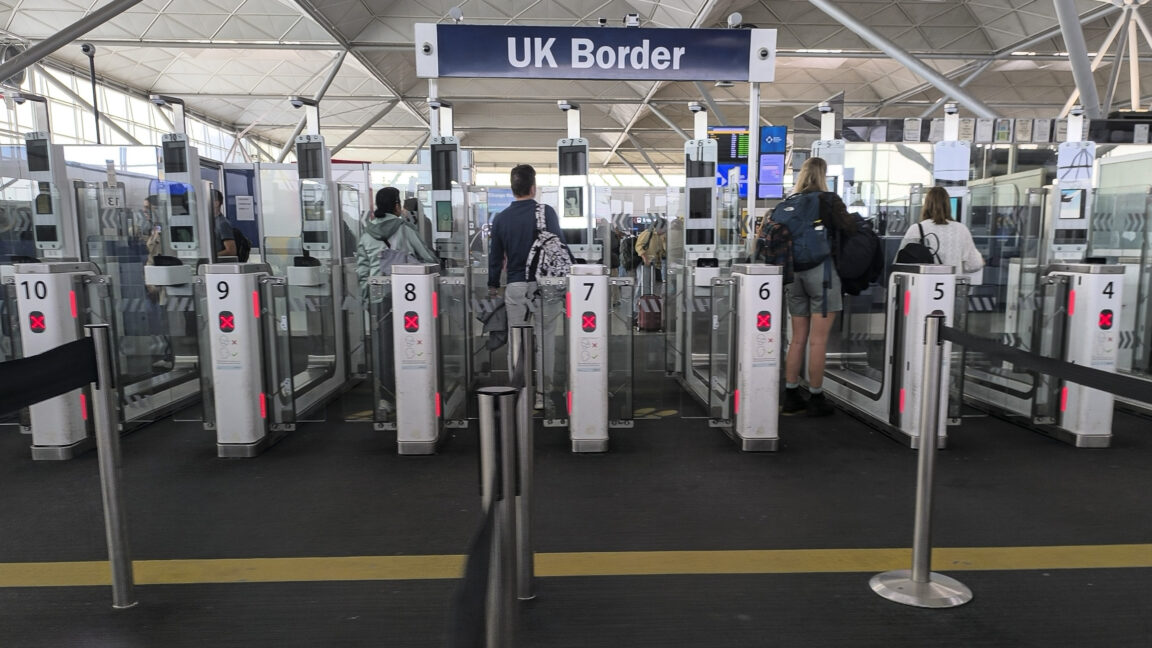
Starting next year, the British government is planning to introduce facial age estimation—where AI scans your face and suggests how old you are—to help determine the age of asylum seekers arriving at the United Kingdom’s border. The move is believed to be the first time that a so-called facial age estimation (FAE) system has been used in this way. Many asylum seekers arriving in the UK will not have documents proving their age, and if children are incorrectly classed as adults, they can be stripped of some legal protections and placed in adult-only detention centers.
An investigation by WIRED and Lighthouse Reports, in collaboration with The Independent, has obtained an internal UK government report detailing its tests of FAE technologies. It shows how the systems regularly mistake children for adults and appear to contain serious bias problems, which directly impact the largest group of migrants subject to age assessments in 2025, according to data from the Home Office. The investigation raises questions about the effectiveness of the technology and whether it should be deployed in such high-stakes scenarios.
Artist Morry Kolman will be livestreaming feeds of the NBA champions’ ticker-tape parade from NYC’s traffic cameras—and this time, the city’s Department of Transportation isn’t demanding he stop.
Reuters reports a cyber extortion group has claimed responsibility for breaching Novo Nordisk's network, stealing roughly 1.3 terabytes of data, including source code, drug research, clinical-trial records, employee and physician information, production-system details, and internal AI model data. The group says it's exploring selling parts of the data after unsuccessfully demanding $25 million from the company. From the report: FulcrumSec, a cyber extortion group that emerged in October 2025, said in a long message posted to its website that it spent more than two months in Novo Nordisk's networks stealing data. It said that data included company source code, proprietary information on released and unreleased drugs, trial data, employee, doctor and patient data, information related to company processing facilities and internal AI model information.
[...] FulcrumSec told Reuters in an email that Novo Nordisk representatives contacted the group on June 3, roughly 48 hours after the group's initial contact to unnamed company executives. The company used a random Proton Mail email address sent to email addresses that FulcrumSec used in its initial outreach, and confirmed it was the company by requesting specific files for verification only the company would know about.
The FulcrumSec representative also said that the group would prefer not to sell data, "as open sourcing it is a more effective deterrent for future companies to avoid paying." [...] FulcrumSec said it would not share some of the data it stole, including information on thousands of company employees and physicians, and roughly 11,500 pseudonymized clinical trial patients. The group said it also would withhold data related to operational technology and software used to interact with sensors and machinery at Novo Nordisk production facilities as part of its "harm-reduction strategy." A Novo Nordisk spokesperson said in an email that the company "is aware of claims that data allegedly copied externally without authorization from our systems has been published online. We take this matter seriously and maintain continued operations of our main platforms. We are in contact with the relevant authorities."
In a groundbreaking development addressing the burgeoning concern of privacy in modern medical technology, researchers at the University of Kansas have unveiled a transformative artificial intelligence (AI) model designed specifically to safeguard sensitive biometric data embedded within electrocardiograms (ECGs). This innovation is poised to reshape how medical institutions share and analyze vital cardiovascular data without compromising patient confidentiality. Electrocardiograms have long been renowned for their role in capturing the heart’s electrical activity to diagnose and monitor cardiac health; however, as AI integration deepens, these signals inadvertently reveal more than just clinical information — exposing personal attributes such as sex, age, race, and even uniquely identifiable biometric markers.
The research team at Kansas, led by doctoral candidate Fairuz Shadmani Shishir in collaboration with the KU Medical Center, has pioneered the privacy-preserving variational autoencoder (PP-VAE). This novel AI architecture is specially engineered to retain the clinical utility of ECG data while systematically obfuscating sensitive biometric features that might otherwise be inferred through advanced AI analysis. The dual objective of PP-VAE is both technically sophisticated and ethically imperative, ensuring that predictive diagnostic accuracy remains uncompromised while minimizing the risk of privacy breaches inherent in sharing raw biomedical signals.
Electrocardiograms, traditionally viewed as a straightforward diagnostic tool, have grown in complexity with modern AI techniques that can extrapolate a multiplicity of patient traits beyond the cardiovascular parameters they were designed to measure. Shishir notes that these advanced systems can uncover “soft biometrics” such as demographic information, which raises pressing data governance and patient privacy challenges. By developing PP-VAE, the researchers aim to reimagine ECG data processing whereby sensitive attributes are masked without degrading the signal quality necessary for important medical prognoses, such as identifying patients at risk of left ventricular ejection fraction (LVEF) abnormalities, a critical indicator linked to heart failure and mortality risk.
The technical underpinning of PP-VAE involves training independent convolutional neural networks to disentangle and suppress identifiable biometric markers while preserving clinically relevant features within the ECG signal. This balancing act required careful engineering to ensure that the encoded ECG data remained diagnostically rich, capable of supporting predictions related to conditions such as left ventricular hypertrophy and forecasting five-year mortality risk. The research showcased that their method consistently outperformed or competed with other state-of-the-art AI models, marking a significant stride in machine learning’s ability to harmonize privacy with clinical efficacy.
Importance of such privacy-preserving strategies becomes particularly clear against the backdrop of the healthcare industry’s increasing reliance on data sharing for collaborative research, AI model development, and multi-institutional patient care coordination. The KU team articulates that unrestricted data sharing without privacy controls introduces tangible risk vectors for patient re-identification and misuse. PP-VAE proposes a scalable approach toward enabling secure exchange of ECG data, thus fostering innovation and improving medical outcomes while staunchly protecting individual privacy rights.
This research also touches on the profound issue of bias within AI-driven medical diagnostics, which has historically contributed to disparities in healthcare delivery among marginalized populations. The team consciously incorporated balanced datasets reflective of gender and racial diversity in their model training to mitigate bias and improve generalized performance across varied demographic groups. While initial validations were primarily conducted using data from KU Medical Center and publicly available datasets, future work is projected to expand this cross-regional training, enhancing the robustness and impartiality of the model when applied globally.
Another compelling facet of this breakthrough is the planned public release of the PP-VAE model, reflecting the researchers’ commitment to transparency, collaboration, and democratization of AI tools in medicine. By allowing institutions worldwide to access and further refine the model with local datasets, the innovation promises to catalyze a new era of secure, privacy-conscious healthcare analytics. Adoption of PP-VAE could alleviate prevalent trust issues among patients concerned about the confidentiality of their biometric health information—a critical barrier to broader acceptance of AI-driven healthcare technologies.
Furthermore, the researchers discuss the broader implications for data-driven diagnosis, illustrating how balancing the protection of sensitive attributes with clinical utility could become a standard principle in biomedical AI applications beyond cardiology. This approach offers a blueprint for addressing ethical and privacy challenges that increasingly pervade the intersection of health data science and artificial intelligence.
The University of Kansas team’s work is also distinguished by its multidisciplinary nature, featuring collaboration between electrical engineering, computer science, and cardiovascular medicine experts. Such an integrated approach enabled the synthesis of advanced machine learning expertise with intimate clinical insight, culminating in a pragmatic solution tailored precisely to real-world healthcare needs.
This pioneering study was recently published in Scientific Reports, showcasing detailed methodology, experimental evaluations, and comparative performance analyses that underscore the efficacy and potential transformative impact of PP-VAE. Supported by the American Heart Association, this research is an exemplar of innovative technological stewardship addressing one of the most pressing challenges in digital health.
As AI continues to proliferate across medical diagnostics, models like PP-VAE will undeniably play a critical role in shaping ethical frameworks and technological architectures for future patient data management. By protecting sensitive biometric identifiers embedded in ECG data, the model not only preserves patient autonomy but also enhances the potential for AI-driven insights to be safely harnessed for better clinical outcomes worldwide.
The journey ahead involves validating and deploying this technology in diverse healthcare environments globally to ensure scalability, efficacy, and fairness remain intact as data heterogeneity increases. Yet, with the foundational work from the University of Kansas, a robust and privacy-conscious approach to ECG analysis and beyond appears well within reach, heralding a new era of secure AI-driven cardiovascular care.
Subject of Research: Privacy-preserving AI models for electrocardiogram data analysis Article Title: Safeguarding Patient Privacy in Electrocardiogram Analysis with AI-driven Models Web References: Scientific Reports Article Image Credits: Fairuz Shadmani Shishir / University of Kansas
Keywords
Privacy-preserving AI, Electrocardiogram (ECG), Variational Autoencoder, Convolutional Neural Networks, Biomedical Data Security, Cardiovascular Diagnostics, Left Ventricular Ejection Fraction, Patient Privacy, Machine Learning Bias, Medical Data Sharing, Artificial Intelligence in Healthcare, Clinical Decision Support
More than 200 of the world's elites registered for a retreat whose agenda runs from panels on cult-building and sex to prepping for World War III. An associated app offers matchmaking.
There's a simple way to do age verification checks online which respect privacy without spending millions on another failed government IT project. So obviously we won't do it, says Phil Hendren.
alternative_right shares a report from The Hill: The FBI released an urgent security warning to the public about a fast-acting scam targeting Microsoft 365 users on Teams, Outlook and OneDrive. The agency warned that the hacking platform Kali365 seeks out OAuth device codes, allowing scammers to sneak past multi-factor authentication codes, and without the need for a password, to access Microsoft accounts. Scammers will send a phishing email impersonating a trusted document-sharing service with a device code and instructions on how to verify, according to the FBI.
"Kali365 lowers the barrier of entry, providing less-technical attackers access to AI-generated phishing lures, automated campaign templates, real-time targeted individual/entity tracking dashboards, and OAuth token capture capabilities," the FBI stated. The platform is sold to scammers with a $250 per month subscription. The FBI, which first detected Kali365 in April, described the hacking platform as an "emerging Phishing-as-a-Service platform." Hackers with limited skills can access advanced phishing tools through the platform, according to NordPass.
Roblox's vice president of safety product policy, Eliza Jacobs, told NBC News that Roblox is "optimistic" that its new facial age estimation tech will "continue to get better," saying, "Ticking a box to say you're 13 or older, it's not enough anymore." NBC invited a group of kids to try out Roblox's new video selfie age check process, but they weren't able to get around it with a fake mustache. Jacobs claims Roblox's facial age estimates can typically land "within 1.4 years of a child's exact age."
Roblox announced plans in April to begin using its video selfie age estimation tech to sort players into age brackets. Users under 16 and unde …
Rank One, whose board includes a former CIA deputy director and a former FBI science chief, supplied face recognition to Meta for internal development of its smart glasses app.
Several trends are now converging that threaten to pit tech companies against the general public.
Miniaturization has finally enabled companies to build AI glasses that look and function like normal glasses, but with microphones and cameras. People are increasingly talking to AI, rather than typing. And multimodal input, especially video, is on the rise.
Put all of these trends together and you get a nascent industry pushing toward all-day, everyday AI glasses with cameras — and a worried public already pushing back at the idea.
Let’s look at how we got here.
Meta started it with a surprise hit: its second-generation Ray-Ban Meta glasses, which later gained multimodal AI capability. Its Meta Ray-Ban Display glasses add one in-lens screen — but both versions of the glasses have cameras. (The company is working on a third generation that will probably ship next year.)
Google provides the AI and software platform through Android XR and Gemini, partnering with hardware makers to put its AI on other companies’ glasses. At Google I/O last month, Google unveiled frames from Gentle Monster and Warby Parker running Android XR with Gemini AI; they’re scheduled to launch this fall. Google is working on two types of AI glasses, one with screens and one that is audio-focused. Both types have cameras, though.
Samsung is working to launch AI-powered smart glasses, too, code-named “Jinju.” The company offered up details at Google I/O alongside Google. The glasses feature a 12-megapixel camera with autofocus; run on Android XR with Gemini AI; are co-designed with Gentle Monster and Warby Parker; and are slated to launch in July at the Samsung Unpacked event.
(As with Meta and Google, Samsung is working on AI glasses with and without screens, but both of its models have cameras.)
Tech giant Apple is also on the glasses train, based on reporting from anonymous insiders. Codenamed N50, the Apple glasses could have two cameras, one for pictures and videos, the other for multimodal AI input and hand-gesture control. (Apple is also working on a pendant and next-gen AirPods, both of which have cameras.)
There’s Amazon, which is reportedly developing a new line of consumer AI glasses with a camera after its earlier, camera-less Echo Frames and Carrera Smart Glasses lines failed. (My guess is the problem was Alexa, not the lack of cameras.) Although its Echo Frames have been effectively discontinued — displayed as sold out online — the company is already testing AI glasses with cameras for enterprise use on hundreds of US-based Amazon drivers.
Amazon Smart Delivery Glasses
Amazon
Huawei in April launched its AI Glasses for the Chinese market — the lightweight glasses sport a dual-engine AI architecture and integration with its HarmonyOS ecosystem. It’s joined there by Xiaomi’s AI Smart Glasses, which are powered by the company’s HyperOS ecosystem and have cameras for photos and videos and for for reading QR codes.
Beyond those well-known firms, other companies are making daily-wear AI glasses with cameras in them, including XREAL, Rokid, TCL, Solos, and Brilliant Labs.
A minority of other companies is focused on glasses without cameras, including Even Realities (G1 and G2); MIRA (MIRA glasses); Dymesty (Dymesty AI glasses); Lucyd (Lucyd Lyte); and Huawei (Eyewear 2).
Get the picture?
Clearly, by the end of the year, the market will be flooded with all manner of AI glasses designed for everywhere, everyday wear. They can use prescription lenses or serve as sunglasses — and most of them will have cameras built in for photos, videos and multimodal AI.
There’s just one problem: The public hates AI glasses with cameras.
Return of the ‘Glassholes’?
As we learned from Google Glass, a lot of people feel uncomfortable with a camera pointed at them while they’re talking to someone. And that backlash is back with the current generation of AI glasses.
Because Meta is the market leader in the US, its Ray-Ban Meta glasses have borne the brunt of early disaffection.
Texas Attorney General Ken Paxton recently launched a formal investigation into Meta’s AI glasses, calling them “a privacy nightmare for Texans,” claiming the devices “can easily invade personal privacy by collecting biometric data and recording Texans without their knowledge or consent.”
Paxton also claimed the LED light on the glasses, which is designed to alert others that the camera is taking pictures or videos, can be easily defeated. In fact, some modders-for-hire charge up to $100 to physically destroy the LED and TikTok videos describe how to disable or cover the light.
The pushback is happening elsewhere. Philadelphia courts banned smart Meta AI glasses with recording features from city courthouses and a petition is circulating to ban them from New York City bars and restaurants. MSC Cruise Line banned smart glasses in all public areas. And restaurants, gyms, and workplaces have begun banning smart glasses because of the camera.
Uncertainty drives some of the concern. People don’t know whether they’re being recorded, and if they are, they don’t know who will see the video. It turns out, those suspicions might be warranted.
The New York Timespublished an internal Meta memo in February describing plans to add facial recognition (“Name Tag”) to Ray-Ban Meta glasses. The memo said the “political tumult in the United States would distract critics from the feature’s release.”
Then earlier this month, WIRED discovered dormant facial-recognition code called “NameTag” hidden inside Meta’s AI companion app. The code would let Ray-Ban Meta glasses identify strangers by face, a feature Meta publicly claimed “does not exist.” Meta quietly erased the code with an update one day after the exposé was published.
A coalition of civil society organizations wrote Congress to demand that Meta abandon its Name Tag facial recognition plans, calling it a “creepy and unacceptable escalation of surveillance.” The letter warned the technology could be adopted by law enforcement to surveil immigrants, people of color, and nonviolent protesters.
On one hand, all the biggest consumer electronics companies are either shipping AI glasses with cameras in them or planning to do so — and many smaller companies are looking to do the same. The industry expects AI glasses with cameras to go totally mainstream.
On the other hand, a growing public, legal and legislative backlash has erupted in opposition to AI glasses with cameras in them.
One possible outcome is that the public disdain for the cameras will fade, overwhelmed by widespread enthusiasm for the benefits they offer. A new social norm might emerge that mirrors the broad acceptance of everybody having cameras in their phones and pointing them in random directions.
Another possibility is that companies will be forced by consumer disdain and legal action to abandon cameras in glasses and focus instead on AI glasses that can’t take pictures or use video for multimodal AI input.
A WIRED investigation found dozens of “nudified” deepfake images and videos on Grok's website, including nonconsensual depictions of celebrities and at least one prominent US politician.
Congress has failed to pass a three-week extension of Section 702 of the Foreign Intelligence Surveillance Act (FISA), with the House voting 218-198 against reauthorizing the controversial warrantless wiretapping authority through July 2nd. After a short-term extension earlier this year, the spying program now appears set to lapse for at least a week. This is the nightmare scenario FISA's proponents have been warning about - but it doesn't actually mean the US has lost its surveillance capabilities.
Proponents of a clean extension claim a lapse will hinder intelligence agencies' efforts to thwart potential terrorist attacks, with surveillan …
The new open-source project could serve as the basis for a future of apps with features as complex as Slack, Discord, or Google Docs—but with added protection against surveillance.
Heads-up, my fellow Android-appreciating animals: Google’s in the midst of rolling out a subtle change to its privacy settings that’s well worth your while to notice.
The change includes a new clause that says the company can use images, files, video, and audio from your interactions with Google Lens, Search, and Gemini Live to train and improve its AI models.
By default, that switch will soon be on and active for your account.
But with about 20 seconds of one-time effort, you can opt out and flip it off (both literally and metaphorically, if you’re so inclined) once and for all.
Lemme show ya how.
[Get level-headed knowledge in your inbox with my free Android Intelligence newsletter. Something new and useful every Friday — from my keyboard to your email.]
Google’s new AI training privacy default
First things first — the nature of the change: According to Google, starting in the next few days, a new “Search Services History” section within the general Google account settings will lead to a significant-seeming policy shift. As per an email the company sent out to users this week:
Your media [will now be] saved when Search Services History is on. Saved media includes your images, files, audio, and video from your interactions with Search services to help improve your experience. … Your saved media is also used to develop and improve Google services and technologies, including AI models and safety measures.
Riiiiiiiiiiight.
Now, to its credit, Google does say the data will never be associated with your account or identity once it’s used for these purposes, and it’ll rely on “filters” to “automatically remove a broad range of identifying info or sensitive personal information.” But still, whether you’re working with important corporate info or simply put off by the idea of your personal media being fed into the AI training machine, this may be news you aren’t exactly thrilled to hear.
If you’re finding AI increasingly creepy or you’re just not so keen on knowing whatever media you submit to search-related services will be used to train and develop AI for the future, now’s the time to proactively speak up and change your Google account settings to shut down this setup before it begins.
That, unfortunately, is where things get slightly complicated — ’cause for most of us, this new Search Services History section doesn’t seem to be present and available just yet.
But that doesn’t mean you’re plum out of luck.
Your 20-second opt-out roadmap
To start on your AI training opt-out adventure, make sure you’re signed into whatever Google account you rely on for work and/or personal purposes, then head to the Google Activity Controls page and see if you see a section there called “Search Services History.”
If you do, this is especially easy for you: Just use the option right then and there to disable the “Save Media” setting within that section, which will stop any media files from being saved and used without eliminating the entire history of things you’ve searched. (If you’d rather eliminate all of your Google Search history from being saved and used even for your own future discovery and recommendations, you can also opt to turn that entire section off. Just be aware that it may have some wide-reaching effects on the personalization you see across a lot of Google services.)
If you don’t see that section — and, again, that appears to be the case for most of us at this point — you’ve got two options for the moment:
You can completely disable all of “Web & App Activity.” Google says if you do this, once your account transitions over to the new approach, all of those “Search Services History” settings will stay off as well. Just be aware that doing so will prevent any and all search history from being saved for you from here on out — which, again, means you won’t be able to revisit your search history yourself and won’t see suggestions and personalization based on past searches throughout Google apps in the future.
If you want to avoid entirely eliminating all of your search history, you can for now uncheck the boxes only for “Include voice and audio activity” and “Include Visual Search History.” That’ll stop search-related media from being saved to your Google account for the time being — though I’d also suggest setting yourself a reminder to look back at that same page once a week or so until you see “Search Services History” appear and can confirm that “Save Media” is unchecked as a result of that previous preference. Right now, Google isn’t explicitly saying that such a preference will carry over, so I’d put it on yourself to double-check and make sure (and then make the needed adjustment in the new interface, if not).
The choice is ultimately 100% yours — but in this case, it’s up to you to take action and opt yourself out if you aren’t comfortable with the default. It’s an unfortunate position to be put in, but now you at least know what’s happening and how you can make your own decision to take back control.
Find the tips and tools that’ll *actually* help you with my free Android Intelligence newsletter. No hype, no nonsense — just useful new stuff in your inbox every Friday, from one (alleged) human to another.
Google is making some changes to how it saves your interactions with Search. In an email sent to users, Google says it will save the images, files, audio, and video you use to search under a new "Search Services History"setting.

 Login