❌

Reading view

Plus grand que le T. rex, ce dinosaure géant savait-il vraiment nager ? Voici ce que révèle une nouvelle découverte

Un os découvert au Niger en 2022 rouvre un dossier paléontologique parmi les plus épineux. Une nouvelle espèce de spinosaure vient d'être décrite dans la revue Science. Et avec elle, la question qui divise les chercheurs depuis des années refait surface : ce dinosaure géant nageait-il vraiment ?

  •  

Avast - Japan Expo 2026 : vérifier applis, liens et téléchargements avant qu’ils n’entrent sur Android

À l’occasion de Japan Expo 2026, où les visiteurs naviguent entre applications mobiles, QR codes, contenus exclusifs et téléchargements rapides, la question de la sécurité numérique devient plus concrète que jamais. Sur Android, les usages s’intensifient au rythme des recherches de programmes,...

  •  

Cancer colorectal : des virus cachés dans nos bactéries pourraient changer la donne

Depuis des années, les scientifiques soupçonnent certaines bactéries intestinales de favoriser le cancer colorectal. Mais une nouvelle étude révèle qu’elles pourraient elles-mêmes être manipulées par un acteur jusqu’ici passé sous les radars : un virus caché dans leur ADN. Une découverte qui...

  •  

113-Million-Year-Old Pterosaur Fossil Reveals What Flying Reptiles Ate

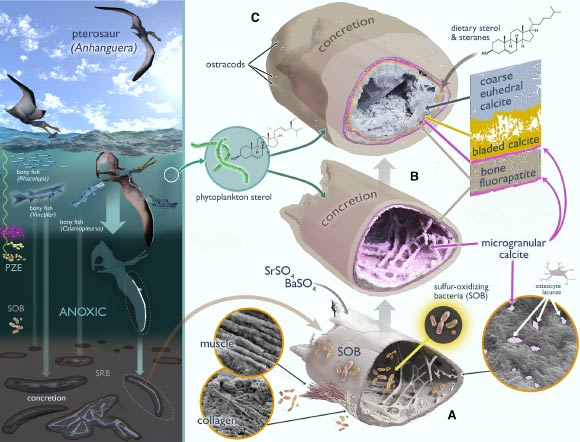
Grice et al. integrate organic geochemical analyses with high-resolution micro-mineral imaging of a three-dimensionally preserved Cretaceous pterosaur wing phalanx from Brazil to reveal steroid biomarkers and multi-stage mineralization pathways underlying its preservation. Image credit: Grice et al., doi: 10.1016/j.isci.2026.116199.

A 113-million-year-old pterosaur fossil from northeastern Brazil has yielded rare evidence of soft tissues, organic molecules and chemical traces of a diet heavy in fish and cephalopods such as squid or nautilus relatives.

The post 113-Million-Year-Old Pterosaur Fossil Reveals What Flying Reptiles Ate appeared first on Sci.News: Breaking Science News.

  •  

Earth’s First Land Animals May Never Have Been Amphibian-Like After All

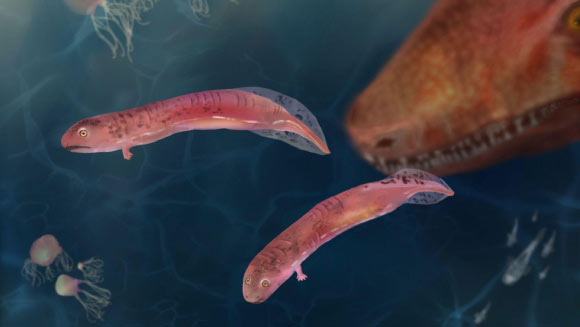
New fossil evidence suggests that embolomeres did not undergo a metamorphosis the way that modern amphibians do when growing up, which challenges a long-standing scientific belief that amphibians, reptiles, and mammals evolved from animals that had a tadpole stage. Image credit: Berit Godring.

Paleontologists from the Field Museum of Natural History have described the fossilized remains of baby embolomeres, crocodile-like predators that prowled ancient rivers and swamps between 350 and 280 million years ago.

The post Earth’s First Land Animals May Never Have Been Amphibian-Like After All appeared first on Sci.News: Breaking Science News.

  •  

AVC, infarctus : la chaleur expose davantage les femmes, et ce n’est pas un hasard

Canicules, nuits tropicales, événements extrêmes… Les conséquences du changement climatique sur la santé sont déjà visibles. Un rapport d'Oxfam met en lumière leur impact disproportionné sur certains groupes de la population.

  •  

Norton – Asteroid Day : protéger les recherches scientifiques entre vidéos, PDF et ressources éducatives

À l’occasion de l’Asteroid Day, les recherches autour de l’espace, des astéroïdes et des enjeux scientifiques attirent un public toujours plus large. Entre vidéos pédagogiques, articles spécialisés, PDF techniques et plateformes éducatives, la navigation devient dense et parfois exposée à des...

  •  

125-Million-Year-Old Crocodile Relative Reveals Its True Colors

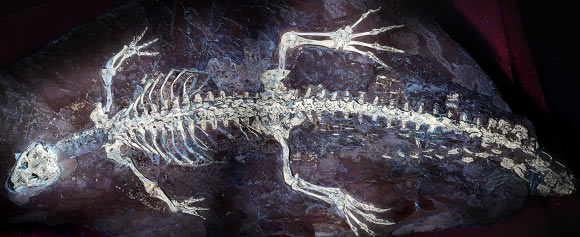
The holotype specimen of Montsecosuchus depereti. Image credit: Castillo-Visa et al., doi: 10.1093/zoolinnean/zlag076.

Exceptionally preserved skin of Montsecosuchus depereti, an extinct crocodylomorph no larger than a house cat that prowled the tropical wetlands of Early Cretaceous Spain, has allowed paleontologists to reconstruct details of its scales, sensory organs and even possible banded markings along its tail.

The post 125-Million-Year-Old Crocodile Relative Reveals Its True Colors appeared first on Sci.News: Breaking Science News.

  •  

OnePlus Pad 3 Pro ufficiale: le specifiche parlano chiaro, è il più potente visto finora

OnePlus Pad 3 Pro è un tablet che fa della potenza il suo marchio di fabbrica: presentato da poco in Cina, è senza dubbio il modello più avanzato visto finora.

CARATTERISTICHE E PREZZI DI ONEPLUS PAD 3 PRO

Il display è da 13,2 pollici, per cui OnePlus Pad 3 Pro punta su dimensioni importanti ma anche su una risoluzione di 3.392 x 2.400 pixel. Abbiamo un display LCD e la frequenza d'aggiornamento, in base all'utilizzo, può cambiare da 30 fino a 144 Hz. La luminosità raggiunge in scioltezza i 1.000 nit, mentre la copertura cromatica DCI-P3 tocca quota 98%.

La batteria poi non è affatto da sottovalutare, ma nonostante questo OnePlus Pad 3 Pro mantiene il suo spessore fermo ai 5,94 millimetri e con un peso di 672 grammi. Proprio riguardo all'autonomia, la capacità del modulo è pari a 13.380 mAh e c'è oltretutto il supporto alla ricarica rapida da 67 W.


Miglior smartphone rapporto qualità prezzo fascia media? Motorola Edge 60 Pro, compralo al miglior prezzo da Price1 a 361 euro.

CLICCA QUI PER CONTINUARE A LEGGERE

  •  

Were dinosaurs doomed before the asteroid hit?

Around 66 million years ago, an asteroid wiped out 75% of the species on Earth. This event caused the extinction of all dinosaurs except birds, referred to as non-avian dinosaurs. However, an open question in paleontology is whether the dinosaurs were already declining before the asteroid hit. Many scientists think that around 5 to 10 million years before the extinction event, dinosaurs became less biologically diverse across America, making them more prone to extinction. 

To investigate this hypothesis, scientists recently revisited fossils in a rock layer from the end of the dinosaur era that previous researchers had incorrectly dated. The bulk of the fossils from this period had previously been collected from a different section of rocks called the Hell Creek Formation in Montana. These researchers studied a rock layer in New Mexico that is exposed to the surface, known as the Naashoibito Member. It’s approximately 30 meters (about 100 feet) thick and formed from ancient river sediments. 

To determine when the Naashoibito Member formed, the scientists measured the decay of radioactive elements within its mineral grains over time, a technique called radiometric dating. The scientist reasoned that these mineral grains must have crystallized before being transported and incorporated into the Naashoibito Member, so their youngest ages should provide a maximum depositional age. 

They determined the ages of 1,046 crystals of the mineral feldspar from 2 dinosaur-bearing rock layers in the Naashoibito Member. Based on these ages, the researchers found that a sandstone within 5 meters (about 16 feet) of the lowest boundary of the Naashoibito Member must be younger than 66.9 million years old. They found that the other layer, which is around 3.5 meters (11 feet) from the base of the lowest boundary, must be younger than 66.4 million years old. These age ranges indicated that the sandstone contains dinosaur fossils formed 400,000 years before their extinction.

Next, the researchers measured the direction of magnetic minerals inside the rocks, using a practice called magnetostratigraphy. The direction of these minerals indicates where Earth’s magnetic field was pointing at that time. Scientists have shown that the Earth’s magnetic field has flipped multiple times over Earth’s history, so they can use these magnetic signals to create a timescale for when the sediments formed. 

The researchers wanted to determine whether the magnetic minerals were lined up in a direction like today, called normal polarity, or the opposite, called reverse polarity. The researchers found one rock layer with normal polarity at the base of the Naashoibito Member, and one with reverse polarity in the upper part of the Naashoibito Member. These magnetic field directions lined up with 2 known polarity intervals over a timeline that matched the feldspar dates. Together, these data demonstrated that the Naashoibito Member formed at the end of the dinosaur era, around the same time as the Hell Creek Formation.

Next, the researchers wanted to test whether non-avian dinosaurs maintained their diversity across different regions of Western North America during this time period. They compared fossil patterns from locations across North America using statistical grouping methods that determine how similar or different their environments were. They found that temperature, rather than geographical location alone, was the best predictor of diversity at the extinction event. 

The team concluded that a diverse population of Naashoibito dinosaurs lived at around the same time as the Hell Creek dinosaurs. Earlier scientists surmised that dinosaurs were already on the decline because they studied the colder northern regions, where diversity was lower. However, these results suggest that warmer conditions in the south still supported diverse dinosaur populations. Together, this evidence suggests that dinosaurs were still diverse and thriving 66 million years ago, and that their extinction was indeed a result of the asteroid impact.


The post Were dinosaurs doomed before the asteroid hit? appeared first on Sciworthy.

  •  

Et si la Méditerranée devenait le terrain de jeu de véritables ouragans ? Voici ce que disent les chercheurs

En mars 2026, le cyclone Jolina ravageait l'Afrique du Nord. Quelques années plus tôt, la tempête Daniel tuait des milliers de personnes à Derna, en Libye. Ces catastrophes ont un nom peu connu du grand public : les médicanes. Le réchauffement climatique leur donne de l'ampleur. 

  •  
❌