 Login
 We've never seen anything like this.
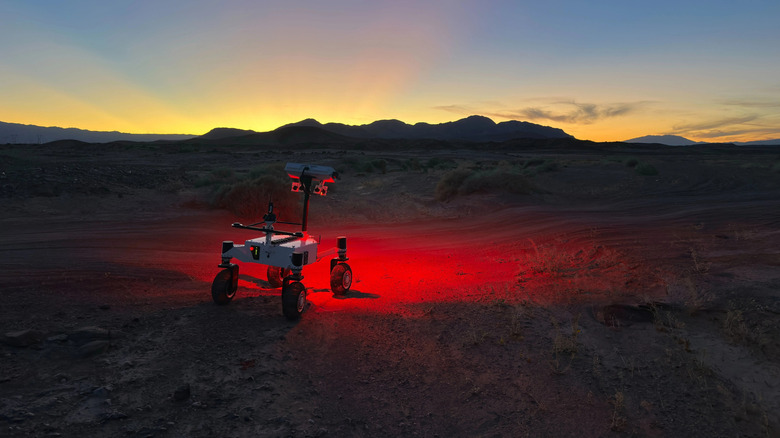
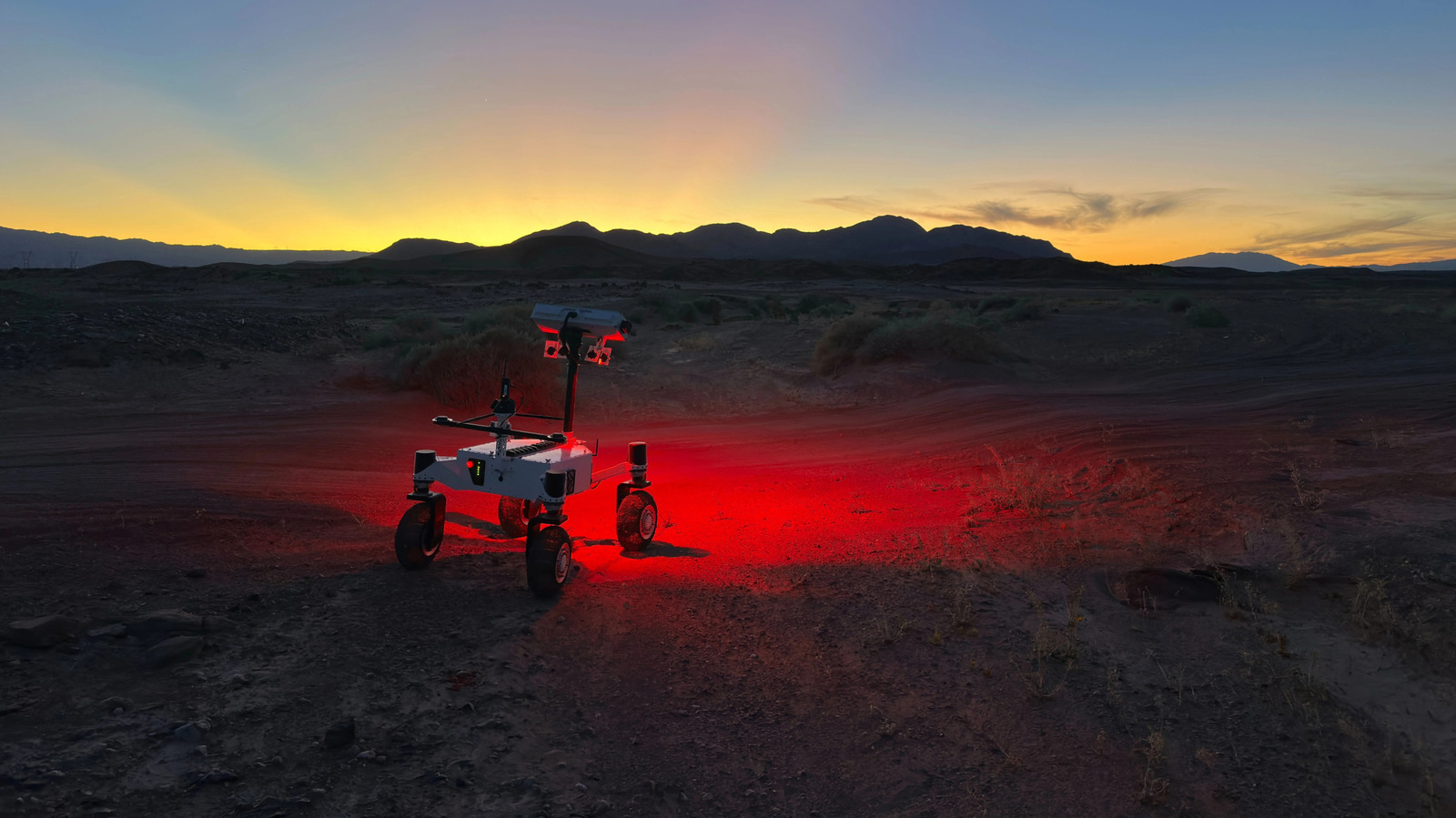





NASA is developing the next generation of surface exploration technology with its Exploration Rover for Navigating Extreme Sloped Terrain (ERNEST), designed with advanced mobility and autonomy capabilities to enable access to previously off-limits regions on the Moon and Mars.
In Southern California’s Colorado Desert, NASA’s ERNEST prototype is traversing rough patches of terrain as the design team at the Jet Propulsion Laboratory (JPL) continues to dial in the rover’s advanced mobility technology.
The four-wheeled, four-foot-long rover can readily handle landscapes that would be impassable for its six-wheeled predecessors, such as Curiosity and Perseverance.
ERNEST features mesh wheels for physically traversing difficult ground, as well as an intelligent decision-making system that determines the best route to its destination. As plans for humanity’s return to the lunar surface grow more ambitious, a rover capable of traveling longer distances at higher speeds will become a necessity. This is what ERNEST is accomplishing for NASA, already showing improvement over the performance of earlier rovers by an order of magnitude, as demonstrated in one test by traveling 16 miles in 37 hours.
The ERNEST prototype is less than half the size that the JPL team expects the final build to be. Since the project began in 2022, this is the third ERNEST prototype, with the other two being only two feet long and built primarily to test various suspension iterations over simulated lunar regolith packed at various slopes. They completed fabrication of the current prototype in September 2024 and operated it remotely via joystick control.
“You could do a science road trip across the Moon — or Mars — with this vehicle,” said James Keane, a JPL planetary scientist working on lunar missions.
ERNEST was a project that grew from relatively humble beginnings: initially, it sought only to replace current rovers with a simple, low-cost alternative by tweaking the rocker-boogie suspension already in use. The new active suspension developed for ERNEST allows it to balance weight among the four wheels rather than distributing it equally across all six wheels, as in the rocker-boogie system.
“We started by postulating that we could do better in designing a planetary surface robotic mobility system,” said Hari Nayar, a JPL principal technologist leading the ERNEST team. “While the rocker-bogie system has been very successful over the past 30 years, there’s been a lot of research in that time on mobility and understanding terrain interaction.”

Powered joints in front of the rover allow it to switch between squirming, wheel-walking, and obstacle-climbing gaits to adapt to changing surface conditions. For less challenging terrain, a clutch allows the system to switch to a more energy-efficient passive suspension, conserving power for longer journeys. Each wheel is articulated to allow movement in any direction, allowing the vehicle to move completely sideways.
These major mobility advances will be a boon to mission planners, who have struggled to reach hard-to-access areas on Mars and the Moon that were previously inaccessible with previous technology.
“This testing is helping us refine the mobility hardware and autonomy software to navigate extreme distances across a wide range of terrain and lighting conditions anticipated on the Moon,” said Issa Nesnas, a principal technologist at JPL.
To move beyond operator control to autonomous decision-making, the team used an artificial intelligence technique called reinforcement learning, in which a model learns through interactions with the environment.
A virtual testing environment, running multiple simultaneous instances for months, allowed the researchers to have the rover ready to meet its environmental challenges from its first real-world test. Conducted at JPL’s Mars Yard, the initial tests featured an obstacle course of steps, slopes, ripples, and rubble. From this, and in many subsequent tests, ERNEST proved successful in navigating a range of very difficult environments.
Further improvements to the rover’s autonomy are being pursued with an eye on intelligent long-distance travel, with the rover independently switching between suspension settings.
Ryan Whalen covers science and technology for The Debrief. He holds an MA in History and a Master of Library and Information Science with a certificate in Data Science. He can be contacted at ryan@thedebrief.org, and follow him on Twitter @mdntwvlf.

For generations, scientists have believed they knew exactly how Earth would die. In roughly five billion years, after exhausting the hydrogen fuel at its core, the sun will swell into a giant red star and eventually expand so much that it engulfs the inner planets. According to most previous studies, Earth is expected to be among the casualties.
A new study, however, suggests the story may not be so straightforward.
Using improved models of stellar tides and updated estimates of how much mass the aging sun could lose, researchers found that Earth might escape the sun’s final expansion instead of being swallowed by it.
“Based on updated tidal dissipation prescriptions, Earth survives the RGB and AGB phases of the sun,” the study authors note.
However, arriving at that conclusion required revisiting one of the most uncertain aspects of the sun’s future evolution.
The question—will Earth ultimately be engulfed by the dying sun, or can it survive by drifting into a wider orbit—has remained unresolved for years because two powerful forces compete as the sun ages.
On one hand, the expanding star generates tidal interactions that can pull planets inward. On the other hand, the sun loses mass through stellar winds, weakening its gravitational grip and allowing planetary orbits to drift outward.
Determining which effect dominates has proven difficult because both processes involve complex physics that scientists have struggled to model accurately. “The predicted fate of the Earth is highly sensitive to the tidal model and the assumed mass-loss rate,” the study authors note.
To investigate the problem, the study authors simulated the future evolution of the Solar System using modern stellar-evolution models.
The team focused on what will happen after the sun leaves its current stable phase and enters two major expansion stages. The first is the red giant phase, during which the sun will dramatically increase in size after running out of hydrogen in its core.
Later, after consuming its helium fuel, it will enter the asymptotic giant branch (AGB) phase, becoming even larger and shedding vast amounts of material into space.
At that point, two competing forces begin to determine the fate of the planets. As the sun expands, tidal interactions develop between the star and the planets orbiting it. These tides act like a brake, gradually draining orbital energy and pulling planets closer to the star.
Previous studies generally concluded that this process would eventually drag Earth into the sun.
At the same time, however, the aging sun will lose enormous amounts of mass through stellar winds. As the star sheds material, its gravitational pull weakens, allowing planetary orbits to move farther outward.
Predicting Earth’s future, therefore, comes down to determining which effect is stronger: the inward pull from tides or the outward push caused by mass loss.
The researchers revisited the problem using more sophisticated tidal models developed over the last fifteen years. These updated calculations suggest that giant stars dissipate tidal energy less efficiently than earlier estimates indicated.
In simple terms, the future sun may be less effective at pulling Earth inward than scientists previously thought.
The team also examined how much mass the sun is likely to lose during its final evolutionary stages. To improve their estimates, they studied observations of L2 Puppis, a nearby aging star often described as a glimpse of the sun’s future.
By analyzing this stellar analog, the researchers obtained updated constraints on how rapidly sun-like stars can shed material near the end of their lives.
When the researchers combined the revised tidal physics with modern mass-loss estimates, the balance shifted significantly. Their simulations showed that Earth’s orbit could expand enough to remain beyond the sun’s maximum size during both the red giant and AGB phases.
Mars also survived in these scenarios, while the expanding star consistently engulfed Mercury and Venus. The findings suggest that weaker-than-expected tidal effects, coupled with substantial mass loss from the sun, could give Earth a chance to avoid the fiery fate predicted by many earlier studies.
However, this doesn’t mean life will also thrive on Earth after billions of years. Intense solar radiation at that time is likely to make the planet uninhabitable.
The study shows how improvements in stellar physics can reshape predictions of entire planetary systems.
While astronomers have recently found evidence that aging stars can engulf nearby planets, the new research suggests Earth’s own fate may be less certain than previously believed.
Instead of being doomed to spiral into the sun, our planet could survive if the sun loses enough mass during its final stages.
However, the researchers caution that the outcome remains uncertain. Their results depend heavily on how much mass the sun sheds during the asymptotic giant branch phase, a quantity that is still difficult to predict.
“Currently, the survival of the Earth and the inner Solar System is not robustly determined and critically depends on the treatment of tidal dissipation and stellar mass loss,” the study authors said.
Future observations of evolved stars such as L2 Puppis and improved models of stellar tides could help narrow the uncertainty.
For now, the study does not guarantee Earth’s survival. Rather, it shows that one of astronomy’s most familiar predictions may need revisiting.
The study is published in the journal Astronomy & Astrophysics.
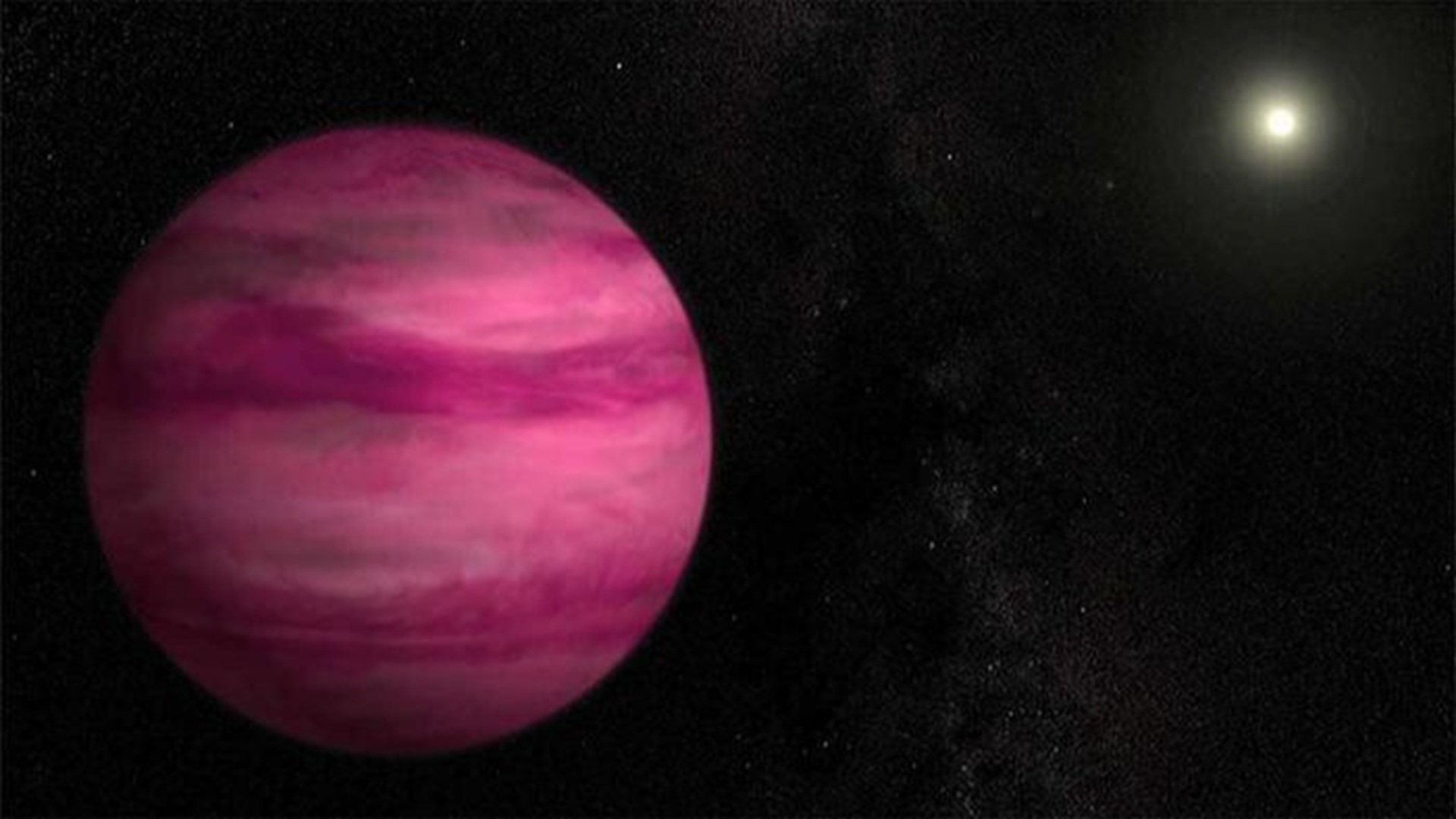
For over a decade, the rosy-hazed world called the “Pink Planet” has been among the most elusive deep-space targets. Discovered in 2013, the cold object was too faint for ground-based instruments to analyze.
Now, using the James Webb Space Telescope (JWST), astronomers have penetrated its glare, uncovering an atmosphere full of exotic chemistry and unique salt clouds never before seen in such a cold world.
The study offers the first direct evidence of metal salt clouds in the atmosphere of a cold cosmic body. Predicted over 15 years ago, their existence was unverified due to technological limits. The move to space-based infrared observation marks a leap in our ability to study faint, cold worlds across the galaxy.
Formally cataloged as GJ504b, the Pink Planet orbits a sun-like star about 57 light-years from Earth. Weighing around 25 times the mass of Jupiter, GJ504b falls on the boundary between massive gas giants and low-mass brown dwarfs, so researchers broadly call it a “planetary-mass companion.”
Adding to its intrigue, GJ504b is much cooler than most exoplanets, with a temperature of about 550°F (290°C)—far below the 1,000–2,000°F typical for similar objects. This cooler temperature is linked to its age, now estimated between 2.5 and 4 billion years.
To capture the world’s incredibly faint light, an international research team led by Aneesh Baburaj, a postdoctoral associate at Northwestern University’s Center for Interdisciplinary Exploration and Research in Astrophysics (CIERA), relied on the advanced coronagraphic capabilities of the JWST.
Working in tandem with the Space Telescope Science Institute (STScI)—including telescope design scientist Marshall Perrin—the team deployed sophisticated data-processing algorithms to strip away the overwhelming, blinding glare reflecting off the companion’s host star.
This combination successfully isolated the light of GJ504b into a clear spectrum, a data graph that breaks down incoming light into individual component wavelengths. Because unique elements and chemical compounds absorb distinct colors of light, analyzing these spectral valleys allows astronomers to safely map out the chemical makeup of an alien sky from dozens of light-years away.
Previous historical attempts to capture this data from Earth required astronomers to spend entire nights tracking the object with the world’s most massive terrestrial telescopes, only to come up entirely empty-handed. With the JWST, the entire high-fidelity data collection sweep was completed in approximately two hours.
The spectrum revealed a complex mix of water vapor, methane, carbon dioxide, and ammonia. Yet, when researchers modeled these findings, the results didn’t make sense until they included cloud formations in their simulations.
By testing three distinct cloud configurations, the team confirmed that specialized salt clouds provided the most accurate mathematical match. These salt structures act as an atmospheric veil, subduing the spectral signatures of more volatile chemical molecules trapped deeper within the companion’s inner layers.
Beyond confirming the existence of these exotic clouds, the processed light signatures indicate that GJ504b is highly enriched with heavy elements, commonly referred to as metals in astronomy.
While the exact cosmic mechanics of how this world originally formed remain an ongoing mystery, the techniques proven by this study bring researchers significantly closer to mapping out the internal chemistry of our own solar system’s cold worlds, such as Jupiter’s elusive ammonia ice clouds.
The study was first published in the journal The Astronomical Journal,

Millions of years ago, a massive star exploded somewhere far away in our galaxy. During this violent event, called a supernova, the dying star blasted huge amounts of matter into space. These materials included carbon, nitrogen and oxygen—the essential ingredients for life—as well as many other elements, some as heavy as iron. The explosion itself […]
The post Mysterious cosmic rays are challenging what scientists thought they knew about the universe appeared first on Knowridge Science Report.


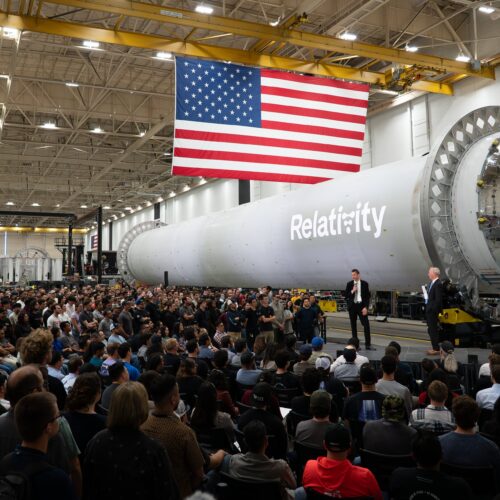
Relativity Space, the rocket company led by former Google executive Eric Schmidt, was picked to launch NASA's Aeolus payload to Mars in 2028, as reported earlier by TechCrunch. Under a new public-private partnership, Relativity Space will provide the "spacecraft, rocket, and cruise operations" to fly Aeolus to Mars, where the payload will "provide the first integrated, daily, global view of Martian winds, temperatures, dust, and clouds."
The Aeolus payload will have four instruments on board for studying the Martian atmosphere, which NASA says will "directly inform entry, descent, and landing systems and support safer, more predictable mis …

For years, scientists and engineers have highlighted the potential of space-based solar power for addressing terrestrial energy shortages.
Now, researchers at Xidian University, China, are developing new technologies to harvest solar energy in space and transmit it wirelessly to Earth.
The project, known as Zhuri or “chasing the sun,” focuses on building systems capable of beaming power from geostationary orbit, more than 36,000 kilometres away.
On the university campus in Xi’an, Shaanxi province, associate professor Fan Guanheng and his team have demonstrated key components for their new approach to space-based solar power.
Using a 4.8-metre dome-shaped mirror suspended from a 75-metre tower, they concentrate sunlight onto solar panels.
The generated electricity is then converted into microwaves and transmitted over 100 metres to a rectenna, which converts the waves back into usable power.
Recent tests achieved kilowatt-level transmission and showed the system could direct energy to multiple moving targets simultaneously, according to an expert review panel last month.
The Xidian University team is also experimenting with 2-7 meter-wide Fresnel lenses, which focus light efficiently with less material while using cooling fluids to manage heat.
In an interview with the South China Morning Post (SCMP), Fan explained the process in three stages: light concentration, microwave conversion and transmission, and rectification. The researchers conducted their tests during peak sunlight hours between 10 am and 3 pm.
Space-based solar power offers significant advantages over ground installations. Solar energy density in orbit can reach six times that on Earth’s surface, unaffected by night cycles, weather, or atmospheric interference.
“That is why space-based solar power is a potential way out of the energy crisis on Earth,” Fan said.
The new project is led by Xidian’s Duan Baoyan, a pioneering electromechanical engineer and former president of the university.
Duan, who was inspired to start this work in 2012 by NASA’s SPS-ALPHA concept of modular satellite arrays, envisions large-scale systems. A one-gigawatt station –sufficient for a mid-sized city–would require mirrors spanning hundreds of metres.
However, challenges remain, such as addressing the deployability of foldable or self-assembling structures, achieving precise microwave targeting, and ensuring beam safety for aircraft and the environment.
The new Xidian design uses modular units flying in formation rather than a single massive structure, improving resilience and maintenance.
China’s efforts place it among leaders in the field, alongside the United States and Japan.
While orbital deployment remains the long-term goal, nearer-term applications include wireless charging of satellites in orbit or powering lunar bases from orbit or the Moon’s surface.
For the team, the next priority is securing funding for orbital experiments. If successful, the technology could provide continuous, high-efficiency clean energy, transforming the global power supply.

MDA Space is buying smallsat manufacturer Blue Canyon Technologies (BCT) for $620 million, giving the Canadian company greater access to the lucrative U.S. government market.
The post MDA Space to buy Blue Canyon Technologies to gain foothold in U.S. market appeared first on SpaceNews.

Astronomers have discovered an unexpected surprise on the famous “Pink Planet,” a strange world known as GJ504b. Using the powerful James Webb Space Telescope (JWST), scientists found that the object is surrounded by salty clouds and has an atmosphere filled with unusual chemicals. GJ504b was first discovered in 2013. It orbits a sun-like star about […]
The post The universe’s famous ‘pink planet’ has salty clouds in its sky appeared first on Knowridge Science Report.

ElevationSpace Inc. (CEO: Ryohei Kobayashi), a company developing Space-to-Earth transportation as well as a Space Environment Utilization and Recovery Platform, has raised a total of US $40 million in its […]
The post ElevationSpace Secures US $40 Million in Series B Funding, Bringing Total Raised to US $63.5 Million appeared first on SpaceNews.
Welcome to Edition 8.46 of the Rocket Report! We don't mention Starship in the body of this week's report, so I'll give a brief update here. The next test flight of SpaceX's mega-rocket—Flight 13—could happen as soon as next month, according to Gwynne Shotwell, the company's president and chief operating officer, in a recent interview with CNBC. There's still a fair bit of work to do before Flight 13, so don't count on a launch next month just yet. What we do know, based on Shotwell's comments to CNBC, is the next Starship test flight will look a lot like the previous one last month, with a suborbital flight path and a splashdown of the ship in the Indian Ocean. SpaceX is holding off on an orbital flight until at least the following launch, Flight 14, after the ship was unable to complete a critical engine restart in space on the last flight.
As always, we welcome reader submissions. If you don't want to miss an issue, please subscribe using the box below (the form will not appear on AMP-enabled versions of the site). Each report will include information on small-, medium-, and heavy-lift rockets, as well as a quick look ahead at the next three launches on the calendar.

Isar test flight scrubbed again. Isar Aerospace still commands top position among a new generation of European rocket startups, but the company’s efforts to launch a critical test flight of its Spectrum rocket continue to encounter roadblocks, Ars reports. The latest delay came Monday, when Isar scrubbed a launch attempt after "detecting off nominal behavior in the vehicle’s fluid systems," according to a social media post. "The teams are analyzing the new data to isolate the root cause." Isar is flush with cash, having raised nearly $1 billion to date, but is still lacking in the critical currency of flight experience. The Spectrum rocket has flown just once to date, on a failed launch last year that lasted less than 30 seconds.

© Relativity Space
Welcome to Edition 8.46 of the Rocket Report! We don't mention Starship in the body of this week's report, so I'll give a brief update here. The next test flight of SpaceX's mega-rocket—Flight 13—could happen as soon as next month, according to Gwynne Shotwell, the company's president and chief operating officer, in a recent interview with CNBC. There's still a fair bit of work to go before Flight 13, so don't count on a launch next month just yet. What we do know, based on Shotwell's comments to CNBC, is the next Starship test flight will look a like like the previous one last month, with a suborbital flight path and a splashdown of the ship in the Indian Ocean. SpaceX is holding off on an orbital flight until at least the following launch, Flight 14, after the ship was unable to complete a critical engine restart in space on the last flight.
As always, we welcome reader submissions. If you don't want to miss an issue, please subscribe using the box below (the form will not appear on AMP-enabled versions of the site). Each report will include information on small-, medium-, and heavy-lift rockets, as well as a quick look ahead at the next three launches on the calendar.
Isar test flight scrubbed again. Isar Aerospace still commands top position among a new generation of European rocket startups, but the company’s efforts to launch a critical test flight of its Spectrum rocket continue to encounter roadblocks, Ars reports. The latest delay came Monday, when Isar scrubbed a launch attempt after "detecting off nominal behavior in the vehicle’s fluid systems," according to a social media post. "The teams are analyzing the new data to isolate the root cause." Isar is flush with cash, having raised nearly $1 billion to date, but is still lacking in the critical currently of flight experience. The Spectrum rocket has flown just once to date, on a failed launch last year that lasted less than 30 seconds.
© Relativity Space
Welcome to Edition 8.46 of the Rocket Report! We don't mention Starship in the body of this week's report, so I'll give a brief update here. The next test flight of SpaceX's mega-rocket—Flight 13—could happen as soon as next month, according to Gwynne Shotwell, the company's president and chief operating officer, in a recent interview with CNBC. There's still a fair bit of work to do before Flight 13, so don't count on a launch next month just yet. What we do know, based on Shotwell's comments to CNBC, is the next Starship test flight will look a lot like the previous one last month, with a suborbital flight path and a splashdown of the ship in the Indian Ocean. SpaceX is holding off on an orbital flight until at least the following launch, Flight 14, after the ship was unable to complete a critical engine restart in space on the last flight.
As always, we welcome reader submissions. If you don't want to miss an issue, please subscribe using the box below (the form will not appear on AMP-enabled versions of the site). Each report will include information on small-, medium-, and heavy-lift rockets, as well as a quick look ahead at the next three launches on the calendar.
Isar test flight scrubbed again. Isar Aerospace still commands top position among a new generation of European rocket startups, but the company’s efforts to launch a critical test flight of its Spectrum rocket continue to encounter roadblocks, Ars reports. The latest delay came Monday, when Isar scrubbed a launch attempt after "detecting off nominal behavior in the vehicle’s fluid systems," according to a social media post. "The teams are analyzing the new data to isolate the root cause." Isar is flush with cash, having raised nearly $1 billion to date, but is still lacking in the critical currency of flight experience. The Spectrum rocket has flown just once to date, on a failed launch last year that lasted less than 30 seconds.
© Relativity Space
A Martian meteorite fragment containing unexpected grains of mineral could hold clues to the Red Planet’s geological history, according to an international team of researchers.
Prior to the team’s new paper, which was published in Geochemical Perspectives Letters, the red mineral garnet had never been observed in any martian rock sample. Now, the meteorite discovery provides scientists with new clues to Mars‘ extreme past conditions, over its 4.5 billion-year history, which could include hidden magma sources or ancient impact events.
Although the gemstone garnet can come in many colors, it is best known for its dark red varieties, which were historically popular in ancient Egypt, Rome, and Victorian England. Beyond its beauty, the rock is important for the record it keeps of its birth, providing Earth’s geologists with information on our planet’s tectonic forces, ore-forming processes, and the fluid-rock interactions of the crust and mantle.
Similarly, the small grains of garnet discovered in the meteorite sample contain important data for reconstructing the forces that forged the Red Planet long ago.
“The findings add a striking new dimension to our understanding of the geology of Mars and open an exciting new window into the evolution of our planetary neighbour,” said co-author Professor James Darling.
“This discovery is going to expand our knowledge of the geologic processes that are possible on this planet,” said lead author Tanya Kizovski, Assistant Professor of Earth Sciences, from Brock University in Canada. “This new garnet-bearing rock type could give us clues to how Mars has changed throughout its history and new insights into the ancient environments that could have formed the garnet and related minerals.”
The garnet fragments were discovered in a tiny Martian meteorite sample held in the Royal Ontario Museum’s collection, designated NWA 8171, discovered in northwest Africa. Kizovski led the team in analyzing the sample’s mineral and chemical composition after identifying it as a unique piece within the collection.
“This little section of the meteorite looked really interesting, and the chemistry was a bit odd,” Kizovski said. “At first, we assumed it was a mineral called pyroxene, which is very common, but then we decided to take a second look.”
The international effort brought in researchers from Italy’s University di Trieste and the UK’s Open University, utilizing the Royal Ontario Museum’s laser equipment and the University of Portsmouth’s Electron Microscopy and Microanalysis Unit.
Having never been observed in any previous Martian sample, the researchers were surprised to identify garnet in the meteorite’s composition. From their analysis of the sample’s chemistry and mineralogy, the researchers began to consider how the unexpected garnet could have formed.
“Garnet is a classic example of a mineral often found in metamorphic rocks on Earth,” Kizovski said. “The process of metamorphism transforms igneous or sedimentary rocks into a new form through exposure to extreme heat, high pressure, or hot fluids.”
“On Mars, the heat and pressure needed to produce garnet through metamorphism could have come from the impact of a meteorite hitting the surface of Mars, magma rising up into the Martian crust, or both,” Kizovski continued.
While garnet provided geologists with some data about how it formed, this is not like the point of origin stamped on a manufactured good. It is possible that the garnet was deposited on Mars during an earlier meteorite impact, only to later travel through the solar system again, or that it was created by a heretofore unknown magma source on Mars.
Only further analysis of the garnet’s isotopic signatures will allow the researchers to determine whether the mineral formed on Mars or elsewhere. Unfortunately, to do so, the team would have to destroy a portion of this rare and precious sample, which measures only 0.8 by 0.5 millimeters to begin with.
“Measuring oxygen isotopes from the garnet-bearing rock type itself would help to confirm if it is Martian in origin or from an exotic meteorite impactor,” Kizovski said.
“Isotopes are a collection of atoms with equal numbers of protons and electrons, but different numbers of neutrons,” she added, “which was avoided thus far due to its rarity, as it may be the only garnet-bearing Martian rock we have for study.”
A few members of the team are continuing their study of the sample by comparing their findings to Martian data collected by rovers and orbital platforms. Further insights, they hope, may help them discover more about how the garnet could have formed, and what its presence means for the deeper history of the Red Planet.
The paper, “Expanding Mars’ Lithologic Diversity: Discovery of a Garnet-Bearing Clast in NWA 8171,” appeared in Geochemical Perspectives Letters on June 16, 2026.
Ryan Whalen covers science and technology for The Debrief. He holds an MA in History and a Master of Library and Information Science with a certificate in Data Science. He can be contacted at ryan@thedebrief.org, and follow him on Twitter @mdntwvlf.
