Since the end of May, rural areas of San José del Guaviare, the capital city of the Guaviare department in the Colombian Amazon, have once again been turned into a war zone. A series of clashes between dissident cells of the Revolutionary Armed Forces of Colombia (FARC), demobilized in 2016, and commanded by Alexander Díaz Mendoza, alias “Calarcá,” and Néstor Gregorio Vera Fernández, alias “‘Iván Mordisco,” has resulted in the deaths of at least 48 people. The warfare between the two armed groups concentrates on a strategic area for illicit economies on the Guaviare River, a tributary of the Orinoco River. The rural community of Cumare, as well as the Nukak and Jiw Indigenous people of the Barranco Colorado Reserve (an ancestral territory in San José del Guaviare), started hearing gunshots and rushed to hide. Since that frightening day, May 26, they have avoided leaving their homes. “People are on maximum alert; no one moves because they fear being caught in the middle of the confrontation,” said a resident of Charras, another rural area of San José del Guaviare, who requested anonymity for safety reasons. “We knew something like this could happen. A bomb fell in the middle of a sports field here in the Siberia rural district,” said a woman who has witnessed the clashes since their very beginning; she also requested anonymity. Colombian Defense Minister Pedro Sánchez stated, “The criminal structures of alias ‘Mordisco’ and ‘Calarcá’ fought in the Barranco Colorado sector, jurisdiction of San José del Guaviare,…This article was originally published on Mongabay
South African police arrested a 28-year-old man at Cape Town International Airport on June 12, 2026. Inside his luggage, tucked between his clothing, authorities discovered 150 live venomous scorpions. Each one was individually wrapped in a clear plastic bag, like candies at a supermarket It’s not known where the alleged smuggler intended to take the scorpions or for what purpose. An intelligence-led operation targeted the suspect: Authorities acted on a tip about a man in possession of wildlife. The bust was conducted by the Kuilsriver Stock Theft and Endangered Species Unit, a special police force, in collaboration with CapeNature, a government agency tasked with environmental protection in the Western Cape. Police spokesperson Sergeant Wesley Twigg told local media that he was arrested on suspicion of being in “possession of a wild animal under the Nature and Environmental Ordinance Act.” An investigation into the case is ongoing. The commercial value of the seized scorpions is yet to be determined, authorities said. The rescued scorpions are being cared for by the Cape of Good Hope SPCA. In a social media statement, the animal rescue organization said they are ensuring the arachnids receive proper care, and they will try to return them “to their place of origin where possible.” The seized scorpions are being cared for at the Cape of Good Hope SPCA. Image courtesy of Cape of Good Hope SPCA/Facebook. Scorpion trade, like other wildlife, is booming The planet is home to more than 2,900 scorpion species; only 25-30 have venom, a…This article was originally published on Mongabay
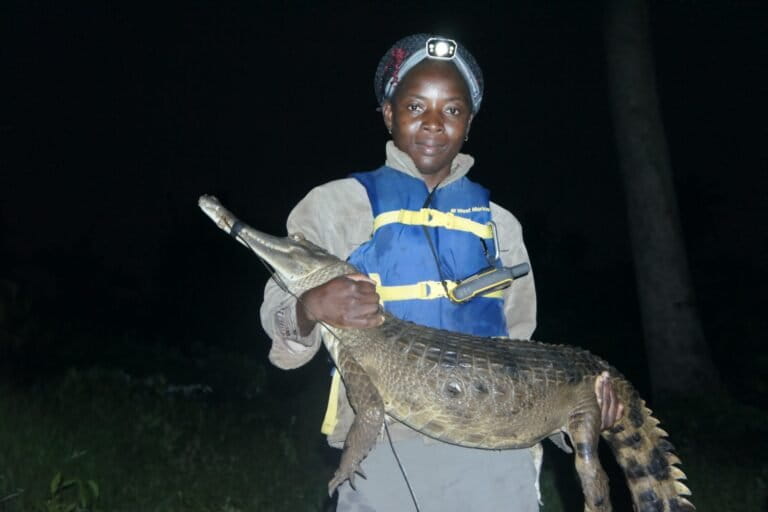
TAI NATIONAL PARK, Côte d’Ivoire — Environmental scientist Christine Kouman says she has always had a passion to take care of things that are overlooked or neglected. The West African slender-snouted crocodile and its habitat in what remains of the Upper Guinean Forest qualify on both fronts. Kouman, co-founder of a conservation NGO called EBURCO that is collaborating with authorities to protect and raise the profile of Taï National Park — a key stronghold of the slender-snouted crocodile (Mecistops cataphractus), — has studied this species in her native Côte d’Ivoire for more than a decade. Her work, which is supported by Project Mecistops, – has produced insights into this little-known species. The project is part of the Tropical Conservation Institute at Florida International University in the U.S. Mongabay recently accompanied Kouman on a night-time boat trip in Taï National Park, up the Hana River, a place where she has undertaken many hours of grueling fieldwork. This interview has been lightly edited for clarity. The slender-snouted crocodile has adapted to its rainforest environment by basking on trees and rocks that protrude from the river. Image courtesy of Christine Kouman. Mongabay: Tell us something about the slender-snouted crocodile. Christine Kouman: I can say it’s a gentle crocodile, because it feeds mainly on fish, and I’ve never heard of the species attacking people. I’ve been working on them for more than 10 years now, and during those 10 years, I touched them, handled them, but I still have all my fingers and my…This article was originally published on Mongabay
Suriname is being presented with a familiar proposition: foreign agribusiness, whether Brazilian, Mennonite, or otherwise, will modernize agriculture, create jobs, and bring prosperity. It is an appealing narrative. It is also one that has played out throughout tropical America, from Mexico to Mato Grosso. The result has rarely been shared prosperity. Instead, it has often meant felled forest, poisoned water, long-term loss of control over land and resources, and local populations watching the wealth pass through on its way to somewhere else. Suriname should pause before replicating this model. The employment benefits are often wildly overstated. Industrial soy and cattle production are highly mechanized systems designed to minimize labor, often conducted by a skeleton crew running combines and GPS-guided sprayers. A few operators can manage thousands of hectares. The jobs that are created tend to be temporary, low-paid, and sometimes filled by external labor rather than local hires because this business model is predicated on keeping labor costs as close to zero as the machinery allows. In contrast, existing sectors—smallholder agriculture, fisheries, and forest-based livelihoods—support far more people and are deeply embedded in local economies. The environmental risks are even more significant. Large-scale monoculture depends on heavy use of agrochemicals like glyphosate and phosphorus fertilizer, applied in huge quantities. These inevitably enter river systems, including those that provide drinking water and food for a large part of Suriname’s population. Fish — the primary protein source for many communities — are directly affected. A brutal imbalance is created: beef and soy…This article was originally published on Mongabay
“Al Dhiwaini!” HRH the Prince of Jazan called in the traditional way that spurred hundreds of people to sprint toward the water, carrying around nets and shouting. Standing on the shores of the Farasan Islands, I watched participants in the annual parrotfish festival pull fish from the sea en masse, with catches reaching up to 78 kilograms (more than 170 pounds) of parrotfish per person. Known locally as hareed — or generally as longnose parrotfish (Hipposcarus harid) — the scale of extraction immediately triggered my instincts as a scientist, as the question asked itself: How is this sustainable? How do the fish keep coming back, year after year? But in that moment, there was nothing to do except run into the water, follow the fish, and give myself over to the thrill of it. From a time before living memory, the people of Farasan have followed the moon to this annual aggregation, a phenomenon so unique and described as the fish swimming willingly to their deaths; the fish seem almost to be waiting to be caught. As a Saudi marine biology Ph.D. student, I know how much of the Red Sea remains scientifically uncharted, and this festival is exactly why science and traditional ecological knowledge must be woven together to manage marine systems. Participant at the annual Hareed Festival in the Farasan Islands, an archipelago in the Red Sea off the coast of Saudi Arabia, with his catch of parrotfish. Image courtesy of Laila Shaaban. When I asked locals where…This article was originally published on Mongabay
You can’t dictate a solution to the worldwide plastic pollution crisis, according to Julio Cordano, the new chair of the United Nations Intergovernmental Negotiating Committee (INC) for a global plastic treaty. He said consensus will be needed. Cordano was elected INC chair in February 2026. That appointment came after INC repeatedly failed to meet its own deadlines for achieving an agreement to deal with the world’s rapidly escalating plastic pollution crisis. INC began treaty negotiations in 2022 with the goal of achieving an agreement by 2024. But negotiators remain deadlocked and nowhere near an accord. That puts Cordano — a career Chilean diplomat and director of the Environment, Climate Change and Oceans Division of Chile’s Ministry of Foreign Affairs — in a difficult position. Today, 184 nations, known as the parties, can’t even agree on whether a treaty should include binding limits on plastic production (a stance held by the roughly 70 High Ambition Coalition member nations), or focus only on voluntary plastic waste management, reuse and recycling (a position held by the Like Minded Group of a handful of petrostates). Talks continue this year, but INC doesn’t expect another formal negotiating session until March 2027 at the earliest. With Cordano in the challenging position of finding common ground between the parties, Mongabay reached out for an exclusive interview to determine his hopes and concerns for the treaty process. He doesn’t often speak to the press and declined a Mongabay interview request, but agreed to answer questions submitted in writing.…This article was originally published on Mongabay
TAÏ NATIONAL PARK, Côte d’Ivoire — The path that leads through the rainforest towards a nesting site for one of its most curious inhabitants is not made by humans but by animals. “It might be half a million years old, this animal path,” says Michele Menegon, a herpetologist and regular visitor to Taï National Park, in southwestern Côte d’Ivoire. It could of course be younger, he adds, but such a clear trail through the forest, following the contour of a ridge, is likely to be an ancient one — maintained by the passage of both Taï’s great and small, from forest elephants (Loxodonta cyclotis) to diminutive antelopes like the Maxwell’s duiker (Philantomba maxwellii), whose piles of tiny black droppings are visible beside the path. The forest floor here is relatively clear of undergrowth. Dominant trees, supported by huge buttress roots, hold their canopies out of sight above; they restrict the sunlight and curtail the growth below. “I’ve never been in a forest with this density of giant forest trees,” Menegon says. The guide, Gliman Hyacinthe, a ranger with the Ivorian Office of Parks and Reserves (OIPR), identifies one of the tree giants as kosipo — Entandrophragma candollei — one of the mahoganies. This part of the forest is boulder-strewn, situated as it is on the slope beneath a large dome of granite whose summit breaks through the canopy of trees but is barely visible from within the forest. OIPR ranger Gliman Hyachinthe, University of Pavia student Caterina Danielon and herpetologist Michele…This article was originally published on Mongabay
Montañita is a place many people intend to pass through. They come for surf, sun, music, and a stretch of Ecuador’s coast known for surf, music, and its free-spirited nature. Some stay longer. They open small businesses, learn the workings of the communes, put children into local schools, and begin to notice what visitors often do not see: the sewage that is not properly treated, the public works that arrive without answers, the land whose ownership becomes uncertain, and the turtles whose nesting beaches are treated as available ground. For a woman from northern Poland, the change of country became something beyond expatriate life. Ecuador was where she made a home, ran a hostel, raised two daughters, and became part of Santa Elena’s disputes and loyalties. Monika Silva Koniuszek, who was found dead on June 8th at her home in Montañita, was 41. The circumstances of her death remain under investigation. In the weeks before she died, she had spoken publicly of warnings that there was a plan to kill her. She had alerted authorities and sought protection. After her death, Polish diplomats, the European Union, human-rights groups, and the Inter-American Commission on Human Rights called for a thorough and independent inquiry. Her public work began with local problems. Montañita’s inadequate sewage system troubled her. So did the way decisions about beaches, mangroves, public land, and services seemed to benefit the same networks of power. She came to see poverty, malnutrition, poor infrastructure, and environmental damage as linked by…This article was originally published on Mongabay
JAKARTA — Pulp and paper giant APRIL made recent changes that are concerning to environmental groups. These changes include suspending and reviewing its flagship sustainability policy, lowering its deforestation commitments, and sourcing wood from two companies responsible for some of Indonesia’s largest recent forest losses. The company, part of the Singapore-headquartered Royal Golden Eagle (RGE) group, the world’s largest manufacturer of viscose rayon, said the changes are needed to align its policies with international standards and secure fiber supplies following the loss of several long-term suppliers. Environmental groups, however, said the move weakens a key safeguard that APRIL has long cited as evidence of its no-deforestation commitments. The controversy centers on APRIL’s decision to add Indonesian concessions PT Industrial Forest Plantation (IFP) and PT Mayawana Persada (Mayawana) askey wood suppliers, integral to manufacturing viscose. Both companies, based on Kalimantan, have experienced extensive forest loss in recent years and have been repeatedly criticized by environmental groups. Previously, RGE and its subsidiaries, including APRIL, pledged not to source wood from plantations linked with deforestation since 2015. It is a pledge the company had reportedly broken. Its new corporate promise lowers the cutoff date to 2020, drawing sharp criticism from environmental groups. APRIL said IFP began delivering wood fiber to the company in May 2026. However, vessel-tracking data reviewed by Mongabay indicated that at least five barges carrying timber from the vicinity of IFP’s operations in Central Kalimantan were tracked traveling to Futong Port in Riau between mid-March and mid-April. Futong serves as…This article was originally published on Mongabay
Researcher Ligia Pizzatto dug a small hole in the ground on the sloping banks of Ryan’s Lagoon in southeast Australia. She carefully placed an egg inside the hollow before covering it with soil, then reached for a large spray bottle and doused the area with a fine mist. The scent of vanilla filled the air, oddly sweet against the smell of damp earth and eucalyptus trees. While looking for another spot to repeat the process, Pizzatto came across a scattering of small bones, flat and almost geometrical in shape. “Turtle bones,” Pizzatto said. “Probably eaten by a fox.” These bones are a small sign of a much larger crisis. Freshwater turtle species that are native to Australia’s Murray-Darling River Basin are increasingly under threat, their populations collapsing under pressure from introduced predators. Not only do foxes kill turtles that venture onto land — typically nesting females — but they also dig up their nests to eat their eggs. Pizzatto, a biologist at La Trobe University in Victoria, is testing an innovative approach to intervene — one that doesn’t require killing a single fox. Young broad-shelled turtle found by Ligia Pizzatto during fieldwork. Broad-shelled turtles are classified as endangered in Victoria. Image by Ligia Pizzatto. Freshwater turtles under threat The Murray River is the longest in Australia; its course marks the boundary between the states of Victoria and New South Wales in the country’s southeast. This river and its basin are a major biodiversity hotspot and home to three native turtle…This article was originally published on Mongabay
KATHMANDU — Nepal’s ambitious efforts to establish a viable population of the vulnerable greater one-horned rhinoceros in western Nepal’s Bardiya National Park 40 years ago has been seen as a conservation success. The park, which didn’t have a surviving population until the 1980s, is now home to 38 individuals, as per recent census. But a new study shows that the translocated animals are wandering far outside their release zones in search of food and water, suggesting the habitat may not be healthy enough to keep them there. Researchers, who GPS collared five of the eight animals translocated from Chitwan in central Nepal in 2016-17, found that the larger home range of the reintroduced rhinos (Rhinoceros unicornis) in Babai Valley (one of the two habitats, the other one being the banks of Karnali River) of Bardiya National Park was primarily due to limited grassland, fragmented riverine forests and seasonal scarcity of water and forage. “Habitat degradation from floods further reduced suitability, forcing rhinos to range widely,” the study said. “Given the small population size and fragmented habitat, Babai Valley may not support a viable rhino population without significant habitat restoration, addition of individuals, or relocation to more suitable sites.” Greater one-horned rhinos in Chitwan, Nepal. Image by Aditya Pal via Wikimedia Commons (CC BY-SA 4.0). Once confined to Chitwan National Park — the heartland of Nepal’s rhino population — a smaller number of animals were relocated to Bardiya and Shuklaphanta national parks in the late 1980s to expand their range. But…This article was originally published on Mongabay
How can the beleaguered carbon market be saved? Carbon market pioneer Daniel Morrell’s solution is straightforward: Go back to the market’s roots by focusing less on carbon and more on biodiversity generation and community welfare. It might be easier said than done; nonetheless, he is giving it a shot. Morrell recently launched Balance, a new avatar of the carbon credit that puts the focus primarily on biodiversity protection and generating new sources of income for local communities. With a three-pillared methodology, he plans to address biodiversity loss, poverty and climate breakdown with the aim of keeping forests intact long after projects have wrapped up. “Tackling any one of these in isolation is ineffective as they are structurally linked,” Morrell, CEO of Balance and climate advisor to the U.K. Prime Minister’s Office, 10 Downing Street, told Mongabay in an email interview. He said he wants Balance units to address these issues simultaneously rather than allowing people and companies to purchase “a ‘get out of jail free’ card to excuse emissions.” Dan Morrell launched Balance credits with the aim of saving the beleaguered carbon market by putting the spotlight on biodiversity protection and community welfare. Image courtesy of John Nguyen. For years, carbon offset projects have allowed people and companies to invest in forest restoration projects to cancel out, or offset, emissions they produce. However, the voluntary carbon market has faced widespread scrutiny for lacking transparency on how it measures the success of projects, leading to allegations of greenwashing. Many projects have…This article was originally published on Mongabay
BRASÍLIA — Illegal miners have adapted their tactics in the Yanomami Indigenous Territory as Brazilian authorities seek to remove all the illegal occupants from the Amazon land, according to a recent report. Since a peak in illegal mining in 2022, there have been “significant and successive reductions” in the rainforest from 2023 to 2025, researchers using satellite imagery found. However, “mining activity was not completely eradicated,” as miners change how they operate, decentralize and move to borders. Sources also raise concerns about the health of isolated Indigenous people, who are at risk of the spread of malaria linked to illegal mining. In 2024 and 2025, mining impacted 129 hectares (318.7 acres) of land, down from about 1,800 hectares (4,448 acres) in 2022. The report, conducted by the NGO Instituto Socioambiental (ISA) and Amazon Conservation, said the steep decline is a reflection of the operations initiated by the Brazilian government in 2023, when president Luiz Inácio Lula da Silva came to power and declared a health emergency due to widespread disease and mercury contamination in rivers from mining. “Illegal mining activity, the invaders, continue on Yanomami land, but the rest have already been expelled,” Dário Kopenawa Yanomami, vice-president of HAY (the Hutukara Yanomami Association) and son of Davi Kopenawa, a spokesman for the Yanomami people, told Mongabay. “The government has carried out many operations, but other invaders, miners, are difficult to remove. They remain in some specific locations, such as border areas with Guyana and Venezuela. These miners who are on…This article was originally published on Mongabay
This week, as governments of various coastal states gather in Mombasa, Kenya, for the Our Ocean Conference, Africa must demand an end to industrial krill fishing in the Southern Ocean before irreversible damage is done to Antarctica and the ocean systems upon which our continent depends. A clear call from Africa would bolster international calls for a ban on industrial krill fishing and support positive leadership developments like the European Parliament’s recent call for a moratorium on krill fishing. The Southern Ocean regulates global ocean circulation, absorbs enormous quantities of heat and carbon dioxide, and sustains marine life across the planet. At the center of this system is Antarctic krill (Euphausia superba), the tiny crustacean that feeds whales, penguins, seals and seabirds while helping lock carbon into the deep ocean. Industrial krill fishing has expanded rapidly over the last few years, with the largest share of this extraction controlled by fleets linked to certain European and Asian countries. Most concerningly, fishing is intensifying precisely where Antarctic wildlife is most vulnerable: critical feeding grounds for whales, penguins and seals are actively targeted by the industry. A single adult Antarctic krill (Euphausia superba) is usually just five centimeters long, but the importance of its massive populations to marine food chains, and the millions of people who depend on ocean protein as part of their daily diet, is major. Image courtesy of Uwe Kils via Wikimedia Commons. The damage is already visible. In April, the International Union for Conservation of Nature (IUCN) classified…This article was originally published on Mongabay
This week, thousands of delegates are gathered in Mombasa, Kenya, for the first Our Ocean Conference to be hosted on African soil. As expected, much of the conversation will focus on the global “30×30” target — protecting 30% of the world’s land, freshwater and oceans by 2030. Yet, far from the conference halls, the big pledges and state commitments, many of the people doing the daily work of marine conservation are community organizations operating on modest budgets along Africa’s coastlines. They often do so far from the spotlight, but their contribution is vital for the global ambition to conserve ocean spaces. The Convention on Biological Diversity (CBD), under whose Kunming-Montreal Global Biodiversity Framework the 2030 targets were adopted, highlights that success hinges heavily on community involvement. Across Kenya, Tanzania and Namibia, four such groups — Coastal and Marine Resource Development (COMRED), Action for Ocean, Mwambao Coastal Community Network and the Namibia Nature Foundation (NNF) — offer a window into what community-led marine conservation looks like in practice. Their work might be underfunded, uneven and sometimes slow, but are increasingly central to how marine protection is imagined on the continent. Marine ecosystems in Africa support fisheries, tourism, transport, carbon storage and coastal protection while sustaining millions of livelihoods from the Western Indian Ocean to Africa’s Atlantic and Mediterranean coasts. In East Africa in particular, mangroves, coral reefs, seagrass meadows and nearshore fisheries underpin food systems and local economies even as they face pressure from overfishing, habitat degradation, climate change and pollution.…This article was originally published on Mongabay
ROOIELS, South Africa — Baboons aren’t exactly punctual, but Gavin Lundie still expected them to appear in the village around 9 a.m. “They’re coming!” his wife Lesley called. Members of the Rooiels baboon troop had begun to make their way down. Lesley made her way to the sliding doors on their patio and secured it with two shoelaces attached to a hook. She remained on the balcony and watched as the troop entered into the village a few properties away. The Lundies live in Rooiels, a small, affluent village on False Bay, approximately 80 kilometers (50 miles) from Cape Town’s city center. The village, scattered from the coastal flats up the slopes of the Klein Hangklip mountain, is part of the Kogelberg Biosphere Reserve. The mountain’s cliff faces offer sleeping baboons (Papio ursinus) protection from leopards, their natural predator, but the sparse vegetation doesn’t offer enough for them to eat or drink. In contrast, the lower slopes, where the village has grown up, is still covered with dense fynbos scrub on undeveloped plots, in gardens and along unpaved verges. The baboons forage on a range of flowers, seeds and berries in the warmer months; in winter, when the fynbos is dormant, the baboons eat kikuyu grass from lawns in the village. They also eat limpets in the intertidal zone, and the Rooiels River is a year-round source of freshwater. A juvenile baboon clings to its mother’s back as she forages in fynbos on the roadside in Rooi Els. Image by…This article was originally published on Mongabay
A mine that has been operating for decades in the Peruvian Andes continues to contaminate the soil, water and air for thousands of people living nearby, according to a lawsuit filed last month. The contamination has displaced farming and livestock, the lawsuit said, while causing cognitive issues in children, among other public health concerns. Companies working at the Cerro de Pasco mine, located in Peru’s central highlands, need to be held responsible for the pollution and public health issues that have affected more than 100,000 people, according to Cerro de Pasco Mayor Julio Rupay Malpartida and public prosecutor Darwin Alejandro Ramón Yalico, who filed the injunction petition on behalf of the municipality. “[The] environmental contamination is on such a scale that it’s present in every corner of the city,” the lawsuit said, “a consequence of the accumulation of heavy metals and toxic substances.” The area has been home to mining activity since at least the 16th century, when the Spanish discovered silver deposits during colonization. More recently, the private company Volcan Compañía Minera took over the mines in 2000 and has overseen underground and open pit operations to extract silver, copper, zinc and lead, among other metals. The lawsuit also lists Volcan subsidiaries Óxidos de Pasco, Empresa Administradora Cerro and Empresa Minera Paragsha as defendants. The Cerro de Pasco mine from above. Image courtesy of SkyTruth/Flickr. CC BY-NC-SA 2.0 Some of the operation is located in the center of the city, with a population of more than 74,000. As a result, particulate…This article was originally published on Mongabay
On Sunday, April 26, Argentine officials stopped an unusual shipment arriving at an airport near Buenos Aires. Inside, they found so many dead and dying fish, octopuses and crabs that a national rescue center had to install 10 new emergency tanks to support the survivors. It was the third time in a year authorities had seized an illegal shipment of sea life at the same airport, the Associated Press reported. Marine wildlife trafficking is a growing global business, driven by demand for ornamental fish, luxury foods and traditional medicines. Much of that trade is routed through airplane luggage or airmail, where the vast majority of animals, dead or alive, go undetected. The combined use of artificial intelligence (AI) and 3D X-ray machines could change that, according to an international team of researchers. Training an algorithm on samples of seahorses, shark fins and sea cucumbers, the scientists achieved successful detection rates between 86% and 96%, according to a research paper published last week. “As it stands, our methods of detecting something that shouldn’t be in our bags on the front line is reliant on human inspection and biosecurity dogs,” Vanessa Pirotta, a marine biologist at Macquarie University in Australia and the paper’s lead author, told Mongabay. “AI could be used to complement that. It’s not a silver bullet, but an assistant and a tool.” Image from the study showing (from top to bottom) shark fin, seahorse and sea cucumber samples next to a security X-ray of each item. Image courtesy of…This article was originally published on Mongabay
NAPLES — On a warm, moonlit night in May, Maurizio Simeone sat in an ambush at his desk about 10 kilometers (6 miles) south of Naples, Italy. The marine scientist and director of the Marine Protected Area (MPA) Gaiola Underwater Park was watching the grainy live feed from cameras surveilling the MPA as poachers descended on the seafloor. “It was midnight. Here they were again,” Simeone told Mongabay. The poachers had come a few nights before to scout the area. Then a second time. This time, Simeone was waiting for them. He rushed to alert the Coast Guard. The poachers operated with ruthless efficiency, using a dangerous illegal method known as the hookah system. A compressor on a small boat pumps air through a hose to a diver, allowing them to stay underwater for hours and systematically strip the seabed. Every 20 minutes, the diver resurfaced to hand over a net full of purple sea urchins (Paracentrotus lividus), grab an empty net and then dive back down. When the authorities moved in, the two men on the boat began dumping hundreds of sea urchins and their gear into the sea, as the diver quickly resurfaced. The three men were old acquaintances of Simeone’s. “They are repeat offenders. It’s not the first time we’ve caught them,” Simeone said. Illegally harvested sea urchins seized in July 2024. Image courtesy of Maurizio Simeone. During a previous bust a year earlier, the vessel was apprehended with a staggering haul: 976 sea urchins pulled from…This article was originally published on Mongabay
In 2018, night patrol teams on Boa Vista, the third-largest island in the Cabo Verde archipelago, started noticing a change along the beaches: The loggerhead turtles were arriving in significantly larger numbers than usual. In previous years, each team, comprised of staff and volunteers from local conservation NGO Cabo Verde Natura 2000 (CVN2), encountered between five and 10 female turtles (Caretta caretta) a night. But now, the teams were each recording between 20 and 30 females a night. By 2021, that number had grown to between 30 and 40. A recent study published in Biological Conservation confirms the upward trend: An 80-fold increase in the population of loggerheads nesting at three of Boa Vista’s beaches over 27 years, from 1998 to 2024. The authors of this first long-term study of Cabo Verde’s nesting loggerheads ascribe the remarkable trend to decades-long conservation efforts at the local and national level. Loggerheads, which primarily inhabit temperate and subtropical regions of the Pacific, Atlantic and Indian oceans and the Mediterranean Sea, are long-lived, slow-maturing migratory animals. With a lifespan of 80 years or more, female loggerheads take decades to reach sexual maturity. The global loggerhead population has declined by 47% over the past three generations, according to the last IUCN Red List assessment, where it remains listed as a globally ‘vulnerable’ species. The IUCN, the global wildlife conservation authority, largely attributes this decline to anthropogenic pressures such as habitat loss, marine pollution, bycatch, poaching and multiple climate change-driven impacts. Loggerhead turtle eggs. Image by…This article was originally published on Mongabay

 Login