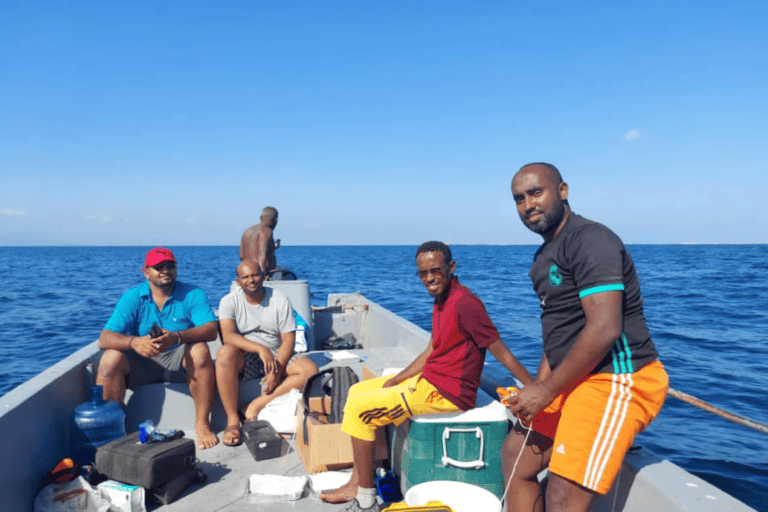
Researchers have described a new-to-science species of walking shark, which lives in the remote, shallow waters off southeastern Papua New Guinea. The newly named Dudgeon’s walking shark (Hemiscyllium dudgeonae) is a type of epaulette shark, a group of small sharks famous for their ability to use their fins to “walk” when stranded in tidal shallows. Walking sharks are nocturnal, feed on invertebrates and aren’t dangerous to humans. Christine Dudgeon of the University of the Sunshine Coast in Australia and her colleagues were surveying the waters in and around Papua New Guinea’s Milne bay after midnight when she captured a meter-long fish by hand. Dudgeon told Mongabay by email that she initially thought she’d caught a Michael’s or Milne Bay walking shark (Hemiscyllium michaeli), also known as a leopard epaulette shark, “which was the one that we were looking for.” Back on the boat and under light, Jess Blakeway, a PhD student at the university and the study’s lead author, noticed the shark’s color pattern was different from any of the walking sharks she had worked with before, according to a press release. Although all walking sharks in the genus Hemiscyllium are similar in size and shape, species can be uniquely identified by their markings, Dudgeon told Mongabay. Dudgeon added the Milne Bay walking shark has very distinctive leopard spots while the species she collected had white stripes and small brown spots all over it “and didn’t look like any of the other species at all.” Over the next two days,…This article was originally published on Mongabay
The government of French Polynesia announced it is expanding the extent of ocean where extractive industries like seabed mining and industrial fishing will not be allowed. With this move, 30% of French Polynesia’s waters will now be fully protected. Last year on June 8, French Polynesia, a French overseas territory, established the Tainui Atea marine protected area. It spans nearly 5 million square kilometers (2 million square miles) of its exclusive economic zone, the area of ocean that French Polynesia has exclusive rights to conserve and manage. Some 900,000 km2 of this (about 350,000 mi2), located near the Society Islands and the Gambier Islands, are fully protected waters where no extractive fishing or mining is allowed. On June 7, 2026, French Polynesia President Moetai Brotherson announced that French Polynesia would expand its fully protected waters by another 520,000 km2 (200,000 mi2) near the Austral, Marquesas and Western Society islands. This brings about 1.4 million km2 (540,500 mi2) or 30% of French Polynesia’s waters under full protection from extractive industries. “French Polynesia has maintained a moratorium on seabed mining in its waters since 2022, reaffirmed by the Presidency in 2025, and banning it was part of the 2025 protection commitments,” Donatien Tanret, principal officer of the Pew Bertarelli Ocean Legacy, which helped develop the conservation plan, told Mongabay by email. The protected area has artisanal fishing zones where local people are allowed to continue fishing and sustain their local communities, but industrial fishing in prohibited, Tanret said. In 2025, artisanal fishing…This article was originally published on Mongabay
U.S. President Donald Trump’s administration recently repealed the 2024 Public Lands Rule, which established that conservation should have equal priority with industry when it comes to accessing leases for U.S. public land. That shift in priorities will apply to 245 million acres (99 million hectares) of public land managed by the Bureau of Land Management (BLM). That’s roughly 10% of U.S. land that the agency leases for a multitude of private uses including grazing, mining, energy development and, until recently, conservation. In the federal register the Department of the Interior (DOI) said, “[b]y rescinding the 2024 Rule, the BLM eliminates mechanisms — such as restoration and mitigation leasing — that threatened to restrict productive use of the public lands.” An example of the decision’s impact can be found in the state of Montana. Roughly 950 American bison (Bison bison) have grazed on 63,000 acres (25,495 hectares) of federal land there since 2022. However, the DOI, which oversees BLM, revoked that grazing permit on May 8, just days before repealing the Public Lands Rule. Interior secretary Doug Burgman said that according to federal grazing laws, public land leases can only be given to animals, “intended for use primarily for their meat, milk, or other animal products.” He added that “considerable evidence” suggests the bison are intended for “for some other purpose, such as conservation.” Before western settlement, upwards of 100 million bison roamed the plains, serving as “ecosystem engineers shape[ing] healthy and diverse ecological communities,” the DOI acknowledged in its 2020 Bison Conservation…This article was originally published on Mongabay
In India’s northeast, local communities are leading the charge for the protection of the marbled cat, one of Asia’s most poorly studied small wild cat species, reports contributor Barasha Das for Mongabay India. The marbled cat (Pardofelis marmorata) is widely distributed across South and Southeast Asia. However, not much is known about its population and movement patterns because it isn’t a species many researchers specifically set out to study. It is “often studied as part of broader wild cat groups rather than through species-specific research,” Jimmy Borah, deputy director of the legal and advocacy division at conservation NGO Aaranyak, told Mongabay India. Most of what is known about the cat is from camera trap records, Borah added. One such camera trap study in Southeast Asia found that only a small proportion of the marbled cat’s range in the region lies within protected areas. Similarly, conservationists with the Eastern Himalayas Marbled Cat Project (EHMCP) used camera traps to confirm the presence of the marbled cat in parts of the states of Arunachal Pradesh, Nagaland and Meghalaya, finding that most habitats of the wild cat extend beyond protected areas. “It became clear that if conservation efforts are to be effective, we need to focus on sensitizing communities living around these forests because they interact more frequently with these species but are less aware of them,” Giridhar Malla, founder of the EHMCP, told Mongabay India. The EHMCP conducted awareness programs in villages near the cat’s habitat and engaged local youth and hunters…This article was originally published on Mongabay
Following a grueling 14-day trek, a team of mountaineers and conservationists has photographed the elusive blue-fronted lorikeet in the highlands of eastern Indonesia’s Buru Island. This is only the second photographed record of the parrot in more than 100 years, according to bird conservation groups. The blue-fronted lorikeet (Charmosynopsis toxopei) is a small species found only in the island of Buru. The bird, which has a lime-green plumage, an orange beak and a pointed tail, was first identified from seven museum specimens collected in the 1920s. The avian species went undetected despite surveys conducted in the lowland and mid-elevation forests they’re described from, until it was photographed in 2014 by Craig Robson during a birding tour, according to the Search for Lost Birds project, a global partnership between the NGOs American Bird Conservancy (ABC), Re:wild and BirdLife International. In April 2026, Indonesian mountaineering group Kanal Buru, which included researchers from ABC, Birdtour Asia and Yayasan Planet Indonesia, led an expedition in Buru. They scaled the limestone terrain of Mount Kapalatmada in the west of the island to reach a 2,700-meter (8,900-foot) summit cloud forest and successfully photographed the parrot. The team also captured its high-pitched calls for the first time. “We noticed two small birds fly into a nearby tree so I picked up my binoculars to see what one of them was,” John C. Mittermeier, director of the Search for Lost Birds at ABC and part of the expedition, said in a statement by the ABC. “I short-circuited with…This article was originally published on Mongabay
Rivers are known to naturally meander, change courses, braid and branch. But as rising temperatures melt glaciers and thaw frozen ground, the courses of Himalayan rivers are shifting and changing shape much more rapidly than before, according to a new study published in the journal Science. The rising instability of the rivers could pose a risk to water security and critical infrastructure, researchers say. The Himalayas, often referred to as the “Water Tower of Asia”, provide vital water resources for nearly 2 billion people downstream. But according to the study, in the upper high Himalayan region, where several important river basins originate, temperatures have risen nearly twice as fast as the global average in the past four decades. The researchers studied three upper high Himalayan river drainage basins: Yarlung Tsangpo, Indus and Ganges. The sources of these rivers occur at elevations of nearly 5,000 meters (16,404 feet), where there is extensive glacier, ice cover and permafrost. Meltwater from these glaciers and permafrost, which is sensitive to climate warming, forms the rivers’ primary water supply. To find out how climate change is shifting and reshaping these upper high Himalayan river basins, the researchers analyzed 40 years of satellite imagery. In particular, they measured 1,079 river bends, covering roughly 1,582 kilometers (983 miles), from 1980 to 2020. Since valleys can confine and influence river movements, the researchers chose unconfined bends or meanders that flowed freely through the landscape for their analysis. Their analysis found that the rivers’ courses were shifting sideways faster…This article was originally published on Mongabay
Founder’s Briefs: An occasional series where Mongabay founder Rhett Ayers Butler shares analysis, perspectives and story summaries. For the Karajarri people of Kimberley in northwestern Australia, the coastline, reefs, wetlands, beaches and desert-edge country form one estate, held through law, memory, work and obligation. That relationship now has new recognition, reports Mongabay’s John Cannon. In March, the Karajarri dedicated Karajarri Jurarr Ngurra, Australia’s first Sea Country Indigenous Protected Area. It covers 237,489 hectares (nearly 587,000 acres) of marine and coastal ecosystems, including part of Malumpurr, the Karajarri name for Eighty Mile Beach. The area is rich in life. Flatback turtles (Natator depressus) nest along the shore of Malumpurr. Migratory birds use the wetlands. Sawfish swim through nearby waters. These species are often recorded through science, surveys and management plans. The Karajarri know them through long presence, close observation and responsibility passed across generations. The new protected area builds on three decades of legal and political work. The Karajarri first secured recognition of their land claims. They then established a land-based Indigenous Protected Area and developed a ranger program. Sea Country protection is the next step. It gives formal weight to an existing relationship. Jesse Ala’i, formerly the Land and Sea Country manager for the Karajarri Traditional Lands Association, put it simply: “In order to have healthy Country, you need healthy people.” The reverse is also true. “Healthy people need healthy Country,” he added. Australia’s Indigenous Protected Areas now account for more than half of the country’s progress toward protecting 30%…This article was originally published on Mongabay
When invasive rats are removed from islands, the ecological benefits can ripple across both land and sea more quickly than scientists expected, according to recent research. Scientists have long assumed that meaningful recovery after the predators are eradicated would take decades. However, researchers with the U.S.-based NGO Island Conservation conducted a rat-removal experiment on Ulong Island in Palau, which provides the first experimental evidence that ecosystems can rebound far more quickly than previously expected. Until recently, rats, which are typically nocturnal, were so abundant on Ulong Island that they were regularly seen during the day. They were a nuisance to campers and deadly for wildlife. As opportunistic omnivores, rats readily prey upon seabird eggs and chicks, devastating nesting colonies on tropical islands. As a result, there were “very few nesting seabirds that we would find,” Coral Wolf, the conservation science program manager at Island Conservation, told Mongabay in a video call. To measure the effects of rat eradication, Wolf designed an experiment in which all the rats were removed from Ulong, while the rats on nearby Ngeruktabel Island remained, serving as a control site. Before the eradication, researchers collected baseline biodiversity data. On land, they recorded bird calls and took soil samples. In the surrounding water, they measured indicators like fish biomass and coral cover. One year after rats were removed, the team repeated the survey and found a dramatic improvement in the biodiversity. Freed from rat predation, seabird activity on the island surged. Detections of bridled tern (Onychoprion anaethetus) calls rose by…This article was originally published on Mongabay
On June 6, nine female white rhinos arrived in Mozambique’s Zinave National Park following a two-day translocation. Their arrival marks the culmination of nearly 10 years of rhino reintroduction efforts in the park, aimed at rebuilding a viable breeding population of the mammals in Zinave after decades of local extinction. The white rhinos (Ceratotherium simum) were transferred from the Manketti Game Reserve in South Africa and join another 30 white rhinos and 22 black rhinos (Diceros bicornis) introduced to Zinave since 2022. “[The translocation] went fantastically well,” Antony Alexander, a regional manager for the conservation nonprofit Peace Parks Foundation, which manages Zinave and organized the translocation, told Mongabay by phone. “I’m sure they’re happy to be in the wild again.” Zinave, which covers around 4,090 square kilometers (1,580 square miles) in the southern province of Inhambane, has previously been called a “silent park” after decades of civil war wiped out much of its wildlife. “You could almost sense the very low levels of life with insects and birds and smells and sounds,” said Alexander, describing Zinave before wildlife restoration efforts began. “That’s changed dramatically over the last 10 years.” Among the species reintroduced since 2016 are the critically endangered black rhino and Selous’ zebra (Equus quagga selousi), as well as the endangered African savanna elephant (Loxodonta africana), vulnerable leopard (Panthera pardus) and spotted hyenas (Crocuta crocuta). The rhinos help maintain Zinave’s ecosystem as they are bulk grazers, eating a high volume of grass. This helps prevent fire risk, as overgrown…This article was originally published on Mongabay
Government officials in Malawi have applied to withdraw bribery charges against wildlife trafficking convict Lin Yunhua, which would pave the way for his release from prison. In July 2025, a presidential pardon set Lin, a Chinese national, free from a 14-year jail sentence he’d received in 2021 connected to illegally trading in wildlife parts such as ivory, rhino horn and pangolin scales. Malawian authorities had arrested Lin, his wife and 13 members of his transnational wildlife crime syndicate in 2019. While pardoned, Lin remained in prison on charges of bribing a prison official and a judge to influence his sentencing; offenses he allegedly committed while on trial for the wildlife crimes. The Director of Public Prosecutions (DPP) Fostino Maele, has now instructed the Anti-Corruption Bureau (ACB), which brought the bribery charges against Lin, to drop those charges. Maele was previously Lin’s lawyer. Environmental and anti-corruption activists demanded that he recuse himself from the case due to a conflict of interest. But Maele did not. At the time of publishing, Maele had not responded to questions from Mongabay about reasons for dropping the bribery charges and concerns of conflict of interest. “We have a serious contradiction here,” environmentalist Charles Mkoka told Mongabay in a phone interview. “We sit in one room and plan what to do to send a strong message to wildlife traffickers that we will not tolerate their crimes. In another room, some offices are scrapping off cases of those that are engaging in wildlife trafficking. This is regrettable.”…This article was originally published on Mongabay
Common medications that billions of people take for ailments like pain, fever and infections were detected in several sites along Djibouti’s Gulf of Tadjourah in East Africa, according to a recent study. Researchers found that untreated urban wastewater contained dangerous concentrations of anti-inflammatory medicine like ibuprofen, caffeine, and the antiepileptic drug carbamazepine, which were contaminating Djibouti’s coastal ecosystem. They also detected the presence of levofloxacin, an anti-tuberculosis antibiotic, and 12 other pharmaceutical and personal care compounds. The Gulf of Tadjourah is an important marine biodiversity hotspot that is home to coral reefs, mangroves and fish nurseries. Djibouti City, home to more than 70% of the country’s population, borders the gulf. “One particularly surprising finding was the relatively high ecological risk associated with some common everyday pharmaceuticals, especially ibuprofen and caffeine,” lead author of the study Abdillahi Elmi Adaneh, an environmental chemist at the regional Observatory for Research on the Environment and Climate (ORREC) in Djibouti, told Mongabay by email. “These compounds are often perceived as ‘ordinary’ substances, yet they were among the main contributors to ecological risk in the coastal waters we studied,” he added. Ibuprofen was among the most concerning substances detected, Adaneh said. At one sampling site, where urban and hospital wastewater are dumped in the water, the team found ibuprofen concentrations hundreds of times higher than levels considered safe for aquatic organisms. “[Ibuprofen] can disrupt several biological functions in marine organisms, including reproduction, growth, enzymatic activity, and physiological responses,” Adaneh said. “Invertebrates, fish, and algae are particularly…This article was originally published on Mongabay
A large property containing a unique wetland system in Australia’s Murray-Darling Basin was transferred into long-term Indigenous ownership in 2026 for conservation. The 33,000-hectare (81,545-acre) property contains most of the Great Cumbung Swamp, located at the end of the Lachlan River in the state of New South Wales. The swamp has a mix of open water and reed beds, bordered by river red gum (Eucalyptus camaldulensis) woodlands, and is an important habitat for waterbirds, frogs, fish and reptiles. The Nari Nari Tribal Council (NNTC), an Indigenous conservation land management organization, purchased the property in January 2026 following joint fundraising efforts by the conservation NGO The Nature Conservancy (TNC) and NNTC. James Fitzsimons of TNC recently wrote about the sale of the property in Oryx. Fitzsimons told Mongabay by email that the Great Cumbung Swamp “acts a refuge when the rest of the landscape is dry,” He added that it supports threatened species such as the Australasian Bittern (Botaurus poiciloptilus), Murray cod (Maccullochella peelii) and the southern bell frog (Litoria raniformis). Each year, approximately 11,500 waterbirds visit the swamp. The wetland is not only of local, state and national significance, but has been evaluated to be listed as a Ramsar wetland of international significance, Fitzsimons said. The property had experienced decades of logging and cattle grazing. In 2019, TNC and the Tiverton Agricultural Impact Fund jointly purchased it to prevent future agricultural intensification and further degradation of the ecosystem. Fitzsimons said grazing pressures have reduced since the purchase. This, combined with…This article was originally published on Mongabay
Founder’s Briefs: An occasional series where Mongabay founder Rhett Ayers Butler shares analysis, perspectives and story summaries. Cambodia is preparing to reintroduce tigers after nearly two decades without a confirmed wild population. The plan is ambitious, and many of its basic assumptions remain contested, report Mongabay India’s Arathi Menon and Mongabay contributor Andy Ball. The last confirmed tiger sighting in Cambodia came from a camera trap in 2007. By 2016, tigers had been declared extinct in the country. The animals were lost after years of poaching, snaring, habitat degradation, and trade in tiger parts. Those pressures remain. Cambodia’s Indochinese leopard (Panthera pardus delacouri) was declared functionally extinct in 2023, and snares continue to threaten large mammals. The proposed reintroduction would use Bengal tigers (Panthera tigris) from India, released into Kravanh National Park in the Cardamom Mountains. Supporters of the program see a chance to restore an apex predator to one of Cambodia’s largest remaining forest landscapes. India has rebuilt its own tiger numbers over several decades, and Cambodia has approved a tiger action plan. A soft-release enclosure has already been built. The unresolved questions are ecological and political. Tigers need abundant prey. One 2020 study found only a low probability that the proposed landscape could support 25 adult tigers, though it might support a small founder population of five tigers. However, small populations face inbreeding risk and require sustained management. Wild pigs in the landscape may form much of the prey base, but experts disagree on whether current prey data…This article was originally published on Mongabay
Manas National Park in India’s Himalayan foothills was once home to some 100 Indian rhinos, almost all of which were wiped out by poaching by the late 1990s. After a campaign to reintroduce them, the population is growing and several calves have been born. But their recovery still needs active support, reports contributor Sneha Mahale for Mongabay India. Researchers followed the fate of 42 greater one-horned rhinos (Rhinoceros unicornis) reintroduced to Manas in the state of Assam from 2006-2021. The rhinos arrived there in one of two ways: 22 wild rhinos were translocated from other protected areas in Assam, and 20 injured or orphaned rhinos were rescued and rehabilitated at a center, then released into Manas. The rhino reintroduction program is showing hopeful signs, the decade-long study found. Between 2012 and 2022, the researchers recorded 35 rhino births in Manas: 19 calves from translocated females, and nine from rehabilitated individuals. First-generation rhino females, born in Manas, also birthed five calves; the mothers of two more calves remained unidentified. “Breeding and calving are among the most important indicators that reintroduced rhinoceroses have adapted well to their new environment,” study lead author Deba Kumar Dutta, a wildlife biologist and member of the Asian Rhino Specialist Group at the IUCN, the global wildlife conservation authority, told Mongabay India. The study also found the two groups of rhinos settled in different parts of the national park. Translocated rhinos spread out over a larger area, often using remote or less-disturbed parts of the park, while…This article was originally published on Mongabay
The intersection of environmental breakdown, climate change and economic instability has emerged as a primary threat to the resilience of smallholder farmers in Indonesia, according to researchers and local entrepreneurs who spoke at a recent convention. During the 2026 Asia Grassroots Forum, held in Jakarta on June 3 and 4, Alex Arnall, an associate professor for environment and development at the University of Reading, U.K., said climate change has become an “agent of exclusion,” creating a “double exposure” for farmers who must simultaneously navigate global market volatility and erratic weather. The Asia Grassroots Forum focused on building sustainable business ecosystems for smallholders. Previous research showed extreme weather events can affect farmers in southeast Asia by damaging crops, agricultural infrastructure like irrigation systems and farm equipment, and by increasing operational costs and reducing revenues. A 2024 report found that every 1% increase in average temperature raises the price of food production by 1% to 2% across Indonesia, Thailand, Vietnam, Malaysia and the Philippines. Researchers have also noted that smallholder farmers in the region face a massive financing gap, with less than one-third of the $100 billion needed annually for climate-smart adaptation, leaving them in urgent need of better access to credit, insurance and targeted financial support Drawing on his work with salt farmers in Thailand, Arnall described how even highly-skilled, traditional producers are seeing their knowledge “undermined” by sea-level rise and coastal change. “Farmers in many places … are losing trust in the weather patterns as they become more unpredictable,” Arnall…This article was originally published on Mongabay
Founder’s Briefs: An occasional series where Mongabay founder Rhett Ayers Butler shares analysis, perspectives and story summaries. The platypus offers a useful lesson in conservation: before acting, it helps to know where the animal still lives, and where risks are growing. Australia’s best-known oddity is also difficult to count, reports contributor Paul Harvey for Mongabay. It feeds around dawn and dusk, spends much of its life underwater in rivers, and leaves few obvious signs. That makes its decline harder to measure and harder to manage. The IUCN Red List classifies the species as near threatened, based on an estimate of about 50,000 animals, though researchers say the true number is uncertain. That uncertainty has become more important as pressure on rivers increases. Drought can shrink the pools where platypuses feed. Bushfires can damage riverbanks and nearby vegetation. Floods can inundate burrows before animals can escape. Pollution from wastewater, mining, industry, and urban runoff can reduce the aquatic invertebrates that make up much of their diet. There is room for optimism because scientists have now developed a framework for deciding when to help platypuses where they are and when animals may need to be moved. Zoos are also preparing for a clearer role in emergencies, including temporary care for animals stranded by drought, fire, or flood. Citizen science can help close the information gap. Projects that map sightings show where platypuses are still being seen. Environmental DNA, collected from water samples, can detect their presence without needing to trap or even…This article was originally published on Mongabay
Researchers have identified three new-to-science species of snake mantises, two from Australia and one from Papua New Guinea, and figured out their distribution and behavior with the help of citizen scientists. Matthew Connors, a Ph.D. candidate at James Cook University in Australia, led the effort to revisit the taxonomy of Kongobatha, a little-studied group of praying mantises known as snake mantises for the snake-like patterns on their wings. They’re also referred to as leaf-planking mantises, because they press their bodies against leaves to camouflage. The blending in helps because they are both predators of insects, including flies and mosquitoes, and prey themselves. “They have this special organ right on their chest that is a sensory thing, and it helps them flatten themselves down really nicely against a leaf, so that they’re really hard for a predator to see,” Connors said in a news release. Previously only two species of Kongobatha were known: one from Australia and another from Papua New Guinea. Now, there are three more, named K. serpens, K. spinosistyla and K. rufilinea. To describe these three species, Connors collected new specimens of the mantises and sourced others from Australian and international museums and private collections. He examined them under a microscope, focusing on male anatomical features called styli, which are a pair of small appendage-like structures located on the end of the abdomen, and may function in mating, although this remains a “mystery,” Connors told Mongabay by email. The styli of snake mantises have many spines on them,…This article was originally published on Mongabay
Researchers in Nepal have confirmed a rare Chinese pangolin living in a small community forest considered sacred by locals, according to a recent study. It may also be the first video evidence of the pangolin in Nepal’s Sunsari district, researchers said. The Chinese pangolin (Manis pentadactyla), listed as critically endangered on the IUCN Red List and protected under Nepalese laws, is threatened by both habitat loss and poaching. This makes every verified population, especially those outside protected areas, important for conservation, study lead author Tujin Rai with Tribhuvan University in Nepal told Mongabay by email. Chinese pangolins are found across Nepal. However, verified records of the species in eastern Nepal remain poor, the authors wrote. Previous research has found indirect signs such as pangolin burrows and footprints in Panchakanya community forest in Sunsari district. The community forest, spanning just 0.56 square kilometers (0.22 square miles), is located “within a mosaic of villages, agricultural lands, transportation infrastructure, and the Sewti River,” Rai said. To verify the presence of the pangolin in the forest, Rai and his colleagues installed camera traps on trails and around recently dug burrows in January 2025. On Jan. 21, 2025, the cameras recorded a male Chinese pangolin. Rai told Mongabay that during field surveys they also recorded nearly 30 pangolin burrows and other signs, especially in areas with abundant ant and termite colonies, which pangolins like to eat. These observations suggest the forest possibly supports more than a single individual; however, right now the team can only…This article was originally published on Mongabay
While on a deep-sea expedition in the Galapagos in 2015, scientists found a golf-ball sized, short-armed blue octopus. In a recent study, they confirmed that it’s new to science. The newly described octopus, named Microeledone galapagensis, was first sighted with a remotely operated vehicle (ROV) near an underwater mountain, roughly 1,773 meters (5,800 feet) below the Pacific Ocean surface close to Darwin Island. Expedition researchers from the Charles Darwin Foundation and the Galápagos National Park Directorate collected it with their ROV. They saw two more octopus individuals on video. The body of the collected specimen was preserved and sent to octopus expert Janet Voight at the Field Museum in Chicago, Illinois, U.S. Voight and colleagues at the museum scanned the octopus using computed tomography (CT) to create a 3D model of the individual. The researchers then used the CT model to examine its internal organs and mouth parts. “When you describe a new species of octopus, you have to look at all the parts, including the mouth, the beak, and the teeth. And to see those things, you have to cut the specimen open. We only had the one specimen, so I didn’t want to take it apart,” Voight said in a press release. A comparison of the blue octopus’ parts with those from other octopus species revealed that it was a new-to-science species. Unlike many octopuses, Microeledone galapagensis is small, squat, and has short, stubby arms with few arm suckers. “One of the interesting questions about…This article was originally published on Mongabay
Severed tissue from a cold-water sea cucumber can survive, heal, and even move independently for years in natural seawater, researchers recently found. Some animals have the ability to regenerate tissues and body parts. Certain lizards can regrow their tails, for example. Some sea stars and sea cucumbers, including Psolus fabricii that live in the cold waters of the Atlantic and Arctic oceans, can regrow their severed arms or halves. However, researchers in the study showed that the discarded parts of a sea cucumber, instead of dying, can also remain viable for long periods of time. “It’s like a lizard that loses its tail,” study co-author Rachel Sipler from Memorial University of Newfoundland in Canada, said in a statement. “We know some lizards can grow new tails; we’re talking about whether the tail can grow a new lizard.” Sipler and her colleagues removed parts of tentacles, feet and the main body from three Psolus fabricii individuals and placed them in natural seawater in the laboratory. The tissues showed active immune responses, cell diversification, and the ability to absorb nutrients (amino acids) dissolved in the seawater. Even when the researchers stopped the experiments after three years, the tissues continued to survive. “We haven’t grown a new, complete sea cucumber yet, but we are seeing pretty stunning growth and diversification of cells literally years after this tissue was removed,” Sipler said in the statement. Cell lines that are “immortal” and can perpetuate indefinitely are crucial for biomedical research. However, most such “immortal” cell…This article was originally published on Mongabay

 Login