“You would not believe the texts I got from these tech guys,” NYT reporters Maggie Haberman and Jonathan Swan quote Donald Trump as telling associates in an upcoming book.
“You would not believe the texts I got from these tech guys,” NYT reporters Maggie Haberman and Jonathan Swan quote Donald Trump as telling associates in an upcoming book.
Wealth tax criticized by billionaires and Gavin Newsom would levy a one-time 5% tax on residents worth over $1bn
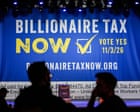
A popular proposal in California to impose a wealth tax on billionaires has gained enough signatures to qualify for the ballot in November, state officials announced on Wednesday.
The news is set to intensify an already heated debate around the tax, which has pitted tech moguls and the state’s governor, Gavin Newsom, against the labor union backing the measure.
One messy database is threatening to disenfranchise thousands or even millions of registered voters, while leaving even more at risk of intimidation or data breaches, in the name of solving a problem that barely exists.
As the 2026 midterm elections approach, election and privacy experts are sounding alarms about the Department of Homeland Security's Systematic Alien Verification for Entitlements (SAVE) Program, which President Donald Trump's administration has expanded to ostensibly catch noncitizens voting. Experts say that amounts to a dangerous, error-prone effort to centralize voter data. "The federal government doesn't have the author …
Everyone knows that Tony Blair and the Pope issued encyclicals in the last week or two. The Pope's was entitled ‘Magnifica Humanitas’; by analogy, Blair's should have been called ‘Labor Imbecilis’, says James Alexander.
In January 2026 alone, the Federal Communications Commission authorized 15,000 Starlink Gen2 satellites. Starcloud has filed for 88,000 orbital data center satellites. SpaceX has filed for 1 million. There is […]
Standing for Reform against Ed Davey's wife in a Lib Dem heartland, Chris Larkin found shy supporters, hostile middle-class lecturers and an unexpected guardian angel in a tower block.
Trump administration officials tell WIRED that if Anthropic wants to rerelease Fable 5, it will need to ensure the model's guardrails can't be circumvented. Security experts say that can't be done.
CEO of Anthropic Dario Amodei attends a working lunch with G7 leaders, G7 outreach partners, and global tech CEOs on innovation and AI, during the G7 Summit on June 17th, 2026, in Evian-les-Bains, France. | Photo: Anna Moneymaker / Getty Images
Hello and welcome to Regulator, an email for Verge subscribers about technology, politics, and what happens when science crashes headlong into self-interest. Not a subscriber? Sign up here today! Got the scoop on a petty feud that's going to somehow fundamentally reshape the entire field of frontier AI development? Send 'em over to tina.nguyen+tips@theverge.com.
Back when I was covering Donald Trump's first presidency, it was incredibly common to read three different versions of the same story. His administration had split into several factions, all of which had different interests, and all of which hated each other. There was the Reince Pr …
MILAN — Switzerland’s decision not to participate in the European Union’s Copernicus Earth observation program during the 2028–2034 funding cycle has revived a broader debate over the value of contributing […]
If United States policymakers deride the wider United Nations, they still spend on the International Telecommunication Union (ITU) because it amplifies the commercial reach of U.S. standards. This includes U.S. […]
In a bid to dismiss a lawsuit over xAI’s polluting gas turbines, the Justice Department claimed the company is integral to military operations—including the Iran War.
Anthropic was already navigating one dispute with the government in its standoff with the Pentagon, and then came an order on June 12th to block off foreign access to its most recently released AI models, Fable 5 and Mythos 5. When they launched on June 9th, Anthropic said “Fable 5’s capabilities exceed those of any model we’ve ever made generally available,” and that Claude Mythos 5 had the same underlying model, “but with the safeguards lifted in some areas.”
According to reports, the order came after conversations between Amazon and the White House about researchers saying they found ways to get Fable 5 to serve information that could be used in cyberattacks.
Anthropic responded by shutting access to both models for all customers, saying, “We are complying with the government’s legal directive and are removing access to Fable 5 and Mythos 5 for all users. However, we disagree that the finding of a narrow potential jailbreak should be cause for recalling a commercial model deployed to hundreds of millions of people.”
U.S. Sen. Marsha Blackburn (R-TN) and Majority Leader Chuck Schumer (D-NY) arrive for a news conference with bipartisan senators on passage of the Online Privacy Protection Act at the Capitol on July 30, 2024 in Washington, DC. | Kent Nishimura/Getty Images.
For months, Big Tech's Washington lobbyists have chased after the holy grail of pro-AI legislation: preemption. This would be a comprehensive federal law, passed in Congress and signed by the president, applying one set of AI rules across the entire country and overriding the legally messy state-by-state approach to regulation. For months, lobbyists have run into roadblocks and incurred nationwide political blowback, and they now face the possibility that after the midterms, Congress will flip to hostile Democrats unwilling to work with them.
But their final, most desperate attempt at preemption is coming with new baggage, related to an ent …
From the day it was announced, on June 16th, 2025, the Trump phone sounded ridiculous. The T1 Phone 8002 (gold version), as it was officially called, was a combination of contradictory specs, product images that were clearly not photographs of a real phone, and the worrying requirement of a $100 deposit to secure a preorder of a $499 phone with no release date. But none of Trump Mobile's outlandish announcements were as bold as the claim that the phone would be "designed and built in the United States."
The US has next to no phone manufacturing infrastructure, few engineers with the required expertise, and little of the affordable, flexible …
 Login