
❌

Reading view

On WASP-121 b, the evening sky runs hot enough to tear water apart, hotter than the morning sky — and James Webb caught the difference by watching the planet turn during a single transit
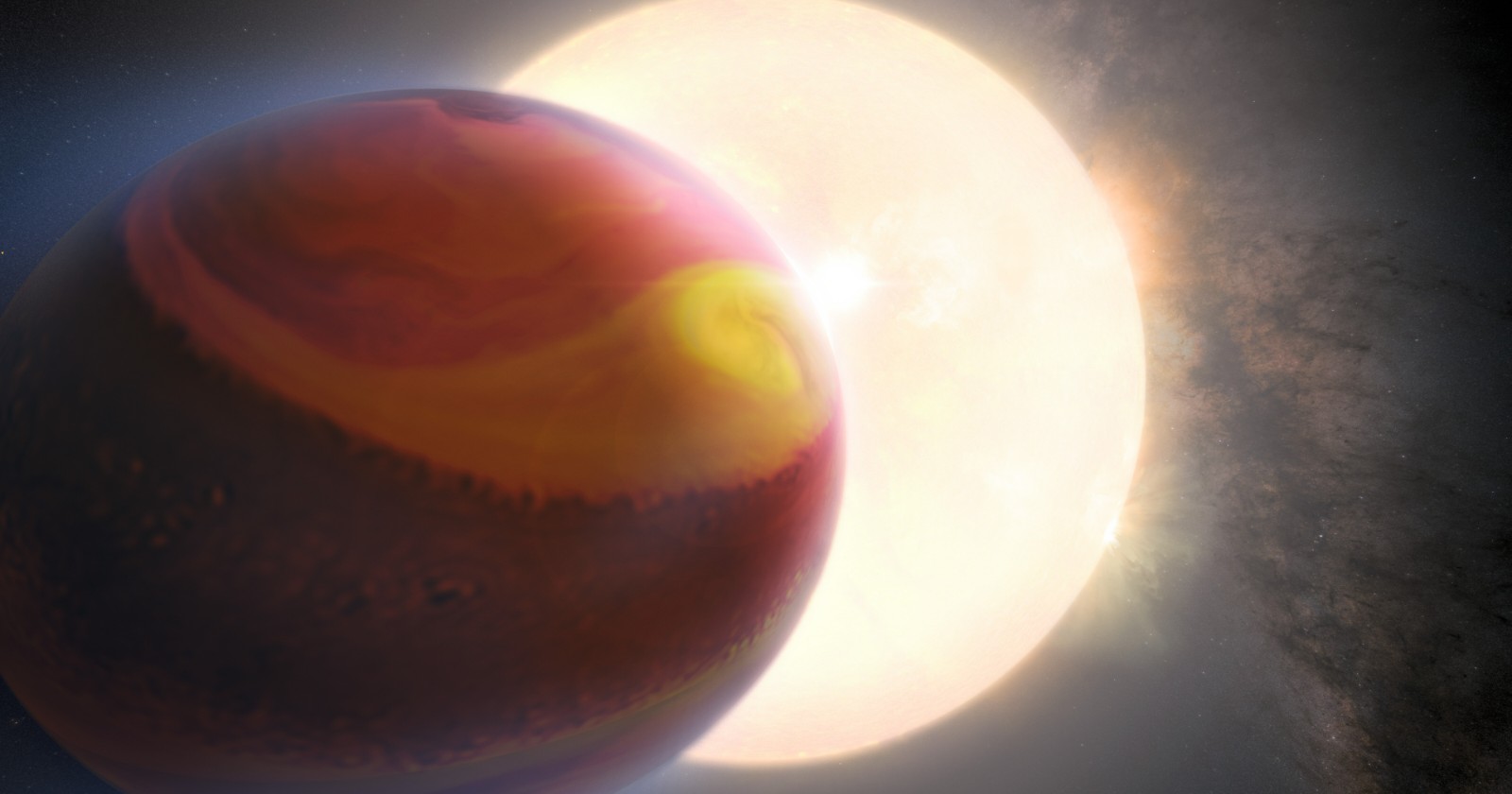
Artist's impression of the ultrahot Jupiter WASP-121 b glowing beside its bright host star, the planet's dark limb lit along its edge.

On WASP-121 b, a gas giant more than 1.5 times the width of Jupiter, the line where day turns to night is not the same temperature all the way around. The edge of the planet where evening is setting runs hotter than the edge where morning is breaking, and on the hotter side the air is fierce enough to tear water molecules into their separate atoms.

A team of astronomers reported the difference in Nature Astronomy on June 10, and the way they found it is almost as striking as the finding itself. They did not photograph the planet or fly anything near it. They watched WASP-121 b cross the face of its star with the James Webb Space Telescope and noticed that the planet’s shadow changed shape as it slowly rotated during the few hours of the crossing. That change is the first time anyone has measured a planet’s rotation during a single transit and read its weather from it.

How you watch a planet turn from light-years away

WASP-121 b is what astronomers call an ultrahot Jupiter, a gas giant with an equilibrium temperature above roughly 2,000 kelvin, which is hotter than some stars are cool. It hugs its star so tightly that a full year there lasts about 30 hours. At that range the planet is tidally locked, meaning one face is held toward the star permanently, the way the same side of the Moon always faces Earth. One hemisphere bakes in endless daylight; the other never sees the star at all.

The usual way to study such an atmosphere is transmission spectroscopy. When the planet passes in front of its star, a sliver of starlight filters through the ring of atmosphere around the planet’s edge, and different gases absorb different colors of that light. Read the colors that go missing and you can tell what the air is made of around the planet’s rim.

The new twist is timing. Because WASP-121 b is so close to its star, it turns far enough during a single transit that the slice of atmosphere backlit at the start of the crossing no longer overlaps the slice backlit at the end. So as the planet rotates, fresh longitudes swing into view, and the amount of starlight the planet blocks shifts from one moment to the next. The team, led by Cyril Gapp, built a light-curve model that allowed the planet’s apparent size to change during the transit, and tested it against the older assumption that a planet’s silhouette stays fixed. Across two separate Webb observations, the changing-size model won by a wide statistical margin.

The two stares were years apart and used different instruments: one in October 2022 with Webb’s near-infrared spectrograph, another in October 2023 with a separate slitless imager. That spread mattered, because WASP-121 b is an awkward target. It circles a hot, fast-spinning star on a tilted orbit badly misaligned with the star’s spin, close enough that the star’s gravity is slowly pulling the planet apart, and the star itself is brighter at its poles than at its equator. Each of those quirks can smear a transit on its own, so the team had to model them out before trusting that the leftover asymmetry belonged to the planet’s weather rather than to its star.

Why the evening edge runs hotter than the morning edge

The shape of the change told the team which way the temperatures ran. As WASP-121 b rotated, the side rotating into view absorbed more and more carbon monoxide while its water signal stayed flat or dipped slightly. The carbon monoxide feature grew by about 200 parts per million relative to the rest of the spectrum.

That pattern points back to heat. Water survives in cooler air but breaks apart on a scorching dayside, a process called thermal dissociation, while carbon monoxide holds together even when it is roasting. So a stretch of atmosphere rich in carbon monoxide but poor in water is a stretch that is extremely hot. The team found that signature strengthening across the evening terminator, the dividing line where the dayside rotates around toward night.

The reading lines up with a picture other instruments have been sketching for years: WASP-121 b’s dayside is lopsided, with the eastern half hotter than the western half. On planets like this a deep circulation carries heat from the permanently lit dayside toward the night side, and a strong equatorial jet drags that flow eastward, piling heat onto the evening side. Webb has now caught that lopsidedness not as a static map but in motion, by letting the planet’s own spin carry the hot air across the telescope’s line of sight.

What this does and does not prove

The detection is statistically strong, and the team did the unglamorous work of ruling out the boring explanations. They showed the asymmetry was not an instrument artifact, and not just an illusion cast by the host star’s uneven brightness, which can mimic a lopsided planet on its own.

Even so, the result comes with honest caveats, and the paper does not hide them. One of Webb’s two detectors recorded a symmetric transit while the other recorded the asymmetric one; the signal lives at the longer infrared wavelengths, which is consistent with the physics the team proposes but is a reminder that the effect is subtle. The interpretation also leans on a three-dimensional climate simulation of the planet, and that simulation does not reproduce the observed asymmetry unless its morning side is made colder by hand. In other words, the model and the data agree on the direction of the temperature difference but not yet on its size.

There is also a number worth not over-reading. The simulation puts WASP-121 b’s dayside at around 2,800 kelvin, but that is a modeled value, not a thermometer reading, and the study deliberately stops short of quoting a precise temperature gap between dawn and dusk. The honest claim is about which side is hotter and why, not by exactly how many degrees. A faint hint in the data even suggests the planet may be slightly squashed by its star’s gravity, but the team declined to make that measurement, judging the evidence too shaky to stand on.

A new way to read distant weather

What makes the work matter beyond one planet is the method. Until now, the difference between a planet’s morning and evening had to be teased out either from the static shape of its silhouette or from ground-based instruments sensitive enough to catch the Doppler shift of moving air. Using the planet’s rotation during a single transit gives astronomers a third handle, one that works at the lower resolution that space telescopes deliver.

The team points to other planets where the same trick should work, fast-rotating ultrahot worlds such as WASP-33 b and KELT-9 b, though those orbit rapidly spinning stars whose own distortions will have to be untangled first. For now, WASP-121 b stands as the test case: a world where the sky on the evening side and the sky on the morning side are different climates, close enough in the data that a telescope more than a million kilometres from Earth could tell them apart by watching the planet quietly turn.

The post On WASP-121 b, the evening sky runs hot enough to tear water apart, hotter than the morning sky — and James Webb caught the difference by watching the planet turn during a single transit appeared first on Space Daily.
  •  

An asteroid long thought to be a chunk of the Moon may be ordinary space rock instead, a new study finds, as China’s Tianwen-2 circles it to grab a sample

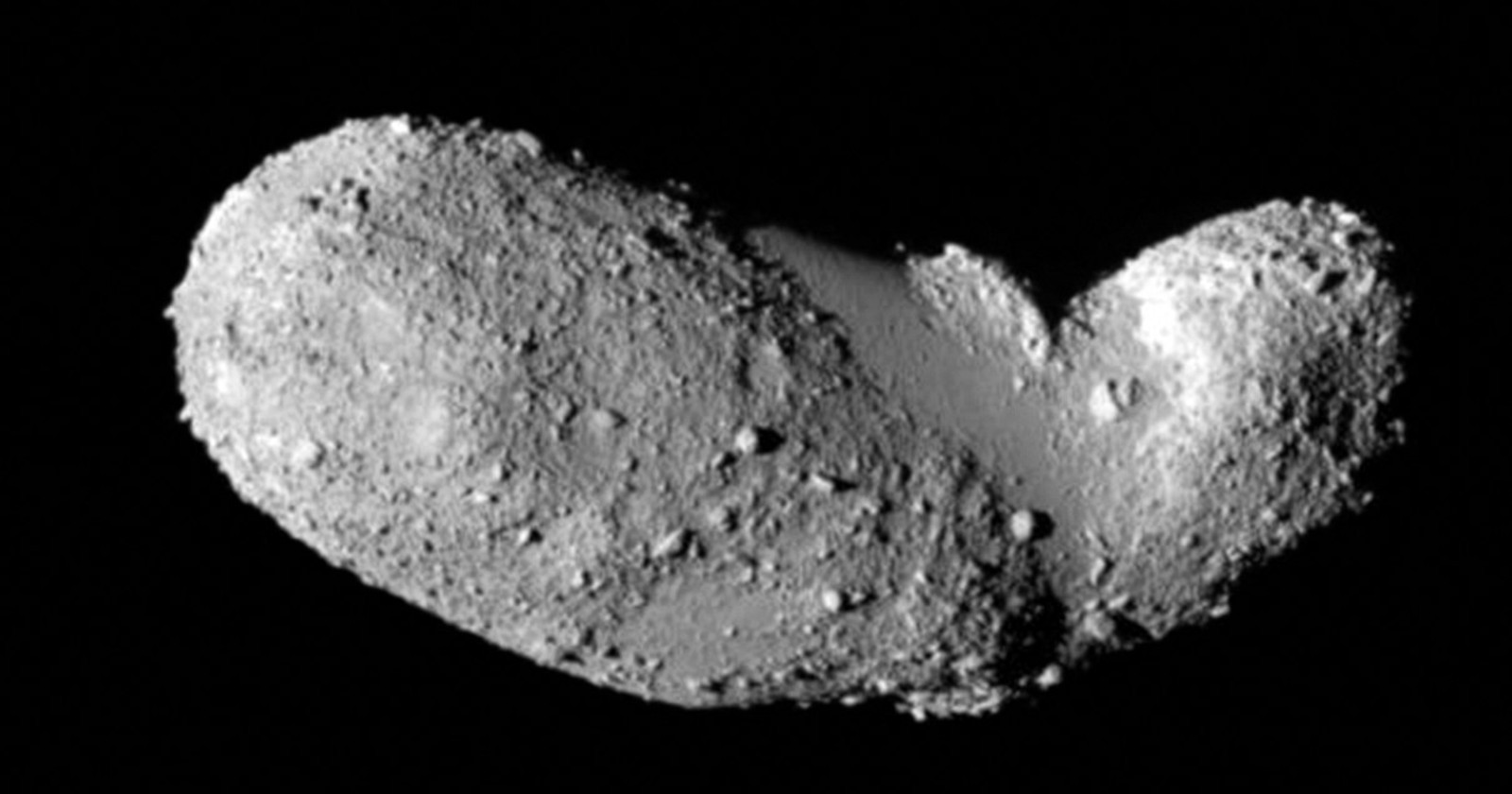
Close-up of the elongated, rubble-strewn asteroid Itokawa against the black of space.

For five years, the leading story about Kamoʻoalewa, a small asteroid that travels alongside Earth, was that it might be a stray piece of the Moon. A new peer-reviewed study argues it is probably something far more ordinary: a fragment of a distant asteroid family, weathered until its surface only looks lunar.

The timing is sharp. On or around June 7, after a 13-month cruise, China’s Tianwen-2 spacecraft slipped into orbit around Kamoʻoalewa, a maneuver tracked by independent radio astronomers even before China’s space agency formally confirmed it. Sample collection is expected within weeks. The asteroid that may decide a long-running debate about its own origin is now being circled by the machine built to bring a piece of it home.

Why the Moon theory took hold

Kamoʻoalewa was found in 2016 by the Pan-STARRS survey in Hawaiʻi, and it is one of a small set of asteroids called quasi-satellites: rocks that orbit the Sun but stay close enough to Earth to seem like loose companions. This one is the most stable of the bunch, expected to linger near us for a few hundred years. It is small, somewhere between roughly 40 and 100 metres across, and it spins fast, turning about once every 28 minutes.

Quasi-satellites are faint and awkward to observe, which is part of why this one drew such outsized attention once a clue to its makeup appeared. It sits close, it stays put for centuries, and it is bright enough to study with large telescopes during its annual passes. For an object that might preserve a record of the early Solar System, that combination is rare.

In 2021, astronomers reported that its reflected light was a closer match to lunar-like silicates than to any common asteroid type, with an unusual extra redness. That resemblance was the spark for the lunar-fragment idea. A 2024 study went further, proposing a specific birthplace: the young Giordano Bruno crater on the Moon’s far side, from which an impact could have flung debris into an Earth-like orbit.

It was a tidy and romantic picture. A souvenir of the Moon, looping around its parent planet, waiting to be collected.

What the new study actually did

Writing in Nature Communications, a large international team led from the Chinese Academy of Sciences reopened the case from three directions. First, they reanalyzed the asteroid’s spectrum and pinned down a key absorption feature at a wavelength of 1.001 micrometres, a value they report as consistent not with lunar material but with LL chondrites, a common type of stony meteorite.

Then they tested whether ordinary meteorite could be made to look like Kamoʻoalewa. In the lab, the team blasted LL chondrite samples with laser pulses to mimic space weathering, the slow darkening and reddening that solar wind and tiny impacts inflict on any airless surface over millions of years. Heavily weathered chondrite powder, they found, reproduced the asteroid’s spectrum. Solid chips of the same meteorite did not.

Finally, they traced where such an object could have come from. Their modeling points to the ν6 secular resonance, a gravitational escape route in the inner asteroid belt, and more specifically to the Flora family, a cluster of asteroids born from an ancient collision. Kamoʻoalewa’s makeup, they write, resembles the well-studied asteroid Itokawa and seven Flora-family members, only more weathered.

The resonance matters because it offers a plausible delivery route. Rocks that drift into it can have their orbits stretched until they cross Earth’s path, which is one way an inner-belt fragment could end up as a quasi-satellite rather than a lunar one. The argument, in short, is that you do not need the Moon to explain Kamoʻoalewa. An ordinary asteroid nudged out of the Flora family and aged in sunlight can account for the same colour, the same orbit, and the same odd companionship with Earth.

Why a powder, not a slab, is the key detail

That powder-versus-chip result is the quiet heart of the paper. A fresh asteroid surface and a deeply weathered one can be the same rock and still reflect light differently, and grain size matters as much as chemistry. The team’s reading is that Kamoʻoalewa is coated in fine, long-exposed dust, which is exactly what would redden an ordinary asteroid until its colour drifts toward the lunar range.

If that holds, the redness that first suggested the Moon is not a fingerprint of lunar rock at all. It is what time does to a small, slow-tumbling asteroid that has been left out in the solar wind for ages. The comparison with Itokawa carries weight here, because Japan’s Hayabusa mission already returned grains from Itokawa and confirmed it as an ordinary chondrite body. The new study places Kamoʻoalewa in that same broad company.

What this does and does not prove

This is a competing explanation, not a verdict. The authors are careful to say Kamoʻoalewa probably came from the Flora family, and the hedge is doing real work. Reflectance spectra are notoriously slippery; weathering, grain size, viewing angle and composition can all nudge an asteroid’s colour in similar directions, which is why two capable teams can look at the same faint object and reach different conclusions.

The lunar-origin case has not been withdrawn, and the dynamical argument for a recent lunar escape still has its defenders. It is also worth noting that the new paper is an early-access version of an accepted manuscript, released ahead of final editing, so small details may still change. What the study does is weaken the single strongest pillar of the Moon theory, the matching red spectrum, by showing that a plain meteorite can be pushed to look the same.

In other words, the resemblance to the Moon is real. The new work simply argues it is a coincidence of weathering rather than a sign of shared birth.

The sample that will end the argument

What makes this debate unusual is that it has an expiration date. Most arguments about an asteroid’s origin are settled, if at all, by ever-finer remote measurements. This one will be settled by holding the rock.

The stakes are not trivial. If the grains turn out to be lunar, Kamoʻoalewa becomes a free sample of the Moon’s far side, delivered to Earth’s neighbourhood without a crewed landing. If they are ordinary chondrite, the asteroid becomes a well-preserved relic of the early Solar System and a test case for how badly space weathering can disguise a familiar rock. Those are two very different prizes, and the same capsule settles which one we get.

Tianwen-2 is expected to collect material from Kamoʻoalewa within weeks and send a capsule back toward Earth in 2027, after which the spacecraft heads onward to a comet. A returned sample can be measured for the isotopes and minerals that distinguish lunar rock from a chondrite asteroid, the kind of test no telescope can perform from afar. For once, a question about where a space rock came from will be answered by the rock itself, and the answer is already on its way.

The post An asteroid long thought to be a chunk of the Moon may be ordinary space rock instead, a new study finds, as China’s Tianwen-2 circles it to grab a sample appeared first on Space Daily.

  •  
❌