Login

iPhone 17 Siri AI Features Missing: iOS 27's 12GB RAM Requirement Explained
The base iPhone 17 supports Apple Intelligence, but Apple’s 12GB memory requirement blocks its most advanced Siri AI features.

Beth Tschida, who became Jamf CEO in May after serving as CTO and as interim CEO, is the first woman to lead the company in its near 25-year history. I spoke with her this week at the London Jamf Nation event, where the company introduced its new AI Governance solution.
“It’s been a great privilege and an adjustment,” she said. “Jamf has always been a company deeply focused on culture, which is exactly why I love being here. Having the ability to influence and improve that culture from this role is something I feel very supported in doing.”
The last few years have seen a variety of changes at Jamf, which was briefly a public company. “We’ve come through a period of change, not all of it easy,” Tschida said. “But we now have a great partnership with Francisco Partners. We’re private, we’re focused on solving customer problems, and we’re finding ways to lean into what we’re good at.”
Tschida is a good choice to lead a software engineering company, as she’s an engineer herself. She originally joined Jamf as vice president for software engineering in 2018, moving up to CTO in 2022. She’s also one of the few women in leadership positions in tech. (To Jamf’s credit, the company also has CIO Linh Lam on its team.)
“I think it’s important for women to stay deep in the tech, build their skills and find their voice confidently,” Tschida said. “You’ll never know all the technology out there. Nobody does. What matters is the ability to keep adapting and evolving.”
Tschida stressed the importance of mentorship. “I feel very honored to have a chance to be a role model for other women,” she said. “I had women who forged a path for me, including a female CIO early in my career who I asked to mentor me and learned an enormous amount from. I’m certainly not the first woman in tech, but I do want to play my part in helping others grow in their careers.
“Ultimately, I want to be respected for what I do, not for my gender. That’s how everyone should be judged.”
Tschida’s product focus means she knows what matters to Jamf. “If you focus on the problems customers have and how your product can help fix them, that’ll take you to where you want to go.”
For many in the enterprise, both in and beyond the Apple space, the next big problem is AI — how to deploy it, how to manage it, and how to regulate it.
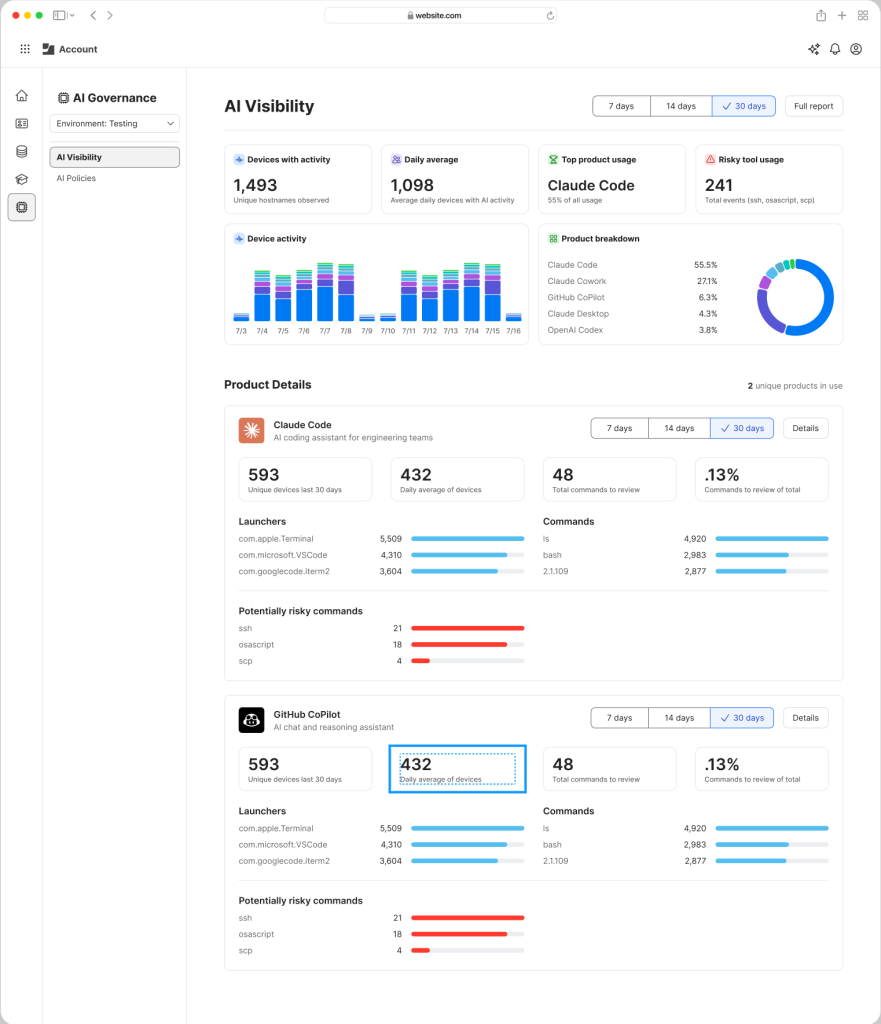
AI Governance is a new Jamf solution that has been developed in response to those pain points. Countless surveys, including Jamf’s own data, show that AI is being widely used across every company, but IT lacks visibility into its use. It’s hard to know what data is being shared with AI tools, which services are being used, and how to report on that use effectively — particularly in regulated industries.
AI Governance is designed to make it possible for anyone managing an Apple fleet to get granular insight into AI use across their Mac, iPhone, and iPad devices. It uses telemetrics to shed light on that use, offers governance and management tools to help IT gain better oversight and control over it, and provides highly comprehensive reporting tools suitable for internal or regulatory review.
“AI is happening whether organizations know it or not,” said Tschida. “That’s the problem. You can try to block it, but that’s very hard to do well. It’s far better to build visibility and governance around it.”
The offering makes it possible for companies to enable the AI use they already know is taking place while protecting corporate interests and enabling fast and accurate reporting. You can find out more details here.
Jamf’s approach is focused on endpoint management. AI Governance means IT can see what’s running on a device, categorize it, and understand what AI tools and models are in use. “If you know how people are running AI on your fleet, you can open it up safely. Then all of your customers and employees can find their way to figure out how AI is going to optimize their workforce,” she said.
What does that look like in practice? Think of it as an orchestration layer. IT can define different AI configurations for different teams: HR might use one set of models, engineers another. And admins can apply opinionated postures per group: what models are permitted, what cloud services they connect to, what’s visible to IT versus the CISO versus the CFO. “It’s an extension of what Jamf has always done, it just now applies to AI endpoints too.”
What about regulatory complexity across geographies? “A lot of governance controls are shared across regulations; a good base set is a healthy way to run regardless. But each regulation has its own twists. Our mission is to make sure customers operating in different markets can expand on that base and fit the specific models and regulations they need, getting the right configurations to the right devices.”
There’s a second dimension beyond management — cost. The industry is developing quickly, with new AI models appearing almost every week. Yesterday’s leading LLM is tomorrow’s fading star, even while the cost of AI infrastructure goes through the roof. As that churn slows, investors will want to start seeing returns on their bets, which is why token costs — the price of running AI services, at least in the cloud — are climbing fast.
As costs become more realistic, that’s going to change the nature of AI deployment from the laissez-faire, anything goes approach to a more strategic management of such use. “Models keep dropping fast, but token costs are only going to go up,” said Tschida.
“Organizations will need to decide: just because you can build something with AI, should you? What’s the right model for what work? We’re helping customers move from, ‘We’ll just block it’ or ‘We’ll turn it on and hope for the best,’ toward a place where they have a real viewpoint and can manage and change that viewpoint over time.”
The ever-changing AI world is also prompting Jamf to make more of its APIs externally available. “We’re used across every industry and every geography, at every scale,” said Tschida. “There’s no way we can build every workflow every customer needs, we’d never get to all of them.”
Embracing openness also helps build future foundations. “Thinking about where we’re heading next — agentic endpoint management — having platform APIs allows our customers to build things they can imagine, that we can learn from, in a way that solves their specific problems.”
Tschida’s comments come shortly after WWDC 2026, where Apple introduced a raft of AI advances that formed a strong foundation for its future, improvements that matter to Jamf. “When Apple innovates, Jamf celebrates,” she said.
“Apple is doing great things in their AI ecosystem, revamping Siri, expanding their AI capabilities, making Apple the platform people want to run AI on because those machines simply perform better. Our job is to take what Apple builds and bring it into the enterprise in the way that enterprises actually need it.”
Most of the industry recognizes that Apple’s enterprise story has changed dramatically as its products see accelerating use, and momentum is not slowing. Tschida reflected on how just a few years ago, Apple in the enterprise was an option in employee choice programs. “Now it’s becoming the clear choice,” she said. “We expect that trend to continue. And the more Apple invests in AI running natively on device, the stronger that argument gets.”
AI Governance is a unique answer to an increasingly important set of questions that are now beginning to affect the IT management of Apple’s platforms. (It’s not clear whether anything as sophisticated exists for other platforms at al, but as the need to manage AI grows, demand for such solutions will grow.)
Ultimately, the company’s latest move reflects Jamf’s inherent strategy under its new CEO. “Focus on customers, listen to them, solve their problems, and don’t throw tech at it. Ask: what’s the problem? Can we solve it? That focus is what takes you where you need to go.
“We’re on a good trajectory, customers stay with us, and the culture has always underpinned us. Now we’re finding ways to lean into it even further,” she said.
You can follow me on social media! Join me on BlueSky, LinkedIn, Mastodon and subscribe to The Core.


Horror is having a moment. In 2026, the genre is especially well-represented: new blood is dominating the box office through films like Backrooms and Obsession, established names like Sam Raimi and Damian McCarthy are at the top of their game, and long-running franchises like 28 Years Later and Resident Evil continue to stay relevant. But the most impressive piece of horror this year might just be found in the world of TV comedy: Widow's Bay, a series that manages the delicate balance of mixing scares with laughs, while also doubling as a loving tribute to the genre. It's the kind of combination that often doesn't work, which is part of what …

Amazon’s Prime Day is now in its second day, and whether you’re looking for a new pair of wireless earbuds or a smartwatch, there’s a good chance you’ll find a discount. The Apple Watch Series 11 has already dropped to a new low price, while the AirPods Pro 3 are discounted to $179. With Tim Cook warning that price hikes are coming, now may be the moment if you’ve been eying one of the company’s devices.
Below are the best Apple deals currently available. Some are exclusive to Prime Day, while others are simply great discounts we think are worth highlighting. We’ll continue updating this guide throughout Prime Day, highlighting more deals as they become available.


Update, June 24th: Adjusted prices and availability.
 Apple’s rumored camera AirPods could let Siri see what you see, all the time.

Now that we're clear of WWDC and all of the new AI-powered features coming to Apple's platforms, Bloomberg reporter Mark Gurman has more details about rumored new hardware, like the camera-equipped AirPods he'd previously written about. He says they are currently on schedule for a late 2027 launch, and that while we're checking out beta releases for this fall's iOS 27 update, the new earbuds are internally being tested with next year's update, iOS 28.
With cameras mounted in their stems and lights to indicate when data is being uploaded to the cloud, they could give the upgraded version of Siri "visual context" about your surroundings, be …

Apple's HomeKit Secure Video service is getting in on the Apple Intelligence party to bring more descriptive alerts from your connected cameras and let you search footage using natural language. The Apple Home app is also getting better notifications powered by AI and is finally adding support for energy reporting.
These improvements were announced at WWDC last week and will be publicly available this fall. I've been playing with some of the features in the developer betas for iOS 27 and tvOS 27 for a few days, and based on my first impressions, Apple's HomeKit Secure Video is much improved - enough to put it back in contention for me as a …

I'll just work from the car, I thought. But after a few minutes of staring at my screen on quick mountain switchbacks I could feel the first signs of cold, coagulated nausea bubbling up from that sweaty place in my gut. I looked to the horizon for relief, but nothing helped… until I remembered Apple's magic dots.
Introduced in 2024, Apple's Vehicle Motion Cues promise to tap into your device's accelerometer and gyroscope to reduce or, in my case, even eliminate the motion sickness felt when trying to use an iPhone, iPad, or MacBook inside a moving vehicle.

According to big-S Science, this type of vehicle motion sickness is caused by the e …
Italy’s antitrust regulator opened an investigation into Apple over alleged violations of the European Commission’s Digital Markets Act (DMA), centred around third-party interoperability policies with its operating systems and iCloud service.
The competition watchdog stated under DMA rules Apple must ensure third-party cloud providers are granted free and effective interoperability with iOS and iPadOS, as well as access under equal conditions to the same hardware and software features as those available to Apple iCloud.
The authority stated it had indications third-party providers “may not be placed on an equal footing” as Apple’s iCloud, pointing to the fact they appear to lack access to the same features used or made available to the in-house service.
For example, Italy’s regulator stated it appears Apple does not allow alternative cloud storage services to use iOS and iPad features enabling end users to fully backup data.
It will now conduct a deeper investigation into potential violations, before sending findings to the European Commission.
It is the first time the Italian authority has launched a probe under the DMA, which allows national authorities to launch initial investigations.
Apple has been a vocal critic of the EC regulation, which came into force in 2022 with the goal of curbing big tech dominance in favour of smaller players.
In September 2025, the iPhone giant demanded the European Union abandon the legislation, arguing it was making it harder for technology companies to do business, reduced consumer choice and created an unfair competitive landscape.
The post Italy launches Apple cloud probe under DMA appeared first on Mobile World Live.
The release of macOS 27 later this fall won't quite close the book on the Intel Mac. The last handful of models that could run macOS 26 Tahoe will be eligible for security and Safari updates for two more years, and elements of the Rosetta compatibility layer for running Intel code on Apple Silicon Macs will be with us in some form for some indeterminate amount of time after that.
But macOS 26 is definitely the last chapter of the Intel Mac story. Anything that happens after this is a coda or an epilogue.
Most of our WWDC coverage has been forward-looking, so indulge us if you will in a look backward at the full history of the Intel Mac, a partnership between two companies that made Macs dramatically better, until it started making them worse.


© David Paul Morris/Getty Images
Europe’s evangelistic approach to insisting Apple open up personal data to competing AI services is hurting Apple users in the region. More than that, it also places its entire business sector at risk, and a newly-published Jamf survey suggests why.
Announced at WWDC 2026, Apple Intelligence/Siri AI relies on personal, contextual data to run. Europe wants that same information to be made available to third-party services for competing apps, but has not worked with Apple to protect user confidentiality. It’s an approach that places your data at risk of exfiltration using those apps because Europe is insisting Apple share personal information with the developers of other apps.
The desire to protect that data is why Apple won’t distribute Siri AI in the EU for a while.
It’s not as if Europe doesn’t understand the risk of data leaks in an era of AI. Just look at the bloc’s focus on things that do matter, such as sovereign AI or managed AI services like Orange Live Intelligence. These locally-produced AI services, alongside Europe’s attitude toward them, tell me the confederation understands the risks.
How real are these risks? Very. Jamf on Monday published survey results confirming the scale of that risk, telling us that one-in-five IT and security leaders in the enterprise sector has already experienced an AI-related incident involving unexpected costs, a security issue, or both. The survey also found that:
The implication is that AI governance is becoming an operational requirement and — as Apple has told us umpteen times in the past — the best way to maintain operational confidentiality is not to collect or share any data at all. That’s the whole point of its approach: the data doesn’t need to be shared, it just needs to be turned into another signal that promotes utility while protecting confidentiality.
There’s another challenge to emerge. There are now multiple brands of AI, with more coming on stream all the time. That’s great in terms of finding a model that suits your needs, but challenging when it comes to ensuring all the services you or your employees use of are equally secure. You don’t want your business to become deeply reliant on any service only for that vendor to subsequently get bought out and/or shut down, nor do you want a service to be hacked or otherwise exploited to your detriment.
“AI isn’t arriving as a single application that IT can approve and move on from,” said Jamf CEO Beth Tschida. “It’s showing up in developer tools, productivity apps, autonomous agents, and other software they already run. The challenge is maintaining visibility and control as that footprint expands.”
The survey described the challenges IT faces with AI deployment: shadow IT, vendor sprawl, and the need to grapple with highly unpredictable use-based pricing models. And that’s even before considering the governance challenges of agentic and developer AI.
“What our survey shows is that governance must keep pace with adoption,” Tschida said. “For organizations built on Apple, the foundation is already an advantage. Apple’s privacy model and the management controls built into the platform give IT teams a strong foundation to build on and … that advantage depends on using tools built for Apple from the start.”
That’s the point of the curated, private and secured service offered by Siri AI, of course. It’s also part of what Apple is building toward with its wider ambitions toward AI on its platform. Bloomberg’s Mark Gurman discussed elements of this in his weekend newsletter, in which he suggested Apple might introduce some subscription services using AI, and that it is building an App Store for Siri Extensions, which would allow third-party chatbots to work with Siri.
What makes that model work is the curation with which Apple surrounds it, and its determination to extend Private Cloud Compute so it can protect your data even when using third-party servers (in this case, Google’s server clusters). It makes sense to think Apple intends to use that system to protect all approved third-parry AI interactions provided across its platforms by its own routes. That’s true, even if users access services free of those safeguards using a web browser, which they currently can.
But the key thing is that if Apple can get this right, offering up a managed, curated, and controllable ecosystem for AI agents and services, it will be going a long way toward building the kind of managed AI ecosystem the Jamf survey shows our modern digital enterprises increasingly need.
You can follow me on social media! Join me on BlueSky, LinkedIn, Mastodon and subscribe to The Core.