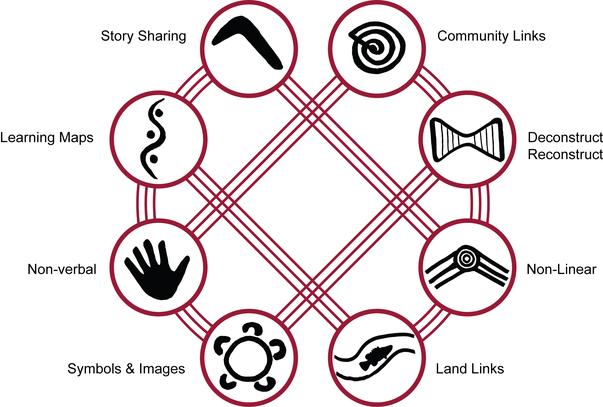
A new book from Indigenous scholar Tyson Yunkaporta of Australia explores how human narratives dictate how modern society governs itself and, crucially, how it exploits or protects the natural world. “It’s a terrible thing to … misrepresent things, make false claims, bear false witness in a way that is bending story, the story that everybody follows,” Yunkaporta told Mongabay’s newscast host Mike DiGirolamo. Yunkaporta is a Deakin University senior research fellow and member of the Apalech clan (Wik) whose traditional lands are located in far north Queensland, Australia. His book, Right Story, Wrong Story: Adventures in Indigenous Thinking, argues that identifying and correcting “wrong stories” is key to stopping environmental exploitation. A wrong story, according to Yunkaporta, is one that acts as a deceptive “curse” by presenting an illusion as if it were real to justify the exploitation of nature and community well-being through narratives that have no connection to the land. To illustrate the “wrong story” of modern resource exploitation, Yunkaporta told Mongabay the Aboriginal folk tale of Tidalik, a giant frog who hoarded all the world’s water for himself. Yunkaporta compares Tidalik to Wall Street firms and billionaires who gamble on water futures and “park their cash” in housing, exacerbating the affordability crisis while stopping the natural flow of resources. In the legend, the animal kingdom does not “eat” Tidalik; instead, an eel makes him laugh by tying himself in knots, forcing the frog to “vomit all the water back into the land.” “A lot of people…This article was originally published on Mongabay
Every April, eastern Nepal’s Tinjure-Milke-Jaljale region sees a rush of tourists, arriving for the vibrant spring bloom of rhododendrons, the country’s national flower. The flowers have now become more than a photo backdrop; they’re part of a new, unregulated market for a “souvenir:” Unlicensed rhododendron liquor. Sold openly in reused bottles with handwritten labels, the rhododendron alcohol market operates without health testing, official tracking or sustainability monitoring, Mongabay contributor Mukesh Pokhrel reports. The Tinjure-Milke-Jaljale (TMJ) region is home to at least 26 species of rhododendron (Rhododendron spp.). It has seen a massive post-pandemic tourism surge, with local officials estimating 500,000 visitors arrived from April 1-15 this year. For some families, the seasonal sale of flower-based alcohol provides supplemental income. “Tourists want something unique from here,” said Denga Lama, a resident who produces the liquor at their home. “People buy the alcohol because it reminds them of the flowers and mountains.” Forests within the TMJ region, where rhododendron plants occur, are largely managed as community forests. Nepal’s conservation laws prohibit commercial harvesting from community forests without approval. However, legal ambiguity regarding rhododendrons grown in private gardens has left officials uncertain about enforcement. When asked about bottled rhododendron liquor, Division Forest Officer Megh Raj Rai told Mongabay it was the first time he had heard about it. Rai said that if the liquor is being produced at large scales, the lack of oversight poses potential public health risks. Certain rhododendron species contain grayanotoxins, neurotoxins that can potentially be fatal; although, the risks…This article was originally published on Mongabay
As rising temperatures, shifting rainfall, and increased pest pressure reduce yields and quality of Arabica and Robusta coffees, the two species that account for nearly all commercial production, researchers and growers are turning to overlooked coffee species for a more climate-resilient future, Mongabay-India contributor Meena Menon reports. Arabica (Coffea arabica) and Robusta (C. canephora) have long dominated the global coffee industry. Other coffee species such as Excelsa (C. dewevrei) were previously relegated to the margins of coffee plantations as boundary markers or shade trees in India. Akshay Dashrath, co-founder of the South India Coffee Company (SICC), is leading efforts to re-evaluate Excelsa for its potential resilience. According to the SICC, a British planter introduced Excelsa to India in the late 1800s as an alternative to Arabica. However, it grew tall and dense, making it an impractical crop to manage and commercialize. Dashrath’s farm in Kodagu district in Karnataka state has 60-year-old Excelsa trees that his family preserved, which are now a source for trials aimed at scaling production. His company is collaborating with the Royal Botanic Gardens, Kew to do the research. Aaron Davis, a senior research leader at the Royal Botanic Gardens, said that the dominance of Arabica and Robusta in the global markets could see major disruptions in the next decade or so from other coffee crop species adapted to altered climates. Excelsa, native to parts of Tropical and West Africa as well as Southeast Asia, is already being scaled in Uganda and Vietnam. According to Kiwuka Catherine,…This article was originally published on Mongabay
Kyrgyzstan has officially designated a massive stretch of its high-altitude landscape as a protected corridor for snow leopards and other mountain wildlife. The Ak Ilbirs ecological corridor, formalized in 2025, spans nearly 800,000 hectares (2 million acres) and was designed with the future climate in mind, Mongabay’s Liz Kimbrough reports. The corridor connects several existing protected areas in the country, as well as pastureland, forest and other ecosystems across 14 rural municipalities to ensure wildlife, including snow leopards (Panthera uncia), can move freely as climate change shifts their habitats. The project was spearheaded by the Central Asian Mammals and Climate Adaptation (CAMCA) initiative, led by the U.N. Environment Programme (UNEP) in collaboration with the Kyrgyz government, Humboldt University of Berlin, and local conservation groups including CAMP Alatoo and Ilbirs Foundation. Murat Zhumashev, director of CAMP Alatoo, said that while the Ak Ilbirs corridor carries official protected area status, it functions differently from most. “The ecological corridor in Kyrgyzstan is based on a regulatory rather than a restrictive approach,” Zhumashev and his colleague Salamat Zhumabaeva told Mongabay by email. “It builds on existing environmental legislation, but unlike strictly protected areas, it does not involve land withdrawal or the introduction of strict prohibitions.” To design the corridor, scientists at Humboldt University “applied a combination of expert local knowledge, climate predictions and technical expertise to build the narratives for the future scenarios,” Julieta Decarre from Humboldt told Mongabay by email. Under future climate emissions scenarios, more than 60% of suitable habitat for snow…This article was originally published on Mongabay
Manas National Park in India’s Himalayan foothills was once home to some 100 Indian rhinos, almost all of which were wiped out by poaching by the late 1990s. After a campaign to reintroduce them, the population is growing and several calves have been born. But their recovery still needs active support, reports contributor Sneha Mahale for Mongabay India. Researchers followed the fate of 42 greater one-horned rhinos (Rhinoceros unicornis) reintroduced to Manas in the state of Assam from 2006-2021. The rhinos arrived there in one of two ways: 22 wild rhinos were translocated from other protected areas in Assam, and 20 injured or orphaned rhinos were rescued and rehabilitated at a center, then released into Manas. The rhino reintroduction program is showing hopeful signs, the decade-long study found. Between 2012 and 2022, the researchers recorded 35 rhino births in Manas: 19 calves from translocated females, and nine from rehabilitated individuals. First-generation rhino females, born in Manas, also birthed five calves; the mothers of two more calves remained unidentified. “Breeding and calving are among the most important indicators that reintroduced rhinoceroses have adapted well to their new environment,” study lead author Deba Kumar Dutta, a wildlife biologist and member of the Asian Rhino Specialist Group at the IUCN, the global wildlife conservation authority, told Mongabay India. The study also found the two groups of rhinos settled in different parts of the national park. Translocated rhinos spread out over a larger area, often using remote or less-disturbed parts of the park, while…This article was originally published on Mongabay
World Oceans Day is celebrated every June 8 to raise awareness about the conservation of Earth’s oceans. In honor of World Oceans Day 2026, the United Nations is focused on marine protected areas (MPA), and the goal of protecting 30% of the world’s oceans by 2030. The world collectively reached a third of the goal in April 2026, MPAs now cover 10% of oceans. Another 20% will need to be protected over the next four years to reach the 30% goal. New Marine Protected Areas The latest additions of MPAs included 284 marine or coastal protected areas in Indonesia and Thailand. This year, Ghana also declared its first MPA, the Greater Cape Three Points MPA, after more than 15 years of efforts. And in September 2025, Pakistan protected the key biodiversity hotspot of Miani Hor Lagoon, home to dalmatian pelicans (Pelecanus crispus) and great black-headed gulls (Ichthyaetus ichthyaetus). French Polynesia, a Pacific territory controlled by France, declared the world’s largest MPA in June 2025. It covers the archipelagos’ entire exclusive economic zone; 4.8 million square kilometers (roughly 1.9 million square miles) of ocean gained official protection with overwhelming local support. Some MPAs allow bottom trawling While there has been progress, experts have also highlighted that some MPAs do not have enough protection. Throughout Europe, many MPAs still allow bottom trawling, a damaging fishing practice that drags weighted nets across the seafloor. Though bottom trawling targets just a few commercially viable species, a recent study found such nets collect roughly 3,000 distinct…This article was originally published on Mongabay
Across the small islands of eastern Indonesia that lie within the Wallacea region, one of the world’s richest marine biodiversity regions, coastal communities are reviving ancient customary systems to safeguard marine ecosystems from destructive fishing and habitat loss. This movement is the centerpiece of Jejak Wallacea, a recent documentary highlighting how local empowerment can succeed where top-down conservation often fails, reports Mongabay’s Hans Nicholas Jong. The film features initiatives across four provinces: East Nusa Tenggara, South Sulawesi, Southeast Sulawesi and Central Sulawesi. These communities have turned to locally rooted methods of reverse biodiversity loss, such as seasonal fishing closures, customary sanctions and mangrove restoration. In Solor, East Nusa Tenggara, residents established traditionally protected marine areas that they refer to as “marine granaries” (kebang lewa lolon) to restore coral reefs and created turtle hatcheries. They are also moving away from harmful blast fishing. “What we chose was conservation, but based on local wisdom,” Vero Lamahoda, director of the local foundation Yayasan Tanah Ile Boleng that is supporting the communities in the transition, said in the documentary. In Southeast Sulawesi, the village of Wabula employs a customary system called Kaombo, which regulates access to traditionally protected areas like seagrass beds and mangroves. Violators face customary fines or rituals like Kaleo Leo, where suspects are dunked into the sea, and the individual who surfaces first is considered the guilty party. Similarly, communities on Langkai and Lanjukang islands in South Sulawesi utilize periodic closures of marine areas for octopus fishing to allow populations to…This article was originally published on Mongabay
Tshopo province in the Democratic Republic of the Congo granted 31 community forest land titles to farmers in May, bringing a total of more than a million hectares of forest in Tshopo under the legal stewardship of local Indigenous peoples. Bantu and Indigenous Mbuti communities have lived in the province for generations, but without official title or control of their own lands and under the ever-present threat of extractive and development projects without their consent. Community Forestry Lands (CFLCs) include community environmental management plans. They also offer legal tenure that’s meant to ensure any development on those forest lands requires the free and informed consent of the communities holding the tenure rights. According to the deforestation-tracking platform Global Forest Watch, Tshopo province lost roughly 46% of its total tree cover between 2002 and 2025, largely driven by timber harvesting, charcoal production and mining. These activities degrade the ecosystem and destabilize the livelihoods and food systems of indigenous peoples. “[E]xtreme poverty is gaining ground among indigenous peoples and local communities, for whom the forest is more of a habitat than a source of vital goods and services,” Alphonse Maindo, director of the environmental NGO Tropenbos DRC that helped the communities obtain CFLCs, told Mongabay’s Didier Makal. The recently granted community forest concessions in Tshopo, when added to other such community management areas, means nearly 6.3 million hectares (15.5 million acres) of secured land in the DRC. That’s an area roughly the size of Togo. Some local residents are planning to start beekeeping and cocoa…This article was originally published on Mongabay
In the remote, over-the-water village of Muara Enggelam in East Kalimantan, Indonesia, the introduction of reliable solar energy has become a catalyst for female entrepreneurship and economic stability. Historically cut off from basic services and reliant on expensive, noisy diesel generators that ran only from dusk to dawn, the village underwent a transformation starting in 2015 following a solar power allocation from Indonesia’s energy ministry, reports Mongabay Indonesia contributor Yuda Almerio. For women like Asniah, a mother of three, 24-hour electricity thanks to a solar array meant the ability to scale a home business. She began using electric blenders to produce amplang (fish crackers), a task that was previously difficult due to the high cost and unreliability of diesel fuel. “Using a blender was a bit of a worry, because the fuel would run out quickly,” Asniah told Mongabay Indonesia. “A liter [of diesel] wouldn’t last an hour — now it’s much more convenient.” Asniah has since expanded her ventures to include a food stall and a digital boutique, utilizing social media for marketing. Muara Enggelam’s solar infrastructure is managed by a village-owned enterprise, BUMDes, led by Jam’ah, a mother of one. This makes it a rare example of female leadership in the energy sector; the United Nations Development Program estimates that women make up less than 5% of energy managers in Indonesia. “Using a generator was expensive, that’s why so few people started businesses,” Jam’ah said. “The solar energy has been a relief for people.” While Muara Enggelam serves…This article was originally published on Mongabay

 Login