❌

Reading view

Ex-Tesla exec builds the home heat pump Tesla gave up for robots

Drew Baglino spent nearly two decades building Tesla’s batteries, motors, and power electronics. Now the former Tesla SVP is quietly building the one home energy product Tesla talked up for years and never shipped: a residential heat pump.

His startup, Sadi Thermal Machines, is a direct bet on an idea Tesla floated openly in 2022 β€” before the company reoriented itself around humanoid robots and robotaxis.

  •  

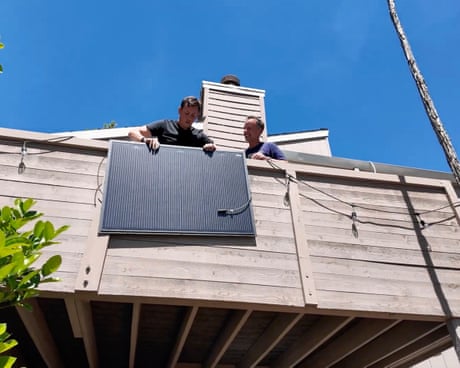
Retail giants join UK government drive to boost β€˜plug-in’ balcony solar panels

Asda, Amazon and B&Q among retailers in talks to sell devices that feed into household sockets and can cut electricity bills by 30%

Bosses of some of Britain’s biggest retailers are discussing plans with the government to start selling plug-in solar panels as part of a drive to encourage more UK homes to generate their own electricity.

Executives from brands including Currys, B&Q and Amazon met Martin McCluskey, the minister for energy consumers, on Tuesday to discuss guidelines for selling β€œbalcony solar panels” to the British public.

Continue reading...

Β© Photograph: Climate Central

Β© Photograph: Climate Central

Β© Photograph: Climate Central

  •  

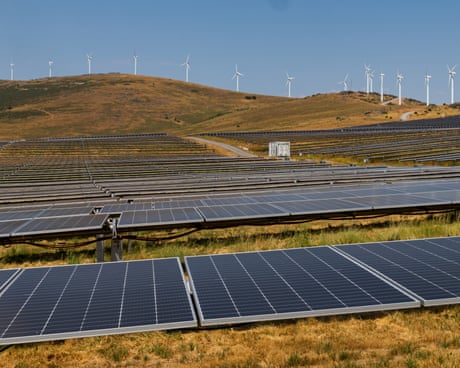
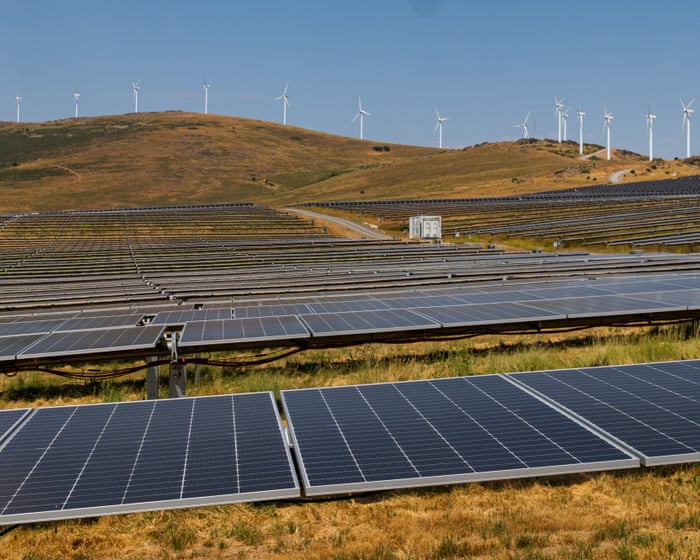
Spanish households save €10 a month thanks to renewables expansion, report finds

Thinktank says decoupling electricity from gas prices has also helped shield Spain from hikes caused by Iran war

Spanish households save €10 a month on electricity bills because of wind turbines and solar panels installed in the last five years, a report has found.

Typical energy bills would be 19% more expensive if electricity costs were still as tightly coupled to gas prices as in 2021, according to Ember, a climate thinktank. It found Spain’s β€œstrategic” expansion of renewables since Russia invaded Ukraine in 2022 has shielded Spanish households from the latest rises in fossil fuel prices caused by the Iran war.

Continue reading...

Β© Photograph: Bloomberg/Getty Images

Β© Photograph: Bloomberg/Getty Images

Β© Photograph: Bloomberg/Getty Images

  •  

When Data Centers Come for Your Backyard

As data centers sprout across Georgia, the state’s utility providers are building new power lines to meet the demand for electricity. We speak with residents in Fayetteville, about 25 miles south of Atlanta, who say the new lines will run through their backyards and make it impossible to resell their homes at their current value.
  •  

US-Iran Peace Agreement Prompts Stock Rally, Leaves Some Investors Skeptical and Questions on Speed of Resuming Oil Production

"Asian stocks rallied Monday while oil prices tumbled," reports CNBC, "after the U.S. and Iran agreed to a peace deal aimed at ending nearly four months of conflict..." The strongest reaction was seen in energy markets. U.S. crude oil futures for July delivery were down 4.77% to $80.83 per barrel by 8:27 p.m. ET. Brent futures, the international benchmark, for August delivery traded about 4% lower to $83.77 per barrel. Asian equities surged. South Korea's Kospi jumped 5.1%, Japan's Nikkei 225 climbed 3.6%, and the broader Topix advanced 2.6%... The U.S. dollar index weakened 0.32% to 99.483, while the yield on the benchmark 10-year Treasury note fell 5 basis points to 4.423%, suggesting that investors were dialing back inflation concerns on easing energy prices. "The most immediate implication is a repricing of the inflation risk premium that markets have been carrying since the Strait closed," said Billy Leung, investment strategist at Global X ETFs... Besides safe-haven Treasurys, gold also rose. "Gold is the interesting outlier here," Leung said. "In a clean risk-on trade, gold should be selling off as the geopolitical premium unwinds, but it is holding bid around $4,300, which tells you the market is not fully trusting the deal yet." Spot gold prices were up almost 2% at $4,302.19 per ounce. That skepticism reflects lingering uncertainty around the agreement, which remains unsigned and subject to implementation risks. [Josh Gilbert, lead Asia Pacific analyst at trading platform eToro] cautioned that "the deal isn't actually signed until June 19th, the details are still thin, and this conflict has shown more than once that headlines can turn on a dime." Analysts at Commonwealth Bank of Australia also stressed that the oil outlook hinges on how quickly shipping and production can normalize. Vivek Dhar, head of commodities and sustainability research at CBA, expects Brent to fall to around $80 a barrel by year-end, assuming the Strait remains open and exports recover. However, he warned that damage to refining infrastructure, the presence of sea mines and uncertainty over tanker traffic could slow the return to normal operations. Even so, he said markets are likely to take comfort from the prospect that oil flows need only recover to around 60%-70% of pre-war levels to restore expectations of a global supply surplus. For investors, the biggest implication will likely be what cheaper energy means for inflation and central banks. Lower oil prices ease pressure on households and businesses while reducing the risk of a broader inflation resurgence just as major central banks enter a busy week of policy meetings. UPDATE: "A US official is rejecting Iran's assertion that it will receive billions of dollars in frozen funds before a planned 60-day negotiating period begins following Friday's signing of an agreement," reports CNN: The pushback came after Iran's deputy foreign minister, Kazem Gharibabadi, said the next phase of talks would depend on Washington first fulfilling several obligations, including releasing Iranian funds frozen abroad. The differing accounts underscore a significant gap between how the United States and Iran are describing what must happen before the next round of negotiations can move forward.

Read more of this story at Slashdot.

  •  

GM Updates 250,000 EVs with Vehicle-to-Grid Firmware, Announces Grid-Scale Sodium-Ion Batteries

"Battery breakthroughs will lessen AI's demand on the electricity grid," argues The Washington Post's editoral board, arguing that GM's latest moves "offer a fresh reminder that resource constraints can be solved by innovation." Or As Fortune put it, "America's electric grid is buckling under extreme weather, aging infrastructure, and an AI build-out that is quietly rewriting U.S. power demand β€” and General Motors wants to turn that crisis into a business." They describe GM's plan as offering itself "as a distributed utility in disguise... stitching together hundreds of thousands of battery-powered cars, new grid-scale storage, and a unified charging platform into what amounts to a virtual fleet of power plants." The bet puts GM on a collision course with Ford's newly branded Ford Energy unit as both Detroit rivals race to repurpose underused EV capacity for a more urgent problem: keeping the lights on in the AI era. GM's case rests on three planks. The first is its existing fleet. GM says more than 250,000 of its EVs on U.S. roads can already charge bidirectionally β€” pulling electricity from the grid and sending it back. "Every evening, a quiet transformation occurs across the American landscape," GM Energy vice president Wade Sheffer writes in an open letter to utilities and regulators, describing the EVs sitting in driveways as "a massive opportunity to aggregate energy storage capacity." A firmware update is rolling out to customers with GM Energy's vehicle-to-home hardware, converting those systems into full vehicle-to-grid assets with no new hardware and turning home backup systems into grid resources when utilities need them. GM is piloting the idea in Michigan with DTE Energy at 30 employee homes, and has sketched a 2030 vision with Pacific Gas & Electric in which more than 52,000 GM EVs help balance the grid out of a projected 130,000 vehicles in the area. GM is also "seeking partnerships with utility companies nationwide to assist in offering such vehicle-to-grid services for customers," reports CNBC, noting it's one of two moves "meant to address concerns about rising energy costs amid an artificial intelligence boom." Forbes reports that GM's second goal "is to leapfrog the dominant battery cell tech used for energy storage packs right now" β€” right past the LFP (lithium-iron phosphate) stage, "which is dominated by China." Sodium batteries are cheaper to use than LFP because they don't need an additional cooling system. They also have a 20-year usable life and are made from materials that can be sourced from within the U.S., the company said at a briefing in San Francisco on Tuesday. "Sodium-ion actually is the better chemistry for that application. And when I say sodium-ion is better, I mean GM's version of sodium-ion," Kurt Kelty, GM's battery chief and a long-time Tesla battery executive, told Forbes. He said GM is seeing great results from its prototypes, even at scorching temperatures of 55 Celsius (131 Fahrenheit). "Sodium-ion-powered energy storage systems have the potential to operate without active cooling and with much less system complexity," Kurt Kelty, GM's vice president of battery and sustainability, said Tuesday in a blog post. "In large energy storage systems, that matters." Not having to cool the battery cells could lead to lower upfront costs as well as operating costs, the automaker said. TechCrunch reports on GM's big new partnership with energy-storage startup Peak Energy to develop GM's sodium-ion battery chemistry for grid-scale deployments: GM wouldn't share with TechCrunch how much money it is investing in this energy-storage effort. But we do know the company has committed $900 million to commercialize new battery chemistries, an investment that includes a new battery-development center. .. The first GM cells are expected to enter trial production at the company's Battery Cell Development Center in 2028. "Our next-generation sodium-ion cell development will drive energy density higher," promises GM's blog post, arguing they're extending the company's battery expertise and technical infrastructure "into the electrical grid itself. If we get this right, we will not just build better batteries. We will help create a more resilient, more affordable and more flexible energy future... Every improvement we make strengthens the development stack that supports both EVs and energy storage." "The message: GM isn't just selling cars into a stressed grid; it's supplying the batteries to stabilize it," argues Fortune. And GM also announced they're augmenting their apps with an "Energy Pass" offering "seamless access to Tesla Supercharger, IONNA, Electrify America, and soon, ChargePoint and EVgo networks." Their goal is to simplify the charging experience with an app "that covers nearly 70% of all DC fast chargers in the United States, plus many Level 2 chargers, all through one app."

Read more of this story at Slashdot.

  •  

World's First Crewed Solid-State Flight Electrifies Aviation's Future

The Helios Horizon has completed what its developers call the first crewed, fixed-wing flight powered by solid-state batteries. New Atlas reports: On June 5, test pilot Miguel Iturmendi lifted off from Zephyrhills Municipal Airport in Florida at the controls of the Helios Horizon -- the first crewed, fixed-wing aircraft ever to fly on solid-state batteries. The flight was neither spectacular in distance nor in duration -- it was a series of short tests to validate the aircraft's weight and balance after the new batteries had been installed -- but it didn't need to be to make history. [...] The Helios Horizon's previous lithium-ion pack delivered 260 Wh/kg (watt-hours per kilogram, a measure of how much energy a battery holds relative to its weight). The new solid-state cells hit 410 Wh/kg, a 60% jump. Chief test pilot and company founder Miguel Iturmendi expects that figure to grow another 40% within two years. Though the battery pack can be topped up over any AC outlet, no special infrastructure needed, fast-charging is also supported for up to 80% capacity in under 15 minutes. The aircraft also recovers energy in flight through wing-mounted solar panels and a regenerative system that spins the propeller as a wind turbine during glides and descents. "Regenerative flight can significantly extend the aircraft's range," Iturmendi said after the test flights. The Helios Horizon itself started life as a Pipistrel Taurus motorized glider. Iturmendi's team added proprietary battery management, a custom propulsion stack, thermodynamic controls, and solar panel wing extensions. The aircraft already holds the world altitude record for electric planes in its weight class, having reached 24,000 ft (7,315 m). The next goal is 40,000 ft (12,192 m), commercial cruising altitude, in stratospheric flights planned for later this year.

Read more of this story at Slashdot.

  •  

Renewable Groups Ask Courts to End Pentagon’s β€˜Total Halt’ of Wind Power

More than 100 planned wind farms in 21 states are now stalled indefinitely as the Pentagon delays military reviews once seen as routine.

Β© Brandon Thibodeaux for The New York Times

The freeze affects 41 wind projects in Texas, which produces more wind power than any other state in the U.S., as well as projects in Colorado, Illinois, Iowa, Kansas, New Mexico, Oregon and Washington.
  •  

Hormuz: The Slow-Motion Crash

The economic shock of the closure of the Strait of Hormuz has sparked calls to abandon fossil fuels faster. But that's the wrong lesson, says Richard Lyon – and Net Zero obsessed Britain will learn this the hard way.

The post Hormuz: The Slow-Motion Crash appeared first on The Daily Sceptic.

  •  

Solar generates more energy in US than coal for first time

Solar supplied 12.8% of US electricity in May even as Trump boosts coal over clean energy

Even as Donald Trump boosts coal over clean energy, solar power is hitting new milestones in the US and remains the leading source of new power.

Data released on Wednesday by the global energy thinktank Ember, along with a report by the Solar Energy Industries Association (Seia) and analytics firm Wood Mackenzie, show the continued growth of solar and decline of coal in the United States despite federal policy. In May, for the first time, solar supplied more of the nation’s electricity than coal, or 12.8%, Ember said. Coal supplied 12.2%, its fourth-lowest monthly share ever.

Continue reading...

Β© Photograph: Angela Piazza/The Dallas Morning News via Getty Images

Β© Photograph: Angela Piazza/The Dallas Morning News via Getty Images

Β© Photograph: Angela Piazza/The Dallas Morning News via Getty Images

  •  

Democrats Once Vowed to Stop Oil and Gas. Now They’re Not So Sure.

As the midterm elections approach, many leading Democrats are rethinking their approach to climate change.

Β© Anna Moneymaker/Getty Images

A talk on rising energy costs on Capitol Hill hosted by Democrats, from left, Sen. Martin Heinrich of New Mexico, Senate Minority Leader Chuck Schumer and Sen. Sheldon Whitehouse of Rhode Island, in March.
  •  

Solar Beats Coal In the US For the First Month Ever

An anonymous reader quotes a report from Electrek: Solar generated more U.S. electricity than coal for the first month on record in May 2026, according to new analysis from global energy think tank Ember. Solar supplied 12.8% of U.S. electricity during the month, while coal dropped to 12.2%. That's a dramatic shift in the U.S. power mix. Just five years ago, coal generated 19.7% of U.S. electricity in May, while solar accounted for only 5.4%. U.S. solar generation hit a record 45.5 terawatt-hours (TWh) in May 2026, up 17% from May 2025 and higher than the previous record set last July. Ember says another record could be broken again this summer. Solar output usually peaks in June or July, but its share of the electricity mix is often highest in spring, when strong sunshine lines up with milder temperatures before summer cooling demand ramps up. May was also the first time solar became the third-largest individual source of electricity in the U.S., behind only natural gas and nuclear. (If solar is included with all other renewables, then they're the second-largest source of electricity as an overall category of electricity.) Meanwhile, coal keeps sliding (and will continue to slide). Coal generation hit an all-time monthly low of 39.3 TWh in April 2026. Output rose slightly in May to 43.4 TWh, but it was still 11% lower than May 2025 levels. Even with that small rebound, coal couldn't keep pace with solar's rapid growth.

Read more of this story at Slashdot.

  •  

A question for Nigel Farage – why is your nationalist party so obsessed with destroying British jobs? | George Monbiot

The net zero economy is booming, so claims that prosperity depends on oil and gas are bunkum – unless you’re a Reform backer with fossil fuel interests, of course

Really? You want to destroy a million jobs? Vote Reform UK for mass unemployment: is that your pitch? Hammer these questions home whenever you meet a supporter of the party. Or, for that matter, a Conservative, as their party now takes an almost identical line.

The figures are stark. They were compiled not by Just Stop Oil or the Green party, but by that bastion of conservatism, the Confederation of British Industry. They show that the net zero economy now directly employs more than 300,000 full-time workers, while supporting the jobs of 1.1 million. The net zero sector is worth Β£100bn to the UK already, and is likely to grow by hundreds of billions more. The rest of the green economy directly employs a further 600,000.

Continue reading...

Β© Photograph: Tolga Akmen/EPA

Β© Photograph: Tolga Akmen/EPA

Β© Photograph: Tolga Akmen/EPA

  •  

More than half of clean energy schemes needed for Labour’s 2030 target offered grid connection

The 700 projects include wind and solar farms, battery storage, gas and hydro plans

More than half the renewable energy projects needed to meet the government’s clean power targets by 2030 are now able to plug into the electricity grid after years of delay, according to the system operator.

The National Energy System Operator (Neso) has offered more than 700 clean energy projects in Great Britain a grid connection date since the start of the year, after a two-year process to unblock a bottleneck that threatened to delay projects into the 2030s.

Continue reading...

Β© Photograph: Murdo MacLeod/The Guardian

Β© Photograph: Murdo MacLeod/The Guardian

Β© Photograph: Murdo MacLeod/The Guardian

  •  

G.M. Plans to Develop Energy Storage Batteries as E.V. Sales Flag

The carmaker will follow Tesla in making components for large batteries used by electric utilities, data centers and other businesses to handle fluctuations in power supply and demand.
  •  
❌