Researchers at the Department of Energy's Manufacturing Demonstration Facility at Oak Ridge National Laboratory have introduced an innovation in additive manufacturing by integrating origami-inspired 3D printing techniques with hybrid composites—materials made from mixed reinforcing components. By eliminating the need for molds to fabricate a part, this process produces lightweight, cost-efficient structures with faster build times and greater adaptability.
A research team led by The Chinese University of Hong Kong (CUHK) has developed a novel integrated all-optical signal processor (OSP) to address the massive data transmission demands of next-generation AI systems, particularly for high-speed links between multiple data centers.
To accommodate the increasing demand for clean energy, researchers have been developing floating solar panels for rivers, reservoirs and other waterways in recent years. While there is, of course, plenty of land for solar farms, problems arise when these projects clash with farming and nature conservation.
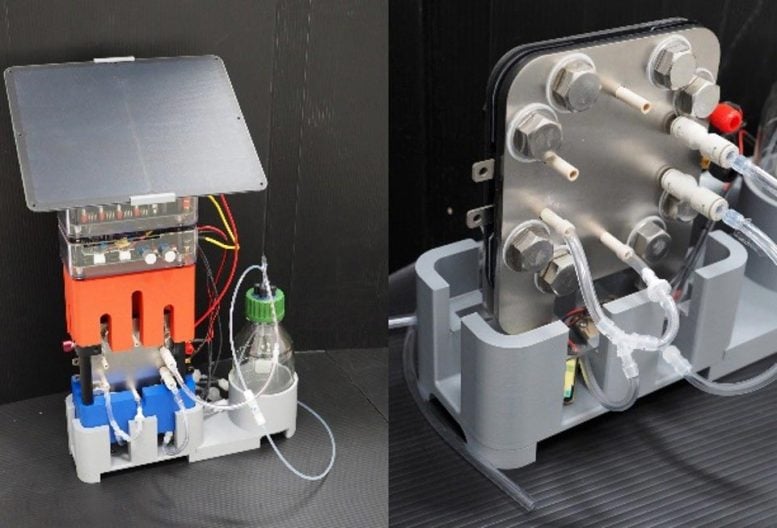
A self-regulating artificial photosynthesis system makes solar fuel without batteries, offering a simpler and potentially cheaper path to clean energy storage. Researchers at Osaka Metropolitan University have created a new artificial photosynthesis system that can produce solar fuel more consistently while eliminating the need for battery-based control systems. The advance comes from incorporating a self-regulating [...]
Climate change and urbanization have intensified the urban heat island (UHI) effect, where urban areas are significantly warmer than rural areas. This has, in turn, increased the frequency of extreme heat events, such as heat waves, and deteriorated both outdoor environments and indoor thermal conditions in buildings, leading to higher cooling energy demands, greater strain on power grids and an elevated risk of power outages.
MIT’s new two-in-one space engine could turn tiny satellites into surprisingly capable deep-space explorers. Researchers at MIT are testing a new propulsion technology that could give small satellites a major boost in capability. The system combines two very different forms of spacecraft propulsion in a single package, allowing satellites to perform both rapid maneuvers and [...]
This week's magnitude 7.8 earthquake in the Philippines came with scenes familiar to New Zealanders: collapsed buildings, shattered facades and streets strewn with rubble.
Researchers in Germany have developed a new gas-sensing technology that could make it much easier and less expensive to detect tiny amounts of gases in the environment, industrial facilities, and energy networks. The breakthrough builds on a scientific phenomenon known as the photoacoustic effect, which was first discovered more than 150 years ago. When certain […]
Researchers from Plasma Technology and Surfaces, Paint/Lacquer Technology, as well as Automation and Production Technology at Fraunhofer IFAM, in collaboration with HYTANK project partners, developed resource-efficient manufacturing and joining technologies for the production of large-format, double-walled hydrogen tanks made of carbon fiber-reinforced plastic (CFRP)—ranging from suitable surface pretreatments and functional barrier layers to automated production on a 1:1 scale, including machining and adhesive-bonding assembly. The goal was to lay the groundwork for the future efficient production of lighter, leak-tight and—under cryogenic conditions—more reliable tank structures, for example, for the aerospace industry.
An intruder has breached the French government’s encrypted messaging service, Tchap, showing once again that human error is a weak spot in any security system.
Tchap was developed in France as an example of national sovereignty and was designed to be a more secure option than WhatsApp for communication between government employees.
In this case, it wasn’t the technology that was at fault, but a user: The intruder gained access to the system by taking over their account, according to DINUM, the French government’s interministerial digital directorate.
DINUM said it has blocked the affected user’s access and is investigating how much information has been revealed. While the system’s encryption was not broken, the intruder would have been able to view unencrypted public chat rooms accessible to the account taken over, potentially affecting 73,467 of the system’s 825,000 users, DINUM said.
That matches at least part of a post on X (formerly Twitter) reporting the intruder’s claim to have accessed the account of a Tchap user in the education sector through social engineering, exposing 73,467 user accounts, 643,459 messages, 876 chat rooms with message history, and 59,386 media files totalling 13.51 GB, including references to documents marked “Diffusion Restreinte” (restricted distribution).
DINUM said that it had reminded all Tchap users that public chat rooms are accessible to any user and are not encrypted, so all participants should refrain from any sensitive or confidential information.
Imagine wearing a jacket that can produce drinking water from the air around you. That idea is moving closer to reality thanks to engineers at the University of Texas at Austin, who have developed a special fabric that captures moisture from the atmosphere and turns it into clean water. The new technology could be useful […]
For many coffee lovers, making espresso seems to require two essential ingredients: very hot water and high pressure. But researchers at the University of New South Wales (UNSW) in Australia have challenged that assumption by creating espresso-strength coffee using room-temperature water and ultrasonic sound waves. The new technique could reduce the energy needed to make […]
A team of researchers from the Massachusetts Institute of Technology (MIT) and other institutions has developed a new way to improve the performance of powerful electronic devices by using an ultrathin layer of diamond. The breakthrough could help future technologies such as 6G wireless networks, satellite communications, radar systems, and even data centers operate faster […]
The photoacoustic effect has been known for more than 150 years: Gases exposed to light heat up. Pulsing the light generates periodic pressure fluctuations, or sound waves, with frequencies that can be uniquely assigned to individual gases. This photoacoustic effect forms the basis for a measurement method that is highly precise even at low gas concentrations. Despite its high sensitivity, the method has previously only occupied a niche, primarily because it relies on a resonator for acoustic amplification. This resonator is highly sensitive to even the slightest changes in air pressure, temperature or mechanical stress. However, ensuring an accurate measurement requires the system to precisely hit the correct resonant frequency.
Autonomous vehicles are already a reality on some of our streets and could become a major part of future transportation systems. Safety, of course, is the main concern, as with all vehicles. To help evaluate and improve its autonomous driving technology, U.S. driverless vehicle company Waymo has created a virtual representation of human driver behavior in near-crash situations.
Every underground coal mine has one thing in common: Coal seams leak methane gas into the tunnel network, presenting a serious safety hazard. The control is the same the world over: continuously pump fresh air through the workings, diluting and pushing out the methane. High-volume mechanical ventilation systems are a cornerstone of mine safety, but they create a stubborn environmental problem.
Hydrogen could be the key to a clean energy future, but a tiny problem has been holding it back: bubbles. In a paper published in Energy & Environmental Science, a multidisciplinary team of UNSW researchers, in collaboration with researchers from TotalEnergies and EPFL, has found a new way to boost the efficiency of green hydrogen production.
Researchers from the private nuclear fusion energy company Commonwealth Fusion Systems have published a series of papers that they claim confirm that their flagship ARC reactor will produce more usable energy than it consumes if built as designed.
Although the company projects it will deliver the first commercial fusion plants by the early 2030s, other researchers say there are remaining challenges to overcome, and won’t declare the ARC reactor successful until an operational version is constructed to validate the research team’s theoretical predictions.
ARC Fusion Reactor ‘Will Work’ When Built
Scientists have long dreamed of capturing the nuclear fusion reaction that fuels our Sun and using it to generate clean, renewable power. Private fusion firms like CFS have received nearly $10 billion in funding over the last decade alone.
The first laboratory “net-energy” controlled fusion reaction, which fusion scientists call “ignition,” didn’t occur until 2022, when physicists at the US National Ignition Facility in Livermore, California, successfully produced more energy than was used to generate the reaction. Although brief, that moment has fueled speculation that practical fusion energy generation may be right around the corner.
Now, the Commonwealth team, which includes 58 researchers from the company and partner institutes, has published scientific papers outlining the physics of their ARC reactor, including new models that they say account for the “expected behavior” of the superhot plasma at the heart of the design.
Brandon Sorbom, the company’s chief science officer, said that the published works “confirm that when we build the ARC fusion power plant, it will work”.
Company Claims ARC Will Produce 400 Megawatts of Net Electricity
After nearly a decade of research, CFS, founded in 2018, is currently preparing its prototype for a 2027 demonstration it calls ‘SPARC.’ The company said they expect that trial run, which will demonstrate their technology’s ability to generate more energy than it needs to heat the plasma, will help them fine-tune ARC’s final design.
A peek inside the Commonwealth Fusion Systems magnet production facility. Image Credit: CFS.
According to the Commonwealth-led team, ARC will generate more energy than is required to operate the entire facility, including plasma heating, resulting in a true net-positive power-generation facility. This includes producing approximately 400 megawatts of net electricity, which the team noted is enough to power 280,000 average US homes. For comparison, recent census data indicates that Boston, Massachusetts, near the company’s headquarters in Cambridge, has around 271,000 U.S. homes.
Like SPARC, the ARC reactor uses high-temperature superconducting magnets to compress the plasma, which remains suspended by the magnetic fields, preventing it from damaging the chamber walls and terminating any potential fusion reaction. Under this extreme pressure, the nuclei of heavy hydrogen trapped inside the chamber fuse to form helium, the same reaction that takes place inside the Sun.
This fusion reaction results in the release of energy, primarily high-speed neutrons. At its hottest, the donut-shaped ring of plasma reaches seven times the temperature of the Sun.
Critics Applaud Publication While Highlighting Unproven Concepts and Systems
Tony Roulstone, a nuclear engineer at the University of Cambridge, UK, conceded that the CFS team and its collaborating authors are “some of the best in the fusion business” and noted the company’s ARC reactor concept is the result of “good work over many years.” However, Roulstone also warned of the pressure on researchers in privately funded companies to “claim things before the evidence is fully in place.”
David Hammer, a nuclear engineer at Cornell University in Ithaca, New York, said it is a good sign that the team is publishing at a high volume, but also warned that published papers will not guarantee that the built device will work as intended.
Their modeling “has to be proven correct by a fusion reactor that works as designed”, he adds. If the firm can get SPARC operating successfully next year, “it will be an important step forward”, he says.
Hamner also noted that several of the design’s subsystems require further development before it can be declared complete. This includes addressing how plasma will behave in the real world when it becomes unstable versus its modeled behavior, proving out the process for extracting usable energy from the generated heat, and demonstrating that the reactor is robust enough to operate for long periods.
The scientists also noted the challenges in sourcing tritium, the isotopic fuel the reactor requires to operate. Although CFS has outlined its tritium generation process, Hamner noted that the series of published papers neither details the process nor demonstrates its viability.
“There are candidate blanket materials and blanket designs, but there are many engineering person-years needed” to bring a functional ARC-style plant to fruition, he explained.
“We certainly have to build more on top of that foundation laid out in these papers,” a company spokesperson said, adding that they will “be able to produce tritium for operations and for future power plants.”
Editor’s Note: This article was updated to correct a previous version that described neutrinos, rather than fast-neutrons, in the context of the reporting, and to clarify that the first achievement of a “net-energy” controlled fusion reaction (ignition) occurred in 2022.
Christopher Plain is a Science Fiction and Fantasy novelist and Head Science Writer at The Debrief. Follow and connect with him on X, learn about his books at plainfiction.com, or email him directly at christopher@thedebrief.org.
Fertility specialists, biotech companies and ethicists are divided over whether progress in early gene editing would wipe out diseases or trigger a rush toward enhancement.

 Login