❌

Reading view

Fossils from Chinese Cave Fill Crucial Gap in History of Gigantopithecus blacki

An artist’s impression of a group of Gigantopithecus blacki within a forest in southern China. Image credit: Garcia / Joannes-Boyau, Southern Cross University.

Deep inside a limestone cave in southern China, paleontologists have uncovered an assemblage of thirteen fossilized teeth belonging to Gigantopithecus blacki, the largest primate species ever known to have lived.

The post Fossils from Chinese Cave Fill Crucial Gap in History of Gigantopithecus blacki appeared first on Sci.News: Breaking Science News.
  •  

New Marsupial Lineage Emerges from Australian Fossils

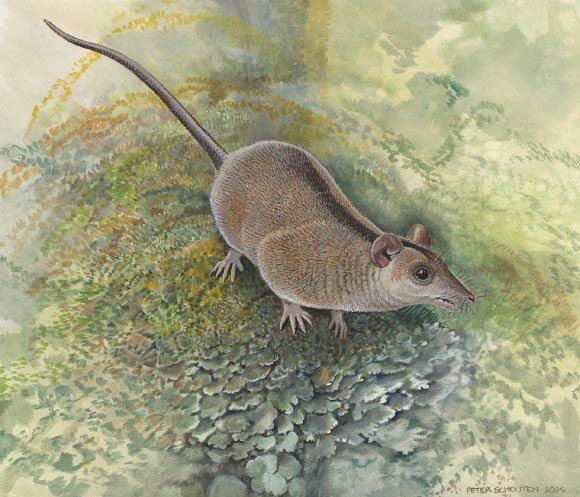
Reconstruction of Phantasmodon travouilloni in the Early Miocene rainforests of northwestern Queensland. Image credit: Peter Schouten.

Paleontologists have described a new genus and three new species of small, insect-eating marsupials from the Early Miocene deposits of the Riversleigh World Heritage Area in northwestern Queensland, one of Australia’s richest fossil sites.

The post New Marsupial Lineage Emerges from Australian Fossils appeared first on Sci.News: Breaking Science News.

  •  

Why Evolution Stalled for Millions of Years Before Suddenly Exploding

Edicaran Animal CommunityA new study suggests evolution stayed stuck for millions of years until sexual reproduction helped unleash a burst of biodiversity. New research suggests that the earliest animals on Earth may have unintentionally slowed the pace of evolution for millions of years. Scientists have found that their reliance on asexual reproduction limited competition and reduced the [...]
  •  

New Feathered Dinosaur May Have Solved a 120-Million-Year-Old Fossil Mystery

Jian changmaensis Attacks Gansus yumenensis in Ancient ChinaA newly discovered feathered dinosaur from China may help solve a long-standing mystery surrounding a fossil bed filled with ancient bird remains. For years, one fossil site in northwestern China has posed a mystery. The area contains hundreds of fossilized birds, many remarkably well preserved. Mixed among them are strange clusters of shattered bones compressed [...]
  •  

New Species of Ancient Bear-Dog Identified in Spain

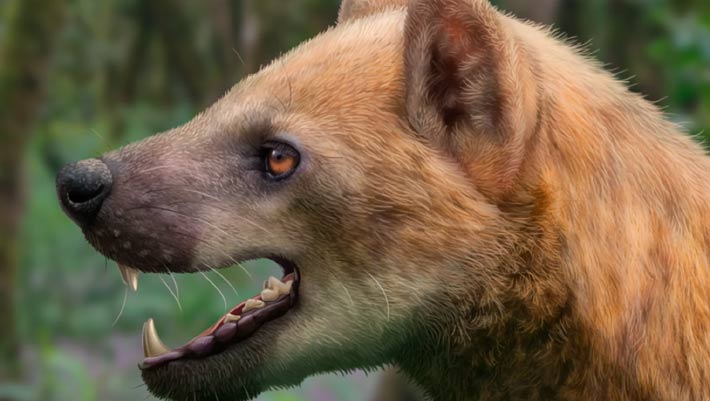
Paludocyon moyasolai. Image credit: Jesús Gamarra.

Paleontologists have identified a previously unknown species of amphicyonid -- the extinct family of carnivorous mammals popularly known as bear-dogs -- from two specimens unearthed at a rich fossil site in the Vallès-Penedès Basin near Barcelona, Spain.

The post New Species of Ancient Bear-Dog Identified in Spain appeared first on Sci.News: Breaking Science News.

  •  

Study: Cave Lions were Distinct Species that Occasionally Bred with Ancestors of Today’s Lions

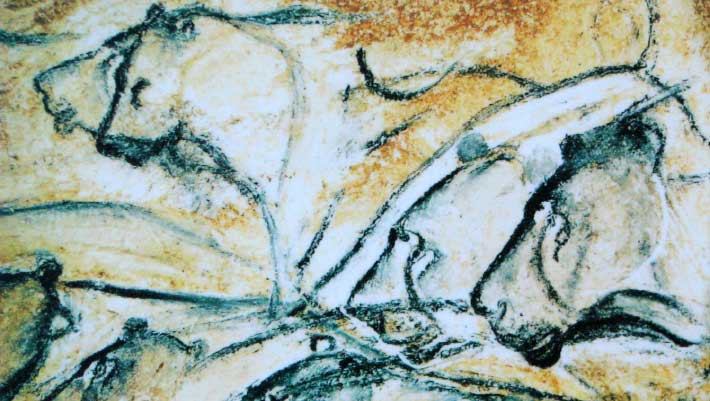
Cave lions painted in the Chauvet Cave, France.

The extinct Eurasian cave lion (Panthera spelaea) and today’s African and Asian lions (Panthera leo) belong to separate evolutionary lineages that diverged roughly 1.7 million years ago -- far earlier than previously thought, according to an analysis of 12 cave lion genomes spanning more than 100,000 years.

The post Study: Cave Lions were Distinct Species that Occasionally Bred with Ancestors of Today’s Lions appeared first on Sci.News: Breaking Science News.

  •  

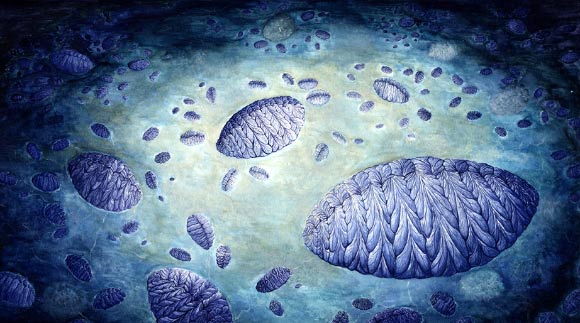
Earth’s Earliest Animals May Have Thrived Too Easily to Evolve

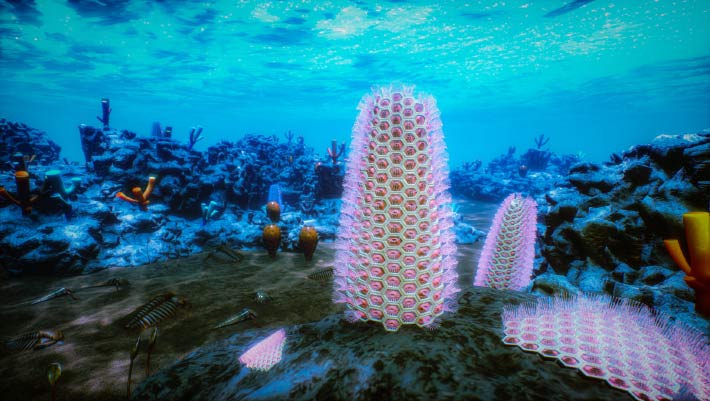
Artist’s reconstruction of the Fractofusus community: the bottom right features a large Fractofusus around which there are 5 to 8 medium specimens clustered; each of the medium specimens also has small specimens clustered around them; the small specimens therefore form an independent double cluster pattern, namely clusters of clusters. Image credit: C.G. Kenchington.

Fossils from some of the oldest-known animals on Earth, dating from 574 million years ago (Ediacaran period), suggest that cloning, not competition, dominated the Ediacaran seas, slowing evolution until environmental stress helped drive the rise of sexual reproduction and a burst of biodiversity.

The post Earth’s Earliest Animals May Have Thrived Too Easily to Evolve appeared first on Sci.News: Breaking Science News.
  •  

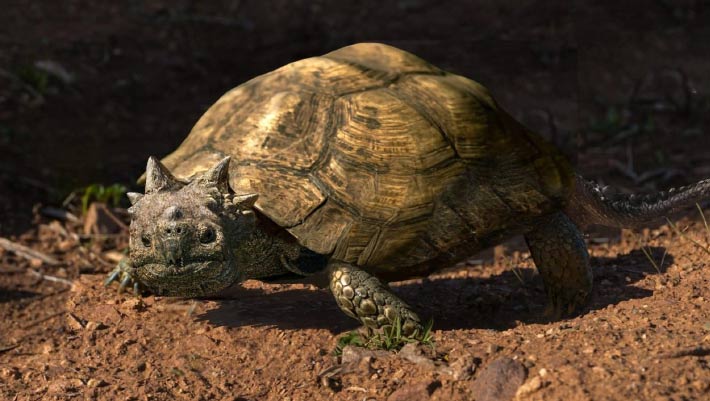
Fossil Discovery in Patagonia Reveals New Species of Horned Turtle

An artist’s impression of Patagoniaemys aeschyli. Image credit: Nawel Vazquez / Museo Argentino de Ciencias Naturales ‘Bernardino Rivadavia’ / CONICET.

Paleontologists have identified a new species of meiolaniform turtle from northern Patagonia, Argentina, that lived during the Maastrichtian age, just before the asteroid-triggered mass extinction that wiped out all non-avian dinosaurs.

The post Fossil Discovery in Patagonia Reveals New Species of Horned Turtle appeared first on Sci.News: Breaking Science News.
  •  

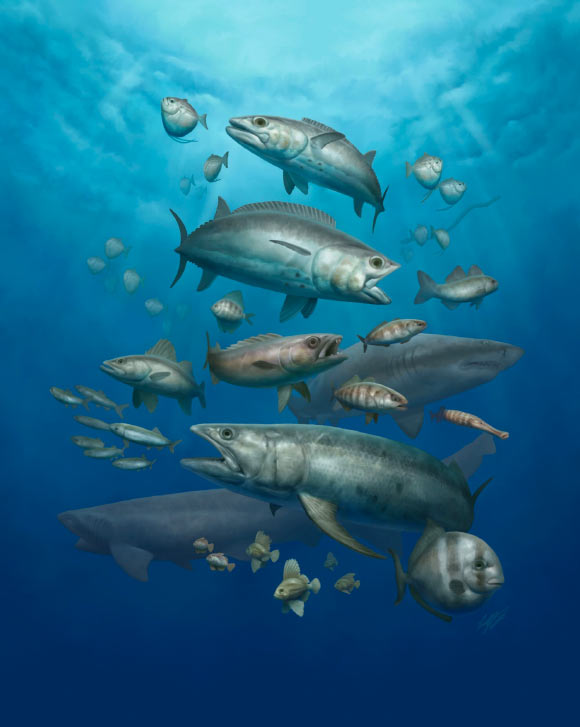
Fish Fossils from Early Paleocene Fill 10-Million-Year Gap after Dinosaur Extinction

Marine fishes from the Early Paleocene site of Qreiya 3 in the Eastern Desert of Egypt. Image credit: Ian Baylatry.

Paleontologists have described an assemblage of marine fish fossils from the 62.2-million-year-old site of Qreiya 3 in the Eastern Desert of Egypt, providing a window into this transition.

The post Fish Fossils from Early Paleocene Fill 10-Million-Year Gap after Dinosaur Extinction appeared first on Sci.News: Breaking Science News.
  •  

Half-Ton Cattle Relatives Roamed Europe 4 Million Years Ago

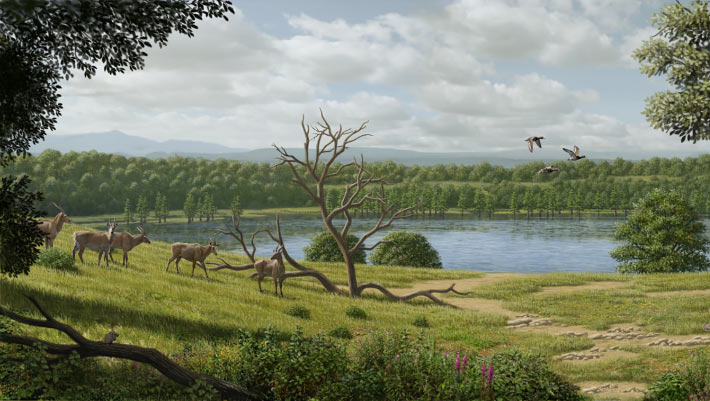
Paleoartistic reconstruction of the environment in the surrounding of Camp dels Ninots maar lake during the Early Pliocene. Image credit: Mauricio Antón.

Near-complete bovine skeletons unearthed the Early Pliocene site of Camp dels Ninots in northeastern Spain reveal that the ancestors of today’s buffalo and cattle were already growing to impressive sizes long before humans arrived on the continent.

The post Half-Ton Cattle Relatives Roamed Europe 4 Million Years Ago appeared first on Sci.News: Breaking Science News.
  •  

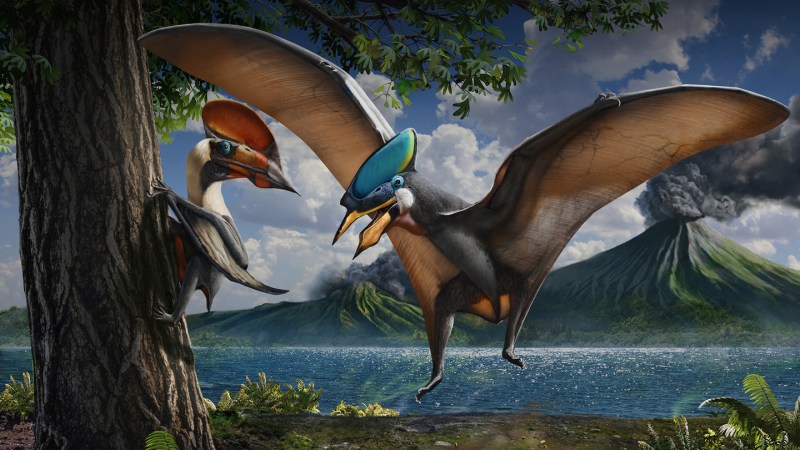
New Microraptorine Dinosaur Discovered in China

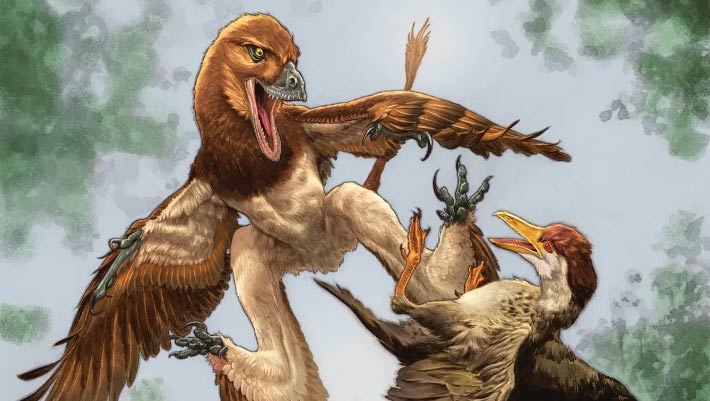
Jian changmaensis (left) attacks the early bird Gansus yumenensis (right) in what is now the Changma Basin of northwestern China approximately 120 million years ago. Image credit: Lewis LaRosa / Jão Canola.

Jian changmaensis is the first non-avian dinosaur found at a paleontological site that has yielded more than 100 specimens of Early Cretaceous birds.

The post New Microraptorine Dinosaur Discovered in China appeared first on Sci.News: Breaking Science News.

  •  

Giant Scorpions Ruled Ancient Britain during Devonian Period

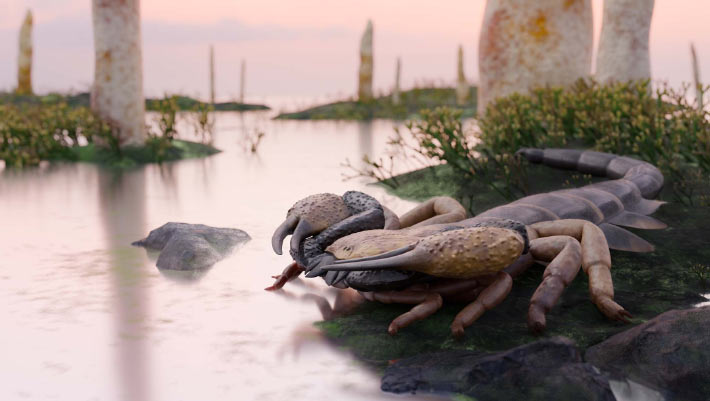
Praearcturus gigas. Image credit: Franz Anthony.

Paleontologists have confirmed that Praearcturus gigas, a creature that prowled shallow waters during the Devonian period, 415 million years ago, is the largest scorpion ever found.

The post Giant Scorpions Ruled Ancient Britain during Devonian Period appeared first on Sci.News: Breaking Science News.
  •  

Ancient Oceans Began Losing Oxygen Millions of Years before End-Triassic Mass Extinction

Early Earth. Image credit: Peter Sawyer / Smithsonian Institution.

Chemical traces preserved in ancient rocks indicate that marine environments were deteriorating long before the catastrophe that wiped out vast numbers of species at the end of the Triassic period, around 201 million years ago.

The post Ancient Oceans Began Losing Oxygen Millions of Years before End-Triassic Mass Extinction appeared first on Sci.News: Breaking Science News.
  •  

Scientists Discover a Bizarre Crocodile Cousin That Walked Like a Dinosaur

Labrujasuchus expectatus ReconstructionA newly discovered crocodile relative from the Triassic had a beak, tiny arms, and walked on two legs, making it look more like an ostrich-like dinosaur than a crocodile. During the Triassic Period, the ancestors of many modern animal groups were branching into an astonishing variety of shapes and lifestyles. Evolution was experimenting with body [...]
  •  
❌