The hunt for Planet Nine continues as new discoveries make the Solar System’s biggest mystery even harder to solve. Is there a massive undiscovered planet on the outer reaches of the Solar System? The idea has been around since before the discovery of Pluto in the 1930s. Labeled as planet X, prominent astronomers had put [...]
A rare meteorite recovered from the Sahara Desert could be a fragment of a Moon-size body that met a violent end in the earliest days of the solar system.
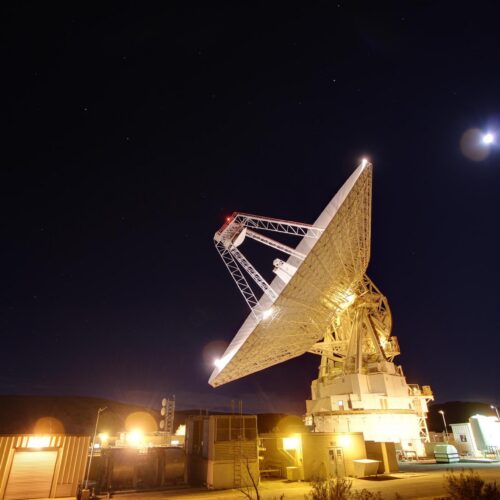
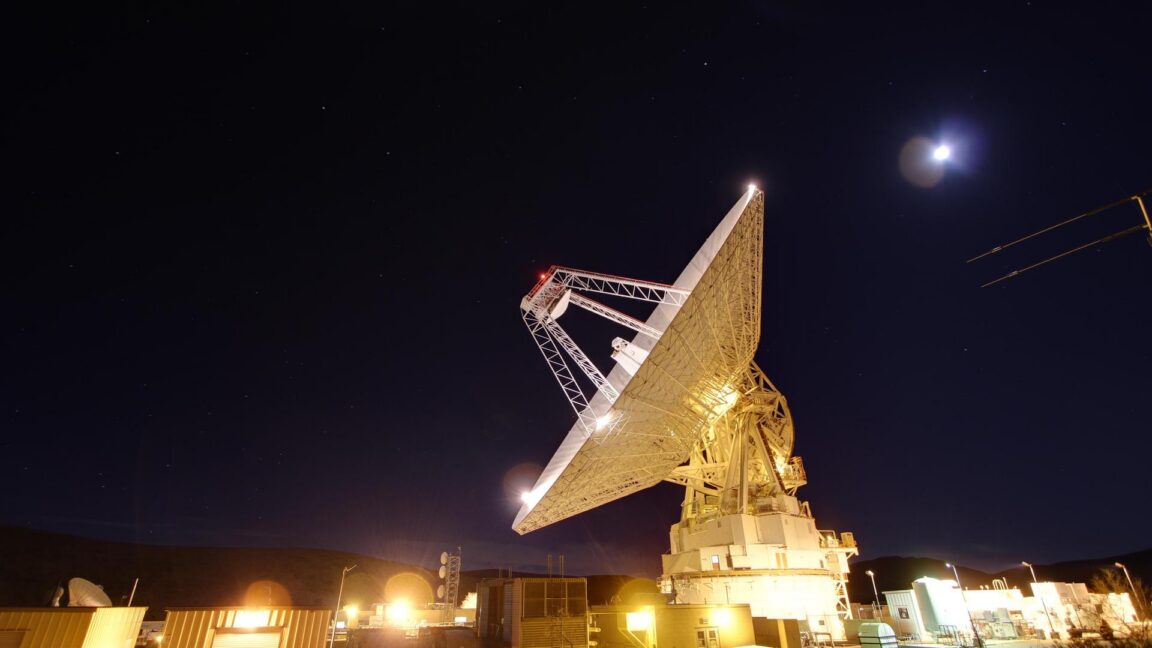
NASA pushed its Deep Space Network beyond its limits during the Artemis I mission nearly four years ago. The global array of deep space communications antennas couldn't keep up with the routine demands of 40 robotic science missions and the extraordinary surge required by NASA's Orion space capsule as it flew around the Moon.
The experience in late 2022 reduced or delayed downlinks from several high-profile science missions, including the James Webb Space Telescope and Mars rovers, as the data-hungry Artemis I mission took priority on NASA's communications network. And that was before the first Artemis mission with astronauts onboard. When Artemis II launched April 1, NASA called upon the Deep Space Network (DSN) again to connect Mission Control to the Orion capsule as it soared more than a quarter of a million miles from Earth.
With a crew of four flying inside the spacecraft, the agency's appetite for data from Orion on Artemis II was even higher than it was on Artemis I. But at a little more than nine days, the Artemis II mission was shorter than the 25 days Artemis I spent in space, helping alleviate the communications overload. Artemis I also launched 10 small CubeSats into deep space, many of which required tracking and telecom services from the DSN. Artemis II carried fewer CubeSats.
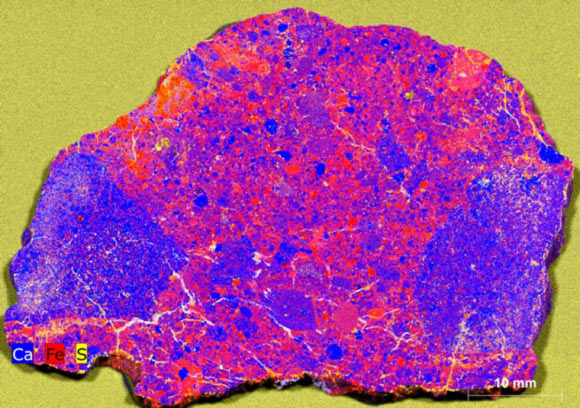
Planetary scientists analyzing a lunar meteorite known as Northwest Africa (NWA) 12593 have uncovered evidence of an asteroid impact that occurred 3.5 billion years ago on the Moon, helping to reconstruct a period of intense bombardment that left lasting marks across the inner Solar System.
Eugene Parker, pioneer of theoretical solar and plasma astrophysics, was born June 10, 1927. Parker revolutionized the field of heliophysics, notably by first proposing the existence of the solar wind — a stream of charged particles ejected from the Sun — in 1958. His theory was confirmed by Mariner II in 1962. Among many otherContinue reading "June 10, 1927: The birth of Eugene Parker"
A rare meteorite found in the Sahara Desert has revealed evidence of a giant ancient world that once existed in our solar system but later disappeared. Scientists believe this lost world formed about 4.5 billion years ago, during the early days of the solar system. It may have been as large as the Moon or […]
The team behind the novel propulsion technology said that electrospray thrusters could allow mission planners to design smaller, more nimble satellites and spacecraft capable of performing faster, more powerful maneuvers or slower, more precise adjustments, depending on mission requirements.
Electrospray Combines the Best of Chemical and Electric Propulsion
Launching rockets into space still requires chemical thrusters, but once spacecraft and satellites reach orbit, engineers continue to develop novel propulsion methods that are more efficient than chemical propulsion technologies. Given the strict weight requirements of spacecraft launches, finding alternatives to chemical propellants has opened up a wider range of mission profiles.
Among the most common alternatives to chemical thrusters are designs that combine electrical energy with small amounts of propellant to produce small but sustainable thrust. Although electric thruster designs require less fuel, saving significantly on launch weight, they also lack both the power and the rapid, quick burst performance of chemical thrusters.
According to study author Amelia Bruno, a former postdoc in MIT’s Department of Aeronautics and Astronautics (AeroAstro), combining chemical and electrical propulsion into a single system is “the best of both worlds.”
“This opens the door for small satellites to do even more science, more observations, and more interesting missions, all on a smaller and cheaper platform,” Bruno explained to MIT News.
Study co-author Paulo Lozano, the Miguel Alemán Velasco Professor of Aeronautics and Astronautics at MIT, agreed, noting that combining both technologies could enable a CubeSat mission to Mars “where they could make the journey slowly, using electrospray thrusters.”
“You could then use your chemical thrusters to quickly move to look at interesting features,” the professor added. “You could have a lot more flexibility to do a lot more things.”
ASCENT Rocket Fuel as the Thruster’s Ionic Liquid Propellant Enables Hybrid Design
According to a statement detailing the new electrospray thruster’s design, the ones developed by the MIT team are about the size of a thumbnail. Each thruster is also placed directly above a small fuel reservoir. For the MT electrospray thrusters, the fuel is an ionic liquid propellant, a liquid composed of salts that remain dissolved in a solution.
These four flight-unit electrospray thrusters were delivered by the MIT Space Propulsion Laboratory to NASA for the upcoming Green Propulsion Dual Mode (GPDM) mission. Image Credit: Amelia Bruno
“Ionic liquids are very stable and can even remain a liquid in space, which not a lot of materials can do,” Bruno explained. “And it’s basically a sea of ions, which is why we base our technology around it, so we can pull those ions out into an electrospray.”
When a spacecraft’s battery delivers an electric charge to the fuel reservoir, the ions within the fuel also become charged. The thruster’s design channels the charged particles from the reservoir and through the thruster tips, expelling them into space.
Although the team has tested several types of ionic propellant in its electrospray propulsion thrusters, Bruno and Lozano have collaborated with the U.S. Air Force to synthesize an all-new ionic liquid propellant, which they are calling the Advanced SpaceCraft Energetic Non-Toxic propellant, or ASCENT.
Originally designed as a “green” alternative to extremely hazardous hydrazine rocket fuel that has been the staple in the rocket industry for decades, Bruno notes that ASCENT “happens to be an ionic liquid mixture.”
“And we said, hey, that’s the stuff we typically use,” the researcher added. “Theoretically, this should work. Let’s go figure out how.”
Tests: Chemical Propellant Equally Efficient as Conventional Ionic Liquids
To test their electrospray design, each tested thruster was attached to a small reservoir about the size of a single Lego brick, and then the reservoir was filled with ASCENT. Next, electrospray thrusters were mounted on opposite sides of a traditional CubeSat.
To simulate the microgravity environment of Near-Earth Orbit, the team placed the thruster-equipped CubeSat on a MagLev stand. The team noted that the MagLev in Lozano’s lab is installed inside a large vacuum chamber. This design allows the researchers to fine-tune the environment to best mimic the conditions in space.
During a series of tests, the team applied varying voltage levels to the electrospray thrusters. As expected, the reaction produced a spray from the thruster nozzles, which spun the CubeSat around on the MagLev stand like a freely spinning top.
During each thruster firing, the team measured the amount of thrust produced. This data, combined with the voltage and fuel data, allowed the team to calculate ASCENT’s fuel efficiency during continuous operation. Some tests lasted up to 100 hours.
When the MIT group evaluated the results, they first determined that the choice of ASCENT was correct, as it successfully fueled each electrospray thruster. Even more significantly, the tests revealed that the readily available chemical propellant was equally efficient as conventional ionic liquids.
“Compared to our normal electrospray propellants, ASCENT can provide similar performance in terms of thrust,” Bruno explained. “Now that we know our thrusters work with ASCENT, we can start thinking of all the ways we can make them even better.”
Testing Electrospray Thrusters on NASA’s Green Propulsion Dual Mode Mission
When discussing the benefits of their successful electrospray thruster tests, Lozano noted that a spacecraft with electric and chemical thrusters can share a single fuel tank. Due to its compact design, this hybrid electrospray thruster could be mounted on a small satellite.
Fortunately, the team won’t have to wait long to see their thruster in action. According to the research team, whose work was partially supported by NASA, their design will be incorporated into NASA’s upcoming Green Propulsion Dual Mode mission scheduled to launch in November. The Green Propulsion Dual-Mode mission will carry a briefcase-sized CubeSat with a primary chemical thruster and specially designed electrospray thrusters, making it the first attempt to combine electrical and chemical propulsion in a small spacecraft.
“This will be the first time that a satellite will have a shared propellant tank,” Lozano explained.
Although a large portion of proposed electric propulsion missions that might employ the new electrospray thruster are designed to explore deeper into the Solar System and beyond, Lozano also highlighted the technology’s possible applications closer to home. For example, satellites equipped with both technologies could rapidly respond to environmental or climate changes in real time with a speed and efficiency unavailable with current propulsion options.
“Say there’s a storm coming, and you’d want to deploy your constellation of small satellites to observe over one location,” the researcher explained. “You could choose to send them quickly or slowly, depending on the nature of the observation.”
“And the only way to do that is if you have two propulsion systems, which is now possible,” he added.
Although the mission will not launch before November, Bruno noted that a successful test could allow engineers to consider missions they never thought possible.
“Now that we know our thrusters work with ASCENT, we can start thinking of all the ways we can make them even better,” the researcher explained.
Christopher Plain is a Science Fiction and Fantasy novelist and Head Science Writer at The Debrief. Follow and connect with him on X, learn about his books at plainfiction.com, or email him directly at christopher@thedebrief.org.
Using the SETI Institute’s Allen Telescope Array, a 42-element radio interferometer at Hat Creek Radio Observatory in Hat Creek, California, astronomers probed 3I/ATLAS for artificial radio transmissions but found only human-made interference.
NASA has ended its attempts to reconnect with the Mars Atmosphere and Volatile EvolutioN (MAVEN) spacecraft and begun decommissioning the orbiter, closing the book on a mission that spent over a decade studying how Mars lost its atmosphere. At a June 3 media conference, NASA officials announced that an anomaly review board — which wasContinue reading "NASA fails to reestablish contact, decommissions MAVEN"

 Login

 The hunt for Planet Nine continues as new discoveries make the Solar System’s biggest mystery even harder to solve. Is there a massive undiscovered planet on the outer reaches of the Solar System? The idea has been around since before the discovery of Pluto in the 1930s. Labeled as planet X, prominent astronomers had put [...]