
❌

Reading view

NASA to Cover 34th SpaceX Resupply Mission Space Station Departure
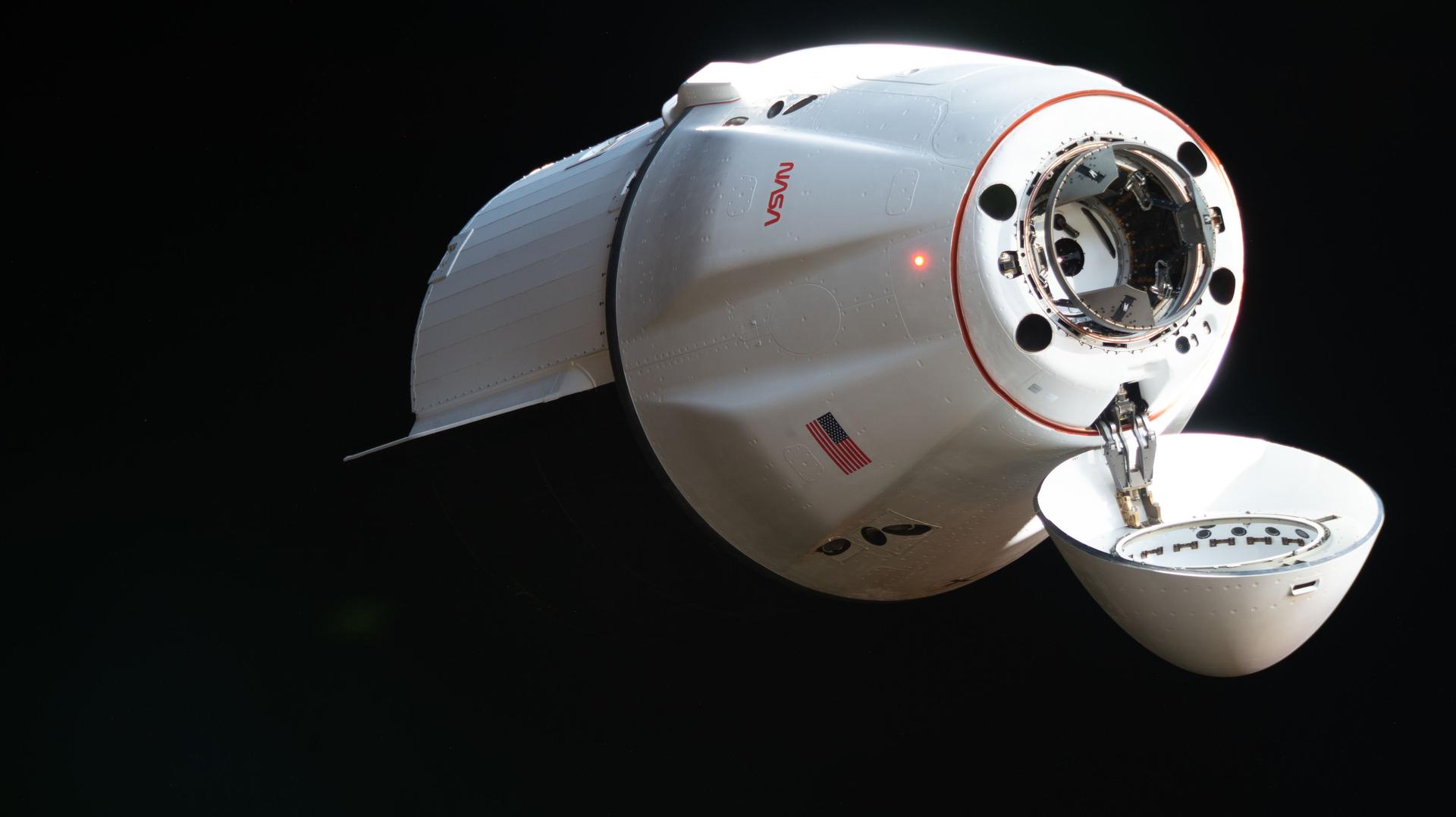
The SpaceX Dragon cargo spacecraft supporting the company’s 34th commercial resupply services mission for NASA approaches the International Space Station on May 17, 2026, carrying nearly 6,500 pounds of food, supplies, and equipment for the Expedition 74 crew.
Credit: NASA

NASA and its international partners are set to receive scientific research samples and hardware as a SpaceX Dragon spacecraft is scheduled to depart the International Space Station on Tuesday, June 16, for its return to Earth.

Watch NASA’s live undocking coverage beginning at 11:45 a.m. EDT on NASA+, Amazon Prime, and the agency’s YouTube channel. Learn how to watch NASA content through a variety of online platforms, including social media.

The Dragon spacecraft will undock from the forward port of the station’s Harmony module at about 12:05 p.m., after receiving a command from SpaceX ground controllers. The spacecraft then will fire its thrusters to move safely away from the orbiting complex.

Following a June 16 departure, the spacecraft will reenter Earth’s atmosphere on Wednesday, June 17, before splashing down off the coast of California at approximately 5:08 a.m. PDT. NASA will not stream the splashdown but will post updates on its space station blog.

Dragon will return to Earth with thousands of pounds of cargo, carrying samples that could shape future space exploration and life on Earth. Research returning includes bioprinted organ and cartilage tissue, data on improving cryogenic fuel storage for future space missions, and DNA‑inspired materials to develop new cancer treatments. The returning hardware includes an ocular imaging device used to monitor crew members’ eye health, an absorbent bed that filters trace contaminants from cabin air, and a separator pump from the waste and hygiene compartment.

Loaded with nearly 6,500 pounds of crew cargo and science experiments, Dragon arrived at the station on May 17 after launching two days earlier on a Falcon 9 rocket from Space Launch Complex 40 at Cape Canaveral Space Force Station in Florida.

For more than 25 years, people have lived and worked continuously aboard the International Space Station, advancing scientific knowledge and making research breakthroughs not possible on Earth. The space station helps NASA understand and overcome the challenges of human spaceflight, expand commercial opportunities in low Earth orbit, and build on the foundation for long-duration missions to the Moon, as part of the Artemis program, and to Mars.

Get breaking news, images, and features from the space station on Instagram, Facebook, and X.

Learn more about International Space Station research and operations at:

https://www.nasa.gov/international-space-station

-end-

Jimi Russell
Headquarters, Washington
202-358-1100
james.j.russell@nasa.gov

Leah Cheshier
Johnson Space Center, Houston
281-483-5111
leah.d.cheshier@nasa.gov

The post NASA to Cover 34th SpaceX Resupply Mission Space Station Departure appeared first on NASA Science.
  •  

NASA to Cover 34th SpaceX Resupply Mission Space Station Departure

The SpaceX Dragon cargo spacecraft supporting the company’s 34th commercial resupply services mission for NASA approaches the International Space Station on May 17, 2026, carrying nearly 6,500 pounds of food, supplies, and equipment for the Expedition 74 crew.
Credit: NASA

NASA and its international partners are set to receive scientific research samples and hardware as a SpaceX Dragon spacecraft is scheduled to depart the International Space Station on Tuesday, June 16, for its return to Earth.

Watch NASA’s live undocking coverage beginning at 11:45 a.m. EDT on NASA+, Amazon Prime, and the agency’s YouTube channel. Learn how to watch NASA content through a variety of online platforms, including social media.

The Dragon spacecraft will undock from the forward port of the station’s Harmony module at about 12:05 p.m., after receiving a command from SpaceX ground controllers. The spacecraft then will fire its thrusters to move safely away from the orbiting complex.

Following a June 16 departure, the spacecraft will reenter Earth’s atmosphere on Wednesday, June 17, before splashing down off the coast of California at approximately 5:08 a.m. PDT. NASA will not stream the splashdown but will post updates on its space station blog.

Dragon will return to Earth with thousands of pounds of cargo, carrying samples that could shape future space exploration and life on Earth. Research returning includes bioprinted organ and cartilage tissue, data on improving cryogenic fuel storage for future space missions, and DNA‑inspired materials to develop new cancer treatments. The returning hardware includes an ocular imaging device used to monitor crew members’ eye health, an absorbent bed that filters trace contaminants from cabin air, and a separator pump from the waste and hygiene compartment.

Loaded with nearly 6,500 pounds of crew cargo and science experiments, Dragon arrived at the station on May 17 after launching two days earlier on a Falcon 9 rocket from Space Launch Complex 40 at Cape Canaveral Space Force Station in Florida.

For more than 25 years, people have lived and worked continuously aboard the International Space Station, advancing scientific knowledge and making research breakthroughs not possible on Earth. The space station helps NASA understand and overcome the challenges of human spaceflight, expand commercial opportunities in low Earth orbit, and build on the foundation for long-duration missions to the Moon, as part of the Artemis program, and to Mars.

Get breaking news, images, and features from the space station on Instagram, Facebook, and X.

Learn more about International Space Station research and operations at:

https://www.nasa.gov/international-space-station

-end-

Jimi Russell
Headquarters, Washington
202-358-1100
james.j.russell@nasa.gov

Leah Cheshier
Johnson Space Center, Houston
281-483-5111
leah.d.cheshier@nasa.gov

  •  

Crew Works Microbiology, Advanced Tech and Congratulates New Artemis III Crew

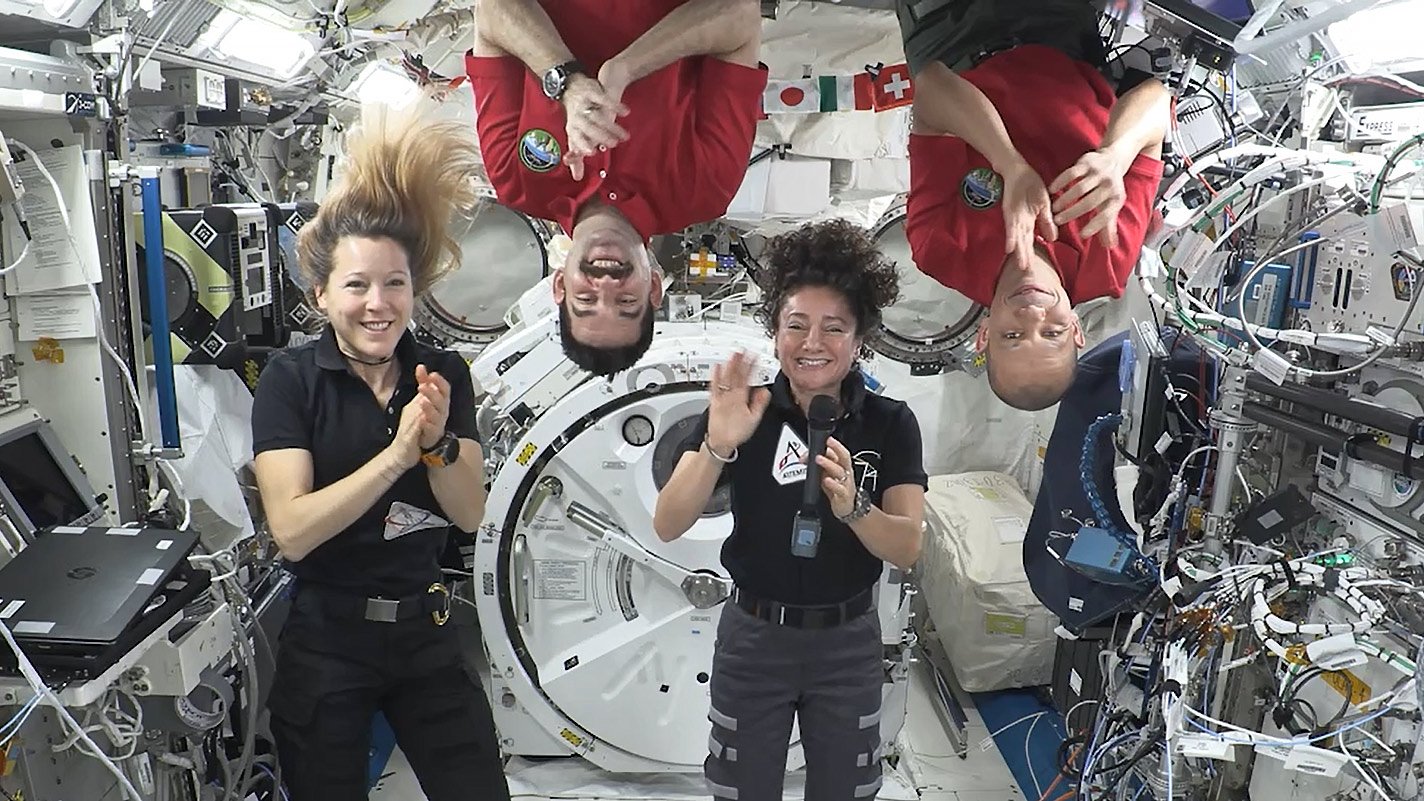
Expedition 74 crew members (from left) Sophie Adenot, Jack Hathaway, Jessica Meir, and Chris Williams congratulate the Artemis III crew in a recorded video message.
NASA

Microbiology and human research were the main scientific focus aboard the International Space Station on Tuesday to protect health on and off the Earth. The Expedition 74 crew members also worked on advanced research hardware and sent down a congratulatory message to the Artemis III crew, who were named during an announcement from the Johnson Space Center in Houston.

Some common bacteria have shown an increased resistance to antibiotics in the space environment potentially affecting an astronaut’s ability to fight an infection. Flight engineers Jack Hathway of NASA and Sophie Adenot of ESA (European Space Agency) explored the antibiotic-resistant organisms inside the Kibo laboratory module’s Life Science Glovebox and the Harmony module’s maintenance work area by processing the microbial samples and preparing them for DNA extraction and analysis. Doctors will use the data to understand how microbes adapt to microgravity possibly informing countermeasures to reduce the risk to astronaut health and protect patients on Earth.

NASA flight engineers Jessica Meir and Chris Williams partnered together loading a CubeSat-packed small satellite orbital deployer into Kibo’s airlock that will soon be placed into the vacuum of space. The Japanese robotic arm will grapple the deployer and point it away from the orbital outpost where it will safely deploy the shoebox-sized satellites into Earth orbit. A series of tiny satellites will be released for public and private research, including the Hokushin-1 CubeSat that will test space technologies such as radio frequency, propulsion, and solar arrays.

Roscosmos cosmonauts Sergey Kud-Sverchkov and Andrey Fedyaev worked on a pair of different investigations on Tuesday to continuously monitor how weightlessness affects the human body. Kud-Sverchkov, the orbital outpost’s commander, strapped an acoustic sensor around his neck that recorded his rapid exhalation to learn how living in space affects the respiratory system. Fedyaev wore a set of cuffs attached to his arms, wrist, and fingers measuring his blood pressure for a microgravity cardiac experiment. Roscosmos flight engineer Sergei Mikaev was back on artificial intelligence research studying new tools to boost crew efficiency and communications aboard a spacecraft.

Four of the station’s astronauts also sent down a message congratulating the four new Artemis III crew members commander Randy Bresnik of NASA, pilot Luca Parmitano of ESA, and NASA mission specialists Frank Rubio and Andre Douglas. The four flight engineers each spoke a few inspiring words with Meir stating, “Congratulations, Artemis III and godspeed on the journey ahead.” Watch the crew message on @Space_Station X.

Learn more about station activities by following the space station blog, @space_stationon X, as well as the ISS Facebook and ISS Instagram accounts.

Get the latest from NASA delivered every week. Subscribe here.

The post Crew Works Microbiology, Advanced Tech and Congratulates New Artemis III Crew appeared first on NASA Science.

  •  
❌