A new study suggests that reproducing a crucial sleep-like brain pattern in awake animals may help preserve memory and learning abilities. What if part of the brain could get some of the benefits of sleep without the rest of the brain ever going offline? A new NIH-funded study suggests that may be possible. Researchers found [...]
EEG studies suggest caffeine can reduce deep, restorative sleep even when sleep duration appears normal. Its effects vary by individual, and relying on caffeine for energy may come at the cost of nighttime recovery. Evening coffee has long been debated. Some people can drink it and fall asleep with no trouble, while others struggle to [...]
A new study has established the first-ever evolutionary history of all living millipedes, one of the planet’s first land animals that pioneered its terrestrial ecosystems (as the first chemical weapon manufacturers, too).
At a time when the Earth was bare, when there were no vertebrates, no trees, no leaves, no flowering plants, and no plants with seeds, millipedes were feeding on decaying mosses, decomposed slime, and primordial gunk.
Though that sounds unappetizing, someone had to complete the “dirty work” necessary to pave the way for life. Though they perform an essential function as one of the first animals on Earth, science still hadn’t fully tracked their history until now.
A new, groundbreaking study published in Current Biology addressed a 100-year-old gap in millipede science surrounding two rare groups of millipedes: Siphoniulida and Siphonocryptida.
Scientists knew that they existed, but without specimens for DNA analysis, they couldn’t confirm where they belonged in the millipede family tree.
But it was no easy feat to find them. One group spends its life underground, while the other survives in only a few known locations.
Penetrating 260 million years of history
Researchers traveled to Los Tuxtlas, Mexico, and Spain’s Canary Islands to collect Siphoniulus neotropicus and Hirudicryptus canariensis, two millipedes whose DNA had never before been included in an evolutionary analysis.
“It took 10 people over a week to find one tiny 10-millimeter adult,” said Luisa “Fernanda” Vasquez-Valverde, the paper’s first author, in a press release.
“Finding them in the field was hard because we were just seeing this little white nematode. We didn’t know for sure it was a millipede until we looked under the microscope.”
After sequencing their DNA, comparing hundreds of genes across 82 millipede species, and combining those results with evidence from 29 fossils, researchers determined where the groups belonged in millipede history and when their lineages emerged.
“Millipedes may have originated nearly 460 million years ago — roughly 35 million years before the oldest known millipede fossils and much earlier than previously believed,” according to the press release.
Siphonocryptida turned out not to be a distinct order after all, but part of an existing lineage. Siphoniulida was finally placed among its closest relatives on the millipede evolution timeline.
All in all, the analysis of the millipede species revealed that the ancient animals originated 460 million years ago, roughly 35 million years before the oldest known millipede fossils, which was “the biggest surprise” to researchers —
“Just how ancient these lineages turned out to be.”
The completed family tree also revealed one of the millipedes’ most important adaptations: they made the first chemical weapons. And it was these defenses that helped scientists trace their origins to about 260 million years ago.
Although the new study brought new insights into one of the planet’s most significant animals, millipedes still hold secrets waiting to be discovered.
Still more to discover
Scientists have described more than 14,000 species worldwide, but experts believe that tens of thousands may still be out there undiscovered.
These “unheralded heroes of the ecosystem” may be one of nature’s most important detritivores — because they break down decaying plant material and return nutrients to ecosystems — but scientists still haven’t fully penetrated this lineage, which is more ancient than the dinosaurs and paved the way on land for vertebrates.
“It’s really kind of puzzling that they have such an important function in the ecosystem, and yet they’re so poorly known,” noted Paul Marek, the study’s lead investigator and associate professor in the College of Agriculture and Life Sciences’ Department of Entomology.
“Millipedes beat vertebrates onto land by more than 80 million years,” continued Marek. “They really set the stage for later life on land, including humans and vertebrates.”
“There is all this potential for discovery,” a press release concluded. “It keeps me wondering what else we’re going to find.”
Rare charcoal fragments from an ancient lakeshore campsite are offering new clues about fire use, resource management, and the environmental knowledge of some of humanity’s earliest fire users. Long before cities, farms, or written language existed, some of humanity’s ancestors had already discovered a resource that would transform the course of human evolution: fire. But [...]
Chinese researchers have reportedly developed a new “three-lane highway” optical fiber system. The new system, the researchers explain, could dramatically expand the data-transfer capacity of future networks, notably those for artificial intelligence (AI).
Put in simpler terms, the innovation effectively “squeezes” more traffic from fiber-optic cables without having to replace or lay new cabling. According to the team, they have been able to increase traffic by as much as five times while also increasing transmission capacity per core by nearly 50%.
Today, most internet traffic travels through glass fibers using laser light. Importantly, each fiber doesn’t just carry one beam of light. It carries many wavelengths (colors) of light simultaneously, like multiple radio stations sharing the airwaves.
Presently, most commercial systems use a mixture of C-band (the workhorse) and L-band wavelengths. The latter is used to extend capacity when needed.
The team, they report, has managed to add a third, called S-band; hence the “three-lane highway” analogy. The fiber itself isn’t necessarily wider; they’re simply using more of the available light spectrum.
Adding an extra lane to optical fibers
So, you might ask, why hasn’t S-band been used before? Well, in short, over long distances, optical signals tend to weaken. To overcome this, telecom companies use optical amplifiers placed along the route.
The industry’s amplifiers were optimized for C-band (and later L-band). S-band signals were more difficult and expensive to amplify cleanly. To this end, the Chinese team claims to have solved enough of these engineering problems to make commercial deployment practical.
But there is another trick up the team’s sleeve: multiple cores to the fibers. Normal optical fibers consist of a single core, but the team’s new ones reportedly actually contain four.
To this end, each of these core acts like an independent fiber. So, unlike traditional fibers with a single core and two optical bands, the new fibers actually have four cores, with three optical bands working simultaneously.
That’s a significant leap in capability. For applications like AI, this could prove to be very useful indeed, especially when it comes to removing data-transfer bottlenecks.
At present, most large AI models tend to use thousands of graphics processing units (GPUs), constantly exchanging data at the speed of light. A modern AI cluster can move terabits per second between machines.
5x the data transfer
Often, the bottleneck is not the GPU but getting data from one GPU cluster to another. So, if you can move five times more data through the same fiber infrastructure, you necessarily get faster training, larger distributed models, and lower network congestion.
Looking at the bigger picture, this isn’t a breakthrough in terms of fiber optics; similar achievements have happened in Japan, Europe, and the US. What is different is that this appears to have been commercially deployed, not just developed in a lab.
According to reports, the new optic fibers have run over about 21.7 miles (35 km) of an existing telecoms network, combining the innovations mentioned. Looking ahead, the team suggests the new cables could be deployed internationally, perhaps even in submarine cables.
It could also play a major role in China’s “Eastern Data, Western Computing strategy,” which seeks to shift data-intensive workloads from densely populated eastern regions to resource-rich western provinces, according to the developers.
A new study suggests evolution stayed stuck for millions of years until sexual reproduction helped unleash a burst of biodiversity. New research suggests that the earliest animals on Earth may have unintentionally slowed the pace of evolution for millions of years. Scientists have found that their reliance on asexual reproduction limited competition and reduced the [...]
Hidden underground around the world lie 110 quadrillion kilometers of arbuscular mycorrhizal fungal networks—webs of ultra-thin threads that, if connected in a single line, would stretch almost a billion times the distance between the Earth and the sun, according to new research published in Science on Thursday.
These fungal communities form intimate relationships with the roots of plants, which they provide with nutrients like phosphorus and nitrogen in exchange for carbon, 1 billion tons of which the networks sequester underground annually, previous research has found. If the fungal network wasn’t storing it, that carbon would be warming the atmosphere.
But those networks have never been mapped globally until now. The new study led by Society for the Protection of Underground Networks, or SPUN, an organization founded to map mycorrhizal fungi networks, used a combination of literature review, soil samples from around the globe, machine learning and laboratory testing to estimate the distribution and mass of these systems and map where they are densest.
A newly discovered feathered dinosaur from China may help solve a long-standing mystery surrounding a fossil bed filled with ancient bird remains. For years, one fossil site in northwestern China has posed a mystery. The area contains hundreds of fossilized birds, many remarkably well preserved. Mixed among them are strange clusters of shattered bones compressed [...]
For decades, nuclear clocks have existed as one of physics’ most tempting promises. A device that could keep time even more accurately than today’s best atomic clocks. Now, two independent research teams have turned this idea into reality.
Researchers in China and Europe have demonstrated working nuclear clocks based on the nucleus of thorium-229, a rare isotope whose unique properties have long made it the leading candidate for next-generation timekeeping.
The achievement represents much more than a new kind of clock. Since a nucleus is far better shielded from environmental disturbances than the electrons used in atomic clocks, nuclear clocks could eventually become the most precise timekeepers ever built.
Plus, this breakthrough could improve navigation, gravitational sensing, and tests of the laws governing the universe.
As the researchers note, “by making a laser-addressed atomic nucleus an operational clock reference, this work extends quantum metrology from electronic to nuclear transitions, and opens a new platform for compact clocks, solid-state nuclear quantum sensors and precision tests of fundamental physics.”
Turning a thorium nucleus into a clock
Modern atomic clocks keep time by measuring the frequency of light absorbed or emitted when electrons jump between specific energy levels inside an atom.
As these frequencies are extremely stable, counting their oscillations provides an exceptionally accurate way to measure time. Physicists have long envisioned building a clock using a nucleus instead of electrons. The idea is attractive because atomic nuclei are much smaller and more isolated from the outside world.
Stray electric and magnetic fields that can slightly disturb electrons have far less influence on the nucleus. In principle, that should allow a nuclear clock to achieve even greater stability and precision.
“Such a nuclear clock might rival or outperform current optical clocks based on electron-shell transitions in atoms or ions, is expected to be more robust against external perturbations, and provides enhanced sensitivity in clock-based tests of fundamental principles of physics,” the researchers explained.
However, the problem is that almost all nuclear energy transitions are far too energetic to be controlled with lasers. They typically require high-energy gamma rays rather than ordinary laser light.
Thorium-229 is a remarkable exception. Its nucleus possesses an unusually low-energy excited state that can be reached using ultraviolet laser light. For years, physicists recognized that this made thorium-229 the only known realistic candidate for a nuclear clock.
Even so, the task remained extraordinarily difficult. The required transition occurs at a wavelength of roughly 148 nanometers, deep in the vacuum ultraviolet region of the electromagnetic spectrum.
Producing stable laser light at this wavelength and precisely matching it to the nuclear transition pushed existing technology to its limits.
Two teams, one breakthrough
The two groups solved the problem using broadly similar strategies. One team, led by researchers at Tsinghua University, and another from the Vienna Center for Quantum Science and Technology, embedded thorium-229 atoms inside calcium fluoride crystals.
“Here, we implement a thorium-229 nuclear clock by stabilizing a continuous-wave laser to the 148 nm nuclear transition with rapid feedback based on continuous absorption spectroscopy,” the researchers from the Vienna Center note.
The crystal acts as a solid host that holds large numbers of thorium nuclei in place while allowing laser light to interact with them. Both groups then illuminated the crystals with highly specialized continuous-wave vacuum ultraviolet lasers tuned near the thorium nuclear transition.
Although the overall concept was similar, the teams optimized different parts of the experiment. The Chinese researchers relied on a more powerful laser system to drive the nuclear transition. The European team instead used crystals containing a higher concentration of thorium nuclei, increasing the number of nuclei available for measurement.
Once they had successfully excited the nuclei, the researchers needed to demonstrate that the system could function as a true clock rather than simply detecting the transition.
So did the system work?
The Chinese team locked the frequency of their vacuum ultraviolet laser directly to the nuclear resonance. In effect, the thorium nucleus became a frequency reference that continuously corrected the laser.
The researchers reported a fractional frequency instability approaching one part in 10 trillion after a day of operation, showing that the nuclear transition could serve as a stable timekeeping signal.
The European team chose a different test. Instead of focusing solely on clock performance, they used their nuclear clock as a scientific probe.
The researchers searched for ultralight dark matter, a hypothetical form of matter that could subtly alter the energy levels inside atomic nuclei. If such particles existed, they might produce tiny periodic shifts in the thorium transition frequency.
“We use the nuclear clock to constrain models of ultralight dark matter by searching for periodic fluctuations and slow drifts in the nuclear transition energy, on time scales between 20 sec and one day,” the Vienna team said.
No evidence of dark matter was detected. However, the experiment demonstrated that the nuclear clock was sensitive enough to rival or exceed the capabilities of the world’s best atomic clocks when searching for such effects.
Together, the two studies provide the strongest evidence yet that practical nuclear clocks are no longer a theoretical concept but an operational technology.
What happens next?
While these first-generation devices are still laboratory systems, they mark the beginning of a new era in precision measurement.
Future nuclear clocks could outperform today’s most advanced atomic clocks because the thorium nucleus is naturally protected from many sources of noise that limit current technologies.
According to the researchers, such clocks could eventually improve satellite navigation, provide more precise gravitational measurements, and enable new tests of fundamental physics.
The next major goal is to refine the technology, reduce its size and complexity, and compare multiple nuclear clocks against one another.
A team at UNSW Sydney has produced an espresso-strength coffee using room-temperature water and sound waves — no heating, no pressure, no boiling — and in a blind taste test with 100 regular coffee drinkers, the result was indistinguishable from a traditionally brewed shot.
The research was led by Dr. Francisco Trujillo from UNSW’s School of Chemical Engineering. His team developed an ultrasonic brewing system that reduces energy consumption by up to 75% compared to conventional espresso machines while producing a concentrated shot in under three minutes.
How acoustic cavitation replaces heat
Traditional espresso forces water heated to near-boiling through tightly packed coffee grounds under pressure — typically 9 bar. The heat and pressure together drive the rapid extraction of flavor compounds, oils, and caffeine from the grounds into the water.
Trujillo’s system replaces heat with high-frequency sound waves. A transducer — a small metal device — is pressed against the side of a modified coffee filter basket.
When activated, it causes the basket to vibrate rapidly at ultrasonic frequencies far beyond human hearing, transmitting those vibrations through both the coffee grounds and the room-temperature water.
The vibrations create a phenomenon called acoustic cavitation: microscopic bubbles form and collapse rapidly in the liquid. When those bubbles collapse near coffee particles, they act like tiny jets of water, pitting and fracturing the surface of the grounds and forcing flavor compounds, oils, and caffeine into the water at rates that would normally require heat.
The result is a concentrated, espresso-strength shot — same richness, same caffeine — brewed with cold water in two and a half to three minutes.
Three variables proved most important in getting it right: the brew ratio (water per gram of coffee, which controls concentration), the grind size (finer grinding accelerated extraction), and the duration of ultrasound application (the sweet spot was 2.5 to 3 minutes for a balanced result).
What the taste test found
To validate the system, the team ran a randomized blind sensory evaluation. Four drinks were tested — traditional espresso, ultrasound-brewed espresso, traditional filter coffee, and ultrasound-brewed filter coffee — all prepared fresh, cooled to the same temperature, and served in identical coded cups in random order. Around 100 regular coffee drinkers rated each drink on a nine-point scale for aroma, flavor, bitterness, and overall liking.
For espresso, there were no significant differences across any taste measure. Most participants could not tell the two versions apart, and no preference for either emerged.
For filter coffee, the ultrasound version actually outperformed the traditional brew. Participants rated it significantly higher overall — particularly for the pleasantness of its bitterness.
The industrial case
Trujillo’s team is clear about where the biggest impact lies. While a home version of the machine is technically feasible, the most compelling opportunity lies in industry. Companies producing ready-to-drink coffee at scale currently operate large volumes of high-energy brewing equipment continuously.
A system that cuts energy use by three-quarters, brews in minutes, and delivers espresso-strength concentrate that can be shipped and later diluted into cold brew, milk-based drinks, or ready-to-drink products represents a meaningful change to that cost structure.
The 75% energy saving is particularly beneficial at that scale, Trujillo noted, and because the process produces a concentrated, espresso-strength coffee, it can be used directly in manufacturing or shipped as a concentrate for a range of coffee products — cutting both energy and processing time from the industrial supply chain simultaneously.
The research was first published in the Journal of Food Engineering.
Fifty years from now, academic treatises will be written about how the world was taken in by the climate madness of a pseudo-scientific doomsday cult, writes Princeton physicist Professor William Happer.
What if time isn’t woven into the fabric of reality at all? A new experiment suggests that the past-to-future march we experience every day could arise from the internal dynamics of a system. Using 24,000 ultracold atoms, scientists built a “mini universe” that allowed them to study how time might emerge without relying on clocks.
The findings, published in Physical Review Research, offer researchers a new way to test ideas that have long remained in the realm of theory. The setup could help scientists explore quantum gravity, the origins of the universe, and the fundamental nature of time inside a laboratory.
Building a mini cosmos
Professor Giovanni Barontini of the University of Birmingham and his team created the miniature universe using a cloud of 24,000 ultracold atoms. The atoms existed just billionths of a degree above absolute zero.
Experiment to trap and cool rubidium atoms close to absolute zero. Credit – University of Birmingham
The researchers confined the particles inside an isolated quantum system. They then used two laser beams to form a thin barrier that divided the setup into two regions. One region remained observable, or “bright.” The other stayed hidden from direct observation and became the “dark” sector.
Inside this simplified cosmos, the bright region repeatedly expanded and contracted. The cycle resembled theoretical versions of a Big Bang followed by a Big Crunch, a scenario in which the universe’s expansion eventually reverses.
Because the system remained sealed from its surroundings, scientists reconstructed the sequence of events using only changes occurring within the mini-universe. They did not need an external laboratory clock.
Time through disorder
The experiment points to a concept known as “entropic time.” Rather than treating time as an independent backdrop to reality, the researchers linked its passage to changes in entropy, or the way particles spread through the system. Atoms moved between the bright and dark regions, altering the distribution of matter.
As those distributions evolved, the system moved forward in time. When the arrangement stopped changing, time effectively stood still. The team found that this version of time flowed in a consistent direction. It also correctly ordered events, even during repeated cycles of expansion and contraction. Its pace could speed up or slow down depending on how entropy shifted within the system.
“In some theories of the universe, especially quantum gravity, time doesn’t appear as a built-in feature,” Barontini said. “Yet in everyday life, time flows from past to future. Why is this so, when most basic laws of physics work the same way forwards and backwards?”
Bringing cosmology to the lab
Barontini said the study provides controlled experimental evidence that changes within a system can define time without relying on an external clock. “It offers new insight into the nature of time in quantum gravity,” he said. “It could be used to describe dynamics just as effectively as conventional time.”
The researchers also showed that quantum mechanics remains mathematically consistent under this framework. They rewrote a version of the Schrödinger equation using entropic time, allowing predictions about how a quantum probability distribution evolves.
The work addresses a long-standing puzzle in physics: If the universe has no fundamental clock, how can events be arranged into a meaningful sequence of “before” and “after”? Perhaps more importantly, the experiment transforms abstract debates into testable science.
The platform could eventually allow researchers to investigate conditions linked to the early universe, probe competing theories of quantum gravity, and even simulate black holes under controlled laboratory conditions.
For decades, many of these questions existed mainly on chalkboards and in complex equations. This miniature universe suggests physicists may finally have a way to put some of them to the test.
In our latest episode of Lexicon, we sat down with Tom Grainger, Commercial Vice President at Niron Magnetics, to explore the hidden role permanent magnets play in modern technology and electrification.
From electric vehicles and wind turbines to smartphones and speakers, these components are essential to countless devices we rely on every day. Tom also discussed the growing strategic importance of rare earth magnets and the risks associated with highly concentrated global supply chains.
Also, subscribe to IE+ for premium insights and exclusive content!
Reinventing the magnet
Permanent magnets rarely make headlines. Yet, as Grainger explained to us, they sit at the core of modern electrification.
“Pretty well every modern electronic device relies on permanent magnets,” he told us. “The car you drive, the speakers you’re hearing me come out of right now, the microphone that’s picking up my voice, all of those are permanent magnet devices,” he added.
“Relying on rare earth magnets today means relying on a supply chain that is over 90 percent concentrated in China. Single point of failure geopolitically,” he said.
But it turns out the issue is not limited to mining.
“All through the supply chain, you see that concentration,” he explained. The result is what he calls a pinch point. “You’ve got a pinch point on which the global economy hinges,” he added.
A magnet-hungry world
Furthermore, the demand side only intensifies the pressure. “As cars install more speakers and compete on infotainment and a great in-cab experience, doubling the speakers doubles the magnets,” Grainger told us.
“Imagine as you move from an F-35 to a swarm of drones, you’re saving a lot of money, saving a lot of material, but you are greatly increasing your magnet consumption,” he added.
Even in a stable geopolitical climate, supply would be strained. “Even if everything is peachy globally, there are just not enough rare earths to solve this magnet-hungry global economy,” he added.
“For some critical rare earths, China put in place export controls,” he said. Those elements are required for high-temperature applications, which represent roughly 80 percent of use cases. Automotive production slowed. Defense programs accelerated alternative sourcing efforts. Phones, he recalls, were “ringing off the hook.”
“Magnets may already be as strategically important as semiconductors,” he added.
Forty years without a new material
Beyond supply risk, Grainger argues, there is a deeper technological constraint. The last major breakthrough in magnetic materials came in the 1980s with rare-earth magnets.
“The last time we had a new magnetic material that has had any sort of real commercial impact was rare earth magnets in the 1980s,” he told us.
That means four decades of motor and generator design constrained by the same materials. He uses a culinary analogy. “You can imagine you are a chef. You’ve been working with four ingredients. Suddenly, you have another option. It is just an unlock for breakthroughs in motor design,” he added.
“We’ve spent four decades without a new key and without a new door open,” he said. That new key, according to Niron, is iron nitride.
Iron nitride to the rescue
According to Grainger, iron nitride is not a brand-new discovery, being first identified in the 1950s. Later attempts in Japan produced promising but inconsistent results. The missing piece was the ability to understand and control the material at the nanoscale.
“We did not have the technology at the time to be able to explain, just from a physics perspective, what makes iron nitride so magnetic, and then to reliably produce iron nitride in this magnetic phase,” Grainger told us.
Advances in imaging and characterization in the 2000s and early 2010s changed that. “The ability to see what you’re doing when you make an experimental attempt to measure it was unlocked by advances in characterization imaging,” he added.
From there, it took more than a decade to move from laboratory research to bulk, commercially viable magnets. “It was a decade from that program to actually having commercially viable bulk permanent magnets,” he said.
The potential upside is significant. “For a rare earth permanent magnet made of neodymium, that number is about 1.6 Tesla,” he explained. “For iron nitride, that equivalent limit is 2.4 Tesla,” he added.
“That ceiling is 50 percent higher than rare earth permanent magnets,” he said.
Temperature performance is another factor. Rare earth magnets rely on scarce heavy rare earth elements such as dysprosium and terbium to maintain performance at high temperatures. “Iron nitride, just by virtue of its underlying crystal structure and properties, gets that temperature stability for free,” Grainger said.
Unlocking variable flux motors
One of the most intriguing applications discussed in the episode is the variable flux motor. Traditional permanent magnet motors use a technique called flux weakening at high speeds, which requires continuous electrical input.
Grainger described it with a metaphor: “think of it as holding a spring. If you move your hand, it pops right back up. And so you’re using power to do that.”
Variable flux offers a different approach. “Instead of continuous energy expenditure holding down that spring, it’s like a ratchet. You push down the spring once, and you lock it into place,” he said.
The result is improved efficiency across the speed range. In electric vehicles, that translates directly to range and battery savings. “You get a 2 percent decrease in battery materials. The cost savings on that don’t just pay for your magnets, that pays for your whole motor,” he added.
The same logic applies to appliances and data centers. Efficiency gains compound quickly when systems operate continuously.
Scaling manufacturing
Moving from breakthrough to production required another leap. “Niron has been introducing iron nitride permanent magnets, and we’re doing so on a nano scale,” Grainger told us.
“Our lab breakthrough was then the second breakthrough, which is really the process. And the process in that case becomes the product,” he said. The goal is modular scalability. Facilities can be replicated in multiple regions, reducing geographic concentration risk.
Iron nitride is composed of iron and nitrogen. Both are abundant and widely sourced. “Anywhere you have an industrialized society, you’ve got an opportunity for iron nitride domestic magnet production,” he said.
A strategic shift
Looking at the bigger picture, Grainger drew a historical analogy to the Haber-Bosch process, which enabled synthetic fertilizer production and reduced reliance on guano mining. “What iron nitride is, is that shift,” he said. “So, what if we could avoid all of that digging. What if we could avoid the reliance on what is fundamentally any mine has a shelf life,” he added.
So, instead of finite ore bodies, he describes a factory-built approach. “This is innovation as a cookie-cutter. Sort of the abundance philosophy around magnets,” he told us.
And, defense customers have taken notice. Programs initially planned for five to seven-year development timelines were “suddenly on 18-month fast tracks” after export controls tightened.
What the next decade has in store
Looking ahead, Grainger defines success in pragmatic terms. “Success for iron nitride is that we’re not talking about magnets as a scarce or critical pain point in global supply chains,” he added.
Beyond stability, he anticipates innovation. New motor and generator designs built around the expanded magnetic ceiling. Localized manufacturing in Asia, Europe, and North America. Reduced vulnerability and expanded design freedom.
“It can be hard sometimes to think about, can new things be done that aren’t just new assembly or new software?” he told us. “And absolutely they can.”
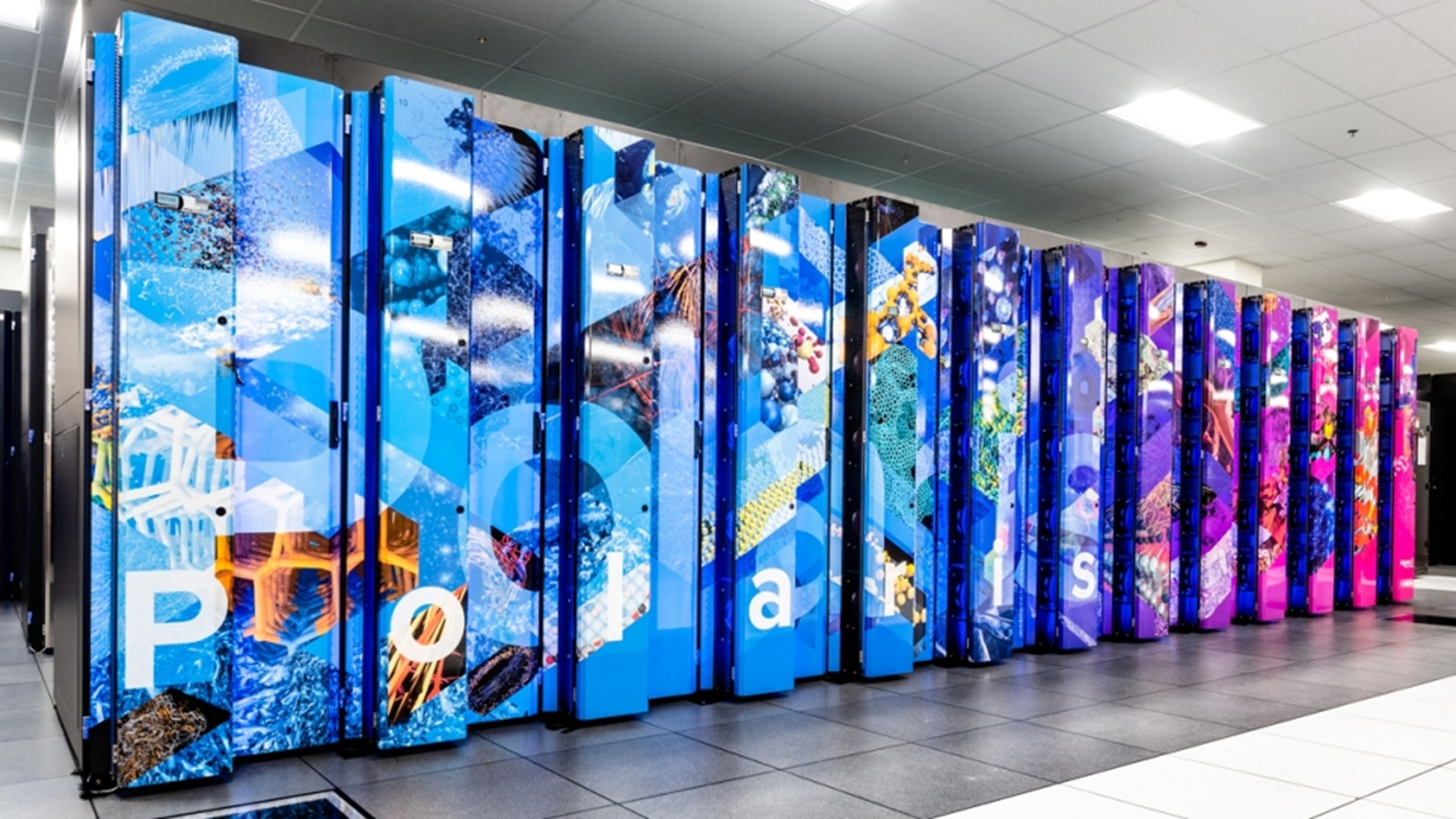
Scientists in the US have utilized the Polaris supercomputer to generate the most detailed three-dimensional (3D) images of the pion, the lightest particle made of quarks.
The study, which helped reveal the internal structure of a pion in unprecedented detail, was conducted by a research team at the US Department of Energy’s (DOE) Argonne National Laboratory (ANL).
Pions are subatomic particles that play a significant role in holding atomic nuclei together. “Pions mediate the strong force that binds nucleons, that is, the protons and neutrons that account for an atom’s mass,” Yong Zhao, PHD, an ANL physicist and principal investigator of the project, said.
According to the Zhao and the team, the findings reveal not only how quarks are arranged within the particle, but also offer new clues on how visible matter forms from fundamental particles. The latter is considered one of the biggest mysteries in physics.
Mapping the pion
Pions are among the lightest and simplest subatomic particles. They are governed by the strong force, which binds protons and neutrons together inside the atomic nuclei. This force accounts for 98 percent of the mass of the visible universe.
They’re also composed of a quark and an antiquark. Yet, despite their importance, scientists have struggled to examine their internal structure because experimental data remains limited. To overcome this challenge, ANL and Brookhaven National Laboratory researchers turned to large-scale computer simulations.
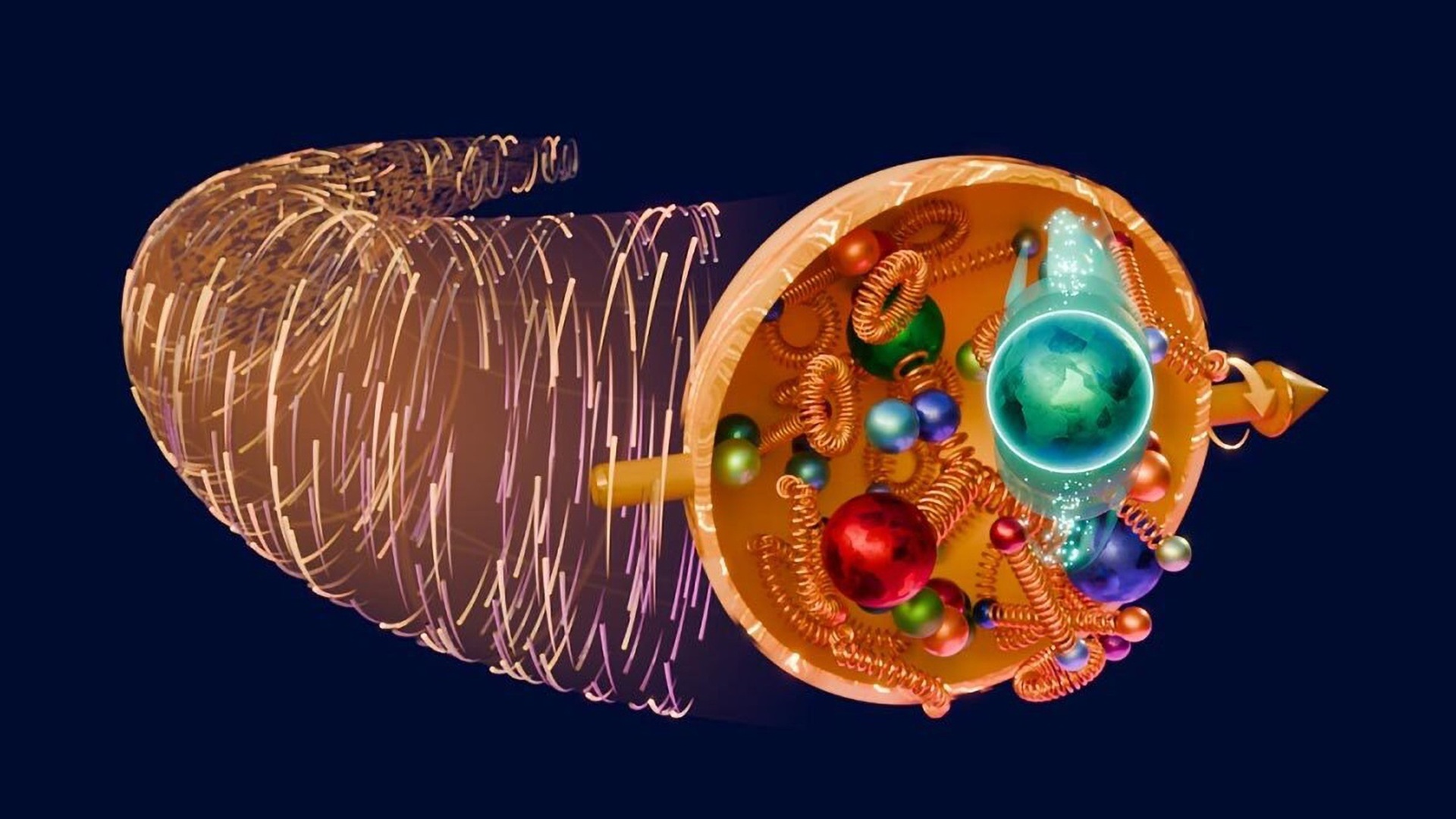
Graphic showing the transverse motion of a quark (green sphere) inside a proton whose spin is aligned with its direction of motion (large yellow arrow). Credit: Valerie Lentz / Brookhaven National Laboratory.
The team combined advanced theoretical models with the computing power of Polaris. This reportedly recreated the pion’s internal structure in remarkable detail.
Zhao pointed out that examining the pion’s multidimensional structure provides a deeper insight into the particle’s fundamental properties. “By probing the pion’s internal structure, we gain a deeper understanding of how quarks and gluons are confined to create visible matter,” he said.
The simulations generated high-resolution 3D images that showed how quarks are distributed throughout the particle. Understanding this structure is essential for explaining how quarks and gluons combine to create the visible matter that makes up the universe.
A new perspective
For the project, the group simulated hundreds of snapshots of four-dimensional (4D) spacetime with lattice quantum chromodynamics. This is a technique that places particles and fields on a vast computational grid.
“This is a task possible only with large-scale parallel computing power like that of ALCF supercomputers,” Zhao said in a statement. “We thereby obtained high-resolution images of the quark structure in a moving pion.” The images showed how quarks carrying different fractions of the pion’s momentum are distributed across the particle.
The team modeled how quarks move both along the pion’s direction of motion and across it. The simulations relied on lattices with millions of grid points. “The simulation captures hundreds of snapshots of our 4D spacetime, represented on a lattice with millions of grid points,” Zhao added.
The calculations revealed the quark generalized parton distribution (GPD) of the pion. This is a mathematical framework that describes how quarks are distributed in both momentum and space. The resulting maps provided a detailed 3D picture of the particle.
As per Zhao, one notable finding was that the pion’s transverse size decreases as its momentum increases. The team also found that the pion appears smaller than the proton at moderate momentum values.
“Our next step is to use the ALCF’s Aurora supercomputer to map the proton in three dimensions,” Zhao concluded. “Protons, together with neutrons, make up all the atomic nuclei that compose the visible matter in our universe.”
The study has been published in the Journal of High Energy Physics.
Astronomers studying the atmospheres of several intensely heated exoplanets uncovered an unexpected pattern that may reveal a hidden property of these distant worlds. Astronomers have uncovered the clearest evidence so far that some planets beyond our Solar System possess magnetic fields. By measuring atmospheric winds on seven extremely hot gas giants, researchers found signs that [...]

 Login

 A new study suggests that reproducing a crucial sleep-like brain pattern in awake animals may help preserve memory and learning abilities. What if part of the brain could get some of the benefits of sleep without the rest of the brain ever going offline? A new NIH-funded study suggests that may be possible. Researchers found [...]














 Our weekly science news roundup.