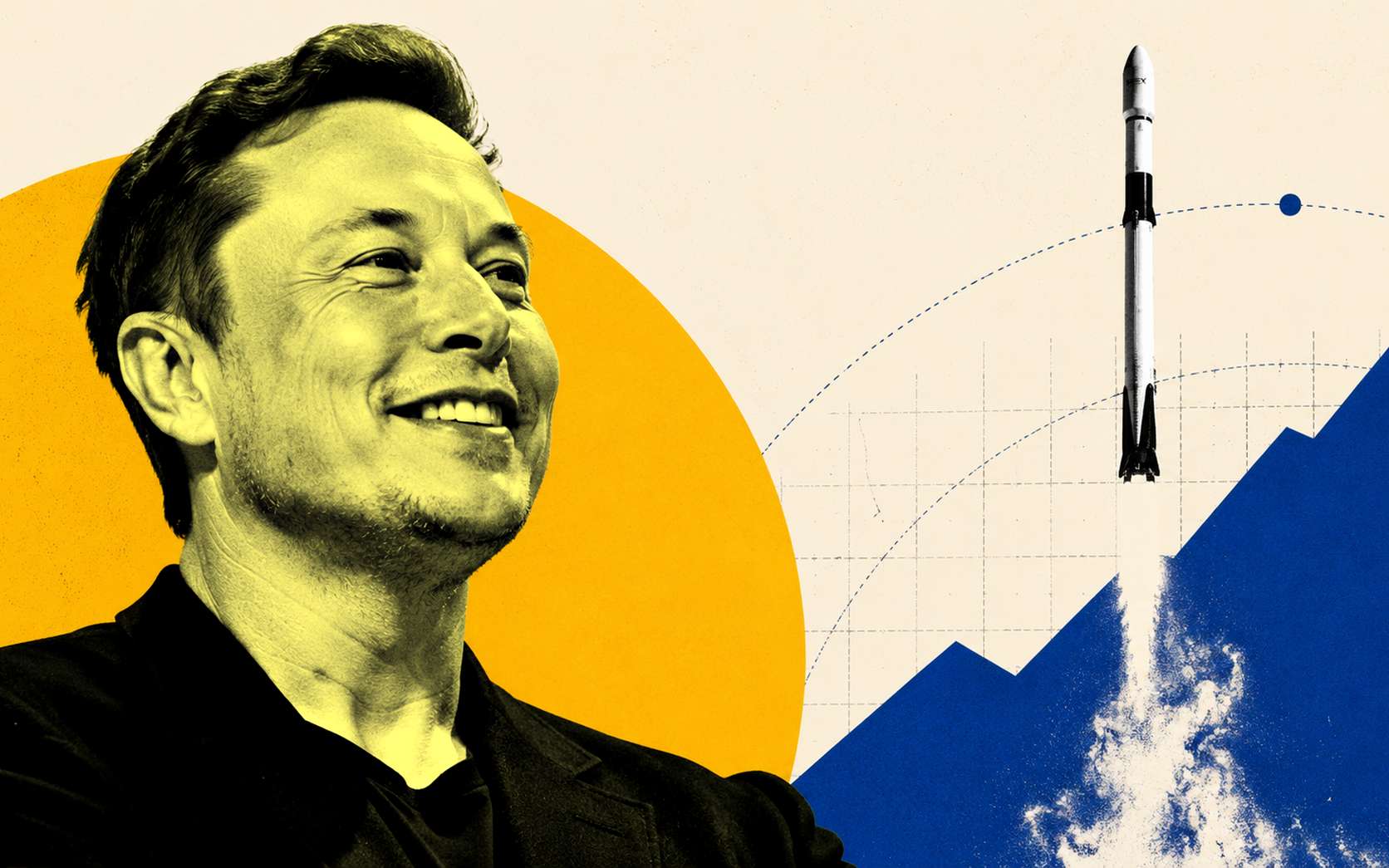
As SpaceX gears up to start launching orbital data center spacecraft as soon as next year, astronomers warn those satellites could cause serious interference with their observations.
Elon Musk is now officially the world's first trillionaire. That is a colossal amount of wealth (and by proxy, power) for one individual to have. Its scale - a thousand times more than a billion - is difficult to fathom for those of us who aren't among the 3,363 billionaires that currently exist in our world. But let's try to comprehend it anyway.
The most frequently cited comparison is time. If you were to count out a million seconds, it would take you 11 and a half days. A billion seconds would take you 31.7 years. But a trillion seconds would take 31,700 years - to reach that point today, you would have needed to start counting in the Pa …
Elon Musk's net worth has passed the trillion-dollar mark after SpaceX's IPO. His net worth, which was hovering around $800 billion before the IPO, includes the value of his 4.8 billion shares in SpaceX, along with his wealth from his other companies, like Tesla. Shares of SPCX opened at $150 and have remained well above the $138 benchmark that gives Musk a 13-figure net worth.
SpaceX combined Musk's rocket, AI, and social media platforms earlier this year, and said in its S-1 that its goal is to "build the systems and technologies necessary to make life multiplanetary, to understand the true nature of the universe, and to extend the light …
The IPO market is back, and it’s not the same companies leading the charge. FAANG had a good run, but a new acronym is taking over: MANGOS — Meta (or Microsoft, depending on who you ask), Anthropic, Nvidia, Google, OpenAI, and SpaceX. Half of that bunch is heading to public markets in the same window, and it’s a stress test for investors, for valuations, and for […]
Nearly three out of every four images obtained by NASA’s new SPHEREx space telescope revealed something many astronomers were afraid of: contamination by artificial objects humans are launching into space.
The findings were reported in a new preprint paper by researchers at NASA’s Ames Research Center, who say that 73.3% of all the images the telescope captured over four months last summer revealed evidence of at least one trail left by SpaceX satellites or other orbital spacecraft.
What may be worst of all is that astronomers aren’t surprised.
With its mission to map the night sky in near-infrared light, NSA’s Spectro-Photometer for the History of the Universe, Epoch of Reionization, and Ices Explorer (SPHEREx) relies on long-exposure imagery that enables it to map large regions of the sky with every viewing.
Unfortunately, long-exposure photography is also ideal for capturing the movement of satellites, an increasing number of which have been placed in orbit in recent years.
Equally troubling is the fact that SPHEREx, from its own position in Earth orbit, had been positioned at an altitude where it was hoped that the number of satellite streaks could be limited. Yet despite such efforts, the new paper featured at the arXiv preprint server reports that, on average, at least two satellite trails were detected in every exposure.
Satellites Mistaken for Cosmic Rays
Astronomers have been raising concerns about this problem already for some time, and presently, there doesn’t appear to be any near-term solution.
Even beyond image contamination, the preprint study also found that several satellites that enter SPHEREx’s field of view are bright enough that they are also triggering the space telescope’s automated system that protects its delicate components from stray cosmic rays.
Designed to shut down the telescope’s data collection when it detects what it suspects are cosmic rays, the new research reveals that some satellites reflect enough light to engage algorithms that control this defense system.
Even in instances where imagery is successfully obtained, albeit with contamination from satellites, the brightness of these orbital objects can effectively obscure objects behind the portions of the telescope’s images where the satellites appeared.
In the images above, several examples of satellite trails are shown in SPHEREx imagery collected during the summer months of 2025 Image Credit: NASA/Borlaff, et al/arXiv.org).
A Growing Concern
The new SphereX findings are only the latest indication that astronomers were right to be concerned about potential light pollution from satellites. In a past study by Sando Kruk and colleagues, Hubble Telescope images had shown an increase in the number of satellites crossing its field of view, rising from contamination shown in just 2.8% of its images, to 5.9% over a period of two decades.
Ideas about how to prevent the issue have focused on using anti-reflective coatings on satellites and other means of reducing their brightness once they reach orbit. However, many modern satellites are large enough that having darker exteriors doesn’t help to significantly mitigate the amount of light they can reflect.
Additionally, the study’s authors note that “Optical reflections are just a fraction of the problem, since satellites also emit and reflect [infrared],” meaning that optical darkening efforts “might even increase their temperature, making them brighter in the IR.”
Worse Before It Gets Better
According to the study’s authors, the problem is likely to worsen before astronomers see any improvements.
“Remarkably, some private operators have announced the intent of deploying 4000 purposely high reflective satellites,” the researchers write, which aim to provide “sunlight on demand.” Such artificial orbital systems, if successfully deployed, would reflect light as much as five times the brightness of the full Moon onto areas of the Earth roughly five kilometers in diameter.
This, the team argues, would potentially have “a catastrophic impact to the quality of the dark sky and the Earth’s inhabitants.”
Fundamentally, the authors hope that bringing additional attention to such issues with their recent study may help to mitigate future concerns about our ever-brightening night sky.
“The widespread contamination addressed in this paper affects multiple areas of astronomical research,” the team says, which they say includes “the study of transient phenomena, deep imaging surveys, spectroscopic studies, and the search for Near-Earth Objects (NEOs), thereby hindering our ability to understand the Universe and protect the Earth.”
The new paper by Alejandro S. Borlaff and colleagues, “SPHEREx confirms predictions for artificial satellite trail pollution in Low Earth Orbit,” appeared at the preprint arXiv server.
Micah Hanks is the Editor-in-Chief and Co-Founder of The Debrief. A longtime reporter on science, defense, and technology with a focus on space and astronomy, he can be reached atmicah@thedebrief.org. Follow him on X @MicahHanks, and at micahhanks.com.
SpaceX’s IPO on Friday allows the public to buy shares of the combined rocket, AI, and social media company for the first time, and raised enough money to make Elon Musk the first trillionaire.
He has more wealth, on paper at least, than the economies of nations like Ireland, Sweden, or his home country of South Africa (CNN cites the International Monetary Fund saying only 20 countries have economies larger than $1.1 trillion), now linked to the promise of a business based on launching AI datacenters into space.
SpaceX n'a pas toujours été l'empire industriel dirigé par un militant d'extrême-droite mégalo que l'on connaît aujourd'hui. Avant d'atteindre les sommets dans le domaine de l'aérospatial, l'entreprise avait commencé comme beaucoup d'autres.
TechCrunch has followed SpaceX's start, struggles, and successes from the early days. And we're here for what happens next too. This package of SpaceX IPO coverage includes who stands to win (and maybe some who won't), pre-IPO deals, and what's tucked inside its S-1 registration document.
In one of the most highly anticipated and controversial public offerings of all time, the rocket venture helmed by Elon Musk started trading on Nasdaq on June 12th at the take-it-or-leave-it price of $135-per-share - though most retail investors will likely pay far more.
The IPO is historic for many reasons: SpaceX is hoping to raise $75 billion under the ticker symbol SPCX, which would make it the largest public offering in history. The company is controlled by Musk, who also runs Tesla, another trillion-dollar company. The IPO is expected to make Musk, who is set to control 85 percent of the voti …
Entre prouesse biotechnologique et storytelling de luxe, un sac à main présenté comme fabriqué en « cuir de T. rex » vient de faire son apparition sur le marché des enchères parisiennes. Affiché à plusieurs centaines de milliers d’euros, l’objet invoque la paléontologie et des fragments de...
A empresa espacial de Elon Musk fixou o preço a 135 dólares por ação, numa avaliação de 1,77 biliões de dólares que "pulveriza" todos os recordes anteriores. As ações da SPCX estreiam-se hoje às 14:30 (hora de Portugal continental) no Nasdaq.
Il y a plus de 550 millions d’années, les premiers animaux peuplaient déjà les océans terrestres sous des formes très différentes de celles d’aujourd’hui. Longtemps dominés par des organismes fixés au fond marin et se reproduisant probablement par clonage, ces écosystèmes auraient connu une...

 Login