❌

Reading view

Jupiter Accelerates Electrons to Near-Light Speed, Offering Clues to Cosmic Ray Origins
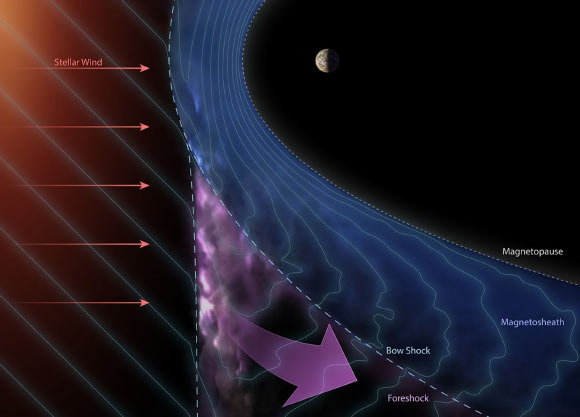
As planets and stars travel through the streams of charged particles flowing across space, their magnetic fields act like obstacles; incoming particles are slowed and deflected, forming a boundary called the bow shock; just ahead of this boundary lies the foreshock, a variable region where magnetic conditions can accelerate some particles to nearly the speed of light. Image credit: Ben C. Smith, Johns Hopkins Applied Physics Laboratory.

The giant planet’s bow shock isn’t just deflecting the solar wind, it’s acting as a powerful particle accelerator, firing electrons to relativistic energies of at least 1 MeV, according to a new analysis of data from NASA’s Juno spacecraft.

The post Jupiter Accelerates Electrons to Near-Light Speed, Offering Clues to Cosmic Ray Origins appeared first on Sci.News: Breaking Science News.
  •  

NASA’s Fermi Telescope Caught a Supernova Doing Something Never Seen Before

Supernova Starburst Space Travel Warp SpeedNASA’s Fermi telescope may have finally uncovered the magnetic powerhouse behind the universe’s brightest supernovae. An international team of astronomers analyzing observations from NASA’s Fermi Gamma-ray Space Telescope has found what appears to be the first convincing detection of gamma rays from a rare type of extraordinarily bright stellar explosion known as a superluminous supernova. [...]
  •  

The Physics of the Curse

The Curse resulted in decay, disease, and death affecting the entire creation, meaning the whole universe. The effects are seen in the cosmos and in living organisms. However a future restoration of creation is promised by God, reversing the effects of the Curse.

  •  

Scientists Find a Smarter Way To Measure the Universe Using Exploding Stars

Supernova Explosion Galaxy CenterA new method could improve cosmology research by analyzing supernovae together with the galaxies that host them. An international collaboration led by scientists at the Institute of Cosmos Sciences of the University of Barcelona (ICCUB) has created a new approach that may sharpen what researchers can learn about how the Universe expands and what dark [...]
  •  
❌