❌

Reading view

Video: New palm-sized robot with 8 smart actuators can walk, trot, and jump
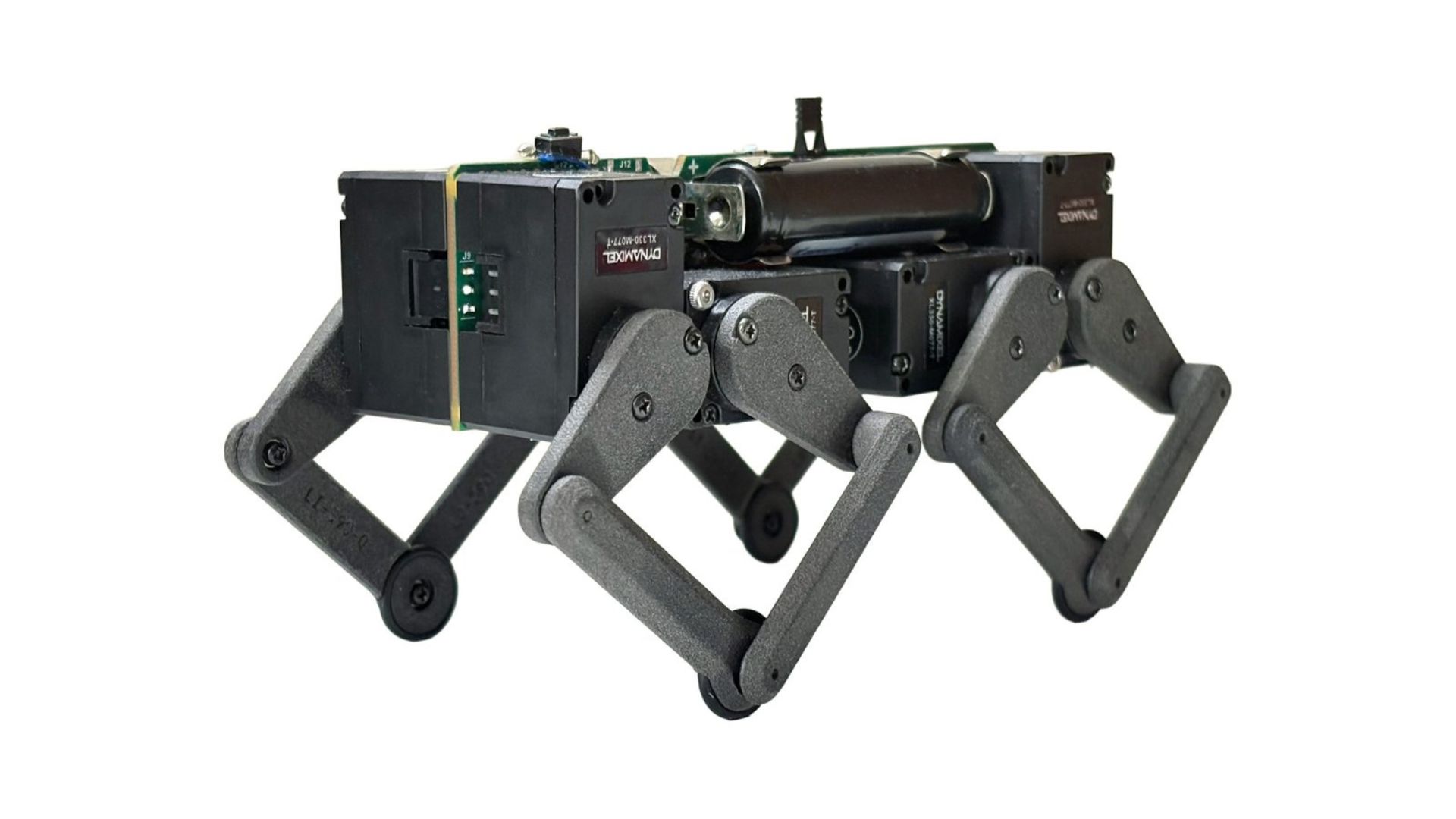
An open-source quadruped robot named Q8botOne aims to provide an affordable, fully assembled robotic platform for hobbyists, researchers, and developers. Building on the original Q8bot’s low-cost, agile design, Q8botOne comes fully assembled and ready to use right out of the box.

The robot now packs programmable actuators into a palm-sized platform, delivering dynamic mobility in a robot compact enough to roam across a desktop.

According to its maker, the robot will soon be available through a Crowd Supply campaign, making quadruped robotics more accessible to a wider audience.

Agile quadruped arrives

Q8botOne is an upcoming open-source quadruped robot developed by Eric Wu to make advanced legged robotics more accessible to hobbyists, students, researchers, and developers.

Despite its small size, Q8botOne is capable of performing a range of dynamic movements typically associated with much larger and more expensive quadruped robots. The robot can walk, trot, and jump, demonstrating agile locomotion that makes it suitable for robotics research, educational projects, and experimentation with autonomous behaviors. By eliminating the need for users to source parts and assemble the robot themselves, Q8botOne significantly lowers the barrier to entry for anyone interested in legged robotics, Hackster reported.

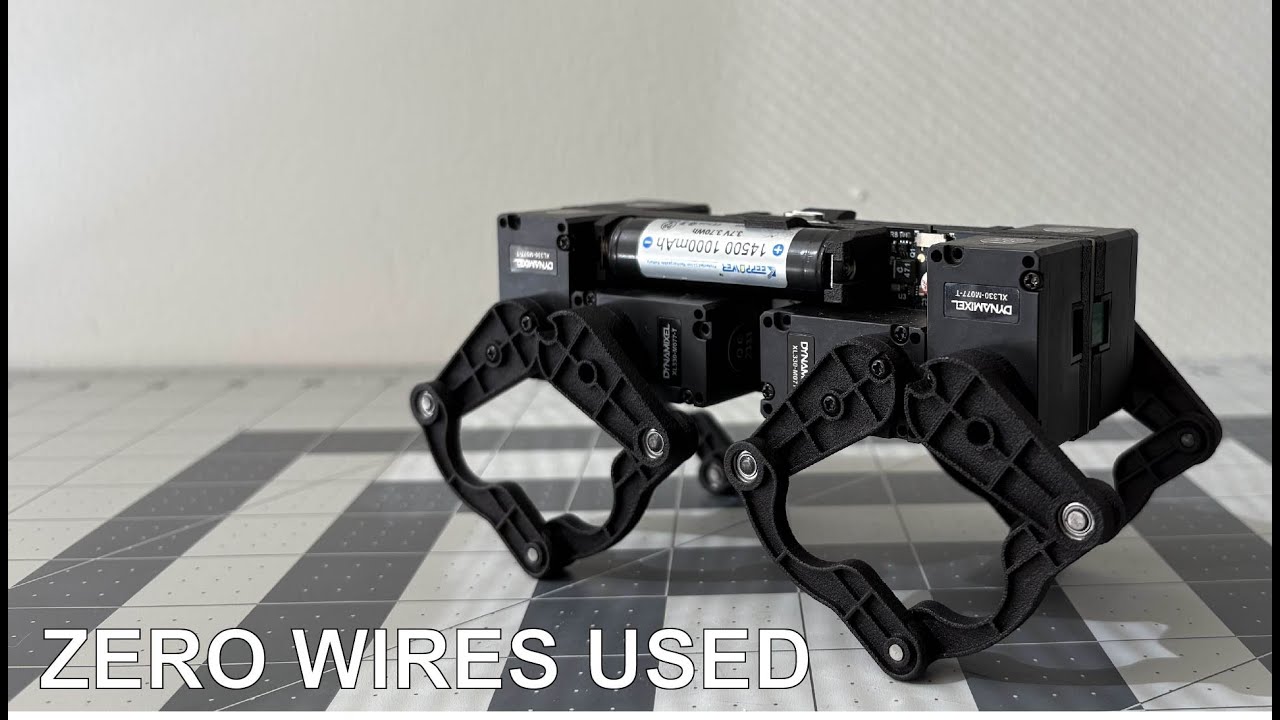
One of the robot’s most distinctive features is its highly integrated design. Unlike many small quadrupeds that rely on numerous wires routed throughout the body, Q8botOne incorporates its electronics directly onto a custom central printed circuit board. This streamlined architecture reduces cable clutter, improves reliability by minimizing potential failure points, lowers overall weight, and simplifies maintenance and troubleshooting. The result is a cleaner and more refined appearance that sets the platform apart from many traditional DIY robotics projects.

The robot’s locomotion system is powered by eight DYNAMIXEL XL-series smart actuators. These actuators drive lightweight parallel-linkage legs constructed from Multi Jet Fusion (MJF) 3D-printed components and precision ball-bearing joints. This combination provides a balance of strength, durability, and low weight, enabling smooth, accurate movement. The mechanical design has been optimized to support dynamic maneuvers while maintaining structural efficiency, according to Crowdsupply. 

At the heart of the system is an ESP32-C3-MINI-N4 microcontroller that manages onboard processing and robot control. Power is supplied by a rechargeable lithium-ion battery equipped with integrated protection circuitry to enhance operational safety and battery management. The robot is designed to provide a convenient user experience, allowing owners to begin experimenting immediately after powering it on.

Open quadruped platform

Each Q8botOne package will include a custom wireless controller dongle that comes pre-paired with the robot.

The controller features a joystick, multiple buttons, and USB-C connectivity for both power and communication. When connected to a computer, the controller provides access to software tools that enable users to configure, monitor, and control the robot in greater detail. This setup allows beginners to quickly get started while also offering advanced functionality for experienced developers, reports Crowdsupply.

Expansion capabilities are another key aspect of the platform. A Qwiic-compatible connector enables easy integration of additional sensors from manufacturers such as SparkFun and Adafruit without requiring complex wiring. The robot also includes a UART interface that supports co-processors, such as a Raspberry Pi. This interface can supply up to 5V at 3A, allowing users to add more powerful computing hardware for applications involving computer vision, AI, autonomous navigation, or custom robotics research.

Continuing the philosophy of the original Q8bot project, Q8botOne will remain fully open source. Mechanical designs are being created in Onshape, and firmware, hardware schematics, and related design files are expected to be released through the ZeroWireRobotics GitHub organization following the completion of the Crowd Supply campaign.

According to experts, the commitment to open-source development will allow users to study, modify, and extend the platform, fostering a community-driven ecosystem around the robot and enabling innovations in affordable quadruped robotics.

💾

Q8botOne brings agile quadruped robotics to the desktop with a compact, open-source, ready-to-use design.
  •  

China’s UBTECH plans to send life-like humanoid robot companions in customer’s homes

Chinese robotics company UBTECH has launched UWORLD, a new consumer-focused brand, along with its U1 series of humanoid robots.

The move marks the company’s expansion from industrial automation into the home robotics market.

UBTECH spent years developing full-size humanoids for factories and warehouses, where manufacturers including NIO and FAW-Volkswagen have used its robots.

The U1 series brings technologies developed for safe human interaction, precision work, and autonomous operation in complex industrial environments into everyday household settings.

In March 2025, UBTECH and Siemens partnered to accelerate humanoid robot production, targeting an annual manufacturing capacity of 10,000 units by 2026.

Lifelike humanoid robots surge

The Shenzhen-based robotics firm recently unveiled the U1 series under its newly created consumer brand, UWORLD. The new series represents a dramatic departure from UBTECH’s traditional focus on industrial humanoid robots deployed in factories and warehouses.

Although the lifelike androids are expected to cost around $30,000, interest has been high. Pre-orders opened on JD.com on June 2, requiring a 3,000 yuan (about $450) deposit, and the company reported more than 2,100 reservations within the first week. Early customers are expected to receive deliveries beginning in mid-September, while a full public launch event is scheduled for June 30, reports Gazgoo.

Over the past several years, the company has supplied advanced humanoid systems for major manufacturers, including Airbus, Texas Instruments, NIO, ZEEKR, Dongfeng Liuzhou Motor, and FAW-Volkswagen. The technologies developed for those demanding industrial environments now form the foundation of the company’s first consumer-oriented humanoids.

UBTECH is offering both male and female versions of the U1. The male model stands 183 centimeters (6 feet) tall, while the female version measures 168 centimeters (5 feet 6 inches). Both feature lifelike silicone skin, realistic hair, expressive facial features, and an impressive 88 degrees of freedom throughout the body. This allows coordinated movement of the arms, legs, hands, neck, chest, and torso, creating highly natural-looking motions, reports Techeblog.

Promotional videos released by the company showcase the robots in cinematic settings, highlighting their realistic appearance. Close-up shots reveal detailed skin textures, natural-looking hair, subtle facial expressions, and reflective eyes designed to enhance their humanlike presence.

UBTECH claims to experience strong early demand for its new line of ultra-realistic humanoid companions, marking a major expansion beyond the industrial robotics market that helped establish the company’s reputation.

Beyond factory bots

Rather than focusing on physical labor, the U1 series is designed primarily for social interaction and emotional companionship.

The robots use onboard artificial intelligence to maintain conversations, recognize moods, and adapt their responses to users. According to UBTECH, the system can analyze facial expressions, tone of voice, and speaking patterns to estimate emotional states and adjust conversations accordingly. When users appear stressed or unhappy, the robot can offer supportive dialogue or attempt to guide interactions in a more positive direction.

The company also emphasizes privacy. Personal memories and conversation data are stored locally with encryption, and owners can customize both the appearance and personality traits of their robot over time. However, UBTECH has deliberately limited the platform’s capabilities. The robots can sit, stand, walk on flat indoor surfaces, and engage in conversation. Still, they are not intended to perform household chores or navigate challenging environments such as stairs or uneven terrain. Users also cannot freely program new behaviors or functions.

UBTECH’s move into consumer robotics is backed by growing momentum in its humanoid robot business. The company reported that revenue from its full-size embodied intelligent humanoid robot products and solutions reached 821 million yuan in 2025, more than 22 times higher than the previous year. The segment accounted for 41.1 percent of total company revenue, up from just 2.7 percent a year earlier, while cumulative deliveries reached 1,079 units, reports Gazgoo.

According to reports, by leveraging technologies originally developed for industrial automation, UBTECH is betting that realistic humanoid companions could become the next major category in consumer robotics.

💾

UBTECH launches UWORLD and U1 humanoid robots, bringing factory-proven robotics technology into homes for everyday use.
  •  

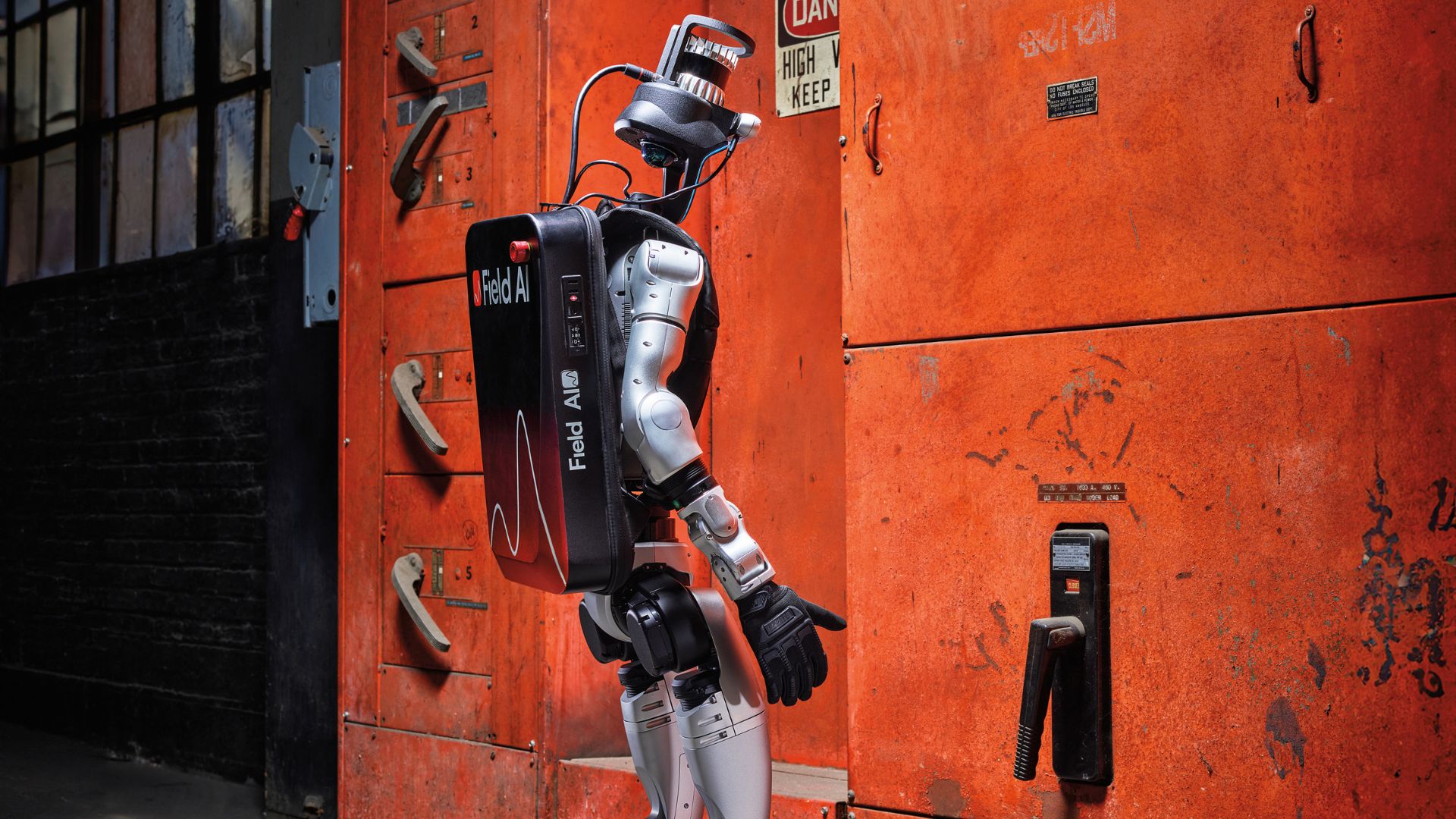
Robots move beyond mapped worlds with advanced lidar sensing

A lidar technology company and a robotics AI developer have announced a collaboration to improve how general-purpose robots perceive and navigate complex environments.

The partnership between San Francisco-based Ouster and California -based FieldAI combines high-resolution lidar technology with a universal robot intelligence platform designed to operate across different robot types, tasks, and environments.

The system enables robots to be deployed at new sites without prior maps, pre-planned routes, supporting infrastructure, or environmental modifications.

“Scaling autonomous systems in demanding real-world conditions starts with advanced sensor technology,” said Andrew Mullen, Head of Hardware at FieldAI, in a statement.

Robots gain perception

The collaboration between Ouster and FieldAI aims to accelerate the deployment of autonomous robots in some of the world’s most challenging industrial environments by combining advanced sensing hardware with general-purpose robot intelligence.

The partnership centers on the integration of Ouster’s Rev8 native color digital lidar technology with FieldAI’s Field Foundation Models, a robotics AI platform designed to enable autonomous operation across a wide range of robot types, tasks, and environments. The companies believe the combination can help robots perform reliably in complex, unstructured settings where traditional automation systems often struggle.

FieldAI has developed what it describes as a universal robot “brain” capable of operating across radically different robotic platforms. Unlike conventional robotic systems that typically require detailed maps, carefully planned routes, specialized infrastructure, or extensive site preparation, FieldAI’s technology is designed to allow robots to enter a new worksite much like a newly hired employee. The robots can assess unfamiliar surroundings, understand environmental conditions, and begin operating without prior knowledge of the location.

At the core of this capability are the company’s Field Foundation Models, large-scale AI models trained to understand and interact with the physical world. These models are intended to help robots navigate unpredictable environments where terrain, obstacles, equipment, and working conditions can change continuously. Such environments include construction sites, mines, industrial facilities, energy infrastructure, and remote operational areas where conventional robotic systems often face significant limitations.

To support these capabilities, FieldAI relies on Ouster’s digital lidar sensors, which provide a detailed three-dimensional perception of the surrounding environment. Lidar technology uses laser pulses to measure distances and generate highly accurate spatial maps. Ouster’s latest Rev8 platform adds native color perception to lidar data, enabling robots to capture richer environmental information while maintaining precise depth sensing.

Scaling physical AI

The Rev8 digital lidar platform is designed to deliver high-resolution perception in conditions where cameras or GPS-based systems may be less effective.

According to its developers, it is particularly important in unmapped environments, indoor facilities, underground operations, and GPS-denied locations where autonomous systems must rely heavily on onboard sensing. The technology’s rugged construction also makes it suitable for deployment in harsh industrial conditions involving dust, vibration, weather exposure, and heavy machinery.

FieldAI already uses Ouster’s lidar technology to support navigation and autonomy in complex operational settings. As the company expands deployments with major industrial customers, it plans to incorporate the enhanced sensing capabilities of the Rev8 platform to further improve robot safety, environmental awareness, and decision-making. The addition of native color data is expected to provide greater interpretability of robot actions and improve the ability of autonomous systems to identify and understand objects and conditions in their surroundings.

The collaboration is expected to support the broader adoption of physical AI systems across industries where labor-intensive, hazardous, or difficult-to-access tasks remain challenging for human workers. Target sectors include construction, mining, energy production, manufacturing, security operations, and government applications.

💾

Two US technology firms partner to combine lidar and AI, enabling robots to navigate complex sites without maps or setup.
  •  

‘World’s first’ shapeshifting soft robotic cells that adapt on demand unveiled

London-based startup morph has launched a new soft robotics platform designed to bring physical intelligence directly into products through adaptive, deformable materials.

Founded by a former reconstructive surgeon, the company says its “soft robotic cells” combine embedded sensing and adaptive control to enable real-time changes in shape and stiffness.

The technology is aimed at creating products that can sense, adapt, and respond to human interaction, marking a shift from traditional static systems to responsive, AI-enabled physical solutions for consumer and enterprise applications.

“With our platform, we can build a new generation of products embedded with soft robotic cells that adapt in real time to support natural movement,” said Dr. Jean Nehme, Founder of morph, in a statement.

A soft robotics platform

The UK startup has unveiled what it describes as the world’s first soft robotics platform, introducing a new approach to physical AI through adaptive, deformable robotic materials.

Founded by London-based Dr. Jean Nehme, a former reconstructive surgeon and founder of surgical AI company Digital Surgery, morph is developing “soft robotic cells” — modular robotic units made from synthetic materials that can sense, process information, and physically adapt to changing conditions.

Unlike traditional robots built from rigid components and designed primarily for industrial environments, soft robots are constructed from flexible materials that allow safer and more natural interaction with people.

The company’s technology enables robotic cells to alter their shape and stiffness in real time in response to environmental conditions and user needs. By embedding sensing, adaptive control, and intelligence directly into materials, morph aims to create products that can actively respond to human movement and interaction rather than remain static. The approach represents a shift toward embodied AI, where intelligence is integrated into physical systems capable of taking action through the product itself.

According to morph, these soft robotic cells can be combined and configured across a range of products, generating data that supports richer interactions between humans and the physical world. The platform is designed to serve as a foundation for multiple industries, allowing manufacturers to integrate adaptive robotic capabilities into their own products.

Future mobility reimagined

Morph’s initial applications will focus on human performance, mobility, and longevity. Early products are being developed for athletic performance enhancement, injury prevention, and mobility support. The company believes its technology could eventually expand into healthcare, automotive, and industrial safety sectors, where adaptive materials could improve comfort, safety, and functionality.

Inspired by the adaptability of octopuses, morph has built a development platform that allows engineers to program robotic cell behaviors, simulate real-world environments, and rapidly prototype deformable components intended for direct human interaction. The system combines reinforcement learning with high-fidelity physics-based simulations, helping accelerate the transition from concept to deployable product while maintaining safety and reliability standards.

The company is currently working with several industrial partners and plans to operate primarily as a software, design, and fabrication partner for businesses seeking to adopt soft robotics technology. Through its business-to-business strategy, morph aims to help companies incorporate adaptive robotic materials into future products.

“Driven by a worldwide team of experts in robotics, AI, medicine, design, and manufacturing, morph enables the creation of products that embed robotic cells. Initial product offerings will focus on human performance and longevity,” claims the firm in a statement.

💾

A UK startup has unveiled soft robotic cells that sense, adapt, and reshape in real time, bringing physical AI into everyday products.
  •  
❌