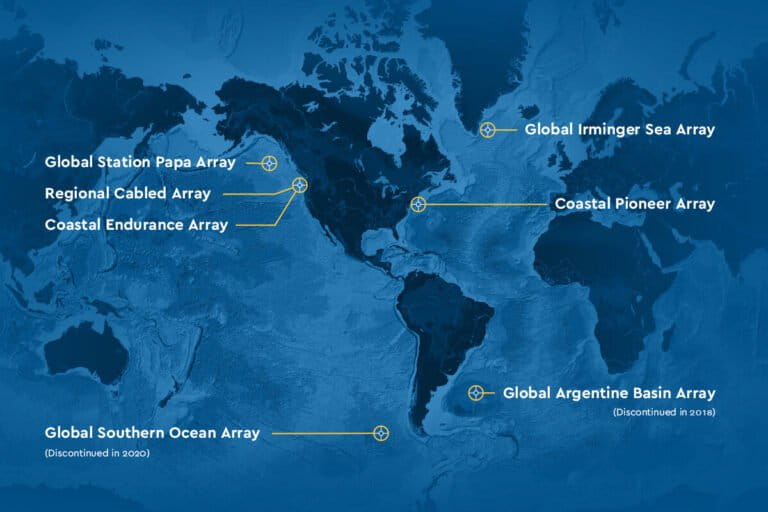
Over the next 15 months, major sensor arrays that have provided crucial, decade-long observations of the ocean, marine ecosystems and climate change will be dismantled. These sensors are part of the Ocean Observatories Initiative (OOI), a $386 million network of more than 900 instruments funded by the U.S. government’s National Science Foundation (NSF), which has provided real-time data on the world’s oceans for more than a decade. The sensors are distributed across both the Atlantic and Pacific oceans to monitor coastal environments, marine ecosystems, and ocean currents that influence the global climate. The decision to end OOI, described by the foundation as a “descoping,” will remove nearly all in-water infrastructure located off the states of Alaska, Washington, Oregon and North Carolina, and the Irminger Sea, an area between Iceland and Greenland. As the instruments are recovered, data streams from those areas will go dark, Jim Edson, principal investigator of the initiative, said in a statement. “However, all previously collected OOI data will remain accessible through the OOI Data Center.” The OOI was designed as a 25-to-30-year project specifically to capture long-term climate signals, which scientists say require at least three decades of continuous data to be meaningfully detected. The network has achieved just 10 years of observations. While satellites can monitor the ocean’s surface, the OOI arrays provided a rare look into the deep sea, measuring low-oxygen zones, carbon absorption, and currents critical to regulating weather patterns. The Associated Press (AP) reported that the removal comes at a particularly sensitive…This article was originally published on Mongabay
Researchers have found a new-to-science species of a tiny sea slug with black and yellow spots resembling “scattered sesame seeds.” Measuring just three millimeters long (0.1 inches long), the researchers have named it Thecacera sesama, according to a recent study. Study lead author Ho-Yeung Chan first spotted the sea slug during a recreational dive in the coastal waters of Keelung, northern Taiwan, in 2019. At the time, he was still an undergraduate student and did not realize the animal was unknown to science until he consulted an expert on Facebook, according to a statement. To formally identify the species, researchers collected six specimens of the sea slug during diving expeditions conducted between May 2021 and June 2025. Between May and September, typhoons can make diving risky. The research team then examined the specimens’ structure and appearance and analyzed their DNA to confirm that it was a new-to-science species. T. sesama is the seventh Thecacera species to be described, and the first one to be named in the genus in nearly three decades. Despite its small stature, T. sesama is visually striking, the researchers wrote. It has a translucent white body covered in small black and yellow spots that look like sesame seeds. While the species looks similar to another sea slug Thecacera pennigera, which has black and orange spots, T. sesama is significantly smaller and genetically distinct. The researchers found that T. sesama lives on and feeds exclusively on bryozoans, small aquatic invertebrates known as “moss animals” that live in…This article was originally published on Mongabay
In the remote, over-the-water village of Muara Enggelam in East Kalimantan, Indonesia, the introduction of reliable solar energy has become a catalyst for female entrepreneurship and economic stability. Historically cut off from basic services and reliant on expensive, noisy diesel generators that ran only from dusk to dawn, the village underwent a transformation starting in 2015 following a solar power allocation from Indonesia’s energy ministry, reports Mongabay Indonesia contributor Yuda Almerio. For women like Asniah, a mother of three, 24-hour electricity thanks to a solar array meant the ability to scale a home business. She began using electric blenders to produce amplang (fish crackers), a task that was previously difficult due to the high cost and unreliability of diesel fuel. “Using a blender was a bit of a worry, because the fuel would run out quickly,” Asniah told Mongabay Indonesia. “A liter [of diesel] wouldn’t last an hour — now it’s much more convenient.” Asniah has since expanded her ventures to include a food stall and a digital boutique, utilizing social media for marketing. Muara Enggelam’s solar infrastructure is managed by a village-owned enterprise, BUMDes, led by Jam’ah, a mother of one. This makes it a rare example of female leadership in the energy sector; the United Nations Development Program estimates that women make up less than 5% of energy managers in Indonesia. “Using a generator was expensive, that’s why so few people started businesses,” Jam’ah said. “The solar energy has been a relief for people.” While Muara Enggelam serves…This article was originally published on Mongabay

 Login