❌

Reading view

Iraq’s archaeological discoveries have shaped understanding of human civilisation – but its scientists have been sidelined
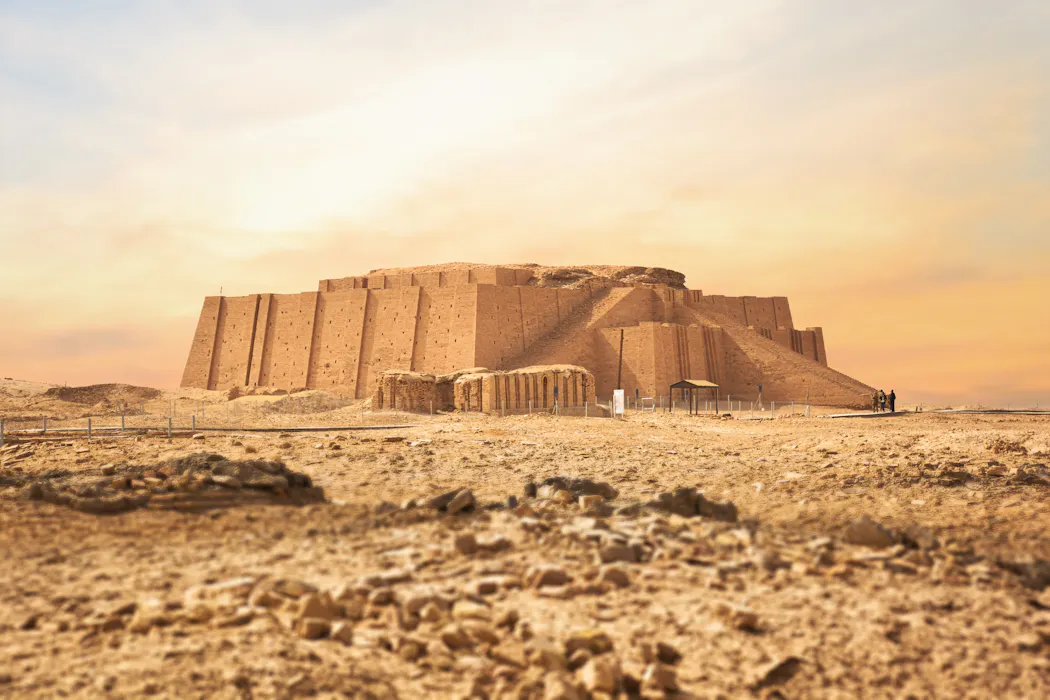
The early bronze age (21st century BC) Ziggurat of Ur in southern Iraq. Abbas Al Yasiri/Shutterstock

In recent years, archaeologists from around the world have marked the centenaries of some of Iraq’s most influential archaeological discoveries.

The excavation of the ancient city of Ur, for example, transformed understanding of early urban life, long-distance trade, royal tombs and burial customs. There has also been a century of research into the Jemdet Nasr period – pivotal in the development of some of the world’s earliest administrative systems and forms of writing.

These milestones are reminders of the profound influence of the archaeology of ancient Mesopotamia. It continues to inspire generations of researchers around the world, including recent work led by the University of Glasgow at the archaeological site of Shakhi Kora in the Kurdistan Region of Iraq.

This has brought new insights into the nature of the first public institutions, their development and demise. Other surveys in southern Iraq seek to understand long-term human relationships with Iraq’s rapidly disappearing marshlands.

But these milestone celebrations and fresh discoveries also invite reflection about the role of Iraq’s scientists and institutions in this developing story of human civilisation.

Changing the narrative of loss and rescue

International discussions of Iraqi heritage have long been dominated by stories of catastrophe. These range from looting after the 2003 US-led invasion and the destruction wrought by Islamic State, to endangered archaeological sites and emergency efforts to save what remains.

Many of these represent genuine crises. But they also frame Iraqi archaeology as a narrative of loss and rescue, with international institutions as providers of expertise. Local archaeologists are often portrayed as recipients of support, rather than equal partners in shaping future research.

Today, Iraqi archaeologists are still underrepresented in the bodies that decide research priorities and interpretations. Many institutions generating archaeological knowledge about Iraq are disproportionately directed from outside the country.

So, when 20 archaeologists and heritage professionals from Iraq and the Kurdistan Region of Iraq gathered in Glasgow alongside international colleagues in May 2025, they seized the opportunity to shift this narrative. Their discussions ranged from social media misinformation to women’s participation in archaeological fieldwork and the challenges that climate change poses, both to heritage and local communities.

Such conversations often came back to one key question: who gets to decide what archaeology in Iraq should focus on today?

Attempts to decolonise archaeology

Discussions about the future of archaeology often focus on participation: who receives funding, who directs projects, and who is included as a collaborator or author. These questions are important.

But meaningful attempts to decolonise this field of study also need to address how archaeological problems are defined, whose expertise is recognised, and who gets to shape research priorities.

At the Glasgow workshop, Iraqi and Kurdish archaeologists, heritage professionals, government officials and university leaders were asked to identify the issues they regarded as most urgent. Creating space for them to articulate priorities marked an important shift away from externally imposed agendas.

The discussion on gender highlighted a striking contradiction in Iraq. At the University of Al-Qadisiyah in the city of Al Diwaniyah, women account for around 70% of archaeology students – yet only around 2% of Iraqi excavation team members and approximately 15% of academic leaders are women.

This raised the question: is increasing women’s participation just a demographic goal – or will it influence the breadth of knowledge produced through archaeology? For example, a wider range of participants may encourage more archaeological attention to labour, care, social relationships and community life in the ancient past, complementing the traditional focus on kings, temples and powerful states.

Redefining what heritage means

Iraq is among the countries most vulnerable to environmental change. The workshop also highlighted rising temperatures, extreme dust storms, water scarcity, soil salination and environmental degradation, stressing their impact on archaeological sites and the communities who depend on wetlands, springs and marshlands.

It became clear that “heritage” meant more than just preservation. Traditional relationships between communities and landscapes offer valuable lessons for adapting to environmental uncertainty. Archaeology becomes less about recovering the past, more about helping to imagine sustainable futures.

According to Rozhen Mohammed-Amin, president of the Cultural Heritage Organisation in the Kurdistan Region of Iraq, one of the most significant achievements was bringing together people who are often “disconnected due to political and institutional divisions”.

Within months of the event, two women were promoted to senior positions at the University of Al-Qadisiyah. Participants also reported stronger engagement between Iraqi universities and the country’s State Board of Antiquities and Heritage.

These changes may seem modest – such developments rarely attract headlines in the way of a spectacular discovery or heritage emergency. But they may prove just as important to the future of archaeology – for Iraq and the wider world.

The Conversation

Claudia Glatz received funding from the British Institute for the Study of Iraq, which supported the workshop discussed in this article. Her research and heritage initiatives in the Kurdistan Region of Iraq have been supported by the British Academy, the British Institute for the Study of Iraq, the G.A. Wainwright Fund, the Cultural Protection Fund-British Council, the Royal Society of Edinburgh, the Alexander von Humboldt Foundation, the Gerda Henkel Foundation, and the National Science Foundation.

Daniel Calderbank works for the University of Glasgow. He has received funding from the Glasgow Centre for International Development and the British Institute for the Study of Iraq, which supported the workshop discussed in this article. He has also received research funding from the British Academy, UK Research and Innovation (UKRI), and the Royal Society of Edinburgh for research and heritage initiatives in Iraq.

Jaafar Jotheri does not work for, consult, own shares in or receive funding from any company or organisation that would benefit from this article, and has disclosed no relevant affiliations beyond their academic appointment.

  •  

We might soon have the technology to reach other star systems

The recent confirmation of an atmosphere around a rocky exoplanet called LHS 1140b has created a wave of interest within the astronomy community. The planet orbits within the habitable zone around its parent star – a red dwarf located some 48 light years from Earth.

The habitable zone is the region around the star where temperatures are just right for water to remain liquid at a planet’s surface. Astronomers detected helium being lost from the upper atmosphere of LHS 1140b. But heavier chemical compounds, such as water, which is a key ingredient for life, could exist lower in its atmosphere.

Observing distant exoplanets using telescopes opens new doors for science, but will it ever be possible to travel to these worlds and observe them up close? While this has generally been seen as the stuff of science fiction until now, emerging technologies allow us to imagine a future where such missions are possible in the decades ahead.

There is particular interest in miniaturised spacecraft for interstellar voyages. In large part, this is because it’s easier and cheaper to propel a small spacecraft to another star system – and have it get there within a person’s lifetime – than it is to do the same with a large vehicle.

Miniaturisation of sensors has seen great advances, for example through smart phone technology where highly capable cameras with low mass, power and volume are routinely used. Researchers have even developed “smart dust”; sensors that are millimetre-scale in size or smaller that can detect light, temperature or chemicals.

The space probe itself would need a form of propulsion capable of accelerating it to mildly relativistic speeds, say 10-20% of the speed of light. After a travel time of many decades, the sensors would pass through a target star system without stopping, making in-situ observations and then very slowly drip data back to Earth.

This isn’t quite Star Trek, but it’s a potentially plausible idea that would enable us to study neighbouring stars and their planets up close. This kind of concept has been actively pursued by a philanthropically funded venture known as Breakthrough Starshot. This programme investigated the key technologies required for an interstellar journey using small probes.

Lights sails are seen as one of the most suitable forms of propulsion for such a mission. As the name implies, these are thin reflective membranes.

Light sails can propel spacecraft using the energy of the Sun. NASA/Aero Animation/Ben Schweighart

For interstellar travel, directed energy from a laser could be used to push the spacecraft forward. Photons, the quantum packets of energy of which light is composed, transport momentum as well as energy. Therefore, when light reflects off a mirror it exerts a pressure on the mirror.

In most circumstances the pressure due to light is imperceptibly small. However, for an intense enough beam of light, and an ultra-lightweight membrane mirror, light pressure can act as a means of spacecraft propulsion.

In order to accelerate a light sail to relativistic speeds, a hefty laser would be required, with an effective power of tens of gigawatts. This wouldn’t be a single device. Instead, it would probably comprise an array of separate laser devices synchronised together to generate a beam of coherent light.

Accelerated to the stars

Pushing a reflective light sail a few metres across with such a laser would accelerate the sail to its cruising speed in a matter of minutes.

The advantage of beam-power propulsion systems is that the laser assembly is left behind and only a small payload is accelerated to the stars. In contrast, conventional rockets have to haul their own propellant, which puts them at a severe disadvantage for such ultra-high energy missions.

The disadvantage of beam power propulsion is that the payload can’t easily stop, so a probe would pass through its target star system in only a few days.

Engineers at Nasa’s Langley Research Center inspect a solar sail. The unfurled sail is approximately 30 feet (about nine metres) on one of its sides. Nasa

While multi-gigawatt laser-pushed light sails may seem to be a bit of a stretch at present due to the colossal scale of such a venture, advances in miniaturisation could pave the way for tiny intelligent sensor nodes to be our first interstellar voyagers.

Perhaps we’ll first travel to the stars with an AI asleep at the wheel for decades, until it awakens for a few days of frantic activity as our machine proxies get their first glimpse of alien worlds.

Aside from pushing light sails with gigawatt lasers, reflective membranes can also be pushed by light pressure from the Sun. These “solar sails” have a long and rich history and were first proposed in the 1920s by Konstantin Tsiolkovsky and Friedrich Tsander, two of the great Russian pioneers of astronautics. Tsiolkovsky wrote of using “tremendous mirrors of very thin sheets”.

Tools for exploring

While laser-propelled light sails are for the future, solar sails are for the present. A number of small solar sails have already been launched into Earth orbit for technology demonstration purposes. Scaling up solar sails for deep space missions could deliver a new set of tools for exploring our solar system.

First, since solar sails do not need to carry propellant, they are capable of high-energy, long-duration missions, some of which are just about impossible for conventional spacecraft. For example, to rendezvous with a long period comet on an elliptical or highly inclined orbit about the Sun requires significant energy.

Moreover, returning a surface sample from such a comet to Earth becomes even more difficult. For conventional rocket propulsion, the spacecraft needs to haul propellant for the return journey all the way to the target comet.

For solar sails, returning to Earth is little different to reaching the comet in the first place. Solar sails can “tack” by tilting the sail to gain momentum and so spiral away from the Sun, or flipping the sail to lose momentum and spiral back inwards towards the Sun.

Solar sails can also move along unconventional orbits with light pressure used to offset gravity. For example, this could allow a solar sail to hover stationary high above the poles of the Earth.

Solar sails and light sails are stepping stones from the present to the future, and from exploring our own solar system to exploring distant stars. Perhaps exoplanet LHS 1140b will be visited by a light sail at some point in our future.

The Conversation

Colin McInnes receives funding from the Royal Academy of Engineering, the European Research Council and the Advanced Research + Inventions Agency.

  •  

Astronomers Unveil Record-Breaking Haul of 161 New Black Hole Collisions

Gravitational Waves IllustrationA new gravitational-wave catalogue reports 161 additional black hole mergers, bringing the total to 390 detections. Scientists at the University of Glasgow’s Institute for Gravitational Research are celebrating the release of a major new collection of gravitational wave discoveries, a milestone that highlights the rapid growth of gravitational astronomy. The latest Gravitational Wave Transient Catalogue [...]
  •  
❌