
❌

Reading view

Iran’s environmental catastrophe has also wrecked its economy

For several decades, Iran has devoted substantial financial, institutional and political resources to military expansion. It has invested heavily in supporting its regional partners, as well as in pursuing geopolitical influence across the Middle East.

Previously, the Islamic Republic has shown few signs of swivelling its resources toward fixing its ever expanding environmental problems.

And those problems are considerable. Around 11% of deaths and 52% of the burden of diseases across the country are attributable to environmental risk factors, according to the World Health Organization.

Excessive groundwater extraction has caused buildings and roads to crack and sometimes collapse. Iran’s capital Tehran is often ranked as having the worst levels of air pollution in the world. In 2025 local media reported 350 deaths caused by poor air quality within a ten-day period. Hospitals at the time reported rising numbers of cases of respiratory and cardiac complications across Iran.

Lake Urmia – once the Middle East’s largest saltwater lake – has dried out, leaving salt-laden dust plumes were capable of travelling hundreds of kilometres and even crossing national borders in less than 12 hours.

The peace agreement that is being hammered out between the US and Iran’s leaders could hand Tehran a significant financial asset. It may unfreeze Iranian assets in foreign banks that they were previously unable to access due to US sanctions. This will give the government access to billions of dollars. Iran is also now exporting millions of barrels of crude oil that had been held in storage during the conflict.

The question then is where will all this money be spent.

Many analysts suggest a massive reconstruction project is needed to rebuild damaged factories, roads, and other essential infrastructure. While it thought highly unlikely that Tehran will see environmental investment as its top priority, the approach could provide major economic benefits.

Iran is now using its groundwater far faster than it can be naturally replenished. As a result, major lakes and wetlands are drying up. Water shortages are undermining agriculture, and forcing some rural communities to leave their farms. Studies indicate that approximately 56,000 km2 (3.5%) of the country’s area is subject to land subsidence, caused by excessive groundwater extraction.

Air pollution imposes significant public health and productivity costs. This contributes to thousands of premature deaths each year, and reduces labour productivity through illness and absenteeism. Dust and salinity storms continue to hit many parts of the country. They damage crops and soils, increase respiratory disease, disrupt daily life, and make already vulnerable regions harder to inhabit.


Read more: Iran’s record drought and cheap fuel have sparked an air pollution crisis – but the real causes run much deeper


Rich rewards

When a state destroys its basic natural resources, it is not merely experiencing an ecological downturn. Natural systems (water, soil, ecosystems) are the foundations of any country. Without them, a nation has severely undermined its long-term economic output: farms disappear, road and rail systems crack and break, and people struggle to live.

A peace dividend from the US deal could therefore present Tehran with a rare moment of strategic re-evaluation and a chance to fix its long-term environmental problems. A different approach could generate long-term value, economic stability and, potentially, improved public health outcomes.

A serious national investment, and reconstruction, programme needs to focus on repairing leaking urban water networks, restoring wetlands and forests that regulate water and reduce dust storms. It could also upgrade ageing water and energy infrastructure, and redesigning cities to better withstand drought, extreme heat, and air pollution. It would also create jobs and mobilise high-skilled labour across engineering, science, manufacturing and technology sectors. This would begin reversing decades of damage to the natural systems on which Iran’s economy depends.

Iran is struggling with extreme levels of air pollution.

What needs work?

Restoring depleted aquifers, rehabilitating degraded land and modernising water and energy systems would increase the economy’s capacity to produce goods and services while reducing the long-term costs associated with environmental degradation.

Iran should see environmental restoration as its most important long-term growth strategy. A national investment programme could be centred on modern irrigation networks, wastewater recycling and reuse. These alongside renewable energy, and ecosystem recovery, would be a massive economic engine.

More efficient water use would strengthen food security. Investments in infrastructure would continue generating economic returns long after the initial capital has been spent.

Legal caps on groundwater abstraction, and economic diversification away from water-intensive crops are essential. Improved irrigation and wastewater reuse plus adjusting water pricing to reflect scarcity would also help.

This approach could not only be a valuable peace dividend for the Iranian people, but also a massive economic boost. Those financial benefits may have some appeal to a government which has ignored many of these environmental problems for so long.

The Conversation

Nima Shokri is affiliated with Hamburg University of technology
  •  

The Caspian Sea has lost an area nearly the size of Sicily: human activities are a major reason why

The Caspian Sea, the largest inland body of water on Earth, is shrinking. Not fluctuating, not entering another natural cycle, but shrinking.

For decades, scientists and policymakers treated changes in the Caspian as part of the basin’s natural variability. Water levels in the sea have always risen and fallen.

But our new study shows something far more troubling: the current decline is increasingly driven by human decisions to dam and divert rivers, and by fragmented decision-making across five countries that border this body of water.

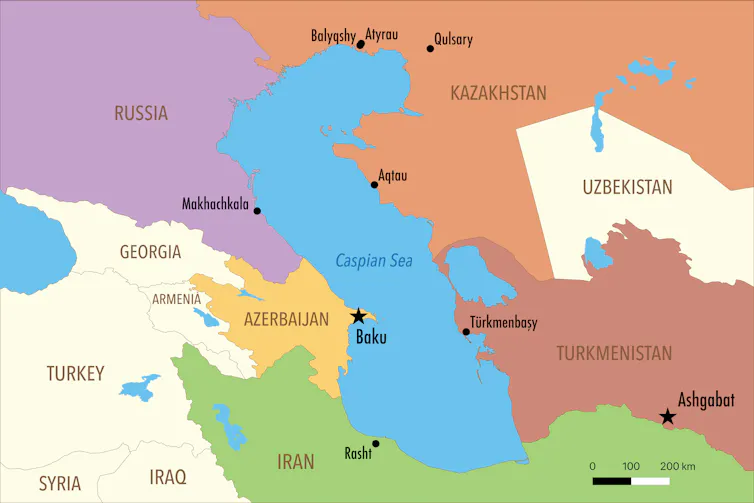
Using satellite observations together with ground-based hydrological records from rivers across all five shoreline states (Iran, Russia, Turkmenistan, Azerbaijan and Kazakhstan), we found that flow into the Caspian Sea has declined sharply over the past three decades.

The main reason is not declining rainfall. In fact, rain over the Volga Basin, which supplies roughly 80% of the Caspian’s inflow, has slightly increased. That finding matters because it overturns one of the most common assumptions surrounding the Caspian crisis. The common narrative has been straightforward: climate change increases evaporation, rainfall declines, and the sea shrinks.

Climate change certainly plays a role: our analysis confirms that evaporation across the Caspian has increased significantly as regional temperatures rise. But evaporation alone explains only about 40% of the observed water loss since the mid-1990s.

The remaining decline points overwhelmingly toward human activity. The Volga River has been heavily engineered for decades. Dams, reservoirs, use for irrigation, industrial consumption and navigation systems have fundamentally altered the hydrology of the basin).

Water that once flowed naturally into the Caspian is increasingly intercepted upstream. One critical but rarely discussed example is the Volga–Don canal system, which links the Caspian basin to the Black Sea through Russia’s internal waterways. Geopolitically and economically, the canal is strategically valuable. But it diverts water away from the Caspian system.


Read more: Why the Caspian Sea has become so important in both the Ukraine and Iran wars


The cumulative effect is now visible from space. Since the mid-1990s, the Caspian Sea has lost roughly 24,000kmΒ² of surface area, an area approaching the size of Sicily. Water levels have fallen by about two metres.

The shallow northern Caspian, ecologically one of the most productive parts of the sea, is drying particularly rapidly. This matters because the northern Caspian is not empty water. It is a critical ecological zone supporting fisheries, wetlands, migratory birds and spawning grounds for sturgeon, the ancient fish species that produce most of the world’s caviar.

Threats to shipping

As water retreats, ecological stress intensifies. Our study also detected a long-term rise in chlorophyll-a concentrations in the northern Caspian, a key indicator of algal activity and declining water quality. In plain terms, the sea is becoming warmer, shallower and increasingly nutrient-rich: ideal conditions for harmful algal blooms.

This is not merely an environmental story. The Caspian region sits at the centre of major energy and trade corridors linking Europe and Asia). Russia’s north-south transport routes and China’s international development plan, the Belt and Road Initiative, plus offshore oil infrastructure and regional shipping networks all depend on the Caspian remaining navigable and stable.

Falling water levels threaten ports, shipping lanes and coastal infrastructure. Declining depths reduce cargo capacity and increase transport costs. What appears initially as an environmental issue gradually becomes an economic constraint.

The Caspian Sea region

A colour map of the Caspian Sea and surrounding countries.
Shutterstock

Political problems

Then there is the political dimension. Unlike oceans, inland seas cannot rely on global circulation to buffer local mismanagement. Their survival depends directly on the behaviour of neighbouring states. And the Caspian is surrounded by countries with competing strategic interests, uneven governance systems and limited transparency over their water use.

That fragmentation has become one of the greatest risks facing the sea. Although regional agreements exist, including the 2018 Aktau Convention (formally the Convention on the Legal Status of the Caspian Sea), there is still no comprehensive and enforceable system governing water allocation, hydrological monitoring or ecological protection across the basin. Data sharing remains limited. Water withdrawals are often opaque. Environmental management is fragmented.

This resembles a pattern seen repeatedly across modern environmental crises: governments prefer to discuss climate change because it externalises responsibility. It allows leaders to portray ecological decline as an unavoidable planetary process.

But the Caspian story is more uncomfortable than that. It is also a story about political choices. Rivers were dammed. Water was diverted. Wetlands were degraded. Pollution controls remained weak. Oil and gas development expanded while ecological safeguards lagged behind. Economic growth consistently outranked hydrological sustainability.

The danger is not simply that the Caspian shrinks, but that ecological thresholds may be crossed – beyond which, recovery becomes extraordinarily difficult.

The Aral Sea, the world’s fourth largest lake, demonstrated how quickly collapse can accelerate once a chain reaction begins. Exposed lakebeds generate dust storms. Fisheries collapse. Salinity rises. Biodiversity crashes. Local climates shift. Economic systems unravel around the drying basin.

The Caspian has not yet reached that stage – but the warning signs are becoming increasingly visible.

There is still time to slow the trajectory. However, doing so would require something historically rare in the region: long-term coordination that prioritises hydrological stability – safeguarding the sea’s natural water balance and keeping water levels from dropping past a dangerous point of ecological collapse – over short-term extraction and geopolitical competition.

This would mean transparent water accounting – the open tracking and sharing of data on exactly how much water each nation is pulling from the feeding rivers for agriculture and industry. It would mean negotiated environmental flow releases from upstream reservoirs, and recognition that the Caspian is not simply an energy corridor or a shipping route, but a fragile water system.

Nature eventually imposes consequences on societies that ignore those limits. The Caspian Sea is beginning to deliver that message.

The Conversation

Nima Shokri is affiliated with Hamburg University of Technology.

Amir AghaKouchak is affiliated with the University of California Irvine, and the United Nations University Institute for Water, Environment and Health.

  •  
❌