❌

Reading view

Disordered environments around tumour cells can promote cancer spread

A new study showing how tumour cells behave when surrounded by a disordered microenvironment could help cancer researchers by providing a biophysics model describing how cancers spread within the human body.

Researchers led by Michael Sixt, head of the Cellular Morphodynamics Group and Edouard Hannezo, leader of the Physical Principles in Biological Systems Group both at the Institute of Science and Technology Austria (ISTA), in collaboration with scientists from the UK’s Francis Crick Institute, have constructed a microfluidic chip experiment and associated computer simulation that shows how heterogeneity (disorder) surrounding a tumour can drive metastasis.

Cancers spread when individual cells detach from the tumour cell collective and invade previously healthy tissue. Whether detachment occurs depends on both genetics and the local microenvironment – including blood vessels, immune cells, signalling molecules and connective tissue. To replicate cancer cells squeezing through pores between the fibres of the tissues they are invading, the researchers created forests of pillars mounted on microfluidic devices for tumour cells to squash past.

As detailed in their recent Science Advances paper, the geometry for some forests was a square lattice of 9 µm-diameter pillars evenly spaced with 9 µm gaps between them, while other forests had their pillars arranged in a disorderly pattern created by moving each pillar from its ordered position by a random angle and distance.

“There were no suitable tools for designing mathematically defined disorder. So I had to write completely new software that can define those patterns, and then translate that into designs that can be manufactured [via standard semiconductor lithography techniques] into microfluidic devices,” explains biotech data science consultant Saren Tasciyan, who designed the microfluidic devices as part of his PhD with the Sixt Group.

The team used a combination of fluorescence imaging and light microscopy to track the behaviour of cancer cells – kept alive for up to eight days thanks to cell culture medium – after they were introduced into the centre of each respective pillar forest. These experiments revealed that the tumour cell collective was more likely to break apart when faced with a heterogeneous environment to navigate compared with a more regular geometry.

In the heterogeneous conditions “we found that the first cells detach, exactly as happens in a cancer metastasis,” says Sixt. The team also observed the pillars increasingly rough up the surface of the spreading cell interface, resulting in finger-like protrusions – from whose tips the cells were more likely to detach.

“When the cell interface moves through this landscape the effects accumulate over time,” continues Sixt, who asked his colleague Hannezo to create computer simulations to verify the experimental results, and study the process over longer periods than the cells could survive.

“Each cell was modelled as a bead that moves through an environment,” says Hannezo group postdoc Zuzana Dunajová, a computational scientist specializing in biological physics, who built the model. These beads are attracted to one another, and move through different geometries that mimic those on the microfluidic devices, she explains.

“I kept seeing the same behaviour in my simulations – the beads detached from the collective more often in the disordered environment compared to the ordered. This was very exciting from the physics perspective because it’s not something that we see just in this particular cell type or system, but suggests a more general principle in living, or active systems. The roughness of the cancer-cell invasion actually follows the same kind of universal behaviour as we see in other systems, such as combustion of paper, spreading of fires or drying coffee drops,” enthuses Dunajová.

Next, Sixt – who hopes these insights will help researchers developing new cancer therapies – plans to study whether cell detachment in a disordered microenvironment leads to epigenetic modifications (heritable changes that do not alter the DNA code) and then later on to genetic modifications. “I want to consider whether the detachment process can drive the single cell evolution into something malignant,” Sixt concludes.

The post Disordered environments around tumour cells can promote cancer spread appeared first on Physics World.
  •  

Radiation shielding vest could reduce cancer risk for astronauts on deep space missions

A radiation shielding vest tested during the uncrewed Artemis I flight in 2022 has been shown to significantly reduce the radiation dose that future astronauts or deep-space tourists might receive.

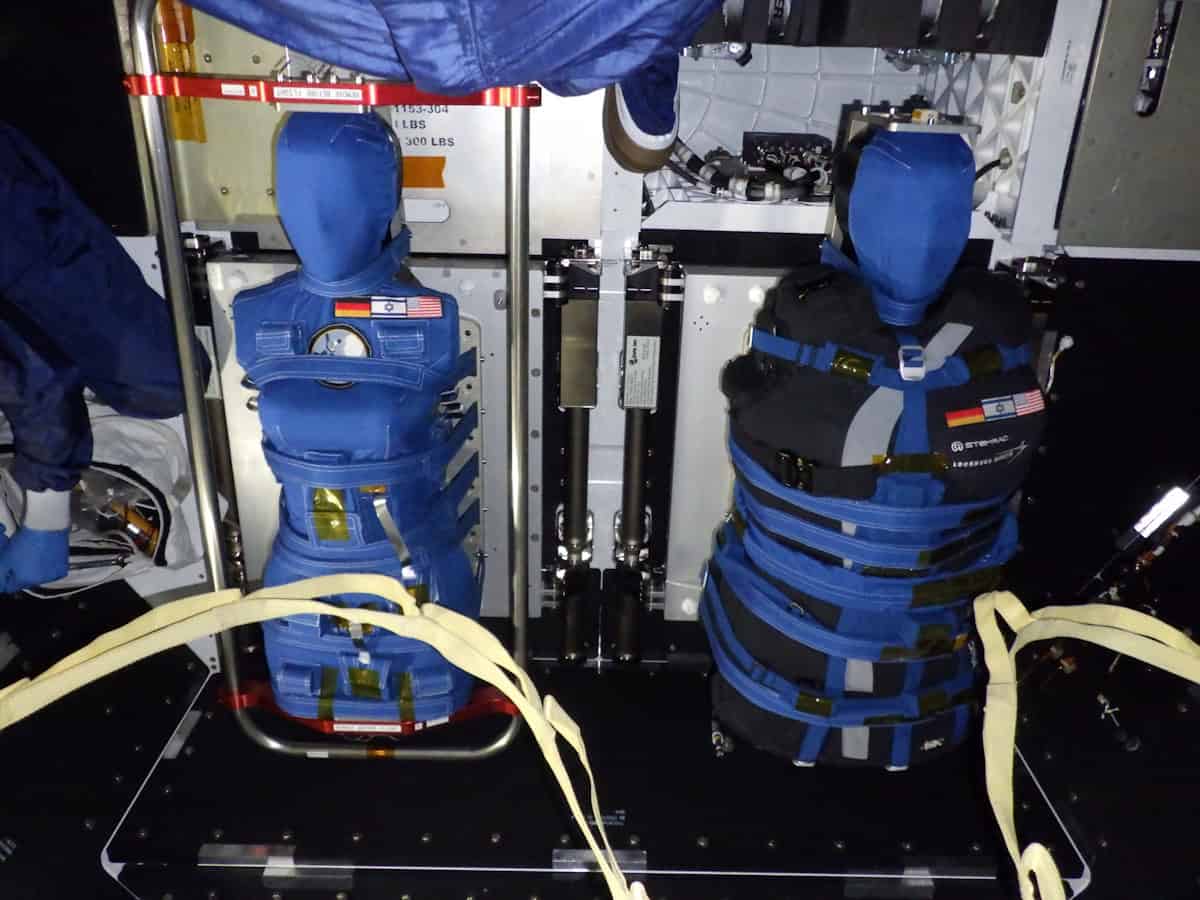
The data for this analysis were obtained via seating two human-tissue-equivalent female torso phantoms in the Orion crew capsule. While the “Zohar” phantom wore the new AstroRad vest, its travel companion “Helga” did not. Numerous radiation dosimeters placed in and on the phantoms allowed the received radiation dose to be compared.

“Exposure to radiation in space is unavoidable, and a single major solar particle event (SPE) can deliver more than one-third of NASA’s 600 millisievert career effective-dose limit. A three-year round trip to Mars would equal or exceed the career limit, which corresponds to a 3% mortality risk from radiation-induced cancer. So we developed the AstroRad vest to significantly reduce this hazard,” explains immunologist Oren Milstein, CEO of StemRad Radiation Protection, which began developing the vest with Lockheed Martin in 2015.

The Helga and Zohar dosimetry phantoms
Dosimetry phantoms The Helga and Zohar (wearing the AstroRad vest) phantoms inside the Orion spacecraft at the NASA Vehicle Assembly Building prior to the launch of Artemis I. (Courtesy: NASA/Lockheed Martin/DLR)

The shielding thickness varies throughout the garment according to the radiation sensitivity of the underlying organs, with breasts, colon, lungs, ovaries, stomach and red bone marrow having concentrated shielding in the test vest. Milstein was inspired to develop this targeted architecture based on the experiences of his PhD supervisor, who treated the first responders to the 1986 Chernobyl nuclear power plant disaster.

With damage to bone marrow the accepted cause of death for all those emergency workers who lost their lives within months of the accident, “that heritage instilled in me a desire to protect people from radiation by selective shielding of the bone marrow,” Milstein explains, adding that the female focus of this experiment is because women have a higher predicted risk of radiation-induced cancer than men.

Astronauts currently shield from SPEs in “storm shelters” consisting of barricades of supplies, or by moving into areas containing more hardware against the walls. AstroRad provides a similar level of protection to the most robust shelter configuration while also “allowing the astronaut wearing it to move around the cabin and continue mission-critical tasks,” radiation physicist Jordan Houri, lead scientist for space exploration at StemRad, tells Physics World.

To maintain flexibility, the vest is constructed from thousands of hexagonal tessellated rods of high-density polyethylene (HDPE) sandwiched between two layers of elastic fabric. The shielding components can also slide past one another and stretch. HDPE was chosen for its high proportion of hydrogen – which is extremely effective at shielding against charged particle space radiation.

While Artemis I did not encounter a solar storm, Orion traversed the inner Van Allen belt, whose protons cover a similar energy range to those in SPEs. This enabled the team to construct a Monte Carlo model of the experiment for testing different radiation environments.

“We created digital twins of Helga and Zohar, the AstroRad vest, radiation detectors and spacecraft shielding,” explains Houri. “Using this model, we generated hundreds of billions of virtual protons and electrons representing the radiation environment of the inner Van Allen belt, before comparing the predicted detector responses directly with the measurements recorded during Artemis I.”

With close agreement found, the researchers then simulated measured SPEs from August 1972 and October 1989. As detailed in their recent Science Advances paper, this revealed that wearing AstroRad would reduce effective dose by around 60% in an August 1972-type scenario, and by almost 40% for a 1989-type SPE – sparing astronauts the dose equivalent from up to 193 and 131 days of deep space travel, respectively.

Combining these results with those from previous experiments, which tested the vests’ ergonomics on the International Space Station, is allowing the researchers to improve comfort and ease of motion, and reduce mass. They are also exploring whether lighter, empty vests could be filled with recycled polyethylene after launch.

Alongside the health benefits, reducing radiation exposure makes economic sense as it extends astronauts’ careers, concludes Milstein, who hopes that the AstroRad vests can help “make lunar habitation and Mars travel truly sustainable and not just a dream”.

The post Radiation shielding vest could reduce cancer risk for astronauts on deep space missions appeared first on Physics World.

  •  

Privacy risks from medical AI are greater than previously thought

Schematic of a membership inference attack
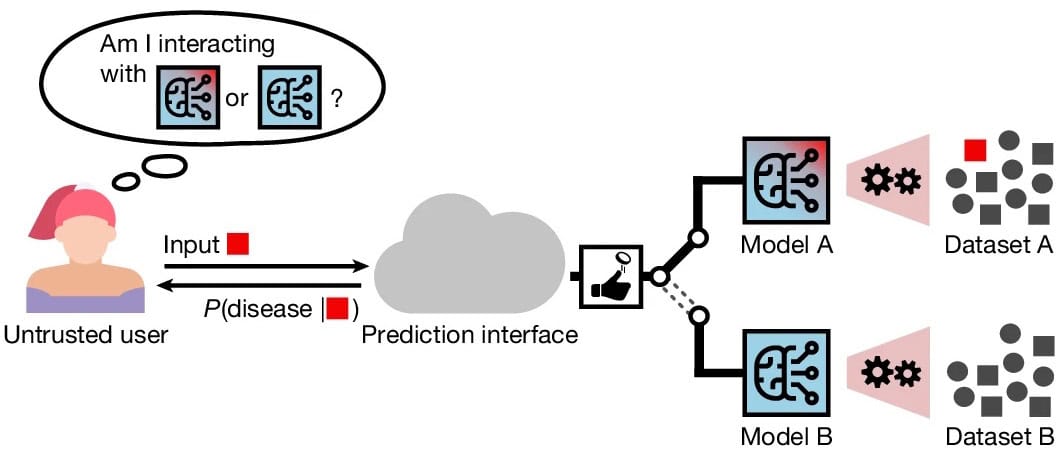
Membership inference attack An untrusted user aims to infer whether a specific target record was part of the training dataset, by observing the predictions of a model. The attack is successful if they can reliably distinguish between models A and B, which are identical except for the inclusion or exclusion of the target record in the respective training dataset. (Courtesy: CC BY 4.0/Nature 10.1038/s41586-026-10688-0)

A new study has revealed that sensitive health information about individual patients can be extracted from medical artificial intelligence (AI) models more effectively than previous research had indicated.

Diagnostic AI models are used to determine whether some given health data belong to a specific class – for example if an X-ray image shows evidence of pneumonia – and offer huge promise for improving patient outcomes. Earlier studies showed that membership inference attacks (MIAs), which determine whether a particular person’s data was used to train an AI model, yielded results no better than random chance. But these previous studies only evaluated the average risk across all patients in a training dataset.

By contrast, in this latest work doctoral student Moritz Knolle and his supervisor Daniel Rückert at the Technical University of Munich (TUM), together with collaborators at Imperial College London and Georg Kaissis from the Hasso Plattner Institute (HPI), examined the privacy risk for an individual patient. “Privacy that only works on average has little meaning. So I asked myself: would I contribute my data to train a medical AI model?” says Knolle.

Daniel Rückert from TUM
Investigating the risks A team led by Daniel Rückert (pictured) at TUM and Georg Kaissis from HPI found that medical AI is more vulnerable to certain attacks than previously thought. (Courtesy: Juli Eberle/TUM)

As detailed in their recent Nature paper, the researchers attacked AI models based on seven different types of real-life medical datasets, including one comprising 21,799 electrocardiograms and another of 377,110 chest radiographs.

“If a model sees a specific data point during training, it usually becomes more confident at predicting it. So in these MIA attacks I compare the predictive probability number for this data point outputted by the medical AI model with the predictive probability number obtained from my model which has not seen that data point,” explains Knolle, adding that the attack is essentially a statistical test to distinguish between the two models.

Their results revealed that the privacy risk for an individual was far greater than the average risk. The team also found that privacy risk is not equally distributed among subgroups.

“We found that patients from minority groups that are under-represented in the training dataset tend to be over-represented among the 99 percentile of extreme [privacy] risk,” Knolle tells Physics World, warning that as medical AI models become larger and more sophisticated the privacy risk is amplified because their deep analysis creates the small changes in predictive probability that MIAs are good at finding.

While an MIA that reveals someone is a UK citizen poses little security risk, discovering that an individual has received a specific type of cancer treatment reveals personal information that could, for instance, adversely affect their medical insurance premiums. “The more specific the training cohort is, the larger the privacy risk,” states Knolle, crediting his medical doctor parents with inspiring his desire to improve healthcare AI.

Countermeasures include differential privacy (DP), in which a small amount of Gaussian random white noise is added in alongside the data during training, thereby reducing the effectiveness of MIAs while maintaining the model’s diagnostic accuracy. “This gives a mathematically provable upper bound for how much privacy risk any individual in this dataset could face, by limiting the information content that flows to the AI model,” explains Knolle.

He notes that, unfortunately, such DP tools have not been widely adopted by hospitals or clinics. This, he fears, could undermine patients’ confidence in sharing their data, and thereby not only reduce AI’s ability to help combat rare diseases, but also compound AI discrimination that occurs when there is too little data from minority groups included in training datasets.

“So we are hoping to inspire the medical AI community to do risk assessments before deploying AI models, and use verifiable strategies such as DP or limiting access to the AI model, so that as an individual you have a statistical guarantee that no harm would come to you by being part of a dataset,” concludes Knolle, who now plans to investigate the privacy risks posed by generative AI models for healthcare.

The post Privacy risks from medical AI are greater than previously thought appeared first on Physics World.

  •  
❌