❌

Reading view

SAVE THE DATE: 2026 Cosmic Origins Early Career Workshop, Oct 2026

SAVE THE DATE: 2026 Cosmic Origins Early Career Workshop, October 20-22nd

16 September 2026

https://science.nasa.gov/astrophysics/programs/cosmic-origins/community/cosmic-origins-second-early-career-workshop-oct-2026

NASA’s Cosmic Origins Program is excited to invite you to the second Early Career Workshop, designed to support and empower the next generation of astrophysics leaders and PIs. The workshop aims to provide insights to early career scientists about the wide range of work done in the Cosmic Origins Program, to explain and demonstrate the tools and opportunities available to them, and to answer any questions they may have. This year we will have MORE early-career talks and panels to share your thoughts and ideas.

The workshop will take place virtually from October 20 – 22nd 1:00-4:00pm ET. Registration and tentative agenda will be announced soon. Make sure you are subscribed to both email lists to receive all updates!

Cosmic Pathfinders ProgramSend an email to Cosmic-Pathfinders-join@lists.nasa.gov with Subject=”join”
Cosmic Origins (COR) News & AnnouncementsSend an email to COR-News-join@lists.nasa.gov with Subject=”join”

News Straight to Your Inbox

Subscribe to your community email news list

We will never share your email address.

Privacy Policy

Sign Up
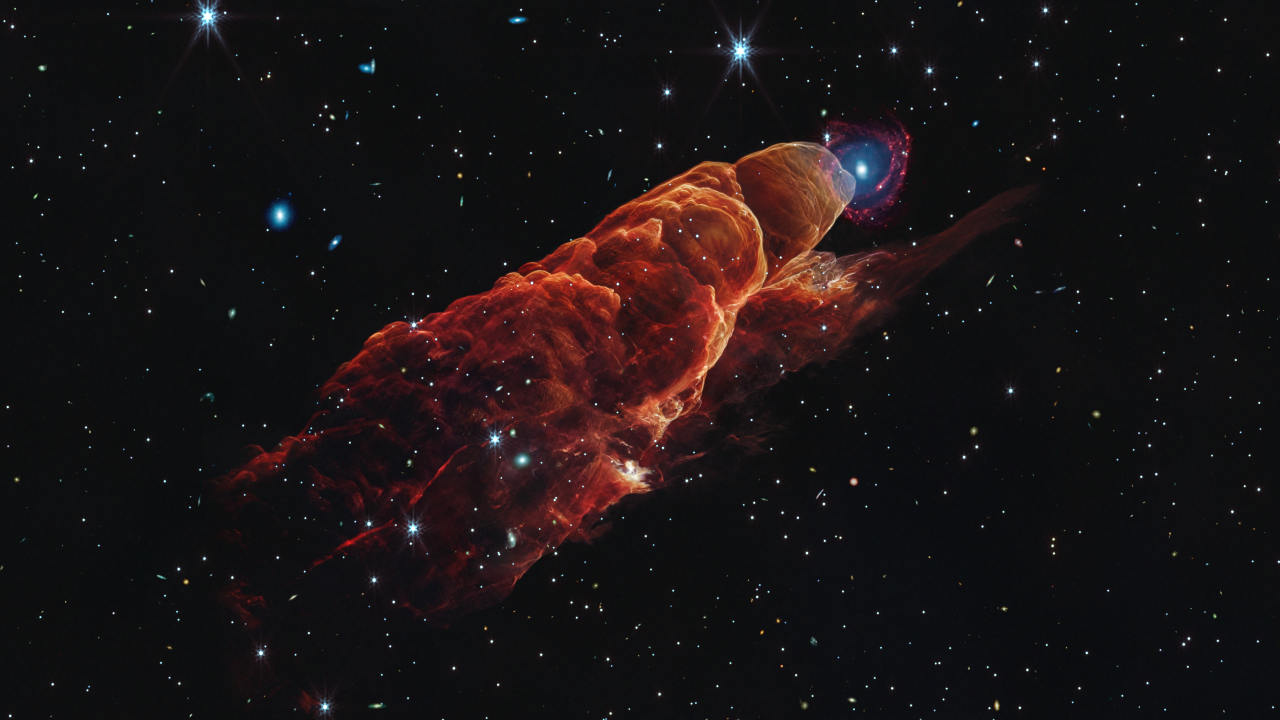
Angled from the upper left corner to the lower right corner is a cone-shaped orange-red cloud known as Herbig-Haro 49/50. This feature takes up about three-fourths of the length of this angle. The upper left end of this feature has a translucent, rounded end. The conical feature widens slightly from the rounded end at the upper right down to the lower right. Along the cone there are additional rounded edges, like edges of a wave, and intricate foamy-like details, as well as a clearer view of the black background of space. In the upper left, overlapping with the rounded end of Herbig-Haro 49/50, is a background spiral galaxy with a concentrated blue center that fades outward to blend with red spiral arms. The background of space is speckled with some white stars and smaller, more numerous, fainter white galaxies throughout.

The post SAVE THE DATE: 2026 Cosmic Origins Early Career Workshop, Oct 2026 appeared first on NASA Science.

  •  

REMINDER: 2027A NASA IRTF Call for Proposals

REMINDER: 2027A NASA IRTF Call for Proposals | Due October 1st

16 September 2026

Solicitation Number: NN2027AOBSERV_IRTF 

Proposals Due: 10/01/2026

Announcement Document: Call for Proposals

Other Documents: IRTF Home Page

The call for NASA Infrared Telescope Facility observing proposals for semester 2027A (February 1 to July 31, 2027) opened on September 1. The proposal Deadline is Thursday, October 1, 2026, 5PM Hawaii Standard Time. Available instruments are listed here. Remote observing is offered from any location with broadband Internet access for any project that utilizes IRTF facility instruments. Click here for information about IRTF Computer and Remote Observing Information. Please see the announcement for available instruments and for further information. Please review the information and use our Online Application Form.  

Questions may be directed to Warren Skidmore at warren.skidmore@hawaii.edu

News Straight to Your Inbox

Subscribe to your community email news list

We will never share your email address.

Privacy Policy

Sign Up
Angled from the upper left corner to the lower right corner is a cone-shaped orange-red cloud known as Herbig-Haro 49/50. This feature takes up about three-fourths of the length of this angle. The upper left end of this feature has a translucent, rounded end. The conical feature widens slightly from the rounded end at the upper right down to the lower right. Along the cone there are additional rounded edges, like edges of a wave, and intricate foamy-like details, as well as a clearer view of the black background of space. In the upper left, overlapping with the rounded end of Herbig-Haro 49/50, is a background spiral galaxy with a concentrated blue center that fades outward to blend with red spiral arms. The background of space is speckled with some white stars and smaller, more numerous, fainter white galaxies throughout.

The post REMINDER: 2027A NASA IRTF Call for Proposals appeared first on NASA Science.

  •  

AI/ML STIG Lecture Series, 21 Sept 2026

AI/ML STIG Lecture Series

Artificial Intelligence & Machine Learning Science and Technology Interest Group

AI/ML STIG about AI/ML STIG Lecture Series

Location

Virtual

dates

21 September 2026
4:00pm ET

Community

AI/ML STIG

Type

Lecture

Hands-On Session I: Agentic Coding and Research Tools

Speaker

Christopher Stubbs, Harvard University

Meeting Connection

Join the Lecture

News Straight to Your Inbox

Subscribe to your community email news list

We will never share your email address.

Privacy Policy

Sign Up
Angled from the upper left corner to the lower right corner is a cone-shaped orange-red cloud known as Herbig-Haro 49/50. This feature takes up about three-fourths of the length of this angle. The upper left end of this feature has a translucent, rounded end. The conical feature widens slightly from the rounded end at the upper right down to the lower right. Along the cone there are additional rounded edges, like edges of a wave, and intricate foamy-like details, as well as a clearer view of the black background of space. In the upper left, overlapping with the rounded end of Herbig-Haro 49/50, is a background spiral galaxy with a concentrated blue center that fades outward to blend with red spiral arms. The background of space is speckled with some white stars and smaller, more numerous, fainter white galaxies throughout.

The post AI/ML STIG Lecture Series, 21 Sept 2026 appeared first on NASA Science.

  •  

Cosmic Origins Community Meeting, 22 Sept 2026

Cosmic Origins Community Meeting

Location

Virtual

Dates

22 September 2026
12:00pm – 1:00pm ET

Community

Cosmic Origins

Type

Meeting

Post-Ad ASTRA Community Science Workshop Update

Hosted by the COPAG Leadership

This community meeting aims to provide you with an overview and explanation of the processes and plans for mission concepts submitted to the Ad ASTRA workshop. The meeting will include a description of how the NASA Astrophysics Division will use the information gathered at the workshop. Additionally, this meeting aims to collect feedback and questions that the COPAG community may have regarding the process and plans that further mission concept selections. 

Please use this form to submit any comments, questions, or feedback for the COPAG community meeting: https://forms.gle/puBBTk1mo34WiGwP7 

Meeting Connection

Join the Meeting

News Straight to Your Inbox

Subscribe to your community email news list

We will never share your email address.

Privacy Policy

Sign Up
Angled from the upper left corner to the lower right corner is a cone-shaped orange-red cloud known as Herbig-Haro 49/50. This feature takes up about three-fourths of the length of this angle. The upper left end of this feature has a translucent, rounded end. The conical feature widens slightly from the rounded end at the upper right down to the lower right. Along the cone there are additional rounded edges, like edges of a wave, and intricate foamy-like details, as well as a clearer view of the black background of space. In the upper left, overlapping with the rounded end of Herbig-Haro 49/50, is a background spiral galaxy with a concentrated blue center that fades outward to blend with red spiral arms. The background of space is speckled with some white stars and smaller, more numerous, fainter white galaxies throughout.

The post Cosmic Origins Community Meeting, 22 Sept 2026 appeared first on NASA Science.

  •  

AGN SIG Spotlight Series, 22 Sept 2026

AGN SIG Spotlight Series

Active Galactic Nuclei Science Interest Group

Our Spotlight Series highlights recent advances in AGN science, with a strong emphasis on participation from early-career researchers, and includes plenty of time for community discussion following the presentations. 

AGN SIG about AGN SIG Spotlight Series

Location

Virtual

Dates

22 September 2026
1:00pm ET / 10:00am PT

Community

AGN SIG

Type

Seminar

Unveiling the Role of Multi-Phase AGN Outflows with MIRACLE

Speaker

Dr. Matteo Ceci (Università di Firenze)

Abstract

Galaxy evolution is tightly connected to Active Galactic Nuclei (AGN) through feedback processes in which gas accretion onto the supermassive black hole drives powerful multiphase outflows. Detailed studies in the local Universe are crucial to resolve the physical scales and gas phases involved, enabling a comprehensive view of AGN-host interactions. I will present first results from the MIRACLE (Mid-IR Activity of Circumnuclear Line Emission) program, combining JWST/MIRI, MUSE, and ALMA observations of seven nearby Seyfert galaxies. Thanks to JWST’s spatial resolution (50-150 pc), we probe atomic and molecular gas in the circumnuclear regions and assess the impact of AGN activity on their host galaxies. Focusing on NGC 1365, we trace the ionized outflow up to kiloparsec scales and constrain its energetics and effects on star formation (SF). By combining mid-IR diagnostics with advanced photoionization and kinematic models, we reproduce ~60 optical and mid-IR emission lines, disentangling AGN- and SF-driven components and providing robust estimates of gas density, ionization, extinction, and outflow mass. We show that classical methods commonly adopted in the literature can underestimate outflow masses by up to an order of magnitude.

Disk Reflection as the Origin of the X-ray Polarization of NGC 4151 with IXPE

Speaker

Dr. Elias Kammoun (California Institute of Technology) 

Abstract

The geometry of the X-ray emitting region around accreting supermassive black holes remains poorly constrained, but X-ray polarimetry now offers a new and direct perspective on it. I will present a spectro-polarimetric study of the nearby type-1 AGN NGC 4151, combining two long IXPE observations from 2022 and 2024 with simultaneous XMM-Newton and NuSTAR spectroscopy. IXPE reveals a polarization degree of 6–7% above 4 keV aligned with the radio jet, plus a distinct low-energy component at a different angle, providing evidence for at least two polarized components in the 2–8 keV band. While earlier work read the hard X-ray signal as a radially extended, slab-like corona, I will test an alternative: that the polarization is instead dominated by relativistic reflection from an accretion disk illuminated by a compact, lamp-post corona. Fitting the IXPE Stokes spectra with recently developed models, we find the data favor a low coronal height and a wide torus opening angle, with disk reflection supplying ~20% of the 2–8 keV flux. The same configuration reproduces the full 0.4–79 keV spectrum, showing that disk reprocessing by a compact corona can account for both the polarization and the broadband spectral properties of NGC 4151.

Seminar Connection

Zoom Registration, you will receive connection details by email after registration: 

https://alaska.zoom.us/meeting/register/V1okit8uSk2ql97gegbdzg

News Straight to Your Inbox

Subscribe to your community email news list

We will never share your email address.

Privacy Policy

Sign Up
Angled from the upper left corner to the lower right corner is a cone-shaped orange-red cloud known as Herbig-Haro 49/50. This feature takes up about three-fourths of the length of this angle. The upper left end of this feature has a translucent, rounded end. The conical feature widens slightly from the rounded end at the upper right down to the lower right. Along the cone there are additional rounded edges, like edges of a wave, and intricate foamy-like details, as well as a clearer view of the black background of space. In the upper left, overlapping with the rounded end of Herbig-Haro 49/50, is a background spiral galaxy with a concentrated blue center that fades outward to blend with red spiral arms. The background of space is speckled with some white stars and smaller, more numerous, fainter white galaxies throughout.

The post AGN SIG Spotlight Series, 22 Sept 2026 appeared first on NASA Science.

  •  

DGCE SIG Seminar, 24 Sept 2026

DGCE SIG Seminar

Diffuse Gas in Cosmic Ecosystems Science Interest Group

DGCE SIG about DGCE SIG Seminar

Location

Virtual

Dates

24 September 2026
4:00pm ET / 1:00pm PT

Community

DGCE SIG

Type

Seminar

How the Faint Radio Sky is Changing Our Understanding of Star Formation and Galactic Outflows

Speaker

Allison Matthews (Carnegie Observatories)

Abstract

In the last decade, with the commissioning of high sensitivity radio telescopes, we have opened a new window into the faint radio sky. These novel facilities probe fundamental physical processes that regulate star formation and characterize star formation in normal galaxies like our Milky Way over nearly all cosmic time. Deep observations from MeerKAT and LOFAR have revealed that prior observations may have missed half the star formation at all cosmic times. This discrepancy has critical implications across astrophysics: estimates of gravitational wave events, the frequency of astrophysical transients, and the chemical evolution of galaxies. These same high-sensitivity radio facilities are simultaneously placing critical constraints on the physical drivers of galactic winds that we believe regulate star formation across all of cosmic time. In this talk, I will present these findings and outline programs with next generation radio facilities that will improve our observational constraints on the rate and regulation of star formation across cosmic time.

Seminar Connection

Join the Seminar

News Straight to Your Inbox

Subscribe to your community email news list

We will never share your email address.

Privacy Policy

Sign Up
Angled from the upper left corner to the lower right corner is a cone-shaped orange-red cloud known as Herbig-Haro 49/50. This feature takes up about three-fourths of the length of this angle. The upper left end of this feature has a translucent, rounded end. The conical feature widens slightly from the rounded end at the upper right down to the lower right. Along the cone there are additional rounded edges, like edges of a wave, and intricate foamy-like details, as well as a clearer view of the black background of space. In the upper left, overlapping with the rounded end of Herbig-Haro 49/50, is a background spiral galaxy with a concentrated blue center that fades outward to blend with red spiral arms. The background of space is speckled with some white stars and smaller, more numerous, fainter white galaxies throughout.

The post DGCE SIG Seminar, 24 Sept 2026 appeared first on NASA Science.

  •  

AI/ML STIG Lecture Series, 14 Sept 2026

AI/ML STIG Lecture Series

Artificial Intelligence & Machine Learning Science and Technology Interest Group

Agentic AI: Fundamentals & Applications

AI/LM STIG about AI/ML STIG Lecture Series

Location

Virtual

dates

14 September 2026
4:00pm ET

Community

AI/ML STIG

Type

Lecture

Foundations of LLM Agents and State of the Art

Speaker

Josh Speagle, University of Toronto

Meeting Connection

Join the Lecture

News Straight to Your Inbox

Subscribe to your community email news list

We will never share your email address.

Privacy Policy

Sign Up
Angled from the upper left corner to the lower right corner is a cone-shaped orange-red cloud known as Herbig-Haro 49/50. This feature takes up about three-fourths of the length of this angle. The upper left end of this feature has a translucent, rounded end. The conical feature widens slightly from the rounded end at the upper right down to the lower right. Along the cone there are additional rounded edges, like edges of a wave, and intricate foamy-like details, as well as a clearer view of the black background of space. In the upper left, overlapping with the rounded end of Herbig-Haro 49/50, is a background spiral galaxy with a concentrated blue center that fades outward to blend with red spiral arms. The background of space is speckled with some white stars and smaller, more numerous, fainter white galaxies throughout.

The post AI/ML STIG Lecture Series, 14 Sept 2026 appeared first on NASA Science.

  •  

Third Early Career Workshop, Sept 2026

Physics of the Cosmos Third Early Career Workshop

NASA’s Physics of the Cosmos Program, in collaboration with the Physics of the Cosmos Program Analysis Group Executive Committee, is pleased to announce the Third Early Career Workshop. Participants will benefit from engaging interactive sessions covering essential topics including grant opportunities, navigating data archives, and effective strategies for career advancement.

Physics of the Cosmos about Physics of the Cosmos Third Early Career Workshop

Location

Virtual

Dates

22-24 September 2026
1:00pm-4:00pm ET / 10:00am-1:00pm PT

Community

Physics of the Cosmos

Type

Workshop

Physics of the Cosmos

Inspiring the Next Generation of Astrophysicists

The workshop will be held on September 22 – 24, 2026, from 1:00PM to 4:00PM Eastern Time and will be fully virtual.

This workshop aims to provide early career scientists with valuable insights into the groundbreaking research conducted within the Physics of the Cosmos Program, demonstrate essential tools and resources available to them, and address their questions and concerns.

Registration about Inspiring the Next Generation of Astrophysicists
Physics of the Cosmos Third Early Career Workshop Poster

This third workshop will discuss three topics—Science, Missions, and Career Development— and will also showcase the importance of collaborations.

This workshop is tailored for graduate students, postdoctoral researchers, and early-career scientists looking to enhance their professional trajectory in astrophysics.

Workshop Schedule

The workshop will include a tutorial on the NASA Astrophysics Data System (ADS) Science Explorer (SciX), talks on upcoming missions including the Compton Spectrometer and Imager (COSI) and the Ultraviolet Explorer (UVEX), updates on NASA programs for students and postdocs, a CV writing mini-workshop, presentations by your fellow early career researchers on exciting science and technology development projects, and much more!

The full program will be coming soon.

Downloads

Physics of the Cosmos Third Early Career Workshop Poster

Aug 11, 2026

PDF (679.39 KB)

News Straight to Your Inbox

Subscribe to your community email news list

We will never share your email address.

Privacy Policy

Sign Up
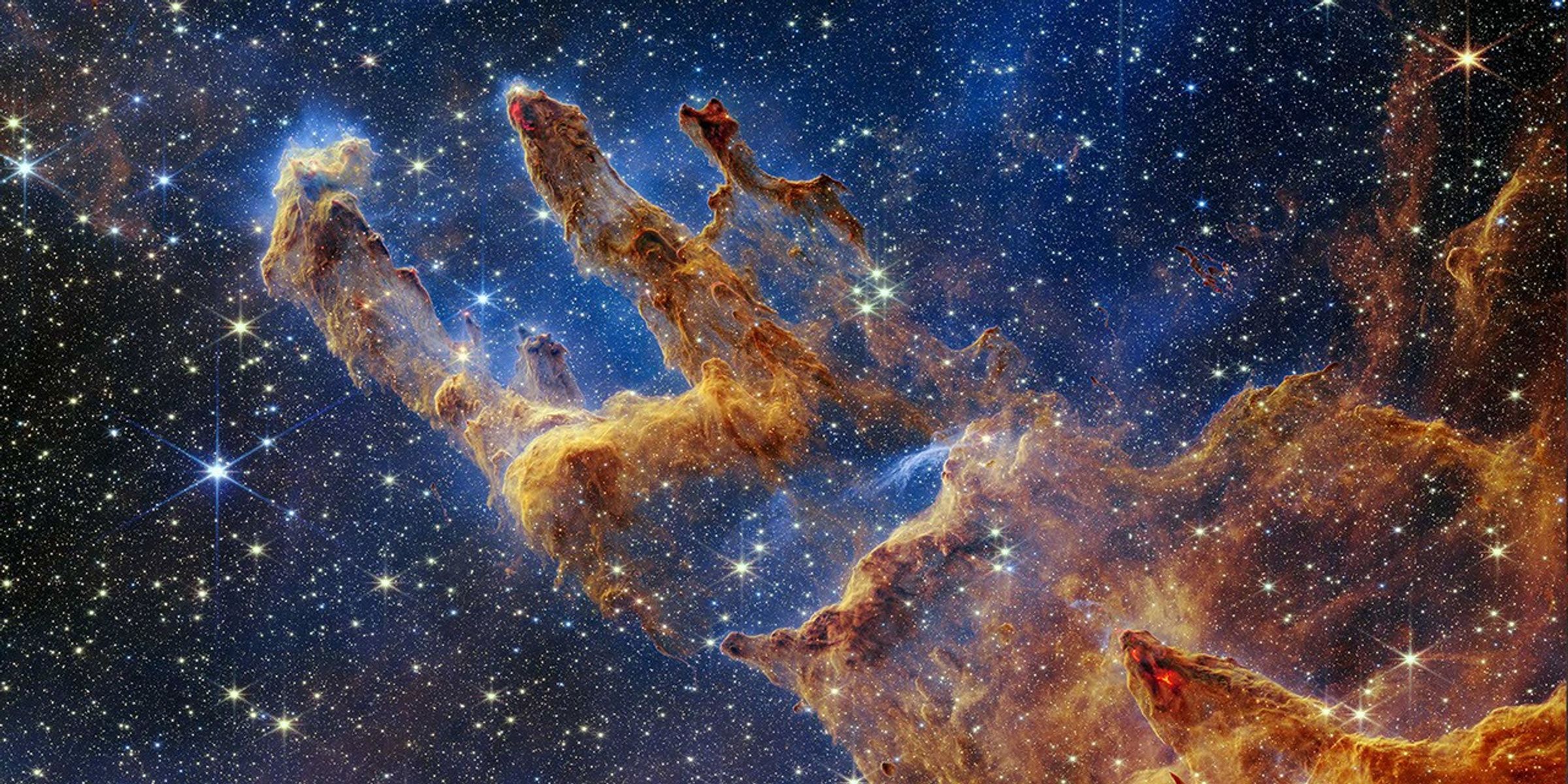
This cropped horizontal image has layers of semi-opaque rusty red colored gas and dust that starts at the bottom right and goes toward the top left. There are three prominent pillars rising toward the top left. The left pillar is the largest and widest. The peaks of the second and third pillars are set off in darker shades of brown and have red outlines.

The post Third Early Career Workshop, Sept 2026 appeared first on NASA Science.

  •  

AO Astrophysics Explorers Program 2026 SMEX Amended

Announcement of Opportunity Astrophysics Explorers Program 2026 Small Explorer (SMEX) Amended Text Released

10 August 2026

The National Aeronautics and Space Administration (NASA) Science Mission Directorate (SMD) announces the release of Amendment #1 to the Announcement of Opportunity (AO) to solicit Principal Investigator (PI)-led space science investigations for the Small Explorer (SMEX) opportunity under the Astrophysics Explorers Program on the NASA Solicitation and Proposal Integrated Review and Evaluation System (NSPIRES). To find the full amended AO text and a copy of Amendment #1 visit https://nspires.nasaprs.com/, and select “Solicitations” at the top of the page, and on the next page in the search box, input the number “NNH26ZDA011O” or use the direct short URL https://go.nasa.gov/APSMEX26. In the event of any lapse in NASA operations, please visit NSPIRES for further information.

Changes within the AO text are noted by using bold for new text and strikethrough for deleted text. The proposal due date, September 9, 2026, remains unchanged. For a summary of the changes made to the AO, locate the Amendment #1 document on the right side of the AO landing page on NSPIRES. Additionally, the official Question and Answers (Q&A) document has been updated on the Science Office for Mission Assessments (SOMA) web site at https://explorers.larc.nasa.gov/APSMEX26/SMEX.

All new questions or comments about the Astrophysics SMEX 2026 AO shall be addressed via email to Dan Moses, APSMEX26 Lead Program Scientist, dan.moses@nasa.gov; Hannah Jang-Condell, APSMEX26 Deputy Program Scientist, hannah.jang-condell@nasa.gov; and Omar Torres, Lead Acquisition Manager for the 2026 Astrophysics SMEX AO, SOMA omar.torres@nasa.gov using subject line “APSMEX26” to be properly routed. The Q&A period for the SMEX 2026 AO ends 14 days before the proposal due date.

Any costs incurred in preparing a submission in response to this notice or the full APSMEX26 AO are solely the responsibility of the submitter.

NASA Science

NSPIRES

NASA Solicitation and Proposal Integrated Review and Evaluation System

Explore
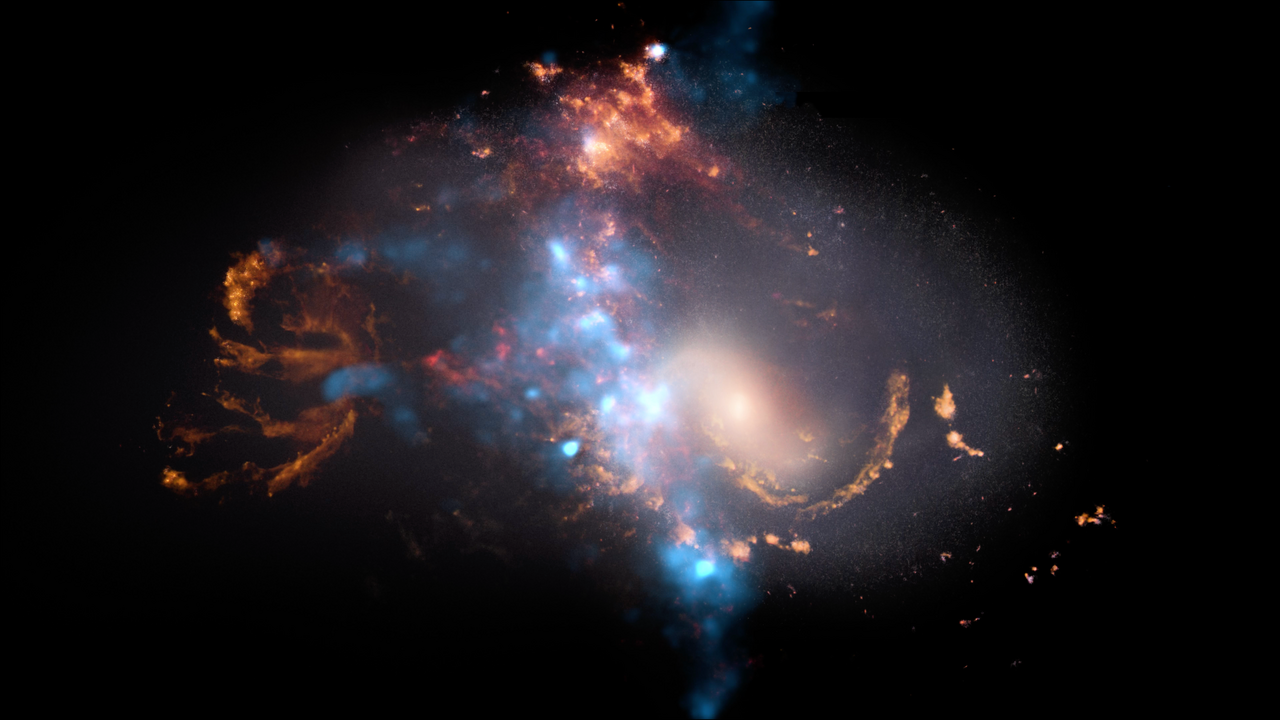
Against a black background, a peculiar galaxy is in the center and takes up most of the frame. This asymmetrical object has distorted spiral arms that extend to the left, above, and to the lower right. The galaxy’s arms are light orange and are not smooth or solid in texture, instead resembling blots and streaks of paint. The galaxy’s distorted spiral arms are overlaid by a light blue ridge of blurry blotches, which are brightest and heaviest in the center and fainter toward the left, ending before the orange areas. The blue blotches also extend to the bottom at the center and faintly toward the top center, but are not seen toward the right. A bright, almost-white orange point is near the center right and has a hazy halo surrounding it, taking up about a tenth of the image. Over the majority of the image is a semi-transparent, elliptical-shaped area that has a white, fuzzy glow.

News Straight to Your Inbox

Subscribe to your community email news list

We will never share your email address.

Privacy Policy

Sign Up
Angled from the upper left corner to the lower right corner is a cone-shaped orange-red cloud known as Herbig-Haro 49/50. This feature takes up about three-fourths of the length of this angle. The upper left end of this feature has a translucent, rounded end. The conical feature widens slightly from the rounded end at the upper right down to the lower right. Along the cone there are additional rounded edges, like edges of a wave, and intricate foamy-like details, as well as a clearer view of the black background of space. In the upper left, overlapping with the rounded end of Herbig-Haro 49/50, is a background spiral galaxy with a concentrated blue center that fades outward to blend with red spiral arms. The background of space is speckled with some white stars and smaller, more numerous, fainter white galaxies throughout.

The post AO Astrophysics Explorers Program 2026 SMEX Amended appeared first on NASA Science.

  •  

AGN SIG Spotlight Series, 21 July 2026

AGN SIG Spotlight Series

Active Galactic Nuclei Science Interest Group

AGN SIG about AGN SIG Spotlight Series

Location

Virtual

Dates

21 July 2026
1:00pm ET / 10:00am PT

Community

AGN SIG

Type

Seminar

Spin Signatures in Horizon-Resolved Images of LLAGN

Speaker

Dr. Daniel Palumbo, Harvard University

Abstract

With the advent of the Event Horizon Telescope (EHT), near-horizon black hole imaging with sub-mm very-long-baseline interferometry (VLBI) is now routine for the two sources for which terrestrial VLBI is sufficient to resolve the black hole shadow: Messier 87* and Sagittarius A*. Since the first images of M87*, the theoretical analysis of these images has advanced a broad class of black hole spin tracers in horizon-resolving observations, all of which have complex interplay with the astrophysical conditions near the horizon. Meanwhile, space VLBI mission concepts such as the Black Hole Explorer aim to drastically improve the angular resolution available via sub-mm VLBI, resolving out the primary accretion disk image to isolate the strongly lensed “photon ring,” which more robustly exposes black hole mass, spin, and viewing inclination to distant observers. In this talk, I will detail the spin signatures in both of these angular resolution regimes, and how they work together to build a “robustness ladder” for spin measurement with which the spins of many more low-luminosity AGN will soon become accessible as sub-mm VLBI sensitivity, frequency coverage, angular resolution improves. The resulting local “spin census” will help fill in missing pieces of the history of accretion and merging in the broader AGN population.

Coupling Driven H2 Excitation in Seyferts: GATOS JWST/MRS

Speaker

Daniel Delaney, University of Alaska

Abstract 

We utilize James Webb Space Telescope/Mid Infrared Instrument (JWST/MIRI) Integral Field Unit observations from the Galaxy Activity, Torus and Outflow Survey to investigate the diverse range of ionized outflow rates of obscured active galactic nuclei (AGN) with similar bolometric luminosity and explore potential associations with AGN feedback. We explore spatial correlations between ionized emission potentially associated with fast shocks ([Fe II]5.34μm) and the excitation of H2. We further constrain our investigation to the inner 400 pc (the nuclear and circumnuclear regions r < 200 pc), and estimate the excitation temperature and column density of H2 assuming local thermodynamic equilibrium and using the S(1)–S(8) rotational H2 emission lines visible to JWST/MIRI spectroscopy. We report the molecular gas temperature of the deprojected 400 pc nuclear region to correlate with the ionized mass outflow rate. We also observe a stronger degree of spatial correlation between [Fe II]5.34μm emission and H2 gas temperature. We observe regions of enhanced [Fe II]5.34μm/[Ar II]6.99μm spatially coincident with the ionization cones of objects with higher ionized outflow rates and [Fe II]5.34μm/[Ar II]6.99μm in the deprojected 400 pc nuclear region to scale positively with both the ionized outflow rate and the estimated molecular gas temperature. We do not observe the estimated jet cavity power within the central 400 pc as strongly correlated with the ionized mass outflow rate or molecular gas temperature of the nuclear region. We take the preceding observations to suggest a higher degree of interaction between AGN outflows and the circumnuclear disk.

Seminar Connection

Zoom Registration (note this is a new registration link), you will receive connection details by email after registration: 

https://alaska.zoom.us/meeting/register/V1okit8uSk2ql97gegbdzg

News Straight to Your Inbox

Subscribe to your community email news list

We will never share your email address.

Privacy Policy

Sign Up
Angled from the upper left corner to the lower right corner is a cone-shaped orange-red cloud known as Herbig-Haro 49/50. This feature takes up about three-fourths of the length of this angle. The upper left end of this feature has a translucent, rounded end. The conical feature widens slightly from the rounded end at the upper right down to the lower right. Along the cone there are additional rounded edges, like edges of a wave, and intricate foamy-like details, as well as a clearer view of the black background of space. In the upper left, overlapping with the rounded end of Herbig-Haro 49/50, is a background spiral galaxy with a concentrated blue center that fades outward to blend with red spiral arms. The background of space is speckled with some white stars and smaller, more numerous, fainter white galaxies throughout.

The post AGN SIG Spotlight Series, 21 July 2026 appeared first on NASA Science.

  •  

DGCE SIG Seminar, 23 July 2026

DGCE SIG Seminar

Diffuse Gas in Cosmic Ecosystems Science Interest Group

DGCE SIG about DGCE SIG Seminar

Location

Virtual

Dates

23 July 2026
4:00pm ET / 1:00pm PT

Community

DGCE SIG

Type

Seminar

From Micro to Macro: Connecting the Physics of Galaxy Formation Across Scales

Speaker

Drummond Fielding, New York University

Abstract

Galaxy formation is controlled by the cycling of diffuse gas through the ISM, CGM, and larger-scale environment, but predictive models remain limited by unresolved microphysics. I will discuss how sub-pc processes—including cosmic-ray transport, magnetic reconnection, and turbulent mixing—regulate multiphase structure, energy and momentum transport, and the launching of galactic winds. I will then describe how simulations, analytic models, and new multi-scale numerical methods can connect these processes to kpc-scale feedback and Mpc-scale galaxy evolution. The aim is to build physically grounded models of gas cycling that can sharpen our interpretation of observations and move galaxy formation theory beyond phenomenological feedback prescriptions.

Seminar Connection

Join the Seminar

News Straight to Your Inbox

Subscribe to your community email news list

We will never share your email address.

Privacy Policy

Sign Up
Angled from the upper left corner to the lower right corner is a cone-shaped orange-red cloud known as Herbig-Haro 49/50. This feature takes up about three-fourths of the length of this angle. The upper left end of this feature has a translucent, rounded end. The conical feature widens slightly from the rounded end at the upper right down to the lower right. Along the cone there are additional rounded edges, like edges of a wave, and intricate foamy-like details, as well as a clearer view of the black background of space. In the upper left, overlapping with the rounded end of Herbig-Haro 49/50, is a background spiral galaxy with a concentrated blue center that fades outward to blend with red spiral arms. The background of space is speckled with some white stars and smaller, more numerous, fainter white galaxies throughout.

The post DGCE SIG Seminar, 23 July 2026 appeared first on NASA Science.

  •  

HWO SIG Seminar, 12 August 2026

HWO SIG Seminar

Habitable Worlds Observatory Science Interest Group

HWO SIG about HWO SIG Seminar

Location

Virtual

Dates

12 August 2026

Community

HWO SIG

Type

Seminar

Title TBA

Speaker

TBA

Seminar Connection

Join the Seminar

News Straight to Your Inbox

Subscribe to your community email news list

We will never share your email address.

Privacy Policy

Sign Up
Angled from the upper left corner to the lower right corner is a cone-shaped orange-red cloud known as Herbig-Haro 49/50. This feature takes up about three-fourths of the length of this angle. The upper left end of this feature has a translucent, rounded end. The conical feature widens slightly from the rounded end at the upper right down to the lower right. Along the cone there are additional rounded edges, like edges of a wave, and intricate foamy-like details, as well as a clearer view of the black background of space. In the upper left, overlapping with the rounded end of Herbig-Haro 49/50, is a background spiral galaxy with a concentrated blue center that fades outward to blend with red spiral arms. The background of space is speckled with some white stars and smaller, more numerous, fainter white galaxies throughout.

The post HWO SIG Seminar, 12 August 2026 appeared first on NASA Science.

  •  

GW SIG Seminar, 23 July 2026

GW SIG Seminar

Gravitational Wave Science Interest Group

GW SIG about GW SIG Seminar

Location

Virtual

Dates

23 July 2026
10:00am – 11:15am ET

Community

GW SIG

Type

Seminar

LISA Preparatory Science and LISA Science Gaps

Details TBA

Seminar Connection

Join the Seminar

News Straight to Your Inbox

Subscribe to your community email news list

We will never share your email address.

Privacy Policy

Sign Up
This cropped horizontal image has layers of semi-opaque rusty red colored gas and dust that starts at the bottom right and goes toward the top left. There are three prominent pillars rising toward the top left. The left pillar is the largest and widest. The peaks of the second and third pillars are set off in darker shades of brown and have red outlines.

The post GW SIG Seminar, 23 July 2026 appeared first on NASA Science.

  •  

Habitable Worlds Observatory SIG Seminar, 12 Aug 2026

Habitable Worlds Observatory SIG Seminar

Habitable Worlds Observatory Science Interest Group

HWO SIG about Habitable Worlds Observatory SIG Seminar

Location

Virtual

Dates

12 August 2026

Community

HWO SIG

Type

Seminar

Title TBA

Speaker

TBA

Seminar Connection

Join the Seminar

News Straight to Your Inbox

Subscribe to your community email news list

We will never share your email address.

Privacy Policy

Sign Up
This cropped horizontal image has layers of semi-opaque rusty red colored gas and dust that starts at the bottom right and goes toward the top left. There are three prominent pillars rising toward the top left. The left pillar is the largest and widest. The peaks of the second and third pillars are set off in darker shades of brown and have red outlines.

The post Habitable Worlds Observatory SIG Seminar, 12 Aug 2026 appeared first on NASA Science.

  •  

GW SIG Seminar, 29 June 2026

GW SIG Seminar

Gravitational Wave Science Interest Group

GW SIG about GW SIG Seminar

Location

Virtual

Dates

29 June 2026
1:00pm ET

Community

GW SIG

Type

Seminar

Laser Interferometer Lunar Antenna: a Sub-Hertz GW Detector on the Moon

Speaker

Volker Quetschke, University of Texas Rio Grande Valley

Abstract

The moon offers unique opportunities and challenges to realize interferometric gravitational wave detectors that are sensitive over a range of frequencies that are currently not covered. Compared with Earth-based detectors, the moon’s reduced gravity and lower seismic activity allow us to shift the sensitivity to lower frequencies.

An update on the Laser Interferometer Lunar Antenna (LILA) project—a next generation gravitational-wave detector on the surface of the Moon—will be presented. The LILA detector will have unique access to sub-Hertz frequencies of gravitational waves. This frequency range of waves cannot be measured by any ongoing or upcoming experiment on the Earth or in space, thus fundamentally changing the landscape of multi-messenger astrophysics that otherwise cannot be achieved. LILA will provide early warnings prior to mergers of black holes and neutron stars. Measurements in the deci-Hertz regime can vastly improve measurements of the Hubble constant, the equation of state of neutron stars, and tests of General Relativity. Furthermore, LILA will uniquely observe phenomena like white dwarf mergers as Type Ia supernovae progenitors, tidal disruption around intermediate mass black holes, and novel dark matter probes.

A preliminary design for the LILA project and the planned future development stages will be shown: the LILA Autonomous Interferometry Technology Demonstration (LILA-AITD), the Initial LILA (iLILA) strainmeter and the full, operational LILA Observatory.

Seminar Connection

Join the Seminar

News Straight to Your Inbox

Subscribe to your community email news list

We will never share your email address.

Privacy Policy

Sign Up
This cropped horizontal image has layers of semi-opaque rusty red colored gas and dust that starts at the bottom right and goes toward the top left. There are three prominent pillars rising toward the top left. The left pillar is the largest and widest. The peaks of the second and third pillars are set off in darker shades of brown and have red outlines.

The post GW SIG Seminar, 29 June 2026 appeared first on NASA Science.

  •  

AMMB STIG Seminar, 1 July 2026

AMMB STIG Seminar

Astrophysics from the Moon, Mars, and Beyond Science and Technology Interest Group

AMMB STIG about AMMB STIG Seminar

Location

Virtual

Dates

1 July 2026
2:00pm -3:00pm ET
11:00am – 12:00 pm PT

Community

Physics of the Cosmos

Type

Seminar

Why and Where Do We Want to Put Telescopes on the Moon?

Speaker

Nivedita Mahesh, CU Boulder

Abstract

The Moon is emerging as a uniquely valuable platform for astrophysics, enabling observations that neither Earth nor free-flying spacecraft can support. This talk surveys the scientific motivation across four complementary regimes. At low radio frequencies, the radio-quiet lunar farside opens a window onto the cosmological Dark Ages and the magnetospheres of exoplanets. In the mid-band gravitational-wave regime, the Moon’s low seismic activity bridges the sensitivity gap between terrestrial and space-based detectors. At ultraviolet wavelengths, its natural vacuum and long coherence times allow high-resolution stellar imaging beyond what is possible on Earth. And in the far-infrared, the cold, stable conditions of permanently shadowed regions offer a naturally cryogenic, absorption-free site for probing star and planet formation and the obscured Universe.

For each regime, I will share updates from the mission concept leads on the efforts now developing within the Astrophysics from the Moon, Mars & Beyond (AMMB) Science Interest Group. Together, these cases point to a paradigm shift: astrophysics from the Moon is becoming not just desirable but necessary.

Seminar Connection

Join the Seminar

News Straight to Your Inbox

Subscribe to your community email news list

We will never share your email address.

Privacy Policy

Sign Up
This cropped horizontal image has layers of semi-opaque rusty red colored gas and dust that starts at the bottom right and goes toward the top left. There are three prominent pillars rising toward the top left. The left pillar is the largest and widest. The peaks of the second and third pillars are set off in darker shades of brown and have red outlines.

The post AMMB STIG Seminar, 1 July 2026 appeared first on NASA Science.

  •  

Cosmic Structure SIG Seminar, 17 July 2026

Cosmic Structure SIG Seminar

Cosmic Structure Science Interest Group

CoS SIG about Cosmic Structure SIG Seminar

Location

Virtual

Dates

17 July 2026
10:00am PT / 1:00pm ET

Community

CoS SIG

Type

Seminar

Constraints on Dynamical Dark Energy from the Full Dark Energy Survey

Speaker

Sujeong Lee, Ohio University

Abstract

The nature of dark energy remains one of the central open questions in cosmology, and recent analyses have reported a weak but intriguing preference for an evolving equation of state. I will present constraints on the w0-wa parameterization from the full six-year Dark Energy Survey (DES) dataset, combining growth and geometric probes — supernovae, BAO, and weak lensing and galaxy clustering (3x2pt) — within a single survey. The DES-only combination yields the tightest such constraints using multiple probes from any single survey, and adding external CMB and DESI BAO data gives a 3.0-sigma deviation from a cosmological constant, with the best-fit always favoring w0 > -1, wa < 0. Because DES relies on different probes and systematics than DESI, this provides an independent cross-check on the recent hints for dynamical dark energy. I will discuss how to interpret these results, and what they imply for Stage IV surveys. This work realizes the multi-probe dark energy program envisioned at the inception of DES.

Seminar Connection

Join the Seminar

News Straight to Your Inbox

Subscribe to your community email news list

We will never share your email address.

Privacy Policy

Sign Up
This cropped horizontal image has layers of semi-opaque rusty red colored gas and dust that starts at the bottom right and goes toward the top left. There are three prominent pillars rising toward the top left. The left pillar is the largest and widest. The peaks of the second and third pillars are set off in darker shades of brown and have red outlines.

The post Cosmic Structure SIG Seminar, 17 July 2026 appeared first on NASA Science.

  •  

AI/ML STIG Lecture Series, 29 June 2026

AI/ML STIG Lecture Series

Artificial Intelligence and Machine Learning Science and Technology Interest Group (AI/ML STIG)

Module 9: AI for Science and Engineering at NASA

AI/ML STIG about AI/ML STIG Lecture Series

Location

Virtual

Dates

29 June 2026
4:00pm – 5:00pm ET

Community

AI/ML STIG

Type

Seminar

Speaker

Steven M. Crawford, NASA HQ

Details TBA

Seminar Connection

TBA

News Straight to Your Inbox

Subscribe to your community email news list

We will never share your email address.

Privacy Policy

Sign Up
Angled from the upper left corner to the lower right corner is a cone-shaped orange-red cloud known as Herbig-Haro 49/50. This feature takes up about three-fourths of the length of this angle. The upper left end of this feature has a translucent, rounded end. The conical feature widens slightly from the rounded end at the upper right down to the lower right. Along the cone there are additional rounded edges, like edges of a wave, and intricate foamy-like details, as well as a clearer view of the black background of space. In the upper left, overlapping with the rounded end of Herbig-Haro 49/50, is a background spiral galaxy with a concentrated blue center that fades outward to blend with red spiral arms. The background of space is speckled with some white stars and smaller, more numerous, fainter white galaxies throughout.

The post AI/ML STIG Lecture Series, 29 June 2026 appeared first on NASA Science.

  •  

AMMB STIG Seminar, 1 July 2026

Astrophysics from the Moon Seminar

Astrophysics from the Moon, Mars, and Beyond Science and Technology Interest Group

AMMB STIG about Astrophysics from the Moon Seminar

Location

Virtual

Dates

1 July 2026
2:00pm -3:00pm ET
11:00am – 12:00 pm PT

community

Cosmic Origins

Type

Seminar

Why and Where Do We Want to Put Telescopes on the Moon?

Speaker

Nivedita Mahesh, CU Boulder

Abstract

The Moon is emerging as a uniquely valuable platform for astrophysics, enabling observations that neither Earth nor free-flying spacecraft can support. This talk surveys the scientific motivation across four complementary regimes. At low radio frequencies, the radio-quiet lunar farside opens a window onto the cosmological Dark Ages and the magnetospheres of exoplanets. In the mid-band gravitational-wave regime, the Moon’s low seismic activity bridges the sensitivity gap between terrestrial and space-based detectors. At ultraviolet wavelengths, its natural vacuum and long coherence times allow high-resolution stellar imaging beyond what is possible on Earth. And in the far-infrared, the cold, stable conditions of permanently shadowed regions offer a naturally cryogenic, absorption-free site for probing star and planet formation and the obscured Universe.

For each regime, I will share updates from the mission concept leads on the efforts now developing within the Astrophysics from the Moon, Mars & Beyond (AMMB) Science Interest Group. Together, these cases point to a paradigm shift: astrophysics from the Moon is becoming not just desirable but necessary.

Seminar Connection

Join the Seminar

News Straight to Your Inbox

Subscribe to your community email news list

We will never share your email address.

Privacy Policy

Sign Up
Angled from the upper left corner to the lower right corner is a cone-shaped orange-red cloud known as Herbig-Haro 49/50. This feature takes up about three-fourths of the length of this angle. The upper left end of this feature has a translucent, rounded end. The conical feature widens slightly from the rounded end at the upper right down to the lower right. Along the cone there are additional rounded edges, like edges of a wave, and intricate foamy-like details, as well as a clearer view of the black background of space. In the upper left, overlapping with the rounded end of Herbig-Haro 49/50, is a background spiral galaxy with a concentrated blue center that fades outward to blend with red spiral arms. The background of space is speckled with some white stars and smaller, more numerous, fainter white galaxies throughout.

The post AMMB STIG Seminar, 1 July 2026 appeared first on NASA Science.

  •  

AMMG STIG Seminar, July 1, 2026

Astrophysics from the Moon, Mars, and Beyond STIG Seminar

23 June 2026

2:00pm ET July 1st, 2026

Why and Where Do We Want to Put Telescopes on the Moon?

https://science.nasa.gov/astrophysics/programs/physics-of-the-cosmos/community/ammb-stig-seminar-1-july-2026

Speaker

Nivedita Mahesh | CU Boulder

Abstract

The Moon is emerging as a uniquely valuable platform for astrophysics, enabling observations that neither Earth nor free-flying spacecraft can support. This talk surveys the scientific motivation across four complementary regimes. At low radio frequencies, the radio-quiet lunar farside opens a window onto the cosmological Dark Ages and the magnetospheres of exoplanets. In the mid-band gravitational-wave regime, the Moon’s low seismic activity bridges the sensitivity gap between terrestrial and space-based detectors. At ultraviolet wavelengths, its natural vacuum and long coherence times allow high-resolution stellar imaging beyond what is possible on Earth. And in the far-infrared, the cold, stable conditions of permanently shadowed regions offer a naturally cryogenic, absorption-free site for probing star and planet formation and the obscured Universe.

For each regime, I will share updates from the mission concept leads on the efforts now developing within the Astrophysics from the Moon, Mars & Beyond (AMMB) Science Interest Group. Together, these cases point to a paradigm shift: astrophysics from the Moon is becoming not just desirable but necessary.

News Straight to Your Inbox

Subscribe to your community email news list

We will never share your email address.

Privacy Policy

Sign Up
Angled from the upper left corner to the lower right corner is a cone-shaped orange-red cloud known as Herbig-Haro 49/50. This feature takes up about three-fourths of the length of this angle. The upper left end of this feature has a translucent, rounded end. The conical feature widens slightly from the rounded end at the upper right down to the lower right. Along the cone there are additional rounded edges, like edges of a wave, and intricate foamy-like details, as well as a clearer view of the black background of space. In the upper left, overlapping with the rounded end of Herbig-Haro 49/50, is a background spiral galaxy with a concentrated blue center that fades outward to blend with red spiral arms. The background of space is speckled with some white stars and smaller, more numerous, fainter white galaxies throughout.

The post AMMG STIG Seminar, July 1, 2026 appeared first on NASA Science.

  •  
❌