Dominic Mutua, a smallholder farmer from Inkoisuk village some 30 kilometers (19 miles) from Amboseli National Park, has often clashed with two elephants that enter his farm and destroy crops. “We had to stay up guarding most nights and chasing them away,” Mutua told Mongabay in a telephone interview. The 2025 census conducted by the Kenya Wildlife Service (KWS) recorded a population of 42,072 elephants (Loxodonta africana) in Kenya, 1,903 of which were counted in the Amboseli park and its surrounding areas. The absence of a perimeter fence means elephants can move freely beyond the national park’s boundaries. To address human-wildlife conflict in this remote rural region of southern Kenya, drones equipped with thermal-imaging technology enable conservation teams to monitor animal movement, detect wildlife at night and warn communities early before encounters escalate. Amy Baird, Deputy Director of the Big Life Foundation, says that aside from data collection, the drones can also safely deter elephants from entering farms and settlements by guiding them away from these areas. The US-based nonprofit works with communities to protect elephants and conserve habitats in the larger Amboseli ecosystem. An Amboseli elephant. Image courtesy of Big Life Foundation. Approximately 200,000 people live within the park and in the broader Amboseli region, which encompasses about 8,093 square kilometers (3,125 square miles) of rangelands, wetlands and wildlife corridors, according to the park’s management. As the park itself covers only 392 sq km (151 sq mi), its survival depends heavily on the health of the surrounding community lands.…This article was originally published on Mongabay
Billionaire Aliko Dangote’s choice of Lamu, Kenya, for his oil refinery project, estimated to cost $17 billion, has elicited mixed reactions, with environmental activists warning of its potential risks to the local ecosystem and the community’s livelihoods, while the government is playing up its economic benefits. The Nigerian business tycoon’s decision to locate the refinery in Lamu, follows months of speculation about whether the project will go ahead in Kenya, Uganda or Tanzania. Devakumar Edwin, Dangote Industries Limited’s vice president, who is in charge of the oil and gas division, told Reuters that the project, with a capacity to refine at least 700,000 barrels of crude oil per day, would be completed within three years. The crude oil is expected to come from within the East Africa region. If completed, the Lamu project would work like a similar one owned by Dangote Industries in Lagos, Nigeria, which can refine at least 650,000 barrels of crude oil in a day. It is currently the biggest oil refinery in Africa. Speaking earlier in July, Kenyan President William Ruto said Kenya had struck a deal with Dangote to have the project in Lamu. He said the project would benefit East and Central Africa, as well as create at least 60,000 jobs for Kenyans during its construction and then operation. Kenyan President William Ruto speaking at State House in Nairobi on July 8, 2026. Image courtesy of Public Service Commission. Concerns about environmental impact Meanwhile, environmental activists have called for transparency and sufficient involvement…This article was originally published on Mongabay
LUSAKA —For years, Zambia and Zimbabwe have boasted of enviable success in harnessing hydropower. More than 80% of Zambia’s power supply and about half of neighboring Zimbabwe’s supply came from hydropower sources in 2024. But climate change has continued to expose the fragility of this dependence. Successive droughts, linked to the 2023-24 El Niño, caused water levels in Lake Kariba, formed by a dam on Zambezi River, to drop, drastically reducing electricity generation. It precipitated one of the region’s worst energy crises in decades. Against this backdrop, coal re-emerged as an attractive, although controversial, option. According to the Global Energy Monitor’s Boom and Bust Coal 2026 report, Zambia and Zimbabwe accounted for more than two-thirds of all new coal power proposals announced in Africa in 2025. Some energy experts argue that coal offers the quickest route to stabilizing electricity supplies and sustaining industrial growth, particularly for the mining sector. Electricity systems in Zimbabwe and Zambia power mining activities, industries and help meet the needs of growing urban populations. However, others warn that expanding coal-fired power risks locking both countries into decades of carbon emissions at a time when renewable energy technologies — especially solar — are becoming increasingly affordable. For Zimbabwe, however, coal has never completely disappeared from that country’s energy landscape. Power Shift Africa Campaigns Manager Kudakwashe Manjonjo said Zimbabwe’s reliance on coal is rooted in history. “Zimbabwe has always been a significant coal-producing country. I live in Hwange, home to one of the largest coal mines on the…This article was originally published on Mongabay
South Africa’s free-roaming cheetah population is much smaller than previously thought, according to the first coordinated national census of the species living outside protected areas. Over three and a half years, between 2022 and 2026, researchers from Ashia Cheetah Conservation, the Cheetah Outreach Trust (COT) and the University of Groningen in the Netherlands surveyed almost 100,000 square kilometers (38,610 square miles) of habitat across South Africa’s northern border. Wild cheetahs that inhabit the unprotected areas of South Africa are considered “free roaming.” Using camera traps, GPS collars, landowner surveys, genetic analyses, scat sampling and public sighting records, they compiled the Free-Roaming Cheetah Census (FRCC), which they described as the most comprehensive assessment yet of South Africa’s free-roaming cheetahs. During this time, they recorded only 83 mature adults, and 119 individual animals in total, which is 70% less than previous, smaller-scale studies suggested using model-based estimates. A young cheetah investigates a monitoring site in North West Province. Image courtesy of Ashia Cheetah Conservation. “Finding fewer than 100 mature adults is an extremely strong indication of how dramatically smaller the population has become within South Africa over the years,” Marna Smit, director of Ashia Cheetah Conservation, told Mongabay. Because of a high mortality rate in young cheetahs, which can be up to 90% for wild animals, mature adults — the breeding population —- are important for the survival of the species. Cheetahs in South Africa are currently managed in four separate systems: The free-roaming population, the semi-protected population in Kruger National Park…This article was originally published on Mongabay
eMALAHLENI, South Africa — Elisabeth Moutloang, 49, lives in the shadows of Duvha Power Station, a 3,600-MW coal-fired power station owned and operated by Eskom, South Africa’s national energy provider. Between it and her community of Masakhane, in the south of eMalahleni, is a coal mine where she used to work twenty years ago as a weighbridge clerk, monitoring the weight of coal-laden vehicles entering and exiting the mine, before it was abandoned. She left the job after seven months but in that time had developed a serious lung problem, which was detected because the mine conducts a health screening before starting employment and when an employee leaves. “When I went to have my exit medical done, I was told that I have a hole on my left lung. That’s when I started having sinus problems, that’s when I started having chest problems. At one stage I had bronchitis,” Moutloang says. “I thought I was going to die.” At the time, she had health insurance from her employer and was able to get the right medicine for the condition. Hers is not a unique story for a resident of eMalahleni (which translates to “place of coal”) located in South Africa’s eastern province of Mpumalanga, 130 kilometers (81 miles) east of Johannesburg. The town lies in the heart of the Highveld Priority Area (HPA), spanning 31,100 km encompassing 12 municipalities, which was designated in 2007 as a priority area for tackling air pollution, because the air quality was very poor. A…This article was originally published on Mongabay
This week, thousands of delegates are gathered in Mombasa, Kenya, for the first Our Ocean Conference to be hosted on African soil. As expected, much of the conversation will focus on the global “30×30” target — protecting 30% of the world’s land, freshwater and oceans by 2030. Yet, far from the conference halls, the big pledges and state commitments, many of the people doing the daily work of marine conservation are community organizations operating on modest budgets along Africa’s coastlines. They often do so far from the spotlight, but their contribution is vital for the global ambition to conserve ocean spaces. The Convention on Biological Diversity (CBD), under whose Kunming-Montreal Global Biodiversity Framework the 2030 targets were adopted, highlights that success hinges heavily on community involvement. Across Kenya, Tanzania and Namibia, four such groups — Coastal and Marine Resource Development (COMRED), Action for Ocean, Mwambao Coastal Community Network and the Namibia Nature Foundation (NNF) — offer a window into what community-led marine conservation looks like in practice. Their work might be underfunded, uneven and sometimes slow, but are increasingly central to how marine protection is imagined on the continent. Marine ecosystems in Africa support fisheries, tourism, transport, carbon storage and coastal protection while sustaining millions of livelihoods from the Western Indian Ocean to Africa’s Atlantic and Mediterranean coasts. In East Africa in particular, mangroves, coral reefs, seagrass meadows and nearshore fisheries underpin food systems and local economies even as they face pressure from overfishing, habitat degradation, climate change and pollution.…This article was originally published on Mongabay
As South Africa transitions away from coal-fired electricity, hundreds of former coal mines are turning into abandoned dumping sites for waste and polluted water, which a new report warns will continue to contaminate surrounding land and waterways for decades. Nor is the South African government taking action to force mine owners to clean them up, environmentalists told Mongabay. South African law requires mining companies to set aside money to clean up and restore the land after mining ends – either in trusts or through bank or insurance guarantees. But a report by the Centre for Environmental Rights found that none of the 412 coal mines that closed between 2006 and 2023 had enough money set aside to pay for the full cost of rehabilitation. The full extent of the problem is unknown as the government has failed to keep any records of mines that closed in 2008, 2010, 2012, 2013, and 2021, the report said. Mining companies must clean up and rehabilitate mines, pay for the damage, and remain responsible until the government officially signs off on the closure, according to the regulations. But most mines do not keep enough money aside to cover even a fraction of the rehabilitation costs, according to the report, titled “No More Ghost Towns : Lessons From Mpumalanga’s Mine Closure Crisis” and released May 22 in Johannesburg. With more than 100 coal mines and most of the country’s aging coal-fired power stations, the Mpumalanga region is the center of South Africa’s fossil fuel-based power…This article was originally published on Mongabay
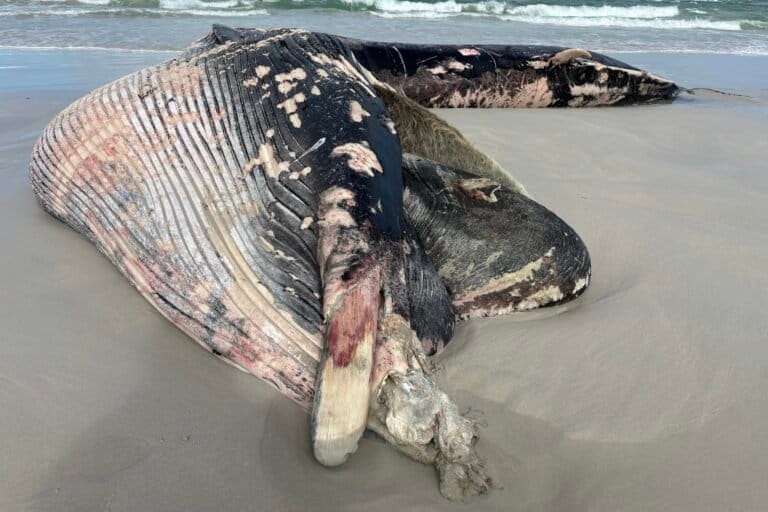
In April this year, two Bryde’s whales washed-up dead-on Dyer Island, a small nature reserve located a few kilometers off the coast of Gansbaai in South Africa’s Western Cape province. Both whales carried severe injuries; their vertebrae had been shattered. “It was very clear that it was [vessel] strikes, because both those whales were snapped in half, and you can also see the propeller marks,” Loraine Shuttleworth, head of research at the Dyer Island Conservation Trust, told Mongabay. Two whale strandings linked to ship strikes in one month alone is an unusually high number, Shuttleworth said. A new risk assessment has linked the increase in risk of ships striking whales to the rerouting of maritime traffic around South African coast. Due to the Houthi rebels attacks on ships traversing the Red Sea, which started in 2023, and the more recent fallout from the blockade of the Strait of Hormuz, many cargo companies have rerouted their vessels around the Cape of Good Hope. With greater shipping traffic comes a growing threat to marine species inhabiting the region: collisions with large, fast-moving vessels. Between December 2023 and December 2024, the number of large vessels traveling through South African waters at average speeds above 15 knots (28 kilometers per hour) has quadrupled, satellite data show. The scale of the increased maritime traffic struck scientist Els Vermeulen from the University of Pretoria’s Mammal Research Institute Whale Unit, on a flight into Cape Town in 2025. “It was a beautiful day, and there were just…This article was originally published on Mongabay
Since May 23, more than 200 primates housed at the Lwiro Primates Rehabilitation Center (LPRC) in South Kivu province in the eastern Democratic Republic of Congo (DRC) have been placed under confinement due to the Ebola outbreak. This measure follows the death of a man who tested positive for the virus on May 21. This individual, a resident of Kahungu, located just 2 km (1.2 miles) from the town of Lwiro, where the center is situated, had traveled in early May to neighboring Ituri province. Ituri is the epicenter of the outbreak, which, as of May 27, is linked to more than 200 suspected deaths. A threat for humans and apes The LPRC houses at least 129 chimpanzees and 108 monkeys of various species, including olive baboons (Papio anubis), yellow baboons (Papio cynocephalus), L’Hoest’s monkeys (Cercopithecus l’hoesti), blue monkeys (Cercopithecus mitis), agile mangabeys (Cercocebus agilis) and others. Parrots, turtles and porcupines can also be found there. These primates, rescued from poaching and the illegal wildlife trade, are being kept in confinement even though “for the moment, no cases of Ebola virus transmission from a human to a great ape have been reported,” primatologist Liz Williamson explained in an email to Mongabay. According to the World Health Organization, the Ebola virus is transmitted to humans through close contact with the blood, secretions, organs or other bodily fluids of infected animals. A chimpanzee at the Lwiro Primates Rehabilitation Center, located in South Kivu province in the eastern Democratic Republic of Congo. Image…This article was originally published on Mongabay
At a time when climate politics in the United States and globally remain deeply polarized, Will Hackman, a climate advocate and political operative, argues that the climate movement needs a new language — one rooted less in doom, guilt and abstract planetary crisis, and more in people’s everyday lives, health, safety, costs and communities. In his new book, Radically Reframing Climate Change: A Guide to Saving Ourselves, he makes the case that climate advocates have too often spoken to those who already agree with them, while failing to reach people who may be cautious, doubtful or simply disconnected from the issue. The challenge, he says, is not only scientific or technological. It is political, cultural and communicative. In the United States, climate change remains politically polarized, with surveys showing that Republicans are less likely than Democrats to view it as an urgent threat, making climate messaging particularly challenging across ideological divides. Mongabay spoke with Hackman over video call about climate messaging, grassroots activism, fossil fuels, political polarization, and why he believes the climate movement must rebuild, creating a broader and more hopeful constituency. Mongabay: You write in your book that much of climate messaging has been framed around fear, guilt and apocalypse. Is that still the right way to talk about climate change? Will Hackman: I think the nature-based messages — polar bears, melting glaciers, “there is no planet B,” “save the planet,” “world on fire” — work for people who already care about climate change. But they do not…This article was originally published on Mongabay

 Login