❌

Reading view

In 1949, researchers testing underwater acoustics off Bermuda lowered an early recording system into the water and kept the unexplained sounds it picked up. Seventy-seven years later they were identified as what may be the oldest preserved recording of a whale singing, made before scientists understood humpback whale song.
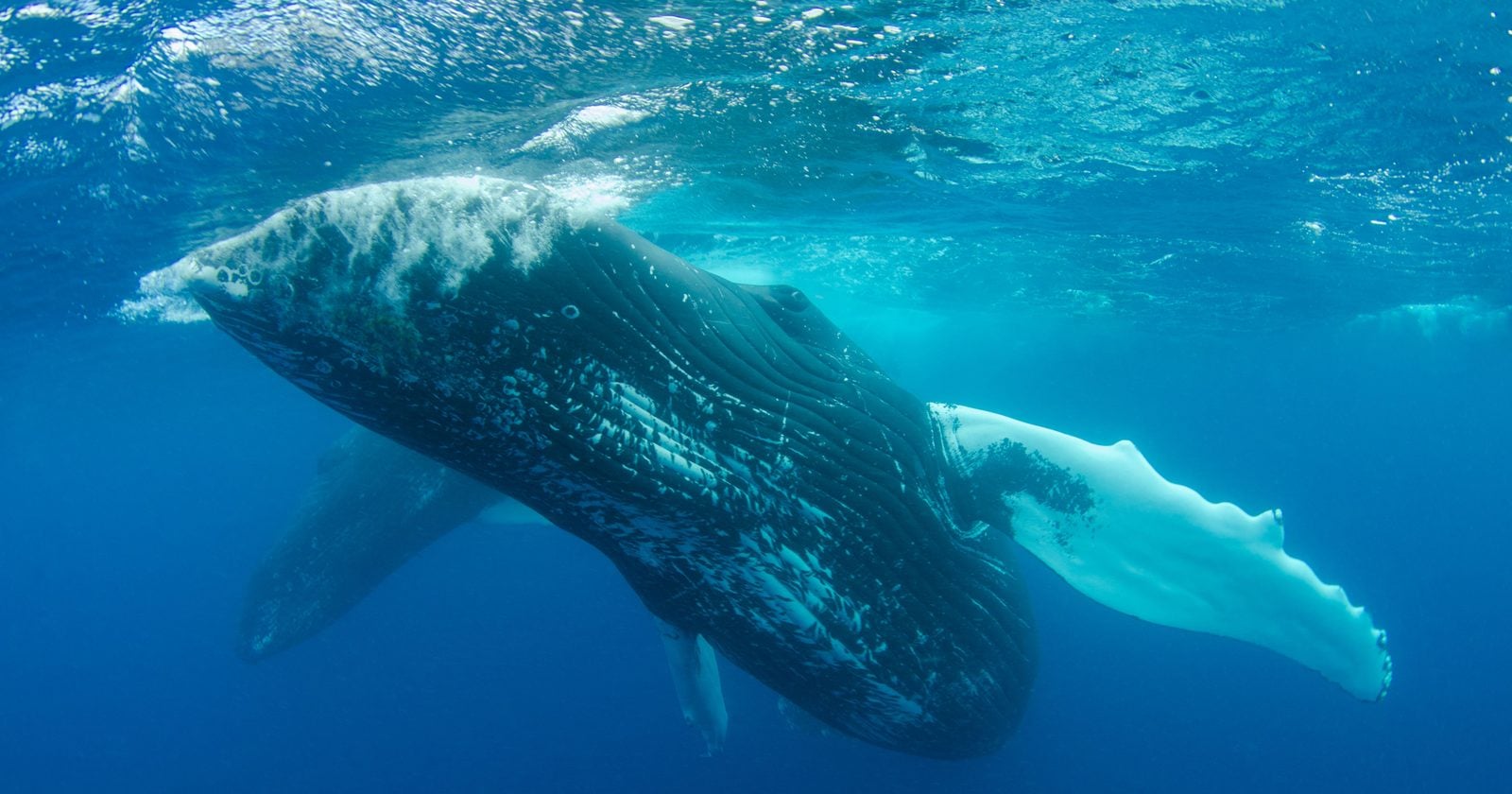
A stunning underwater photograph of a humpback whale swimming gracefully in the deep blue ocean.

A man’s voice reads a date onto a plastic disc. “The date, 7 March, 1949,” he says, as reported by Smithsonian Magazine. Underneath the announcement there is something else: a low, looping sound with a shape to it, rising and falling. It came up through the water off Bermuda into an experimental rig the researchers had lowered over the side.

They did not know what it was. They kept it anyway.

What they had captured, as noted by Woods Hole Oceanographic Institution, was the song of a humpback whale and it sat in a drawer for the better part of a century before anyone could say so.

A sound nobody could place

The recording came out of ordinary work. In March 1949, researchers aboard WHOI’s research vessel, the R/V Atlantis, were off Bermuda testing sonar for the U.S. Office of Naval Research.

The gear was makeshift by later standards: an early underwater setup and a Gray Audograph, an office dictation machine that etched sound onto thin plastic discs. Into that they fed noises coming up from below that they could not explain.

WHOI’s announcement in February 2026 identified that March 7, 1949 disc as what may be the earliest preserved recording of a whale. The hedging in that sentence matters, and we’ll come back to it. The striking part, for now, is the gap. The people at the rail heard the sound as they made it. The people who understood it were born, in some cases, decades later.

Why it sat unheard for seventy-seven years

The disc survived partly by luck of material. Magnetic tape from that era tends to break down; plastic holds up better. As Ashley Jester, WHOI’s director of research data and library services, put it, “these audograph discs survived because of their material and careful preservation.”

The 1949 disc is one of more than 200 audograph discs in WHOI’s archives, only a handful of which have been listened to so far. Digitizing the collection was funded by a $10,000 award from the National Recording Preservation Foundation. It took someone deliberately going back through old plastic, disc by disc, for the unexplained sound of 1949 to become the humpback song of 2026.

Made before we knew what whale song was

What makes the timing land is what came after it. The idea that humpbacks sing structured, repeating songs is usually traced to the 1960s. Navy engineer Frank Watlington recorded humpbacks off Bermuda in 1964 and shared his tapes with Roger and Katharine Payne. That work led to the album “Songs of the Humpback Whale,” which put the idea into the public mind that these animals compose.

The 1949 disc predates all of that by fifteen years. The researchers who saved it had no framework to hear it with. To them it was noise worth keeping, not song worth studying, because the idea of humpback song as a thing to study did not yet exist.

That gap is also what gives the old recording its value now. Laela Sayigh, a marine bioacoustician at WHOI, framed the scarcity plainly: “Data from this time period simply don’t exist in most cases,” she said. Her point, as we read it, is not that no mid-century ocean audio survives anywhere, but that this window is close to blank, which is what makes a single clean disc worth so much.

Sayigh suggested the recording “can provide insight into how humpback whale sounds have changed over time, as well as serving as a baseline for measuring how human activity shapes the ocean soundscape.” 

Peter Tyack, an emeritus research scholar at WHOI, made the same point about what the disc lets you hear beyond the whale. The recordings, Tyack said, “not only allow us to follow whale sounds, but they also tell us what the ocean soundscape was like in the late 1940s,” adding, “That’s very difficult to reconstruct otherwise.”

Why “may be the oldest” is the careful phrasing

WHOI has been careful, and we think that care is worth keeping. “May be the earliest preserved recording of a whale” is not the same claim as “is the oldest whale recording.” Older discs could be sitting unlistened-to in the same collection, or in someone else’s. The institution is describing what it has found and verified, not making a claim about everything that ever existed. When a headline flattens that into a superlative, it drops the part of the sentence that’s actually accurate.

That caution reflects how thin the evidence is. For context, WHOI points to other archives, including the Ocean Alliance collection of more than 2,400 recordings of whale and ocean sound from the 1950s through the 1990s. Even so, the 1940s remain close to silent in the record. A hedge isn’t weakness in a claim like this. It’s the accurate shape of what’s known.

The case for keeping what you can’t explain

Nobody in 1949 filed that disc thinking they’d captured the oldest whale song on record. They filed it because it was data, and you keep data. The understanding arrived seventy-seven years late, delivered to people the original researchers never met.

Jester put it plainly. “These recordings remind us why we collect data, even when we don’t immediately know what it means,” she said, and framed it as a duty across time: “preserving data when it is created is an investment in the future of science.”

The post In 1949, researchers testing underwater acoustics off Bermuda lowered an early recording system into the water and kept the unexplained sounds it picked up. Seventy-seven years later they were identified as what may be the oldest preserved recording of a whale singing, made before scientists understood humpback whale song. appeared first on Space Daily.
  •  

Young fish are dropped from a small airplane over Utah’s mountain lakes, poured out of one tank divided into seven chambers so the fish fall the last stretch through open air. More than 300 lakes inaccessible by vehicle are stocked this way each year, a practice Utah has used since 1956.

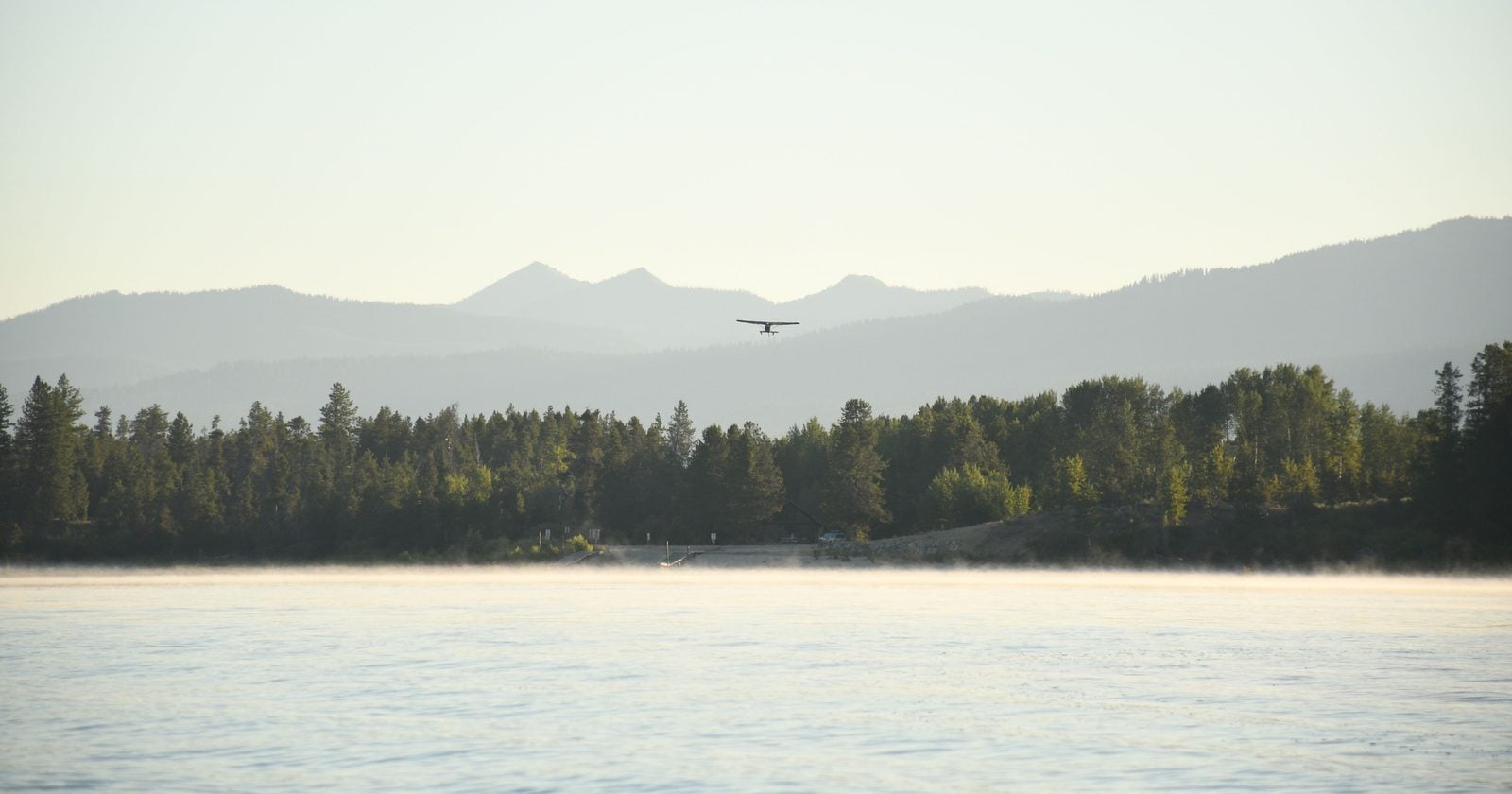
A small airplane soars above a tranquil mountain lake with misty waters and lush forests below.

You want to put fish into a high mountain lake, one with no road and no short trail to it. Fish need water to travel in, water is heavy, and no truck can get up there. So how do you do it?

Utah’s answer, worked out over decades, is to skip the ground entirely. The fish arrive by air, and for the final stretch they arrive through open air, falling out of an airplane into the lake below.

The method: a Cessna, seven chambers, and a low pass

The plane doing this work is a small single-engine aircraft, and its cargo hold is the clever part. The Utah Division of Wildlife Resources describes a plane that “can carry the pilot and a copilot, plus one fish tank that has seven chambers, allowing the aircraft to stock seven different lakes in one flight.” Seven chambers, seven lakes, one loop through the mountains before the plane comes back to reload.

The plane comes in low and slow over the lake, about 50 to 150 feet above the water, and releases the fish from one chamber so they tumble the last stretch down. Then on to the next lake, the next chamber. A single flight can carry over 10,000 fish before anyone needs to land and refill.

Why the fish survive a fall from a plane

This is the part that stops most people. A fall from a hundred feet or more, into water, sounds like the end of the fish. It mostly isn’t, and the reason comes down to size.

The fish being dropped are tiny. They are fingerlings, young fish only 1 to 3 inches long, and at that scale the physics works in their favor. The DWR’s own explanation is that “the young fish — called fingerlings — are so small (ranging from 1-3 inches long) that the air slows their drop. The slower fall allows the fish to survive.” A body that small weighs very little for its size, so air resistance slows it fast. Instead of dropping like a stone, the fish flutter down more the way a leaf does.

We are not fish biologists, and this is the agency’s account of its own program rather than an independent study, so it reads better as the DWR’s reasoning than as settled fact. The agency is clear about the size limit, though. If you tried this with bigger fish, the DWR says, “if the fish were larger, the survival rate would not be as high.” The whole method depends on keeping the fish small enough to fall gently.

How long this has gone on, and how far it reaches

Dropping fish from planes is not a recent experiment. Utah has done it since as early as 1956, and it wasn’t the first method anyone tried. Matt McKell, a biologist with the DWR’s Northern Region, has written about the earlier, more awkward approaches. In the early days, McKell has written, the fish were carried up in metal milk cans on horseback. A horse can only carry so much water so far up a mountain.

Aircraft solved the reach problem, and they stuck. McKell writes that “by the 1950s, small airplanes became the preferred method for stocking fish into backcountry lakes, which is actually still the case today.” Seventy years on, the plane handles the long-distance work, while backpacks, buckets, and four-wheelers still cover the lakes a person can walk or drive to.

The scale now is large. The DWR reports that “more than 300 lakes are aerially stocked in Utah each year. These lakes range in size from smaller than 5 acres up to 500 acres.” Independent reporting puts the figure at roughly 300 high-elevation lakes as well, so the number is not just an agency talking point.

Why bother stocking a barren lake at all

There is a fair question underneath all of this. Many of these high lakes hold no fish naturally. Steep outlets and long winters mean fish often can’t reach them or can’t breed once there, which is exactly why they require frequent stocking rather than a one-time drop. So why put fish in a place that can’t keep them going on its own?

The plain answer is recreation. These are backcountry fishing spots, and a lake with no fish is a long hike to nothing for an angler. Stocking keeps hundreds of remote lakes worth the walk.

What makes the whole operation possible circles back to the fingerlings. The airplane, the seven chambers, the low pass over the water, all of it works only because the fish are small enough that falling a hundred feet does them little harm. Grow them a few inches and the physics turns against you. The program depends, in the end, on dropping a creature light enough to be caught by the air on the way down.

The post Young fish are dropped from a small airplane over Utah’s mountain lakes, poured out of one tank divided into seven chambers so the fish fall the last stretch through open air. More than 300 lakes inaccessible by vehicle are stocked this way each year, a practice Utah has used since 1956. appeared first on Space Daily.
  •  

In 1869, a French entomologist trying to breed a hardier silkworm let a batch of moth larvae escape his Massachusetts yard. Twenty years later they had defoliated 360 square miles nearby, and the species can still strip a million acres in a single bad year.

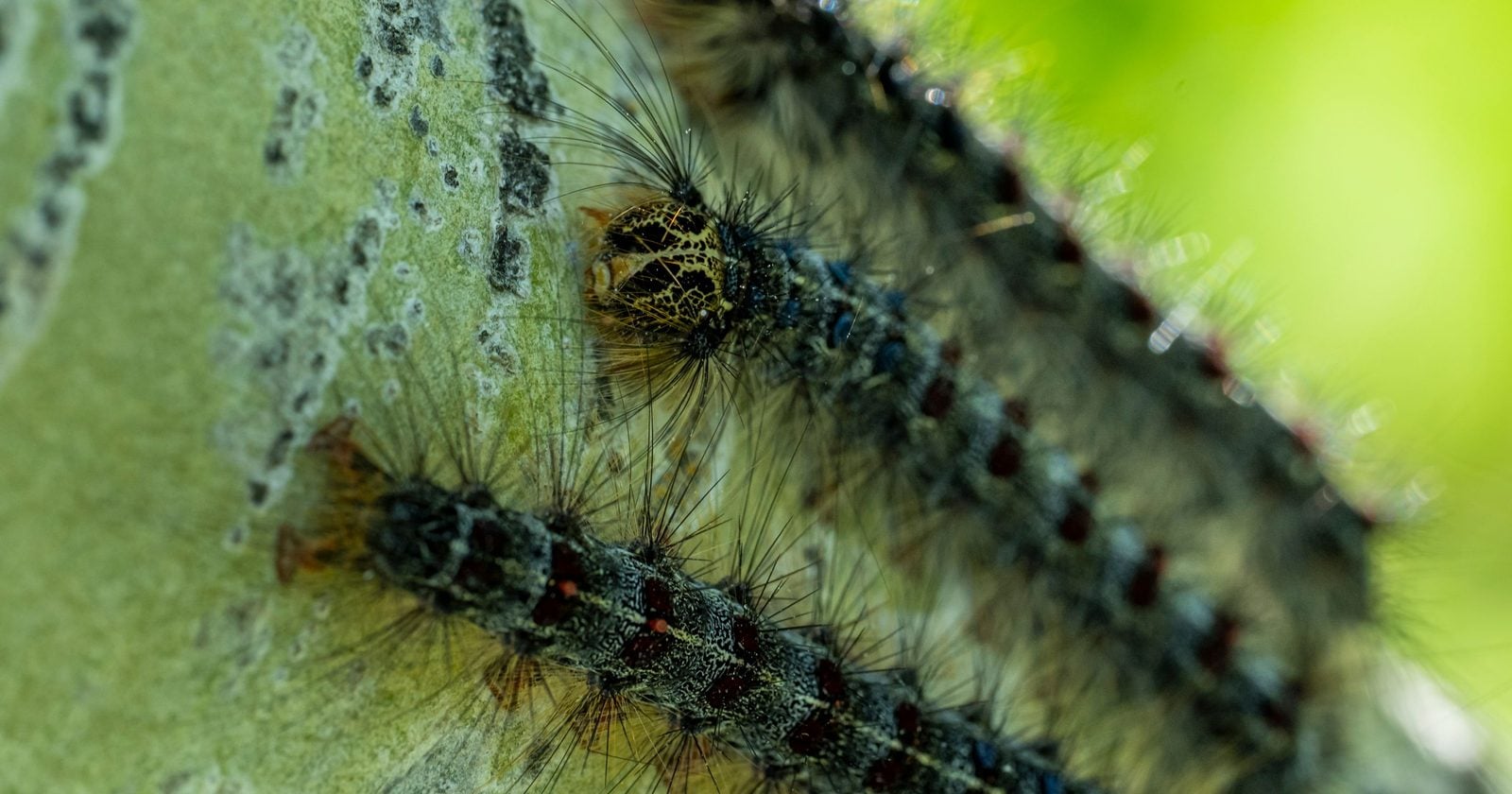
Macro shot of caterpillars on a lichen-covered tree branch in Rouyn-Noranda, Québec, Canada.

One amateur naturalist, working in a modest backyard outside Boston, kept a colony of caterpillars behind his house. A windstorm scattered some of them into the woods and a little over a century later, the descendants of those loose larvae had become one of the most expensive forest pests on the continent, able to chew bare more than a million acres of trees in a single bad year.

How does one careless moment on a residential lot in 1869 turn into that?

The short answer: it took twenty years to look like anything at all. That delay is what makes the story worth telling. So let us walk it forward from the yard.

Who Trouvelot was, and what he was trying to do

The man in the yard was Étienne Léopold Trouvelot, a French amateur naturalist and artist who had settled in Medford, Massachusetts. He was not trying to unleash anything. He was experimenting with silk production. Trouvelot wanted to breed a silk-spinning caterpillar more resistant to disease than the domesticated silkworm.

For that he turned to the European gypsy moth, a species the Entomological Society of America formally renamed the “spongy moth” in 2022.

As the education service EEK tells it, some of Trouvelot’s moths escaped in 1868–1869 and subsequently multiplied in a vacant lot next to his home in Medford, Massachusetts. Not a secret rogue experiment. A hobbyist’s version of a reasonable farming bet, gone wrong in the most ordinary way imaginable.

The escape

It is often said that eggs got loose. The record does not quite support that. Trouvelot had imported clumps of eggs, but what escaped were the caterpillars he was actively raising behind his house.

According to historical accounts, a windstorm damaged his nets and scattered the caterpillars. Smithsonian magazine’s account of the episode traces the whole invasion back to insects escaping from nets and cages in that backyard.

Two things about the insect made the accident far worse than it should have been. It had few natural predators in North America. And the female of this species cannot fly, which sounds as though it should have limited the spread. But the young caterpillars compensate by floating on threads of silk carried by the wind, giving the moth almost nothing eating it and a quiet, wind-driven way of moving across the landscape.

The twenty-year fuse

For roughly two decades, not much visibly happened. That is the part that trips up our intuition. We expect consequences to arrive on the same timescale as the mistake, and invasions rarely oblige. The population built generation after generation until it crossed a threshold.

The first recorded major outbreak came around 1889, about twenty years after the escape. Caterpillars stripped the leaves off fruit and shade trees across a 360-square-mile area around Medford. 

Massachusetts launched a campaign to wipe the moth out, and the methods of the day were blunt. Ken Gooch, forest health program director at the Massachusetts Department of Conservation and Recreation, described that early era to the Daily Hampshire Gazette: “They did an incredible amount of really, really toxic pesticide spraying.” 

The effort failed. The moth kept moving, spreading through the Northeast, the Mid-Atlantic and the Midwest over the following century. Reporting from Grist puts that historical march at roughly 13 miles per year for over a century, and the total damage between 1970 and 2013 at 81 million acres stripped of leaves.

Why it still matters

The caterpillars are not fussy eaters. The USDA notes they feed on more than 300 species of trees and shrubs, which is a large part of why the damage scales the way it does.

Losing leaves for one summer does not usually kill a mature tree. Repeated years do real harm. Brian Eshenaur, a plant pathologist with Cornell University’s Integrated Pest Management Program, explained the strain to Grist: “When trees are defoliated like this right at this time of year, they are using reserves that are in the trunk and in the roots to put out a second flush of growth.” A stripped tree burns through its stored energy to grow a new set of leaves. Drain those reserves year after year and the tree weakens.

The same reporting notes that after two straight years of feeding, up to 80 percent of the trees in a hardwood forest can die. That is a cited figure, not a guarantee, and how far it plays out depends on drought, tree species and how healthy the forest was to begin with.

The financial toll is large too. Missouri’s Department of Conservation puts the yearly cost of damage nationwide at an estimated $868 million.

Wiping the moth out is off the table now. The goal is containment, run through the federal Slow the Spread program. It pairs a network of traps with two other tools: chemical scents that disrupt mating, and treatment sprayed from aircraft. A natural ally also arrived on its own in 1989, when a fungus, Entomophaga maimaiga, was found attacking the caterpillars and has since helped knock back some outbreaks.

What stays with us is the shape of the timeline. Slow-fuse invasions teach the hardest lesson precisely because there is no alarm at the moment it matters. A colony scattered by a storm in 1869 sat almost invisibly in the woods for two decades before it announced itself across 360 square miles. More than 150 years later, a multi-state partnership is still spending money and effort to hold the line against it. The gap between the small careless moment and the long tail of its consequences is enormous, and nothing about the yard in 1869 would have let anyone see it coming.

The post In 1869, a French entomologist trying to breed a hardier silkworm let a batch of moth larvae escape his Massachusetts yard. Twenty years later they had defoliated 360 square miles nearby, and the species can still strip a million acres in a single bad year. appeared first on Space Daily.
  •  

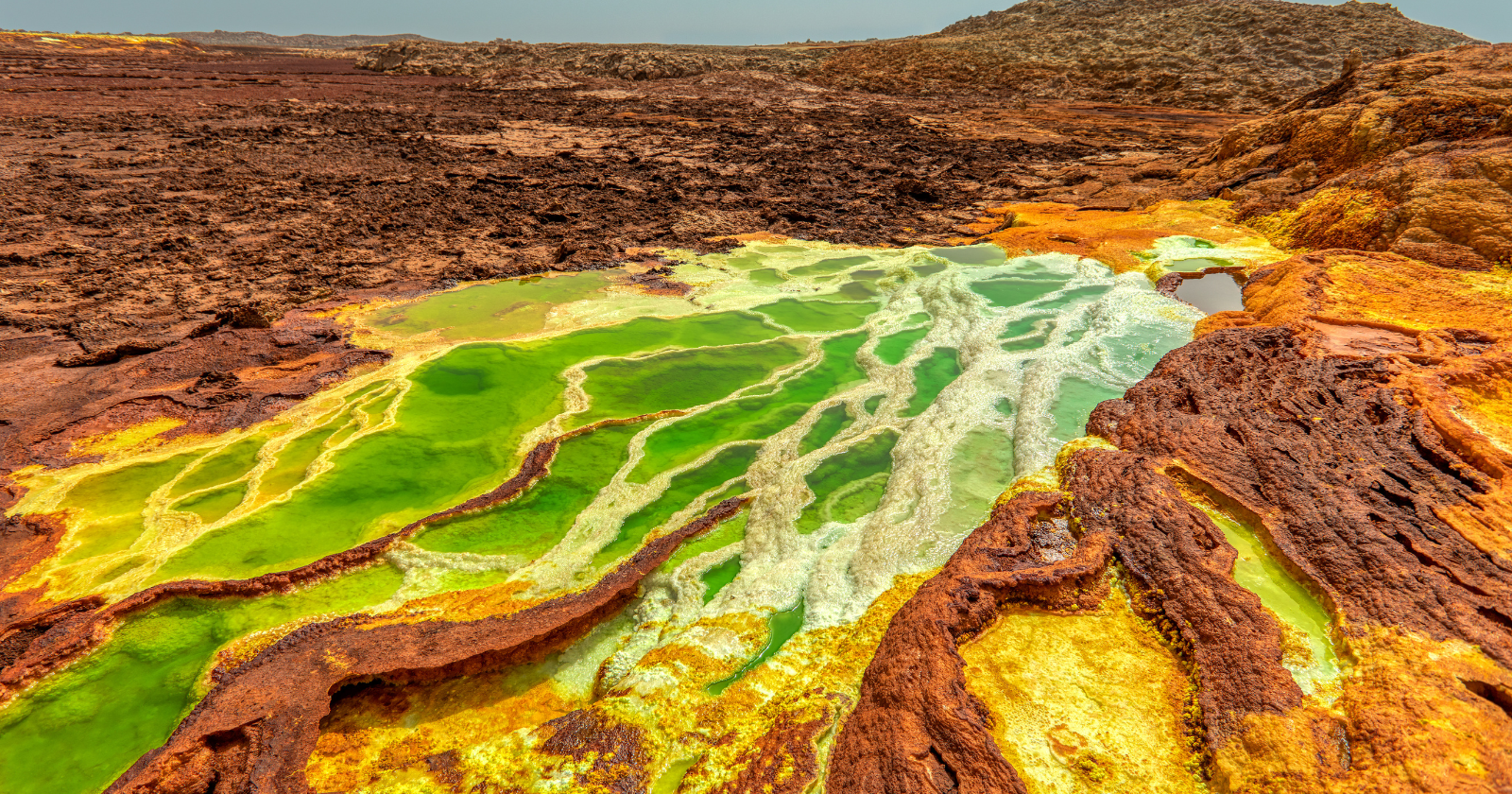
A pond in Ethiopia’s Danakil Depression has a measured salinity of 433 grams per kilogram — roughly twelve times saltier than the open ocean and saltier than the Dead Sea — sitting inside one of the hottest, most hostile landscapes on the planet

Bright green and yellow mineral pools in the Danakil Depression

Near the base of the Dallol hydrothermal field in Ethiopia’s Afar region sits a pond barely 60 meters long, its water tinted pale yellow by dissolved iron. Chemists who sampled it found a total dissolved solids concentration of 433 grams per kilogram — 43.3 percent by weight — making it, by current measurement, the record for saltiest lake documented anywhere on Earth. The pond is known locally as Gaet’ale, and the figure comes from a 2017 study by Pérez and Chebude of Addis Ababa University’s Department of Chemistry, published in the journal Aquatic Geochemistry.

For context, the world’s oceans average about 35 grams of dissolved salt per liter, according to NOAA ocean salinity data and the USGS salinity reference — putting Gaet’ale at roughly twelve times ocean salinity. That figure is also higher than the Dead Sea, whose salinity is commonly cited around 340 grams per liter in recent measurements, though older or differently calculated figures put it lower — Guinness’s own comparison table, for instance, lists it at 23.1 percent by weight.

Ordinary seawater’s salt is mostly sodium chloride, or ordinary table salt. Gaet’ale’s brine is instead built around calcium chloride and magnesium chloride, at concentrations of roughly 2.72 moles per kilogram and 1.43 moles per kilogram respectively, according to Pérez and Chebude’s analysis, with trace sodium, potassium, nitrate and iron(III) complexes responsible for the water’s yellow cast. The researchers noted the pond’s chemistry closely resembles that of Don Juan Pond in Antarctica’s Dry Valleys, another calcium-chloride-dominated hypersaline pool long studied as one of Earth’s most extreme aquatic environments, though Gaet’ale’s higher temperature allows it to hold even more dissolved salt before reaching saturation.

The pond itself is shallow and crescent-shaped, sitting at around 50 to 55 degrees Celsius, with no inflowing or outflowing stream. According to the Gaet’ale Pond entry, local accounts attribute the pond’s formation to a January 2005 earthquake that reactivated a dormant thermal spring. The broader depression sits more than 100 meters below sea level in places, part of a tectonically stretched landscape laced with active volcanoes, sulfur vents and salt flats left behind by an ancient sea that repeatedly flooded and evaporated over geological time. The nearby Dallol hydrothermal field, roughly four kilometers northwest of the pond, is famous for acid ponds in shades of green, orange and yellow, produced when magma-heated groundwater dissolves the buried salt and mineral layers and pushes the resulting brine back to the surface.

A natural laboratory for other worlds

The combination of heat, acidity and salinity has made the region a working laboratory for scientists who study the outer edges of habitability. A multinational research effort coordinated through the Europlanet research infrastructure has sent microbiologists, geologists and planetary scientists to the depression in recent years. Karen Olsson-Francis and Vincent Rennie of the Open University sampled acidic, saline channels there for signs of microbial survival; Hugo Moors and Mieke De Craen of Belgium’s SCK CEN nuclear research center used the site to test methods relevant to how microbes might behave around deep nuclear waste repositories; and planetary geologists Daniel Mège of the Polish Academy of Sciences and Ernst Hauber of the German Aerospace Center studied Danakil’s salt-and-magma hydrothermal structures as an analog for Martian rift systems, work feeding into ongoing observations from the ExoMars Trace Gas Orbiter.

Jani Radebaugh of Brigham Young University and Ralph Lorenz of Johns Hopkins University’s Applied Physics Laboratory have separately used terrain models from the depression to interpret surface roughness data relevant to Saturn’s moon Titan.

Where even extremophiles give up

The scientific interest in the region’s brine pools goes beyond geology. A 2019 study led by Purificación López-García of the French National Centre for Scientific Research (CNRS), working with researchers from Spain’s Geological and Mining Institute and the Autonomous University of Madrid, searched the most extreme pools in the Dallol field — hyperacidic, near-boiling and saturated with salt simultaneously — for any trace of microbial life. Using genetic sequencing, culturing attempts, flow cytometry and electron microscopy, the team reported finding none, a result summarized by Phys.org as evidence that liquid water alone does not guarantee habitability. The researchers concluded that the pools’ combination of high magnesium and calcium concentrations, extreme acidity and heat produces a “chaotropic” chemical environment that actively breaks down biological molecules instead of simply placing them under stress.

That finding matters for astrobiology because it complicates a common assumption: that any environment with liquid water, however extreme, should host at least some microbial life. A separate 2021 study of nearby, slightly less extreme hypersaline lakes in the Danakil Depression, published in Environmental Microbiology by researchers including members of the same French-Spanish collaboration, found the opposite — diverse communities of salt-loving archaea thriving right up to the edge of what those less punishing pools could support. Gaet’ale itself is hot and dominated by chaotropic calcium and magnesium salts, not the sodium chloride of ordinary seawater. Pérez and Chebude’s 2017 paper focused on the pond’s chemistry rather than a dedicated search for microbial life, but a separate 2021 metagenomic study of Gaet’ale specifically found it dominated by bacteria — unlike the sterile conditions found in Dallol’s most extreme pools.

Together, the pond’s chemistry and its surrounding hydrothermal field illustrate why the Danakil Depression continues to draw researchers from chemistry, microbiology and planetary science alike. A 60-meter pool of scalding, mineral-saturated brine is, on its own, a curiosity of extreme terrestrial chemistry. Set inside a landscape already used to model early Earth, present-day Mars and the hydrocarbon lakes of Titan, it becomes a reference point for a broader question: how much stress a chemical system can absorb before it stops being able to host life at all.

The post A pond in Ethiopia’s Danakil Depression has a measured salinity of 433 grams per kilogram — roughly twelve times saltier than the open ocean and saltier than the Dead Sea — sitting inside one of the hottest, most hostile landscapes on the planet appeared first on Space Daily.
  •  

Five species of wrasse fish in the western Atlantic have been filmed selecting a specific rock or coral slab as an anvil, smashing shellfish against it, and switching anvils depending on the prey — the first video evidence of the behavior in the western Atlantic, extending a foraging technique already known among Indo-Pacific fish to a new ocean basin

Marine biologists have documented five species of wrasse in the western Atlantic using rocks, coral rubble and shells as makeshift anvils to crack open crabs, mollusks and other armored prey — a foraging technique already documented in fish from the Indo-Pacific but never before filmed in the Atlantic. A study published in Coral Reefs in March 2025 provides the first evidence of anvil use in three of the five species and the first video documentation of the behavior in the other two.

The wrasses behind the discovery

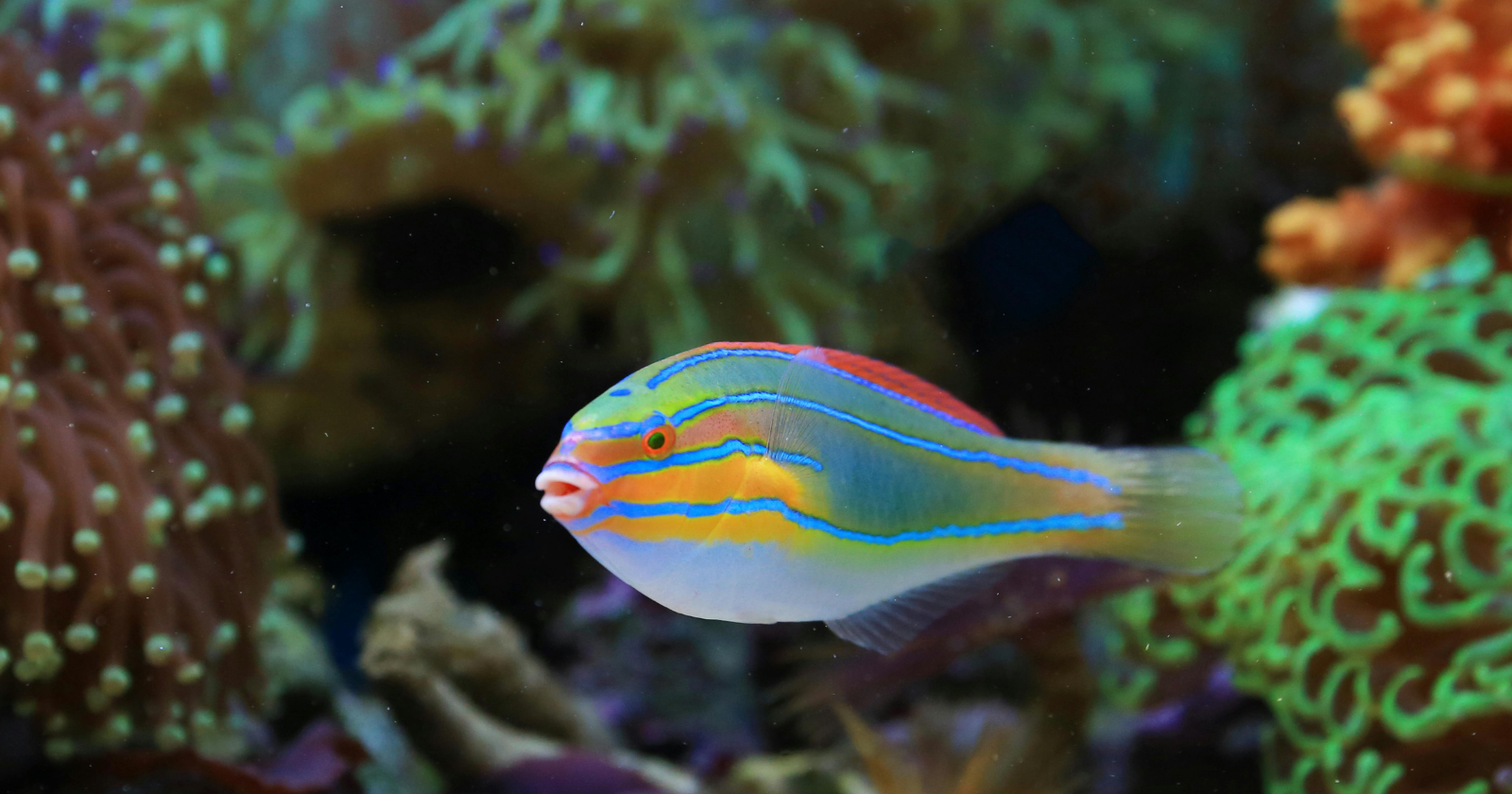
The research, led by Dr. Juliette Tariel-Adam of the Fish Lab at Macquarie University’s School of Natural Sciences in Sydney, focused on New World wrasses in the genus Halichoeres: the slippery dick (H. bivittatus), the Brazilian wrasse (H. brasiliensis), the yellowhead wrasse (H. garnoti), the black-ear wrasse (H. poeyi), and the puddingwife wrasse (H. radiatus), documented at Fernando de Noronha Island off Brazil’s northeast coast.

The paper lists co-authors Jaqueline G. Toledo, C. E. O’Brien, Sergio R. Floeter and Professor Culum Brown alongside Tariel-Adam. Anvil use in fish is not new to science. Since it was first documented in an orange-dotted tuskfish roughly fifteen years ago, researchers have logged the behavior in roughly two dozen of the more than 550 known wrasse species, almost all of them in the Indo-Pacific and Indian Ocean. What sets this study apart is geography and scale: it is the first systematic documentation of anvil use among wrasses native to the western Atlantic, and it draws on the largest video dataset yet assembled for the behavior in this ocean basin.

The team built that dataset by turning to citizen scientists. Divers, snorkelers and underwater photographers working across the Caribbean, the Caicos Islands and Brazil submitted footage and written accounts through a public call for observations, contributing 16 new records to the study. Combined with existing records, the dataset gave researchers close, repeated looks at details of the behavior that had previously been described only impressionistically.

How the fish crack their prey

Fish in the study grabbed a hard-shelled item — in most cases a crab, mollusk, sea urchin or hermit crab — and swam it to a chosen surface before repeatedly slamming it against that surface to crack it open. Successful cracking attempts required an average of six or more strikes and took at least a minute to complete, and prey was successfully accessed and consumed in 12 of the 19 documented events, according to the published paper. One of the study’s more striking findings involves anvil choice. 

The wrasses used a range of materials as anvils — rock outcrops, coral rubble, reef platforms and shells — without sticking to a single preferred striking surface, switching anvils mid-attempt in 53 percent of observed strikes.

Researchers interpreted this flexibility as a sign the fish are actively assessing which surface will most efficiently break a given prey item rather than relying on a classic bite-and-swim mechanism regardless of the target.

Researchers make the case for fish cognition

Tariel-Adam framed the findings as part of a broader case for taking fish cognition seriously. “Tool use is typically associated with humans, but this behaviour is proof that fish are far cleverer than they get credit for,” she said, in comments reported by Phys.org. Senior author Culum Brown, who has spent much of his career studying fish behavior and welfare, added that the wrasses “demonstrate flexible and dexterous tool use, expanding our understanding of tool use evolution in the animal kingdom.”

The paper situates the discovery within debates over how and why tool use evolves. Because anvil use has now turned up independently in wrasse lineages on opposite sides of the globe, the behavior increasingly looks like a foraging strategy that several unrelated reef fish lineages have independently evolved — one that is easily missed by divers not specifically watching for it, which is part of why the researchers built their dataset largely around community-contributed footage, supplemented by only a handful of controlled observations.

Coverage of the paper by Scimex and Oceanographic magazine both note that the research team is continuing to solicit new footage from divers and underwater photographers, on the expectation that further observations will clarify how widespread the behavior is among western Atlantic reef fish and whether other genera beyond Halichoeres practice it as well.

Further detail on the study is available via the Macquarie University research profile and additional reporting from ZME Science.

The post Five species of wrasse fish in the western Atlantic have been filmed selecting a specific rock or coral slab as an anvil, smashing shellfish against it, and switching anvils depending on the prey — the first video evidence of the behavior in the western Atlantic, extending a foraging technique already known among Indo-Pacific fish to a new ocean basin appeared first on Space Daily.
  •  

Researchers picked oyster, mussel and cockle shells off Irish beaches, crushed the 3 kinds of shell into grains, and dropped them into water carrying rare earth metals at concentrations similar to badly polluted industrial runoff. The oyster grains took up as much as roughly 1.5 grams of metal for every gram of shell.

Collection of empty oyster shells in natural setting, showcasing coastal beauty.

A single gram of crushed oyster shell pulled in up to around 1.5 grams of rare earth metal, more than the shell’s own weight, out of water spiked with the kind of contamination you would expect from severe industrial pollution. A throwaway material, the sort of thing you might crunch underfoot on a beach, holding more than its mass in metals that the electronics and clean-energy industries fight over.

That’s the finding a Trinity College Dublin team reported in early 2026. Below, we walk through what they actually did, why oysters won and mussels and cockles fell short, and how much of this holds up once you leave the lab bench.

What the researchers actually did

The setup was low-tech at the front end. As reported in The University Times, the team collected oyster, mussel and cockle shells from beaches around Dublin, cleaned them, dried them, and crushed them into small grains. Then they dropped those grains into solutions carrying three rare earth elements and watched what happened over time. The three metals were lanthanum, neodymium and dysprosium, at concentrations chosen to mimic badly polluted water.

The chemistry underneath is where it gets interesting. Shells are mostly calcium carbonate, and in the rare-earth-rich water that calcium carbonate dissolves and is replaced, more or less on the spot, by new solid minerals built around the rare earth metals. In the peer-reviewed paper, published in Science of the Total Environment, the crushed shells were reacted with the metal-rich solutions across a wide range of temperatures, 25 to 205 degrees Celsius for up to three months. What you end up with is not the original shell soaking up metal like a sponge, but the shell being rebuilt, mineral by mineral, into something new.

As principal investigator Juan Diego Rodriguez-Blanco put it, “the process is entirely mineral-driven – the shells naturally transform dissolved rare earth elements into new solid minerals, so this isn’t a process that is difficult to drive, or one that requires much financial outlay or technical equipment.” That last part is a lab-based expectation rather than a proven cost sheet, but the appeal is easy to see: no exotic reagents, no elaborate rig, just waste shell and time.

Why oysters won and the others didn’t

All three shells are made of the same basic stuff, so why did oysters run away with it? The answer is structure. Oyster shell has a porous, layered microstructure, and that lets the dissolve-and-replace reaction work its way right through the grain rather than stalling at the surface. That’s how oyster grains reached uptake of up to roughly 1.5 grams per gram.

Mussels and cockles behaved differently, and the reason is more physical than chemical. A crust of new mineral formed quickly on the outside and then sealed the grain off, so the reaction couldn’t reach the inside. In those shells, the study reports that more than half of the original shell was left unchanged once that crust became impermeable. Same starting material, very different outcome, decided by how the shell is put together.

Why pull rare earths out of water at all

Rare earth elements are the unglamorous ingredients in a lot of modern hardware, from the magnets in wind turbines and electric motors to phone components. Mining them is expensive and messy, and industrial processing can leave behind runoff carrying dissolved metals. Two problems are tangled together here: recovering a valuable resource, and cleaning up water that carries it.

The shell angle is attractive partly because the raw material is a nuisance to begin with. As first author Rémi Rateau described it, “every year, the global aquaculture industry generates millions of tonnes of shell waste, much of which is discarded or sent to landfill.”  Rateau also noted that “relatively small amounts of shell waste could remove substantial quantities of rare earth metals from contaminated water.” 

What this is, and what it isn’t

This is one study, and it is a lab result. The concentrations were high by design, the conditions were controlled, and real industrial wastewater is a far messier soup of competing ions, organics and pH swings than a prepared solution in a flask. The team is upfront that the work still needs pilot-scale testing under genuine conditions before anyone talks about a deployable cleanup system. A promising lead is not a finished product, and this sits firmly in the former category.

Our read lands roughly where the team’s does. The measured uptake is striking, the input material is cheap and otherwise wasted, and the driving chemistry looks simple. Rodriguez-Blanco frames the ambition plainly: “we can start designing” low-cost strategies to remove critical metals from contaminated waters while giving new value to a major waste product. Start designing is the honest verb. On the strength of these numbers, it’s a lead worth taking out of the beaker and testing against the real, dirty water it was built to handle.

The post Researchers picked oyster, mussel and cockle shells off Irish beaches, crushed the 3 kinds of shell into grains, and dropped them into water carrying rare earth metals at concentrations similar to badly polluted industrial runoff. The oyster grains took up as much as roughly 1.5 grams of metal for every gram of shell. appeared first on Space Daily.
  •  

Physicist Bhupal Dev at Washington University used the debris from GW170817 — the 2017 neutron star merger — to squeeze new limits on axion-like particles, treating the hot post-collision remnant as a natural forge for dark-matter candidates

Physicist Bhupal Dev at Washington University used the debris from GW170817 — the 2017 neutron star merger — to squeeze new limits on axion-like particles, treating the hot post-collision remnant as a natural forge for dark-matter candidates

For about one second after two neutron stars collided 130 million light-years away, the wreckage they left behind was hotter than anything else in the observable universe. Bhupal Dev, a physicist at Washington University in St. Louis, and four collaborators asked what that one second would have manufactured if a hypothetical particle called an axion-like particle exists — and then went looking for the light it should have left behind.

Nothing arrived. The shape of that absence is the result.

What GW170817 actually was

On 17 August 2017, the LIGO and Virgo detectors recorded a gravitational-wave chirp lasting roughly 100 seconds, the longest signal captured to that point. About 1.7 seconds later, NASA’s Fermi Gamma-ray Burst Monitor caught a short gamma-ray burst from the same patch of sky. The coincidence is documented in the collaboration’s multi-messenger paper in The Astrophysical Journal Letters.

Less than eleven hours after the merger, the one-metre Swope Telescope in Chile pinned the source to NGC 4993, a lenticular galaxy about 40 megaparsecs — roughly 130 million light-years — away. Within a day, dozens of observatories were watching a fading point of light that astronomers had spent decades predicting and never seen: a kilonova.

Two neutron stars had spiralled into each other, each somewhere between about one and two times the mass of the Sun, each compressed into an object about the size of a mid-sized city. When they touched, the collision briefly produced conditions denser and hotter than anywhere else in the observable universe.

neutron star merger illustration

ESO’s telescopes in Chile tracked the afterglow across a wide range of wavelengths, and the observatory’s October 2017 announcement of the first visible counterpart to a gravitational-wave source reported spectra suggesting caesium and tellurium in the ejecta. Two years later, a separate analysis of VLT X-shooter data pinned down strontium, the first individual heavy element identified in a neutron star collision. Some of the gold in a wedding ring was made in events like this one.

Why the remnant is a particle factory

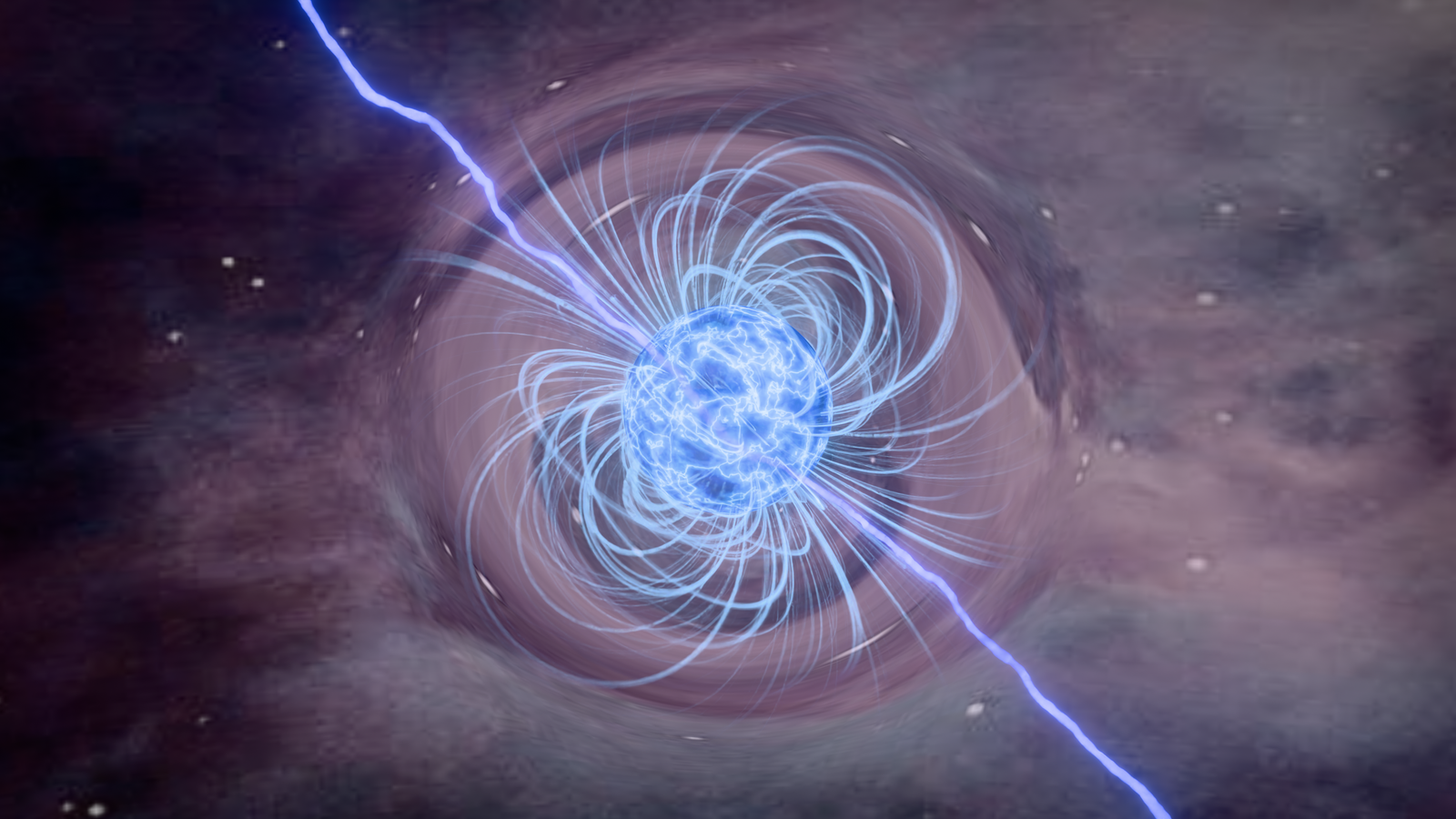
Before they merge, neutron stars are cold by particle-physics standards — thermal energies around a kilo-electron-volt. The collision changes that within milliseconds. Temperatures in the remnant climb into the tens of MeV, and the benchmark merger profile Dev’s group used exceeds 50 MeV in places, roughly 600 billion degrees. Production rates for weakly coupled particles rise steeply with temperature. Whatever exists in the right mass window gets made.

Axion-like particles, or ALPs, are among the most-hunted candidates. They are cousins of the axion — the particle implied by the Peccei-Quinn mechanism proposed in 1977 to resolve a puzzle in the strong nuclear force, and named the following year by Weinberg and Wilczek. ALPs relax the axion’s strict relationship between mass and coupling, and they appear generically in string theory and in many extensions of the standard model.

The catch is that they interact with ordinary matter so feebly that laboratory experiments struggle to reach the parameter space that matters. Which is where dead stars come in.

How the bound actually works

The property Dev’s group targeted is the ALP’s coupling to photons. In the hot, dense matter of the remnant, two processes make ALPs: the Primakoff process, in which a photon scattering off a proton converts into an ALP, and photon coalescence, in which two photons merge into one. Primakoff dominates at low masses, coalescence at high ones, with the switchover around 100 MeV.

What happens next is the whole argument. ALPs stream out of the remnant — those with enough kinetic energy to climb out of its gravitational well, at least — and then decay back into pairs of photons well outside the debris. The team required decays beyond about 1,000 kilometres, far enough that the emitted photons would not simply be reabsorbed by the ejecta. The result would be a gamma-ray signal arriving roughly along the line of sight to the merger, offset in time from the gravitational waves by the geometry of where each ALP happened to decay.

Fermi-LAT was watching. It missed the prompt burst, but it collected data in the window from 1,153 to 2,027 seconds after the gravitational-wave signal, across 0.1 to 1 GeV, and saw nothing above a flux upper limit of 4.5 × 10⁻¹⁰ erg per square centimetre per second at 95% confidence. Every combination of ALP mass and photon coupling that would have produced a brighter signal than that is excluded. The preprint sets out the full calculation, including the decay geometry and the in-medium photon physics.

That is the first constraint of its kind derived from a merger, as the university’s announcement of the work noted. Two representative points in the newly excluded region sit at masses of 200 and 398 MeV. Worth being precise about what this is not: it is not a cooling argument. The team explicitly checked that across the parameter space they constrain, ALP emission does not drain enough energy to alter how the remnant cooled.

What the bound covers, and what it does not

The GW170817 exclusion is weaker than the long-standing limit from Supernova 1987A, and the reason is geometry rather than physics. Photon flux at Earth falls off with the square of the distance to the source. A supernova in the Large Magellanic Cloud is far closer than a merger at 40 megaparsecs, so it delivers more photons even from an identical ALP population.

What the merger offers instead is timing. The arrival of the gravitational-wave signal defines a clean zero point, which supernovae generally lack — for SN 2023ixf, no neutrino signal was detected at all. Combining spectral and temporal information from a merger, the authors argue, is where this method becomes competitive, particularly for observations inside the first second.

The constraint is also more robust than the article’s underlying uncertainties might suggest. GW170817’s remnant is thought to have survived about a second before collapsing to a black hole; varying that assumed lifetime between 0.72 and 1.29 seconds barely moves the exclusion region, and the result depends only weakly on which of nine merger profiles is used.

None of this detects anything. It tells you what an ALP cannot be, given that GW170817 behaved the way it did. And the dark matter question is separate again: an ALP in this mass range could in principle be a dark matter component, but a production bound from one merger says nothing about cosmological abundance. It shrinks the box. It does not confirm anything is in it.

The source that keeps giving

The merger’s own story has kept moving independently of the particle physics. Chandra saw nothing when it first slewed to the target, then found a point source on 26 August 2017. That sequence — non-detection, then detection — was itself the clue. It indicated a narrow relativistic jet pointed away from Earth, whose emission only reached the detector once the jet slowed and widened into the line of sight.

Chandra X-ray observatory

Then the fading stopped. As the Center for Astrophysics reported in March 2022, Aprajita Hajela of Northwestern University and colleagues found that from March 2020 through the end of that year the X-ray brightness held roughly constant. Something besides the jet had taken over. The two candidates are a kilonova afterglow — a shock from the expanding debris — or matter falling onto a newly formed black hole. Either would be a first, and radio observations are the test: a kilonova afterglow should brighten in radio, accretion onto a black hole should not.

At the time of that release, Chandra was the only observatory still able to detect the source, more than four years after the collision.

Space Daily has covered other corners of the same search. A Rice University team has used a grain-of-sand-sized magnet levitated above a superconductor to hunt for ultraheavy dark matter, extending the search toward candidates approaching the mass of a living cell, according to the group’s own account of the experiment. That is the far end of the mass axis from the MeV-scale ALPs Dev’s group is bounding — a table-top instrument at millikelvin temperatures on one side, a collision 130 million light-years away on the other.

Using distant catastrophes as instruments

GW170817 remains the only confirmed binary neutron star merger with a full electromagnetic counterpart. LIGO and Virgo have caught other candidate neutron star events, but none produced the same multi-wavelength bounty, which is why the same dataset keeps being reprocessed for new physics. A 2021 review by Milton Ruiz, Stuart Shapiro and Antonios Tsokaros in Frontiers in Astronomy and Space Sciences surveys what relativistic simulations can now say about these events, including the consensus that GW170817’s remnant lasted under a second before collapsing.

A cleaner ALP constraint needs more mergers, or closer ones. The authors sketch both: a stacked analysis of several events, a hypothetical merger ten times nearer, and early observation windows starting a tenth of a second after the gravitational-wave trigger. Proposed MeV gamma-ray missions such as AMEGO-X and e-ASTROGAM would help considerably.

When that data arrives is unsettled. O4 ended on 18 November 2025, and the detectors have since been in upgrades and commissioning. According to the LIGO-Virgo-KAGRA observing plan, an interim six-month run is expected around late 2026, while the timeline for the fifth observing run remains under discussion.

The hot phase of the merger lasted about one second. The gravitational-wave chirp lasted about a hundred. Somewhere between those two numbers is a photon signal that never reached Fermi’s detectors — and the precise shape of that absence, how bright it wasn’t and how early it wasn’t, is what now fences off a corner of parameter space where a particle nobody has ever seen can no longer hide.

The post Physicist Bhupal Dev at Washington University used the debris from GW170817 — the 2017 neutron star merger — to squeeze new limits on axion-like particles, treating the hot post-collision remnant as a natural forge for dark-matter candidates appeared first on Space Daily.
  •  

French, Russian, and German researchers thawed sediment from nine sites of Siberian and Kamchatkan permafrost and revived thirteen previously undescribed viruses, the oldest of them from ground beneath a Yakutian lake bed dated to more than 48,500 years, and the reason every one of the thirteen can infect nothing but amoebae is a decision the team made before the first sample went into the dish

Thirteen viruses that have not circulated on Earth since before the last Ice Age’s coldest stretch are now, technically, alive again. A team led by Jean-Michel Claverie and Chantal Abergel at Aix-Marseille University, working with Russian colleagues from the Melnikov Permafrost Institute and other institutions, and German permafrost scientists from the Alfred Wegener Institute, pulled the samples from nine locations across Siberian and Kamchatkan permafrost and coaxed the ancient particles back into active replication in a lab dish. The oldest, a giant virus the team named Pandoravirus yedoma, came from sediment more than 16 meters beneath a thermokarst lake at Yukechi Alas in central Yakutia, radiocarbon-dated to over 48,500 years old. The strange part is not any of that. It’s that every single one of the thirteen, across five separate viral families, turned out capable of infecting exactly one thing: amoebae.

That is not a coincidence or a discovery about what these viruses are inherently limited to — it’s the result of a rule the researchers built into their methods before they ever opened a sample.

Nine sites, one very old lake bed, and a five-family haul

The study, published in the journal Viruses in February 2023, describes sampling seven ancient Siberian permafrost cores, a Lena River sediment sample, and one modern surface soil sample from Kamchatka as a comparison point. Out of that set, the team isolated 13 new viral strains spanning five clades: pandoraviruses, cedratviruses, megaviruses, pacmanviruses, and a new strain of pithovirus, the family first revived by the same lab back in 2014. Beyond the 48,500-year Pandoravirus yedoma strain, other samples dated to more than 27,000 and 28,600 years old, meaning the youngest viruses in the batch had still been dormant since well before agriculture existed anywhere on the planet.

Getting a virus that old to replicate again sounds harder than it is, mechanically. Permafrost is an unusually good preservative: constant sub-zero temperatures, no light, and low oxygen slow decay to something close to a standstill. The genuine difficulty was deciding what, exactly, the revived particles should be allowed to infect — not reviving them in the first place.

Why the answer was decided in advance

Every one of the 13 viruses was isolated using a single host organism: Acanthamoeba castellanii, a free-living amoeba common in soil and freshwater that happens to be an excellent, and epidemiologically inert, lab culture system for giant viruses. The paper’s own framing makes clear this was the point, not an accident: as the authors put it, the viruses recovered “belong to five different clades infecting Acanthamoeba spp.” precisely because of “the host specificity imposed by our protocol.” In plain terms, the team only exposed each sample to amoeba cultures, so the only viruses that could be detected at all were ones already capable of infecting amoebae. Anything in the sediment that might have targeted a mammal, a bird, or a human cell simply had no host present to reveal itself.

Claverie has been explicit about why that constraint exists. “Our protocol is to put amoeba cultures in the lab in contact with various samples, in the hope that they will contain viruses capable of infecting amoebas,” he told Live Science, adding a flatter, more direct version of the same point: “We will never risk isolating a virus eventually capable of infecting modern mammals.” The paper itself makes the comparison explicit, noting that the biohazard from reviving amoeba-only viruses is “totally negligible” next to the far riskier work of hunting for pathogens directly inside the frozen remains of mammoths and other ancient mammals, which is why that specific line of research is confined to a biosafety level 4 facility in Novosibirsk rather than an ordinary university lab.

Every choice the team made before opening a single sample was a choice about what they were willing to risk being wrong about.

The part that actually worries the researchers

That caution isn’t really about this batch of 13 viruses. It’s about what else permafrost is holding, and how much more of it is on its way to thawing. Claverie has made this argument before: back in late 2022, months before Pandoravirus yedoma’s record-setting age was even published, he told Newsweek, “If amoeba viruses can survive in these conditions, there is no reason for other viruses not to survive as well” — the same underlying logic the yedoma finding would go on to reinforce.

The paper’s own conclusion frames the risk in terms of exposure rather than certainty: nobody can currently estimate how long a thawed ancient virus would stay infectious once it hit open air, or how likely it would be to encounter a suitable host in that window. What has changed, and what makes the question worth asking at all, is the denominator. Arctic permafrost is thawing faster as the region warms, and industrial development, mining, and new settlements are sending more people into exactly the areas where 48,500-year-old ground is being exposed for the first time since before modern humans reached most of the planet. The amoebae were never really the point. They were the deliberately narrow lens the researchers chose so that the first question, can something this old still replicate at all, could be answered without opening a second, much harder question before anyone was ready to.

The post French, Russian, and German researchers thawed sediment from nine sites of Siberian and Kamchatkan permafrost and revived thirteen previously undescribed viruses, the oldest of them from ground beneath a Yakutian lake bed dated to more than 48,500 years, and the reason every one of the thirteen can infect nothing but amoebae is a decision the team made before the first sample went into the dish appeared first on Space Daily.
  •  

Saudi Arabia sits on the world’s largest sand desert and yet imports sand by the shipload from Australia and Scotland, because the wind-rounded grains of the Empty Quarter are too smooth to bind in concrete and modern construction can only use the jagged sand pulled from riverbeds and quarries

Saudi Arabia sits on the world's largest sand desert and yet imports sand by the shipload from Australia and Scotland, because the wind-rounded grains of the Empty Quarter are too smooth to bind in concrete and modern construction can only use the jagged sand pulled from riverbeds and quarries

Saudi Arabia sits on the Rub’ al Khali, an unbroken sea of dunes roughly the size of France, and still puts sand on ships from Perth and the Firth of Forth to pour into its concrete. In 2023, according to World Bank trade data reviewed by Autonocion and OkDiario, the kingdom bought around $138,600 worth of Australian construction sand — about the price of a mid-range pickup truck, hauled across the Indian Ocean because the grains under Saudi feet are the wrong shape to hold a building up.

The problem is not the quantity. It is the geometry of each grain.

Why desert sand fails the concrete test

Concrete is mostly aggregate — sand and gravel — held together by a thin film of cement paste. For the paste to lock, the grains have to bite against one another edge to edge, wedging into the cement and into each other like pieces of a rough jigsaw. River sand and crushed quarry sand do this well because they are geologically young: recently broken from larger rock, jagged, angular, sharp-faced.

Desert sand behaves in the opposite way. Wind does not fracture grains; it polishes them. Over thousands of years of rolling and bouncing across dunes, each grain wears down into a smooth, near-spherical pellet. Dropped into a wet concrete mix, the grains act like ball bearings, sliding past one another instead of interlocking. The cured block ends up riddled with microscopic voids and weak seams.

You can build a garden wall with it. You cannot build a supertall tower.

Rub al Khali dunes

Ren Wei, a postdoctoral fellow at the Norwegian University of Science and Technology, put the same problem plainly in a EurekAlert release on his team’s work: “The challenge is that desert sand is so fine-grained that it is not suitable as a fastener in concrete. In other words, the concrete will not be hard enough to be used in various construction projects.” His team has spent years trying to give the useless stuff a second life by binding it with wood lignin under heat and pressure — a workaround that only exists because ordinary Portland cement will not.

The scale of what sits under Saudi feet

The Empty Quarter covers roughly 650,000 square kilometres of the southern Arabian Peninsula. Some of its dunes climb more than 250 metres, taller than most skyscrapers the kingdom is trying to build. Every major construction site in Saudi Arabia sits within trucking distance of a dune field that could, in raw volume, bury the project many times over.

And yet the trade ledgers keep filling. The same World Bank data show Saudi Arabia imported roughly $1.22 million in non-metal-bearing natural sands in 2023, with the Australian line item nested inside. A separate category — silica and quartz sands used mainly in glass and specialist applications — brought in about $5.23 million, sourced from China, Belgium, the United States, India and the UAE.

The dollar figures are almost comically small. That $138,600 from Australia is not a fortune. The point is that a budget code exists at all. A country sitting on one of the largest sand deposits on Earth has a purchase order for sand shipped from Fremantle.

Salt, corrosion, and the second reason engineers refuse dune sand

Shape is only half the objection. Desert and beach grains often carry enough chloride to slowly corrode the steel reinforcement inside concrete — a slow-motion disaster for anything load-bearing. Reporting on the paradox by Ecoticias notes that salt content is one of the reasons even coastal sand cannot simply be substituted in.

Engineers have spent years trying to make dune sand behave. A team at Imperial College London developed Finite, a concrete alternative made from desert sand. There are patents for crushing and re-fracturing dune grains under enormous pressure just to give them edges again. None of it has displaced the cheapest fix on the table: put good sand on a boat.

What Dubai’s palm actually stands on

The clearest illustration is next door in the Emirates. The Palm Jumeirah, finished off the Dubai coast in 2006, was built out of roughly 94 million cubic metres of sand and rock. That sand did not come from the desert a few miles inland. It was dredged from specific patches of Persian Gulf seabed where the grain size was right, placed by GPS-guided vessels using a technique called rainbowing — spraying sand in an arc through the air onto the growing island. Dutch and Belgian dredging firms ran the operation around the clock for years.

The Burj Khalifa tells the same story going up. Its roughly 330,000 cubic metres of concrete were mixed with sand sourced from outside the UAE, because the local dunes could not deliver the required strength. The paradox of desert cities importing the material they appear to be standing on is baked into every Gulf skyline.

Burj Khalifa concrete construction

A global shortage of the ordinary

Saudi Arabia’s predicament is a sharper version of a shortage the whole planet now shares. Humans pull about 50 billion tonnes of sand and gravel out of the Earth every year, making them the most-extracted solid materials on the planet and, by UN accounting, the second-most-exploited natural resource after water. Demand for construction sand alone is projected to climb by up to 45 percent by 2060.

Nature replaces sand through erosion on geological timescales, far slower than construction crews dig it out. The UN Environment Programme calls the difference the sand gap, and it now stretches from Cambodian riverbeds to Sicilian beaches, with organised sand-mining operations documented across India and West Africa.

The mining is not a small business. A recent Eos editors’ vox on river-sand mining lays out the downstream damage: channel incision, collapsed banks, saltwater intrusion into aquifers, and delta shorelines that stop being replenished from upstream. The concrete in a Gulf tower is often paid for, ecologically, by a river mouth several thousand kilometres away.

Space Daily has covered the same paradox from the angle of Arabian geology, tracing how thousands of years of aeolian polishing wore the grains beyond usefulness. What changes when the story is told through trade data is the scale of the workaround: every megaproject is, somewhere in its bill of materials, a sand story with a very long supply line.

Why the Empty Quarter’s sand ended up so smooth

The Arabian Peninsula was not always this dry. Research published in the Nature family of journals has documented recurrent humid phases across Arabia over the past 8 million years, with rivers, lakes and grasslands appearing and disappearing on cycles tied to orbital changes. During dry stretches — including the last several thousand years — wind takes over as the dominant sculptor of the surface, and the grains it moves get progressively rounder.

The Empty Quarter’s sand is the end product. Sediment that has been reworked so many times by wind that its edges have been worn down almost to the atomic. The same grains that make the dunes photograph beautifully at sunset are the grains that will not bond to cement. Comparative morphology studies of construction sands — the sort catalogued in the Nature journal literature on sand sources — consistently rank aeolian dune grains at the bottom of the pile for angularity and surface texture.

The workarounds nobody has scaled yet

Ren Wei’s team at NTNU and the University of Tokyo have made a prototype they call Botanical Sand Concrete, or Sandcrete. Equal parts desert sand and powdered wood are combined at 180 °C in a double-plate hot-pressing machine, and the lignin in the wood — the same natural polymer that stiffens tree trunks — melts and glues the smooth grains together. New Atlas reported on the material last year, noting the blocks meet Japanese Industrial Standards for pavement bricks.

It is not a structural concrete. Wei has been careful about that. The team envisions indoor use and pavement stones, and points out that any environmental gain evaporates if Sandcrete itself has to be shipped across continents. “The production process is relatively simple, so in principle the material can be made in many places,” he told reporters covering the study’s release. “But we need to test more, including how it can withstand cold, before it can be used in Norway.”

Manufactured sand — crushed rock milled into angular fragments — behaves more like river material and is expanding inside Saudi Arabia’s domestic supply chain. Recycled concrete from demolished buildings can be crushed and reused. Neither has yet displaced the bulk carrier.

Where the sand actually comes from now

Australia ranks as the world’s second-largest sand exporter behind only the United States, shipping roughly $273 million worth in 2023 by the Observatory of Economic Complexity’s accounting. Ports like Jebel Ali in Dubai and Dammam in Saudi Arabia handle graded construction and silica sand quietly, in bulk carriers that look no different from the ones bringing in cars and electronics.

Scotland’s contribution is smaller in tonnage but old in reputation. Silica sand from quarries in the Scottish lowlands has moved into Middle Eastern markets for decades, prized for its consistency and low impurity content, and it turns up in specialist concrete mixes and glass production across the Gulf.

The pressure on riverine sources has begun to reach places that once looked untouched. A 2026 explainer in the Milwaukee Independent describes Great Lakes deposits being eyed as global sand shortages ripple into North America, with infrastructure projects from Southeast Asia to the Middle East pulling on inland reserves that were previously considered safe.

NEOM and the sand appetite still to come

Saudi Arabia’s ambitions are not slowing the appetite. NEOM, the Red Sea Project, Qiddiya, the Diriyah Gate redevelopment — each is one of the largest construction sites on the planet, and each is hungry for the angular, water-eroded sand the region does not have. The Red Sea Project’s plan for a large archipelago along the coast will need dredged marine aggregate on a scale that rivals the great Gulf reclamation schemes.

THE LINE, NEOM’s proposed 170-kilometre mirrored city, would be one of the most concrete-intensive projects in human history if built anywhere near its original specification. Every cubic metre of that concrete needs grains with corners.

The supply lines lengthen with the ambition. The polished dunes stay where they are, drifting slowly in the wind, useless to a cement mixer and unlikely to change.

A material paradox that keeps repeating

Saudi Arabia’s sand imports get passed around online as a fun bit of trivia, the kind of fact that sounds invented. It stops being a paradox the moment you understand how sand actually forms. Wind makes beautiful dunes and terrible concrete. Water makes ugly gravel and skylines.

Life Signs has spent time this year on other quiet contradictions in the natural world — honey that stays edible for three thousand years because of the chemistry of its own preservation, or sharks that will not breed until the 22nd century. The desert-sand paradox belongs on the same shelf. The material that seems most abundant is exactly the material that will not do the job, because the process that piled it up is the process that ruined it.

The bulk carriers keep coming. Ships loaded in Fremantle and Grangemouth cross into Dammam and Jeddah, offload sand that spent geological ages tumbling in rivers or sitting in a quarry, and the sand is poured into towers rising a few kilometres from dunes 250 metres tall. Somewhere in the Empty Quarter tonight, wind is rolling another grain half a millimetre across the crest of a dune, wearing off another atomic layer, making it that much smoother, and that much more useless for the city being built next door.

The post Saudi Arabia sits on the world’s largest sand desert and yet imports sand by the shipload from Australia and Scotland, because the wind-rounded grains of the Empty Quarter are too smooth to bind in concrete and modern construction can only use the jagged sand pulled from riverbeds and quarries appeared first on Space Daily.
  •  

The Greenland shark grows about one centimetre per year and does not reach sexual maturity until roughly age 150, meaning the pups being born in the North Atlantic this year will not breed until the 22nd century

The Greenland shark grows about one centimetre per year and does not reach sexual maturity until roughly age 150, meaning the pups being born in the North Atlantic this year will not breed until the 22nd century

The Greenland shark, Somniosus microcephalus, grows at roughly one centimetre a year and does not reach sexual maturity until it is about 150 years old. That figure comes from a 2016 study in Science led by Julius Nielsen at the University of Copenhagen, which radiocarbon-dated the eye lenses of 28 female sharks caught as bycatch in the North Atlantic. A pup born in the cold water off Baffin Island this August will not be old enough to breed until sometime in the 2170s.

Read that sentence again. The pup’s first mating season will arrive more than a century and a half from now.

Greenland shark swimming

What the number actually means

One centimetre a year is a rate of growth so slow it barely registers on any human timescale. A shark that is 400 centimetres long — about the length of a small car — has been adding tissue at that pace since roughly the reign of Louis XV. The 2016 study found that the two largest sharks in the sample, at 493 and 502 centimetres, were estimated at around 335 and 392 years old.

The species’ average lifespan sits somewhere near 272 years. Individuals can plausibly push past 400. Only the ocean quahog clam, Arctica islandica, is known to live longer.

The one-centimetre figure is not a laboratory measurement in the usual sense. It is a rate inferred from recaptured sharks and from back-calculation against the radiocarbon ages of the eye lenses. One tagged Greenland shark has been documented growing only a small amount over more than a decade, which tells you something about why the biology of this animal has been so hard to pin down.

How you date a shark that has no growth rings

Most sharks can be aged by counting bands in their vertebrae, the way a forester reads a tree stump. Greenland sharks cannot. Their vertebrae are too soft and lay down no legible record.

So Nielsen’s team turned to the eye. The lens of a vertebrate eye grows in transparent layers throughout life, and the innermost tissue — the nucleus — is laid down before birth and never replaced. If you can extract that pre-natal tissue and measure its carbon-14 signature, you can locate roughly when the animal was born against the known atmospheric carbon record.

The technique works particularly well for sharks born after the mid-1950s because atmospheric nuclear weapons testing dumped a spike of carbon-14 into the environment. That spike, sometimes called the bomb pulse, shows up in the eye lenses of younger sharks and gives researchers a firm calibration point. Older animals sit below the pulse and their ages come with wider uncertainty bars — the oldest shark in the study was placed, with 95 percent certainty, somewhere between 272 and 512 years old.

That range is not a failure of the method. It is the honest shape of what radiocarbon dating can and cannot tell you about a creature that was alive before industrial carbon began skewing the atmosphere.

Why sexual maturity at 150 changes everything

Late maturity is the part of the story that reshapes how the species should be managed. A Greenland shark pup born in 2026 will spend its entire first century-and-a-half without contributing a single offspring to the population. If it dies at 140, it dies without ever having bred.

Compare that with smaller fish species that can mature in one to two years, or other shark species that mature within decades. Even other long-lived marine mammals reach sexual maturity far earlier in their lifespans.

For the Greenland shark, the reproductive clock runs on a scale that predates most nations. Any pressure on adult numbers — bycatch, warming, pollution — takes an unusually long time to show up in the population, and an even longer time to reverse. The slow replacement rate makes population recovery particularly challenging.

The animals a Greenland shark outlives

A shark born in the year the Great Fire of London burned would be about 360 today. One born the year Newton published the Principia in 1687 would be 339. A pup swimming under the ice off Svalbard right now will still be growing, if it survives, when the great-grandchildren of everyone reading this are old.

The shark shares this deep-time company with a small number of other animals that have taught biologists to distrust human intuitions about aging. Other long-lived species in cold northern waters provide similar insights into extreme longevity.

The Greenland shark is a different case. It ages, it slows, it eventually dies. It just does all of this at a rate that makes the human life-cycle look like a mayfly’s.

Arctic sea ice

What the cold has to do with it

Greenland sharks live in water between minus 2 and 7 degrees Celsius, at depths that can reach 7,200 feet. They are extremely slow swimmers, moving at a pace that allows prey like seals to easily outpace them, and their tissues are laced with compounds that behave like antifreeze.

Cold and slow are the two variables that keep coming up in animals that live for centuries. Cold probably plays a role in extreme vertebrate longevity but is unlikely to be the whole story. Plenty of short-lived species share the same water.

Something else is going on inside those muscles. The Greenland shark’s cells have been contracting, dividing, and repairing themselves continuously since long before the theory of evolution was written down. Whatever biochemical maintenance keeps that machinery running is one of the more interesting open questions in the biology of aging.

What the study does not show

The 2016 Science paper sampled 28 females caught as bycatch. It did not sample males. It did not follow individuals across their lives — no one has, because no one lives long enough. The one-centimetre-per-year growth rate is an inference, and the 150-year figure for sexual maturity is estimated from the length at which females are first observed carrying developing pups, cross-referenced against the age-length relationship the eye-lens data produced.

That is the best evidence available. It is not the same as a longitudinal record. The upper age estimate of 392 years carries an uncertainty of roughly plus or minus 120 years, which is a window wider than the entire history of Australian federation.

The lower bound is the interesting number for conservation. Even at 272 years, the Greenland shark is the longest-lived vertebrate ever documented, and its late maturity is not in serious dispute.

What a 150-year adolescence looks like in practice

A female Greenland shark spends her first century-and-a-half in the dark, slow water of the North Atlantic and Arctic, eating what she can find. Stomach contents recorded by researchers have included fish, squid, and seals, along with occasional carrion.

She is often functionally blind, because a tiny crustacean parasite latches onto her cornea and scars it. This does not seem to inconvenience her much. In waters that dark, vision was never doing most of the work.

She grows a centimetre a year. She does not breed. She keeps moving.

By the time she reaches her 150th birthday, empires have risen and fallen at the surface. She is finally large enough to reproduce. If she is lucky, she has another 150 or 250 years ahead of her.

The Icelandic footnote

Greenland shark meat is toxic when fresh — concentrations of trimethylamine oxide and urea in the tissue can cause vomiting, disorientation, and convulsions, effects that Icelanders have traditionally associated with improperly prepared shark meat. The traditional preparation is to bury the flesh, let it ferment for weeks, then hang it to dry for months. The result, kæstur hákarl, is eaten in small cubes and has a reputation for being one of the more challenging foods on Earth.

Every cube of it is old. A single serving may contain tissue from an animal that was born before the founding of the United States.

The pups being born this year

Female Greenland sharks give birth to litters of around ten pups, each about 40 centimetres long. The pups drift down into the cold water and begin the slow work of adding a centimetre a year.

The ones being born this August will not breed until the 2170s. By then, the ice cover of the Arctic will look different, the shipping lanes will run through waters that are currently frozen, and whatever species is still tracking sharks with radiocarbon will be reading a bomb pulse that has faded further into the background carbon record.

The shark will still be growing. A centimetre a year, in the dark, under the ice, on a clock that does not care.

The post The Greenland shark grows about one centimetre per year and does not reach sexual maturity until roughly age 150, meaning the pups being born in the North Atlantic this year will not breed until the 22nd century appeared first on Space Daily.
  •  

In 1994, a bushwalker rappelling into a sandstone canyon 150 kilometres from Sydney found a stand of trees with waxy bubbled bark that matched fossils 90 million years old, and the Wollemi pine turned out to be a species everyone had assumed died with the dinosaurs

In 1994, a bushwalker rappelling into a sandstone canyon 150 kilometres from Sydney found a stand of trees with waxy bubbled bark that matched fossils 90 million years old, and the Wollemi pine turned out to be a species everyone had assumed died with the dinosaurs

Roughly 150 kilometres north-west of Sydney, at the bottom of a narrow sandstone canyon in Wollemi National Park, stands a grove of trees with bark like bubbling chocolate and needles arranged in flat sprays. A 2020 census counted 89 wild plants across four sites in a single canyon system. Forty-six of them were mature. That is the entire wild population of the species, worldwide.

In September 1994, a New South Wales National Parks and Wildlife Service field officer named David Noble abseiled into that canyon on a weekend bushwalk. He came out with a sprig of foliage he could not place. Nothing matching it had ever been described alive. The nearest thing in the record was fossil pollen, and the oldest of that pollen was laid down about 90 million years ago.

What Noble had was Wollemia nobilis, a conifer whose family had been reduced, across most of the planet, to impressions in rock.

Wollemi pine foliage

What Noble actually found

The canyon is one of hundreds cut into the sandstone tableland that spreads west from Sydney into the Blue Mountains and, further north, into the Wollemi wilderness. Most have never been walked. They are too narrow, too wet, too choked with ferns and fallen rock, and they only open up if you rope in from the rim.

Noble was an experienced canyoner who had explored hundreds of them. He stopped at the base of one drop, looked up at a stand of tall trees he did not recognise, snapped off a piece of foliage, and put it in his backpack. It was the bark that caught him first. The trunk surface of a mature Wollemi pine is knobbled and nodular, and the comparison that stuck in Australian coverage was Coco Pops. Speaking at the National Arboretum in Canberra two decades later, Noble made the point that the find turned on a coincidence of person and place. As The Canberra Times reported, he said it had to be the right person at the right time, because it is one thing to be out there canyoning and another to be paying attention to the flora while you are.

Back in Sydney, the sample defeated the standard keys. It matched nothing living. The tree was eventually described as a new species in a new genus in 1995 by three people: Wyn Jones, a National Parks naturalist; Jan Allen, a horticulturist at the Blue Mountains Botanic Garden; and Ken Hill, a botanist at the Royal Botanic Garden Sydney. The species name honours Noble.

The fossil link came from pollen rather than leaves. Grains almost identical to Wollemia pollen had been catalogued for decades under the name Dilwynites, recovered from oil-exploration cores across southern Australia and later from New Zealand, East Antarctica and Patagonia. The morphospecies that most closely resembles modern Wollemi pollen, Dilwynites granulatus, is traceable to the Turonian age of the Late Cretaceous, between 89.8 and 93.9 million years ago.

Nobody had known what plant produced it. The macrofossils were worse than useless, because Araucariaceae leaf and cone fragments are hard to tell apart and the Wollemia characters sit awkwardly between the two genera anyone had to compare them with. The pollen had a name. The tree did not.

Why the lineage was written off

The Araucariaceae are an ancient conifer family. Their close relatives, the monkey puzzles and Norfolk Island pines and kauris, were once widespread across Gondwana. Dilwynites pollen turns up in sediment laid down when Australia was still joined to Antarctica and both were still joined to South America.

Then the record thins. American Scientist traced the decline: the pollen peaked in abundance during the Paleocene and Eocene, then fell away steadily as the planet cooled and Australia drifted north into drier latitudes. The most recent known Dilwynites came out of two-million-year-old sediment beneath the floor of Bass Strait, between Tasmania and the mainland. That is the early Pleistocene. After it, nothing.

Two million years of silence is enough for any palaeobotanist to close the file, and the file stayed closed until 1994.

The technical term for what Noble found is a Lazarus taxon: a group known first from fossils, then found alive. The coelacanth, hauled up off East London in South Africa in 1938, is the famous marine example. The Wollemi pine is the botanical one, and the gap it closes is longer.

How forty-six trees survived when the rest of the family did not

The canyon that holds the wild grove is a specific kind of refuge. Deep, narrow, permanently shaded, fed by a creek. The walls block wind. The overhang blocks most of the direct sun. Temperature barely fluctuates across the year and the humidity stays high.

These are the conditions Australia’s east coast used to have across far more of its area. As the surrounding country turned into dry sclerophyll forest and in places semi-desert, most of the moisture-loving Cretaceous flora died back. A handful of tiny pockets, canyon floors and permanently damp gullies and cloud-catching mountain tops, kept the old conditions going.

The trees also have a trick. Wollemi pines coppice prolifically, throwing new trunks from a single below-ground root mass, with some individuals carrying more than forty stems. Individual trunks can pass 400 years. The root systems are far older. Genome resequencing published in 2023 found the population has been relictual since the last major glacial and drying period in Australia, around 120,000 years ago.

Fire is the standing threat. In January 2020, as the Gospers Mountain fire moved through Wollemi National Park, air tankers laid retardant ahead of the front and specialist remote-area firefighters were winched into the gorge by helicopter to set up an irrigation system that wet the ground fuels. Helicopters water-bucketed the fire edge as it closed. Around 90 per cent of the park burned. The grove came through it singed but alive.

sandstone canyon Blue Mountains

The classified coordinates

The exact location of the wild stand has never been made public. New South Wales treats it the way it treats sensitive infrastructure: need-to-know, restricted access, penalties for trespass. The National Parks and Wildlife Service kept the 2020 firefighting operation quiet for the same reason, and only described it publicly after the fire had passed.

The concern is not theft. It is pathogens, and the concern is no longer hypothetical. Phytophthora cinnamomi, a soil-borne water mould that colonises and kills root systems, was detected in the largest subpopulation in 2005, and a second species, Phytophthora multivora, in 2009. Both are thought to have arrived on the footwear, clothing or equipment of unauthorised visitors. Infected mature trees have shown extensive stem and canopy dieback, though none is known to have died outright.

Rangers and approved researchers now follow a decontamination protocol that would not be out of place in a biosecurity lab, and are flown in and out to avoid tracking material along an approach path. Seed has been harvested from the canopy by helicopter.

The other structural weakness is genetic. For two decades after the discovery, repeated surveys could find no variation at all between wild individuals. Then researchers at the Royal Botanic Garden Sydney and the University of New South Wales sequenced whole chloroplast genomes from 65 trees covering all four wild sites. They found three chloroplast lineages, one dominant and two rare. It was the first variation ever detected in the species. It also confirmed how little there is.

Why the tree is now on sale in garden centres

The counterintuitive part of the conservation strategy is commercial propagation. Cuttings from the wild trees were rooted, grown on, and licensed to nurseries. Wollemi pines are now sold as ornamental garden trees in Australia, the United Kingdom, Europe, North America and Japan, and a share of the proceeds funds the recovery program.

The logic is simple. Every backyard specimen is an insurance policy. If the wild grove burns or the Phytophthora spreads, the species does not go with it. The nursery line is genetically narrow, mostly cloned from a handful of parents, but it exists in the thousands.

The serious conservation work is a step beyond that. Because the nursery trees carry so little of the wild variation, the Botanic Gardens of Sydney built a genetically diverse living collection at the Australian Botanic Garden Mount Annan, then shipped more than 170 saplings abroad to seed a metacollection. Six went into the ground at Bedgebury National Pinetum in Kent in 2023, with the rest distributed to 28 botanic gardens across the UK and Europe, plus five Australian gardens and one in Atlanta.

On the thirtieth anniversary of the discovery in September 2024, a backup collection went in at the Blue Mountains Botanic Garden Mount Tomah, and translocated populations inside Wollemi National Park were topped up to more than 835 saplings. A wild population of 89. A cultivated and translocated population in the thousands.

What ninety million years actually looks like

Try to hold the timescale. When the oldest Dilwynites pollen was settling into Australian sediment, the Atlantic was still opening. Flowering plants were a relatively new evolutionary experiment. Tyrannosaurus rex would not appear for more than another 20 million years. Australia was attached to Antarctica, and both were attached to South America.

The lineage was already old then.

It survived the asteroid strike at the end of the Cretaceous, apparently in small refugia. It survived the drying of the continent through the Miocene. It survived every glacial cycle of the Pleistocene. It survived roughly 65,000 years of Aboriginal land management and two centuries of European botanical surveying that concluded it did not exist.

It survived because one canyon stayed wet.

Before 1994 the working assumption in Australian botany was that the continent’s flora had been surveyed thoroughly enough that no large, distinctive, unknown tree could still be standing. The grove sits about a two-hour drive from the country’s largest city. Aircraft had flown over it. Bushwalkers had passed within kilometres of it for a century. Nobody had looked down into the right canyon. An earlier Space Daily piece worked through the tension that follows: the species needs public attention to be funded, and the population needs public ignorance to be safe.

The grove is doing about what it was doing on the morning of Noble’s abseil, and what it was doing for the two million years before anyone arrived to describe it. The adult trunks are slowly adding rings. New stems are coming up off the same root masses. Cones drop. The creek runs. The overhang holds back the sun. Somewhere on a New South Wales government server the coordinates sit in a restricted file, and a few dozen people know them.

The rest of us can go and look at the cultivated ones, at Kew, at Bedgebury, at Mount Annan, in a suburban backyard in Adelaide. The bark still knobbles the way it did in the canyon. The needles still come off in flat sprays. The tree is still doing what it was doing when the pollen that would become its only record was drifting down into a Cretaceous seabed.

It just took someone with a rope to notice.

The post In 1994, a bushwalker rappelling into a sandstone canyon 150 kilometres from Sydney found a stand of trees with waxy bubbled bark that matched fossils 90 million years old, and the Wollemi pine turned out to be a species everyone had assumed died with the dinosaurs appeared first on Space Daily.
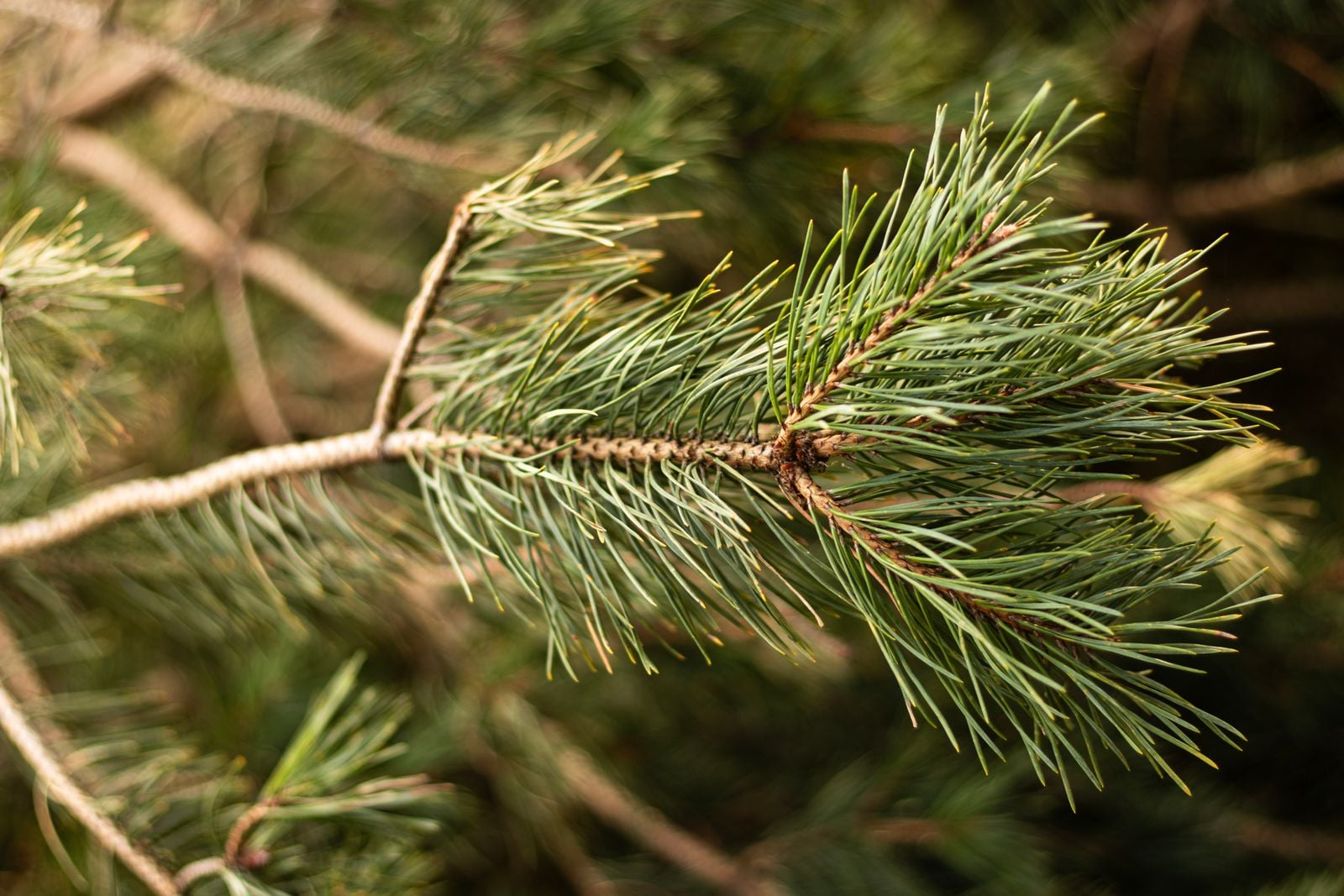
  •  
❌