
❌

Reading view

Human ‘safety drivers’ in Uber robotaxis could lose skills if all they do is observe
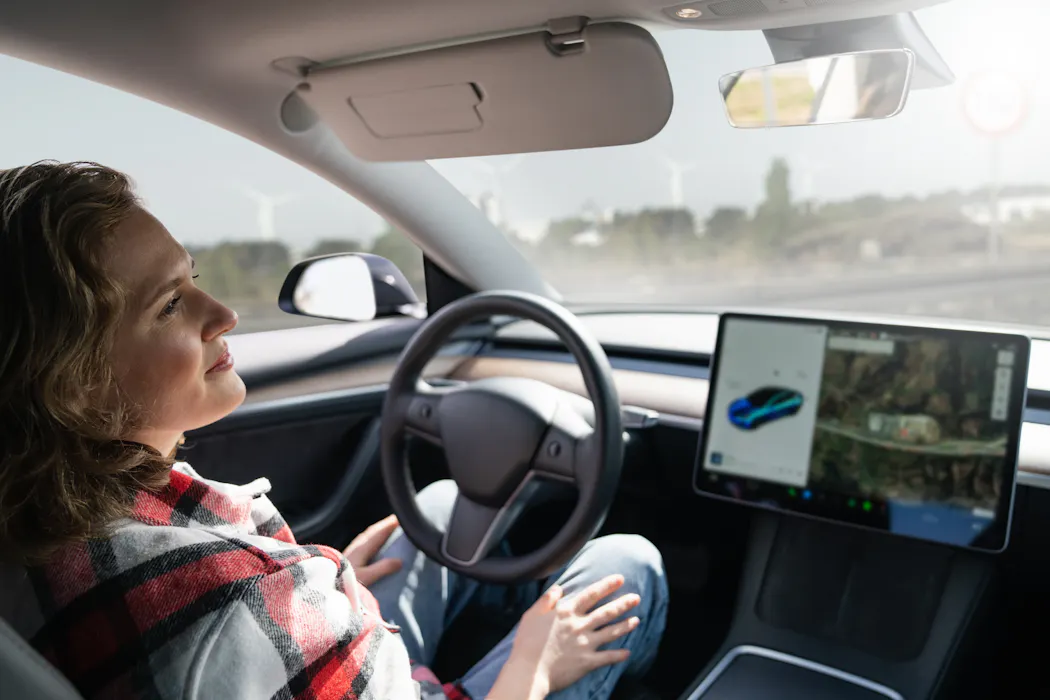
A safety driver may become less of an operator and more of a critical supervisor. Scharfsinn / Shutterstock

Imagine getting into a London taxi. Someone is sitting in the driver’s seat, but the car is driving itself. If the autonomous system gets into difficulty, they must recognise what is happening, decide whether to intervene and, within seconds, potentially take control.

This is no longer hypothetical. Uber and the British autonomous driving company, Wayve, have been granted licences to operate self-driving taxis in London with human safety drivers seated inside, with more than 100,000 people having joined a waiting list for the service. Uber launched its service, with 15 autonomous vehicles, on September 3.

Much of the debate thus far has focused on whether robotaxis will eventually replace human drivers. But there is another important question: what happens to human skill when our job changes from doing something to watching a machine do it?

Driving involves reading the road, anticipating others’ behaviour, judging risk and responding to unexpected situations. Autonomous vehicles transfer much of this work to software, but humans don’t necessarily become unskilled; their expertise changes.

They become less of an operator and more of a critical supervisor. There is, however, a problem with this arrangement, one that was identified long before today’s enthusiasm for AI.

In 1983, Lisanne Bainbridge published an influential paper, Ironies of Automation, noting that automation tends to leave humans with the tasks machines find most difficult, namely, monitoring complex systems and dealing with unusual situations.

The irony is that automating routine work can leave people with fewer opportunities to practise the skills they need when something goes wrong. Applied to robotaxis, this paradox is striking: the better the autonomous system becomes at driving, the less its human supervisor needs to drive.

However, the less that person drives, the fewer opportunities they have to practise the skills they may suddenly need when the system encounters something it cannot handle.

Meaningful oversight

There are signs of a similar problem elsewhere. For example, a 2025 study of clinicians using AI-assisted colonoscopy found that after routinely working with AI, their ability to detect precancerous growths when working without the technology declined, falling from 28.4% before regular exposure to AI to 22.4% afterwards.

This does not mean that AI makes doctors worse, nor that autonomous vehicles will inevitably make people poor drivers. The significant distinction is between the performance of the human-machine system and the capabilities retained by the human within it.
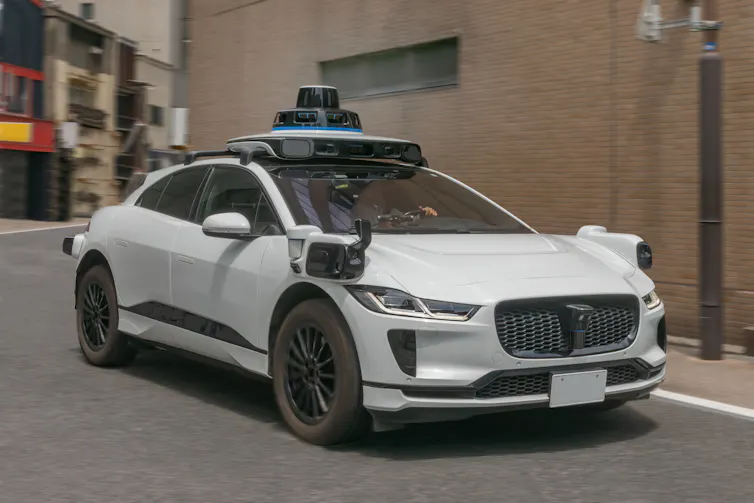
Self-driving car
A number of cities around the world have seen trials of self-driving cars. Caito / Shutterstock

A system can improve while the human supervisor becomes less practised. We hear about keeping a “human in the loop” in medicine, education, law and workplaces increasingly reliant on machine-generated analysis. However, having a human present is not the same thing as having meaningful human oversight.

For that, the person needs enough expertise to recognise when the machine is wrong, enough confidence to challenge, and enough authority to intervene.

A temporary job?

Robotaxis already operate in the US, China and the Middle East, sometimes without a supervisor. This raises an uncomfortable question about London’s safety drivers: do they represent a new kind of skilled occupation (expertise in supervising autonomous systems) or are they temporary workers, required until the technology is considered reliable enough to work alone?

There may, in other words, be two kinds of displacement happening. Eventually, the taxi driver may be displaced by the machine, but before that happens, driving itself becomes displaced by supervising. And that transformation is likely to reach far beyond transport.

The government had anticipated commercial trials beginning this year, but regulatory and technical hurdles have delayed the rollout. Transport for London has not published the guidance operators will need and no vehicles have thus far completed the approval process required for fully driverless passenger services.

The delay has been welcomed by some campaigners who have raised concerns ranging from employment and road safety, to privacy and the environmental costs associated with data intensive technologies. However, the postponement should not be read as evidence that autonomous vehicles have failed or that they are inherently unsafe.

Indeed, it highlights something more fascinating – that technological capability, regulation and social preparedness do not necessarily develop at the same speed.

Before fully autonomous vehicles can become ordinary features of London’s streets, regulators must confront questions that are partly technical but also ethical; such as, who supervises an autonomous system? Who is responsible when something goes wrong?

And at what point are we prepared to decide that the human supervisor is no longer needed? London’s delayed experiment is therefore testing a relationship with technology that is becoming increasingly familiar: machines performing while humans watch, judge and remain responsible.

As such, the challenge is no longer about keeping a “human in the loop”, but ensuring that when we do, humans retain the skills, judgment and agency that make their presence meaningful.

The Conversation

Gareth Evans-Jones does not work for, consult, own shares in or receive funding from any company or organisation that would benefit from this article, and has disclosed no relevant affiliations beyond their academic appointment.
  •  

How a ‘psychic’ horse named Clever Hans changed the way we do science

Do you sometimes wish that you had telepathic or other supernormal powers?

Around a hundred years ago, some of the greatest minds in philosophy thought there were people who had such abilities. In fact, they even suggested that perhaps horses and dogs could have them too.

At the turn of the 20th century, many great scientists, psychologists and philosophers became fascinated by the possibility of “psychic phenomena” like telepathy, clairvoyance or ghosts. Many of them, like J.J. Thomson, the 1906 winner of the Nobel prize in physics, performed experiments to test mediums. Others, like the philosopher C.D. Broad, attended seances and thought about the possibility of precognition – the ability to foresee future events.

These weren’t just marginal charlatans. Many of them had an impact on philosophy and science in the 20th century. Many of the concepts philosophers of time still argue over today trace back to C.D. Broad, such as the growing block theory, which says that the past is real, the present is real, but the future does not yet exist.

Most of their focus was on the psychic abilities of humans. However, some of these “psychic researchers” went even further and began wondering about the possibility of telepathy in animals.

The philosopher Friedrich Canning Scott Schiller (1864-1937), who spent most of his career at the University of Oxford, was an active member of the Society for Psychical Research (SPR). He was one of the founders of pragmatism, the philosophical view that the truth of a theory can be judged based on whether it works in practice.

Schiller engaged in heated discussions about the psychic abilities of animals. His article on “psychical research” for the Encyclopedia Britannica has a section about “equine mathematicians” – horses with supposedly paranormal mathematical abilities that they demonstrated by tapping out solutions to equations with their hooves.

In 1914, Schiller wrote an article for the SPR about Rolf, “the thinking dog of Mannheim” (in south-west Germany). Rolf was credited with the ability to tap out answers to mathematical problems with his paw. And, with the help of a spelling code for letters and syllables, Schiller even claimed that the dog managed to produce entire sentences.

On one occasion, Schiller alleged that the dog professed its Catholic faith to a priest.

The case of Rolf (and other “thinking dogs” who suddenly started cropping up elsewhere) caused a dilemma for psychical researchers. Some thought this proved that animals have hidden intellectual powers just like humans. Others, like the Russian scientist Vladimir Bechtereev, suggested that the whole thing can be explained by telepathy.

Bechtereev went on to make major discoveries about memory and brain structure. In his view, the dog’s owner telepathically communicated all the information to him.

Schiller believed that his theory of pragmatism could help settle these disputes. He thought there was no point discussing these things in the abstract. What matters is whether either of the theories can be shown to have practical consequences for how the animal behaves. If Rolf was really so skilled at arithmetic, why does he not use mathematics in everyday life? And if he is a confessed Catholic, why does he not go to church?

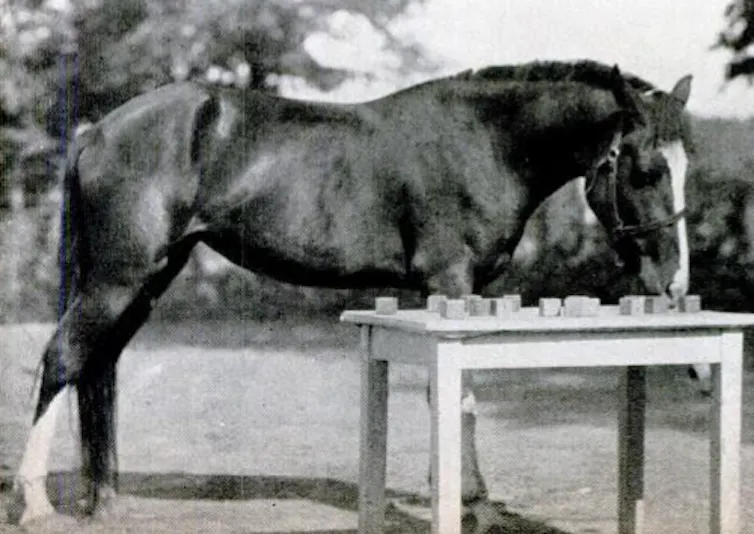
Horse stands next to table covered in blocks.
The alleged Francis Wickware

Joseph Banks Rhine (1895-1980) and his wife Louisa (1890-1983) are widely considered to be the founders of the controversial field of parapsychology. They published the influential volume Extra-Sensory Perception (1934) and founded the Parapsychology Laboratory at Duke University, which has since been shuttered. Their approach of using a large number of tests with multiple subjects has been closely connected with modern statistics.

In 1929, the Rhines published an article about the horse Lady Wonder. This horse was seemingly able to make predictions, work out answers to mathematical problems, and tell time, all of this by touching lettered and numbered blocks with her nose.

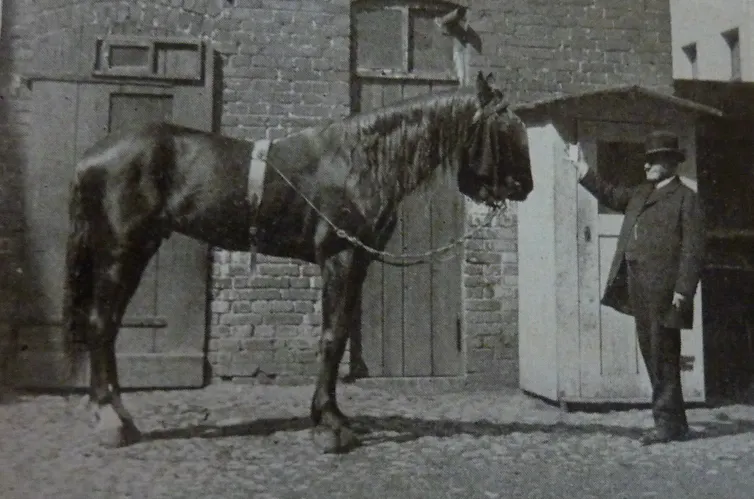
The most famous of these mathematically gifted horses was Clever Hans. Just like Lady Wonder in the US, Hans attracted huge crowds to his native Germany, who were eager to witness his arithmetic abilities. This included psychical researchers curious to see whether Hans had supernormal powers, as well as Carl Stumpf (1848-1936), one of the fathers of modern psychology.

It was Stump’s research assistant Oskar Pfungst who eventually got to the root of Hans’s miraculous powers. Pfungst observed that Hans could only provide the correct answer when his owner, standing nearby, knew the answer to the question asked – and only when Hans could see him.

Large horse looks at man holding up a card
Clever Hans and his owner Wilhelm von Osten. Karl Krall

This led Pfungst to conclude that Hans was simply responding to involuntary signals from his owner, signals that his owner did not even realise he was providing. Pfungst thereby discovered the so-called Clever Hans effect. This describes situations where the bad set up of an experiment causes the experimenter to unintentionally influence the subjects they are studying.

Pfungst’s explanation got rid of the need to appeal to supernormal abilities and partially contributed to the gradual disappearance of psychical research from universities. Like many other psychic phenomena, modern psychology could explain what was going on.

Although it turned out that these horses and dogs had no such mathematical powers, the studies conducted by psychical researchers helped uncover new knowledge. One surprising example is the development of randomisation in experiments.

Randomisation means deciding the order or allocation of things in an experiment by chance, rather than allowing the researcher or participant to choose. It is now a basic part of good experimental design because it helps prevent expectations from influencing the results. Surprisingly, attempts to test telepathy helped drive its development. Researchers realised that if people knew what answer was expected, even tiny unconscious cues could affect the outcome.

The case of Clever Hans and other “telepathic” animals shows just how turbulent this period of time was for modern science and philosophy. The telephone suddenly made it possible to contact someone on the other side of the world, and the X-ray allowed you to see inside the body. So perhaps it’s not that surprising that some of the greatest minds began to investigate telepathy in animals.

The Conversation

Matyáš Moravec does not work for, consult, own shares in or receive funding from any company or organisation that would benefit from this article, and has disclosed no relevant affiliations beyond their academic appointment.

  •  

‘AI needs to be disarmed’: Pope Leo sees threat to humanity in technological arms race

In the first landmark publication of his papacy, Pope Leo XIV has addressed recent advances in artificial intelligence by focusing on the threat it poses to workers, social justice and “the dignity of persons”.

Presenting his first papal encyclical, “Magnifica Humanitas” (“Magnificent Humanity”), at the Vatican on May 25, Leo declared: “Artificial intelligence needs to be disarmed.”

In the document – comprising around 42,300 words in its English translation – the pope writes: “To disarm does not mean rejecting technology, but preventing it from dominating humanity.”

Encyclicals are exceptionally important papal documents that respond to the most pressing social issues of the time. Typically written as letters to all bishops and archbishops, they have become a crucial vehicle for disseminating the theology and political commitments of the Roman Catholic Church across the world.

Pope Leo XIV signing his first encyclical on May 15 2026. Video: Vatican News.

Leo chose to sign his first encyclical on May 15 2026, the exact anniversary of Pope Leo XIII’s “Rerum novarum” (“Of new things”). This famous encyclical, which responded to the technological advances of the industrial revolution, became the foundational document of all modern Catholic social teaching.

Indeed, the current pope probably chose the name Leo because of Leo XIII’s renowned commitment to social justice.

Just as “Rerum novarum” responded to the industrial revolution by emphasising workers’ rights and the dignity of human labour, so too Leo XIV has responded to the explosion of AI technology by emphasising the importance of human over machine intelligence.

In 1891, Leo XIII wrote: “Wage-earners … should be specially cared for and protected by the government.”

Leo XIV now makes similar appeals to world governments about AI: “It is necessary to establish adequate regulatory tools capable of upholding justice and curbing the distorting effects of technological power.”

Pope Leo XIII
Pope Leo XIII. Wikimedia

The current pope follows a long tradition of Catholic engagement with new tech – from concerns about the impact of the printing press in the 15th century to the rise of the internet over 500 years later.

Leo XIV’s presentation was preceded by a short film which juxtaposed images of previous popes with major technological innovations. Radio towers gave way to images of broadband centres; early computers to a sea of people holding up their smartphones in St Peter’s Square, Vatican City.

Perhaps the crucial theme of this video was the connection between technology and war. Pictures of second world war aircraft were intercut with the dropping of the atomic bomb, soon followed by images of the 9/11 attacks.

In the encyclical, Leo warns: “The growing ease with which autonomous weapons systems can be deployed makes war more ‘feasible’ and less subject to human control.”

Call for disarmament

Leo XIV isn’t the first pope to address the potential threat posed by AI technology. In January 2025, his predecessor Francis signed off the doctrinal note “Antiqua et nova” (“Ancient and new”) – which called for AI technology “to include the least of our brothers and sisters, the vulnerable and those most in need”.

Leo’s new call for the disarmament of AI is not a demand to discontinue its development, but to regulate AI robustly so it only serves the common good.

In this, the pope drew an analogy with the nuclear disarmament movement, suggesting that both nuclear and AI technologies should only be developed for the good of humanity, and never used as weapons.

Video: Vatican News.

Those invited to offer their thoughts on Leo’s encyclical included Christopher Olah, the Canadian billionaire and co-founder of AI firm Anthropic. The appearance of Olah marks the first time a speaker entirely outside clerical or theological circles has been included in such a presentation.

Anthropic is currently locked in a legal dispute with the US government regarding the military application of its AI systems. Leo’s encyclical underlines his concerns about the escalation of war around the world, stating: “It is important to reaffirm that the ‘just war’ theory, which has all too often been used to justify any kind of war, is now outdated.”

Olah echoed Leo’s demands for greater social justice around the use of AI, stating: “His Holiness’s call for disarmament is profoundly timely.”

He called for people working outside computer science to contribute to AI governance and ethics – people “beyond the incentives” of financial markets “who can see what we, from the inside, cannot”.

Leo answered Olah by saying: “In the name of the Church, I accept your invitation to walk together, to listen and to speak – and together, to find the way for humanity in this time of artificial intelligence.”

The Conversation

James Lorenz does not work for, consult, own shares in or receive funding from any company or organisation that would benefit from this article, and has disclosed no relevant affiliations beyond their academic appointment.

  •  
❌