❌

Reading view

Not just Proton: Getting to know Valve's new SteamOS compatibility layers

Since the release of the Steam Deck, Valve fans have gotten very familiar with the idea of the Proton compatibility layer that allows games written for Windows to run capably on the Linux-based SteamOS (though Valve's efforts in this realm date back further than that). To get more games running on the SteamOS-powered Steam Frame, though, Valve is relying on two additional compatibility layers that are new to the Steam architecture.

The first, FEX, is Valve's port of fex-emu, an open source project that emulates x86 processor instructions on an Arm chipset. Since 2018, what started as a small cross-platform emulation project has grown to include "an advanced binary recompiler that supports all modern extensions of the x86(-64) instruction set," according to the Fex website. The emulator can also make calls to graphics libraries like OpenGL and Vulkan to reduce overhead and uses "code caching to minimize stuttering as much as possible," according to Steam's own developer documentation.

While Proton was based on the pre-existing Wine conversion tool, Valve engineer Pierre-Loup Griffais told The Verge last year that the company has been funding Fex lead developer Ryan Houdek since the project was just a prototype. Back then, Valve was already anticipating that "close to a decade of work [would be] needed before [Fex-emu] would be robust enough people could rely on it for their libraries."


Read full article

Comments

Β© Aurich Lawson

  •  

AI leaders want to hit the brakes after years of reckless speed

For years now, the major frontier AI labs have all been acting as if they're in an all-out, winner-take-all race with control of world-changing machine superintelligence (or at least market-changing artificial general intelligence) at the finish line. This weekend, the industry as a whole rapidly started turning away from that posture, urging coordination on slowing down the development of frontier AI that they say could soon be too dangerous and unknowable to control.

Anthropic's Dario Amodei was at the forefront of this change in tone, arguing in a nearly 4,000-word essay this weekend that "we must slow the pace at which we improve the capabilities of AI models" to avoid "a race to the bottom, spurred by commercial incentives, [that] can make [catastrophic] risks more acute."

Within hours, other AI leaders were echoing the same call. OpenAI co-founder and CEO Sam Altman posted his agreement on social media and said similar pacing discussions had been taking place at OpenAI. Alphabet Chief Scientist and Google DeepMind cofounder and chair Demis Hassabis said that Amodei's essay "points towards the right path forward," and renewed his own recent call for an industry-wide standards body. Microsoft CEO Satya Nadella posted that the company "welcome[s] the research, focus, and deliberate pacing needed to get alignment right as the design goal," ahead of the release of a lengthy "humanist AI" code of conduct for its models.

Read full article

Comments

Β© Getty Images

  •  

Anthropic researcher quits with a warning: Self-improving AI could "kill us all"

When a prominent researcher quits a job at a frontier AI lab these days, it's often to pursue a new startup or protest a new business model. But AI researcher Jacob Coxon is using his departure from Anthropic to publicly warn that frontier AI companies are "gambling with our lives" with systems that they "earnestly believe... could kill us all by the end of the decade."

In a social media thread Tuesday night, Coxon said that this existential risk is inherent not so much in today's models but more in the impending prospect of "self-improving superintelligence" creating "superhuman systems that can hack anything, revolutionize any field overnight, and acquire real power and resources." Others working on these models have either not "internalized the civilizational stakes" or believe that they need to "speedrun" the race to superintelligence to prevent an irresponsible party from getting there first, he wrote.

Lest you think this is just one departing researcher expressing an unpopular opinion, Anthropic Alignment Science lead Evan Hubinger piped in on social media to say that "Jacob is correct hereβ€”we really do earnestly believe AI could kill all humans! I personally think it is >10% within the next decade."

Read full article

Comments

Β© Getty Images

  •  

GOG brings back "big box" PC games, one printable template at a time

Those who remember PC gaming in the days before Steam may have fond memories of the "big box" packaging that made those games stand out as shelf eye candy and sought-after in-home collectibles. Today, PC gaming platform GOG is hoping to reignite some of the nostalgia for those days by adding downloadable 3D models and printable, foldable high-res packaging scans for a handful of PC games on the platform.

Thus far, the "Printable Big Box" collection on GOG is limited to just five games: Armikrog, Descent, Hitman: Codename 47, Myst, and Star Trek: 25th Anniversary. Players browsing those games on the GOG store will now see "3D Boxes" listed among the included "Goodies" before purchase. Owners of those games on GOG can download a ZIP file containing a version of the box art as an animated 3D object file (in an easy-to-open GLB format) and a "flat printable template" in PDF, SVG, and Adobe Illustrator formats. Those downloads allow for what GOG calls "a proper papercraft project for anyone who misses shelves full of PC game boxes."

The 3D model animates to show the front flap opening. Credit: GOG

"Physical media doesn’t survive the way software canβ€”boxes get lost, crushed, thrown out," GOG writes in today's announcement. "Scanning them, and letting you print your own, is preservation in a different shape: the same mission that keeps these games running on modern PCs, applied to the objects they used to come in."

Read full article

Comments

Β© GOG

  •  

The White House made a "Tetris" clone. The Tetris Company was not amused.

An anti-immigration-themed adaptation of Tetris was removed from the White House website over the weekend. The move comes days after The Tetris Company disavowed any involvement with the game and said that it "take[s] copyright infringement very seriously."

The White House's "Build the Wall" game asked players to stop a "Zombie Border siege" by stacking Tetris-styled bricks in an attempt to "hold the line." Unlike in Tetris, though, the blocks in "Build the Wall" don't disappear when you complete a line, meaning each brick contributes to an impassable barrier for the pixel-art "zombies" marching in from the "Southern Border." That change makes the gameplay pretty uninteresting for anything but cheap propaganda, and it also means that every game quickly and ironically ends with a "Border Breached" message when the blocks inevitably fill up the well.

Amerika Garcia Grewal, co-director of Texas migrant rights group Frontera Federation, told AFP last week that the makers of the game "have lost touch with what it means to be human and care for others."

Read full article

Comments

Β© WhiteHouse.gov / Internet Archive

  •  

Ars Live: Ross Scott discusses the Stop Killing Games movement

By now, any serious gamer is familiar with a favorite title becoming unplayable after a centralized online server gets shut down, or being unable to purchase and download a digitally delisted, critically acclaimed title from yesteryear. Can anything be done about this video game preservation problem?

To help answer that question, we'll be hosting a live conversation with Ross Scott, the founder of the Stop Killing Games campaign, on August 11 at 2:30 pm ET as part of the Ars Live series. As Ars' Senior Gaming Editor, I've documented countless examples of once vibrant games being left for dead by their creators.

You can watch the discussion live on YouTube when the time comes.

Read full article

Comments

Β© Stop Killing Games

  •  

Valve slowly expands SteamOS support on non-Valve hardware

SteamOS is continuing its slow march to fuller support on a wider variety of non-Valve hardware. This weekend's release of the SteamOS 3.8.25 Beta includes "initial gamepad support" for a few recent gaming handhelds and improved support for a few others.

Those newly supported handhelds include MSI's Claw 8 EX AI+, the extremely expensive, extremely powerful handheld built around Intel's Arc G3 processor that launched this summer. While SteamOS has long included beta support for "other AMD powered handhelds," Valve has only recently been working on offering compatibility with Intel-based handhelds like the MSI Claw line. This weekend's update suggests the company hasn't abandoned those efforts and that Intel chips aren't being left out of the SteamOS conversation.

SteamOS 3.8.25 also newly supports the controllers built into Ayaneo's Android-focused Pocket S2 and the more recently released Windows-based Konkr Fit. Valve also says the new OS offers "improved support" for older MSI Claw devices and the OneXPlayer line of portable gaming PCs.

Read full article

Comments

Β© Aurich Lawson | Steam

  •  

Canadian legislator reads out apparent LLM response in floor speech

Anyone who has used the Internet in recent years is probably used to encountering telltale signs of LLM prompting that lazy users sometimes forget to remove from their AI-generated pabulum. But a Canadian legislator took that idea to an embarrassing new level this week, reading an apparent LLM prompt instruction into the record during a floor speech.

Bill Oliver, a Progressive Conservative Party member of the legislative assembly of New Brunswick, noted in a speech last month that "One of the dangers associated with creating advocacy offices is that citizens often develop expectations that exceed the powers actually granted to those offices." He then went on to say out loud that "here’s a more natural, flowing version of that section that reads like a legislative speech rather than a series of short points," a line with all the hallmarks of an LLM presenting an alternative style option in response to a prompt.

The odd reading went more or less unnoticed at the time, but video of the remarks started spreading around social media networks like Reddit and Threads earlier this week. In Canada, the snafu is now getting mainstream attention from the likes of the Canadian Broadcasting Corporation and The Toronto Star, the latter of which called it a sign of "a growing divide in our society: between the elites, who are only too happy to delegate their duties to the Borg; and the masses, who find this objectionable."

Read full article

Comments

Β© Getty Images

  •  

Hundreds rally at Bethesda HQ to protest Xbox layoffs, and Ars was there

ROCKVILLE, Marylandβ€”Hundreds of Bethesda Game Studios and Zenimax Online Studios employees and their supporters braved nearly 100Β°F temperatures to protest sweeping layoffs across Xbox during a lunchtime rally in front of parent company Zenimax's headquarters today. The rally was one of five organized today by Zenimax Workers United and its parent union, the Communication Workers of America, at offices across Texas, California, and Montreal.

Attendees held up signs with messages like "Layoffs... layoffs never change" and "Our players deserve better" as union organizers and employees rallied the crowd with speeches and songs. The overwhelming message was one of solidarity and a willingness to push back against job cuts they say have decimated their development and quality assurance teams.

"It's about us building our movement and making sure that we get seen and we're visible," Bethesda technical producer and union volunteer organizer Nathan Hahn told Ars. "Because we want to make sure that we're not okay with these layoffs and that Xbox knows."

Read full article

Comments

  •  

OpenAI's first branded hardware is... a light-up keyboard?

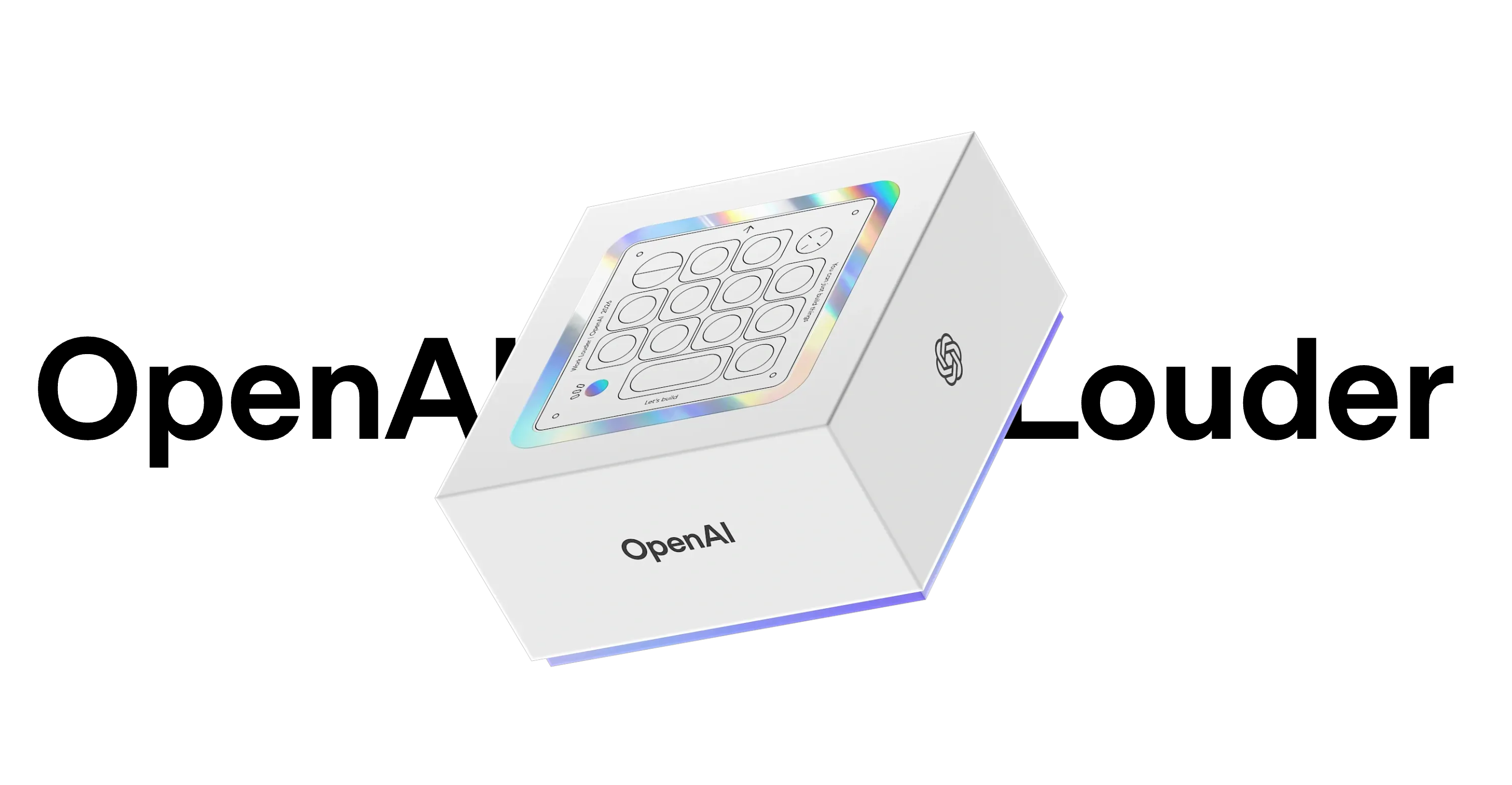
As rumors continue to swirl about OpenAI's work on a personalized smart speaker and other hardware, the company is today rolling out its first branded device. The $230 Codex Micro is a specialized, RGB-lit mini-keyboard designed to let users monitor and quickly interact with multiple Codex agents with a glance and a few clicks.

The device is described as a "limited-run collaboration" with Work Louder, which already sells a very similar-looking Creator Micro line of customizable square keyboards targeted at creative professionals. The Codex Micro differentiates itself from those mainly through six frosted keys in the top two rows, which offer color-coded live feedback on up to six Codex threads, even when they are not in focus on-screen.

Open the OpenAI box for AI assistance. Credit: OpenAI / Work Louder

Ideally, those colored keys will cycle from white when a thread is idle to blue when Codex is thinking to green when a task is complete. But the keys can also flash amber when Codex requires feedback or a decision from a human operator and red when a thread encounters an error, letting users know at a glance which of their Codex tasks needs immediate attention. A quick tap on the lit-up button brings up the applicable Codex window on-screen.

Read full article

Comments

Β© OpenAI / WorkLouder

  •  

Anthropic "pauses" token-based billing for its Claude Agent SDK

Last month, Anthropic announced a billing change that would have substantially increased costs for heavy users of its automation-focused Claude Agent SDK, including many third-party apps. On Monday, though, Anthropic abruptly announced it had paused those pricing changes just as they were set to take effect, allowing Agent SDK users to continue drawing from the more generous usage limits in their existing Claude subscriptions.

The plan, as announced on May 13, would have treated usage of the Claude Agent SDK (including via third-party apps and the programmatic "claude -p" command) separately from "standard" Claude usage via the chat interface or the official Claude CLI. At the time, Anthropic said that, as of June 15, that kind of outside SDK usage would be billed at Anthropic's prevailing API rates, with subscribers receiving a simple monthly usage credit equal to their subscription price.

That would have been a major change from the current setup, where Agent SDK use is limited only by the standard weekly caps applied to a user's current Claude subscription tier. Those generous limits allow power users to squeeze a lot more usage out of those paid subscriptions than they would get by paying the same price for API fees. One analysis suggests that Claude Opus users start saving money from their subscription after just two to three messages per day, and that their subscription could be worth many multiples of its monthly cost in API usage.

Read full article

Comments

Β© Anthropic

  •  

Leaked financial docs show OpenAI is losing billions of dollars a year

As OpenAI files SEC paperwork ahead of an expected initial public stock offering, newly leaked financial documents show a company with quickly growing revenues that are currently being overwhelmed by even larger expenses.

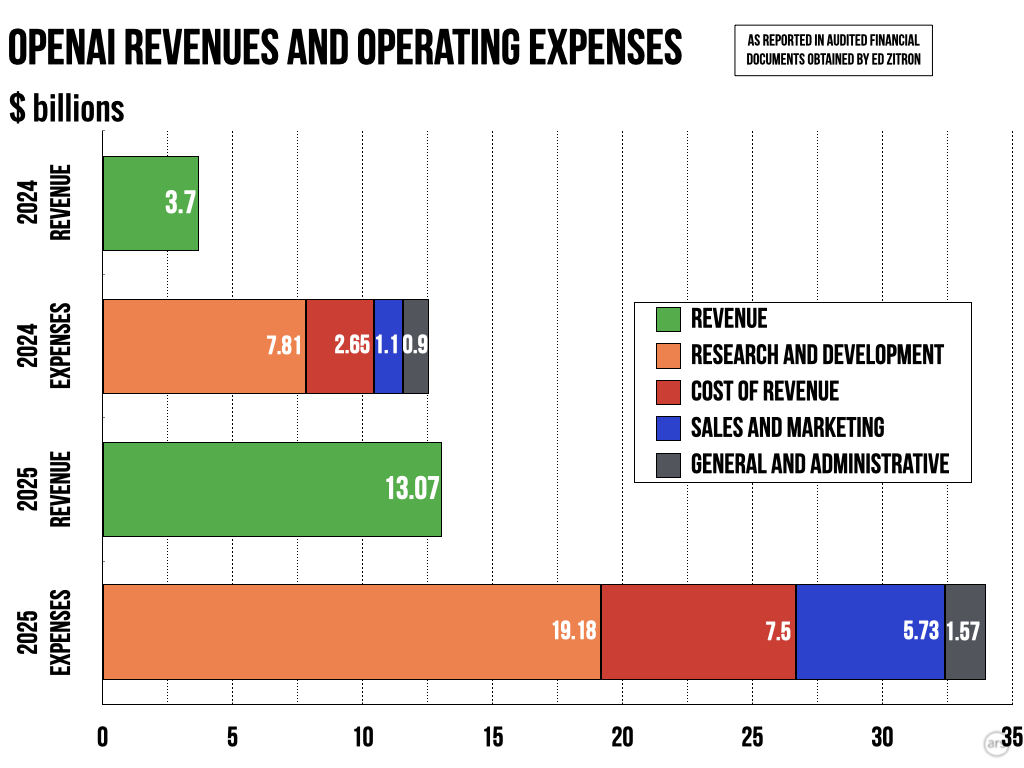
The audited financial statements, obtained by independent journalist Ed Zitron, show OpenAI's reported revenue growing from $3.7 billion in 2024 to $13.07 billion in 2025. The Financial Times, which reviewed the same documents, writes that the company's monthly revenues had grown to nearly $2 billion by the end of 2025, suggesting that its ongoing revenue rates continued to grow throughout the year.

R&D expenses alone still easily outpace OpenAI's quickly growing revenues. Credit: Ars Technica

But the company's fast-growing revenues are still dwarfed by its even more significant expenses. OpenAI's total revenues in both of the last two years were outpaced by research and development alone, which grew from a $7.81 billion line item in 2024 to a massive $19.18 billion cost in 2025. Those numbers seem to reflect the significant costs OpenAI incurred in training new models and include $10.59 billion in R&D costs paid to Microsoft alone in 2025.

Read full article

Comments

Β© Getty Images

  •  
❌