❌

Reading view

Could AI really kill off humanity within the decade? Expert Q&A

Samuel Boivin

Artificial intelligence (AI) could wipe out humanity this decade, according to three researchers from the US company Anthropic. One of the employees, Jacob Coxon, has quit the AI firm.

His predictions were backed by two other current Anthropic researchers in posts on social media. On X, Coxon claimed: “The people building AI earnestly believe that it could kill us all by the end of the decade. This is not a marketing stunt.”

It’s not the first time AI researchers and companies have issued such assessments. Here, Kate Devlin, professor of artificial intelligence & society, explains what is behind them and whether there’s anything different about the latest warning.

The latest claims about AI have come from a researcher who resigned from Anthropic. What is your general view on what has happened here?

To give this a sense of perspective, we should remember that it’s one AI company ex-employee posting on a platform known for grandiose claims, which was then quoted by a current AI company employee who put a figure on the risk of human extinction at greater than 10%.

So, it’s another doom-laden narrative about the supposed threat from AI. There is some dialling back from this in a follow up tweet from current Anthropic employee Evan Hubinger that read: “I think the risk from present models is low. What I’m worried about is superintelligence”.

These tweets have gained huge coverage because these kinds of things always do. It taps into our very primal fears – and our decades of watching dystopian sci-fi.

The claims from Jacob Coxon were backed by current employees of Anthropic. Why do you think AI companies are happy to support these kinds of claims in public?

It’s likely that these men believe what they’re saying, but we’ve heard warnings like this for years. It does seem odd that AI companies are okay with these kinds of claims.

Let’s remember that they are constantly looking for investment and, in return, they promise the most powerful and dominant models. What could be more powerful than a model that threatens our very existence?

One theory for doom-mongering by AI companies is that they want to avoid regulation. Do you think outside regulation of AI companies is inevitable?

It has been incredibly difficult to regulate AI, certainly at an international level. There has been little appetite for AI to be regulated in the US because there’s a view that regulation might stifle innovation.

The UK doesn’t have any AI-specific laws either, just existing laws that might apply in some cases. China began to introduce national-level laws but has now replaced that with technical standards and sector regulation. The EU remains the only place where there is dedicated AI regulation.

However, it looks like this has kicked off yet another call for better regulation, and we’re seeing that at present in US Congress and in the Houses of Parliament in the UK.

There is another angle, in that industry might be on board with regulation, as big tech companies would have the money to comply, but it could knock out their competitors with smaller budgets, so it would leave the leaders in dominant positions.

How far away are we from the kind of superintelligent AI mentioned in the latest warnings?

We don’t have superintelligence. I’m reluctant to put a time frame on that. Often people say “5-10 years” but that’s happened a lot in AI and 5-10 years pass without anything arising. It also depends on what is meant by superintelligence. Something that is conscious and thinks for itself? That might never happen.

In this case, it doesn’t really matter, as there are other harms already happening from AI, and there are other ways things can go wrong, though probably not at the existential level that’s being suggested here.

For example, AI is energy-hungry. It needs water to cool data centres. It has a damaging environmental impact. There are also issues around the content generated by AI, anything from a lack of plurality in the models’ outputs (meaning that the information it returns is homogenised, converging on particular viewpoints) to the spread of misinformation and disinformation.

We also know there is hidden labour in the AI supply chain: there are people working in terrible conditions to deliver the technology. And we know that it’s having an impact on people’s lives in terms of how it’s changing the workplace.

What are the potential practical ways in which AI could actually wipe out humans?

“Wiping out” is a bit extreme but there are some dangerous threats. There are the “bad actor” scenarios where AI is used destructively, like creating weapons or deadly viruses.

More mundane, but potentially very destructive, are AI agents let loose due to human carelessness or incompetence, hacking or taking control of insecure systems.

A survey we recently ran at King’s College London found that the UK public are feeling increasingly negative about AI, and that 42% of people are deliberately limiting their AI use. With claims from tech companies that it poses a direct threat to our existence, it will be unsurprising if public opinion dips even further.

The Conversation

Kate Devlin does not work for, consult, own shares in or receive funding from any company or organisation that would benefit from this article, and has disclosed no relevant affiliations beyond their academic appointment.

  •  

Pomegranates Could Unlock a New Treatment for Heart Failure

Male Medical Anatomy Human Heart CloseA compound produced in the body after eating pomegranates improved heart function by up to 80% in experimental models of a type of heart failure with limited treatment options. For people with heart failure with preserved ejection fraction, the heart can still pump blood but struggles to relax and refill properly between beats. In experimental [...]
  •  

The new technologies in the UK defence investment plan

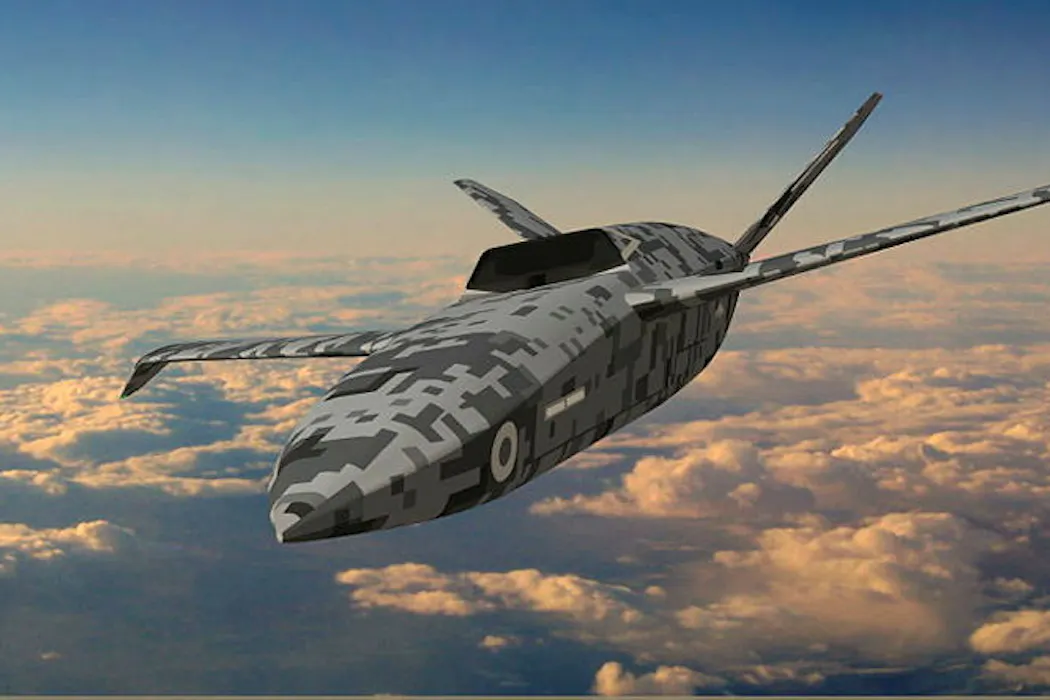
The MOD's Lightweight Affordable Novel Combat Aircraft (LANCA) initiative aims to develop low-cost, uncrewed fighter drones. UK MOD / Crown Copyright

Seventy years ago, Britain confronted a dilemma. It wanted to remain a leading military power but no longer had the economic resources to sustain all the conventional capabilities it had inherited from the second world war.

The solution proposed in the 1957 Sandys defence white paper was technological. Guided missiles, Duncan Sandys argued, were transforming warfare so fundamentally that many traditional capabilities, including some crewed combat aircraft, would become obsolete.

In other words, by embracing this technological revolution, Britain could achieve defence on the cheap. Britain’s new Defence Investment Plan (DIP) reflects a similar strategic instinct. The technologies may have changed but the underlying dilemma has not.

Announcing the DIP in the House of Commons, Dan Jarvis, the defence secretary, said the UK would be making its “largest ever investment in drone warfare: £5 billion for strike, protector and surveillance drones across the Royal Navy, the Army and the Royal Air Force.”

Here are some of the key technologies discussed in the Dip.

Drone ships

At least a quarter of the £5 billion announced for drone warfare is going towards a “hybrid fleet,” a fundamental re-imagining of the Royal Navy. The UK’s sole ballistic missile defence capability – the Type 45 destroyers – will no longer be replaced by a like-for-like. Instead, a network of Crewed Combat Vessels (CCVs) will act as control hubs for specialised, uncrewed boats.

These would include Type 91 missile barges, Type 92 and Type 93 anti-submarine and underwater surveillance platforms, and Type 94 radar vessels. In principle, distributing the sense, decide and strike functions across the navy offers several advantages.

It could ease chronic personnel shortages by reducing crew requirements, extend radar and sonar coverage over a wider area, and make the fleet more resilient by dispersing combat power rather than concentrating it in a handful of expensive warships.

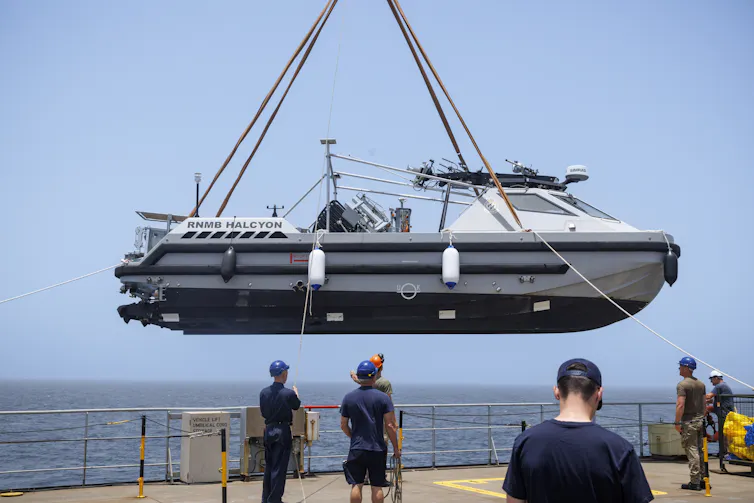
The MOD has experimented with using the RFA Lyme Bay as a mothership for autonomous craft. UK MOD / Crown Copyright

Uncrewed vessels could also be rearmed or maintained independently and without the design constraints of supporting sailors at sea. However, the challenges are significant.

The DIP envisages this concept becoming proven and operational before the Type 45 retires in the mid-2030s, despite the fact that resilient communications and electronic warfare protection for autonomous warships remain immature.

Nor is Ukraine’s use of naval drones a straightforward template. The Royal Navy’s principal tasks – particularly anti-submarine warfare in the High North and North Atlantic – are far more demanding than Ukraine’s use of maritime drones in the Black Sea.

While experiments such as using RFA Lyme Bay as a mothership for autonomous mine countermeasures (including drone minesweepers) are encouraging, retiring Britain’s only ballistic missile defence destroyers before the wider architecture has been proven would entail significant operational risk.

AI targeting network

The army’s Project Asgard illustrates the same technological philosophy in a different domain. Asgard aims to transform how – and how quickly – the army identifies and strikes targets, by linking sensors, armoured vehicles, drones and long-range weapons into a single, AI-enabled targeting network.

First trialled in 2025, Asgard is now receiving £370 million to develop an operational capability, reflecting the Army’s ambition to achieve a tenfold increase in combat power primarily through automation rather than expanded forces.

This idea has an important intellectual history. During the 1990s, the United States championed the concept of network-centric warfare: the proposition that superior information sharing would enable smaller, more agile forces to defeat numerically superior opponents. But Britain was soon concerned about the affordability and technological challenge of creating such highly connected forces, adopting in its place a lighter version: network-enabled capabilities.

The DIP suggests that the government now believes the technology is catching up with the theory. But old weaknesses remain. Networks only work if they survive. Communications can be jammed, satellites disrupted and software attacked, and Russia has the electronic warfare capabilities that could, without adequate safeguards, do all three.

‘Loyal wingmen’

It is also the case that what has worked at smaller levels now needs to be scaled across Nato. If it works, Project Asgard would provide Nato land forces with the ability to control long-range weapons of their own, reducing their reliance on air forces which will need to focus on supressing and destroying enemy air defences.

That task is motivating the DIP’s investment in Collaborative Combat Aircraft (CCAs) – uncrewed platforms that will fly alongside the RAF’s Typhoons and F-35s.

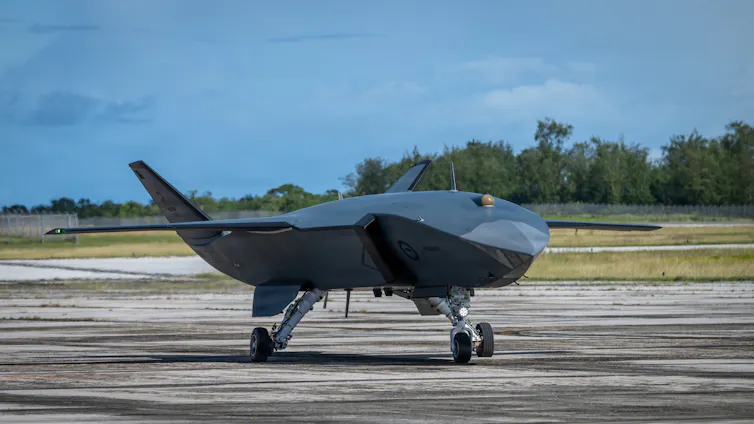
Boeing’s MQ-28 Ghost Bat is designed to act as a ‘loyal wingman’ to extend the reach of piloted aircraft. US Air Force / Senior Airman Adrien Tran

These “loyal wingmen” drones would support crewed aircraft by acting as scouts, decoys, absorbing enemy fire or jamming enemy radars. They could be controlled by the pilot of the combat jet, or work autonomously.

Systems such as the MQ-28 Ghost Bat are at an early stage of development. To be militarily useful CCAs must combine long range, high speed, low observability, resilient data links and meaningful payloads, requirements that quickly approach the complexity, and potentially the cost, of the crewed aircraft they are intended to complement.

Will it be cheaper?

Against these challenges, the government’s headline commitment of £5 billion on these systems therefore seems more like a down payment than the full mortgage. Spread across four years, three armed services and an exceptionally diverse range of programmes, it is less transformative than some may believe, and certainly not on the timelines some think are necessary as tensions continue with Russia.

The unit costs of what will be specialist equipment may remain prohibitively expensive. Take the hybrid Navy as an example. The autonomous systems in question require resilient communications, sophisticated sensors, electronic warfare protection and high engineering reliability, meaning the combined cost of CCVs and their uncrewed flotillas could approach that of the destroyers they replace.

Even if the funding can be found – and there are good reasons to question whether it can – Britain must still demonstrate that its defence industry can deliver this technology-intensive force. Expanding military output requires far more than larger budgets: it demands additional factory capacity, skilled workers, shipbuilding infrastructure and resilient supply chains. This is particularly true for autonomous systems whose military value depends on being produced, sustained and replaced at scale.

The DIP rests on three assumptions: that autonomous systems mature quickly, prove affordable and can be produced at scale. The Sandys Review rightly foresaw the missile age but underestimated the staying power of conventional forces; new technologies reshape warfare but they rarely replace its enduring fundamentals.

If Britain is to bet on autonomy, therefore, it also needs the spending profile to make that bet credible. After all, the most important judgement on the DIP will not be that of future historians, but of the occupant of the Kremlin today.

The Conversation

Arun Dawson is affiliated with the Royal United Services Institute.

  •  

Germany pulled the plug on flagship FCAS fighter jet – the implications for European defence are worrying

The effective collapse of the Future Combat Air System (FCAS) fighter jet programme is a major setback for European defence cooperation.

France, Germany and Spain have spent nearly a decade trying to develop what was intended to become Europe’s premier next-generation combat aircraft, only for the programme to succumb to disputes over leadership, the distribution of work and intellectual property.

Yet Europeans shouldn’t be surprised. The history of European combat aviation is littered with programmes that struggled under the weight of competing national ambitions. In this respect, FCAS looks less like an extraordinary failure than the latest chapter in a recurring story.

The more important question is not why FCAS has run into trouble, but rather what its collapse reveals about Europe’s ability to generate and sustain the military capabilities it will need in a more dangerous world.

Adversaries are now investing heavily in integrated and layered air defences encompassing long-range missiles, electronic warfare capabilities and increasingly sophisticated sensors. Maintaining the ability to penetrate defended airspace in future conflicts will require a step change in capability.

FCAS was conceived as a “sixth-generation” combat system – the latest leap in fighter jet technology – to overcome this contested air environment. At its centre would sit a new combat aircraft, supported by autonomous drones, advanced sensors, electronic warfare systems and a digital network linking everything together from the 2040s.

The challenge is that such programmes are becoming extraordinarily expensive to develop. By sharing costs, expertise and industrial capacity, European governments hope to achieve capabilities that would otherwise be beyond their reach.

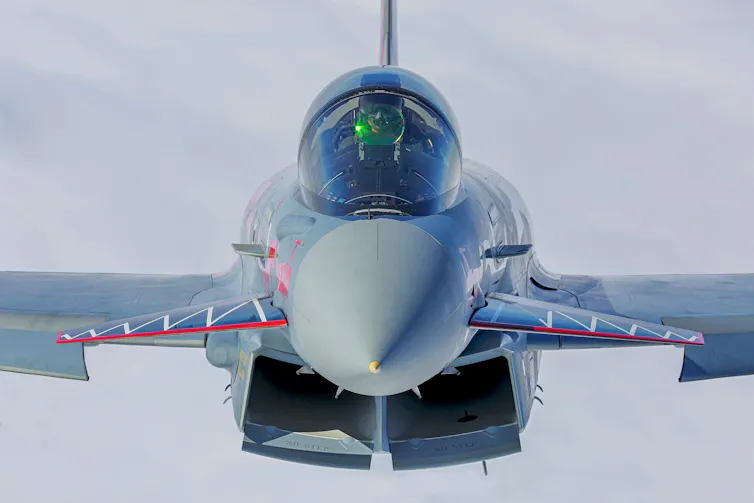
The Eurofighter Typhoon was one of the most successful military collaborations of the cold war. R. Sanchez Aviation Photo / Shutterstock

Reality check

Despite the perceived commonalities, the FCAS nations – France and Germany in particular – had very different objectives.

For France, the project was never simply about replacing its Rafale fighter jet. Any successor aircraft would eventually have to support the airborne component of France’s nuclear deterrent, operate from its aircraft carrier, and preserve sovereign industrial capabilities – specifically the ability to independently design and build advanced combat aircraft. The insistence by France on design leadership for FCAS therefore reflected concerns about national autonomy, even if portrayed as industrial obstinacy.

Meanwhile Germany, represented by the aerospace giant Airbus, had little interest in financing a programme that was likely to concentrate Europe’s most valuable expertise, intellectual property and design authority in Dassault, the French aerospace company, for decades to come.

These tensions are hardly new. In the 1960s, Britain and France attempted to build the Anglo-French Variable Geometry aircraft. But France’s withdrawal in 1967, for similar reasons to FCAS, led to the project’s collapse.

Other joint European projects have succeeded. For instance, the Panavia Tornado. And in the 1980s, the Eurofighter consortium was developed. This time, despite France withdrawing (to produce the Rafale), the UK, Germany and Italy proceeded (with Spain later joining) with what would become the Eurofighter Typhoon.

Reliance on America

For decades, therefore, European collaborative programmes have been expected to do several things at once: deliver military capability and sustain national industries while strengthening diplomatic relationships or at least not upsetting them.

That may have been a manageable compromise when Europe’s security was underwritten by the United States and the threat from Russian appeared contained. It is far harder to justify when European governments are warning that the continent must rearm.

Emmanuel Macron and Friedrich Merz.
Emmanuel Macron and Friedrich Merz have several options in the wake of the project’s collapse. EUS-Nachrichten

The challenge is compounded by the changing relationship between governments and industry. Unlike Airbus, which remains partly state-owned, Dassault is controlled by the family that bears its name.

This reflects a broader trend of European governments often exercising less influence over major defence firms than they did during the cold war, when state ownership and greater industrial competition gave them more leverage. This is to say nothing of the tech firms increasingly fundamental to military capability.

That matters because armed forces are built over decades, not electoral cycles. If European governments struggle to mobilise industry to meet their defence requirements, they may find themselves confronting capability gaps at precisely the moment they are trying to deter aggression.

Germany’s defence minister, Boris Pistorious, has already outlined three alternatives to FCAS. The first and simplest is to buy more F-35s from the US. But this would fall short of Germany’s requirements while also deepening dependence on the US – something European nations are keen to avoid.

The second option is to join another collaboration, most likely the UK-Italian-Japanese effort to build a sixth-generation fighter, called the Global Combat Air Programme (GCAP). Germany’s growing defence budget could provide the project with additional funding and a larger order book. But it would also raise questions about influence.

If Berlin rejected a subordinate role within FCAS, it is unlikely to accept one within GCAP. Existing partners may therefore conclude that the benefits of expansion are outweighed by the risks of delay to a programme targeting entry into service by 2035.

The third option is a German-led effort, being discussed through the proposed Team Gen 6 industrial grouping – an Airbus-led alliance of eight defence firms. This would solve industry concerns, preserve German design ambitions and might allow Berlin to build a coalition with other partners, such as Spain and Sweden.

But it could be prohibitively expensive, risky, and by further fragmenting Europe’s already crowded combat aircraft landscape, reduce the viability of all the existing programmes. France faces similarly difficult choices. It can pursue a national successor to Rafale, preserving control over industrial, nuclear and carrier requirements but accepting substantial costs. Or it could seek a revised collaborative framework.

In the meantime, both French president Emmanuel Macron and Germany’s chancellor Friedrich Merz have made clear that other opportunities for collaboration exist, such as the drones intended to support the FCAS fighter jet, or the main aircraft’s engine.

The experience of FCAS is not that Europe cannot cooperate. History shows otherwise, and GCAP may yet again demonstrate that a pragmatic coalition can succeed where a more politically ambitious partnership failed.

What FCAS does reveal, however, is a growing mismatch between Europe’s security environment, the way it continues to procure defence equipment and the costs involved. The recent resignation of Britain’s defence secretary, John Healey, amid disputes over defence funding, points to the same problem.

European governments increasingly agree on the threats they face, but remain “unwilling” to make the financial and political compromises required to address them. That should concern us all.

The Conversation

Arun Dawson does not work for, consult, own shares in or receive funding from any company or organisation that would benefit from this article, and has disclosed no relevant affiliations beyond their academic appointment.
  •  
❌