❌

Reading view

American states are holding tens of billions of dollars in forgotten bank accounts, uncashed cheques and insurance payouts, and anyone can search their name for free to see whether some of that money belongs to them

Karen Baker runs the Yolo Food Bank in Northern California’s Yolo County, which she describes as the most food-insecure county in the state. When CBS News California Investigates told her, on camera, that California had been sitting on money that belonged to her organisation, she asked one question: was it really hers? It was.

Tens of millions of Americans are in the same position, without a journalist on hand to tell them.

Where the money comes from

Every US state runs an unclaimed property program, which is essentially a lost and found for cash. The National Association of Unclaimed Property Administrators, the body that coordinates those programs across all fifty states, estimates that about one in seven Americans has something waiting. Searching costs nothing.

Nothing glamorous, mostly. Dormant savings accounts, uncashed payroll cheques, utility deposits from a flat someone moved out of in 2009, insurance payouts nobody told the family about, share dividends posted to an address three moves ago, and the contents of safe deposit boxes whose renters died or forgot.

Companies do not get to keep this stuff. State law obliges banks, insurers and other holders to hand it over once an account has gone quiet for a set period, typically three years in California, as the State Controller’s unclaimed property division explains. The state then holds it. There is no deadline to claim, and no fee.

The scale of the pile

California alone is minding about $15 billion in unclaimed property, per the State Controller’s Office, spread across tens of millions of individual records. New York is worse, or better, depending on your perspective: the Office of the New York State Comptroller oversees $19 billion in unclaimed funds, some of it dating back to 1943, and returned $504 million of it in a single fiscal year.

Nationally, the numbers move. NAUPA’s own annual report put total returns at $4.49 billion to Americans in fiscal 2024. That sounds like a lot until you set it against what is still sitting there.

What the states do while they wait

So what happens to the money while it waits to be claimed? In many states, it flows straight into general operations, and the state keeps whatever it earns until someone comes looking.

Citing the California Legislative Analyst’s Office and state budget documents, CBS News reported that unclaimed property is one of California’s top General Fund revenue sources, generating around $1 billion a year, while the state has returned roughly 3.5 per cent of what it holds. The original sum comes back when the owner claims it. The interest does not.

That reporting comes from a single news investigation focused largely on one state, not a national audit.

Washington notices

Sam Liccardo and Mike Lawler agree on very little. Liccardo is a Democrat, Lawler a Republican, and together they have introduced the Safeguarding Americans’ Fairly Earned Retirement Act, which would sharply limit when states can take custody of securities, digital assets and investment accounts. Senator Elizabeth Warren has separately written to NAUPA requesting state-by-state data on how these systems work and how the rules are changing.

Whether any of that passes is anyone’s guess. The databases are already open.

Where the records sit

NAUPA’s search hub links out to every participating state’s official database, alongside MissingMoney.com, the multi-state tool covering 49 states, several Canadian provinces and Puerto Rico. Hawaii runs its own system separately.

Property is reported by the company holding it, which means records often sit in a state the owner left years ago.

Old savings bonds now follow the same route. The Treasury retired its Treasury Hunt tool on 30 September 2025, and unredeemed bonds are handled through state unclaimed property offices instead.

A market has grown up around all this. Private recovery firms, legal in most states, charge a percentage to locate money that sits in the same public databases the states publish for free.

A dollar surrendered to a state in 1994 comes back as a dollar. Not a dollar plus thirty years of compounding, not a dollar adjusted for what groceries cost now, just the dollar. Whoever holds it in the meantime is the only party earning anything.

This article is journalism, not financial or legal advice. Unclaimed property rules, dormancy periods and claims procedures vary by state and change over time. Anyone dealing with a substantial claim, an estate, or a disputed entitlement should consult a qualified professional.

The post American states are holding tens of billions of dollars in forgotten bank accounts, uncashed cheques and insurance payouts, and anyone can search their name for free to see whether some of that money belongs to them appeared first on Space Daily.

  •  

George Vanderbilt hired a young forester in 1892 to restore the exhausted farmland and cut-over woods surrounding his vast North Carolina estate — the experiment that followed transformed thousands of acres and became the first professionally managed forest in America

America’s first professionally managed forest finished its first year in the red, and the man running it called that a good result.

The shortfall was $392.40. It sits in a table near the back of Gifford Pinchot’s account of the first year’s work at Biltmore Forest, a slim pamphlet printed in Chicago in 1893 as an exhibit for the World’s Columbian Exposition. Pinchot opened by pointing out that the attempt was the first practical application of forest management in the United States.

What Vanderbilt bought

George Vanderbilt had been assembling land south of Asheville since the late 1880s for a house the size of a small village. The ground came cheap because it was wrecked. As the Special Collections Research Center at NC State University documents, landscape architect Frederick Law Olmsted advised that the soils and terrain would never support a grand park, and suggested growing timber instead.

Pinchot’s survey put the estate at 7,282 acres, a little over half of it woodland. The families who had farmed the land before Vanderbilt bought it cut anything sellable as fuel, fencing or saw-logs, grazed cattle through the young growth, and burned the woods off for pasture. Asheville had been heating itself on those hillsides for years.

Pinchot summed up the condition of much of it in three words: “deplorable in the extreme.”

A card catalogue for a forest

Pinchot arrived on 2 February 1892, aged 26, trained in Europe because there was nowhere in America to train. NCpedia records that Olmsted put his name forward, and that he and Vanderbilt agreed on three objectives: sell timber at a profit, produce a steady yield every year, and leave the forest healthier than it was.

Then he counted. Crews broke the woods into more than 600 sections of about 5.7 acres each, describing every one in shorthand on a postcard-sized card and filing the cards as a catalogue of the whole property. He grouped the forest into 92 numbered compartments bounded by ridges, streams and old wood roads, then set a rotation of 150 years, meaning the second crop would be ready for the axe a century and a half after the first came out. Nobody involved expected to see it.

What the first year’s books showed

Labourers earned between 90 cents and a dollar a day, mules 75 cents.

The forest sold cordwood to the estate brickworks, ties to the railroad and lumber to anyone who wanted it, at open market prices. Expenses ran to $9,911.76. Receipts and stock on hand came to $9,519.36. Pinchot kept his own salary out of the accounts and conceded that supervision costs for fewer than 4,000 acres were far too high, arguing the same effort would have covered ten times the area.

Two findings mattered more than the balance. Large old trees could be dropped out of dense young growth with very little damage to the crop underneath, and the additional cost of careful work over ordinary destructive logging was small enough to be beside the point. Both were arguments about money, the case Pinchot had to make in a country that still treated trained forestry as a European specialty.

The German who built a school

Pinchot left in 1895 and went on to become the first chief of the US Forest Service. His replacement came from Germany. Biltmore’s own history of the estate credits Carl Alwin Schenck with running and expanding the plan over the next 14 years, and founding the Biltmore Forest School in 1898, the country’s first forestry school, which trained more than 300 of America’s earliest professional foresters before closing in 1913.

How a private estate became public land

In 1894 Pinchot came across the Pink Beds, a valley of rhododendron and mountain laurel in Transylvania County, and told Vanderbilt to buy it. That purchase and others became Pisgah Forest, and the holdings eventually stretched to roughly 125,000 acres.

Vanderbilt died in March 1914. Per NCpedia’s history of Pisgah National Forest, his widow Edith offered the federal government 86,700 acres at $5 an acre, around $200,000 below the price the family had asked a year earlier, and completed the sale in 1915. Combined with other purchases made under the Weeks Act, that land became Pisgah National Forest on 17 October 1916, the first national forest created under the act, as the Forest History Society documents.

Congress went further in 1968, setting aside 6,540 acres around the Pink Beds as the Cradle of Forestry in America, a site built around the remains of Schenck’s school.

The slow part of the work was never the trees. Pinchot enlarged his crews carefully, because the men he hired had only ever cut wood one season at a time, and the idea of protecting a crop nobody present would live to harvest had to be taught one foreman at a time. It took. More than half a million acres of North Carolina now run on a principle that began as a line item somebody had to justify to a very rich man.

The post George Vanderbilt hired a young forester in 1892 to restore the exhausted farmland and cut-over woods surrounding his vast North Carolina estate — the experiment that followed transformed thousands of acres and became the first professionally managed forest in America appeared first on Space Daily.

  •  

Modern humans interbred with Neanderthals before they disappeared, and most people of non-African ancestry still carry roughly 1 to 4 percent Neanderthal DNA today — meaning part of the human population we once thought we simply replaced never actually vanished

A man who died in a Romanian cave about 40,000 years ago carried more Neanderthal DNA than any other human ever sequenced, ancient or modern. His jawbone turned up in Peștera cu Oase, and when geneticists analysed it the result was startling: between six and nine per cent of his genome came from Neanderthals. Because those segments were still long and unbroken in his chromosomes, researchers reporting in Nature could work out that he’d had a Neanderthal ancestor only four to six generations back.

He was simply closer to the event than anyone alive today.

What the first Neanderthal genome settled

For most of the twentieth century the textbook story was replacement. Modern humans left Africa, Neanderthals died out, end of chapter. Anatomists had spent decades staring at skull shapes and reaching opposite conclusions from the same fossils. That held until 2010, when a draft sequence of the Neanderthal genome, assembled by Richard Green, Svante Pääbo and a large team from bones found in Vindija Cave in Croatia, showed that Neanderthals shared more genetic variants with living Eurasians than with living sub-Saharan Africans. Their estimate put the Neanderthal contribution to non-African genomes at one to four per cent.

Sixteen years of better data have tightened that figure rather than overturned it. Most current estimates sit closer to one or two per cent, with East Asians carrying about a fifth more than Europeans.

The meeting had a duration

How long did the two species actually overlap before Neanderthals disappeared? Two papers published on the same day in December 2024 finally gave a precise answer. A study in Science, led by Leonardo Iasi and Manjusha Chintalapati, compared 58 ancient Eurasian genomes against 275 present-day ones and dated the average moment of mixing to about 47,000 years ago, with gene flow continuing for some 7,000 years. A companion analysis, published in Nature, examined 45,000-year-old remains from Ranis in Germany and Zlatý kůň in Czechia and traced the archaic stretches in those genomes to a single admixture event between 45,000 and 49,000 years ago, shared by every non-African sequenced so far.

Seven thousand years is a long time to call an encounter. It is longer than everything that has happened since the first cities of Mesopotamia.

The parts that did not make it

“These deserts may have formed very rapidly after the gene flow,” Leonardo Iasi, one of the authors on the Nature paper, told UC Berkeley. He was describing what he and his colleagues call Neanderthal deserts, long stretches of the modern genome where archaic DNA is completely absent. Ancient human genomes from roughly 40,000 years ago already show no ancestry in those deserts, which is what led him to that conclusion. Read plainly, it means certain Neanderthal variants were harmful enough in a modern human body to be scrubbed out within a few thousand years.

The Oase man makes a similar point from the other end.

For all his recent Neanderthal ancestry, his population left little genetic trace in later Europeans.

What the surviving fragments do

Picture Neanderthal DNA as a jigsaw dropped and scattered across a crowd. No single person holds more than a sliver, but the crowd between them is still carrying a fifth of the picture. That is roughly what Benjamin Vernot and Joshua Akey found, writing in Science in 2014, when they sifted the genomes of 379 Europeans and 286 East Asians and recovered Neanderthal sequence covering roughly twenty per cent of that species’ entire genome.

There is a second archaic contributor in the mix too. Priya Moorjani of UC Berkeley, a senior author on the 2024 Science paper, is now studying people of East Asian descent, who carry both a larger Neanderthal share and up to 0.1 per cent of their genome from the Denisovans, a population known mainly from a handful of bone fragments and an enormous quantity of statistics.

Some of the surviving Neanderthal DNA is doing useful work. The variants that reached high frequency cluster around immune function, skin pigmentation and metabolism, which fits a group that had spent a few hundred thousand years adapting to Europe’s winters and its pathogens before anyone else showed up.

Some of it is a liability. In a paper published in Nature in 2020, Hugo Zeberg and Svante Pääbo showed that the strongest genetic risk factor then identified for severe COVID-19 was a stretch of roughly 50,000 bases on chromosome three, inherited from Neanderthals and carried by about half the population of South Asia and around sixteen per cent of Europeans. One paper, one chunk of chromosome, and the biology behind it is still being argued over. The provenance, though, is not really in dispute.

What to call an ending like that

Extinction normally means a line stopping. Neanderthals did stop existing as a distinct population, around 40,000 years ago, and no amount of genetics changes that. What the genetic evidence changes is the shape of the ending. A population that dies out and a population that gets absorbed look much the same in the fossil record and nothing alike in the genome.

That leaves an odd little fact sitting in the middle of human prehistory. The last Neanderthals were not necessarily childless. Some of them had children, those children had children, and the arithmetic has been running quietly ever since, through a few hundred million bedrooms, down to whoever happens to be reading this.

The post Modern humans interbred with Neanderthals before they disappeared, and most people of non-African ancestry still carry roughly 1 to 4 percent Neanderthal DNA today — meaning part of the human population we once thought we simply replaced never actually vanished appeared first on Space Daily.

  •  

Sweden is moving parts of an Arctic city because decades of iron mining are deforming the ground beneath it — in 2025 a 672-ton church was placed on giant transporters and rolled five kilometers to the new city center

Kiruna’s church went for a walk in August 2025, at half a kilometre an hour, on 224 wheels.

The trip took two days and included a daily stop for fika, the Swedish afternoon coffee break, because some traditions outrank engineering schedules. One driver steered the entire building with a handheld control box across roughly twelve hours of travel, along a route crews had spent months preparing. The Associated Press, in coverage carried by CTV News, reported that a main road was widened from nine metres to 24 and a viaduct was dismantled to clear a new intersection. State-owned mining company LKAB, which paid for the whole performance, lists the church at 672.4 tonnes and 40 metres across. Thousands of people stood in the wind to watch a building do the one thing buildings are designed never to do.

Norwegian contractor Veidekke built the road the church rolled along and the foundations waiting at the far end, as documented by Dezeen. It was not the first tenant to make the trip. By July, AP counted 25 buildings already jacked onto beams and wheeled east, with 16 still queued behind them.

Why the ground is giving way

Beneath the town sits the largest underground iron ore mine on the planet. White Arkitekter, the practice behind the masterplan for the new city, describes daily extraction as the equivalent of six Eiffel Towers of ore, and notes that two thirds of Kiruna’s residents depend on the mine for work. Digging began in 1910. The church was completed two years later, a gift from the company, built on a hill so the congregation could look out over the town the company had also built.

Take enough rock out from under a place and the rock above fractures, sags and follows the hole down. Crews are now working towards a main level 1,365 metres deep, and the surface has been reporting back for years in split walls and buckled roads. In 2004 LKAB told the municipality that the centre would have to be picked up and shifted east, since the alternative was to stop mining.

Sweden chose the mine.

What it costs to relocate a town centre

The company’s own accounting is blunt about the scale. LKAB estimates that at least 3,000 dwellings are affected, 6,000 residents must move and 450,000 square metres of floor space stands in the way, with roughly a third of the urban centre inside the affected zone. The replacement centre opened in September 2022. Per France 24, shifting the church alone carried a price tag of 500 million kronor, about 52 million US dollars.

Then came the sequel. LKAB has since published an expanded impact area that adds a further 6,000 people and 2,700 homes to the queue over the next decade, and CNBC has put the company’s estimated compensation costs across that period at 22.5 billion kronor, roughly 2.4 billion dollars.

Not all of it reads as loss. The Institution of Civil Engineers treats the relocation as a rare chance to redraw a city from scratch: a denser centre planned around good lighting through the long polar dark, 3,000 new homes, and streets arranged so nobody lives more than three blocks from open country. The same assessment records that the rebuild has squeezed Sami reindeer herders, who were working the land long before LKAB arrived.

The residents who cannot be loaded onto trailers

Lars-Marcus Kuhmunen chairs Gabna, the reindeer-herding Sami community whose grazing corridors have already been carved up by the mine, the railway and the town. Speaking to Swedish public broadcaster SVT, he said a new mine at the Per Geijer deposit would mean the end of reindeer herding as they know it, because the ore sits beneath the last narrow passage his herds use between seasonal pastures.

Per Geijer is the reason the arithmetic keeps changing. A report by the Stockholm Environment Institute, covered by ArcticToday, found the project carries significant risk of breaching the Indigenous rights of Sami community members, in the words of senior research fellow Rasmus Kløcker Larsen. That is one institute’s assessment rather than a court ruling, and permitting has years to run. The deposit holds 1.2 billion tonnes of mineral resources including 2.2 million tonnes of rare earth oxides, which is why the European Union has flagged it as strategically important for cutting its dependence on Chinese supply.

Reindeer, unhelpfully, cannot be rerouted by memo.

What happens to the building

Henning Larsen’s circular town hall anchors the relocated core, and the church is due to reopen at its new address, between the cemetery and the new town centre, in 2026. Parts of the stone wall that ringed the old site will be moved across to join it. Where it used to stand becomes a mining town park, kept as a quiet green space until the ground beneath it is needed, at which point the fences go up and the park goes the way of the neighbourhood.

Kiruna has become very good at a peculiar skill: treating permanence as a logistics problem with a budget attached. Beams, jacks, 224 wheels, a control box and a coffee break. A church can be lifted onto a trolley and driven down the road. A migration route cannot.

The post Sweden is moving parts of an Arctic city because decades of iron mining are deforming the ground beneath it — in 2025 a 672-ton church was placed on giant transporters and rolled five kilometers to the new city center appeared first on Space Daily.

  •  

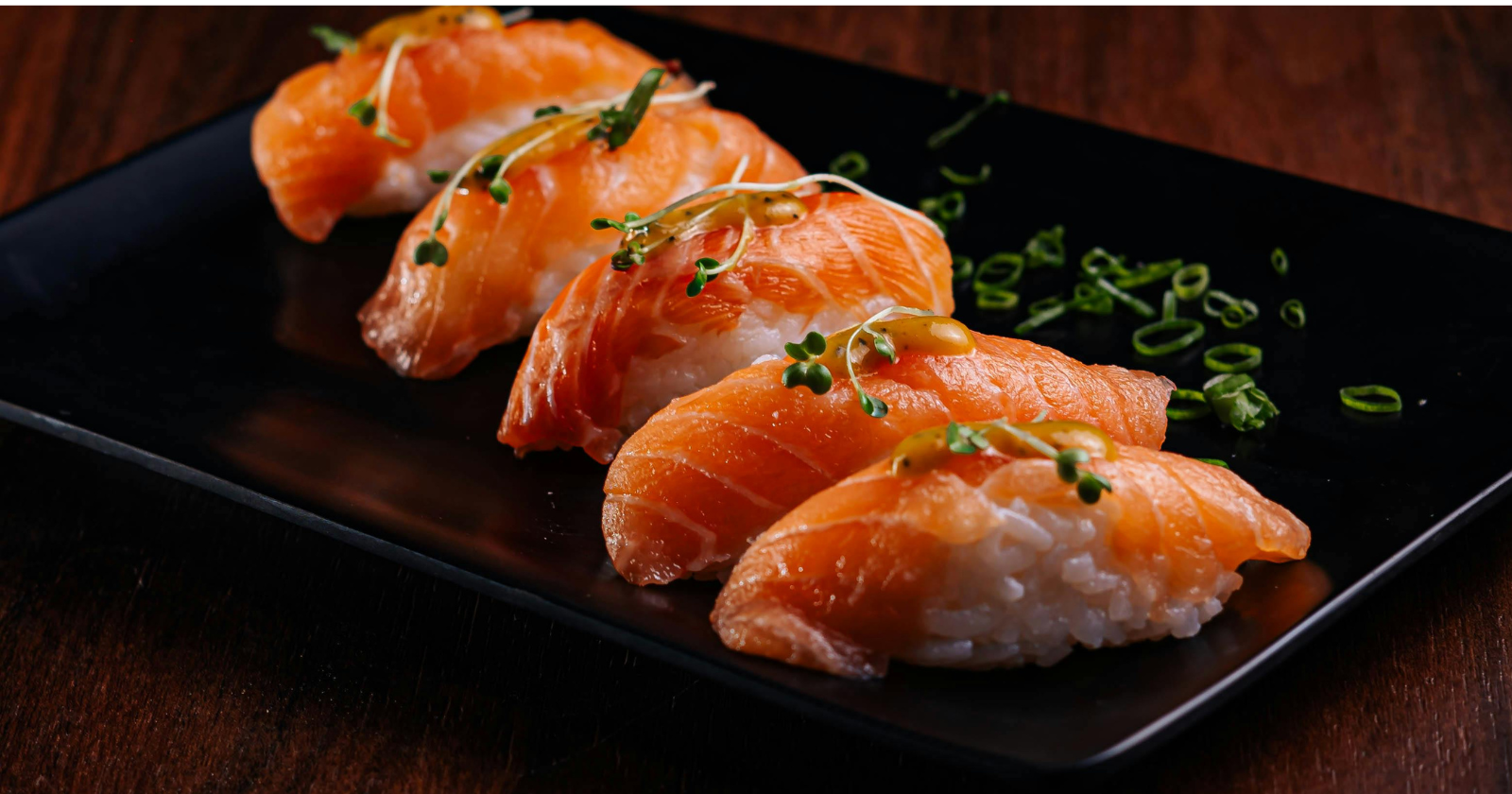
That salmon on your sushi plate feels like an ancient Japanese tradition, but it isn’t — until the 1990s the Japanese didn’t eat raw salmon at all, and the reason they do now traces back to a Norwegian marketing campaign

Somewhere in Tokyo in the mid-1980s, a Norwegian marketing strategist stood in front of a room of Japanese seafood executives, served them raw salmon, and watched the room politely fall apart. The colour was wrong, they told him. Its smell, they said, had a river-like quality. Someone objected to the shape of the fish’s head.

I think about that meeting every time I sit at a conveyor belt and watch the orange slabs go past. Salmon nigiri has the settled look of something that was always there, parked next to the tuna and looking as venerable as a prawn tempura. It has been on Japanese menus for about thirty years.

What Japan actually ate before

Japanese cooks have used salmon for centuries. They grilled it, salted it, flaked it into rice balls and packed it into lunchboxes. Nippon.com describes grilled salmon and salmon flakes as fixtures of home cooking, with a hard line drawn between that cooked fare and anything sliced raw. The domestic workhorse was chum salmon: lean, firm, nobody’s idea of sashimi.

So the fish was there. The appetite for raw fish was very obviously there. Those two facts never met.

The parasite question, answered properly

There was a real reason for the line, and fussiness was not it.

Wild Pacific salmon carry Anisakis simplex, a nematode larva that causes a thoroughly miserable illness called anisakiasis if you swallow it alive. Heat kills it. Deep freezing kills it. Slicing the fish fresh and eating it does not, which is why generations of Japanese cooks treated raw salmon as a hazard to be cooked out.

Farmed Atlantic salmon raised on heat-treated pellets is a different animal. The Norwegian Food Safety Authority exempts farmed salmon and rainbow trout from the freezing rule that otherwise applies to fish destined to be eaten raw, on the grounds that the fish eat nothing but dry feed containing no viable parasites and barely graze on wild organisms in the pen. That exemption tracks a 2010 European Food Safety Authority opinion and its 2024 re-evaluation.

A survey published in the Italian Journal of Food Safety put numbers on it: 270 slices of smoked farmed Atlantic salmon examined, zero anisakids found, against ten positives out of thirteen slices of wild sockeye. One paper on one processed product, not a settled literature, but it points the same way the regulators do.

Norway had too much fish

Norway started farming salmon commercially in the 1970s, then watched its own population drift towards chicken and red meat.

Freezers filled up.

The Norwegian Seafood Council, which has every commercial reason to tell this story well, dates the campaign to 1985, when a delegation led by former fisheries minister Thor Listau flew to Tokyo. Their figures: two tonnes of Norwegian salmon went to Japan in 1980, and twenty years later the annual number was above 45,000 tonnes.

Underneath all of it sat one piece of arithmetic. Fish sold for the grill competes on price with every other cheap protein, while fish accepted for sashimi could fetch up to ten times more, as Bjørn Eirik Olsen, who ran market research for the project, later told The Japan Times.

A name change, then a decade of nothing

“We couldn’t just say that our fish doesn’t have parasites,” Olsen said in that interview. Walking into a foreign industry and announcing that its national fish is wormy tends to close doors rather than open them.

So he went after the word instead. The Japanese for salmon is sake, and sake carried every association he was trying to escape: grilled, salted, cheap, the thing in the lunchbox. Olsen borrowed the English word and pushed the katakana sāmon, the term still stamped on essentially every sushi menu in the country. Same animal, different shelf.

Then came the advertising, all clean fjords and clear arctic water, and it achieved almost nothing for years. Olsen told NPR that pressure from home to abandon the sushi idea and dump the stock into the grill market was relentless.

The deal that broke it open

In 1992, Olsen offered the frozen food giant Nichirei 5,000 tonnes of salmon at close to giveaway prices, with one condition written into it: the fish could only be sold as sushi. Nichirei said yes.

That was the crack in the wall. Through the 1990s, Iron Chef and celebrity chefs including Yutaka Ishinabe put Norwegian salmon onto national television, and appetite did the rest. Olsen has said he knew the campaign had landed when he started noticing plastic salmon nigiri in restaurant window displays.

Where salmon sits now

Salmon has topped Japan’s biggest conveyor-belt sushi survey for fifteen consecutive years. In the 2026 round, run by Umios (the company known as Maruha Nichiro until March), 47.7 per cent of respondents named it as the topping they eat most often, more than eleven points clear of lean tuna in second place. The split runs along age lines: older diners tend to open with lean white fish and work up to tuna, while younger ones go straight for the orange.

Norway built something very large on the back of it. The seafood council reckons roughly 30 per cent of all Norwegian salmon now ends up raw in sushi, and that Norway supplies a little over half the global salmon market across 113 countries.

The high end went too. That’s the part I still find slightly hard to credit. Iwasa-zushi in Toyosu used to turn away customers who asked for salmon back when the market was at Tsukiji, and now has it on the board. Yamagata Tadashi, whose family has run a Nihonbashi sushi restaurant since 1887 and who chairs the Japan Sushi Environmental Health Federation, expects salmon to become a staple of Edomae sushi, arguing that clinging to wild domestic fish alone will empty the sea.

What a tradition is made of

The reasoning that lost for a decade turned out to be correct. Cold water, controlled feed, negligible parasite risk, safe raw. Olsen simply had no way to prove it to a room that had already decided, and no vocabulary that did not sound like an insult.

The argument never won anyone over. A discount and a shipping container did.

What gets me is how completely the seam has vanished. A teenager ordering sāmon at a kaiten place in Osaka is not participating in a trade negotiation or performing globalisation, any more than an Indian cook reaching for a chilli is. Thirty years is apparently long enough for a foreign product, sold under an English name at a loss by a government agency with a warehouse problem, to become simply what people like. Every cuisine anybody calls ancient is carrying a few of these, quietly, with the receipts thrown out.

The post That salmon on your sushi plate feels like an ancient Japanese tradition, but it isn’t — until the 1990s the Japanese didn’t eat raw salmon at all, and the reason they do now traces back to a Norwegian marketing campaign appeared first on Space Daily.

  •  

South Korea was producing very little internationally recognised music in 1995 — within three decades it was topping the global album charts and had climbed into the world’s largest music markets, a rise seeded by a post-1997 government bet on culture as an export and built by the record labels that bet alongside it

In 1995, South Korea’s recorded music business was, commercially, a domestic one. Seo Taiji and Boys were selling in the millions at home and registering nowhere abroad. The country had no act on a major Western album chart and no meaningful export line for music.

Three decades on, the Korea Customs Service logged US$301.7 million in K-pop album exports for 2025, the first year the figure passed US$300 million. Japan took US$80.6 million of that, China US$69.7 million, the United States US$64 million. In the IFPI’s 2025 Global Music Report, covering 2024, South Korea ranked as the seventh largest recorded music market in the world.

Those are physical album shipments alone. Streaming, publishing, touring and merchandising sit outside that customs line.

What the 1999 statute created

What the law actually did is less sweeping than the retellings suggest. The Framework Act on the Promotion of Cultural Industries passed on 8 February 1999, and it named music and games as industries in their own right. That classification is what made them eligible for the tax breaks, cheap credit and government-built facilities the Act goes on to describe. Investment funds could now be set up specifically for cultural products. A guarantee scheme let producers borrow against work they had not yet finished, which is the ordinary difficulty in paying for an album or a film. Government money could go towards overseas marketing and towards co-productions with foreign partners. A state content agency was created under the Act, the body that after a 2009 merger became the Korea Creative Content Agency.

The ministry was already running a cultural industry bureau before the Act passed, which makes 1999 an escalation of an existing function rather than a founding. Kim Dae-jung took office in February 1998, the same month that ministry was renamed from Culture and Sports to Culture and Tourism in a broader government reorganisation.

On the strategic framing, the Victoria and Albert Museum’s account of hallyu’s origins describes the post-crisis gamble as a twin bet on information and communication technologies and on culture industries, with the stated aim of quadrupling cultural industry exports.

The sums were modest. The cultural industry budget rose from roughly US$14 million in 1998 to around US$84 million by 2001, a figure traced to the 2003 White Paper on Culture and Industry and cited in a 2025 piece on Korean cultural statecraft in the US Army War College’s War Room. Set beside the semiconductor build-out of the same years, that is a rounding error.

What the state did not do

No agency built the acts. That was done by privately held companies incorporated in the same window: SM Entertainment in 1995, YG Entertainment in 1996, JYP Entertainment in 1997. H.O.T. debuted in 1996 and set the template the sector still runs on, which is long-horizon trainee development, in-house production, and groups configured for a specific market rather than assembled around a single writer.

Financing is the part usually left out. SM Entertainment listed on the KOSDAQ exchange in 2000, meaning a pop label was raising public equity at a point when its overseas earnings came overwhelmingly from elsewhere in Asia. That structure, listed capital funding multi-year artist development, let firms absorb the cost of acts that would not return anything for five or six years.

The state bet on the category. Labels bet on individual careers, with shareholders carrying the risk.

The 2018 threshold

Commercial proof arrived twenty years after the statute. BTS’s Love Yourself: Tear, released by Big Hit Entertainment on 18 May 2018, entered the Billboard 200 at number one with 135,000 equivalent album units, 100,000 of them traditional album sales. It was the first Korean-language album to top the chart and the first predominantly non-English one since Il Divo’s Ancora in 2006.

That ratio matters more than the position. Streaming supplied a small share of the debut; most of it was people buying objects. Korean labels had spent a decade refining album packaging, version variants and pre-order mechanics for domestic and Japanese fan markets, and the same machinery worked in the United States unmodified.

The 2024 plateau

Growth was not continuous, and the middle of this decade complicates the arc considerably.

Exports came to US$291.8 million in 2024, up 0.55 per cent on 2023 by Korea Customs Service reckoning, which after nine years of compounding growth amounts to a standstill. Shipments to Japan fell 24.7 per cent that year. Korea’s own recorded music revenue declined 5.7 per cent in 2024, the only contraction among the IFPI’s top ten markets that year even as the country held seventh place. Circle Chart, run by the Korea Music Content Association, recorded a fall in album sales for the first time since 2014.

Sales kept sliding through 2025. Circle Chart put the combined domestic and overseas total at roughly 93.5 million copies, a second consecutive annual decline from about 120 million in 2023, with plastic CD waste and reduced fan-targeted marketing cited by analysts as contributors. Exports rose while units fell.

Where the money sits now

HYBE, the largest of the listed firms, reported record 2025 revenue of 2.65 trillion Korean won, roughly US$1.86 billion, up 17.5 per cent. Operating profit dropped 72.9 per cent to 49.9 billion won, taking the operating margin from 8.2 per cent to 1.9 per cent. Concert revenue climbed almost 70 per cent while recorded music fell 10.2 per cent. Net loss came to 256.7 billion won, widened by an impairment of about 200 billion won booked in the fourth quarter against the restructuring of the North American business, which the company describes as an accounting item with no cash outflow.

IFPI’s Global Music Report 2026 records physical formats returning to growth worldwide in 2025, up 8.0 per cent, which it attributes to fan demand for tangible releases and a 13.7 per cent rise in vinyl, vinyl’s nineteenth consecutive growth year. Japan, the second largest market, returned to growth at 8.9 per cent.

What the first half of 2026 answered

Two questions left open by the 2025 filings have since been settled, at least provisionally.

The first was whether a BTS return would lift recorded music or only touring. HYBE’s first-quarter 2026 results answer it plainly. Recorded music revenue nearly doubled to 271.5 billion won on the back of Arirang, released 20 March, a rise of 98.9 per cent. Concert revenue fell 42.8 per cent to 88.7 billion won, because the tour had barely begun. Total quarterly revenue of 698.3 billion won was its largest opening quarter to date. HYBE still posted a net loss of 156.7 billion won, driven by a one-off stock award expense of about 255 billion won; excluding it, adjusted operating profit was 58.5 billion won.

The second was the geography. K-pop album exports reached US$257.48 million in the January to June period, up 125 per cent year on year, with roughly 55 million units shipped. The United States took US$74.12 million, ahead of China at US$61.18 million and Japan at US$45.61 million. Japan has been the anchor of Korean physical sales abroad since the 2000s and is now third.

What remains unresolved is the domestic market and the margin. Album sales inside Korea have fallen two years running, and the concentration question sits underneath the 2026 numbers: a single comeback moved the national export total by 125 per cent. Whether the investment that flattened HYBE’s margins in 2025 produces a second tier of exportable acts is not something a strong first half can demonstrate.

The post South Korea was producing very little internationally recognised music in 1995 — within three decades it was topping the global album charts and had climbed into the world’s largest music markets, a rise seeded by a post-1997 government bet on culture as an export and built by the record labels that bet alongside it appeared first on Space Daily.

  •  

In microgravity, the human spine lengthens by as much as five centimetres, and astronauts come home temporarily taller than when they left, before gravity compresses the column again within days of landing

Astronauts come home from long stays in orbit measurably taller than when they launched. The usual figure is one to three per cent of standing height, which for someone around 1.8 metres works out at roughly five centimetres, and the gain disappears within days of landing as body weight starts pressing down through the spinal column again.

Nobody in the business finds this surprising. What is less widely appreciated is that the number exists in the literature mainly because spacecraft seats and spacesuits have to be built around it.

What the measurements actually show

Early data came from awkward improvisation. During the nine-day Apollo-Soyuz Test Project flight in 1975, stature was recorded with the crewmember’s feet against the docking module hatch and body supine along the control and display panel, a colleague reading off a measurement decal taped to that panel. Those readings showed increases of up to three per cent within about two days, after which stature held steady, a history summarised in Karen Young and Sudhakar Rajulu’s paper in Applied Ergonomics.

On the 84-day Skylab 4 mission, William Thornton measured one crewmember to the sixteenth of an inch. That astronaut gained 3.8 centimetres by the end of the mission, with the increase plateauing at around day 29.

In their review in Frontiers in Physiology, David Green and Jonathan Scott give the same range, noting older reports of gains as large as seven centimetres. They set that against the ordinary overnight increase of about one per cent, to make the point that months of unloading produce something larger than a long sleep, not merely more of the same.

Where the disc explanation stops

Swelling of the intervertebral discs in the absence of compressive load is the standard account, and the imaging record complicates it.

Douglas Chang and colleagues at the University of California San Diego published an MRI study of six crewmembers in Spine in December 2016, before and after six-month ISS missions. Lean paraspinal muscle content fell from 86 per cent of total muscle cross-sectional area to 72 per cent immediately after flight, and about two thirds of that loss had been recovered by a follow-up scan 46 days later, which still left lean content below preflight levels. Lumbar disc heights showed no appreciable difference at any point measured.

Those are post-flight scans, so they cannot describe what the discs do in orbit. Reviewing the evidence for the European Space Agency, Daniel Belavý and colleagues put it plainly: increased disc swelling during spaceflight has not been shown directly, only inferred from the height gain and from bed-rest studies. NASA’s write-up of the seated height experiment names a second contributor, without gravity the natural curve of the spine straightens, and a straighter column is a longer one.

Why the number is a hardware requirement

Spinal elongation became a design constraint before it became a research question. Young and Rajulu note that some crewmembers have had trouble donning spacesuits after extended periods in orbit, and that an allowance of 2.54 centimetres is added to suit torso length as standard. Soyuz crew fly in a pre-moulded Kazbek seat liner sized on the ground.

Seat layout is the tighter squeeze. Orion stacks four crew two by two, which limits headroom for the lower pair, and the Applied Ergonomics paper puts the clearance at stake at 6.6 centimetres. Its sample was 29 crewmembers, eight from ISS increments and 21 from Shuttle flights. An earlier NASA abstract on the same work reported in-flight seated height rising by roughly two to six per cent, a larger proportional change than the figures quoted for standing height. Seated height and stature are different measurements, and it is the seated one that governs whether a helmet clears the structure above it.

An astronaut who grows in orbit and cannot fit the seat is a re-entry problem, not a curiosity.

The reloading is the part that matters

Coming back down is where the clinical interest lies. The Skylab 4 crewmember whose height Thornton tracked reported back pain on landing day, associated with a herniated disc.

Chang and colleagues cite the figure that has driven much of the recent work: a 4.3 times higher rate of herniated discs in the astronaut population than in matched controls, reported by Smith Johnston and colleagues in Aviation, Space, and Environmental Medicine in 2010. The dataset behind it deserves attention. As Jojo Sayson and Alan Hargens describe it in Acta Astronautica, the analysis drew on NASA’s Longitudinal Study of Astronaut Health, covering 321 astronauts from April 1959 to December 2006, which makes it largely a record of the Apollo and Shuttle era.

That distinction does real work. The same ESA review reports that Apollo-era and Shuttle crews had a higher incidence of disc injury than ISS and Mir crews, and puts much of the difference down to what happens once the vehicle opens. Shuttle crews landed seated and walked away. Soyuz crews are carried out and spend considerably longer lying down. Seven of the post-flight herniations in the Johnston data occurred within a week of landing and 14 within the first year, the window its prevention advice targets.

Green and Scott are blunt about what is missing. There are few contemporary reports of in-flight back injury and no recent studies of post-flight injury incidence, so the size of the current risk under current exercise regimes is not well characterised.

What to watch

Stature is no longer measured routinely aboard the ISS. It is taken before spacewalks, for suit fit, and otherwise largely left alone, which is part of why Green and Scott called for routine in-flight measurement, pre- and post-flight imaging, and injury tracking for at least two years after landing.

The open question is the one Chang’s group flagged at the end of their paper: whether an exercise countermeasure aimed specifically at the lumbar paraspinal muscles can be performed usefully with the equipment available on orbit, and whether it shortens recovery. That matters more for Artemis surface operations and any Mars-class transit than it does for low Earth orbit, because the reload would happen a long way from a rehabilitation team.

The post In microgravity, the human spine lengthens by as much as five centimetres, and astronauts come home temporarily taller than when they left, before gravity compresses the column again within days of landing appeared first on Space Daily.

  •  

A female shark can reproduce with no male at all: a process called parthenogenesis, first confirmed when a captive female housed for years without males produced a pup carrying only its mother’s DNA

Three female bonnethead sharks shared a tank at the Henry Doorly Zoo in Omaha, Nebraska, with no male of their species on site for around three years. Then one of them gave birth.

Genetic testing of that pup, reported by Demian Chapman and five co-authors in the Royal Society journal Biology Letters in August 2007, found it homozygous at every microsatellite locus examined, carrying no allele that could have come from anywhere but its mother. The paper, Virgin birth in a hammerhead shark, was the first genetic confirmation of parthenogenesis in any cartilaginous fish. Another confirmed case followed in 2008, in a blacktip shark, published by Chapman, Beth Firchau and Mahmood Shivji in the Journal of Fish Biology.

Before that, births of this kind had a standard explanation, and a defensible one.

What the genetics ruled out

Female sharks store sperm. They store it well, and for a long time. In whitespotted bamboo shark work published by Jennifer Wyffels and colleagues in Scientific Reports on 13 May 2021, a single artificial insemination produced fertile eggs for up to 121 days afterwards, close to four months of viable storage inside the female reproductive tract. Longer durations have been recorded elsewhere, including 45 months in the related brownbanded bamboo shark. Keepers who saw a lone female give birth had reasonable grounds to look back to a previous season.

Homozygosity is what separates the two accounts. A pup conceived from stored sperm inherits alleles from a father, and those show up as differences between its two copies of each gene. A pup that develops without fertilisation has nowhere else to draw from. When every marker tested returns two identical copies, the stored-sperm hypothesis fails.

Why the pups are not copies of their mothers

The mechanism generally proposed for sharks is automixis, most often terminal fusion, in which an unfertilised egg is joined by a genetically related cell formed during the same division. Every gene in the resulting animal traces back to the mother. She is not, however, duplicated in it. Her own heterozygosity largely collapses in one step, and the offspring ends up carrying identical copies at loci where she held two different versions.

Doubling up that way is the leading explanation for the poor survival recorded in these births, since recessive variants that a two-parent inheritance would mask are left exposed. It remains an inference rather than a demonstrated cause. What the records do show plainly is the attrition. In the zebra shark case described below, the 2014 to 2015 season yielded live embryos in six of 47 eggs, and all six died between 35 and 94 days of incubation.

The shark that switched

Christine Dudgeon’s team at the University of Queensland and Reef HQ Aquarium, writing in Scientific Reports in January 2017, documented the clearest instance of an individual changing strategy. A female zebra shark taken from the wild in 1999 mated successfully with a male at Reef HQ Aquarium in Townsville from 2006 and laid viable eggs every year from 2008. He was removed permanently after mating in 2012. Offspring from that final encounter followed, she skipped the next season entirely, resumed laying in 2014, and hatched three juveniles between February and April 2016. Genotyping across nine informative microsatellite loci placed those hatchlings as parthenogenetic, which puts the whole switch inside a two-year window.

Her daughter, hatched in 2009 and moved into the same tank, began reproducing asexually in her second year of maturity, having never been housed with a mature male.

Dudgeon’s team read the removal of the mate as the likeliest trigger, while noting they cannot rule out cues passing between mother and daughter. They are also explicit about the limits of the genetic evidence: elevated homozygosity fits terminal fusion, but gametic duplication and the development of an unfertilised haploid egg produce a similar signature and cannot be excluded from microsatellite data.

One set of cases from the wild

Everything above happened under managed care, which is where the phenomenon is easiest to observe and hardest to generalise from. In June 2015, Andrew Fields, Kevin Feldheim, Gregg Poulakis and Demian Chapman reported in Current Biology that routine DNA fingerprinting of critically endangered smalltooth sawfish in Florida estuaries had turned up seven immature individuals whose genotypes fitted parthenogenesis, roughly three per cent of the fish sampled. They were living alongside sexually produced sawfish and were tagged and released.

A badly depleted population, on the team’s proposed reading, makes finding a mate unreliable. That fits the data without being established by it.

What the bamboo shark counts complicate

The same bamboo shark paper that measured sperm storage also did the counting work nobody else had. Over 105 consecutive days, all 1,053 eggs laid in a habitat holding 48 females and no males were incubated and monitored. Five of the 28 fertile eggs hatched. Confirmed parthenotes accounted for 1.1 per cent of eggs laid, rising to a maximum of 2.5 per cent if every embryo that could not be genotyped is assumed to be one, and at least four of the 48 females were involved.

Two of twenty artificially inseminated females then laid clutches containing both asexual and sexually fertilised hatchlings, 10, 80 and 83 days apart. The authors record this as the first instance of both modes inside a single reproductive cycle in any fish.

A background rate of one to two per cent, in animals that also breed normally, sits awkwardly with the description of parthenogenesis as an emergency measure. Giuseppe Esposito and colleagues, whose July 2024 paper in Scientific Reports reported the first case in the endangered common smooth-hound shark, note that the phenomenon in elasmobranchs has mainly been documented in captivity. Whether isolation causes these births or merely makes them visible is unresolved. The bamboo shark females were housed without males throughout, so that study cannot separate a baseline rate from an isolation effect, and its authors say as much.

For anyone running a breeding programme the consequence is concrete. Asexually produced offspring add no new genetic material, so a studbook that assumes two parents behind every hatchling will record more diversity than the tanks actually hold.

What remains unknown is whether these animals reproduce. Parthenogenetic whitespotted bamboo sharks have survived for years, and a second generation was documented by Nicolas Straube’s group in 2016, but no wild parthenote has been followed through to breeding adulthood. The sawfish released in Florida are the obvious test, and the screening method that team published for microsatellite databases remains the cheapest way to find out how common any of this is.

The post A female shark can reproduce with no male at all: a process called parthenogenesis, first confirmed when a captive female housed for years without males produced a pup carrying only its mother’s DNA appeared first on Space Daily.

  •  

Researchers who study cults say the people most likely to join aren’t the gullible or the unstable: they’re often people in the middle of a life transition who met the group through someone they already liked

The research literature on why people join tightly bound religious groups is around sixty years old now, and it has been unusually consistent on a finding that never quite made it into general conversation. Those who join are rarely the credulous ones. They are frequently educated, sceptical about the society around them, and carrying a sense of obligation they had not yet found anywhere to put.

What the studies keep landing on instead is timing and company. Somebody meets the group during a stretch when the ordinary structures of a life have come loose, and meets it through a person they have already come to like.

The pattern appears across several independent studies of different movements, conducted by researchers who disagreed with each other about a great deal else. It is also a literature with real boundaries, which we take up further down.

What the 1965 model actually proposed

Most of this traces back to a paper by John Lofland and Rodney Stark, published in the American Sociological Review in December 1965 as “Becoming a World-Saver: A Theory of Conversion to a Deviant Perspective”. The group they observed was a small millenarian movement on the American west coast. It was later widely understood to have been the first American cell of the Unification Church.

Their model was sequential. Conversion required a person to be experiencing enduring and acutely felt tension, and to interpret that tension in religious rather than political or psychiatric terms. From there, the person had to come to see themselves as a seeker, and to encounter the group at what the authors called a turning point in life. An affective bond with a member then had to form, competing outside attachments had to weaken, and the recruit had to be drawn into sustained daily interaction.

Seven conditions, each necessary, none sufficient alone.

How far the scheme travelled was contested almost immediately. Lofland returned to the same movement in a 1977 article in American Behavioral Scientist, revising his account of how its conversion organisation had changed. Within a decade other researchers were putting the model to work on other groups, with mixed results.

The turning point does more work than the personality

Lofland and Stark meant something specific by a turning point: a stretch in which old lines of action had been completed, disrupted or broken off, and new ones had not yet formed. Graduation. A move to a city where nobody knows you. The end of a marriage. Recovery from a long illness. The month after the work you organised yourself around stops. Somebody in that position has more unassigned hours, fewer people who would notice a changed schedule, and no ready answer to the question of what they are doing with their life.

Later social movement research made a related structural argument. David Snow, Louis Zurcher and Sheldon Ekland-Olson, writing in the American Sociological Review in 1980, found that recruitment ran along existing social networks and worked most efficiently on people with few countervailing commitments holding them in place. That literature came to call the condition structural availability.

Friendship arrives before belief

Sturdiest of all is the finding about who does the recruiting. Rodney Stark and William Sims Bainbridge brought quantitative data from three quite different radical religious groups to the American Journal of Sociology in 1980, and made the case that interpersonal bonds were the essential mechanism. They treated the older deprivation-based explanations and the newer network-based ones as complementary rather than rival, and observed that social ties underpin commitment to conventional faiths as well.

On that account, doctrine comes second. People become close to members and take on the beliefs afterwards, as part of the cost and the pleasure of belonging. It accounts for the failures too. Recruitment stalls when the people already in somebody’s life stay close enough to keep asking questions.

Barker’s figures, and the part that gets left out

Eileen Barker, now emeritus professor of sociology at the London School of Economics, published The Making of a Moonie: Choice or Brainwashing? in 1984, after close to seven years of fieldwork. She attended workshops and communal centres, and put long interviews and questionnaires to four distinct populations: current members, ex-members, non-joiners who had been through the movement’s recruitment approach and declined it, and separate control groups of uninvolved people from comparable backgrounds. Parents, spouses and friends were surveyed too.

Her retention figures are the interesting part. Writing later in the Encyclopedia of Religion and Society, Barker put it plainly: the overwhelming majority of those exposed to the alleged brainwashing techniques did not join the movement. Most of those who did join left of their own accord within a couple of years. Enumerations in the 1984 book put the yield of the residential two-day workshop, described at the time as the movement’s most effective instrument of persuasion, at fewer than a quarter of attendees staying beyond a week.

Very little stuck.

In the same entry, Barker describes the intake of the early 1970s as disproportionately middle-class and well educated: young people giving up college and careers to work long hours on the street for the movement. She characterises the membership of that period as youthful idealists with few responsibilities.

The idealism and the availability arrive together.

How to read the psychiatric data

Marc Galanter, Richard Rabkin, Judith Rabkin and Alexander Deutsch published a study of 237 Unification Church members in the American Journal of Psychiatry in February 1979. Members completed a 216-item questionnaire. They scored below the mean of an age and sex matched comparison group on a general wellbeing scale, and reported significantly more distress in the period before conversion than after it.

Two cautions on that. The pre-conversion measure is retrospective self-report gathered from people currently inside the group, and a movement that teaches members to read their earlier life as empty has supplied both a reason and a vocabulary for describing it that way. Elevated distress before a transition also sits some way short of psychiatric instability, which a cross-sectional questionnaire was not designed to assess.

What survives is less comfortable than either misreading. Whatever else the organisation was doing to its members, they reported feeling better inside it than they remembered feeling outside.

What the literature does not settle

Nearly all of it describes one window: American and British new religious movements between the mid 1960s and the mid 1980s, examined by sociologists who were arguing, often explicitly, against the brainwashing accounts then running in the press. That argument shaped which questions got asked.

Within the model itself, the turning point element has had a harder time than the friendship element. David Snow and Cynthia Phillips tested the Lofland-Stark sequence against data on the Nichiren Shoshu Buddhist movement in America, writing in Social Problems in 1980, and found little empirical support for the model in its entirety. The tension, seekership and turning point conditions fared poorly in their data. Affective bonds and intensive interaction held, and the authors concluded that conversion was highly improbable in their absence. Any ordering inside the pattern belongs to those datasets and those groups.

How people get in also says almost nothing about what happens to them once they are inside, and the two questions have frequently been run together, including by critics who read this body of work as going easy on the groups it described. An entry route can be entirely ordinary while the organisation waiting on the other side of it does real damage.

Across these studies, what predicted joining was what else somebody had on that month, and who was already sitting beside them.

The post Researchers who study cults say the people most likely to join aren’t the gullible or the unstable: they’re often people in the middle of a life transition who met the group through someone they already liked appeared first on Space Daily.

  •  

At Kyoto University, dogs who saw a stranger snub their owner later took fewer treats from that stranger, and what’s hard to shake is how closely it mirrors us: keeping careful account of who let us down while barely noting who showed up

Published in Animal Behaviour in August 2015, the experiment was a small piece of domestic theatre staged in front of 54 dogs. The owner sat in the middle. A stranger sat on either side. For eight to ten seconds the owner struggled with the lid of a transparent container holding a roll of vinyl tape, then turned to one of the strangers and held the container out, asking for help.

In one version the stranger took the container in both hands, the lid came off, and the owner cheerfully showed the tape to the dog. In another, the stranger turned away and the owner kept failing. Afterwards both strangers held out an identical treat on an open palm at the same moment, neither of them looking at the dog.

The dog chose one.

Dogs who had watched the refusal took food from that person less often than from the stranger on the other side who had done nothing at all. Across the four trials each dog completed, choices of the refuser fell significantly below the chance level of two, at P = 0.023. Hitomi Chijiiwa, Hika Kuroshima, Yusuke Hori, James R. Anderson and Kazuo Fujita published it as “Dogs avoid people who behave negatively to their owner: third-party affective evaluation”.

This is one study, not settled consensus. None of us are comparative psychologists, and what follows is a reading of the paper, of the university’s own summary published on 24 June 2015, and of the research it sits beside.

What the dogs were actually watching

One obvious objection is that a person turning their body away is simply unpleasant to watch, and the design anticipates it. Dogs were assigned to one of three groups of eighteen. In the helper condition the owner asked and received help. In the nonhelper condition the owner asked and was refused. In the control condition the owner worked at the lid for the same interval, paused briefly, and the actor turned away without having been asked anything. In that condition too, the owner failed to open the container.

Dogs in the control condition showed no preference. Turning away, on its own, cost the actor nothing. What cost the actor something was turning away after being asked.

Smaller details make the result harder to explain away. Inside the container was a roll of tape, of no use to a dog, and the authors record that no dog tried to get it out at any point. The neutral person sat looking at the floor throughout, nobody made eye contact with the dog at the moment of choosing, positions were counterbalanced, and every dog got a treat whichever hand it went to.

The half of the result that goes missing

In the helper condition, the dogs’ choices were indistinguishable from chance. Watching a stranger step in and solve the owner’s problem did not make that stranger more attractive than a person who had spent the whole sequence studying the carpet. Reported effect sizes were r = 0.54 in the nonhelper condition, against 0.32 in the helper condition and 0.16 in the control, neither of the latter two reaching significance.

Chijiiwa and colleagues flagged the lopsidedness themselves, noting that the same one-sided pattern has turned up in three-year-old children and in the tufted capuchin monkeys their lab had tested earlier. Their reading was that negative evaluation comes first, with positive evaluation of helpful agents arriving later in human development. Whether dogs show the positive version under other conditions they left open, and put on their own list of things to test next.

Why the shape of it is familiar

Anyone who has spent time with the human negativity-bias literature will recognise the contour. Most of that work traces back to Roy Baumeister, Ellen Bratslavsky, Catrin Finkenauer and Kathleen Vohs, writing in Review of General Psychology in 2001. They worked through evidence across everyday events, close relationships, feedback, learning and impression formation, and found the same skew almost everywhere they looked. Bad impressions form faster than good ones and hold up better against later evidence that contradicts them.

That paper deserves the same scrutiny we are applying to everything else here. It is a narrative review rather than a meta-analysis, assembled a quarter of a century ago and before psychology’s replication reckoning, and its authority comes from breadth of convergence rather than from any single robust result.

Most people can audit the ordinary human version of this themselves. A colleague who did not back you in a meeting stays filed, retrievable years later, in some detail. The one who did back you is remembered as having been there. Help that arrives because it was requested tends to get absorbed into the expected, and things absorbed into the expected stop being events.

What the study does not establish

It does not show that dogs have a moral sense, and the authors do not claim it. Their framing in the university summary puts the weight on affective functions, not on language or on close evolutionary proximity to humans, and allows that the process may be automatic rather than conscious.

One alternative route stays open. That control condition rules out the turning-away gesture and holds the owner’s failure constant, which is careful work. What it cannot fully hold constant is the owner. A person who has been visibly refused may carry themselves differently in the seconds afterwards than a person who has simply paused, and a dog reading its owner’s bearing would produce the same result as a dog evaluating the actor. Separate work from the same lab that year, by Akiko Takaoka and colleagues, showed how finely dogs track human reliability when their own interests are at stake.

Eighteen dogs per condition and four trials each is a small foundation, and the adjacent human literature has become less tidy than it looked. A 2007 study by Kiley Hamlin, Karen Wynn and Paul Bloom reported that infants prefer a character who helps over one who hinders, and it became the anchor for the claim that social evaluation appears in the first year of life. A preregistered multi-laboratory replication run through the ManyBabies framework and published in Developmental Science targeted the video-stimulus version instead of the original live puppet show. Across 37 laboratories and 567 retained infants aged five and a half to ten and a half months, the preference did not differ from chance.

That has not settled the matter against Hamlin. Replication attempts have gone both ways over nearly two decades, and swapping live puppets for video is itself a candidate explanation for a null result. Contested is the accurate word.

Kyoto’s own follow-through is instructive. Running the identical procedure with cats, Chijiiwa and colleagues reported in Animal Behavior and Cognition in 2021 that cats showed no avoidance of the person who had refused their owner. They published the null result rather than leaving it in a drawer, which is more than the field always manages.

The bookkeeping

What the dog result suggests, if it holds, is how little machinery this kind of accounting requires. No language, no theory of anyone’s motives, nothing at stake, and the record still comes out one-sided. A mechanism that cheap is unlikely to be one that insight corrects, and whether knowing about the asymmetry does anything to interrupt it is not a question this literature has answered.

In their write-up, the Kyoto group listed what they wanted to test next. One was whether a helper would earn a positive evaluation if the help came unprompted. That idea is smaller and more testable than anything about moral sense: being asked may change what an act is worth to whoever is watching.

The post At Kyoto University, dogs who saw a stranger snub their owner later took fewer treats from that stranger, and what’s hard to shake is how closely it mirrors us: keeping careful account of who let us down while barely noting who showed up appeared first on Space Daily.

  •  

Trained dogs can sniff out certain cancers from a person’s breath or urine, with accuracies above 90 per cent in some studies. What scientists still can’t fully pin down is exactly which chemical compounds make up the scent a dog is locking onto

A dog can be trained to pick which of seven urine samples in a line-up came from a person with bladder cancer, and to do it more often than chance allows. That was the result of the proof of principle study by Carolyn Willis and colleagues at Amersham Hospital, published in the BMJ in 2004: six dogs, a mean success rate of 41 per cent against the 14 per cent expected from guessing, with a confidence interval running from 23 to 58 per cent. Two decades of follow-up work has produced accuracy figures that in several studies sit alongside the tests currently used in clinics. It has not produced an account of what the dogs are responding to.

What exists is not one paper, and not a consensus either. It runs from single-dog pilots with a few dozen samples to a prostate study of more than nine hundred participants, and the reported accuracy ranges from barely better than chance to almost perfect. Both ends of that range are real.

What the accuracy numbers cover

Prostate and colorectal research has produced the strongest results. Jean-Nicolas Cornu’s group at Tenon Hospital in Paris trained a single Belgian Malinois over twenty-four months, then tested it double-blind on urine from 33 biopsy-confirmed prostate cancer patients and 33 men whose biopsies came back clear. The dog found the cancer sample in 30 of 33 runs, giving sensitivity and specificity of 91 per cent in European Urology in 2011. One of the three men it called wrongly was re-biopsied and found to have cancer after all.

A larger Italian study led by Gianluigi Taverna used two German Shepherds from the Italian Ministry of Defence veterinary centre, testing 362 prostate cancer patients against 540 controls. Writing in the Journal of Urology in 2015, they reported sensitivity of 100 per cent and specificity of 98.7 for the first dog, 98.6 and 97.6 for the second. On the colorectal side, a Kyushu University team led by Hideto Sonoda worked with one eight-year-old black Labrador and reported in Gut in 2011 a breath-sample sensitivity of 0.91 and specificity of 0.99 measured against colonoscopy, with watery stool samples performing slightly better again. Their dog held up on early-stage disease and was not thrown off by smoking or benign bowel conditions.

Set against those, the lung cancer study by Rainer Ehmann and colleagues in Stuttgart, published in the European Respiratory Journal in 2012 under the title “Canine scent detection in the diagnosis of lung cancer: revisiting a puzzling phenomenon”, used four dogs and 220 volunteers including a group with chronic obstructive pulmonary disease. Sensitivity landed at 71 per cent, specificity at 93.

Same species, same broad method, materially different result.

Why the compounds have not been pinned down

The assumption running through most of these papers is that a tumour and the tissue around it release volatile organic compounds, that some of those reach breath or urine, and that a trained nose is picking up a subset of them. Thorsten Walles, the senior author on the Stuttgart paper, put the frustration plainly in the European Respiratory Society’s announcement of the work: It is unfortunate that dogs cannot communicate the biochemistry of the scent of cancer.

Fifteen years on, the chemistry has not converged.

The clearest window into why comes from a 2021 pilot in PLOS ONE led by Claire Guest of Medical Detection Dogs, with collaborators at Johns Hopkins, MIT and the University of Texas at El Paso. The team ran the same urine samples three ways: past two trained dogs, through gas chromatography-mass spectrometry, and through 16S sequencing of the urinary microbiota. The dogs, a Labrador called Florin and a wire-haired Hungarian Vizsla called Midas, each correctly indicated five of seven Gleason 9 samples, giving 71.4 per cent sensitivity with specificity between 70 and 76 per cent. Gas chromatography turned up more than 1,157 distinct compounds in the sample headspace. The handful that differed significantly between cancer and control were not the ones earlier urinary volatilome studies had flagged, and one of them was trimethyl silanol, a breakdown product of silicones rather than anything a prostate makes.

The case for a mixture rather than a marker

The Guest paper’s authors argue something more interesting than a failed search. Their position is that work across prostate, colorectal, liver and lung cancer has repeatedly found selection rules that separate positives from negatives inside a given dataset, without any of those rule sets generalising into a template that holds elsewhere. On their reading, what a dog responds to may be scent character rather than molecular composition, an emergent property of a mixture in which no single compound does the work.

This matters commercially as much as scientifically. A dog is not a scalable diagnostic, and every group in the field is ultimately aiming at a device. A device needs a target, and if the target is a pattern in perceptual space rather than a named compound at a measurable concentration, the engineering problem changes shape. Several groups have since shifted to training machine-learning models on the dogs’ calls instead of on chemical identifications.

What happens when the samples are unfamiliar

Kevin Elliker and colleagues at Cambridge and Nottingham set out to train ten dogs on prostate cancer urine. Three reached the second stage of training, and two of those learnt to pick the cancer sample out of a four-position array often enough to look convincing, one of them at around 76 per cent against a chance rate of 25. Then came three double-blind tests using donors the dogs had never met. The nine-year-old Labrador scored 2 of 15 and 2 of 16 arrays, a sensitivity of 0.13. The Border Collie managed 4 of 16, a sensitivity of 0.25. Neither beat chance, and given samples from the same donors the two showed no agreement with each other. Their conclusion, published in BMC Urology in 2014, was that the dogs had memorised the odour of individual training donors rather than generalised to anything shared by the disease.

The Guest pilot turned up a smaller version of the same difficulty. Both dogs independently flagged the same two cancer-free controls, in the same order, despite blinding and randomised positions. Sequencing later showed both had unusual bacterial profiles. Whether the urinary microbiota was contributing to the odour is unresolved, and the authors list it for larger studies.

Why these results are not a reason to skip standard screening

Nothing in this body of work supports substituting a dog, or a dog-derived test, for colonoscopy, mammography, low-dose CT or a PSA discussion with a doctor. Most of the studies above are case-control designs on selected patients, which is a different task from screening a general population. The largest recent trial, the 2024 Scientific Reports paper on the commercial SpotitEarly breath platform, tested 1,386 participants of whom 338 had cancer. Of those, 261 had one of the four cancer types the system was trained to detect, and for that subset the paper reports 93.9 per cent sensitivity and 94.3 per cent specificity. Two of the authors are SpotitEarly employees and two more were funded by the company, as the declarations state.

Run that same performance at a population prevalence of 1 per cent and, by our arithmetic, about one in seven positive results would be a true positive. The paper does not claim otherwise. Prevalence is what separates a case-control accuracy figure from a working screening test, and it is the first thing to check when a number like that reaches a headline.

What would change the picture is a compound set that can be named, measured and reproduced across laboratories with different sample handling and different patient groups. Sonoda’s team said as much in 2011, and it remains the stated goal of most of the groups working on breath volatilomics. Until someone gets there, each new accuracy figure adds to a pattern the field can demonstrate but cannot yet explain.

The post Trained dogs can sniff out certain cancers from a person’s breath or urine, with accuracies above 90 per cent in some studies. What scientists still can’t fully pin down is exactly which chemical compounds make up the scent a dog is locking onto appeared first on Space Daily.

  •  

Quote by Neil deGrasse Tyson: “For me, I am driven by two main philosophies: know more today about the world than I knew yesterday and lessen the suffering of others. You’d be surprised how far that gets you.”

The self-help shelf in any bookshop is a monument to overcomplication. Forty-seven habits, twelve rules, seven levels, a morning routine that begins at half past four and involves cold water and a gratitude journal. I have read a depressing number of these, mostly in airports, and retained almost none of it past the departure gate.

Then Neil deGrasse Tyson, the astrophysicist, was asked on a Reddit thread in 2012 what drives him, and he gave an answer short enough to fit on the back of a receipt. Two philosophies, he said. Know more today about the world than you knew yesterday, and lessen the suffering of others. You would be surprised how far that gets you.

My first reaction was the one you are probably having. Lovely. Goes nicely on a mug. My second reaction, a few years later, was that the man had calmly described the only two things that have ever worked for me, and that the second one once stopped me making the stupidest decision of my career.

Know more today than you knew yesterday

The first one is the scientific method pointed at your own life, and it is far more modest than it sounds.

It does not ask you to be a genius, or to ever finish. It asks you to be slightly less wrong tonight than you were this morning. That is more or less the whole engine of science. Nobody in a serious lab is trying to be right in some final, permanent way. They are trying to be marginally less mistaken than the last person, write it down, and let someone else chip a bit further along.

The humility runs deeper than people outside science tend to assume, too. We have been studying gravity for three centuries and still only know Newton’s constant to three significant figures. Around ninety-five percent of the universe is made of things we have politely named dark matter and dark energy, mostly so we do not have to say out loud that we have very little idea what they are. The best-informed species on the only planet known to carry one spends most of its day confidently not knowing things.

I got this wrong for years in a particular way. I thought “know more” meant collect facts and deploy them to win. I was the man at the table with the correction loaded and ready. What I was doing was the precise opposite of the rule, because a person busy being right learns nothing. The truer version is duller and harder. Assume, every single day, that there is a fact you do not yet have. Above all about a person.

The cook I nearly sacked

That stops being abstract very quickly in a kitchen.

Years ago I had a line cook, a quiet lad called Tomas, who started arriving late. Ten minutes, then twenty, then a morning he missed altogether. In the economy of a busy kitchen that is close to a capital offence. The prep does not do itself, and one slow start poisons the entire service behind it. I had the conversation drafted in my head, the regretful, businesslike one that ends with a final pay packet. By the cold numbers, he had to go.

What stopped me was a flat, almost accidental question. I asked him, with no great warmth, what was actually going on. And it came out that his mother had been taken into a hospital on the far side of the city, that he was sitting with her until the small hours, and then walking ninety minutes to my door because the night buses did not connect and the fare, on a cook’s wages, was a genuine decision every morning.

None of that was visible from where I stood, which was the whole point. I had a full and confident model of Tomas, the unreliable cook, and it was missing the single fact that explained all of it. I knew less than I believed I did, which is the standard human condition and the exact thing the first rule is trying to beat out of you.

So I did something small. I shifted his start to the evening, which suited the kitchen anyway, and stopped docking him for the lost mornings. It cost me close to nothing. He stayed four years, became the steadiest pair of hands in the building, and covered for me more times than I can count when my own life later fell apart. You would be surprised, as the man said, how far that got me.

Lessen the suffering of others

People hear the second philosophy as the soft one. The charity bit, bolted on after the clever bit, to make the clever bit look kind. I think that is exactly the wrong way round.

They are the same engine. Knowing more about Tomas was worthless as trivia. Its only value was that it let me take a little weight off him at almost no cost to me. And easing what he carried was not me playing the saint. It was the most clear-headed thing I did that year, because it kept a good cook and bought a loyalty that no bonus on earth would have. Knowledge without the second philosophy is just cleverness, which is cold and gets you avoided at parties. Kindness without the first is good intentions fired blindfold, which mostly miss the target. You need the two of them aimed together.

That is what Tyson tucks into that last offhand line. He does not promise you enlightenment, or wealth, or a flat stomach by June. He promises only that two ordinary habits will carry you “surprisingly far,” which may be the single most honest sentence in the entire self-improvement trade. Nobody can tell you how far. You would be surprised. That is the whole claim, and it happens to be true.

I walked away from the restaurants a few years after Tomas, and I have since forgotten most of what I once knew about margins and stock rotation and the correct way to close down a kitchen at midnight. What stayed was the picture of a tired young man crossing a sleeping city on foot to stand at my stove, and the small, unheroic discovery that the cheapest thing I ever did, ask one question and move one shift, turned out to be the cleverest entry in the books. Two rules, typed into a website by a stargazer at his keyboard. They really will carry a person an absurd distance, though their author had the good manners not to say how far. He left you to walk it and find out.

The post Quote by Neil deGrasse Tyson: “For me, I am driven by two main philosophies: know more today about the world than I knew yesterday and lessen the suffering of others. You’d be surprised how far that gets you.” appeared first on Space Daily.

  •  

Quote by Hannah Arendt: “Loneliness is not solitude. Solitude requires being alone whereas loneliness shows itself most sharply in company with others.”e: “He who has a why to live for can bear almost any how.”

Thought of the week, from Hannah Arendt: “Loneliness is not solitude. Solitude requires being alone whereas loneliness shows itself most sharply in company with others.”

We tend to treat those two words as different doses of the same medicine. Solitude is a bit alone, loneliness is very alone, and both come down to the simple business of not having people around. Arendt is saying something stranger and, I’ve come to believe, far truer. They aren’t two points on one scale at all. They’re separate states, and the proof is that the worst of one tends to strike at the exact moment you’re surrounded.

The two aren’t even related

Solitude is being alone, and it can be one of the better things in a life. When I’m in it, I’m not actually without company. I’ve got myself. There’s a quiet conversation that goes on between you and you when no one else is about, and in solitude that conversation has room to happen. You think, you wander, you settle. Alone, and entirely fine.

Loneliness is a different animal altogether. It’s the sense of not being met, of there being nobody, possibly including yourself, who registers that you’re really there. And its cruel signature, the thing Arendt puts her finger on, is that it doesn’t require you to be physically alone to do its work. It does its sharpest, coldest work in a full room.

Two evenings

I can hand you both states as two specific nights.

The first was a solitary one. An evening alone in my flat, no plans, nobody about, the phone face down. I cooked something slow, read for a good while, sat out on the balcony watching the city do its restless thing. Not a word exchanged with another human for hours, and I felt full, settled, perfectly good company to myself. That was solitude. Alone, and not lonely in the slightest.

The second was a crowded one. A big party here in Bangkok, packed and loud, a whole room of people I half-knew, a drink in my hand, laughter going off all around me. And somewhere in the thick of it, a cold wave of about the purest loneliness I know rolled straight through me. Surrounded on every side, and abandoned. Everyone present, nobody meeting me, the noise widening the gap rather than filling it. The strange thing was that I’d have sworn, walking in, that a big lively night was exactly what I needed. It turned out to be the precise opposite of the cure. I left early, walked home by myself, and felt better the instant I was out the door, because being alone had never been the problem. The un-meeting crowd was.

Why we reach for exactly the wrong cure

Because we muddle the two together, we reliably apply the wrong fix. Someone admits they’re lonely and we tell them to get out more, see people, fill the diary up. Sometimes that helps. Often it makes things worse, because we’ve prescribed company for a condition that sharpens in company. It’s handing a man dying of thirst a tall glass of saltwater. More people is the right answer to a solitude you didn’t choose. It is frequently no answer at all to loneliness, and now and then it’s an accelerant.

It runs the other way too. People who genuinely need solitude, real time alone with themselves, often grow frightened of it, because they’ve absorbed the idea that all aloneness is the dangerous kind. So they stuff their lives with company to dodge a thing that would actually have done them good, fleeing solitude as though it were loneliness, and losing the one dependably restorative sort of alone there is.

The company you keep with yourself

What sits underneath Arendt’s distinction is the relationship you have with your own self. In solitude you’re alone but not deserted, because you’re still keeping yourself company, still on decent terms with the only person guaranteed to be in the room. Loneliness, in her sense, is when even that company gives out, when you’ve been deserted by everyone else and, worse, by your own self too, and that is a desertion no crowd on earth can reach. A party can’t talk you out of it, because the party isn’t addressing the actual absence. Arendt put it with a precision I can’t improve on: in solitude I am with myself, two-in-one, but in loneliness I am truly one, left by everybody. The absence is closer to home than any room full of strangers.

That reframes the whole problem. If the loneliness that bites hardest in a crowd is partly the loss of your own company, then a real portion of the cure was never out there in a bigger guest list at all. It’s in rebuilding the ability to sit with yourself, so that you turn up to the party already in decent company, and the crowd becomes a bonus rather than a frantic, failing remedy. The people hardest to make lonely tend to be the ones most at home in their own solitude, the ones who never lost the thread of that quiet two-way conversation in the first place.

Working out which one you’re in

So the genuinely useful first move, when the alone feeling lands, is to figure out which of the two has actually arrived, because they want opposite things from you. If it’s solitude you’re flinching from, the answer is to stop bolting, sit in it, and rediscover that your own company isn’t an enemy to be drowned out. If it’s loneliness, especially the sort that flares up in a crowd, the answer was never simply more bodies in the room. It’s the harder work of being properly met by a few people, and of repairing the relationship with the self that’s gone silent.

I think about those two evenings whenever I catch myself reaching for company as a cure-all. The night alone that felt full, and the crowded night that felt like being left behind. Between them they taught me what Arendt put far more elegantly, that being alone and being lonely have almost nothing to do with one another, and that the loneliest I am ever likely to be is not in an empty flat but in a bright, loud room full of people, not one of whom, myself included, is fully there. Solitude I can always go home to. Loneliness is the thing that follows me into the party. Telling them apart is the first step to not handing myself the saltwater every time.

The post Quote by Hannah Arendt: “Loneliness is not solitude. Solitude requires being alone whereas loneliness shows itself most sharply in company with others.”e: “He who has a why to live for can bear almost any how.” appeared first on Space Daily.

  •  

Quote by Friedrich Nietzsche: “He who has a why to live for can bear almost any how.”

Quote of the day, from Friedrich Nietzsche: “He who has a why to live for can bear almost any how.”

It’s the kind of line that can sound like a fridge magnet if you meet it cold, the sort of thing printed under a photo of a mountain. But it has a much heavier history than the mountain photo suggests. Viktor Frankl, the psychiatrist who survived the Nazi camps, took this exact sentence as the key to who lived and who didn’t around him. The prisoners who held on, he observed, were rarely the strongest or the best fed. They were the ones who still had a why, a person to get back to, a piece of work unfinished, some reason waiting on the far side. Strip a man of his why and the how, however mild, became unbearable. Give him one and he could endure almost anything.

The how is never the deciding factor

We get this backwards most of the time. We assume people break under the weight of their circumstances, the how, and that if we could just make the how easier, lighter, more comfortable, people would cope better. So we chase comfort, and we treat hardship as the enemy, and we measure a good life largely by how few difficult hows it contains.

What Nietzsche saw, and Frankl confirmed in the most extreme laboratory imaginable, is that the how is almost never what does people in. People endure staggering hows, illness, grief, poverty, loss, as long as the why holds. And people crumble under remarkably gentle hows, a comfortable life, no real hardship at all, the moment the why goes missing. It isn’t the size of the burden that breaks a person. It’s carrying any burden at all without a reason to.

My grandmother, who refused to die on schedule

I watched this play out in my grandmother, my mum’s mother, in the last stretch of her life.

She’d been given a grim prognosis, a matter of a few months at the outside, and by every medical expectation she should have gone roughly when they said she would. She did not. She hung on, stubbornly, well past the date, and the doctors did that polite shrug doctors do when a patient ignores the timetable. What kept her going wasn’t medicine or clean living or luck. It was my cousin’s wedding, eight months out, which she had decided, flatly and without negotiation, that she would attend.

That wedding was her why. She talked about it constantly, planned her outfit, fussed about the seating, used it as a rope to pull herself along a corridor everyone else assumed she’d already reached the end of. She made it. She sat in the second row in a hat she’d agonised over for weeks, cried through the vows, danced one slow number with my cousin, and she died about three weeks later, the job done, the why spent. I have never seen a clearer demonstration that the body will keep going far past what seems possible if the mind has somewhere it absolutely intends to be.

The danger of a borrowed why

The trouble with a why is that not all of them hold, and we’re often running on ones that can be taken away. A why pinned entirely to another person, to your children, say, or a partner, is real and powerful, but it has a hostage quality. If they leave, or grow up, or die, the why goes with them, and people who built their entire reason for being on a single relationship can collapse spectacularly when it ends.

The sturdiest whys, I’ve come to think, tend to be the ones that renew themselves. A piece of work that’s never quite finished. A craft you keep getting better at. A cause larger than your own lifespan. Even, in my grandmother’s case, a next thing, always a next thing, a wedding and then a christening and then a great-grandchild she’d decided in advance she had to meet. She kept manufacturing new whys the moment the old ones were used up, which is, I suspect, the real trick. A why isn’t a thing you find once and keep. It’s a thing you have to keep renewing, because life keeps spending them.

Why comfort can be the quiet danger

What unsettles me about all this, as a reasonably comfortable man living a reasonably comfortable life, is the warning Nietzsche’s line carries underneath. If a why lets you bear almost any how, then the people most at risk aren’t necessarily the ones with the hardest hows. They’re the ones with the emptiest whys.

You can build a life with the difficulty engineered almost entirely out of it, smooth, cushioned, frictionless, and find yourself strangely unable to bear it, because comfort is not a why. It’s just an easy how. A person with everything and no reason can be far more fragile than a person with nothing and a fierce one. Which means the modern project of removing all hardship, if it isn’t matched by the harder work of building a reason, can leave people more breakable, not less. We optimise the how and forget to ask about the why, and then wonder why so many of the comfortable are the ones falling apart behind closed doors.

The question worth keeping in view

I don’t have my grandmother’s clarity. Most of us don’t, until something forces it on us. But the quote has changed the question I ask myself when a stretch of life gets heavy. The instinct is always to ask how do I make this easier, how do I reduce the load, how do I escape the how. Nietzsche points at the better question, which is whether the why is still there at all.

Because if the how feels unbearable, it’s worth checking whether the real problem is the weight or the missing reason underneath it. Often the burden hasn’t actually grown. The why has slipped out from under it, and the same load that was fine last year has become impossible, not because it got heavier, but because the thing that made it worth carrying went missing while you weren’t looking.

My grandmother couldn’t be killed on schedule because she point-blank refused to miss that wedding. None of us gets to choose our hows, not really. The one thing we have any say over is whether we’ve got a why strong enough to drag us through them, and whether, when one gets used up, we’re paying enough attention to reach for the next.

The post Quote by Friedrich Nietzsche: “He who has a why to live for can bear almost any how.” appeared first on Space Daily.

  •  
❌