 Login

AI Hysteria: Take a Deep Breath and Ask, “Who Benefits from Apocalyptic Claims?”
Anthropic researcher Jacob Coxon quit and posted at X last Tuesday, to over 25 million views, that “No other human activity poses this level of danger.”


UK gardens took a battering this summer as a heat dome settled over western Europe, and much of the green and pleasant land turned a dusty beige.
Some areas went without rain for almost two months. The “joy of gardening” turned into waiting until the cooler evening period, then laboriously trailing out from the kitchen with buckets of water to keep the patio plants alive.
But as the rains begin to return, what can gardeners do to restore their garden’s lustre? And what have we learned as we look around our parched borders and fractured lawns?
Let’s start with the good news. Nature is resilient and many plants may still be alive despite appearing bedraggled, wilted or defoliated. They just implemented strategies that help them survive a drought.
Leaf wilting and abscission is the plant’s natural response to conserving water and protecting its vital phloem (which transports sugars from the leaves to the rest of the plant) and root tissues from desiccation.
So, gardeners don’t need to take the hacksaw to the shrub border yet with the notion of making a fresh start. They can check if individual woody plants are still alive by scraping off the epidermal cells (young bark) of the shoots with a thumbnail. If the phloem tissues below are green, life prevails.
Some of the garden’s woody plants may re-leaf again this autumn – or if they are herbaceous, throw up new shoots from the soil. But many will wait until next spring before investing in a new set of leaves or stems.
Gardeners should avoid the temptation to feed plants up (add fertiliser) now, as such chemicals placed on hard soils will simply wash away with the first rains, rather than be incorporated effectively into the soil. More than anything else, gardeners need patience at this time.
Some plants will have dead stems; these can be pruned out immediately. With perennial plants, though, it is worth hesitating before removing the whole specimen, as shoots can regenerate from the stem base or remaining root system.
Similarly, brown lawns will turn green again. However, if there are residual bare patches, new growth can be encouraged by sowing grass seed mixed in with sand in mid-to-late September.

Plants employ different strategies for survival based on the climate they evolved in, and we see a legacy of this in the cultivated species we use in the garden.
Those from high rainfall areas – such as certain rhododendron, pieris, hydrangea, magnolia and sorbus – struggled this summer. Hydrangea has limited capacity to control moisture loss, whereas more drought-adapted species such as cotinus can precisely regulate their stomatal pores (where CO₂ is absorbed and moisture vapour lost).
Other plants such as forsythia and fuchsia are chance takers, still trying to grow throughout a dry period by keeping their stomata open and just running the risk of water shortage. But these types of plants can come a cropper as water columns within their xylem vessels (which transport water and minerals from the roots to the rest of the plant) snap, causing the whole stem to fail.
Anecdotally, despite the harsh dry, hot conditions, some garden plants performed well this year. Salvia, verbena, lavander and, in my garden’s clay-based soils, roses flowered prolifically, even if their shoot growth was curtailed.
For those gardeners keen to rejuvenate their dreary, desolate brown patches quickly, autumn bedding plants can help provide some late season cheer. Plants such as cyclamen, chrysanthemum, aster and winter pansies can be planted now as soil moisture is restored.
After a summer like this, some precious plant specimens will be lost, but many gardens should return to their former glories – if the UK experiences a cooler summer next year.
Over the longer term, as climate change moves the UK’s southern regions to something akin to a Mediterranean climate, some gardeners will need to adapt. Mainly, this will mean planting more Mediterranean flora.
Much more challenging, however, is the climate turbulence that accrues from climate change. This compounding of stresses – such as flooding in early summer followed by drought a few weeks later, not to mention more extreme events such as fire and high wind speed – is a much more difficult phenomenon for plants.
Read more: A rollercoaster of weather extremes: drought and heatwaves are creating UK’s climate whiplash
While research on this problem is still in its infancy, early results suggest that gardeners may need to look to plant species with multiple stress tolerances. Some garden plants that are popular in Britain, like buddleia, already have good resilience.
We can also look to new genotypes from the natural world. Plants from dry river beds, for example, cope well with both drought and flooding.
Plantlife with wide natural geographical distributions and weed-like strategies (where they grow and reproduce quickly) should also be brought into breeding programmes now, to help improve climate resilience in the garden plant palette.

Ross Cameron is an advisor to the Royal Horticultural Society (RHS). Some of the research outlined in this article has been funded by the RHS and other environmental charities. Ross does not receive any personal income from these affiliations.
If you’re thinking about moving house or just feeling nosy about your neighbours, your first port of call may be an online property marketing site: Rightmove and Zoopla in the UK, Zillow in the US or Magic Bricks in India.
They offer 3D plans of their properties and a video walkthrough, sometimes with added interactive tools. It all seems very modern – yet it turns out, at least one pioneering London estate agent was offering its clients 3D visual walkthroughs long before the advent of commercial photography.
In the UK, estate agents came into being as a specialised profession in the mid-19th century, as rapid urbanisation and greater social and geographic mobility led to a dramatic increase in the demand for housing.
But in this pre-photography era, how did the Victorian era’s newly monied see what they could buy with their gains from trade or industry? One high-end London estate agent, Brooks & Green, came up with a novel answer.

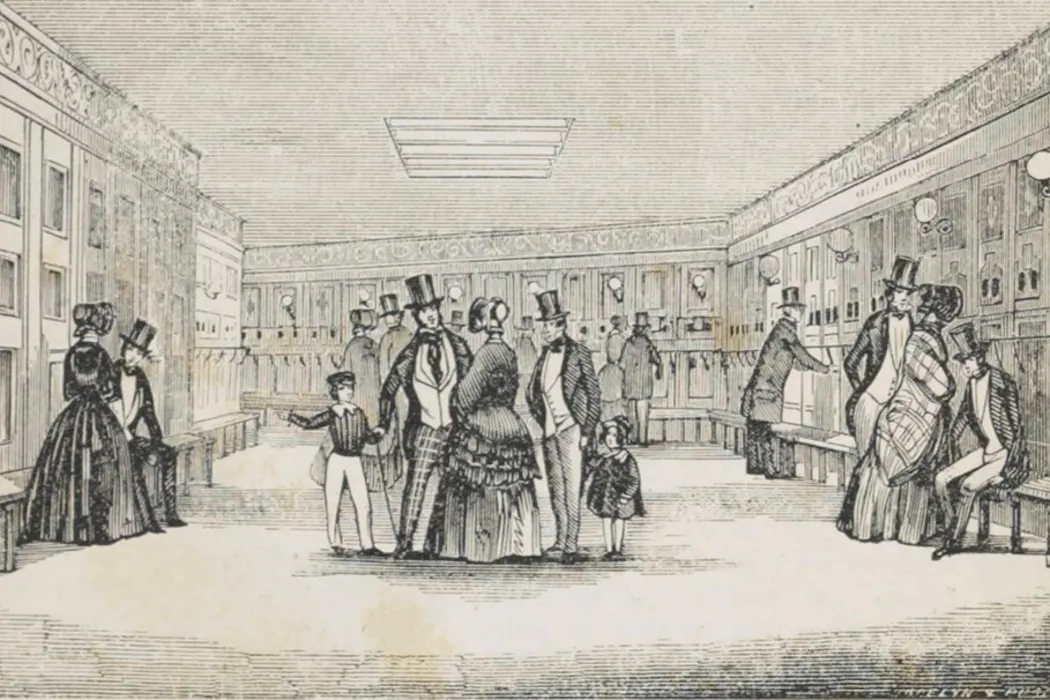
In 1838, the year of Queen Victoria’s coronation, this Old Bond Street estate agent began advertising an early form of immersive visual technology called a “cosmorama”, to offer prospective buyers a virtual tour of the properties it was selling.
A cosmorama involved looking at paintings or artists’ prints through a large convex lens, which magnified the image and enhanced the perspectival depth, creating a basic 3D effect.
A blackened square frame between the lens and picture hid the edges – enhancing the viewer’s sense of looking at a large scene through an extended opening. Clever lighting effects further enhanced the depth and immersive effects.
To create this cosmoramic view, a skilled artist would have had to visit the estate to prepare the sketches. For 20 years, Brooks & Green promoted its “cosmoramic gallery” as a proto-version of a digital walkthrough. This was nearly 50 years before photography was widely used to advertise property.

The estate agent advertised heavily in the London press. An 1842 advert claimed its office property gallery included “several hundred views of different estates”. Prospective buyers of one property were promised an “aerial perspective, the site and architectural elevation of a mansion, the local scenery and features of a park [and] ornamental grounds”.
The viewing experience of the cosmorama supposedly offered much more realism and detail than a written prospectus – without rich London buyers having to travel miles to inspect the property in question.
But this service was definitely not available to ordinary families. Only high-value mansions and estates were valuable enough to be visualised in this way. Entrance to the Brooks & Green gallery was supposedly free, but you needed an admission card – probably granted only to those who looked like they had suitably deep pockets.

For the first half of the 19th century, the cosmorama was one of the most common forms of visual show across Europe and the Americas. It was first revealed at a Paris exhibition in 1808 by the French showman Abbot Constant Gazzera. His success led to many more exhibitions throughout Europe during the 1820s and ‘30s.
In London, the Cosmorama Rooms opened in 1821 at 29 St James’s Street, moving to Regent Street in 1823. The gallery became one of the established London attractions for over 30 years. With Regent Street only a mile from Old Bond Street, it may have prompted an ambitious Brooks & Green employee to have the idea of using this innovation to market its property.
Also shown across Europe in pleasure gardens, popular science institutions, retail bazaars and fairgrounds, the cosmorama was successful because urbanisation and population growth had created a critical mass of middle-class audiences. It offered a new kind of immersive visual exhibition, reaching audiences who would never visit a fine-art gallery.
Cosmorama means “views of the world” in Greek. It was mainly used to display picturesque landscapes, renowned European sites and striking architectural interiors – such as the eruption of Mount Vesuvius, the canals of Venice or the interior of Saint Peter’s Basilica in Rome. The interest in this device reflected the public’s growing desire to be cultivated, and to learn about the wonders of the wider world.
But the cosmorama is just part of the story of immersive pictorial entertainment from the early 19th century. Other popular technologies included peepshows, panoramas and dioramas, all of which offered users a sense of virtual travel.
Panoramas were large circular paintings – the Imax cinema of the age – and dioramas were illusionistic spectacles created from 3D models. At the same time, itinerant exhibitors of peepshow boxes travelled the country’s fairgrounds displaying scenes of national events and sensational murders. Picturegoing had become part of everyday life.
I came across the Brooks & Green adverts for its cosmorama in my research for a historical project led by the Universidade Lusófona in Lisbon, which has mapped cosmorama exhibits across Europe and beyond. In all, Curiositas: Peeping Before Virtual Reality has catalogued more than 650 cosmoramas in Portugal, Spain and the UK.
Many more of these devices were exhibited in countries as far apart as North America, Brazil, Cuba and Australia. The famous US showman P.T. Barnum installed a cosmoramic gallery in his American Museum in New York.
The cosmorama was ultimately superseded by the stereoscope, which also created a 3D photographic experience by looking through lenses. Thus, the cosmorama was an early part of the story of our fascination with virtual worlds – of being taken outside and beyond ourselves, and immersed in another environment.

John Plunkett does not work for, consult, own shares in or receive funding from any company or organisation that would benefit from this article, and has disclosed no relevant affiliations beyond their academic appointment. He is the co-author of Popular Visual Shows 1800-1914: Picturegoing from Peep Shows to Film (Oxford University Press, 2025)
