❌

Reading view

AI is making disinformation harder to spot – but we’ve found a new way to catch it

Do you ever see comments on social media that seem way off topic, but still manage to wrench the discussion around to divisive political debate?

A discussion about the cost of living suddenly becomes an argument about immigration. A conversation about the war in Ukraine turns into claims about government corruption. It can feel jarring – and sometimes this is deliberate.

As generative AI becomes more powerful, malicious groups are increasingly using it to produce and spread disinformation online. Automated accounts can flood social media with convincing comments designed to sow division, inflame political debate and undermine trust in reliable information.

But our latest research offers a way to spot these attempts. Rather than trying to identify whether a post was written by AI, we focus on something different: whether it’s trying to derail the conversation.

Until recently, identifying malicious accounts was often quite straightforward. Many campaigns relied on people writing in a second language. So, posts sometimes contained grammatical mistakes or unusual word choices. Detection systems could look for these patterns in the language used.

But generative AI has changed that. AI systems can now produce fluent, natural-sounding text that is much harder to distinguish from human writing. For example, patterns like use of em-dashes and the word “delve” used to be telltale signs of a text being generated by AI. But AIs are adapting, and these older systems are increasingly ineffective.

Trying to detect AI purely from the words people use is becoming a losing battle. We believe the better approach is to look at what a message is trying to achieve.

Looking for signs

Attempts to spread disinformation often work by steering conversations away from their original topic, towards more polarising issues. So, instead of analysing individual words, we set out to build a system that could recognise this phenomenon in online discussions.

We analysed comments posted beneath BBC News videos on YouTube, a platform that has previously been targeted by organised disinformation campaigns.

For example, imagine a comment about Ukraine’s president, Volodymyr Zelensky, interacting with senior UK political figures: “Zelensky must be wondering how many foreign secretaries the UK goes through.” Now, imagine another person responding: “Mind you, Zelensky has barely been president for four years. Maybe that’s why the little tyrant bans his opposition.”

Whether that second point is true or false is not the issue. Instead of responding to the original comment, it redirects the conversation towards a different, more divisive topic.

This is known as a red herring: introducing an unrelated issue that distracts from the original discussion. These kinds of shift are difficult for conventional disinformation detection systems to identify, because they are not tied to particular words or phrases.

Composite photo collage of a person sitting at a chair with a manipulative hand hanging over them.
36% of derailing messages online included ‘red herrings’. Roman Samborskyi/Shutterstock

We manually analysed more than 1,600 comments under BBC News videos, labelling them according to 25 different features of online discussion – and discovered some clear patterns.

We found that 36% of derailing messages had red herrings, 65% had leaps in logic known as “non sequiturs”, and 20% contained personal attacks. They were also much less likely to acknowledge previous comments or express empathy.

Spotting manipulation

The next step was to see whether an AI system could recognise these patterns automatically. We used an AI to catch an AI.

For every genuine online comment, we asked an AI large language model to generate several reasonable, relevant responses. Returning to the example of UK foreign secretaries, the AI suggested replies such as: “The current situation in this country must come as quite a shock” or “One too many?”. Both responded directly to the original point.

The system then compares the real response with our AI-generated replies. If the actual comment differs substantially, it may indicate that someone is attempting to steer the conversation in a different direction. So, rather than searching for suspicious words, our system looks for unexpected changes in the flow of the discussion.

How the system works:
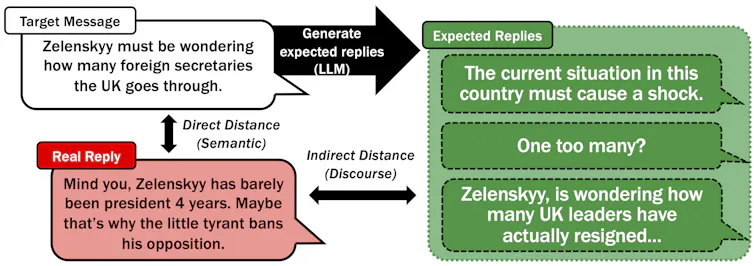
A diagram of a system for detecting derailing discourse
Discourse derailment is measured by the distance between the real reply and a set of expected replies generated by an AI. Krykoniuk, Hopkin-King & Roberts: Using LLMs to identify discourse derailment as a potential cue for disinformation in social media posts (2026)., CC BY

We tested this approach using our manually labelled dataset. In our second study, the system correctly identified derailing comments around 77% of the time.

That’s far from perfect, but no detection system is – particularly when analysing something as complex as human conversation. However, our approach performed around twice as well as existing systems based on word-level sentiment analysis. It also achieved results comparable with the level of agreement between human researchers.

Our approach is effective because the AI learns what a typical response to a conversation looks like. When a reply unexpectedly changes the discussion, the system can identify that change and analyse patterns that earlier methods couldn’t detect.


Read more: Why science GCSEs matter more than we think in a post-truth age


Of course, going off topic isn’t necessarily a sign of malicious intent or disinformation. People naturally take conversations in unexpected directions, and there are many legitimate reasons why discussions evolve.

For that reason, this technology may act as an early-warning system rather than a replacement for human judgment. It could help moderators identify conversations that deserve closer attention – but any final decisions should remain with trained experts.

There are also important ethical questions to address. AI systems can reflect biases in the data they are trained on, and they still do not understand conversations in quite the same way that people do. Improving how AI represents and interprets human discussion remains a challenge.

As AI-generated content becomes increasingly difficult to distinguish from human writing, detecting disinformation requires more than simply searching for telltale words. It requires understanding how conversations work, how they are manipulated, and when someone is trying to quietly steer them off course.

The Conversation

Seán Roberts was funded by the AI and autonomy for intelligence, surveillance and reconnaissance (A2ISR) project at the Defence Science and Technology Laboratory (Dstl) through the Defence and Security Accelerator (DASA), which is part of the UK Ministry of Defence, United Kingdom.
Kateryna Krykoniuk was funded by the AI and autonomy for intelligence, surveillance and reconnaissance (A2ISR) project at the Defence Science and Technology Laboratory (Dstl) through the Defence and Security Accelerator (DASA), which is part of the UK Ministry of Defence, United Kingdom.

  •  

Why the US-China Moon race could turn into a lunar land grab

Nasa is planning to build up its lunar base in stages. Nasa

Sixty years ago, the United States and the Soviet Union were embroiled in a race to the Moon, which the USA won. The 21st-century lunar contest, with China stepping in for the Soviet Union, has many similarities, but key differences.

The Apollo astronauts planted the stars and stripes in lunar soil, bounced – and drove – around, set up experiments and collected scientifically valuable rock samples. Ultimately, however, there was no real plan to stay.

The new Moon race is different: space agencies are targeting the south pole of the Moon due to its deposits of water ice. This water can be used for life support on a lunar base. It can also be turned into rocket fuel, splitting it into the hydrogen and oxygen used by space vehicles, making it a valuable resource.

But ice deposits are not evenly distributed and suitable spots for establishing human outposts are finite. This could spark competition to bag the best spots. So will the US-China lunar contest turn into a land grab?

For anyone growing up in the 1980s and 90s, human space travel almost seemed to become “routine”, but that era was still mainly the domain of the US and the Soviet Union (and then Russia). While the European Space Agency was growing, it focused largely on robotic scientific mission and commercial launches. Now, 30 years later, the sector has grown massively, and space is no longer the sole domain of a few superpowers.

Around 20 nations are able to carry out space launches, mainly to send satellites into orbit. But there have also been privately funded robotic missions to the Moon – albeit with significant support from government agencies.

Artemis II crew
The Artemis II mission recently returned astronauts to the Moon for the first time in more than 50 years. Nasa

Despite this globalisation of space, only three countries are currently able to send humans into space using their own rockets: the US, Russia and China. This is largely a reflection of the fact that spaceflight gets much harder when people are involved, because they need continuous supplies of food, water, heat and air.

Space is an unforgiving environment, so there is absolutely no margin for error. There’s limited scope for backup or rescue, and so everything needs to be tested and tested again.

That’s part of the reason China is on track to catch up with the US and Russia in terms of achievements in space, despite starting decades later. As of 2021 they operate a modular, permanently crewed space station called Tiangong. While not as large as the International Space Station, there is plenty of scope for expansion.

The very successful Chang'e lunar programme has returned samples from the Moon’s far side, deployed relay satellites to provide more reliable communications, and explored the lunar terrain with rovers. It’s due to these successes that China, partnering with Russia, is the main competition for the United States in Moon race 2.0.

China has been developing a lunar landing vehicle called Lanyue (CCTV Video News Agency).

So how should we expect this lunar contest to unfold? The US-led effort has a medium-term goal of establishing a permanent human base at the south pole. These lunar outposts would probably operate in a similar way to the International Space Station, and the research bases in the Antarctic, staffed by rotating crews.

Nasa is using the Orion spacecraft to carry astronauts from Earth to our closest celestial neighbour. But they will need a separate vehicle to land. These landers do not yet exist in final form. Two companies, Blue Origin and SpaceX, are competing to develop separate landing craft. An important test will take place next year: for Nasa’s Artemis III mission, an Orion capsule will attempt to dock with one or both landers in low Earth orbit.

Over the next few years a fleet of robotic craft will also send experiments, deliver cargo and use drones and rovers to scout landing sites and locations for lunar outposts. Like the lunar lander, many of these missions will be led by private industry.

Moon
Lunar bases may operate in a similar way to outposts in the Antarctic, accessible within a few days’ travel time from Earth. Nasa

But the lunar south pole is a challenging place for astronauts to operate. The ice deposits are at the bottom of craters that never see sunlight, where temperatures are more than 200 degrees below zero. There are mountaintops near the pole that are almost always visible from Earth, but relay satellites in lunar orbit are needed to help with communications when they do drop over the horizon.

The Sun also rises to just a few degrees above the horizon, and is sometimes below it for days at a time – plunging some locations into darkness. The low temperatures require heating units for humans and equipment alike. But, with inconsistent sunlight to generate solar power, other energy sources, such as nuclear fission, will be needed to keep the batteries charged.

Visualisation of the interior of Shackleton Crater, at the south pole of the Moon. NASA's Scientific Visualization Studio

The next phase of lunar exploration, pencilled in for 2029-2032, should see the laying down of key infrastructure, such as power supplies and communications systems.

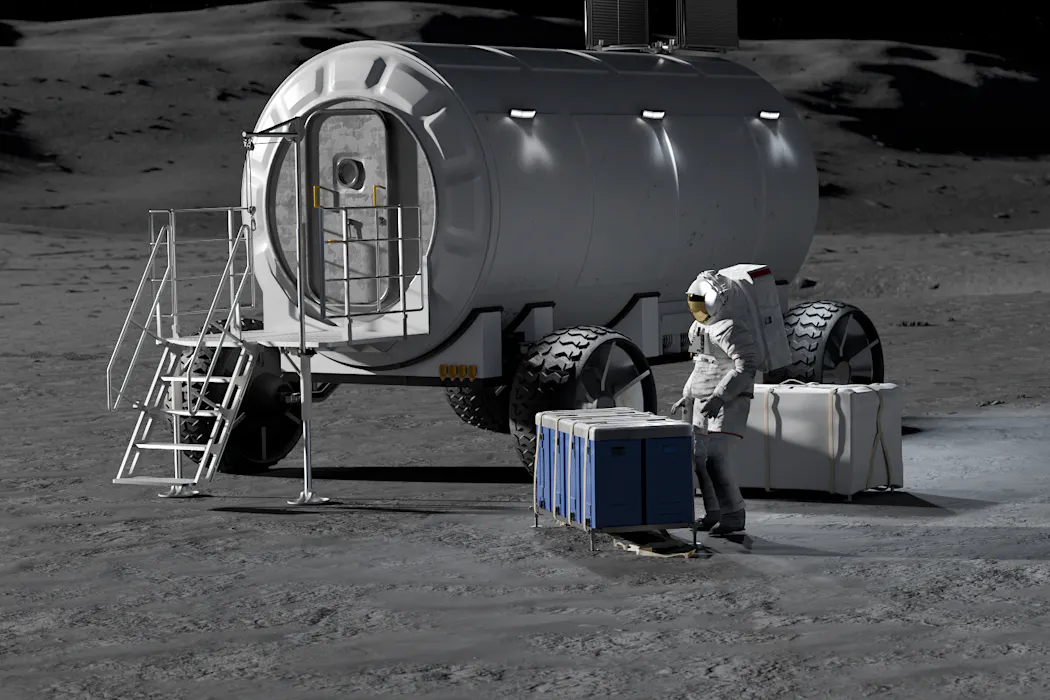
Drilling and digging will prepare the ground for an eventual base, which could be partly underground to protect against radiation and impacts by tiny space rocks. Nasa will also send a more sophisticated Japanese-built rover to the surface with a pressurised interior. This will allow astronauts to live and work in a mobile lab without bulky space suits

The plans for the final phase, from 2032 onwards, involves people living for long periods on the Moon, building up a modular base and taking advantage of the Moon’s resources to produce water, oxygen and even building materials.

The Japanese space agency and Toyota are building a pressurised rover for lunar missions. SuFlyer, CC BY

For the rival effort to build a lunar base, China is partnering with Russia and collaborating with several other countries. Over the next couple of years, Beijing will test its Mengzhou crew capsule and Lanyue landing vehicle ahead of a first lunar landing around 2030.

Construction of a base, called the International Lunar Research Station, is scheduled to be underway by 2035. The planned location for this base is also the lunar south pole, so there’s a race to pick the best spot.

There’s plenty of science to be done by crews living in these bases, some of it related to understanding the structure and formation of the Moon itself, as well as investigations related to medical and materials research.

Artemis III (now IV) candidate landing sites
Nasa has been studying potential landing sites at the lunar south pole. Nasa

Another scientific goal could be to establish radio telescopes on the far side of the Moon, where they would be shielded from the sea of radio communications originating on Earth. This could allow astronomers to detect faint cosmic signals that are otherwise impossible to detect using ground-based instruments.

And the relatively low gravity of the lunar surface could make it easier than Earth for launching missions to other destinations in the solar system. By sending up components and assembling them on the Moon, future missions could use much larger, more capable spacecraft. That’s particularly important if there are people on any of those missions.

There are also economic benefits to having a lunar presence. Private companies will make money by building the landers, rovers and other key technologies. There may also be a market in transporting equipment and experiments to the lunar surface. Making rocket fuel on the Moon would make space exploration cheaper than lugging it from Earth. It could even be used to refuel satellites in Earth orbit.

If humanity can do one thing well, for better or worse, it’s to exploit the natural environment.

The 1979 United Nations Moon Agreement states that no one can claim sovereignty over the Moon, and must use its resources responsibly – which sounds promising. Unfortunately, almost none of the countries involved with Artemis, including the US and UK, have signed it. As scientists, we live in hope that this doesn’t all turn into a big land grab.

The Conversation

Chris North does not work for, consult, own shares in or receive funding from any company or organisation that would benefit from this article, and has disclosed no relevant affiliations beyond their academic appointment.

  •  

The secret life of roots: how plants fight back against salty soils

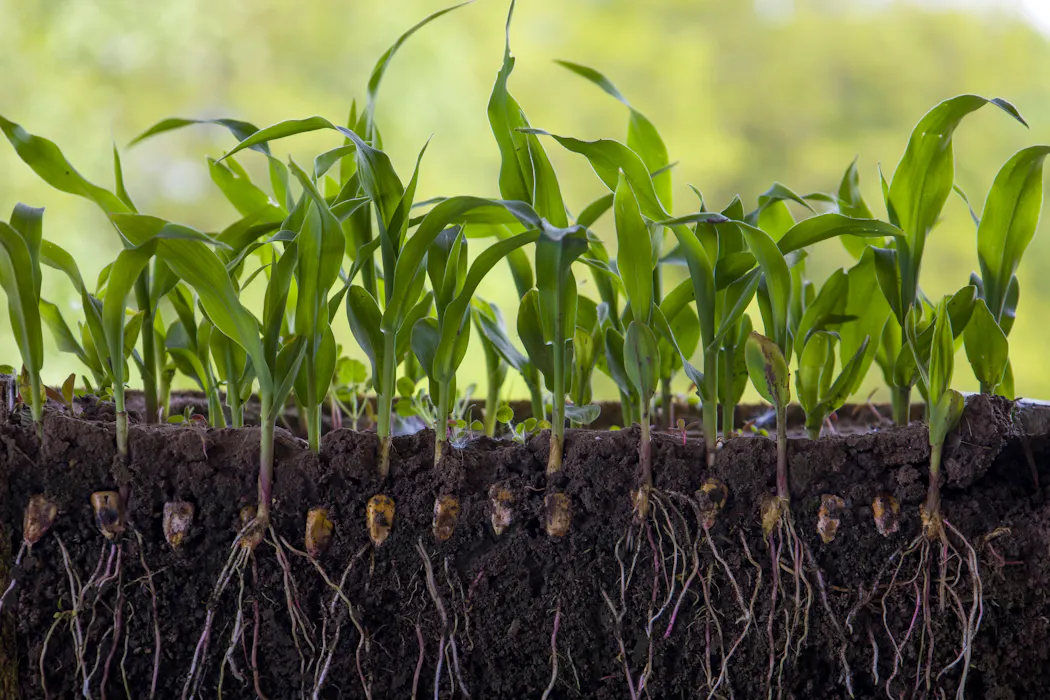
Young shoots of corn. malshkoff/Shutterstock

To people, salt is a kitchen staple. But to crops, too much of it can be devastating.

Across coastal regions and irrigated agricultural land, salt is accumulating in soils, making it harder for plants to absorb water and reducing harvests. Scientists estimate that around half of the world’s irrigated farmland is now affected by salinity to some degree.

The problem is only expected to grow. Rising sea levels can push saltwater into coastal farmland, while changing rainfall patterns and more frequent droughts are increasing reliance on irrigation. Poor-quality irrigation water and the overuse of fertilisers can worsen the problem, leaving salts behind in the soil year after year.

This is an issue because the global population is expected to approach 10 billion by the middle of the century, while demand for food continues to rise. Finding ways to grow crops in increasingly difficult conditions is becoming one of agriculture’s biggest challenges.

But plants are not passive victims. Beneath the surface, their roots are engaged in a constant battle with their environment. They sense danger, adapt their growth and deploy sophisticated strategies to survive.

Underground intelligence network

Roots do far more than anchor plants in the ground. They are the plant’s frontline, constantly gathering information about the soil around them. Every day, roots assess water availability, nutrient levels and environmental threats. When salt levels begin to rise, they are the first part of the plant to detect the change.

For plants, excess salt creates a double challenge. First, it makes it harder to draw water from the soil, almost as if the plant is trying to drink through a blocked straw. Second, sodium can build up inside tissues, damaging cells and interfering with essential biological processes.

Roots can detect these changes remarkably quickly. As salt concentrations increase, cells in the root begin sending warning signals through the plant. These signals trigger a cascade of responses, including shifts in hormone levels and the activation of emergency survival mechanisms designed to protect growth.

Aerial view of agricultural land affected by salinity
Saline soil in a wheat crop field. RUPESH_ROY/Shutterstock

One of the most remarkable things about roots is their flexibility. Unlike the branches above ground, roots can continually reshape themselves in response to changing conditions. Faced with salty soil, they may alter how deeply they grow, how many side branches they produce and even the direction they travel.

In effect, roots can steer themselves away from trouble. Research has shown that plants can bend roots away from highly saline patches of soil while continuing to search for water and nutrients elsewhere. Growth may slow in certain areas, helping the plant avoid pushing vulnerable new tissues into harmful conditions.

This hidden reshaping of the root system can make a difference to the chances of survival. By avoiding the saltiest parts of the soil, plants can reduce the amount of sodium they absorb while continuing to access the resources they need.

At the same time, roots are working to control any salt that does enter the plant. Excess sodium is dangerous because it can damage proteins and cell membranes. To prevent this, root cells actively move sodium into storage compartments where it can do less harm, or pump it back into the surrounding soil.

The result is a carefully managed balancing act that helps protect the more sensitive tissues above ground.

Can plants ‘remember’ stress?

Perhaps the most surprising area of research is the idea that plants may be able to learn from experience. Scientists are increasingly finding evidence that previous exposure to environmental stress can influence how plants respond in the future. In crops such as rice, for example, plants that have encountered salt before can sometimes cope better when exposed to it again.

Rather than involving memory in the human sense, these experiences appear to leave lasting chemical marks on DNA and associated structures within cells. These marks can influence which genes are switched on or off when stress returns, allowing plants to respond more quickly or effectively.


Read more: How plants are able to remember stress without a brain


Similar effects have been observed in responses to heat and drought stress. It suggests that plants may possess a surprisingly sophisticated ability to prepare for future challenges.

Some studies even suggest that aspects of these stress responses could be passed to the next generation, potentially helping offspring cope better with harsh environments. While many questions remain unanswered, the possibility that plants can retain and pass on information about past stresses is opening up an exciting new area of research.

But what does this mean for future food supplies? As salt levels in soil increase, crops face mounting pressure. Salinity can stunt growth, reduce yields and leave plants less able to cope with other challenges such as drought and extreme heat. In reality, these stresses often arrive together. That’s why understanding roots has become such an important scientific priority.

The better researchers understand how roots detect, avoid and tolerate salt, the better equipped breeders will be to develop crops that can thrive in difficult conditions. By identifying the root traits that help plants survive saline environments, scientists may be able to breed or engineer varieties capable of maintaining yields on land that would otherwise become less productive.

Much of this battle is invisible, unfolding centimetres below our feet. But the decisions that roots make underground could have profound consequences above ground. In a future where climate change is making agriculture increasingly unpredictable, the key to protecting food supplies may lie in understanding how plants wage their quiet war against salt.

The Conversation

Amber Williams receives funding from UKRI.

  •  
❌