
❌

Reading view

Meet Likweli – the newly named monkey that hints at Congo’s hidden secrets

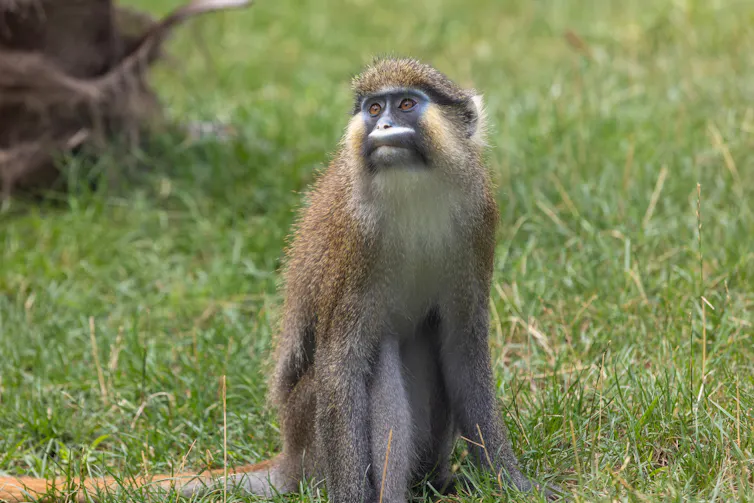
Colobus congensis, known locally as 'likweli', has a dramatic black face with pinkish-orange lips. Junior Amboko, CC BY-NC

Hearing that a new primate species has been named is exciting news for scientists because primates across the world are in decline. According to the IUCN Red list, a global inventory of animal extinction risk, 44.4% of primate species are classed as endangered or critically endangered (versus 13.2% of all mammals).

In most cases when the number of primate species increases, it is because a known species has been upgraded from the status of subspecies to species, or two populations that were previously considered the same species are re-classified into two separate ones. The African monkey Likweli (Colobus congoensis), however, is a completely new addition to the primate family tree, which makes this news particularly interesting.

Likweli is a colobus monkey. The word colobus stems from the ancient Greek word ΞΊΞΏΞ»ΞΏΞ²ΟŒΟ‚, meaning truncated, because they don’t have much of a thumb. It has an orange mouth, lives in the Democratic Republic of Congo and is part of the large subfamily colobines. Colobines are found in both Asia and Africa, but not in the Americas.

Three colobine genera are found in Africa. The olive colobus genus, has one species (a small monkey with drab olive-brown fur and a grey-black face). The red colobus genus and the black-and-white colobus genus, that Likweli belongs to. What is interesting about Likweli is that its closest relative is the black colobus (Colobus satanas), which has two subspecies – the critically endangered Bioko black colobus on the Island Bioko (20 miles off the coast of Cameron) and the Gabon black colobus on the nearby mainland. Their nearest range is 1,200km away from the range of Likweli monkeys.

Colobines have specialist digestive adaptations, including multi-chambered stomachs, that allow them to digest high fibre leaves and toxic seeds. To accommodate their large gut, many colobines are relatively large for monkeys. Likweli is smaller than the other colobus species though, and more comparable to some Asian colobines (like langurs and leafmonkeys). African colobines depend on forests and rarely come to the ground, but they can survive in small forest fragments and mangroves.

Likweli’s orange tinted mouth resembles that of some Asian langurs. But members of the Colobus genus have all black faces, making it almost impossible for human observers to recognise individuals based on their facial features. This also makes it hard to see their facial expressions. Scientists believe these monkeys’ more subtle facial expressions are related to the relatively low levels of competition within groups and less stringent social hierarchies.

Relationships between groups, however, can involve threats, loud roars and sometimes fights. Colobus males produce a loud roar to warn group members of danger, scare off predators, or during encounters with other groups of the same species. Likweli monkeys produce a similar roar although the researchers were unable to determine the sex of the callers. Likweli’s roar resembles that of the black colobus, but is distinctly different from that of other nearby colobus species.

It is not surprising that the central African region is providing new scientific discoveries. The area has been politically unstable for decades and a difficult place to conduct scientific work in. Working in these forests as a scientist means a risk of running into rebels, soldiers and professional poachers.

But the area is not only under-studied, it also represents a birthplace for many new species because the region has diverse soil including one of the largest peatlands on the globe. Plus, the landscape has been shaped and reshaped over centuries by a combination of tectonic plate movement, climatic changes, human influences and changes in its wetlands and rivers. Current climate change forecasts suggest that the area will remain suitable for colobus species in the future.

Black money with long white hair sits in tree
The Angolan colobus. Tomas Hejlek/Shutterstock

Some forests in this region contain around 20 species of primate, a value only matched by some Amazonian regions.

Most of those species are cercopithecids, the sister sub-family of the colobines. Likweli also shares its range with the striking Angola colobus, Colobus angolensis and the Lomami red colobus (Piliocolobus parmentieri). Likweli, like many red colobus species, has often been found mingled in with groups of other primates (up to six species), like guenons and sometimes Angola colobus or Lomami red colobus.

There are also apes (gorillas, chimpanzees and bonobos) in the region. Chimpanzees in other regions are well known to hunt red and black-and-white colobus monkeys for meat.

Likweli lives in small groups (a mean of six but this can range from one to 20). All Colobus species typically live in units of multiple females together with one male and their offspring. Multi-male groups are rare. Some Colobus species, like the Angola colobus, can form large aggregations of over 200 monkeys, consisting of multiple smaller one-male units travelling together.
Monkey with long facial hair sits in grass.
The moustached guenon or moustached monkey. Roberto Dani/Shutterstock

The Likweli is only the fifth new African monkey species to have been described since 1975, one of which was a local guenon, the Lesula (Cercopithecus lomamiensis). Meanwhile, Miss Waldron’s red colobus has probably gone extinct as there have been no conclusive sightings since 1978, despite intense searching after some unconfirmed sightings in 2000 and 2001.

The Likweli is already considered endangered and protection of this hotspot for biodiversity is urgently needed.

There may well be more undescribed primates (although another monkey species is unlikely) hiding in these forests. It is nice to imagine that these African forests still contain hidden secrets.

The Conversation

Amanda Korstjens does not work for, consult, own shares in or receive funding from any company or organisation that would benefit from this article, and has disclosed no relevant affiliations beyond their academic appointment.

  •  

A Lost Human Lineage May Have Left a Genetic Legacy in People Today

Homoerectus dmanisi Skull PaleontologyHomo erectus may have left a detectable genetic trace in living humans through ancient interbreeding with Denisovans. For much of the 20th century, human evolution was often pictured as a branching tree. One trunk split into separate limbs, and each ancient human relative, or hominin, occupied its own tidy branch. That was the version many [...]
  •  

Why power banks in hold luggage pose such a risk on holiday flights

Skrypnykov Dmytro / Shutterstock

Airline passengers are being warned not to pack power banks in their hold luggage ahead of the summer holiday travel period.

Devices with rechargeable batteries, like mobile phones, laptops, tablets, and smartwatches can be plugged into power banks on the go, where charging sockets may not be available. However, power banks are not danger-free or environmentally friendly.

The warning has come from the UK’s Civil Aviation Authority (CAA), which believes that many travellers still aren’t aware of the rules – or the fire risk.

Passengers on UK flights must take power banks – and other items containing lithium batteries – with them into the cabin. They must never be used to charge another electronic device while on the plane. Additionally, only two power banks per person are allowed on a flight.

Consider a scenario where you are about to take off on a flight. You have settled into your seat, started using your mobile phone, and put it in airplane mode. All of a sudden, an unusual hissing sound comes from your bag; smoke starts rising, and within seconds, there is a fire inside your luggage.

This actually happened on a flight between South Korea and Hong Kong in January 2026, when a power bank caught fire in mid-air. The accident on this flight is not a rare occurrence; hundreds of fires, explosions and other safety incidents involving lithium batteries and power banks have been recorded by the US Federal Aviation Administration (FAA).

The main reason for accidents involving power banks is the lithium-ion battery, the most common battery type used in them. The lithium-ion battery has a tendency to overheat, which can trigger a thermal runaway in which the temperature rises rapidly, leading to the battery’s explosion.

A lithium battery fire broke out on an Air China flight in 2025 (NBC News).

Such an explosion can occur for many reasons, including poor design, manufacturing issues, and improper use. In 2017, a family in the UK woke to smoke filling their home. The cause of the fire was a power bank charger, plugged into an electrical outlet. It overheated and set itself ablaze. Their rooms were burned down.

From a scientific point of view, the answer is obvious: heat is the sworn enemy of lithium-ion batteries. Each time you recharge or discharge a power bank, chemical reactions produce heat in the battery. And if that heat is not properly controlled – whether due to inadequate design or excessive environmental temperature – a thermal runaway occurs (an uncontrolled, self-heating chain reaction).

In 2026, an Australian man left a power bank in his vehicle on a hot day in Mount Nathan in Queensland. The extreme heat caused the battery to explode, starting a fire. Luckily, no one was injured in the incident.

Electric shocks

Fire and explosions are not the only hazards associated with these gadgets. They can also cause a dangerous electrical shock to users. This is despite the fact that they are operating at lower direct current voltage.

If the power bank becomes faulty due to being dropped, getting wet or because of manufacturing defects, the circuitry inside may fail. This would cause the device to shoot a surge of electricity into the user’s body.

In May 2026, a 75-year-old woman in the US died when her power bank exploded while charging it.

China, which manufactures many of the world’s power banks, has seen manufacturers recall hundreds of thousands of devices due to defects. Some of these faults have been blamed on downstream suppliers.

Another alarming trend has been the rise of counterfeit power banks.

I have spent a great part of my career and life caring about the environment and developing eco-friendly technologies, and the widespread use of power banks is a serious concern due to their negative environmental impact. The manufacturing and disposal of power banks may generate large amounts of electronic waste that can pollute soil, water and air.

Moreover, the extraction of lithium and other materials for power-bank production poses environmental and societal risks. For example, lithium mining in Chile’s Atacama desert has resulted in pollution and friction with indigenous communities.

As a scientist and professor of engineering, I urge people to be aware of the potential dangers posed by power banks and how these risks can be mitigated. By adhering to precautions, such as charging devices on hard, non-flammable surfaces, we can ensure the safe usage of these devices.

In addition, it is vital to understand the significance of responsible innovation and sustainability to ensure that technologies can be safely developed and deployed.

Your power bank is a powerful tool, but it demands respect. Treat it with the caution it deserves.

The Conversation

Amor Abdelkader does not work for, consult, own shares in or receive funding from any company or organisation that would benefit from this article, and has disclosed no relevant affiliations beyond their academic appointment.

  •  
❌