Bolivia recently began overhauling one of its principal mining laws, with the goal of modernizing the industry and improving oversight. Civil society and Indigenous groups have raised concerns about the process, but officials say the new mining code will promote economic development and include environmental protections. “We want a mining code that responds to the current needs of the sector, generates legal certainty, and establishes clear rules to support the development of Bolivian mining,” Marco Antonio Calderón de la Barca Quintanilla, the minister of mining and metallurgy, said in a statement. The ministry says it’s held weekly meetings with key mining stakeholders about their concerns and proposals for the new mining code. This month, their ideas were given to a technical committee to consider while drafting a preliminary bill, which will be delivered to the national legislature for approval. The government hasn’t announced when the bill will be completed. The current code was passed in 2014 and establishes the mechanisms for mining development, environmental oversight, and the participation of local and Indigenous communities, among other things. Updates will focus on strengthening mining rights, promoting investment, formalizing mining activity, and improving transparency, a ministry statement said. Updates will also involve “consolidating responsible environmental management.” The details of potential changes haven’t been finalized or released. But local reports said some ideas have included new tax and royalty structures, removing the 30-year limit on mining contracts to extend them indefinitely, and restructuring the ministry and other mining institutions. Other ideas include protections for…This article was originally published on Mongabay
Populations of sardinella, an important protein-rich fish, are in rapid decline in the waters off Guinea-Bissau in West Africa. The decline appears to be related to industrial fishing for two species of sardinella used to make fishmeal, according to a report by investigative news organization OCCRP. In Guinea-Bissau, fish like the Madeiran sardinella (Sardinella maderensis) and round sardinella (Sardinella aurita) are among the primary ingredients in fishmeal, a processed fish product added to livestock feed for added protein and nutrients. But sardinella is also a crucial food for people in Guinea-Bissau and other West African nations. A fisheries assessment for the Guinea-Bissau government showed sardinella stocks have been decimated, according to the OCCRP report. This decline coincided with the arrival two Chinese fishmeal factories and a fleet of Turkish fishing boats off the coast of Guinea-Bissau. In an email to Mongabay, OCCRP report co-author Josef Skrdlik said the migration patterns of sardinella still aren’t fully understood, so there could be other explanations for the decline. “That said, the assessment, combined with the export data we’ve compiled, points to the Chinese-owned factory ships as the main culprits,” Skrdlik said. “The export data indicates that the production on the ships — supplied by a Turkish fleet for which sardinella was a key target — took place at a scale consistent with the decline in the sardinella stocks observed between 2013 and 2025,” he added. “In particular, fishmeal exports by a company linked to the floating factories corresponded to at least 350,000 tons…This article was originally published on Mongabay
Several years of severe drought are forcing people to leave their homes in Angola to search for water and food in neighboring Namibia. “There is real hunger and thirst here; that’s why the village has become depopulated,” Nghikembua (not his real name), who lives in Cunene Province in southern Angola, told Amnesty International in 2021. Nghikembua said nearly all the able-bodied people of his village have left, leaving behind only the elderly, like himself, “Those who still had some strength left felt forced to leave the village for Namibia.” More than 1.8 million people live in Cunene and nearly 75% of the population is rural and depends on pastoralism and subsistence farming. “Southern Angola has experienced repeated severe droughts, extreme heat and environmental degradation for quite a number of years, leaving families without water, crops, or livestock,” said Victor Nyamori, an Amnesty International researcher and migration lawyer who collected the testimonies for the recently published report featuring Nghikembua. Approximately 30% of the area has been degraded by desertification, according to the Amnesty International report, leaving many subsistence communities without livelihoods. “Namibia has also suffered from drought, but the state has responded much better and has put solutions in place to prevent the population from falling into food insecurity and to ensure access to water,” Nyamori told Mongabay in a phone call. Between 2023 and 2024, a strong El Niño event brought the most severe drought in more than a century to the region. Namibia responded to the drought by expanding…This article was originally published on Mongabay
Two Przewalski’s horse foals were born in a reintroduction center in the grasslands of central Kazakhstan in late August. They are reportedly the first wild horses born on Kazakh soil in more than 200 years. The first foal, a male, was born Aug. 22 to a 7-year-old mare named Tessa. The second, also male, followed on Aug. 31, born to a mare named Umbra. They share the same father, a stallion named Zorro who has since died. The Equus ferus przewalskii foals have not yet been named, but their births are being celebrated as a milestone of the Kazakhi reintroduction effort. “The birth of these two foals is important because it shows that the horses are adapting to this climate, to this territory,” Alyona Krivosheyeva, conservation director of the Association for the Conservation of Biodiversity of Kazakhstan (ACBK), told Mongabay by phone. “This is the proof of success of what we do.” Rewilded Przewalski’s horses with the second foal born on Aug. 31. Image courtesy of Kanat Batyrkhanuly/ACBK. Both foals were born inside a 56-hectare (140-acre) enclosure at the Alibi Wild Ungulates Reintroduction Center, part of Kazakhstan’s 489,000-hectare (1.2-million-acre) Altyn Dala State Nature Reserve. The reserve has also been an important recovery site for saiga antelopes (Saiga tatarica) and Asiatic wild asses (Equus hemionus kulan). Known locally as kertagy, Przewalski’s horse is the only living wild relative of the domestic horse. It was listed as extinct-in-the-wild until one adult was found in 1996, after which it was re-listed as critically…This article was originally published on Mongabay
Scientists recently described a new species of a tiny brown frog found in the Amazonian floodplain forests of Ecuador and northwestern Brazil. It looks nearly identical to related species but its slow, widely spaced out call sets it apart, researchers note in a study. “I’ve had to get into arguments because people said the frog I study is ugly,” lead author Marianna Borburema, who studied the species as an undergraduate student at the Federal University of Minas Gerais and is now a researcher at the University of São Paulo, told Mongabay by phone. “I find it absurd. The frog I study is beautiful! It is super cute.” “Super cute” specimen of the newly described Adenomera varcena species. Images courtesy of Marianna Borburema. Despite dazzling the study’s lead author, the evolution of the frog, named Adenomera varcena, hasn’t been one focused on appearances. Biologists call this a “cryptic species”, a species whose external traits can be very similar to related species. It is roughly 22 to 24 millimeters (0.9 inches) long and has brown skin and dark blotchy patterns. “Because of natural selection, the pressure isn’t on the frog’s appearance, it’s on the call,” said Borburema, who spent three weeks analyzing the frogs’ sounds. “We understand that evolution happens faster in their call because the song is what interests the female.” Related species typically call frequently, some up to 70 notes a minute. However, the songs of A. varcenas include just one to five notes a minute, the slowest rate documented…This article was originally published on Mongabay
July 31 is World Ranger Day, which celebrates the work rangers do for the natural world and commemorates those killed or injured in the line of duty. Among them was Anton Mzimba, head ranger at Timbavati Private Nature Reserve in South Africa, where he had served for 25 years. On July 26, 2022, Mzimba was shot dead outside his home by two men, allegedly in connection with his rhino protection work. Four years later, the case remains open, with no arrests made. “If a ranger of Anton’s standing and integrity can be killed for doing work that serves the greater good, and there are still no consequences for the people who perpetrated this crime, what confidence does that inspire in the men and women holding the line on the front lines of conservation?” John Jurko II, lead director of a documentary about Mzimba titled Rhino Man, told Mongabay by email. In 2024, Jurko II launched a “Justice for Anton Mzimba” campaign to help speed up the investigation. Mzimba’s killing is being investigated by the Hawks, a specialized unit within the South African Police Service. Hawks typically investigate organized crime and police murders, but took over Mzimba’s case because of its links to rhino poaching and an ongoing investigation, according to Nico J. Gerber, the police general who heads the Hawks in Mpumalanga province, where Mzimba was killed. Gerber told Mongabay by email the case “has progressed well” and the case file was submitted to the Director of Public Prosecutions, which decides whether…This article was originally published on Mongabay
Long-tailed macaques, monkeys native to Southeast Asia, have been listed as endangered on the IUCN Red List since 2022 after their populations declined by at least 50% over 30 years. Yet, the U.S. Fish and Wildlife Service (FWS) has twice now declined to consider protecting the species under the domestic Endangered Species Act. The most recent decision was announced on July 14, 2026. Such a listing would have restricted the primate’s import for biomedical research, one of the biggest threats to its population. Mongabay asked FWS for comment but did not receive a response by publication. Long-tailed macaques (Macaca fascicularis) can live in a wide variety of habitats, from riverbanks and mangroves to rainforests and, even, cities. Despite their adaptability, populations of the medium-sized primates have declined sharply due to habitat loss, climate change, hunting and trade, primarily for biomedical research, according to the IUCN, the global wildlife conservation authority. A 2025 study found that macaques poached from the wild are likely supplementing the breeding farms in Cambodia, Laos and Vietnam that supply laboratories abroad. Lisa Jones-Engel, chief scientific advisor for primate experimentation with People for the Ethical Treatment of Animals (PETA), said trapping macaques for medical testing is the biggest factor in their population decline. “Because habitat change, climate change — these animals are so fabulously adaptable, they could roll with that,” Jones-Engel told Mongabay in a video call. She said entire troops of long-tailed macaques are captured from the wild, including infants and breeding females, and sold to breeding…This article was originally published on Mongabay
Kenya Wildlife Service (KWS) is investigating the deaths of 15 elephants in the Amboseli savannah ecosystem, near the border with Tanzania. KWS told Mongabay that some preliminary laboratory investigations have found a toxic substance in the dead elephants. The animals were found between June 24 and July 24, 2026, at the Kimana Sanctuary and Kuku Ranch, an area at the crossroads between three national parks in southern Kenya. “Ten elephants exhibited similar clinical signs, including partial paralysis that left them unable to stand before dying within one to two days,” KWS communications Director Duncan Wanyama said in a statement provided to Mongabay. “The remaining five carcasses were too decomposed or had been scavenged, making it impossible to establish the cause of death. The condition primarily affected adult females and their calves, with only one adult male reported.” The University of Nairobi detected a toxic substance in the elephant samples they tested. However, test results from Government Chemist, a Kenyan national lab, were negative for toxic substances. “Further quantitative analysis is underway,” KWS stated. Some elephants were equipped with tracking devices, and authorities were alerted to the deaths when the tracked animals stopped moving, Wanyama told Mongabay in a phone call. He said investigations, including analysis of water sources and other resources, were underway to determine if the elephants were exposed to a common source. “The condition observed is confined to the affected elephants, and there is no indication that it is transmissible to humans,” Wanyama said. Meanwhile, local leaders want…This article was originally published on Mongabay
A federal judge in Brazil has given the country’s government 24 months to recognize the traditional territory of the Kajkwakratxi-Tapayuna Indigenous people in the northwestern state of Mato Grosso. The court accepted evidence from federal prosecutors that detailed decades of government inaction following massacres, forced displacement and other human rights violations against the Kajkwakratxi-Tapayuna people. The ruling, issued on June 11 by Federal Judge Pablo Kipper Aguilar in Diamantino, Mato Grosso, also orders the federal government to issue a public apology and pay 10 million reais ($2 million) in collective moral damages. “It has been a very difficult journey,” Yaiku Suya Tapayuna, a leader of the Kajkwakratxi-Tapayuna people, told Operação Amazônia Nativa (OPAN). “It is a decision we have dreamed about, and we are now celebrating this victory.” In his decision, the judge drew upon decades of evidence of violence against the Kajkwakratxi-Tapayuna, beginning with a massacre in 1953 involving armed attacks and deliberate poisoning. A dictatorship-era report published in 1967 documented that a nearby rubber tapping business left a sack of sugar laced with arsenic on a riverbank in the Tapayuna area for the Indigenous community to consume. Another poisoning attack occurred in the 1960s with meat laced with tick poison. In 1969, a “poorly planned” official visit organized by the federal Indigenous affairs agency brought in the influenza virus, contaminating the Kajkwakratxi-Tapayuna people. An account given to national media at the time described, “Indigenous corpses decimated by the flu across the forest, and children nursing from the breasts…This article was originally published on Mongabay
The Kenya Wildlife Service (KWS) has been accused of harassing co-petitioners in a case challenging the relocation of the Nairobi Animal Orphanage to make it part of the larger Bomas International Conference Complex. The proposal would carve out between 76 and 89 acres inside Nairobi National Park for upgrades to wildlife rescue and rehabilitation facilities. Conservationists are concerned that the facility, which will include parking for 1,300 vehicles, poses threats to a protected indigenous forest and habitat for the critically endangered black rhino. On July 16, the Environment and Land Court in Nairobi ordered its deputy registrar Vincent Kiplagat to visit the park in the presence of all parties to prepare and file a report about the proposed facility. The Nairobi-based NGO Save the Nairobi National Park (SaveNNP) said it was denied court-ordered access to the site. In a statement sent to Mongabay, SaveNNP condemned “threats and intimidation” by KWS personnel. In the same statement, SaveNNP and JustAct, another Nairobi-based NGO, accused the KWS of planning to “control the narrative and ensure the voice of Kenyans was not heard by the courts or the media while on site.” Similar claims were made by Friends of Nairobi National Park. Mongabay asked KWS spokesperson Duncan Wanyama for a comment and was referred to a local media report in which Wanyama said the visitors were not obstructed and that rangers were just enforcing standard protocols within the park. The activists said they were later allowed in, but “only once the court officers, KWS…This article was originally published on Mongabay
Sea salt sold in markets across Lombok Island, Indonesia, is contaminated with microplastics, according to a recent study. Microplastics are small plastic particles less than 5 millimeters in length that form when larger plastic waste breaks down. Microplastics have been found everywhere scientists have looked for them, including seafood and table salt, raising concerns for public health. Much of the plastic waste generated on land ends up in the ocean where it can break down into microplastics. Because sea salt is created by evaporating salt water, it is particularly vulnerable to microplastic contamination when the source water contains suspended microplastics. Scientists estimate that there are millions of tons of plastic pollution in the ocean, by far the largest form of marine pollution. The research team lead by Anna Ida Sunaryo Purwiyanto collected 20 salt samples from vendors at 10 markets across Lombok Island. They extracted potential microplastic particles from the samples and identified the particles using a stereo microscope. Every salt sample contained microplastics, “indicating widespread contamination across the surveyed markets,” the study notes. The researchers found some variation in microplastic contamination levels in different markets and in crystal versus fine sea salt. However, the results consistently showed that the source material for the salt, the ocean surrounding Lombok Island, is contaminated with microplastics. The researchers note that crystal sea salt had higher levels of microplastics than fine salt, likely because fine salt is washed and filtered, which removes some microplastic particles. They conclude that additional washing and filtering of salt…This article was originally published on Mongabay
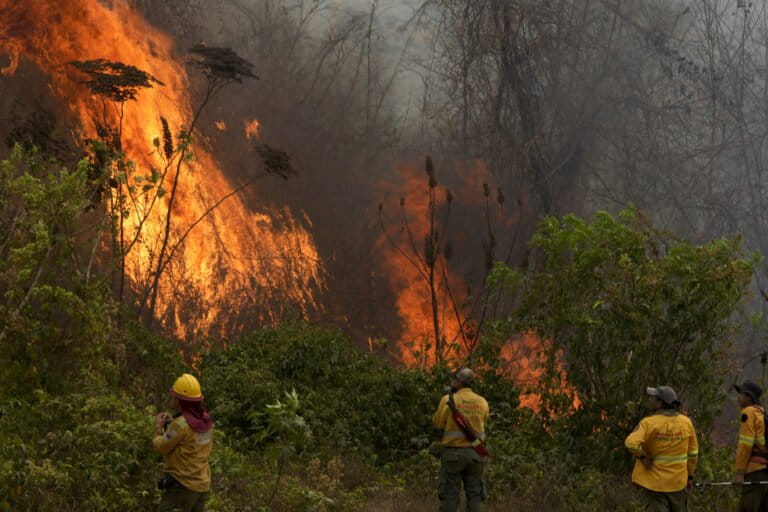
Wildfires have burned thousands of hectares of forest and savanna in the Chacobo-Pacahuara Indigenous territory in the Beni department of northern Bolivia, according to satellite imagery and on-the-ground sources. The fires likely resulted from illegal burns in pastures surrounding the Indigenous territory. The fires hit Chacobo-Pacahuara in September and October 2025, the third consecutive year of unusually high fire activity in the Indigenous land, according to the most recent data released by Global Forest Watch, a platform that uses satellite data to track forest loss worldwide. The flames consumed Indigenous subsistence crops and homes. Locals also expressed worry for the safety of isolated Indigenous communities. “We have Indigenous relatives who live in voluntary isolation, and we do not know what has happened to them because the forest and the forest islands where they lived burned,” Constantino Toledo Ortiz, a leader of the Chácobo people, told Mongabay in a voice message. “We think they may have crossed into Brazil.” According to a bulletin published by the Center for Legal Studies and Social Research (CEJIS), 1,141 heat hotspots, typically caused by fire, were recorded in the territory between Jan. 1 and Sept. 12, 2025. CEJIS recorded an additional 845 heat hotspots between Sept. 29 and Oct. 16, 2025. The sharp increase is in line with the Bolivian Amazon’s typical fire season, which usually peaks around August and September when the climate is at its driest. Chacobo-Pacahuara was the most affected Indigenous territory in the Bolivian Amazon in 2025. Map by Andrés Alegría/Mongabay. In 2024,…This article was originally published on Mongabay
The world’s largest meatpacking company, JBS, has scrapped two of its key environmental goals in its latest annual sustainability report. JBS’s “Net Zero by 2040,” which aimed to reduce greenhouse gas emissions throughout its supply chain, and zero deforestation targets were substantially rolled back compared to previous years, according to its 2025 Sustainability report, published July 8. Instead, the company redesigned its targets with a focus solely on its most direct emissions, called Scope 1 and Scope 2. Those include direct emissions from JBS factories, vehicles, and electricity provided to its facilities. Indirect emissions, called Scope 3, make up the vast majority of the company’s emissions and were dropped. Those include methane from cows, and transportation and deforestation emissions from supplier farms. “Backtracking on measurable targets doesn’t diminish the scrutiny JBS will face for its climate and nature-wrecking record of pollution, deforestation, land grabbing, human rights abuses and corruption,” Gemma Hoskins, global climate lead at U.S.-based environmental nonprofit Mighty Earth, wrote in a statement. Until 2025, JBS touted a commitment to “zero illegal deforestation in all Brazilian biomes by the end of 2025 for direct and indirect cattle suppliers,” Mongabay previously reported. JBS justified the change by saying it’s difficult to control indirect emissions. “Bold ambition is fine, but you now need to actually have really good, measurable, accountable goals. And that’s what we’re doing — we’re now setting goals that we believe where we have operational control,” Jason Weller, JBS’s chief sustainability officer, told the Financial Times. JBS operates more than 250 meat production facilities, mostly in Brazil and the U.S. It…This article was originally published on Mongabay
The European Union has dropped leather from its final list of products targeted under the bloc’s landmark antideforestation law. Experts say the July 13 decision is the result of industry lobbying rather than a true reflection of leather’s deforestation footprint. The EU deforestation regulation, or EUDR, mandates that companies selling commodities such as cattle, soy, palm oil and cacao in the European market must prove their supply chains aren’t sourcing from recently deforested land. The law is currently set to take effect at the end of this year, following two years of delays. It has faced a series of revisions that effectively weaken the law since it was first passed. “The decision to exclude leather from the EUDR is deeply disappointing. It ignores strong evidence linking European consumption of leather to deforestation in Latin America,” Fyfe Strachan, policy lead at U.K.-based watchdog organization Earthsight, wrote in an email statement. “It overlooks the voices of EU citizens from the recent public consultation and instead prioritizes the interests of industry lobbies,” she added. As Mongabay recently reported, the European Commission’s own research concluded that leather could account for up to 17% of the deforestation footprint linked to imports covered by the EUDR. Transparency records compiled by the nonprofit LobbyFacts revealed that leather industry groups met with lawmakers at least 22 times since 2021, and the EUDR was explicitly listed as a discussion topic in 11 of the meetings. The lobbying efforts were led by two Italian leather tannery unions, COTANCE and Unione…This article was originally published on Mongabay
In 2008, wildlife researchers surveying a massive, underexplored forested region in the Democratic Republic of Congo photographed a black monkey. That region eventually became Lomami National Park. And now, nearly 20 years later, the team has confirmed in a study that the black primate is a new-to-science species of colobus monkey. The monkey isn’t well known by local communities, but those who have encountered it call it likweli, said John Hart, study lead author and scientific director at the Lukuru Wildlife Research Foundation, which spearheaded the creation of Lomami. The researchers have given the monkey the scientific name Colobus congoensis. Both male and female likweli are almost entirely black. What makes the species easy to distinguish from other colobus monkeys is a prominent patch of pinkish to orange-cream bare skin surrounding the mouth, Hart told Mongabay in a video call. When the likweli was first photographed in 2008, it was one of several monkeys the researchers couldn’t identify. “They are not in our field guides,” Terese Hart, the Lukuru foundation director, wrote in a blog post in 2008. Another of those monkeys, locally named lesula, also turned out to be new to science and was scientifically described as Cercopithecus lomamiensis in 2012. With the focus on the lesula and conservation work in the area, the likweli went on the back burner, John said. It was only 10 years later, in 2018, that local field researcher Jean Pierre Kapale photographed likweli several times during surveillance patrols and surveys. Kapale insisted the…This article was originally published on Mongabay
In its most recent update to the Red List of threatened species, the International Union for Conservation of Nature (IUCN) identified deep-sea mining as the biggest threat to a critically endangered deep-sea snail. Discovered in 2021, scientists named the mollusk Lirapex felix — the lucky lirapex — because of the luck it took to find the roughly 2.5 millimeter (0.1 inch) long sea snail. So far, only two individuals have been recorded in one location 2,000 kilometers (1,242 miles) south of Madagascar in the Longqi vent field on the Southwest Indian Ridge. “Luckily, these two specimens gave us just enough information on its morphology and DNA so we could describe it comprehensively and give it a name,” Chong Chen, the scientist who first described the species, told Mongabay via email. “This likely means this species is naturally rare, making it especially vulnerable to anthropogenic impacts like deep-sea mining.” The species was found in an area that overlaps with a 15-year exploration license for polymetallic sulfide mineral extraction. The license was issued by the International Seabed Authority to China and expires this year. If exploitation-phase mining goes ahead, sediment plumes could smother and kill vent communities, Chen said. Even though little is known about the Lirapex felix, it was classified as critically endangered. By assigning the highest risk category the IUCN has taken a precautionary approach and recommends further research into mining impacts. It has also called for surveys to see if the species exists at other vent sites along the…This article was originally published on Mongabay
The European Union’s parliament voted decisively to end its logging oversight partnership with Liberia on June 17, marking the end of a long-running attempt to reform the country’s timber sector through foreign aid. The vote, which passed with 92% in favor, is expected to lead to a formal decision by the EU to terminate the agreement. The EU’s “Voluntary Partnership Agreement” (VPA) with Liberia was part of its signature effort to tackle illegal logging and deforestation in timber-exporting countries. It was designed to help overhaul Liberia’s logging industry, long associated with corruption and environmental mismanagement, and facilitate legal trade with the EU. Under the terms of the agreement, the EU provided funding for Liberia to set up tracking and transparency systems for timber shipments. Liberia committed to verifying that all logs shipped out of its ports were felled legally and to carve out space for local environmental groups to monitor its compliance with the agreement. Similar agreements were signed with eight other countries, including four in Africa. But more than a decade after the December 2013 agreement was implemented many of the EU’s expectations were unmet, including the development of a licensing system for Liberian logs to access EU markets, a centerpiece of the agreement. After repeatedly missing deadlines, the licensing system was never implemented. Last year, the EU Commission recommended the VPA be canceled. Environmental groups opposed the commission’s recommendation, saying that despite the agreement’s weaknesses it had been invaluable in promoting local oversight of the notoriously opaque timber…This article was originally published on Mongabay
Fifteen countries from Africa, Asia, Latin America and Europe adopted the Mombasa Declaration on June 17, 2026. Together, they committed to advance global fisheries transparency and strengthen efforts to combat illegal, unreported and unregulated (IUU) fishing. The declaration was adopted during the 11th meeting of the international Our Ocean Conference, held in Mombasa, Kenya. Africa had the most countries signing on: Cameroon, The Gambia, Ghana, Guinea, Liberia, the Republic of the Congo and Somalia. “In my country, our very existence depends on fish,” said Emelia Arthur, Ghana’s Minister of Fisheries and Aquaculture, in a statement shared with Mongabay. “Sixty percent of our animal protein comes from fish, and ten percent of our population depends on the fisheries value chain for livelihood. Fisheries are a matter of culture and national security for us. I’m happy that Ghana is among the first countries to sign the Mombasa Declaration,” she added. Countries hope that by working together to harmonize regulations and share information on vessels operating in their territorial waters, they will become more effective in their fight against IUU fishing. “Illegal fishing perpetrators are getting more and more sophisticated in the way they are evading from one country’s laws and regulations by moving to another one,” Cephas Asare told Mongabay in a phone call. Asare is the West Africa regional manager for the Environmental Justice Foundation (EJF), a British NGO working to combat illegal fishing. “This needs to end. That is why we need to address the issue together, to be more…This article was originally published on Mongabay
MIAMI (AP) — A cluster of storms along the Gulf Coast could become the first named tropical storm of the 2026 Atlantic hurricane season, the National Hurricane Center said. The storms threatened to bring heavy downpours that could lead to dangerous floods across southern states including Texas and Louisiana. The system was centered Tuesday afternoon about 55 miles (85 kilometers) south-southwest of Corpus Christi, Texas, according to a hurricane center advisory. National Hurricane Center director Michael Brennan said meteorologists are expecting the system to strengthen, possibly into a tropical storm by early Wednesday. But coastal areas could experience tropical storm conditions this week, even if the system doesn’t officially get a name, Brennan said. “The main hazard with these types of systems is largely the flooding from the heavy rainfall,” Brennan said. “And we could see potentially life-threatening flash and urban flooding across the Texas coast eastward into central Mississippi through Thursday. Prolonged rainfall may extend the flood threat into the weekend.” Tornadoes were possible from the upper Texas coast across southern Louisiana, Mississippi, Alabama and the Florida Panhandle, forecasters said. The storm’s maximum sustained winds were around 30 mph (45 kph) Tuesday, just shy of the 39 mph (63 kph) needed to be named a tropical storm. The system had a 70% chance of forming into a tropical cyclone over the next two days, the hurricane center said. Houston, where a World Cup match between Portugal and the Democratic Republic of the Congo is scheduled for Wednesday, has been under a flood warning since…This article was originally published on Mongabay

 Login