❌

Reading view

The Times They Are A-Changin’: Searching for Shifts in Variable Star Light Curves

field of stars containing RR Lyrae variables

Editor’s Note: Astrobites is a graduate-student-run organization that digests astrophysical literature for undergraduate students. As part of the partnership between the AAS and astrobites, we occasionally repost astrobites content here at AAS Nova. We hope you enjoy this post from astrobites; the original can be viewed at astrobites.org.

Title: Search for the Blazhko Effect in Field RR Lyrae Stars Using LINEAR and ZTF Light Curves
Authors: Ema Donev and Željko Ivezić
First Author’s Institution: XV. Gymnasium (MIOC)
Status: Published in AJ

RR Lyrae stars are a class of pulsating variable stars — similar to better-known Cepheid variables — that sit on the horizontal branch of the Hertzsprung–Russell diagram. Because of the regularity with which they pulsate, these stars are useful for a number of scientific applications, including standard-candle distancing (helping astronomers set the scale of distances in the universe) and as probes of very old star formation in nearby populations (because most RR Lyrae stars are at least 10 billion years old).

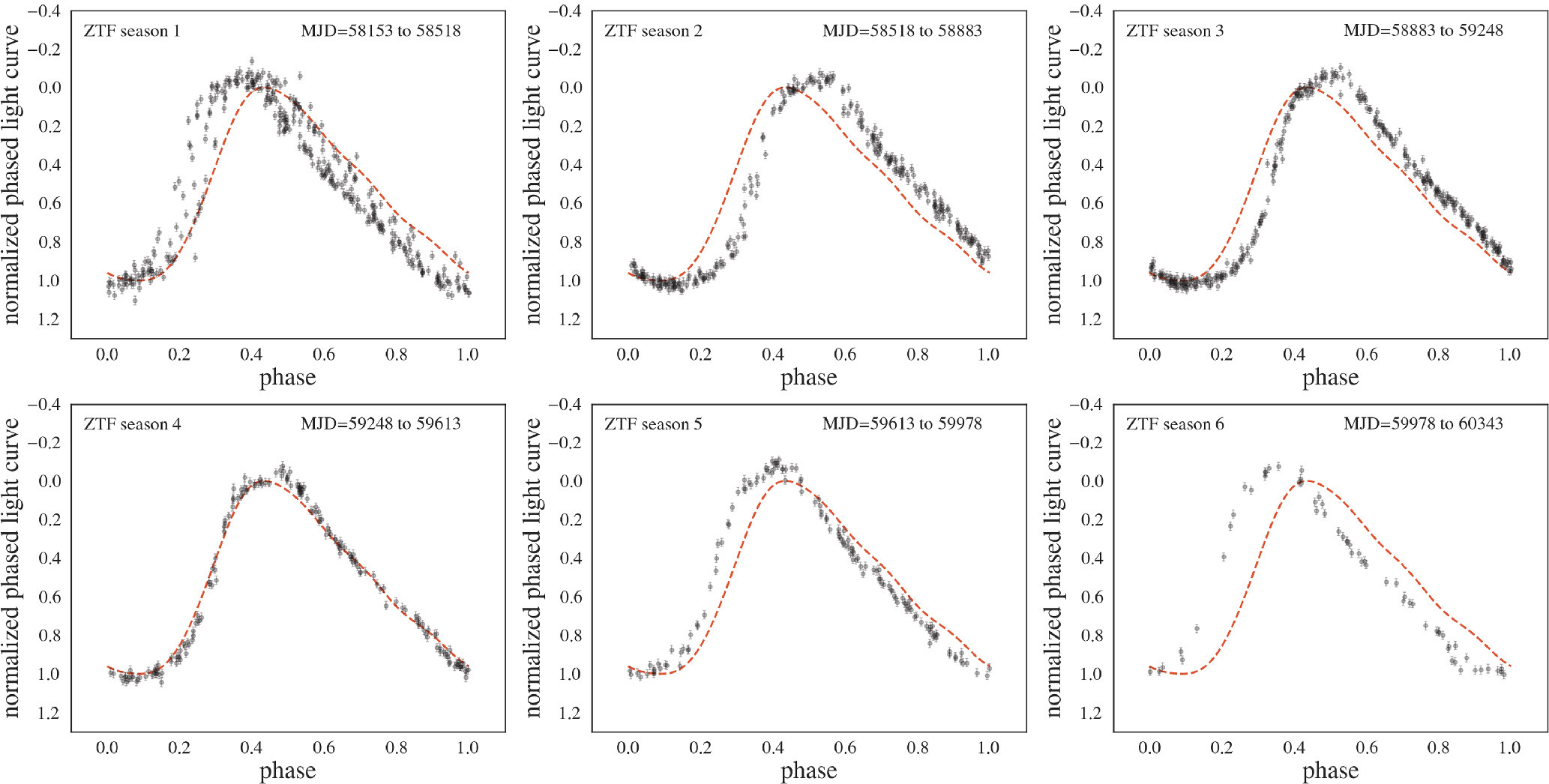
Today’s article studies the Blazhko effect in RR Lyrae stars. Simply put, the Blazhko effect is a long-term change of the duration (period) or strength (amplitude) of pulsation in some RR Lyrae variables. Fig. 1 shows an example from today’s article. While this effect was first observed as early as 1907, the physical mechanism for Blazhko modulation is still formally unknown, as is the percentage of RR Lyrae stars that exhibit it. Broadly speaking, there are three explanations for this effect: 1) nonlinear resonance between a star’s primary pulsation mode and some higher-level pulsation, 2) magnetic influence, or 3) cycles in the convection activity.
example of the Blazhko effect

Figure 1: An example of the Blazhko effect. Each panel shows data from ZTF for the same source for different seasons (at different times). The best-fit pulsation model for the total data set is shown in red. Over time, the actual pulsation of the source (black data) varies significantly from the average best fit due to Blazhko modulation. [Adapted from Donev and Ivezić 2025]

Today’s article searches for and identifies a population of Blazhko stars that may be used for future research into the Blazhko effect. Using data from the Lincoln Near-Earth Asteroid Research (LINEAR) asteroid survey and the Zwicky Transient Facility (ZTF) survey, the authors analyze around 2,857 RR Lyrae stars found in both data sets. The LINEAR survey was taken over a period of about 6 years, and the ZTF survey over about 5 years. On average, there is a 15-year difference between the LINEAR and ZTF observations. Using both, therefore, allows the authors to search for Blazhko modulation in each survey individually, as well as to compare between the two over the 15-year period. They additionally require a source to have at least 150 data points in both surveys to be considered.

From this initial set of RR Lyrae stars, today’s article identifies 531 potential Blazhko star candidates that are moved on to a visual inspection step. In order to identify the candidates for visual inspection, the authors establish two pre-selection methods based on the direct light curve and periodogram for each source:

  1. Light curve selection works by algorithmically assigning a score to each source, with higher scores indicating a greater expectation that the source is a Blazhko RR Lyrae star. The scores are associated with best-fit pulsation models. One way a given source could earn points was by having a very high reduced χ2 statistic in one or both data sets. Blazhko modulation changes the characteristics of the pulsations over time, meaning the best-fit model will be a poor fit to many of the pulsations within one or both data sets. Generally, poorer fits mean higher reduced χ2 values. In addition, candidates could earn points by having a moderately high reduced χ2 statistic in one or both data sets, as well as a significant change in pulsation characteristics of the best fit model from one data set to the next. Such a change between data sets is an indication of long-term Blazhko modulation. From this 479 of the 531 candidates are identified.
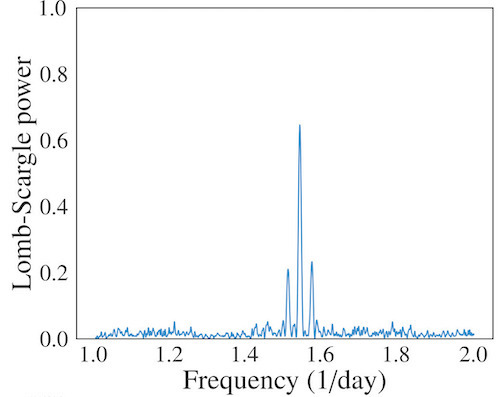
  2. Periodogram selection works by looking for interactions between the primary pulsation and Blazhko frequencies. First, the authors create a periodogram for the time-series data. In short, a periodogram plots a number of possible frequencies (or periods) of variability in the data versus the “power” associated with that frequency (or period), where higher power means the data vary more strongly at that frequency. When periodic data have only one associated frequency, the periodogram will show a single peak with high power. In the case where there are two effects of variation (in this case, the pulsation of the star and the Blazhko modulation) with disparate frequencies, a single, large peak will occur at the average frequency, with a smaller peak appearing to either side. Fig. 2 shows an example using simulated data. By identifying the location and strength of these side peaks, the authors are able to identify a handful of additional Blazhko sources (29), as well as estimate the frequencies of Blazhko modulation.
simulated Lomb–Scargle periodogram

Figure 2: A simulated Lomb–Scargle periodogram made using the sum of two sine functions with similar, but different, frequencies. Note the primary peak at the frequencies’ mean, and the smaller side peaks indicating the difference. [Adapted from Donev and Ivezić 2025]

From here, the authors visually inspect the 531 candidates and confirm that 228 of them exhibit convincing evidence of the Blazhko effect. They are able to place a lower limit on the percentage of RR Lyrae stars that are Blazhko sources at 11.4 ± 0.8%. In addition, they report that for a certain subclass of RR Lyrae stars, those that show the Blazhko effect have pulsation periods 5% shorter on average but no significant difference in amplitude. But a less common subclass of RR Lyrae stars shows no significant difference in period or amplitude when comparing Blazhko sources to the general population. Finally, the authors highlight that some sources show Blazhko modulation in one data set, but not the other, indicating that the modulation itself may change over time. Further research into this finding may help us better identify the most likely physical mechanism(s) for the Blazhko effect.

Original astrobite edited by Kylee Carden.

About the author, Catherine Slaughter:

Catherine is a PhD candidate in astrophysics at the University of Minnesota. Her research primarily deals with stellar population astrophysics in local dwarf galaxies, with particular focus on the intersection between computational and observational research methods. Prior to moving to Minnesota, she completed her BA in Physics and Astronomy, and MSc in Astronomy Research at Leiden University.

The post The Times They Are A-Changin’: Searching for Shifts in Variable Star Light Curves appeared first on AAS Nova.

  •  

Shortest-Period Polar Cataclysmic Variable Discovered

cataclysmic variable system

Astronomers have discovered the most compact cataclysmic variable system containing a strongly magnetized white dwarf. The extreme closeness of the system suggests that the companion may be a metal-poor star — the first time such a star has been paired with a strongly magnetized white dwarf.

Meet the Cataclysmic Variable

Cataclysmic variables are binary star systems that contain a white dwarf and a companion star in uncomfortably close quarters. In these systems, the companion star transfers gas to the white dwarf, resulting in sudden, irregular, and often repeated outbursts as the stolen gas ignites on the scorching surface of the white dwarf.

These bound-together stars typically orbit one another on orbits ranging from about 80 minutes to 10 hours. Though theorists place the minimum orbital period around 76 minutes, a handful of cataclysmic variable systems have cropped up with periods below this limit. The systems that have limboed under the limit are thought to have stellar companions that are more compact than typical main-sequence stars, allowing the white dwarf to nestle in closer.

Exploring Below the Limit

Discovered in 2019 by the Gaia spacecraft, Gaia19bxc is a cataclysmic variable that fluctuates with a period of 64.42 minutes. If this variability is linked to the orbital period of the system, that would place it well below the theoretical minimum period. Adding to the intrigue, early observations also hinted that Gaia19bxc’s white dwarf is strongly magnetic, making the system what’s called a polar. In polar systems, the white dwarf’s magnetic field diverts the accreted matter toward the white dwarf’s poles as it is collected, rather than into a disk around the white dwarf’s equator.

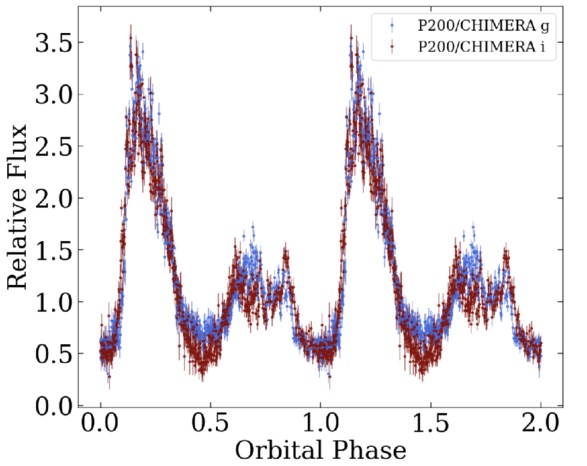
Light curves of Gaia19bxc

Phase-folded light curves for Gaia19bxc from the Caltech HIgh-speed Multi-colour camERA (CHIMERA) on the Hale Telescope. The double-peaked light curve is evidence for cyclotron beaming, which occurs in strongly magnetized white dwarfs. [Adapted from Galiullin et al. 2025]

Now, Ilkham Galiullin (Kazan Federal University) and collaborators have analyzed photometry and spectra of Gaia19bxc from the Zwicky Transient Facility, the Hale Telescope, and the Keck I telescope to investigate the nature of this unusual system.

The team’s analysis confirmed that the stars of Gaia19bxc orbit one another every 64.42 minutes, cementing the system’s place below the period minimum for typical cataclysmic variables. The system’s double-peaked light curves and evidence for an accretion stream — rather than an accretion disk — confirm the system’s polar nature, implying a magnetic field strength greater than 10 million Gauss. This makes Gaia19bxc the most closely orbiting system to contain a strongly magnetized white dwarf.

A Sign of Discoveries to Come

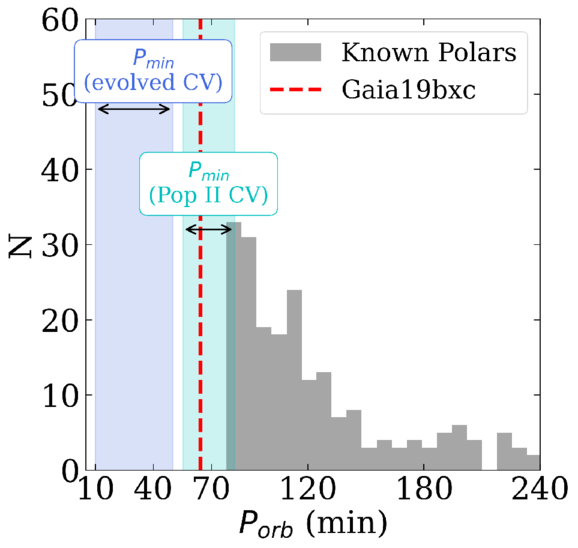
histogram of cataclysmic variable orbital periods

Gaia19bxc’s orbital period compared to known polar cataclysmic variables (gray) as well as the theorized minimum periods for systems containing a metal-poor (Pop II) companion (cyan) and an evolved companion (blue). [Galiullin et al. 2025]

These observations illuminate the nature of the white dwarf — but what about the companion star?

Galiullin and coauthors saw no evidence for metal lines in Gaia19bxc’s spectrum, nor did they see spectral features arising from a hot companion star. These findings suggest that the companion is an old, cool, compact, metal-poor star, which would make Gaia19bxc the first known polar to contain a metal-poor star. It’s also one of only a handful of cataclysmic variables to contain a metal-poor star and be below the theoretical period minimum.

Though Gaia19bxc is currently in a class of its own, it may not be for long; with the start of the Vera C. Rubin Observatory’s Legacy Survey of Space and Time rapidly approaching, many more cataclysmic variable systems as faint as or fainter than Gaia19bxc may soon be discovered.

Citation

“Optical Spectroscopy of the Most Compact Accreting Binary Harboring a Magnetic White Dwarf and a Hydrogen-Rich Donor,” Ilkham Galiullin et al 2025 ApJL 990 L57. doi:10.3847/2041-8213/adff82

The post Shortest-Period Polar Cataclysmic Variable Discovered appeared first on AAS Nova.

  •  
❌