Paleoanthropologists have identified a trove of Denisovan fossils from a cave in China’s Yunnan province, extending the known range of the elusive human relative and providing the first-ever direct evidence of what its forearm bones looked like.
Deep inside Ojo Guareña, one of the largest cave systems in Europe, in the northern Spanish province of Burgos, archaeologists have spent eleven consecutive summers digging through a single Neanderthal layer. This year’s season, which wrapped up in late August 2026, pushed the excavated area of that layer — known as level 4D — to […]
Prehistoric art hidden in caves throughout southwestern Ireland for thousands of years could push back the timeline on the earliest human presence on the Emerald Isle by as much as 5,000 years, archaeologists say.
The remarkable discoveries may reveal a previously unknown chapter in the ancient history of human migrations across the British Isles during the Ice Age, and how they once traversed a portion of the landscape that is now sunken beneath the Irish Sea.
Reported by a team of researchers with the international Lost Land Bridge Project, the discoveries involve prehistoric markings located in eight caves in Ireland that could potentially date as far back as 15,000 years ago.
Some are engravings into the cave’s stone walls, while others are markings made with ochre and charcoal, and include lines traced along cave surfaces that appear to depict ancient animals that include deer, and extinct species such as mammoths.
If confirmed, Ireland’s long-hidden ancient artwork could dramatically shift past thinking about the earliest evidence of human arrivals on the island, which was previously believed to have occurred around 10,500 years ago.
One of the entrances to Killavullen Caves, a limestone cave system which is known to have been inhabited over time (Image Credit: Fattonyni/Wikimedia Commons/CC 3.0)
Early Humans Crossing an Ice Age Landscape
If humans arrived in Ireland this early, it also raises an intriguing possibility: that they might have done so by traversing terrain that would only have been exposed amid the lower sea levels that prevailed toward the end of the last Ice Age.
This effect was due to the amount of water that was held within the vast glaciers near Earth’s poles, which, in addition to lowering sea levels, helped to reshape the geography of northwestern Europe during the Pleistocene.
Because of this, certain portions of the ancient landscape that are now submerged beneath ocean waters would have been exposed. Among these, one that stretched from modern Pembrokeshire in Wales and southeastern Ireland near Rosslare might have been used by ancient travelers who could have made their way to Ireland, leaving a record of their Ice Age journey on the walls of caves they used as shelter, according to Dr. George Nash of the University of Liverpool, who coordinated the project.
Nash believes this ancient crossing could have comprised a 46-mile-long area, where ancient nomadic people following natural subsistence patterns would have encountered vast expanses of grassland and vegetation, along with ample resources that included horses, bison, reindeer, mammoths, and other animals that these ancient hunter-gatherers were skilled at hunting.
Evidence from throughout Europe and other parts of the ancient world already shows that ancient hunter-gatherers were well-accustomed to following migrating animals and seasonal resources, and that the landscape could have provided a natural route westward.
Nash recently said that until now, archaeologists had relied mainly on accidental discoveries that suggested a human presence in Ireland by around 10,500 years ago. However, a growing number of archaeologists had begun to doubt that this was the period when humans initially arrived.
“We just weren’t looking hard enough, and not in the right places,” Nash said.
Technology Unveils Evidence of Ancient Art
To determine locations where reliable evidence of an earlier human presence might be found, the researchers examined several features associated with prehistoric caves in southern Wales, where documented discoveries linked them to an early human presence.
Based on these characteristics, the team then relied on computer modeling to help them identify Irish locations that had similar features.
The team was assisted by Shane Diffily, an expert in caving, and digital mapping consultant Darren Lee, which allowed them to quickly narrow their search to just under 30 potentially promising caves throughout southwestern Ireland, according to Heritage Daily.
Of those locations, eight were found to contain what appeared to be various kinds of prehistoric rock art. The exact locations of those caves have not been released by the team, to protect the sites from vandalism, or potential looting—a major issue that has long complicated archaeological investigations.
Striking Discoveries
Along with direct engravings into limestone surfaces and markings made with ochre and charcoal, researchers also discovered a few instances of what appear to be “finger flutings,” where soft surfaces such as clay or sediment were marked by ancient artists who dragged their fingers along such surfaces.
One of the most significant discoveries uncovered by Nash and the team appears to be a portion of a deer, and an image within one of the caves that appears to represent a mammoth. Examples like these could potentially help provide connections to similar examples known from prehistoric rock art that has been documented in Wales.
From those sites, some of the same prehistoric artists may have made their way across the ancient land bridge that was once available, leaving their markings at similar sites that once offered shelter as they arrived in Ireland.
Unveiling a Lost Chapter of Ireland’s Past
The initial discoveries at the newly identified eight cave locations may represent only a small portion of the long-overlooked archaeological evidence throughout Ireland, which may document its earliest arrivals. Future investigations will likely focus on sites located near Wexford, Waterford, Cork, and other areas along routes that people may have followed as they made their way to southwestern Ireland.
As investigations continue, Nash and the research team say that reliable dating of the art will be an important next step toward determining how early these prehistoric artists might have arrived.
Once that testing is completed, it will help determine whether the timescales on the arrival of Ireland’s earliest human inhabitants will indeed be pushed back by thousands of years. If so, the newly uncovered cave art could offer an unprecedented look at the lives of those ancient hunter-gatherers who once traversed a landscape before it sank beneath rising ocean waters as Ice Age glaciers retreated.
Micah Hanks is the Editor-in-Chief and Co-Founder of The Debrief. A longtime reporter on science, defense, and technology with a focus on space and astronomy, he can be reached atmicah@thedebrief.org. Follow him on X @MicahHanks, and at micahhanks.com.
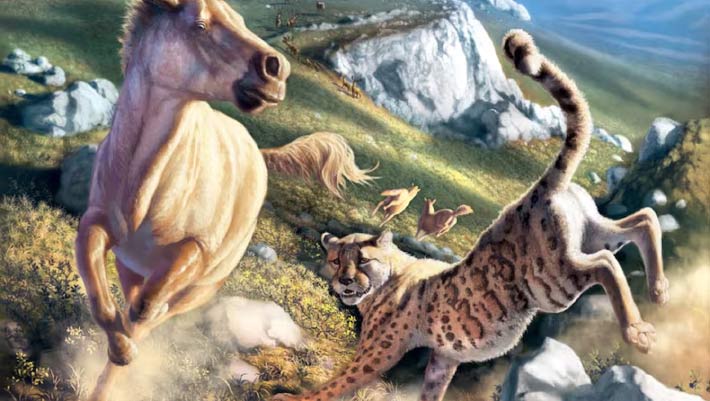
For several decades, paleontologists have described Miracinonyx trumani -- an extinct species of cheetah-like felid that roamed the North American prairies and steppe terrains more than 13,000 years ago -- as North America’s answer to the African cheetah (Acinonyx jubatus).
A new analysis of three skull fragments unearthed at the Gran Dolina cave site in Spain indicates that Homo antecessor had bone thickness closer to that of Neanderthals and modern people than to more archaic hominins.
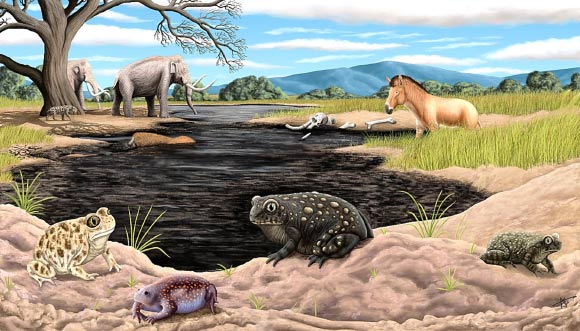
Paleontologists studying the La Brea Tar Pits, one of the world’s richest Ice Age fossil sites, have identified a previously unknown species of spadefoot toad that lived in what is now California during the latest Ice Age.
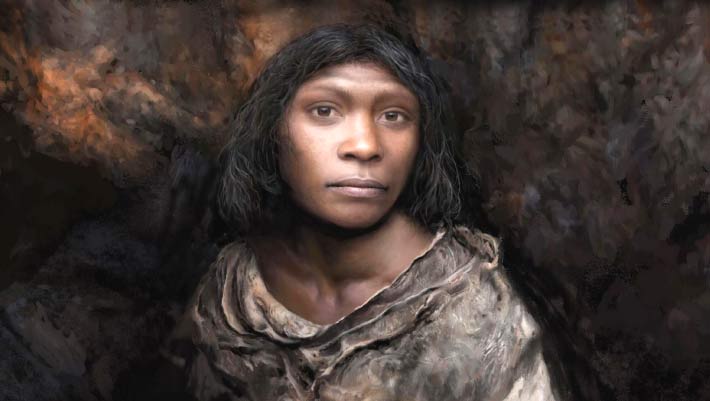
New research led by the University of California, Berkeley reveals that beyond Neanderthals and Denisovans, humans interbred with two mysterious ‘ghost’ lineages: one in Africa more than 50,000 years ago, another in Eurasia over 1.7 million years ago.
A fossilized skull fragment of Homo sp. unearthed in central Spain offers paleoanthropologists a fresh window into the story of ancient humans who lived in Europe hundreds of thousands of years ago.
A set of 1.43-million-year-old fossil footprints preserved along the margin of an ancient lake in northern Kenya is offering paleoanthropologists new evidence about the size, gait and social lives of the beings who made them and reopening questions about which species they belonged to.
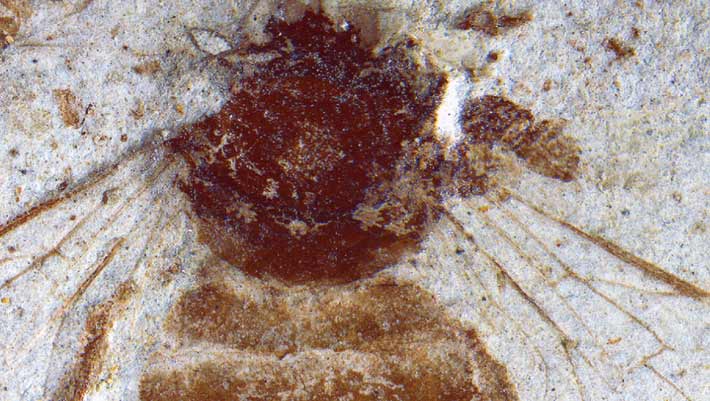
Paleontologists have announced the discovery of a new fossil honeybee species that fills a long-standing gap in the evolutionary record of the genus Apis.
An international team of researchers has documented a set of fossilized footprints that offer an exceptional snapshot of the behavior of a group of ancient human relatives who inhabited the shores of a lake in northern Kenya. The recently published study analyzes the imprints belonging to eight individuals of the species Paranthropus boisei, an extinct […]
Des terriers restés prisonniers du pergélisol pendant des centaines de milliers d’années ont livré un témoignage exceptionnel sur les écosystèmes de l’ère glaciaire. Grâce à l’ADN préservé dans des excréments fossilisés d’écureuils terrestres, des chercheurs ont reconstitué une partie de leur...
Scientists have uncovered compelling new evidence that early human ancestors, likely Homo erectus, were deliberately bringing fire into Wonderwerk Cave in South Africa as far back as 1.79 million years ago.
Deep inside a limestone cave in southern China, paleontologists have uncovered an assemblage of thirteen fossilized teeth belonging to Gigantopithecus blacki, the largest primate species ever known to have lived.
The extinct Eurasian cave lion (Panthera spelaea) and today’s African and Asian lions (Panthera leo) belong to separate evolutionary lineages that diverged roughly 1.7 million years ago -- far earlier than previously thought, according to an analysis of 12 cave lion genomes spanning more than 100,000 years.

 Login