These new findings could help scientists adapt crops to dry environmental conditions in the future. Plants rely on sunlight to turn water and carbon dioxide into energy-rich sugars and oxygen through different forms of photosynthesis. Drought can make that process far more difficult. A research group led by Wolfram Weckwerth at the University of Vienna [...]
For millennia, farming in Switzerland did not reduce plant diversity but helped increase it, researchers have shown in a detailed reconstruction covering the past 7000 years. Only recent decades paint a different picture.
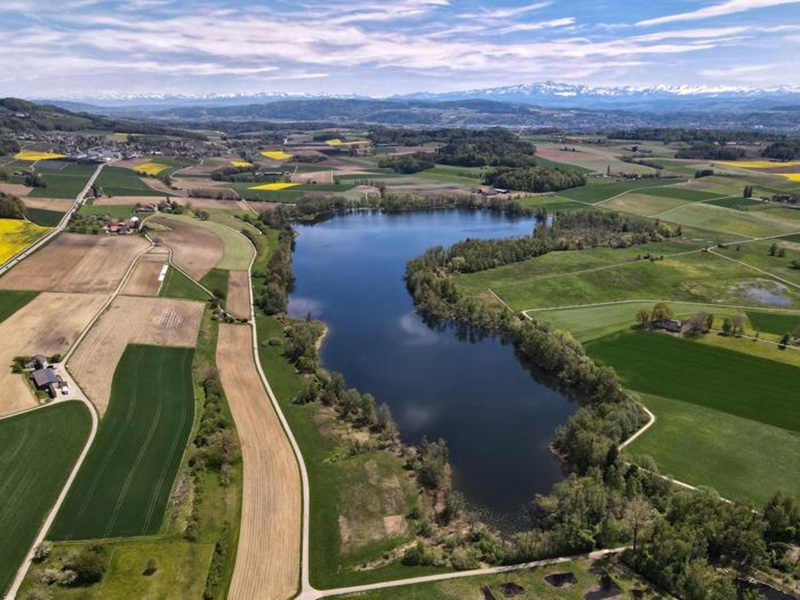
Aerial view of Hüttwilersee, one of three lakes in Switzerland that provided insights into 7000 years of plant diversity. Photo: Thomas Stadler, Zurich
The fall of the Roman Empire and major plague outbreaks: These events not only affected people but also reduced plant diversity on the Swiss Plateau, as human land use temporarily declined. Researchers led by Dr. Fabian Rey and Professor Oliver Heiri at the University of Basel report 1.
Their analyses are based on sediment deposits in three Swiss lakes: Moossee near Bern, Burgäschisee near Herzogenbuchsee, and Hüttwilersee in Thurgau. The researchers extracted sediment cores from these lakes and then analyzed the material deposited in the sediments over the course of millennia. This allowed them to infer and date variations in both plant diversity and agricultural land use in the areas surrounding the lakes.
“This is an exceptionally comprehensive and precisely dated dataset,” says Oliver Heiri. “It allows us to reconstruct changes in plant diversity around the lakes over the past 7000 years at a time resolution comparable to long-term ecosystem studies in modern ecology – and for a period long before modern ecology existed.”
Agriculture made the landscape more diverse
Since the Neolithic period, plant diversity increased with increasing agricultural activity. “You might think that human impact must be bad for plant diversity, because that’s what we see today,” says Fabian Rey. “But agriculture back then made the landscape more diverse.” Before early agricultural activities, the Swiss Plateau was largely covered by forest and was therefore a relatively uniform ecosystem.
“As agriculture expanded, a mosaic of habitats emerged over time,” says Rey. Fields, pastures, hedgerows, and later orchards of tall fruit trees alternated across relatively small areas. This provided varied conditions for plants adapted to those specific environments.
However, there were also recurring periods when plant diversity declined sharply: For example, during the Migration Period following the fall of the Roman Empire, or when plague outbreaks claimed many lives in the Middle Ages. “In times when people were less able to continue farming, the forest grew back and plant diversity declined at the landscape level,” explains Heiri.
Times of crisis caused diversity to decline
More agriculture, more biodiversity: However, this parallel trend lasted only until around World War II. Over the past 80 years, plant diversity has declined sharply. The research team attributes this to the intensification of agriculture since then.
Instead of a fragmented mosaic of habitats, large, uniform areas have emerged that are easier to farm using heavy machinery. The increasing use of fertilizers and pesticides also caused many specialized plant species to retreat.
“However, our data also show that plant diversity has recovered from earlier declines when people returned to farming practices that included varied landscapes,” says Rey. This suggests that the trend of the past 80 years could also be reversed if farming practices change again.
Pollen from seven millennia
The data for the study are based on more than a decade of analyses of sediment cores, conducted in close collaboration with researchers from the University of Bern and the Department of Archaeology of Canton Thurgau. To collect the data, Fabian Rey extracted pollen samples from every centimeter of the cores, which he chemically processed, prepared, and analyzed under a microscope. For each sample, he identified 500 pollen grains, enabling him to determine the diversity of plants around the lake.
The intensity of agricultural use during each period was determined based on the presence of specific pollen in the samples – including both cultivated plants and species that thrive on farmland – as well as a comparison with archaeological and historical data.
The scientists dated the layers using the 14C method, a technique for determining the age of organic material. The sediment cores date back approximately 7000 years, to the Neolithic period.
 
References
Rey, F., Tinner, W., Wick, L. et al. (2026) Decadal-scale pollen records link land use and plant diversity change across European lowlands over seven millennia Nat Commun doi: 10.1038/s41467-026-74214-6↩
A surprising discovery inside desert mosses could reshape scientists’ understanding of plant evolution. In some of the driest places on Earth, the ground itself can be alive. What looks like a thin, dark crust on desert soil may actually be a miniature ecosystem, packed with mosses, fungi, bacteria, algae, and tiny animals. These biological soil [...]

 Login

 These new findings could help scientists adapt crops to dry environmental conditions in the future. Plants rely on sunlight to turn water and carbon dioxide into energy-rich sugars and oxygen through different forms of photosynthesis. Drought can make that process far more difficult. A research group led by Wolfram Weckwerth at the University of Vienna [...]