❌

Reading view

Physicists Spot Curious Signal in Hunt for Elusive Dark Matter Particles

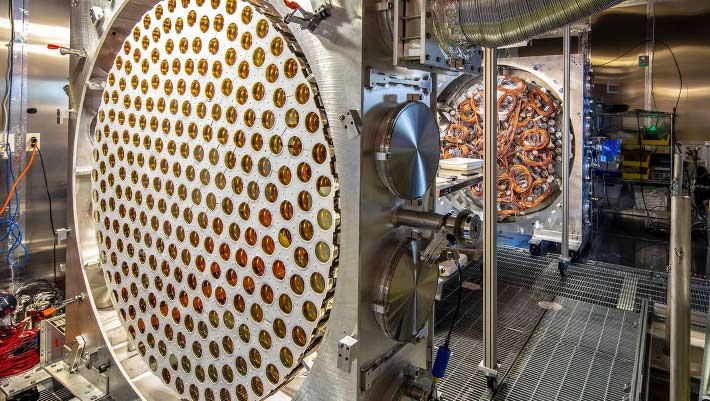
To search for dark matter, LZ uses photomultiplier tubes (shown here before installation in the detector) to capture light from particle interactions. Image credit: Matthew Kapust / Sanford Underground Research Laboratory.

Physicists using the LUX-ZEPLIN (LZ) dark matter detector deep underground in a former South Dakota gold mine say they’ve recorded a single particle interaction that they can’t easily explain, but they’re a long way from claiming a discovery.

The post Physicists Spot Curious Signal in Hunt for Elusive Dark Matter Particles appeared first on Sci.News: Breaking Science News.

  •  

CERN Physicists Discover Third and Final Member of Doubly Charmed Baryon Family

An artist’s impression of the doubly charmed Ωcc⁺ baryon. Image credit: Daniel Dominguez / CERN.

Physicists with LHCb Collaboration at CERN’s Large Hadron Collider (LHC) have detected the elusive Ωcc⁺ baryon, a particle containing two charm quarks and one strange quark, completing a long-sought family of doubly charmed baryons first predicted over half a century ago.

The post CERN Physicists Discover Third and Final Member of Doubly Charmed Baryon Family appeared first on Sci.News: Breaking Science News.

  •  

Physicists Say This Exotic Particle’s Odd Decay Could Reveal Clues to a Longstanding Mystery

Physicists have revealed that the unusual decay of an “exotic” subatomic particle could offer new clues to its mysterious structure.

The discovery, reported by a team of physicists in a study published in Physical Review Letters, argues that it provides the first “crucial discrimination” between current theoretical models of a variety of subatomic particles known as the Ds(2317) meson.

Exotic Subatomic Mysteries

The new research has its beginnings more than two decades ago, with the initial detection of an unusual particle known as the Ds(2317) meson. Part of what makes this particle unique is the fact that it possesses one charm quark (or “c quark,” a kind of elementary particle) and one strange antiquark—the third lightest of all the known quarks.

It was deemed a major discovery at the time, and for good reason: it seemed to point at a significant discrepancy between the particle’s measured mass of 2.317 GeV/c2, and predictions based on estimates that placed it significantly higher, at around 2.4 GeV/c2.

Now, in a new study by researchers with the Belle and Belle II Collaboration, observations of previously undetected behaviors that include never-before-seen light-emissions during the particle’s decay have been described for the first time.

Based on their analysis, the team believes their new findings mark not only a significant first in the study of these particles, but that they may also help researchers solve the longstanding mystery involving apparent discrepancies between the observed and expected mass values for the Ds(2317) meson.

The findings, the team says, could also provide physicists with deeper insights into the fundamental forces that currently bind matter.

Unraveling a Baffling Discrepancy

The team approached the problem by first proposing a range of different models that could potentially describe the internal structure of the Ds(2317) meson. Of key importance was the fact that each of the different models allows researchers to predict a specific range of potential values for the particle’s decay.

This was achieved based on the probability that the Ds(2317 meson will decay by emitting a gamma ray, which was then divided by an entirely separate probability: that the particle would emit a pion—a type of meson with a mass roughly 270 times that of an electron—rather than a gamma ray.

Based on these two possibilities, the team determined that measurements indicating a ratio of greater than 8.1% would point to the likelihood that the meson represents a compact state involving quark-antiquark models.

However, if the calculated value turned out to be lower—specifically in the range of between 0.5% and 4.25%—that would instead favor models that describe the particle as functioning closer to being a sort of molecule-like state of two separate mesons.

Well Above Standard Deviations

With such values in mind, the team then went to work to determine which was more likely with help from data collected by the Japanese KEKB and SuperKEKB electron–positron colliders.

Using this information, the particle’s gamma-emitting decay was successfully detected, revealing a statistical significance above ten standard deviations. Next, the Belle and Belle II Collaboration conducted measurements that showed the decay ratio between photons and pions was close to 7%, placing the determined value smaller than the majority of quark-antiquark models, and at a greater value than those in the molecular models.

“This result provides crucial discrimination between theoretical models of the Ds(2317) structure,” the team writes.

Going forward, the researchers believe additional insights that may help to conclusively reveal the mysterious Ds(2317) meson’s structure may be achievable through more complete measurements of the particle’s decay rate.

The recent paper, “Observation of the Radiative Decay 𝐷*𝑠0(2317)+→𝐷*𝑠+𝛾,” appeared in Physical Review Letters.

Micah Hanks is the Editor-in-Chief and Co-Founder of The Debrief. A longtime reporter on science, defense, and technology with a focus on space and astronomy, he can be reached at micah@thedebrief.org. Follow him on X @MicahHanks, and at micahhanks.com.

  •  

Material Scientists Just Created a Revolutionary New Building Material Based on a Tangled Ball of Staples


A new material, inspired by the frustratingly powerful strength of a tangled ball of staples, could represent the future of flexible, adaptable design.

Published in the Journal of Applied Physics, material scientists and engineers from the University of Colorado Boulder’s Paul M. Rady Department of Mechanical Engineering revealed an interlocking particle design that can be shaped into rigid structures, and then return to a pile of loose pieces with only a targeted movement or vibration.

The particles, the team says, could potentially be used as a building material with high strength and flexibility, capable of reshaping into new forms on command.

Staple Ball Strength

The difficulty of separating tangled metal, such as a cluster of standard office staples, intrigued the researchers enough to investigate how interlocking particles could be used in recyclable construction. Such techniques are found in nature, as birds weave together found objects to create strong structures to protect their young.

On the level of particles, interlocking such elements is called “entanglement,” and is a relatively new focus for material scientists.                                                                                                                                                                                                                                                                                                                                                                                                                                                                                                                                                                                                                                                                                                                                                                                                                                                                                                                                                                                                                                                                                                                                                                                                                                                                                                                                                                                                                                                                                                                                                                                                                                                                                                                                                                                                                                                                                                                                                                                                                                                                                                                                                                                                                                                                                                                                                                                                                                                                                                                                                                                                                                                                                                                                                                                                                                                                                                                                                                                                                                                                                                                                                                                                                                                                                                                                                                                                                                                                                                                                                                                                                                                                                                                                      

“We’ve been playing around with the idea of building blocks and geometry for many years, but we started looking at interlocking, entangled particles only recently,” said Professor Francois Barthelat, the leader of the Laboratory for Advanced Materials & Bioinspiration.

“We are excited about the combination of properties we can get out of these systems, and we believe this technology has the potential to go in many directions,” Barthelat said.

Manufacturing Entanglement

While entanglement occurs naturally, as in the combination of soft protein and hard minerals that interlock to form bones, producing it artificially requires a careful understanding of how these interactions work. According to the team, particle shape is the most foundational element to natural entanglement.

“Let’s take sand as an example,” says PhD student Youhan Sohn. “Sand is smooth and convex-shaped, meaning it cannot interlock from grain to grain.”

“However, we found that if we change the shape of a grain of sand, we can drastically affect its behavior and mechanical properties, including the particle’s ability to link with other particles,” Sohn adds.

With shape decided as the researcher’s primary focus, they began running computer models, called Monte Carlo simulations, to observe how various potential shapes would interact, aiming to identify the optimal entanglement geometry. The shape their research settled on was remarkably similar to that of a staple: a particle with two legs.

Laboratory Material Experiments

After achieving success in the digital realm, the researchers fabricated the shape in the real world to test its behavior under practical conditions. During these tests, the team discovered that their optimized shape contained even more beneficial qualities than they had initially understood.

Conventional materials typically experience a trade-off between toughness and tensile strength. Typically, materials that are extremely tough and can absorb large amounts of energy are also quite brittle, lacking the ability to stretch or bend. However, this staple-like particle design exhibits an unusually high amount of both properties simultaneously.

“Our entangled granular material using the staple-like particle demonstrates both high strength and toughness at the same time,” said PhD student Saeed Pezeshki.

Additionally, they discovered that applying different vibrational patterns would change the particles’ degree of entanglement, allowing the team to assemble and disassemble a shape instantly. Applying a light vibration caused the pieces to interlock, whereas a heavy vibration untangled them as a pile of loose particles.

Material Applications

“No binder is required, so particles can be rapidly assembled in an infinite number of shapes, which can be reconfigured with appropriate mechanical stimuli, making them attractive for lightweight and reversible materials and structures and aggregate architectures,” the authors recently wrote.

“The fundamental understanding of entanglement gained in this project is also relevant to other physical systems, including biological structures, ‘living’ entangled matter, robotic materials, as well as colloidal assemblies,” the authors add.

“It’s a strange material because it’s obviously not a liquid. However, it’s also not quite solid,” Barthelat said. “This opens new and intriguing engineering possibilities.”

“Handling a bundle of these entangled particles feels very remote and exotic,” he added.

The paper, “Combined Effects of Particle Geometry and Applied Vibrations on the Mechanics and Strength of Entangled Materials,” appeared in the Journal of Applied Physics on April 14, 2026.

Ryan Whalen covers science and technology for The Debrief. He holds an MA in History and a Master of Library and Information Science with a certificate in Data Science. He can be contacted at ryan@thedebrief.org, and follow him on Twitter @mdntwvlf.

  •  

The Amaterasu Particle May Not Be a Proton at All, New Research Suggests


In 2021, scientists detected a cosmic ray entering Earth’s atmosphere with as much kinetic energy as a fast-moving tennis ball, all contained in a single subatomic particle. Named the “Amaterasu particle” after the Japanese sun goddess, the event left researchers questioning its origin because its arrival direction pointed to a region of space with no known source capable of producing such energy.

Researchers at Penn State now suggest that the puzzle may stem more from assumptions about the particle’s composition rather than its missing source.

A recent study in Physical Review Letters suggests that the Amaterasu particle, along with other extremely energetic cosmic rays, may actually be atomic nuclei heavier than iron. If correct, the idea could change how researchers search for the sources of cosmic rays.

A Particle of Unknown Origins

Ultrahigh-energy cosmic rays are some of the rarest and most violent phenomena in nature. These particles slam into Earth’s atmosphere with more than 100 exa-electron volts of energy, which is about 10 million times more than what the Large Hadron Collider can produce. The Amaterasu particle, found by the Telescope Array in Utah in May 2021 and reported in Science in 2023, had about 244 exa-electron volts of energy. This makes it one of the most energetic natural events ever recorded.

The mystery extended not only to the particle’s energy, but also to its origin. It came from the direction of the Local Void, which is an almost empty area of space next to the Milky Way, where there is no known source that could create such a powerful particle.

“The origins and acceleration mechanisms of ultrahigh-energy cosmic rays have been among the biggest mysteries in the field for more than 60 years, since the first example was reported,” said Kohta Murase, professor of physics and astronomy at Penn State’s Eberly College of Science and the study’s lead researcher.

The Heavy Nucleus Hypothesis

The Penn State team ran computational simulations to study how particles of different masses travel through intergalactic space. They found that atomic nuclei heavier than iron, known as ultraheavy nuclei, lose energy much more slowly than protons or lighter nuclei as they move through the radiation fields of deep space.

Most research on cosmic rays has assumed that the most extreme events involve protons, which are the simplest and lightest atomic nuclei. Ultraheavy nuclei lose energy much more slowly during their journey, allowing them to reach Earth carrying far more energy than lighter particles traveling similar distances. That makes them strong candidates for the most powerful cosmic ray events we’ve seen, including the Amaterasu particle.

“When we detect individual cosmic-ray particles such as the Amaterasu particle here on Earth, we can often use their energies, arrival directions and expected magnetic deflections to infer their possible cosmic sources,” Murase said.

New Theoretical Limits

The hypothesis that these particles are ultraheavy nuclei also changes the range of possible sources. If the particles are indeed heavier nuclei rather than protons, their production would require some of the most extreme environments in the universe. The researchers identify collapsars, which are massive stars collapsing directly into black holes, and binary neutron-star mergers as likely candidates. Both phenomena are also associated with gamma-ray bursts, which are among the most energetic explosions known to science.

The team’s calculations set new theoretical limits on how much ultraheavy nuclei may contribute to the overall population of ultrahigh-energy cosmic rays. Murase also noted that these sources could help explain a possible asymmetry in the ultrahigh-energy cosmic-ray spectrum between the northern and southern hemispheres.

“The most promising sites for producing and accelerating such ultraheavy nuclei are massive star deaths involving explosive collapse into black holes or strongly magnetized neutron stars, as well as binary neutron-star mergers known to be powerful gravitational-wave emitters,” Murase said.

Testing the Idea

The researchers stress that they are not saying all ultrahigh-energy cosmic rays are ultraheavy nuclei, but some of the most extreme ones might be. This could change what scientists look for in future studies. New observatories and upgrades, like AugerPrime in Argentina and the planned Global Cosmic Ray Observatory, could test these ideas. If ultraheavy nuclei are important, future observations should find evidence that protons alone cannot explain.

More than six decades after scientists first detected ultrahigh-energy cosmic rays, researchers may finally have a new clue about what the most extreme particles in the universe are made of.

Austin Burgess is a writer and researcher with a background in sales, marketing, and data analytics. He holds an MBA, a Bachelor of Science in Business Administration, and a data analytics certification. His work focuses on breaking scientific developments, with an emphasis on emerging biology, cognitive neuroscience, and archaeological discoveries.

  •  

CERN Physicists Observe New Exotic Particle

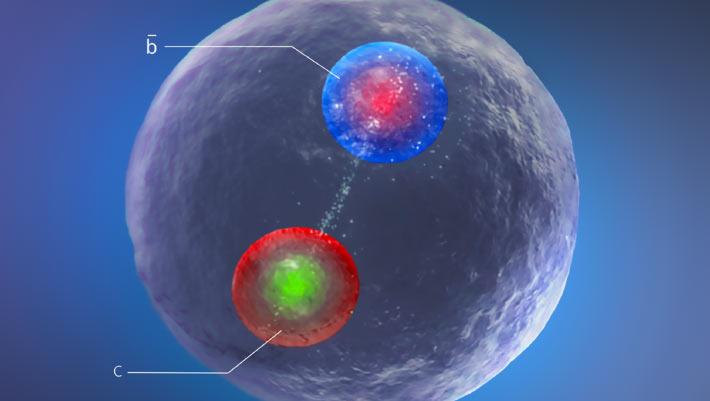
An artist’s impression of the Bc*+ meson. Image credit: Daniel Dominguez / CERN.

Physicists with the ATLAS Collaboration at CERN’s Large Hadron Collider (LHC) have observed the Bc*+ meson, an excited version of the Bc+ meson -- both consist of a charm quark and a bottom antiquark.

The post CERN Physicists Observe New Exotic Particle appeared first on Sci.News: Breaking Science News.

  •  
❌