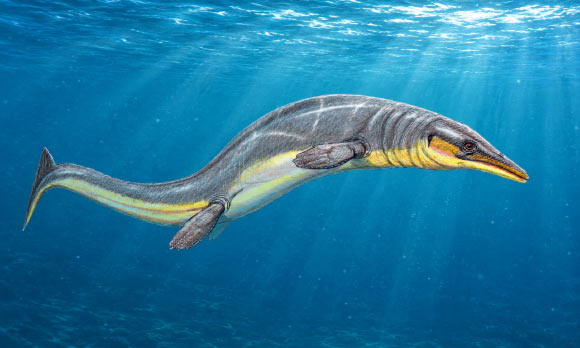
Paleontologists have described a previously unknown species of mosasaur -- a group of extinct marine reptiles that patrolled Cretaceous seas alongside dinosaurs on land -- based on fossils unearthed in Egypt’s Dakhla Oasis.
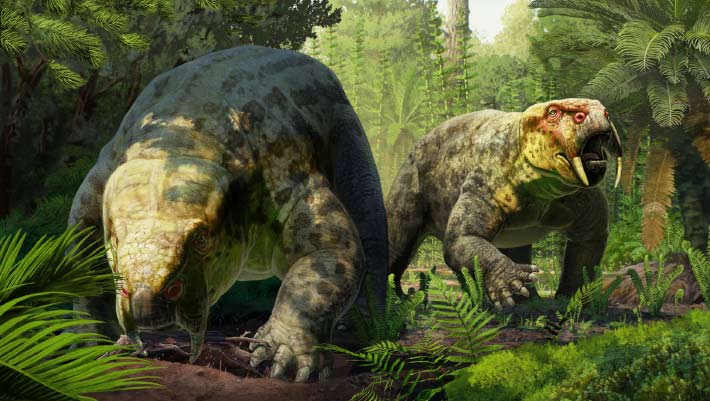
Paleontologists have identified a new species of ancient, distant mammal relative from two fossil specimens found decades apart in the Manda Beds of Tanzania.
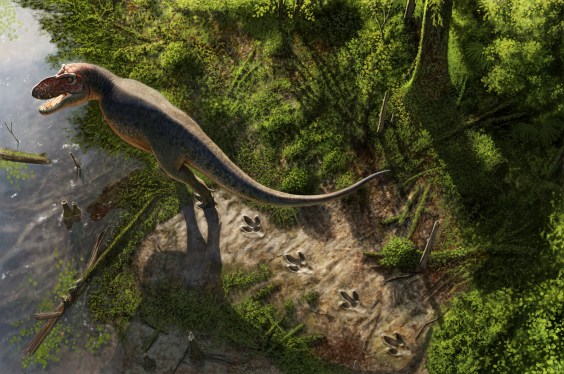
Kent Hups, a high school science teacher in Colorado, discovered a 23-foot trackway of fossilized dinosaur footprints, which offer a glimpse of how the apex predator moved 66 million years ago.
El Soplao, a fossil site tucked into the hills of Cantabria in northern Spain, stands out for yielding amber pieces with a blue-violet hue and abundant bioinclusions, according to a new review paper.
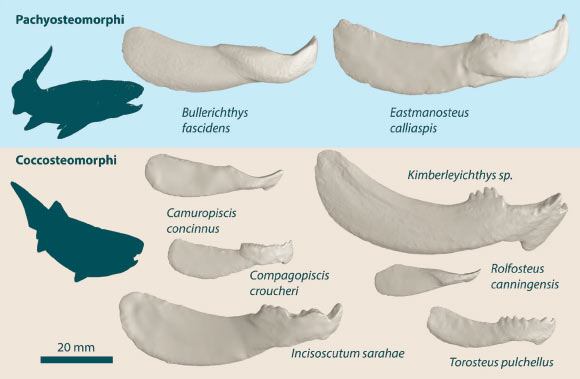
Long before sharks or reptiles ruled the seas, armor-plated fish called placoderms were already experimenting with different jaw designs to crush hard-shelled prey.
The newly analyzed bird feather fossil that provided the missing clues comes from an extinct bird group called Hesperornithiforms and not from the ancestor of modern birds, Neornithes.
However, the team said subtle differences between the species suggest previous theories crediting adaptation to water diving as the key to Neornithes’ survival were likely on the right track.
Survival of Modern Bird Ancestors Posed a 66-Million-Year-Old Mystery
When a huge piece of space rock slammed into Earth, killing off virtually all dinosaur species save the ancestors of modern birds, the event also left behind a 66-million-year-old mystery. How did these ancient avians survive this apocalyptic event, resulting in every bird species we see today?
Jingmai O’Connor, the associate curator of fossil reptiles at the Field Museum in Chicago, said her career has been spent analyzing fossils to try to answer this single, critical question. However, unlike the new poop-encased bird feathers, most were not so ‘naturally’ protected from the ravages of time.
“It’s such a beautiful, well-preserved feather, from such an unexpected source, and it’s exciting that it could help us answer this huge question in paleontology,” explained the lead author of a study detailing the new analysis. “As far as I know, no one has ever thought to look for feathers or to study feathers in coprolites, so this project was really exciting.”
Dinosaur Dropping Provided Effective Preservation Medium
Researchers discovered the ancient bird feather in 2016 in Montana. Although she initially suspected it could be a coprolite rock (fossilized feces), O’Connor said she couldn’t confirm the theory for a decade.
David DeMar, Jr., holding the exposed fossil feather in the coprolite fragment on the day of its discovery in 2016. Image Credit: David DeMar, Jr.
The situation changed when O’Connor and Nate Carroll, a co-author of the paper and paleontologist at the Carter County Museum in Ekalaka, Montana, gained access to the micro-CT scanner at USC’s medical campus in Los Angeles, California. According to O’Connor, that’s when “the full feathery fabric of this fossil feces” started to finally reveal itself.
“Every hour processing the data revealed another feather, another scale, another bone—in stunning 3D,” Carrol also recalled.
The fossil feather preserved in dinosaur poop. Image Credit: O’Connor et al.
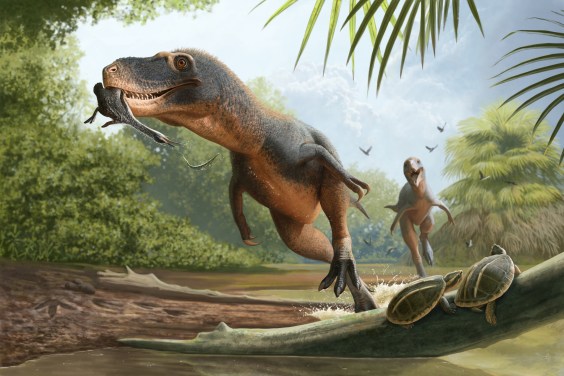
Along with multiple feathers and tiny fish scales, the ancient dinosaur poop, which may have come from a Tyrannosaurus Rex, also contained legs from a hesperonithiform bird.
O’Connor said hesperonithiforms were ancient aquatic birds with similarities to modern loons. Critically, these cousins of the modern bird ancestor group had evolved specialized feet to hunt for fish by diving deep into the water.
“The feathers showed adaptations for being underwater that we see in living aquatic birds,” O’Connor explained.
Notably, the team said this evolution likely cost ancient hesperonithiforms like the one that was consumed by a dinosaur the ability to fly.
Connection to Modern Birds Offers a Solution
Although the bird group represented by the fossilized feather did not survive the dinosaur-killing asteroid, its connection to the ancestor of modern birds appears to support a previously proposed theory that adaptation to water may have helped Neornithes survive. O’Connor said she thinks that small differences in the feathers of the two ancient bird species hold the answer to a 66-million-year-old mystery.
“We think the types of feathers that these birds had, and/or the way they molted those feathers, may have been one of the underlying causes of the selectivity of the end-Cretaceous mass extinction,” the researcher explained, adding that this is “essentially why some birds died out and why others survived.”
Specifically, O’Connor pointed to the “smaller, fuzzy, primitive body feathers” found on the extinct bird “that we associate with dinosaurs and enantiornithines” alongside more modern-looking waterproof adaptations.
The team said that these evolutionary relics suggest that hesperornithiforms like the one that left behind its feathers were an evolutionary bridge between older bird groups and the Neornithes that survived the cosmic collision. Even more critically, the team said these earlier feather structures may not have retained heat as effectively as Neornithes feathers, allowing one species to survive the asteroid and another to die in the extreme cold that followed.
“The hesperornithiforms retain primitive feather types that may not have been as efficient for insulation as modern plumaceous feathers, and that could explain why they went extinct along with the enantiornithines,” O’Connor explained.
Christopher Plain has spent the last six years as Associate News Editor and Head Science Reporter at The Debrief. Follow and connect with him on X, learn about his novels at plainfiction.com, or email him at christopher@thedebrief.org.
Paleontologists have identified a new species of extinct alligatorid that lived in what is now Colorado just a few hundred thousand years after the asteroid impact that wiped out the non-avian dinosaurs.
New research from the Natural History Museum at the University of Oslo suggests ichthyosaurs’ rib cages may have done a job modern whale ribs don’t: acting as ballast to help them dive.
A University of Cambridge-led research team has announced the discovery of a 560-million-year-old animal fossil preserved in three dimensions (3D) in a sheep field in the Norwegian Arctic.
The exceptionally rare Ediacaran Period fossil is the first of its kind in Europe in decades and gives scientists a unique window into a period of Earth’s history when the first complex life forms began to appear.
The discovery suggests the site could hide an entire lost ancient ecosystem that has remained hidden for hundreds of millions of years.
3D Fossil of 560-Million-Year-Old Lifeform ‘Unlike Animal Life Today’
When announcing the historic discovery, the Cambridge-led team noted that the fossil, called a Charnia, resembles a fern more than any animal life we would likely recognize today.
For example, Charnia has none of the organs we typically associate with animals. The archaic life form also lacks a mouth or visible means of locomotion. The closest modern comparison would be a sedentary jellyfish.
While previous efforts have identified ancient animal-life fossils from this period, the team noted that most are found as “flat impressions.” As a result, Professor Neil Davies from Cambridge’s Department of Earth Sciences said that many fossils from this period “occur as impressions where they’ve been squashed down under layers of rock,” like a flower pressed into a book.
“As a fossil record, the Ediacaran has several things working against it, primarily that most organisms were soft-bodied and skeletons hadn’t evolved yet, so that they are harder to preserve,” the team member and co-author of the study detailing the research explained.
Dr Veema agreed, while noting the difficulty in finding such rare specimens.
“Fossils need to be embedded within sedimentary rocks to be found, so if the rocks themselves are less common, then that makes the fossils harder to find,” the researcher explained. “Most Ediacaran fossils come from just a handful of locations, which makes it exciting to find them somewhere new.”
Fortunately, the newly identified 560-million-year-old life form was preserved in all three dimensions. The team said that discovering an ancient life form preserved in 3D is incredibly rare, particularly for soft-bodied organisms like Charnia. Finding one from this extremely ancient time, when animal life first began to appear, is even more unlikely, making the discovery unusually rare.
560 million years ago, when this Charnia was still alive, evidence suggests that it was buried during an ancient underwater avalanche. This sudden submergence also filled the animal’s body with sediment. The researchers said these events caused the fossil to become preserved in 3D
For example, the research team identified small ridges along the animal’s branches. Called keels, these extremely subtle features had never been detected in other, flatter Charnia fossils.
A 560-million-year-old Charnia fossil revealed subtle ridges not seen in previous specimens. The discovery could hint at a lost ancient ecosystem. Image Credit: Dr. Yorick Veenma.
Dr Yorick Veenma, from Cambridge’s Department of Earth Sciences and the lead author of the study detailing the team’s discovery, said finding a 3D fossil from this archaic time has provided them with an entirely new perspective.
“When you see the same species preserved in a different way, you start noticing properties you hadn’t seen before,” Dr. Veenma explained.
“There May Be a Whole Undiscovered Community of These Very Early Organisms”
Although scientists have found a few fossils from this period, they are often from the same handful of sites. However, this is the first time one has been found in Norway. Dr. Veema said this shows that discoveries can be made “in less familiar places.”
The researchers also successfully identified other components of the ancient ecosystem that this Charnia fossil called home. Future efforts may reveal that it was one small part of a larger, ‘lost’ ancient ecosystem supporting a variety of complex life forms.
“There may be a whole undiscovered community of these very early organisms preserved up there,” Davies explained. “Weird little umbrella-shaped blobs, things that don’t fit with what people know from elsewhere.”
“There are a whole host of different things that were not known before,” the researcher added.
Christopher Plain has spent the last six years as Associate News Editor and Head Science Reporter at The Debrief. Follow and connect with him on X, learn about his novels at plainfiction.com, or email him at christopher@thedebrief.org.
In 2016, paleontologist David DeMar Jr. was crawling across a rocky outcrop in northeastern Montana, hunting for fish fossils, when he spotted a dark, reddish-brown nodule about half the size of a golf ball. He picked it up and looked at it through his hand lens. On its surface was something he didn’t expect: a […]
Paleontologists in Montana have discovered remarkably preserved feathers of an ancient aquatic bird inside a fossilized dinosaur dropping, offering rare insight into why certain birds survived the asteroid strike that wiped out the dinosaurs 66 million years ago.
Tyrannosaurus Rex was likely one of the Cretaceous period’s most fearsome predators, and a new discovery is revealing how the long-extinct dinosaur may have moved.
In a recent paper published in the Journal of Vertebrate Paleontology, an international team of researchers reveals the first-ever adult T. rex trackway, discovered in North Dakota.
While fiction media shows dinosaurs in motion, paleontologists still have many questions about how species actually moved. The new discovery goes a long way toward answering these questions with the first-ever record of a real T. rex gait.
Finding a T. Rex Track
The work was a collaboration between the Denver Museum of Nature & Science and England’s Liverpool John Moores University, centered on a literally groundbreaking set of footprints.
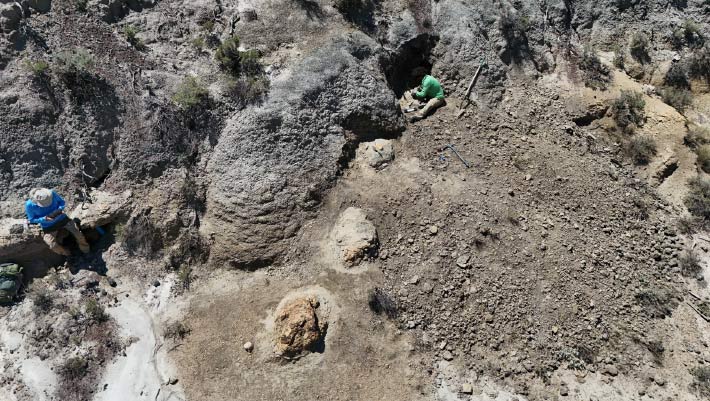
The discovery was made in the Hell Creek Formation, one of the world’s most intensely studied Cretaceous and Paleocene rock formations, which continues to reveal new secrets about Earth’s remote past. Although the formation covers thousands of square miles, this particular discovery was made on U.S. Forest Service land outside Marmarth, North Dakota.
Intriguingly, a local teacher at Northglenn High School made the discovery in a fortuitous example of citizen science. His discovery earned him an author position on the resulting paper.
“As a teacher, I’m always telling my students that science starts with curiosity, passion, and careful observation. I never imagined that could lead me to a discovery like this,” said co-author Kent M. Hups.
The Hell Creek tracks reveal T. rex’s stride for the first time. Credit: Tyler Lyson
High Tech Analysis
“The technology we’re able to apply in the digital age means my colleagues could scan the tracks in the field and then send the 3D information over to me to visualize on my computer and in VR, enabling me to take as close a look as they did in person,” said lead author Peter Falkingham, a professor of palaeobiology at Liverpool John Moores University and a dinosaur track expert.
Using high-resolution 3D surface scanning, the team measured each footprint along the 66.5-million-year-old trackway. Using these data, they constructed digital and physical 3D models of the T. rex tracks. The footprints are about three feet long, and the trackway extends for roughly 23 feet. Their size and distinctive narrow toe shape led to the Tyrannosaurus identification, further supported by the known recovery of T. rex fossils in the area.
Tyrannosaurus Movement
This isn’t the first time paleontologists have seen a track believed to have been made by a T. rex, but it is the first time such tracks have been found in a sequence. Locating a series like this provides scientists with crucial new evidence about how the dinosaur moved while it was alive.
“Bones tell us an enormous amount about these animals, but footprints capture a moment of behavior. With a trackway, we can actually follow an animal as it moved across the landscape. That is incredibly rare for T. rex,” said co-author Tyler Lyson, senior curator of vertebrate paleontology at the Denver Museum of Nature & Science.
The stride between the footprints was about 13 feet, with a symmetrical sequence of two left and two right tracks. Due to weathering, it is challenging to be certain, but the team estimates that the dinosaur was moving at 3.5 to 4.5 miles per hour—roughly what would be a brisk walking pace for a human.
The work will continue this fall, when three of the prints will be physically removed from the location and transported by helicopter to the Denver Museum of Nature & Science. The institution plans to make the most of the opportunity, providing updates over the winter as researchers conduct an in-person analysis of the tracks.
Ryan Whalen covers science and technology for The Debrief. He holds an MA in History and a Master of Library and Information Science with a certificate in Data Science. He can be contacted at ryan@thedebrief.org, and follow him on Twitter @mdntwvlf.
Paleontologists in North Dakota have unearthed a set of 66.5-million-year-old fossilized footprints that can be confidently attributed to a full-grown Tyrannosaurus rex.
Before 2025, paleontologists had confirmed exactly two footprints anywhere in the world made by an adult Tyrannosaurus rex — one in New Mexico, one in Montana. Isolated prints, each capturing a single instant, with no way to tell how the animal that made them actually moved. That changed with a discovery in the badlands of […]

 Login