❌

Reading view

JNR Meteorite 100K VS Maskking Camo 100K: Comparison Review

The high-puff vaping landscape is evolving rapidly, moving beyond basic single-use hardware into advanced, high-capacity systems designed for longevity and customization. Leading this shift are two powerhouses: the JNR Meteorite 100K and the Maskking Camo 100K. Both devices redefine what users can expect from heavy-duty setups by offering incredible longevity, refillable flexibility, and high-performance dual-mesh coils. While they share the same impressive target milestone of up to 100,000 puffs, they approach style, power delivery, and user experience from entirely different design angles.

Design

When it comes to visual identity, these two devices appeal to completely distinct aesthetics. The JNR Meteorite adopts a sleek, modern look focused on futuristic tech. Its standout feature is an animated curved display screen that brings your vaping data to life with fluid visual feedback, making it feel premium and highly responsive. It also includes a portable lanyard, emphasizing daily on-the-go utility.

On the other hand, the Maskking Camo embraces a charmingly unique, retro camera-inspired silhouette. It swaps a standard screen for an eye-catching “dynamic ring display” and features a modular magnetic build that makes interacting with the device feel tactile and mechanical.

Features

Digging into performance and layout, both models are engineered to give you complete control over your inhale, though their fluid delivery systems differ. The JNR Meteorite functions as a highly compliant, user-focused kit that pairs a visible e-liquid level indicator with adjustable airflow. It delivers its massive puff count through a smart multi-bottle configuration, bundling four separate 10ml bottles at a smooth 2% nicotine strength. The Maskking Camo relies on a massive 17mL reservoir supporting up to four complete refills. Both devices feature custom performance scaling; the Meteorite utilizes a 0.6Ω dual mesh setup with a specialized Boost Mode to ramp up cloud production, while the Camo uses a 0.5ohm dual mesh element managed by a physical firing button to alternate seamlessly between Normal and Boost modes.

Battery

Power management is another area where these two kits showcase unique engineering paths. The JNR Meteorite utilizes a robust dual-battery architecture, combining a large 1200mAh primary cell with a 200mAh secondary backup to ensure massive operational endurance between charges. The Maskking Camo opts for a streamlined approach, keeping the chassis pocket-friendly with a single 650mAh internal battery capacity. While the Meteorite offers a larger total power reserve upfront, both hardware designs are equipped with rapid USB Type-C charging ports, meaning downtime is kept to an absolute minimum for both setups.

Verdict

Choosing between these two top-tier systems comes down to your personal workflow and style preferences. If you appreciate smooth ergonomics, a high-tech animated screen, extended battery life, and a highly compliant multi-bottle setup perfect for daily travel, the JNR Meteorite 100K stands out as an incredibly dependable companion. Conversely, if you love vintage-inspired aesthetics, tactile button operations, magnetic modularity, and a compact camera style that turns heads, the Maskking Camo 100K delivers a uniquely satisfying, flavor-packed experience. Both represent excellent leaps forward in hardware longevity.

Read Also: JNR Meteorite 100K Refillable Vape Kit Review: A Revolutionary Powerbank-Style Vaping System

The post JNR Meteorite 100K VS Maskking Camo 100K: Comparison Review appeared first on IGeeKphone China Phone, Tablet PC, VR, RC Drone News, Reviews.

  •  

Rare Meteorite From New Jersey Roof Strike Offers New Clues to the Origins of Life

Not all meteorites are created equal, and one that crashed through the roof of a New Jersey home is giving scientists a rare glimpse into the chemistry of an ancient asteroid while offering new clues to the puzzle of how life began on Earth.

On July 16, 2024, a daytime meteor streaked across the sky and produced a sonic boom as it passed south of the Statue of Liberty.

“A forensic study of the fragments revealed that they contained preserved bits from near the surface of a primitive asteroid where it experienced concentrated salty fluids—a process not previously known from this type of proto-planet world,” said lead author and meteor astronomer Peter Jenniskens of the SETI Institute and NASA’s Ames Research Center in California’s Silicon Valley in a statement.

Two years later, after analyzing fragments from the event, researchers found that the meteorite contained evidence of ancient salty fluids, complex organic chemistry, and processes that occurred on a primitive asteroid billions of years ago.

meteorite

Daytime meteor (left), impact site, and a fragment of the Hillsborough meteorite (Image Credit: (A) M. Kirschner and M. Hankey, American Meteor Society; [(B) to (D)] A. Gordon/SETI Institute).The findings, published in the journal Science Advances, come from an international team led by meteor astronomer Peter Jenniskens of the SETI Institute and NASA Ames Research Center.

“Our cameras in Northford, Connecticut, and Douglassville, Pennsylvania, as well as a doorbell camera in Wayne, New Jersey, captured the meteor, and from that we measured its trajectory,” said American Meteor Society operations manager Mike Hankey. 

Traveling at approximately 32,000 miles per hour (14.4 kilometers per second), witnesses from the surrounding areas, including New York, New Jersey, Connecticut, Rhode Island, and Pennsylvania, reported seeing a bright fireball that broke apart while a part of it broke through the roof of a New Jersey residence.

“The path traced back to low in the asteroid belt,” Hankey adds. 

Using footage from meteor cameras, including systems in Connecticut and Pennsylvania, researchers reconstructed the meteor’s path. The trajectory traced back to a region of the asteroid belt between Mars and Jupiter. The space rock disappeared from view about 22 miles above the surface. Shortly afterward, weather radar at Newark Airport detected a cloud of falling debris stretching from Staten Island into New Jersey. 

The homeowner acted quickly, handling the space rock with gloves and aluminum foil before placing it in a glass container to protect the material from contamination.

The meteorite was classified as a CM1/2 carbonaceous chondrite, a rare type of primitive meteorite known for containing organic compounds and evidence of water weathering. 

According to researchers, the Hillsborough meteorite is only the second witnessed fall of a CM1/2 carbonaceous chondrite ever recorded. Most known CM meteorites belong to the less-altered CM2 category, while no CM1-type meteorite fall has ever been observed.

Hillsborough meteorite
A fragment of the Hillsborough meteorite (Image Credit: SETI Institute).

“A high fraction of compounds were the product of organic chemistry with minerals,” said organic mass spectrometry specialist Phil Schmitt-Kopplin of Technical University Munich. “We do not know if these magnesium organic compounds were contributed by brine chemistry or were simply left over from earlier impact shock processes.”

The final analysis showed tiny salt-rich pockets inside the meteorite, pointing to a formation where water once evaporated on its parent asteroid, leaving behind highly saline fluids. Scientists are comparing these minerals with samples from the asteroids Ryugu and Bennu to better understand early solar system chemistry.

These ancient salty waters may have helped protect and change the molecules needed for life before life first began. The meteorite contained carbon, nitrogen, amino acids, and other organic compounds, many of which appear to have formed through interactions between water, minerals, and carbon-rich chemistry.

“We are thrilled that nature delivered such a precious asteroid sample on our doorstep,” said curator Denton Ebel from the Department of Earth and Planetary Sciences at the American Museum of Natural History.

The recent paper, “Meteor over New York City: Brines in a primitive CM asteroid,” appeared in the journal Science.

Chrissy Newton is a PR professional and the founder of VOCAB Communications. She currently appears on The Discovery Channel and Max and hosts the Rebelliously Curious podcast, which can be found on YouTube and on all audio podcast streaming platforms. Follow her on X: @ChrissyNewton, Instagram: @BeingChrissyNewton, and chrissynewton.com. To contact Chrissy with a story, please email chrissy @ thedebrief.org.

  •  

NASA’s Bennu Samples Reveal Tiny Ancient Clues About the Asteroid’s Long-Lost Origins

When NASA’s OSIRIS-REx spacecraft delivered pristine samples from the asteroid Bennu back to Earth in 2023, scientists knew they were receiving one of the most chemically untouched collections of material ever recovered from the Solar System.

Since then, the returned grains have steadily transformed researchers’ understanding of how asteroids formed, how water altered primitive worlds, and even how the ingredients for life may have spread through the early Solar System.

Now, a new study, published in Nature Communications, has uncovered another surprise hidden inside those microscopic particles. Embedded within Bennu are tiny mineral fragments that formed during the Solar System’s earliest moments—less than 100,000 years after its birth—and they may reveal that the asteroid’s ancient parent body formed much farther from the Sun than scientists once suspected.

The research suggests that Bennu inherited some of the oldest surviving solids ever created, while simultaneously preserving evidence that Jupiter’s formation may have acted as an enormous cosmic filter, separating different populations of dust before planets had even fully formed.

“Our observations of phyllosilicates replacing olivine and interstitial phyllosilicates between olivine grains within AOAs… collectively indicate that these refractory inclusions experienced aqueous alteration on Bennu’s parent planetesimal,” researchers write. “Therefore, they were incorporated into the parent planetesimal before the onset of aqueous alteration, during which phyllosilicates and magnetite formed.”

“These mineralogical, isotopic, and chronological similarities among refractory inclusions in Bennu samples, Ryugu samples, and CI chondrites provide evidence that their parent planetesimal(s) accreted a common suite, and likely similar relative abundances, of high-temperature refractory inclusions and their fragments,” researchers write.

The research concentrates on “refractory inclusions”—tiny mineral-rich objects known as calcium-aluminum-rich inclusions (CAIs) and amoeboid olivine aggregates (AOAs). These objects are widely considered the oldest solid materials to condense from the hot gas surrounding the newborn Sun.

Long before planets existed, the infant Solar System consisted of a rotating disk of gas coupled with dust known as the protoplanetary disk. Temperatures near the young Sun exceeded 2,000 degrees Fahrenheit (roughly 1,100 degrees Celsius), allowing only the most heat-resistant minerals to crystallize.

These refractory inclusions were among the very first solids to emerge from that environment before eventually being transported throughout the growing Solar System.

Although scientists have found such inclusions in meteorites for decades, Bennu offered an unprecedented opportunity to examine them in material collected directly from an asteroid rather than from meteorites that survived passage through Earth’s atmosphere.

To investigate, researchers analyzed polished sections prepared from 12 Bennu particles using scanning electron microscopy, transmission electron microscopy, oxygen isotope measurements, and radioactive aluminum-magnesium dating techniques.

The team identified six amoeboid olivine aggregates and three calcium-aluminum-rich inclusions, all remarkably small—none exceeding roughly 100 micrometers across, or about the thickness of a human hair. This turned out to be one of the study’s most important discoveries.

The mineral chemistry and oxygen isotopes showed these inclusions formed in an extremely hot, oxygen-16-rich environment during the Solar System’s earliest stages. Radioactive dating using aluminum-26 indicated at least one inclusion formed essentially at the very beginning of Solar System history, within roughly the first 100,000 years after the earliest known solids condensed.

In other words, Bennu contains fragments that have survived for approximately 4.567 billion years with surprisingly little alteration. Yet, those ancient relics also preserve evidence that they later encountered liquid water.

Several inclusions show minerals partially replaced by phyllosilicates—water-bearing clay minerals—while magnetite and other alteration products reveal that water once circulated through Bennu’s ancient parent body after these primordial objects had already become incorporated into it.

For scientists, that sequence helps establish a timeline. First, the earliest high-temperature solids formed close to the newborn Sun. Later, they were transported outward through the protoplanetary disk. Only after they became part of Bennu’s larger parent asteroid did liquid water alter portions of the rock.

Researchers found distinct similarities between Bennu’s inclusions and those previously identified in samples returned from Japan’s Hayabusa2 mission to asteroid Ryugu, as well as in rare CI carbonaceous chondrite meteorites found on Earth.

The oxygen isotopes, crystal chemistry, and formation ages all closely match, suggesting these seemingly distant objects inherited material from the same population of ancient Solar System building blocks.

That mutual heritage points toward a surprisingly interconnected early Solar System, where material formed close to the Sun was efficiently transported across enormous distances before eventually becoming incorporated into multiple asteroid populations.

However,  the absence of something proved just as revealing as what scientists found.

Unlike many carbonaceous meteorites, Bennu contains no large refractory inclusions larger than about one-tenth of a millimeter. Other meteorites frequently preserve inclusions ranging from submillimeter sizes up to several centimeters across.

According to the researchers, the missing population may reflect the increasing influence of the Solar System’s first giant planet.

As proto-Jupiter accumulated mass, its gravity likely created a pressure bump within the gas disk encircling the young Sun. Such pressure bumps act as natural traffic jams for dust, trapping larger particles while allowing much smaller grains to continue drifting through the disk.

Under this scenario, larger refractory inclusions became concentrated closer to Jupiter’s orbit. At the same time, only the smallest particles were able to migrate farther outward into the distant regions where Bennu’s parent body eventually formed.

If correct, Bennu’s microscopic inclusions effectively record the influence of Jupiter before the giant planet had even fully matured.

The hypothesis also helps explain why Bennu, Ryugu, and CI meteorites all possess nearly identical populations of tiny refractory inclusions while lacking the larger varieties commonly found elsewhere.

Rather than showing different source materials, the distinction may instead reflect where—and perhaps when—their parent bodies assembled within the developing protoplanetary disk.

The findings similarly reinforce earlier studies suggesting Bennu is among the Solar System’s most chemically primitive objects. Because large refractory inclusions contain unusually high concentrations of certain elements, their absence helps preserve Bennu’s overall composition close to that of the earliest solar nebula from which the planets formed.

That makes the asteroid an unusually valuable time capsule. Every new microscopic grain examined inside the OSIRIS-REx collection provides another insight into processes that occurred billions of years before Earth existed as a habitable world.

Rather than simply representing rubble from a small asteroid, Bennu appears to preserve a remarkably faithful record of how the Solar System sorted, mixed, transported, and assembled its earliest building materials.

The study also demonstrates why sample-return missions have grown increasingly important to planetary science. Laboratory instruments on Earth can perform measurements impossible for spacecraft operating millions of miles away, letting researchers reconstruct events that occurred within the Solar System’s first fractions of a million years.

“We conclude that Bennu’s parent planetesimal, like those of Ryugu and CI chondrites, accreted small refractory inclusions that persisted in the outer Solar System beyond the influence of the proto-Jupiter-induced pressure bump,” researchers write. “Taken together, these findings highlight the need to integrate Bennu samples into comparative studies of early Solar System solids to better constrain the diversity and possible genetic links among planetesimal formation pathways,” researchers write.

The study, “Refractory inclusions in Bennu samples indicative of outer Solar System accretion,” appeared in Nature Communications.

Tim McMillan is a retired law enforcement executive, investigative reporter and co-founder of The Debrief. His writing typically focuses on defense, national security, the Intelligence Community and topics related to psychology. You can follow Tim on Twitter: @LtTimMcMillan.  Tim can be reached by email: tim@thedebrief.org or through encrypted email: LtTimMcMillan@protonmail.com 

  •  

A New Solution to the Dinosaur-Killer Meteorite Mystery Creates Fresh Questions

Researchers from the University of British Columbia studying material from the mysterious dinosaur-killer meteorite that wiped out 75% of Earth’s species, including non-avian dinosaurs, have determined the doomsday space rock was likely a rare type of carbonaceous chondrite.

Although the international team behind the discovery, which includes researchers from Paris, Brussels, and Vienna, said the evidence for this category of “oddball” meteorite offers a viable solution to its mysterious composition, they note that the rarity of chondrite meteorites makes its origin a new mystery that needs to be solved by future research.

They also note that a chondrite meteorite impact would have much less effect on atmospheric sulfur, which is critical to most extinction models, potentially casting doubt on its central role in dinosaur extinction.

Many Details About the Dinosaur Killer Meteorite Remain a Mystery

According to a statement, the Cretaceous-Paleogene impactor resulted in one of the largest extinction events in the planet’s history. While most scientists agree that the event played a significant role in ending the dinosaurs’ reign, the study’s authors note that “the exact mechanism and the extent of the impact-extinction link are debated.” They also note that the origin and composition of the dinosaur killer have remained a mystery.

An analysis of the Chicxulub impact structure reveals that the doomsday dinosaur-killer meteorite was between 10 and 15 kilometers (approximately 6 to 9 miles) wide. Estimates also suggest it impacted Earth at 64,000 km/m (40,000 mph) beneath the modern-day Yucatán Peninsula in Mexico.

Although previous studies identified the meteorite as similar to carbonaceous chondrites, the researchers said that carbonaceous chondrites are a diverse class of space rock, “leaving the exact nature of the impactor unclear.”

“Carbonaceous chondrites of the Ornans class (CO) are definitely not like the typical meteors you find in museum collections,” explained study co-author and visiting professor Dr. Philippe Claeys.

For example, the professor explained, a CO contains fewer volatile elements, such as zinc, carbon, Sulphur, and H20 “than other classes of meteorites we’ve discovered so far on Earth.”

One Mystery Solved

To try to unravel the mystery of the dinosaur-killer meteorite, the researchers teamed up with scientists from the Institut de Physique du Globe and the Université de Paris to conduct high-precision nickel isotope measurements of meteor samples from the event that have been collected over the years from the thin, worldwide layer of clay created by the explosive impact.

Dr. Claeys, a professor at Vrije Universiteit Brussel, currently visiting the Pacific Center for Isotopic and Geochemical Research in Earth, Ocean and Atmospheric Sciences at UBC, noted the challenging nature of the isotopic analysis, primarily due to the limited number of samples.

“Only a minute fraction of the projectile is preserved in the planet’s KT clay layer because the entire meteorite vaporized upon impact,” the researcher explained.

Still, the study authors explain, evaluating Nickel isotopes offers several advantages over other testing methods. For example, Nickel has five isotopes that the researchers note  “allow for up to three separate internally normalized signatures.” They also highlight the availability of Nickel in “virtually all types of available early Solar System solids,” including iron meteorites, which allows for comparison with a wide variety of potential impactors.

Finally, they write, CI chondrites have a distinct Ni isotope signature from the rest of the class, therefore “making it possible to distinguish a CI-like impactor clearly” from other meteorite types.

After completing an isotopic analysis of samples of marine clays containing microscopic pieces of the ejecta, the team said their results “constrain the impactor to one group of carbonaceous chondrites, CO chondrites, “ as well as some evidence for “ungrouped chondrites.”

“By combining our new Ni isotope data with the existing evidence, we demonstrate that the composition of the Chicxulub impactor was most likely CO chondrite-like,” the researchers write, adding that this identification is possible “given nickel’s high abundance in primitive meteorites compared to the Earth’s crust and the distinct isotope compositions they record.”

A New Mystery is Created

While the isotopic analysis offers a compelling solution to the composition of the famed dinosaur-killer that slammed into Earth millions of years ago, the team said the identification casts doubt on the extent of its role in the dinosaurs’ extinction. Specifically, they note that CO chondrites are “dry” compared to others in their class, meaning they contain much less of the volatiles that most extinction theories cite as a significant mechanism.

“As highly volatile elements, such as C, N, and S, in CO chondrites are less abundant than in the typical CCs, questions arise whether the impactor was an essential contributor to the volatiles released during the impact,” they explained.

The most important volatile in most extinction theories is Sulfur (S). However, the authors note, CO chondrites would deliver “approximately half as much S” as more common types.

If the new analysis is correct, it also puts the dinosaur-killer’s origin in question. The authors note that possible sources include distant, debris-rich regions of the outer Solar System or even the outer area of the asteroid belt near Jupiter.

Combined with the compositional analysis lacking volatiles, the team notes that their findings allow “further studies of the mechanism behind the extinction.”

Finding “Doesn’t Alter Our Theory” of What Caused Land Dinosaur Extinction

When discussing the potential implications of their findings, the researchers said their study “highlights the extraterrestrial origin of the K-Pg mass extinction and the isotopes of Ni as a well-suited tool to characterize the nature of extraterrestrial material on Earth.” They also note that the composition of the dinosaur-killer “opens the door for further research into the connection between the impact and the mass extinction.”

From a scientific perspective, the research said their work “highlights the use of Ni isotopes in fingerprinting extraterrestrial materials on Earth,” and helps evaluate the risks associated with “potential future impact events and their consequences.” The study also shows how even an uncommon type of space rock can permanently alter the planet’s history.

“Being impacted by such a rare, distant projectile really underscores how unlucky the dinosaurs were,” Dr. Claeys said.

The researcher also noted that the lack of volatiles in this category of meteorite “doesn’t alter our theory of what caused the extinction event.” However, he notes, if correct, the result “makes it less likely that Sulphur contained in the impactor was the smoking gun.”  Instead, the fine debris “thrown into the atmosphere” by the forceful impact would have been the primary factor in the end of the dinosaurs.

The study “The origin of Cretaceous-Palaeogene impactor revealed by nickel isotopes” was published in Science Advances.

Christopher Plain is a Science Fiction and Fantasy novelist and has spent the last six years as Associate News Editor and Head Science Writer at The Debrief. Follow and connect with him on X, learn about his books at plainfiction.com, or email him at christopher@thedebrief.org

  •  

Dinosaurs May Have Been Wiped Out by ‘Oddball’ Space Rock

This painting depicts an asteroid slamming into tropical, shallow seas of the sulfur-rich Yucatan Peninsula in what is today southeast Mexico. The aftermath of this immense asteroid collision, which occurred approximately 65 million years ago, is believed to have caused the extinction of the dinosaurs and many other species on Earth. Shown in this painting are pterodactyls, flying reptiles with wingspans of up to 50 feet, gliding above low tropical clouds. Image credit: Donald E. Davis / NASA.

By analyzing nickel isotopes preserved in the 66-million-year-old debris left by the Chicxulub impact, researchers conclude that the asteroid responsible for Earth’s last mass extinction most likely belonged to an exceptionally rare class of primitive meteorites called carbonaceous chondrites of the Ornans type (CO chondrites).

The post Dinosaurs May Have Been Wiped Out by ‘Oddball’ Space Rock appeared first on Sci.News: Breaking Science News.

  •  

Mysterious “Space Dust” Falling on Earth May Originate from Unidentified Objects Lurking Near Our Planet, New Study Finds

Every year, more than 5,000 tons of material with cosmic origins lands on Earth’s surface, with as much as 15,000 tons of this “space dust” making its way into the atmosphere but vaporizing during reentry.

The resulting rain of micrometeorites that reaches our planet consists mostly of tiny objects anywhere from 30 to 200 micrometers in size, based on past studies. But what are the origins of these large volumes of material that accumulate over time as they shower the Earth throughout the year?

According to new research, evidence for one potential source of this cosmic debris has now been found: it could be coming from unidentified near-Earth objects.

Space Dust with Unknown Origins

The problem with tracing the origins of space dust is that most of it that makes its way into Earth’s atmosphere doesn’t survive the intense conditions of atmospheric entry, and those tiny bits that do—known as cosmic spherules—are reshaped as they melt from the friction they encounter while falling.

Although their original mineral structure is compromised as well as their shape, there are a few isotopes—namely oxygen—that these spherules maintain that scientists can use to help trace their origins. Based on their chemical “fingerprints,” cosmic spherules are placed into different groups by planetary scientists, with many being able to be traced back to known varieties of meteorites and other sources.

space dust
Image obtained using an electron microscope of space dust possibly originating from a comet (Image Credit: NASA)

Among these groups, around ten percent fall into a category possessing unusually small quantities of the isotope oxygen-16. This category, known as Group 4, doesn’t appear to match any known meteorite group—the implication, therefore, is that some of this cosmic debris may originate from an unidentified variety of near-Earth objects.

New Clues to the Origins of Uncorrelated Space Dust

Now, according to new research by Matthias Van Ginneken and colleagues, there are at least some ways that the origins of these spherules can be determined, one of which involves their orbital parameters.

In one case, the team writes in a recent study published in Science Advances, “the mineralogical and textural properties of a subset of cosmic spherules do provide information on the orbital parameters of their precursors, including eccentricity and encounter velocity.”

This group of materials, which is dubbed “CumPo” based on its material consistency of cumulate olivine porphyritic, is “characterized by clustered olivine phenocrysts that increase in size from one side of the spherule to the other,” the team writes.

In short, this unique class of spherules points to equally unique orbital characteristics that may be associated with what the research team surmises could be atypical types of near-Earth objects, or NEOs, that could be near enough to our planet to provide a likely source.

A particular clue offered by these objects is that some of them may have undergone unusually high entry speeds, as evidenced by their surface texture. One factor that could potentially account for this is that they may have entered Earth’s atmosphere at angles consistent with objects possessing high orbital eccentricity.

More Clues from Antarctica

As with past studies, researchers were able to retrieve several samples of these CumPo cosmic spherules from Antarctica, which provides a pristine environment that helps to facilitate their discovery and collection. However, another source location had been far less remote: urban rooftops, where a large amount of cosmic dust lands every year.

With the aid of electron microscopy and microprobe chemistry studies, Ginneken and colleagues examined the mineralogy, chemistry, and textures of these spherules, as well as the oxygen isotopes they contained.

What they found indicated an entirely new subset of spherules, which possess significant amounts of cumulate olivine rich in sulfur, garnering the name “SCumPo.” This unique new class of samples has links to the “Group 4” class and their minimal inclusion of oxygen-16. Other unusual similarities they possess are an overall absence of magnetite and a low presence of nickel in their olivine crystals, paired with an abundance of iron-nickel sulfur and a significant amount of sulfur present within glasses produced from vitrification.

Intriguingly, some spherules appeared to show a combination of signatures that were both poor in oxygen-16 in some areas, while rich in the isotope in others. This suggests that these cosmic materials had likely been mixed from two separate original sources, since such conditions could not be otherwise explained through natural processes.

“We interpret this as strong evidence that the SCumPo precursors were composite materials containing at least two different components,” the team writes in their study. Then, by running numerical simulations of crystal settling to help determine the likely entry speeds of these materials, and thereby their eccentricities while in orbit, the team determined that the settling of olivine is most consistent with entry speeds of as much as 17 kilometers per second, and likely no more than 14 kilometers per second—speeds that would be consistent with NEOs, as opposed to asteroids originating from the main-belt.

Evidence for an Unknown Class of Space Objects

Based on their findings, the team believes that unsampled meteorites from the CM, CO, and CY classifications of carbonaceous chondrites—a group of primitive, carbon-rich meteorites containing some of the oldest materials in our Solar System—are the likely sources for these cosmic materials.

“Given that we have linked their composition to the CM-CO-CY clan of carbonaceous chondrites, it is plausible that their parent body was a primitive carbonaceous asteroid that migrated onto an Earth-crossing orbit—attaining comet-like orbital parameters,” the team writes.

“For instance, one might consider the disrupted fragments of a thermally altered but water-bearing asteroid (like the CY group) that evolved into near-Earth space,” they add.

Although still only inferred from their studies, the team suggests the existence of a hypothetical new variety of NEOs based on the samples they studied, which are unlike any variety of meteorites currently known on Earth.

“These findings point to a previously unsampled, primitive, sulfide-rich CY-like near-Earth asteroid, which represents a ‘missing’ meteorite parent body that contributes distinctive 16O-poor cosmic dust to Earth,” the team writes, noting that any future confirmation of the existence of this unknown class of meteorites would represent “a pivotal discovery.”

The team’s new paper, “16O poor cosmic spherules from near-Earth CY chondrite asteroids,” appeared in Science Advances.

Micah Hanks is the Editor-in-Chief and Co-Founder of The Debrief. A longtime reporter on science, defense, and technology with a focus on space and astronomy, he can be reached at micah@thedebrief.org. Follow him on X @MicahHanks, and at micahhanks.com.

  •  

How many asteroids can we detect before they hit Earth?

When you think of an asteroid impact, you’re probably imagining something like the cataclysmic event that nearly wiped out the dinosaurs. In an astonishingly rare event, a rock the size of the island of Manhattan could come hurtling from deep space towards Earth and destroy the world.

On the contrary, asteroids are generally leftover debris from the primordial solar system that didn’t become part of a larger body, like a planet or moon, and they’re not particularly rare. Scientists estimate that there are about 1 billion asteroids and comets classified as near-Earth objects, or NEOs. NEOs are generally much smaller than the asteroid that killed the dinosaurs. They range from weakly held-together piles of rubble 200 meters (700 feet) across, to the minuscule 2024 BX1, approximately 44 centimeters (17 inches) across. 

For several decades, astronomical surveys of the sky have looked for these asteroids. NASA’s Center for Near-Earth Object Studies (CNEOS) Fireball and Bolide Database has records of over 1,000 incidents of objects colliding with our planet since the mid-1990s. Among these is a set of 11 objects that scientists detected before they hit Earth, known as imminent impactors. Finding imminent impactors allows scientists unique opportunities to study the smallest building blocks of the solar system, enabling them to learn more about asteroid composition, structure, and history.

A team of scientists recently conducted a study on how the newly built Vera Rubin Observatory could detect more imminent impactors before they strike Earth. They examined the CNEOS Fireball and Bolide Database impact records spanning February 1, 1994, to January 1, 2026, for records of the asteroids’ coordinates, velocities, and the energy they released at the time of collision. 

They found that 343 NEOs met this criterion, including 5 known imminent impactors. Using these recorded data, they reconstructed the objects’ pre-impact characteristics. The team predicted the asteroids’ orbital paths from the recorded coordinates and velocity. Assuming the objects were spherical, they estimated the size from velocity and impact energy. From this information about the asteroids’ state before impact, the team could then simulate whether the Rubin Observatory would have detected them. 

When small asteroids hit Earth, they mostly burn up in the atmosphere, producing a bright flash that is relatively easy to spot compared to when they are in space. The Rubin Observatory can see objects up to 10 billion times dimmer than the brightest star in the night sky, Sirius. To predict if the Rubin Observatory can detect dim NEOs, the team used the solar system simulator SORCHA. SORCHA takes an observatory’s specifications and the physical properties of the NEOs and uses these to determine whether the observatory could detect them. It also estimates the measured sizes and speeds of the NEOs, and predicts when the observatory would have seen them. 

At the Rubin Observatory, an imminent impactor is considered discovered if it’s observed at least 3 separate times over 15 days before hitting Earth. So this team applied this same criterion to their simulation. They found that of their 343 impactors, SORCHA estimated that the Rubin Observatory would have discovered 14 of them before impact. 

They also found that SORCHA predicted 4 additional impactors that could have been observed at least once, potentially allowing scientists to search other telescope data for evidence of their existence in pre-collision images. Based on these results, the team estimated that the Rubin Observatory could find 4% of all objects longer than 1 meter (3 feet) before they hit Earth. This percentage of discovery translates to 1 to 2 imminent impactors detected every year, at least double their current discovery rate.

The ability to more consistently find imminent impactors would allow researchers to study the smallest pieces of the solar system in detail and to draw general conclusions about the properties of objects that could potentially collide with Earth. This would also allow scientists to more accurately calculate the orbits of imminent impactors, determine where more meteorites land to recover them, and keep tabs on the extremely rare but more hazardous large impactors for planetary defense initiatives. So, humanity can learn more about the ancient solar system, and hopefully avoid going the way of the dinosaurs while doing so!

The post How many asteroids can we detect before they hit Earth? appeared first on Sciworthy.

  •  

Une intense « boule de feu » a illuminé le ciel de Paris et du nord de la France : le phénomène enfin expliqué

En levant les yeux vers le ciel nocturne dans la nuit de lundi à mardi, peut-être avez-vous eu la chance d’apercevoir une brève mais intense traînée de lumière. Mais de quoi s’agissait-il ?

  •  

Inside a Martian Meteorite, These Grains of an Unexpected Gemstone Hold Clues to a Hidden Past


A Martian meteorite fragment containing unexpected grains of mineral could hold clues to the Red Planet’s geological history, according to an international team of researchers.

Prior to the team’s new paper, which was published in Geochemical Perspectives Letters, the red mineral garnet had never been observed in any martian rock sample. Now, the meteorite discovery provides scientists with new clues to Mars‘ extreme past conditions, over its 4.5 billion-year history, which could include hidden magma sources or ancient impact events.

Garnet and Geology

Although the gemstone garnet can come in many colors, it is best known for its dark red varieties, which were historically popular in ancient Egypt, Rome, and Victorian England. Beyond its beauty, the rock is important for the record it keeps of its birth, providing Earth’s geologists with information on our planet’s tectonic forces, ore-forming processes, and the fluid-rock interactions of the crust and mantle.

Similarly, the small grains of garnet discovered in the meteorite sample contain important data for reconstructing the forces that forged the Red Planet long ago.

“The findings add a striking new dimension to our understanding of the geology of Mars and open an exciting new window into the evolution of our planetary neighbour,” said co-author Professor James Darling.

“This discovery is going to expand our knowledge of the geologic processes that are possible on this planet,” said lead author Tanya Kizovski, Assistant Professor of Earth Sciences, from Brock University in Canada. “This new garnet-bearing rock type could give us clues to how Mars has changed throughout its history and new insights into the ancient environments that could have formed the garnet and related minerals.”

Mars Meteorite NWA 8171

The garnet fragments were discovered in a tiny Martian meteorite sample held in the Royal Ontario Museum’s collection, designated NWA 8171, discovered in northwest Africa. Kizovski led the team in analyzing the sample’s mineral and chemical composition after identifying it as a unique piece within the collection.

“This little section of the meteorite looked really interesting, and the chemistry was a bit odd,” Kizovski said. “At first, we assumed it was a mineral called pyroxene, which is very common, but then we decided to take a second look.”

The international effort brought in researchers from Italy’s University di Trieste and the UK’s Open University, utilizing the Royal Ontario Museum’s laser equipment and the University of Portsmouth’s Electron Microscopy and Microanalysis Unit.

Having never been observed in any previous Martian sample, the researchers were surprised to identify garnet in the meteorite’s composition. From their analysis of the sample’s chemistry and mineralogy, the researchers began to consider how the unexpected garnet could have formed.

“Garnet is a classic example of a mineral often found in metamorphic rocks on Earth,” Kizovski said. “The process of metamorphism transforms igneous or sedimentary rocks into a new form through exposure to extreme heat, high pressure, or hot fluids.”

“On Mars, the heat and pressure needed to produce garnet through metamorphism could have come from the impact of a meteorite hitting the surface of Mars, magma rising up into the Martian crust, or both,” Kizovski continued.

Explaining Martian Garnet

While garnet provided geologists with some data about how it formed, this is not like the point of origin stamped on a manufactured good. It is possible that the garnet was deposited on Mars during an earlier meteorite impact, only to later travel through the solar system again, or that it was created by a heretofore unknown magma source on Mars.

Only further analysis of the garnet’s isotopic signatures will allow the researchers to determine whether the mineral formed on Mars or elsewhere. Unfortunately, to do so, the team would have to destroy a portion of this rare and precious sample, which measures only 0.8 by 0.5 millimeters to begin with.

“Measuring oxygen isotopes from the garnet-bearing rock type itself would help to confirm if it is Martian in origin or from an exotic meteorite impactor,” Kizovski said.

“Isotopes are a collection of atoms with equal numbers of protons and electrons, but different numbers of neutrons,” she added, “which was avoided thus far due to its rarity, as it may be the only garnet-bearing Martian rock we have for study.”

A few members of the team are continuing their study of the sample by comparing their findings to Martian data collected by rovers and orbital platforms. Further insights, they hope, may help them discover more about how the garnet could have formed, and what its presence means for the deeper history of the Red Planet.

The paper, “Expanding Mars’ Lithologic Diversity: Discovery of a Garnet-Bearing Clast in NWA 8171,” appeared in Geochemical Perspectives Letters on June 16, 2026.

Ryan Whalen covers science and technology for The Debrief. He holds an MA in History and a Master of Library and Information Science with a certificate in Data Science. He can be contacted at ryan@thedebrief.org, and follow him on Twitter @mdntwvlf.

  •  

Lunar Meteorite Preserves Evidence of Colossal Asteroid Strike

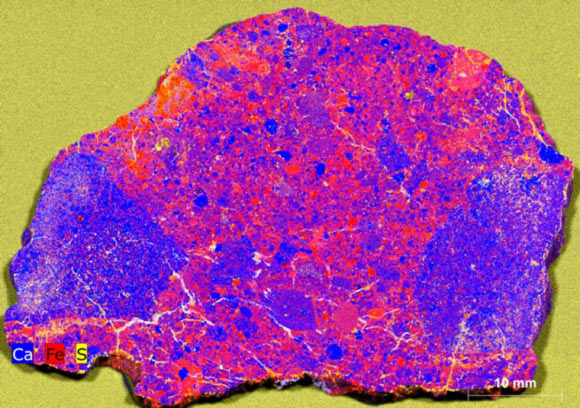
XRF map of 7.53 g slice of NWA 12593: calcium (Ca) and iron (Fe) illustrate the location and diversity of clasts; sulfur (S) highlights the location of cracks and terrestrial weathering. Image credit: Crow et al., doi: 10.1130/G54386.1.

Planetary scientists analyzing a lunar meteorite known as Northwest Africa (NWA) 12593 have uncovered evidence of an asteroid impact that occurred 3.5 billion years ago on the Moon, helping to reconstruct a period of intense bombardment that left lasting marks across the inner Solar System.

The post Lunar Meteorite Preserves Evidence of Colossal Asteroid Strike appeared first on Sci.News: Breaking Science News.

  •  

Rare Sahara meteorite uncovers a hidden planet from the early solar system

A rare meteorite found in the Sahara Desert has revealed evidence of a giant ancient world that once existed in our solar system but later disappeared. Scientists believe this lost world formed about 4.5 billion years ago, during the early days of the solar system. It may have been as large as the Moon or […]

The post Rare Sahara meteorite uncovers a hidden planet from the early solar system appeared first on Knowridge Science Report.

  •  

This Rare Meteorite Could Be Evidence of a “Massive World” Once Hidden Deep in Our Solar System


A meteorite discovered in Africa could be evidence of a lost protoplanet that once orbited our Sun, according to researchers at the University of Colorado at Boulder.

In a recent paper published in Earth and Planetary Science Letters, the team revealed evidence of an ancient protoplanet that may have been as large as Mars based on simulations of how the meteorite sample may have formed.

The four-and-a-half-billion-year-old world carried an unexpected geological makeup, which the researchers say casts doubt on common assumptions regarding planetary evolution.

Protoplanetary Demise

According to the UC Boulder team, the massive protoplanetary body collided with another object four and a half billion years ago, shattering it completely. This is the first definitive evidence of a lost protoplanet in our solar system, based on analysis of the angrite meteorite NWA 12774, a shard of that planetary embryo recovered from the Sahara Desert.

“It’s incredible to think there was once a world this large,” said lead author Aaron Bell, an assistant research professor in the Department of Earth Science at CU Boulder. “We only know it existed because a few fragments of it happened to land on Earth. These meteorites preserved evidence of a completely different pathway through which early planets developed.”

A Rare Meteorite Sample

Angrites, a rare type of volcanic rock, serve as a record of our solar system’s distant past. These rocks began forming only a few million years after the solar system’s birth, making them valuable evidence of this early era. However, they are extremely rare and difficult to find.

NWA 12774 is one of only 68 angrite samples identified among more than 80,000 meteorites cataloged by scientists. Given its rarity, the discovery could potentially reshape how researchers understand these ancient rocks.

Until now, scientists had assumed that angrites originated from relatively small asteroids less than 124 miles (200 kilometers) wide, based largely on their chemical composition. Large rocky planets such as Earth and Mars contain significant amounts of silicon dioxide, while angrites contain very little of the compound.

Unexpected Meteorite Discovery

Researchers began to reconsider those assumptions when they identified clinopyroxene in the meteorite sample. This mineral, commonly found in Earth’s crust and mantle, appeared unusually rich in aluminum, suggesting that it formed under significant pressure deep within a planetary body.

To investigate this unusual characteristic of NWA 12774, the University of Colorado Boulder team recreated the conditions under which the sample could have formed. Their analysis revealed that pressures of at least 17.5 kilobars were required to produce the aluminum-rich clinopyroxene found in the meteorite. For comparison, one kilobar is roughly equivalent to the pressure at the deepest part of Earth’s oceans, near the bottom of the Mariana Trench.

Rethinking Meteorite Origins

The researchers’ discovery proved that at least this particular angrite sample could not have formed inside a small meteorite, as a body with a radius of at least 621 miles would be required to generate the pressure needed to produce the crystals. 

Additional evidence suggested the parent body may have been even larger. The crystals’ sharp edges and delicate internal structures indicate they likely formed at relatively shallow depths beneath the surface. Reconciling both the high-pressure conditions and the shallow formation depth suggests that the parent body may have ranged in size from the Moon to Mars.

“There are many meteorites sitting in drawers that haven’t been thoroughly studied, so there were likely more of these protoplanets we don’t know about,” Bell said.

Exactly what happened to this ancient world remains uncertain, but researchers believe it was likely destroyed in a massive collision early in the solar system’s history. Fragments of that lost protoplanet may have later contributed material to other bodies, potentially including Earth itself.

“The materials that formed the angrite parent body are fundamentally different from the ingredients of Earth and Mars,” Bell concluded. “It points to a distinct and separate evolutionary path in planetary formation in the early history of our solar system.”

The paper, “High-Pressure Clinopyroxene in Northwest Africa 12774 and New Geobarometric Evidence for a Planetary Embryo-Sized Angrite Parent Body,” appeared in Earth and Planetary Science Letters on July 1, 2026.

Ryan Whalen covers science and technology for The Debrief. He holds an MA in History and a Master of Library and Information Science with a certificate in Data Science. He can be contacted at ryan@thedebrief.org, and follow him on Twitter @mdntwvlf.

  •  
❌