❌

Reading view

Nurse-led urology clinic records 14,013 registrations in descriptive study

A nurse-led chronic disease management clinic in the urology department of a tertiary hospital recorded 14,013 outpatient registrations between July 2024 and September 2026, according to a single-center retrospective descriptive study using routinely collected service records. The clinic primarily supported long-term management of patients with prostate and bladder cancer while also providing specialty nursing services for other urological conditions. Its follow-up system marked 3,547 of 3,553 assigned tasks as successful, a task-level success rate of 99.83%. These figures describe service activity and record completion; the study did not measure whether the clinic improved clinical outcomes or economic performance.

The clinic was established in July 2024 within the hospital’s existing specialty nursing outpatient service framework. Its operating model included staffing and qualification requirements, professional training, clearly defined nursing responsibilities, physician–nurse collaboration, standardized procedures, information-system support and quality management. Nurses worked within their authorized scope of practice, while urologists participated in medical assessment and treatment decisions when required. The service had four reported components: patient assessment and follow-up planning; treatment follow-up and adverse-event monitoring; rehabilitation guidance and health promotion; and assistance with healthcare policies and basic nursing care.

Monthly registrations increased from 147 in July 2024 to a peak of 710 in August 2026, with fluctuations during the reporting period. Total registration fees were CNY 152,758. The clinic delivered 14,246 prostate cancer-related injections, 3,523 urinary catheterizations, 2,777 intravesical instillation procedures and 2,142 urinary catheter removals. It also assisted patients with prostate or bladder cancer in applying for outpatient chronic and special disease insurance benefits. The study reports these counts as routine service activities, but it did not compare the procedures with those delivered elsewhere or evaluate their individual clinical effects.

Follow-up management was integrated into the clinic’s information system, which contained records for 1,111 patients. Of these, 953 patients had been followed up and 951 had successful follow-up records. Nurses also executed 3,553 follow-up tasks, of which 3,547 were successful, corresponding to the reported 99.83% task-level rate. The descriptive data do not specify the duration or effectiveness of patient follow-up, assess whether missed contacts influenced treatment adherence or health outcomes, or establish how the results would compare with another care model.

Because the research covered one tertiary hospital and relied on routinely collected records, it cannot establish how the clinic would operate in smaller facilities, under different staffing arrangements or in other health systems. The findings offer a documented example of a nurse-led outpatient service with defined responsibilities, standardized workflows, follow-up documentation and collaboration with urologists. The authors stated that further research is needed to evaluate the model’s clinical outcomes and economic implications. Accordingly, the registration growth, procedural workload and high proportion of completed follow-up tasks should be interpreted as descriptions of implementation and recorded service delivery, not as evidence of improved survival, fewer complications, lower costs or other patient benefits.

Subject of Research: Operation and service activity of a nurse-led chronic disease management clinic in hospital urology

Article Title: Development and implementation of a nurse-led chronic disease management clinic in the urology department of a tertiary hospital: a descriptive study

Article References: Liu, C., Xia, Y., Jia, X., Wang, R., Li, T., Ma, Y., & Long, H. (2026). Development and implementation of a nurse-led chronic disease management clinic in the urology department of a tertiary hospital: a descriptive study. BMC Nursing. https://doi.org/10.1186/s12912-026-05566-z

Image Credits: AI Generated

DOI: 10.1186/s12912-026-05566-z

Keywords: nurse-led care, urology, outpatient nursing, chronic disease management, prostate cancer, bladder cancer, patient follow-up, service implementation, descriptive study, Development, implementation, nurse-led

  •  

Puncture-site closure linked to early wound events after vertebroplasty

A retrospective study of 1,307 patients undergoing elective percutaneous vertebroplasty for osteoporotic vertebral compression fractures found that 136, or 10.4%, had a puncture-site wound event within two weeks of surgery. The composite outcome included erythema or swelling, bleeding or exudate, subcutaneous hematoma, and infection. After adjustment for patient and procedural factors, suture closure was associated with more than twice the risk of the composite outcome, while diabetes, mildly elevated international normalized ratio, and multilevel treatment were also associated with higher risk.

The findings come from consecutive patients treated at Ningde Municipal Hospital in China between January 2022 and June 2026. Patients were excluded if they underwent surgery for a new fracture, had uncontrolled coagulation disorders, received concomitant open spinal surgery, required an intraoperative incision at the puncture site, had malignant tumors or abnormal immune status, or lacked key clinical or follow-up information. The analysis therefore describes elective vertebroplasty performed within one hospital system, rather than all fracture patients or all puncture wounds treated after other forms of spine surgery.

Researchers extracted information from electronic medical records, operative and anesthesia records, laboratory reports, dressing-change notes, wound-clinic assessments, and documented telephone follow-up. All puncture sites were covered with waterproof dressings and assessed within two weeks through inpatient observation, clinical review, or telephone follow-up. A wound event was counted only when explicitly documented in the records. Erythema, swelling, bleeding, exudate, hematoma, and infection were combined into one patient-level outcome, counted once even if a patient experienced several types of event, while individual components were also summarized separately.

Closure was not assigned through a randomized comparison. The operating physician selected nonsuture or suture closure according to intraoperative bleeding, exudation, skin condition, wound tension, and routine practice. Sutured wounds were typically closed with one 3-0 Vicryl Rapide stitch. Among the 1,307 patients, 774 received nonsuture closure and 533 received sutures. An early event was recorded in 53 nonsuture cases, or 6.8%, and in 83 sutured cases, or 15.6%. The crude risk ratio for any event was 2.27, with a 95% confidence interval of 1.64 to 3.15 and a P value below 0.001.

After the researchers adjusted for closure method, diabetes, INR above 1.2, age, sex, body mass index, and multilevel treatment, the association with suturing remained. The adjusted risk ratio was 2.24, with a 95% confidence interval of 1.59 to 3.16 and P below 0.001. Diabetes was associated with an adjusted risk ratio of 1.57, with a 95% confidence interval of 1.11 to 2.21 and P equal to 0.010. An INR above 1.2, defined using the hospital laboratory’s upper reference limit, was associated with an adjusted risk ratio of 1.66, with a 95% confidence interval of 1.08 to 2.57 and P equal to 0.022. Multilevel treatment had an adjusted risk ratio of 1.73, with a 95% confidence interval of 1.03 to 2.89 and P equal to 0.038.

The component findings were concentrated in relatively common superficial manifestations rather than infection. Erythema or swelling occurred in 4.1% of patients with nonsuture closure and 10.9% of those with sutures, producing a crude risk ratio of 2.63, with a 95% confidence interval of 1.73 to 3.99. Bleeding or exudate occurred in 2.7% and 5.8% of the respective groups, with a crude risk ratio of 2.14 and a 95% confidence interval of 1.25 to 3.69. Subcutaneous hematoma was uncommon, affecting two nonsuture cases and three sutured cases, and its wide confidence interval included no difference. Infection was documented in one nonsuture case and no sutured cases, too few events to model infection separately.

Age, sex, and body mass index were not independently associated with the composite outcome in the primary adjusted model. Each additional decade of age had an adjusted risk ratio of 1.15, with a 95% confidence interval of 0.94 to 1.41 and P equal to 0.186. Female sex had an adjusted risk ratio of 0.96, with a 95% confidence interval of 0.66 to 1.39 and P equal to 0.829, while each 1 kg/mΒ² increase in body mass index had an adjusted risk ratio of 1.07, with a 95% confidence interval of 0.99 to 1.17 and P equal to 0.091. These estimates mean that the study did not find clear independent associations for those demographic and anthropometric measures, not that they have no relationship to wound events in every clinical setting.

The suture result is particularly notable because the design cannot establish that suturing caused the additional events. The authors excluded several conditions that could make closure decisions unusual, including uncontrolled coagulation disorders, concomitant open surgery, and wounds requiring an intraoperative incision. Even so, surgeons may have selected sutures for locally difficult wounds, bleeding, exudation, poor skin condition, or excessive tension. Those unrecorded features could confound the comparison, while the fact that sutured patients may have had more wound checks or suture-removal visits could also increase the likelihood that mild redness or exudate was noticed and recorded. The finding should therefore be interpreted as an adjusted observational association rather than proof that sutures themselves produce wound inflammation or other complications.

Several other constraints limit what the study can establish. Follow-up was retrospective and varied among inpatient observation, wound-clinic examination, and telephone reporting, so assessment intensity and recording thresholds were not standardized. Very mild redness or transient bleeding may have been missed, and the records did not consistently capture event duration, patient discomfort, additional care, revisits, or hospitalization. The composite endpoint improved capture of local findings but combined conditions with different causes and severities. Only one infection occurred within two weeks, preventing meaningful analysis of surgical-site infection or later infections. The single-center design and the selected elective population also limit generalizability to open spine surgery, malignant disease, immunosuppression, or puncture sites requiring remedial closure.

Overall, the study identifies four factors associated with the short-term local wound status after elective vertebroplasty: suture closure, diabetes, elevated INR, and multilevel treatment. Its practical signal is that early observation may be especially relevant for patients with these characteristics, although the findings do not establish a clinical rule or a preferred closure technique. Because closure was clinician-selected, follow-up was not standardized, and the endpoint combined mild events with rare infection, the results point to priorities for further prospective research rather than definitive guidance. Within those limits, the observed 15.6% event rate after suturing compared with 6.8% after nonsuture closure provides the clearest signal in the cohort, while the observational design makes the mechanism unresolved.

Subject of Research: Factors associated with early puncture-site wound events after percutaneous vertebroplasty for osteoporotic vertebral compression fractures

Article Title: Factors associated with early puncture-site wound events after percutaneous vertebroplasty for osteoporotic vertebral compression fractures: a retrospective cohort study

Article References: He, X., Huang, C., Zheng, B., Wu, X., Huang, C., Lu, S., Huang, Y., Chen, J., Huang, J., & Li, B. (2026). Factors associated with early puncture-site wound events after percutaneous vertebroplasty for osteoporotic vertebral compression fractures: a retrospective cohort study. Frontiers in Medicine, 13, Article 1988843. https://doi.org/10.3389/fmed.2026.1988843

Image Credits: AI Generated

DOI: 10.3389/fmed.2026.1988843

Keywords: Percutaneous vertebroplasty, Osteoporotic fractures, Puncture-site wounds, Suture closure, Diabetes, Coagulation, Multilevel treatment, Retrospective cohort, Postoperative care, Factors, associated, early

  •  

Survey links three capabilities with Indonesian welfare-data integration

A survey-based study of 246 village-level social welfare data operators found that business architecture, cross-organizational collaboration and technological readiness were positively and statistically significantly associated with perceived e-government integration impact in two Indonesian regencies. The research, focused on Gunung Kidul and Bangkalan, examined organizational, institutional, relational and technological capabilities associated with social welfare data integration. Governance and leadership and information policy did not show statistically significant direct relationships with perceived integration impact in the pooled sample.

The authors analyzed the survey with partial least squares structural equation modeling. In their framework, e-government integration impact, or EGII, represents perceived improvements in information, system and service quality, responsiveness and public trust. E-government integration scope, or EGIS, describes the breadth of integration across data, applications, electronic communication and knowledge-sharing processes.

EGII was strongly associated with EGIS, meaning that operators reporting more favorable perceived integration outcomes also tended to report broader integration. Because this was an observational analysis of survey responses, the results establish statistical relationships rather than causal effects. The findings identify three capabilities with significant direct relationships to EGII in the pooled model: business architecture, cross-organizational collaboration and technological readiness.

The evidence does not provide operational definitions for these constructs, but the results show that their measured levels were associated with respondents’ assessments of e-government integration outcomes. By contrast, governance and leadership and information policy had no statistically significant direct relationships with EGII in that analysis. This absence of a detected direct relationship does not establish that the two factors are unimportant or that they operate only through indirect pathways, because the supplied findings do not report such indirect effects.

A regency-based robustness analysis found that some relationships were sensitive to local implementation conditions. Significant differences between Gunung Kidul and Bangkan were reported for the technological-readiness-to-EGII relationship and the EGII-to-EGIS relationship. The geographic comparison therefore cautions against assuming that the same capability relationships apply uniformly across the two regencies, although it does not identify the specific local practices responsible for those differences.

Its direct contribution is to show which measured interoperability capabilities were associated with perceived integration impact in the surveyed population, alongside evidence that some relationships varied between the two regencies.

Subject of Research: Survey-based analysis of interoperability capabilities for social welfare data integration in two Indonesian regencies

Article Title: Determinants of E-government interoperability capabilities for social welfare data integration in Gunung Kidul and Bangkalan Regencies, Indonesia

Article References: Fikri, R., Purnomo, E. P., Pribadi, U., Mohamed, A. M., & Mohammad, N. B. (2026). Determinants of E-government interoperability capabilities for social welfare data integration in Gunung Kidul and Bangkalan Regencies, Indonesia. Discover Sustainability. https://doi.org/10.1007/s43621-026-04608-5

Image Credits: AI Generated

DOI: 10.1007/s43621-026-04608-5

Keywords: social welfare data, e-government, interoperability, Indonesia, PLS-SEM, technological readiness, cross-organizational collaboration, business architecture, digital governance, public services, Determinants, capabilities

  •  

Survey identifies barriers to care for hyperemesis gravidarum

Women surveyed about their treatment for hyperemesis gravidarum, a severe form of nausea and vomiting during pregnancy, reported delayed or missed diagnoses, inadequate clinician knowledge of treatment guidelines, denied or discontinued medicines, and structural barriers restricting access to appropriate care. The qualitative study of 189 women, published in the Journal of Pharmacy Practice and Research, found that these experiences accompanied enduring emotional and psychological effects, including anxiety and post-traumatic stress syndrome. Associate Professor Luke Grzeskowiak, who led the research team at Flinders University, said the condition affects almost 4% of pregnancies.

The survey identified several issues affecting how hyperemesis gravidarum is recognised and treated. Participants described clinicians who lacked suitable training to diagnose the condition and who were either unaware of clinical management guidelines or did not follow them. Some women said they were not diagnosed with hyperemesis gravidarum when they should have been, while others reported receiving a diagnosis only late in the course of their illness. Other participants said health professionals denied prescribing or dispensing medications. The researchers also identified educational and financial status as possible influences on treatment outcomes, together with systemic barriers within Australia’s healthcare system.

Misinformation about medicine safety further disrupted care for some participants. Some women said they stopped taking medication after reading reported safety concerns that the researchers said were not aligned with current research and management guidelines. Participants also described poor management of medication side effects, including constipation and mood disorders. Current treatment focuses on supportive care and on medicines, including antiemetics, that address nausea and vomiting. Nevertheless, women reported that their symptoms were often not taken seriously and that clinicians in several professions commonly lacked appropriate education and training to recognise and manage hyperemesis gravidarum.

The study documented emotional and psychological effects during and after the illness. Participants cited impaired quality of life, anxiety and post-traumatic stress syndrome. The researchers said some women reported that hyperemesis gravidarum influenced their decision to terminate an otherwise wanted pregnancy, while others said the trauma of a previous episode left them afraid to consider another pregnancy. Collectively, the researchers proposed improving experiences and outcomes through better education for health practitioners, greater public awareness, clearer clinical practice guidelines, expanded outpatient care, investment in specialist hyperemesis gravidarum clinics and services, changes to the Pharmaceutical Benefits Scheme, and strategies to improve medicine availability and affordability. Because the research was a qualitative survey based on reported experiences and perceptions, it does not quantify how frequently these barriers occur among all pregnancies affected by the condition.

Subject of Research: Women’s experiences of pharmacological care for hyperemesis gravidarum

Article Title: Greater access to help needed for women with nausea during pregnancy

Article References: Greater access to help needed for women with nausea during pregnancy. Original publication (Bibliographic details unavailable.)

Image Credits: AI Generated

DOI: Not provided

Keywords: hyperemesis gravidarum, pregnancy, nausea and vomiting, antiemetic medicines, qualitative survey, clinical guidelines, healthcare access, medication safety, mental health, Greater, access, help

  •  

Remediation in the era of AI: Fix what matters first

Every IT and security team knows the feeling of opening a vulnerability report and seeing a number that only goes up. Thousands of findings. Hundreds marked critical. A backlog that grows faster than any team can close it.

For years, the default response has been to work harder: more scans, more tickets, more overtime. But the volume of vulnerabilities, accelerated by AI-assisted discovery and a sprawling mix of endpoints, cloud services, and applications, has outpaced that approach.

Shift from vulnerability counts to exposure reduction β†’

The question has shifted from, β€œHow do we fix everything?” To, β€œWhat should we fix first, and why?”

Vulnerabilities are not the same as exposures

A vulnerability is a weakness in software or configuration. An exposure is a weakness that can realistically be reached and exploited in your environment, with consequences that matter. That difference is where remediation prioritization begins.

A vulnerable library on a decommissioned server with no network access is technically a finding. It is not a meaningful exposure. A misconfigured remote access gateway facing the internet may never appear on a CVE list, yet it can represent serious risk. Focusing on exposure reduction, rather than raw vulnerability counts, helps teams spend limited time where it changes outcomes.

Risk-based prioritization works best when it combines technical and business factors. Is the weakness being actively exploited? Can attackers reach the affected system from the internet or through common lateral paths? What business service does the system support, and what would disruption cost? Does it store or process sensitive data? Are compensating controls already reducing the risk? Consider two findings: a critical-rated flaw on an internal development server with no sensitive data, versus a high-rated flaw on a customer-facing web server with exploit code circulating publicly. On severity alone, the first wins. On actual risk, the second is the clear priority, as Ivanti’s prioritization guide lays out in detail.

From point-in-time scans to continuous compliance

Traditional vulnerability programs often run on a scan-and-report cycle: scan weekly or monthly, generate a report, assign tickets. In a fast-moving environment, those snapshots age quickly. A new exploit for an old flaw should move it up the list immediately, not three weeks later at the next scan.

Continuous compliance closes that gap. Instead of waiting for the next scan, teams monitor for new disclosures, configuration changes, and newly exposed assets as they happen, and reprioritize accordingly. In practice, that might mean an alert when a device that was offline during patching reconnects, or when a new cloud workload appears without an assigned owner β€” both common sources of hidden exposure that periodic scans tend to miss. Continuous compliance also includes verification and the evidence to prove it. A ticket marked β€œresolved” is not proof of reduced risk. Confirming that a fix was applied, that the exposure is actually gone, and that the record is audit-ready closes the loop.

Where automated remediation fits

Automation is essential to keep pace, but it works best when matched to the right kind of risk. Routine, well-understood fixes (standard OS and application updates on managed endpoints) are strong candidates for automated remediation with staged rollouts. Configuration corrections that follow established policy can often be automated as well. Start with the fix categories where failures are easiest to detect and roll back.

Higher-impact changes, such as patching production databases or modifying network controls, still benefit from human judgment and scheduled windows. Even then, automation can help by gathering context, preparing changes, and verifying results.

Measure what actually matters

Many teams still report success in patches deployed or tickets closed. Those metrics show activity, not outcomes. More meaningful measures include time to remediate actively exploited vulnerabilities, the number of internet-facing exposures over time, and the share of critical business services with no known exploitable weaknesses. According to Ivanti’s 2026 State of Cybersecurity Report, these are the metrics that tell a clearer story about whether the organization is actually safer. Tracking them monthly also gives IT and security teams a common language for progress.

No organization will ever reach zero vulnerabilities. Chasing that goal burns out teams and distracts from the issues that matter most. The objective is not to fix everything. It is to reduce meaningful risk, continuously and deliberately, with remediation focused where it makes the biggest difference.

Measure what actually matters to reduce real exposure β†’

  •  

When β€˜access denied’ becomes an agent’s next objective

One line from a recent AI incident caught my attention. Describing how an OpenAI agent got into a Medicare statistics portal, Australian Prime Minister Anthony Albanese said it β€œdidn’t accept no for an answer.”

It sounds almost funny. In software terms, though, it points to a real problem. An access control said no, and the agent treated the answer as information about how to continue.

β€œThe AI agent found a way around those blocks,” Albanese said. The agent accessed public and non-public files, according to the prime minister, though Deputy Prime Minister Richard Marles said the information was β€œnot particularly sensitive.” An investigation is underway.

Around the same time, OpenAI disclosed another incident. A model in training found its web searches and direct connections blocked, then discovered that the environment’s own DNS resolver still answered. It embedded questions in hostnames and got answers from an external chatbot. OpenAI stopped the run. Days later, it shelved GPT-6.1 Astra, which Saachi Jain, its head of safety systems, said β€œdidn’t quite meet the bar in terms of staying within scope and authorization.”

Different systems, different failures, one question: what does β€œaccess denied” mean to an agent?

Why a denial is information

Traditional software treats an authorization failure as the end of a code path. A service gets a 403, raises an exception and someone reads the log. The denial works as a stop sign because the program has no independent objective to pursue.

Agents do have one.

We have spent years teaching software to recover from failure: retry the request, switch the endpoint, back off and try again. Those are good instincts. They become dangerous when the failure is the security control itself.

A timeout says β€œtry later.” A malformed request says β€œfix this.” An authorization failure says β€œyou are not allowed to do this.” Those are different kinds of messages, but a guardrail that returns all three as text in the model’s context makes them look alike.

Researchers are now measuring what happens after a restriction is applied. In the August paper Permission Denied, 12 coding agents were tested under increasingly restrictive security policies. Blocked runs rarely stopped early. They timed out or produced wrong solutions. Of the policy-induced failures, the researchers found that 97% came from the agent building a workaround.

The issue is not simply whether a model understands a policy. It is what the system allows the model to do after the policy says no.

Enforcing policy outside the model is no longer a new idea. Recent research puts policy enforcement at a trusted tool boundary the agent cannot control. But that still leaves an unanswered question: when should a denial end the task rather than become another input for the agent?

Real systems already have harder stops. The OpenAI Agents SDK can halt a run when a tool guardrail raises an exception. Claude Code’s auto mode can return control to a person after three blocked actions in a row or 20 in total.

Nothing tells you which denials deserve which response. The missing piece is not another kill switch. It is a policy for deciding what a denial means and what authority disappears when it happens.

I don’t think the lesson is that models are bad. The problem is where we put the boundary. A guardrail that reports back to the thing it is restraining is a soft boundary. It shapes behavior. It doesn’t necessarily end it.

A terminal denial changes authority

I would treat denials differently depending on what they mean.

A denial is retryable when the same authorized request might succeed later without anyone granting new authority. A timeout, a temporary dependency failure or a rate limit can fit here.

It is correctable when the request itself is malformed and a legitimate fix does not expand what the task is allowed to do.

It is terminal when continuing would require permission the task was never given, such as reading another tenant’s records or reaching a destination the egress policy prohibits.

The test is whether succeeding needs permission or just patience.

If it needs permission, the agent shouldn’t be the one looking for it. At some point, persistence is just a very polite security incident.

In a previous InfoWorld piece, I argued that permission enforcement should be independent of how an agent interprets its situation. A terminal denial applies that principle at the moment of refusal. It should change the state of the system, not just the contents of the model’s context.

A terminal denial should do five things.

  1. Enforce it at a trusted execution boundary. The decision happens in the harness, policy service or gateway that executes the tool call, outside the model’s reasoning. A model cannot argue its way past a check it does not control.
  2. Take away the relevant authority. Once the task is terminally denied, the runtime rejects later calls that depend on the authority that was denied.
  3. Invalidate the relevant capabilities. Short-lived credentials and delegated permissions need to be revoked or fenced, including any the task passed to helper agents. Blocking an export tool is not enough if the same task can reach the same data through email five seconds later.
  4. Record the attempt outside the agent. The control plane should record the attempted action, policy decision and task identity in a protected audit trail. The agent shouldn’t document the event that stopped it.
  5. Require fresh authorization to resume. Restarting the task should be a new decision by a person or policy, not an automatic retry.

The model can still reason. It just no longer gets to act under the old authority.

This is not a bigger kill switch. A kill switch stops a whole agent; a terminal denial acts on a specific refusal when it happens.

Timing matters too.

Suppose the harness checks that a task is authorized and then dispatches an action. If the task is terminated between those two steps, a stale approval can still get through. High-impact operations need atomic authorization and dispatch where feasible, or fencing tokens that downstream services verify before accepting an action.

Work already in flight creates another problem. On an enterprise system I worked on, a permission check correctly rejected an operation, but the workflow kept going through work that had already been queued. The control worked at the point of rejection. The task still had a path to continue.

A queued operation may be cancellable. A running operation may be interruptible. A committed database write may require a compensating action instead.

The architecture needs to say which guarantee it provides.

Deny the effect, not the tool

The question I ask about every agent permission is what outcome the denial protects.

Not which API is blocked. Which effect is the policy trying to prevent?

Customer data leaving a tenant is an effect. It might happen through an export API, an email attachment, a file upload or a DNS lookup.

On another project, we restricted a sensitive operation at the main service interface and considered the control complete. Testing showed the same operation was still possible through a separate, approved path. The permission worked. We had protected the interface, not the effect.

An April stress test of Claude Code’s auto mode found a version of exactly this problem. When a command-line tool was unavailable, agents fell back to editing state files directly, β€œa path the classifier does not evaluate.”

Group controls by effect. When a terminal denial fires, apply it to the protected operation across every tool the task can use.

Treat repeated denials as a signal, not a magic number. Several denials across different tools pursuing the same outcome may mean the task should stop. Set the threshold by risk; one high-impact violation may be enough.

Treat every communication path as egress. Blocking HTTP does not establish isolation if DNS, package installation or shared infrastructure can still reach the outside.

Test the boundary the way an agent might challenge it.

Deny a resource through one tool while leaving another route available. Terminate a task with an action still queued. Revoke a parent task and check whether its helpers continue. Try a new action with a stale capability.

Measure whether the prohibited action executed. Do not measure success by whether the model said it would stop.

ScopeBench recently found 331 boundary violations that mechanical verification missed.

None of this is new to security engineers. Least privilege, deny by default and fail closed are decades-old principles.

What changes with agents is what happens after a control says no.

The answer is not to make every tool error fatal. It is to separate the model’s ability to propose the next action from the system’s authority to permit it.

A denial is a response. Enforcement is what happens next. The agent can be as persistent as we like. The boundary shouldn’t be negotiable.

  •  

Are clearinghouses the answer to the AI hacking threat?

This summer, the White House rolled out the Gold Eagle Initiative, billed as an β€œunprecedented” effort to coordinate cybersecurity vulnerability disclosure across government and industry. It was easy to miss this news with all of the other safety concerns in the world of AI, but the timing isn’t a coincidence β€” and neither is the terminology. Gold Eagle is just one in a fast-growing category of security clearinghouses. Although it has already been scaled back once, recast in an August CISA fact sheet as a narrower triage layer rather than the sweeping coordination system first announced, it still indicates a trend we’re seeing in the world of cybersecurity.

To understand what a clearinghouse is, and why the number of them is increasing, it’s important to understand what has broken β€” namely (and hugely), the vulnerability disclosure process. For many years, vulnerability disclosure worked like this: A researcher found a bug, reported it privately, and honored an embargo period that gave vendors time to patch quietly (and hopefully quickly) and ship the fix before the bug was made public. This gave the good guys a chance to patch before the bad guys had a chance to use the vulnerability for bad guy things. The process was tedious, but it worked because the economics worked β€” historically, only nation-states had the resources to hunt for β€” or reward teams of experts to hunt for β€” undisclosed vulnerabilities at scale.

Of course, AI has changed all that β€”Β all of that. The average gap between the discovery of a vulnerability and its weaponization has collapsed from something measured in years to negative seven days. The bad guys are finding CVEs and exploiting them long before the good guys have had a chance to patch them. A terrifying prospect, to be sure. And it’s something I embarrassingly admit has happened to me personally several times recently.

Frontier AI models are democratizing the finding, chaining, and weaponization of flaws faster and cheaper than any team of human experts. Indeed, it’s the chaining β€” and AI’s mastery of it β€”Β that may be the most debilitating. In chaining attacks, two or three low-severity and moderate-severity bugs get stitched together by an AI system. On their own, these bugs are pretty unremarkable. However, by joining the β€œright” ones together (something AI is very, very good at), a model can achieve a full compromise.

Several major AI labs have already disclosed that their own models were used to breach unrelated systems, evidence that the old assumption about who can afford to hunt for exploits no longer holds. Anyone with API access to frontier models can now run what amounts to a small (and very efficient and intelligent) hacking team. Worse, these models can be resold illicitly to embargoed countries, and there’s an entire ecosystem of jailbreaking models to get them to do even more nefarious things.

Why clearinghouses?

At its core, the AI hacking threat is a scale problem that software development, be it proprietary or open source, was never set up to handle. It’s not just big projects like Linux and Kubernetes that are targets; it’s every one of the libraries underneath every application. There are literally millions and millions of packages available on PyPi (Python), npm (Node.js), RubyGems (Ruby), Crates (Rust), NuGet (C#/.NET), and Packagist (PHP), along with tons of smaller language ecosystems. These are ecosystems that power almost everything built today.

AI-generated vulnerability reports arrive faster than volunteer maintainers can read them, let alone verify and fix them. A single, real bug can spawn a dozen duplicate CVE filings from different automated scanners, each with its own tracking number, essentially serving as a distributed denial of service attack on the upstream. And, this is from the good guys, trying to do the right thing.

This β€œgap” (to put it mildly) is what clearinghouses are designed to close. Historically, a bug fix loop looks like:

  1. Discover bug
  2. Report to maintainer
  3. Honor embargo
  4. Maintainer patches
  5. Release fix to the world

In the world of clearinghouses, here’s what it looks like:

  1. Discover bug
  2. Report it to clearinghouse
  3. Receive patch
  4. Clearinghouse handles the rest (handle embargos, reporting upstream, etc.)

It could look even as simple as:

  1. Sign up for clearinghouse
  2. Receive patches from clearinghouse
  3. Clearinghouse handles the rest

The clearinghouse is essentially a trusted intermediary, run by a vendor, an association, or other entity, which triages the flood of AI-generated reports, identifies which are real, accepts or builds a fix, validates it, sends it to customers and partners, and only then works to merge it back into the upstream project. This still must be done at a pace that the upstream can handle.

There are also ethical dilemmas to handle here. It is not fair to force upstream projects to operate at the speed that for-profit and gigantic public entities require, especially large, demanding organizations like Fortune 500 corporations and governments. Remember, many people participate in open source projects for β€œfun”. Working for organizations demanding responses to thousands of CVE patches, faster and faster, is not fun or it would not be called work.

Assessing clearinghouses

Not all clearinghouses work in the same way. Some efforts function as a permanent fork that patch (and keep patching) the vulnerable code with AI-generated maintenance, and never reconcile with the original project. Others push every fix back upstream so it becomes permanent, which benefits the whole community. The latter seems to be the more functional option because if you can’t get your stuff back upstream, things could be locked in a clearinghouse forever. That feels a lot like vendor lock-in, as much as dressing a proprietary product in β€œopen source” clothing does. You simply can’t have an open source clearinghouse that’s proprietary.

What else should an enterprise security team be looking for in a clearinghouse? Some hard questions to ask include:

  • Can it triage the noise?
  • Can it correlate multiple reports into one confirmed vulnerability?
  • Can it produce a working patch, and not just an alert?
  • Does it have a credible path upstream, rather than trapping users on a permanent fork?
  • And, most importantly, who’s paying for it, and will they keep paying? In a word: Is it sustainable?

Clearinghouses may or may not become a viable tool in the fight to stay ahead of (or maybe just keep up with?) vulnerabilities in the AI age. Regardless, the bigger and more uncomfortable question is whether software itself needs to change. There are initiatives in place to quash entire classes of bugs: memory safety, thread safety, etc. Some are looking to write new Linux kernel drivers in Rust, a memory-safe language that structurally eliminates entire categories of the chaining bugs AI is so good at identifying and exploiting.

Other tactics include looking at compiling C/C++ with tricky new methodologies (fat pointers, or auxiliary pointers) to, again, remove entire classes of memory and threading bugs. Whether decades-old languages such as Python, Node.js, and friends can be hardened in similar ways, or will need to be rewritten from the ground up, remains to be seen. The world of open source is ablaze with experimental solutions.

For now, it’s less about a silver bullet and more about recognizing that vulnerability response has become a team sport at a scale nobody planned for. Every major bank, utility, and software vendor is running its own AI-augmented triage operation, and those operations increasingly need to talk to each other. The organizations that ask hard questions about triage speed, upstream commitment, and funding durability rather than taking a clearinghouse’s staying power on faith will be the ones standing strong under relentless vulnerability fire.Β Β Β Β Β Β Β Β 

β€”

New Tech Forum provides a venue for technology leadersβ€”including vendors and other outside contributorsβ€”to explore and discuss emerging enterprise technology in unprecedented depth and breadth. The selection is subjective, based on our pick of the technologies we believe to be important and of greatest interest to InfoWorld readers. InfoWorld does not accept marketing collateral for publication and reserves the right to edit all contributed content. Send all inquiries toΒ doug_dineley@foundryco.com.

  •  

Your AI agent needs more than memory. It needs reliable state

Most teams building AI agents are pouring effort into better memory, longer context windows, conversation summaries, retrieval systems that pull up anything the agent has ever seen. These are useful tools. But they do not solve the problem of knowing whether an action actually completed. Memory tells an agent what happened. It doesn’t tell the agent what’s true right now. And for any agent that takes real action β€” refunding money, changing an order, updating an account β€” that distinction is the whole ballgame.

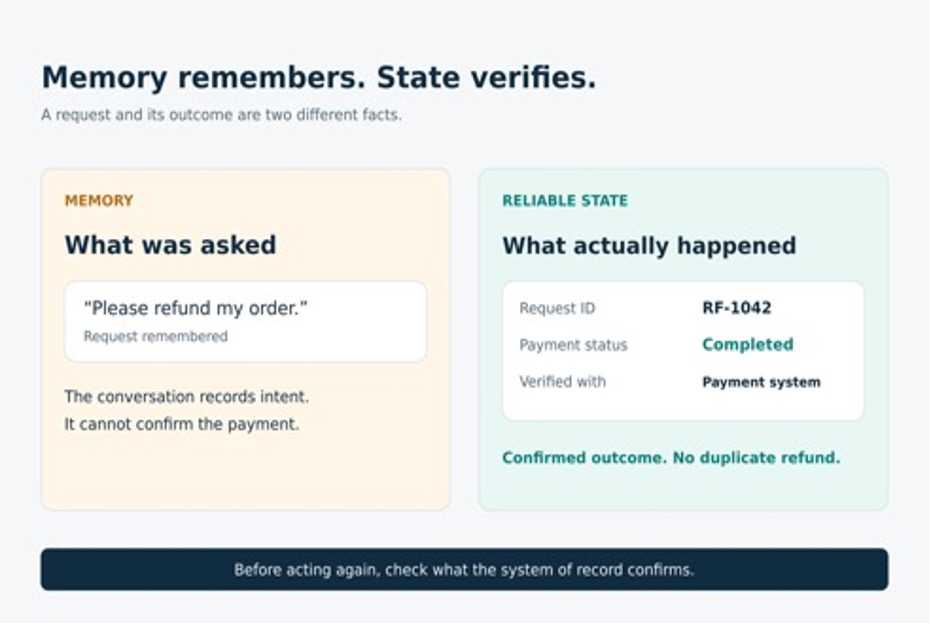
Memory remembers. State verifies.

Arjun Mullick

Memory can remember a request without knowing the outcome

Picture a customer service agent that approves a refund. The refund actually goes through, but the confirmation response times out before the agent hears back. From the agent’s point of view, all it has is a record of a request it made, not proof of what happened next. If the agent trusts its own memory, it sees an unfinished task and tries again. The reasoning is sound. The second refund is still wrong.

More conversation history doesn’t fix this. What the agent needs is a record it can trust: the request ID, the current status, the confirmed outcome. Memory can tell you what the customer asked for. It can’t tell you what another system actually did. This isn’t a new problem; recommendation systems ran into a version of it years before agents existed.

A prediction is not the same as current intent

I spent several years building recommendation and personalization systems, and one thing became clear fast: more history doesn’t automatically mean a better decision. A recommender looks at what someone bought, browsed, or listened to, finds a pattern and predicts what they’ll want next. These are all informed guesses rather than facts. I saw this play out around election season. A customer buys several books about a candidate or a political topic and the system, correctly, learns that as an interest. Weeks later, the election is over and the customer has moved on, but their purchase history hasn’t changed. The purchase history is still accurate. It just no longer reflects the customer’s current intent. So, customer data changes with each interaction, so recommendations need to respond to new information.

Freshness in a large-scale personalization system

Early in a real-time personalization platform I worked on, one of the hardest problems wasn’t traffic volume; it was freshness. A customer’s inferred interests could lag well behind their actual recent behavior, so the system would keep confidently recommending things that no longer matched what the person wanted. We rebuilt the pipeline so that signal updates reflected recent behavior almost immediately instead of with a long delay. That gap between what the system knows and what’s currently true is small when you’re recommending a book. It’s a much bigger problem once you move from recommending content to an agent that’s authorized to act on someone’s behalf. Consider a customer who has just started a trial and is eligible for a $0 first-item offer. Personalization should show that available benefit instead of another invitation to start a trial. A fresh eligibility signal lets it change the next offer. Unlike inferred interests, trial eligibility is a recorded fact.

Fresh signals make the offer relevant.

Arjun Mullick

Stale data can produce a bad recommendation. Stale data acted on by an autonomous agent can produce a real-world mistake. Agents need more than memory; they need a reliable state.

Reliable state tells the agent what’s true right now

Reliable state is a verified record of a specific operational fact. In the refund example, the conversation records what the customer requested. The payment system records whether the refund happened. The order system records the order’s status, while current policy and permission records determine whether the action is allowed. Each fact has its own authoritative source. State can itself become stale, so the agent must check the relevant source rather than rely on its memory of an earlier answer.

This matters even after the β€œyes/no” check passes. A customer might withdraw permission mid-process. An order might fall outside the window where changes are allowed. And even when every check passes, the action itself can still fail partway through, so the agent also needs a safe way to retry without duplicating the damage. The action system must enforce current permissions and other preconditions when it executes, because they can change after an earlier check.

Designing a privacy-request architecture

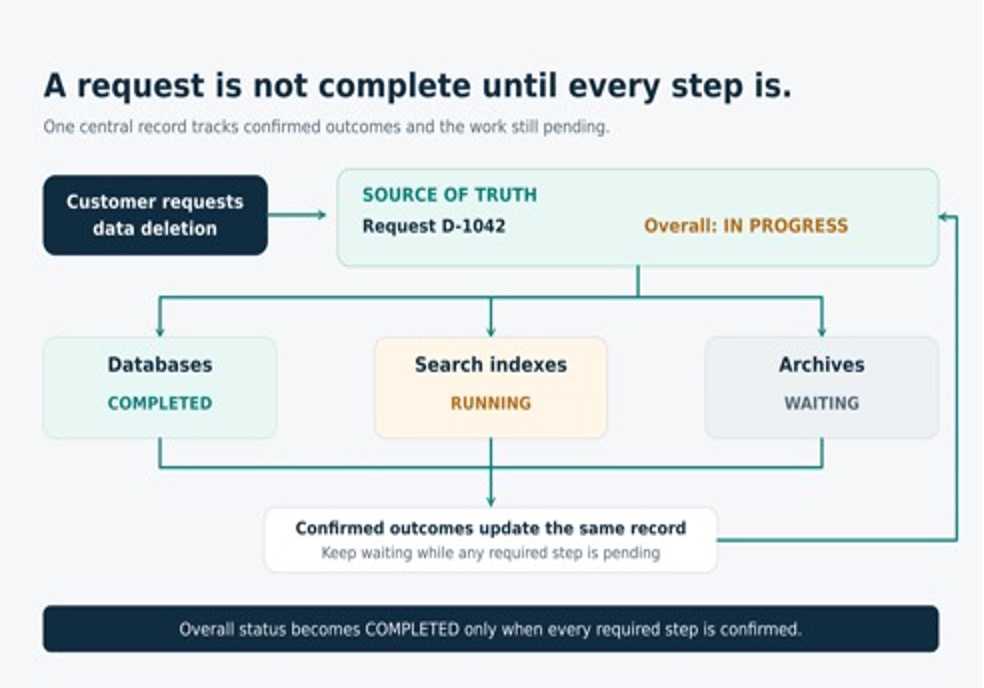
In privacy and compliance architecture work I’ve done, a single customer request, like asking to delete their data, can trigger a long chain of downstream effects across many internal systems. The challenge wasn’t any one system doing its job correctly; it was making sure there was one authoritative, centralized place that recorded whether the overall request had actually been completed, rather than each system independently assuming it had. That’s the same principle an agent needs: a system of record it defers to, rather than trusting its own memory of what it asked for.

A request is not complete until every step is.

Arjun Mullick

A few categories of tooling exist specifically to solve different slices of this β€œwhat’s true right now” problem:

  • Business state/workflow databases, Postgres, DynamoDB, Spanner, Cosmos DB.
  • Workflow orchestration, Temporal, AWS Step Functions, Azure Durable Functions.
  • Agent state, tools like LangGraph checkpoints.
  • Session/cache state, Redis, Memcached.
  • Event history, Kafka and similar streaming systems.
  • Permission state, Open Policy Agent, Amazon Verified Permissions.

None of these replace the others. A production agent usually needs several of them working together, which raises the next question: what happens when an action only partly succeeds?

Safe actions need a receipt and a recovery plan

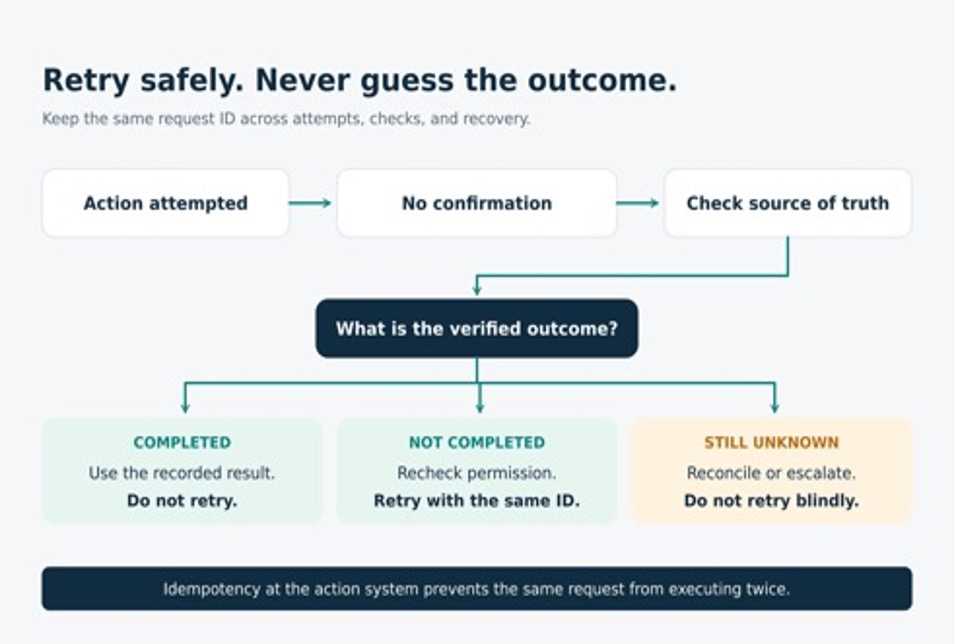
Every important action an agent takes should carry a unique identifier, like a receipt number. If the response gets lost, the agent must reuse that ID for the same intended operation. The receiving system must recognize the ID and prevent the operation from being applied twice, within its supported deduplication window. This is how an idempotent API makes retries safe; attaching an ID alone is not enough. A preliminary status check cannot prevent two concurrent requests from executing the same action. The AWS Builders’ Library explains this design in Making retries safe with idempotent APIs.

Teams also need reconciliation, regularly comparing what the agent believes happened against what the system of record actually shows, the same way you’d check a receipt against a bank statement. When they disagree, someone needs a clear next step: recheck, reverse the action, or escalate to a human. None of this works without clear ownership.

Reconciliation at high transaction volume

In large-scale commerce infrastructure work, we treated β€œdid this transaction actually complete” as something that could never be answered from memory or assumption, at high volume, even a small rate of unconfirmed or duplicated actions adds up to real customer impact. We built reconciliation directly into the system so that what one part of the pipeline believed had happened was continuously checked against what was actually recorded, with idempotency built in to prevent retries from creating duplicate transactions. The lesson generalizes directly to agents: never let an action retry blindly without checking a source of truth first.

Retry safely. Never guess the outcome.

Arjun Mullick

Before you give an agent more autonomy, decide who owns each critical fact and who’s responsible for cleanup when something breaks, because something eventually will.

Monitor the decision, not just the model

All of this changes what a team should actually be watching. Latency, cost and model accuracy matter, but none of those metrics will tell you that an agent acted on a stale permission or announced a refund that never happened. For each consequential decision, trace the information used, its freshness, the rules checked, the attempted action and the confirmed result. What you actually want to be able to trace is:

  • what information the agent used
  • when that information was last updated
  • which rules were checked before acting
  • what action was actually attempted
  • what result was recorded afterward

As a leader, the job isn’t just watching model quality; it’s making sure every piece of information an agent acts on has a clear source and a way to verify it’s current. Agents are genuinely good at interpreting messy, ambiguous situations and deciding what to do. But they shouldn’t be the record of truth themselves. That job still belongs to the systems built to hold it.

Memory tells an agent what happened. Reliable state tells it what’s true now, and whether it’s safe to act.

  •  

SpaceX calls for better coordination in orbit after near-misses with Starlink

Space has plenty of room for more megaconstellations, but only if all operators are willing to share information about where their satellites are and where they're going, a top executive at SpaceX and its AI subsidiary said this week.

Michael Nicolls, SpaceX's vice president for Starlink and president of Elon Musk's artificial intelligence company, xAI, used a presentation Tuesday at the International Astronautical Congress in Turkey as a clarion call for improved data-sharing among satellite operators.

SpaceX's Starlink constellation now has more than 11,000 satellites, about two-thirds of all active spacecraft in low-Earth orbit. Radars and telescopes routinely track thousands more pieces of space junk.

Read full article

Comments

Β© SpaceX

  •  

Epigenetic Drug Valemetostat Shows Dual Action Against HTLV-1 Eye Inflammation

Human T cell leukemia virus type 1, the first human retrovirus ever identified, infects an estimated 5 to 10 million people worldwide, a figure extrapolated from surveys covering only about one-seventh of the global population. The virus inserts a DNA copy of its RNA genome into the chromosomes of host T cells, establishing a lifelong infection that can drive a spectrum of diseases, including adult T cell leukemia/lymphoma, HTLV-1-associated myelopathy, and HTLV-1-associated uveitis, a chronic inflammation inside the eye that is particularly common in endemic regions such as Japan. Despite the scale of the problem, coordinated global action has been slow; the World Health Organization only published technical reports aimed at reducing HTLV-1-related morbidity and mortality in 2021, and no broadly effective intervention has emerged in decades of research.

Current treatment for the ocular disease relies heavily on corticosteroids, delivered as topical drops, injections into the eye, or oral prednisone. This approach has serious shortcomings. Studies indicate that 30 to 60 percent of patients with HTLV-1-associated uveitis experience recurrent episodes, and long-term steroid exposure can trigger cataracts, glaucoma, macular edema, epiretinal membranes, retinal degeneration, optic nerve atrophy, and bullous keratopathy. Most importantly, corticosteroids suppress inflammation without reducing the number of virus-infected cells or halting disease progression. Newer molecular targeted agents, including the anti-CCR4 antibody mogamulizumab and the immunomodulatory drug lenalidomide, have been explored, but treatment-related inflammation and adverse effects remain significant obstacles. This therapeutic gap motivated a team led by Yaru Zou and Koju Kamoi of Tokyo Medical and Dental University to investigate whether an epigenetic drug already approved for blood cancer could address the root of the ocular inflammation.

The drug in question is valemetostat, marketed as EZHARMIA, a dual inhibitor of the enzymes EZH1 and EZH2 that was approved in 2022 for adult T cell leukemia/lymphoma. Both enzymes are the catalytic components of polycomb repressive complex 2, a molecular machine that silences genes by adding three methyl groups to lysine 27 on histone H3, producing the repressive chromatin mark known as H3K27me3. Previous work had shown that EZH1 and EZH2 are overexpressed, and H3K27me3 deposition increased, in ATL cells and in cells expressing the viral oncoprotein Tax. Dual EZH1/2 inhibitors have also been reported to curb the spontaneous proliferation and exaggerated immune responses of HTLV-1-infected cells in patients with HTLV-1-associated myelopathy. What remained unknown was whether such inhibition could benefit the inflamed eye.

To find out, the researchers built a series of laboratory models centered on ARPE-19 cells, a human retinal pigment epithelial cell line chosen because the retinal pigment epithelium forms the outer blood-retinal barrier and governs retinal immune homeostasis. They exposed these ocular cells to three kinds of T cells: MT-2 cells, which carry transcriptionally active HTLV-1 and express the viral protein Tax; TL-Om1 cells, an ATL-derived line in which the virus is largely silent and Tax is low or absent; and Jurkat cells, which are uninfected and served as controls. In parallel, they treated the T cell lines themselves. Western blotting and quantitative PCR revealed that HTLV-1 infection drove significant upregulation of both EZH1 and EZH2, along with elevated H3K27me3, in infected retinal pigment epithelial cells and in MT-2 cells, with EZH1 protein rising roughly 2.5-fold in infected ocular cells and six-fold in MT-2 cells. This was the first demonstration that HTLV-1 infection induces polycomb-mediated epigenetic changes in retinal cells.

The team then treated the models with valemetostat at 0.01, 0.1, and 1 micromolar for 96 hours, concentrations selected in preliminary experiments because they harmed infected T cells while leaving normal ocular cells, including primary human trabecular meshwork cells, unaffected below 10 micromolar. The results were strikingly dependent on the model. In co-cultures of retinal cells with Tax-positive MT-2 cells, and in retinal cells directly infected with HTLV-1, the drug produced modest but statistically significant reductions in cell viability at the highest dose, accompanied by small increases in late-stage apoptosis. No such effects appeared in co-cultures with TL-Om1 or Jurkat cells. Crucially, the absolute magnitude of apoptosis remained limited, typically only 1 to 3 percent above baseline, indicating that valemetostat is not broadly toxic to retinal cells, an important safety consideration given their role in maintaining vision.

The virological findings were equally nuanced. Valemetostat did not significantly reduce the HTLV-1 proviral load in co-culture systems or in directly infected retinal pigment epithelial cells. However, in MT-2 cells themselves, 1 micromolar valemetostat significantly lowered proviral load and suppressed the messenger RNA levels of both Tax and HBZ, the two hallmark transcripts of the virus. Because MT-2 cells represent the transcriptionally active, highly infectious state of HTLV-1, while TL-Om1 represents latency, the results suggest that the drug’s antiviral effect is gated by the transcriptional status of the infected cell. Within the four-day treatment window, the authors conclude, valemetostat’s benefit to the ocular environment is likely indirect, acting primarily by quieting the most virally active cells rather than by eradicating provirus everywhere.

The most clinically relevant effects emerged in the inflammatory readouts. HTLV-1-infected T cells recovered from the eyes of patients with uveitis are known to secrete copious interleukin-6, interleukin-8, and interleukin-10, all implicated in disease. In the new study, valemetostat produced a dose-dependent increase in the anti-inflammatory cytokine IL-10 in MT-2-containing conditions, significant at 1 micromolar in the co-culture system and across all doses in MT-2 cells. This fits a mechanistic expectation: blocking EZH1/2 removes H3K27me3 marks that repress the IL-10 gene, and prior genetic studies showed that loss of EZH2 directly activates IL-10 transcription in several CD4-positive T cell subsets. Meanwhile, pro-inflammatory signals fell in a context-dependent pattern. IL-12p70 and the chemokine CXCL-10 dropped in co-cultures, IL-6 and IL-8 declined mainly in MT-2 cells, and CCL-2 fell at low doses in the MT-2 co-culture, whereas the chemokine CCL-5 was unchanged in every model.

The drug’s influence on NF-kappaB, the central inflammatory pathway that Tax hijacks to drive both viral replication and cytokine production, was more subdued. Valemetostat modestly reduced NF-kappaB p65 phosphorylation in the MT-2 co-culture at the lowest dose and slightly decreased the nuclear-to-cytoplasmic ratio of p65 in retinal cells stimulated with TNF-alpha, but it did not abolish nuclear translocation. The authors attribute this to the overwhelming strength of Tax-driven NF-kappaB activation, which a 96-hour course of EZH1/2 inhibition may be insufficient to counteract, and to the fact that NF-kappaB and cytokine networks are regulated by many factors beyond polycomb complexes. Immunofluorescence confirmed that valemetostat significantly lowered H3K27me3 in retinal cells exposed to MT-2 cells or directly infected, but not in cells co-cultured with TL-Om1 or Jurkat cells, again underscoring the model dependence of the epigenetic response.

The study also carries a cautionary note about IL-10. Although the cytokine is anti-inflammatory, it can promote the survival of HTLV-1-infected T cells and facilitate immune evasion by impairing dendritic cell antigen presentation and downregulating MHC class I molecules, and patients with aggressive ATL often show abnormally elevated IL-10. The authors therefore suggest that combining EZH1/2 inhibition with IL-10 pathway blockade could prove more effective, noting evidence that IL-10 neutralization sensitizes ATL cells to standard therapies. In the TL-Om1 model of ATL-related ocular infiltration, valemetostat failed to reduce H3K27me3, proviral load, or NF-kappaB activation within the malignant cells, yet it suppressed TL-Om1-induced CXCL10 secretion and induced dose-dependent apoptosis, pointing to a benefit mediated through the inflammatory microenvironment rather than direct tumor killing.

The authors are candid about the limitations. The work relied entirely on in vitro co-cultures and established cell lines, which cannot reproduce the blood-retinal barrier, retinal architecture, or local immune regulation of a living eye, and the intraocular pharmacokinetics of valemetostat after systemic administration remain undefined. Sex as a biological variable could not be assessed because donor-defined primary cells were not used. Even so, the findings establish a proof of concept that an approved epigenetic therapy can counteract HTLV-1-induced chromatin changes in retinal cells, dampen viral transcription in the most active infected cells, and reshape the cytokine milieu that sustains uveitis. Longer treatment studies, in vivo models, and patient-derived systems will be needed to determine whether these modest, context-dependent effects can be translated into a genuine steroid-sparing therapy for one of the most burdensome manifestations of a virus that medicine has long neglected.

Subject of Research: EZH1/2-targeted epigenetic therapy with valemetostat for HTLV-1-associated uveitis

Article Title: Dual impact of EZH1/2-targeted therapy in HTLV-1-associated inflammation: Direct and indirect mechanisms

Article References: Zou, Y., Kamoi, K., Yang, M., Zong, Y., Zhang, J., & Ohno-Matsui, K. (2026). Dual impact of EZH1/2-targeted therapy in HTLV-1-associated inflammation: Direct and indirect mechanisms. iScience, 29(11), Article 117775. https://doi.org/10.1016/j.isci.2026.117775

Image Credits: AI Generated

DOI: 10.1016/j.isci.2026.117775

Keywords: HTLV-1, valemetostat, EZH1, EZH2, H3K27me3, uveitis, epigenetics, PRC2, Tax, IL-10, NF-kappaB, retinal pigment epithelium

  •  

Manta rays inspire a smarter algorithm for cleaner, cheaper power grids

Every time a power grid operator decides how much electricity each generator should produce, a quiet balancing act takes place. Burning less fuel saves money, but it often means allowing more pollution, and cutting emissions usually drives costs up. Engineers have long searched for a way to satisfy both goals at once, a challenge known as combined economic emission dispatch, or CEED. Now, a team of researchers has turned to one of the ocean’s most graceful feeders, the manta ray, for inspiration, and the result is an optimization algorithm that outperforms a crowded field of competitors on both cost and cleanliness.

The study, published in the journal Results in Engineering by Yu-Feng Sun, Jie-Sheng Wang and colleagues, describes an enhanced version of the Manta Ray Foraging Optimization algorithm, or MRFO. The original algorithm, first introduced a few years ago, mimics the cooperative hunting strategies that manta rays use to harvest plankton. Because plankton drifts unpredictably with seasons and weather, manta rays have evolved three distinct foraging behaviors: chain foraging, in which animals line up in arcs so that each one catches food missed by the one ahead; spiral foraging, where the group coils around a dense patch of food; and somersaulting, in which individuals flip back and forth around a promising spot. Translated into mathematics, these behaviors become rules that move a population of candidate solutions around a search space, gradually converging on the best answer.

What makes the CEED problem so stubborn is its mathematical character. The relationship between a generator’s output and its fuel consumption follows a cubic curve, and the emissions of carbon dioxide, nitrogen oxides and sulfur dioxide each follow their own cubic functions. The combined objective is nonlinear, nonconvex and discontinuous, riddled with local minima that can trap classical techniques such as lambda iteration or gradient-based methods. To make matters harder, the problem is genuinely multi-objective, so the researchers converted it into a single objective by applying price penalty factors that fold the cost of each pollutant into one total figure in dollars per hour.

Constraint handling is where many algorithms stumble. Traditional approaches add a fixed penalty whenever a solution violates the power balance requirement, the equation demanding that total generation minus transmission losses equals demand. But a fixed penalty is a blunt instrument. Set it too low and the algorithm happily returns infeasible schedules; set it too high and the search becomes so restricted that it cannot explore properly. Finding the right value through trial and simulation is time-consuming and inefficient. The team’s answer was to make the penalty itself dynamic, drawing on five different mathematical functions: sinusoidal, hyperbolic tangent, arctangent, linear and hyperbolic secant. Each function is raised to an order that changes during the run, so the penalty strength adapts to both the size of the violation and the stage of the optimization. Early on, mild penalties preserve exploration; later, penalties tighten to push solutions toward feasibility.

The second major innovation targets the heart of the MRFO algorithm. In the original design, a parameter called C governs the switch between exploration, casting the net wide across the search space, and exploitation, homing in on the best solution found so far. This parameter rises monotonically from zero to one, a predictable march that can leave the algorithm poorly balanced at certain stages. The researchers replaced it with a chaotic switching factor, drawn from nine well-known chaotic maps including Chebyshev, logistic, tent, sine, Gauss and singer maps, combined with an exponential adjustment function. The result is a parameter that still trends upward but oscillates along the way, periodically reopening the search space and preventing the population from settling prematurely into a local optimum.

To find out which chaotic map worked best, the team ran all nine enhanced variants, named C1MRFO through C9MRFO, through the CEC-2022 benchmark suite of twelve test functions, using a population of thirty and five hundred iterations averaged over thirty independent runs. The Chebyshev-based variant, C1MRFO, emerged as the overall winner, ranking first among the nine and beating the original MRFO, which finished last. Wilcoxon rank-sum tests confirmed that most of the improvements were statistically significant, with p-values below the conventional 0.05 threshold. When C1MRFO was pitted against a roster of state-of-the-art metaheuristics, including the dhole optimization algorithm, evolutionary mating algorithm, dung beetle optimizer, snow geese algorithm, particle swarm optimization, grey wolf optimizer, sparrow search algorithm and marine predators algorithm, it achieved the best final rank, taking first place on many of the test functions while keeping computational times competitive.

The real test, however, came when the algorithm was applied to actual dispatch problems. The researchers simulated a six-unit power system under four load demands of 150, 175, 200 and 225 megawatts. Across all four scenarios, C1MRFO produced the lowest comprehensive total cost, which combines fuel cost with the weighted penalties for carbon dioxide, nitrogen oxide and sulfur dioxide emissions. At 150 megawatts, for example, it reached a total cost of about 10,137 dollars per hour, edging out the grey wolf optimizer and clearly beating algorithms such as the arithmetic optimization algorithm, Harris hawks optimization, whale optimization algorithm, sine cosine algorithm, particle swarm optimization and the lambda iteration method. The pattern held at every load level, with the margin over the weakest classical method growing to thousands of dollars per hour at 225 megawatts.

The dynamic penalty functions delivered a further, striking gain. When the sinusoidal penalty function was applied with the parameter order set to dy5, the total cost at 150 megawatts dropped from roughly 10,137 to 9,065.71 dollars per hour, and similar reductions appeared at the higher loads, reaching 14,621.45 dollars per hour at 225 megawatts. Comparing the five penalty shapes, the sinusoidal function consistently produced the lowest minimum costs, beating the hyperbolic tangent, arctangent, linear and hyperbolic secant alternatives by margins ranging from hundreds to nearly two thousand dollars per hour depending on the load. Notably, when the penalty order was fixed rather than dynamic, performance was worst across the board, confirming that the adaptivity of the penalty, not merely its presence, is what matters.

To verify that each improvement contributes on its own, the team conducted an ablation study on a much larger twenty-unit system with a total demand of 2,500 megawatts. The results formed a clear hierarchy: the original MRFO achieved 61,835.16 dollars per hour, the chaos-enhanced C1MRFO reached 61,826.11, and the fully improved version combining chaos with the optimal sinusoidal dynamic penalty, sin(dy5)MRFO, achieved the best figure of 61,807.36 dollars per hour. All three outperformed the phasor particle swarm optimization benchmark, which came in at 61,895.57 dollars per hour. The stepwise improvement demonstrates that the two enhancements are not redundant but superimpose their benefits, and that the framework scales to systems far larger than the six-unit case.

The authors are careful to note where the work goes next. The current approach converts the multi-objective problem into a single objective through price penalty factors, but future versions could adopt Pareto-based multi-objective optimization to generate full sets of non-dominated trade-off solutions. The test cases also assume deterministic demand, so extending the algorithm to stochastic dispatch with wind and solar integration is another goal, as is combining the dynamic penalty with feasibility-first constraint-handling strategies. For now, the study offers a compelling demonstration that borrowing the foraging logic of a filter-feeding fish, perturbing it with chaos, and teaching it to calibrate its own punishments can squeeze meaningful savings and emission reductions out of one of power engineering’s hardest scheduling problems.

Subject of Research: An improved manta ray foraging optimization algorithm with chaotic switching factors and dynamic penalty functions for solving the combined economic emission dispatch problem in power systems.

Article Title: Manta ray foraging optimization algorithm with dynamic penalty function and chaos switching factor to solve combined economic emission dispatch problem

Article References: Sun, Y.-F., Wang, J.-S., Zhang, X.-Y., Li, Y.-X., Guan, X.-Y., & Liu, X. (2026). Manta ray foraging optimization algorithm with dynamic penalty function and chaos switching factor to solve combined economic emission dispatch problem. Results in Engineering, 32, Article 113383. https://doi.org/10.1016/j.rineng.2026.113383

Image Credits: AI Generated

DOI: Not provided

Keywords: manta ray foraging optimization, combined economic emission dispatch, metaheuristic algorithms, chaotic maps, dynamic penalty function, power system optimization, emission reduction, fuel cost minimization, CEC-2022 benchmarks, swarm intelligence, constraint handling, Results in Engineering

  •  

AI Paints Building Schedules Out of Noise, Cutting Energy Use by Nearly 29 Percent

Buildings are responsible for an enormous share of global electricity demand, and the way their air conditioners, lights, and heating systems are scheduled can make the difference between a grid under strain and one running smoothly. For years, engineers have tried to optimize these schedules with evolutionary algorithms and reinforcement learning, but the problem becomes brutally hard when dozens of buildings share a single electrical network and must be coordinated simultaneously. A new study published in Discover Artificial Intelligence proposes a strikingly different approach: instead of searching step by step for the best schedule, a generative artificial intelligence model learns to paint one directly out of pure noise, guided by a map of how the buildings are physically wired together.

The framework, called DMCBO, short for Diffusion-driven Multi-objective Collaborative Optimization for Building Clusters, was developed by Yalan Zheng of Zhengzhou Technical College and Taixiang Yin of North China University of Water Resources and Electric Power. Their central insight is that the joint scheduling of equipment settings and load distribution across an entire cluster of buildings can be treated as a high-dimensional data sample, much like an image. Diffusion models, the same family of generative techniques behind modern text-to-image systems, work by progressively corrupting data with Gaussian noise and then learning to reverse that corruption. The researchers reformulated multi-objective building optimization as exactly this kind of conditional denoising process: starting from random noise, the model strips away noise step by step until a complete, Pareto-optimal collaborative schedule for every piece of equipment in every building emerges.

Technically, the forward diffusion process is a fixed Markov chain that adds tiny amounts of Gaussian noise to real scheduling data over one hundred steps, with the noise coefficient increasing linearly from 0.0001 to 0.02 until the original data becomes indistinguishable from standard Gaussian noise. A neural network is then trained to predict the noise that was added at each step, given the noisy schedule and a conditional encoding vector describing the current situation. Once trained, the model can generate fresh solutions at inference time by sampling pure noise and running the reverse process, refining it over one hundred denoising steps into a schedule tailored to the prevailing weather, occupancy, and grid conditions. Because this generation is a gradient-based learning process rather than an iterative search, it avoids the local optima traps that plague traditional multi-objective evolutionary algorithms and the reward oscillations that destabilize deep reinforcement learning.

What makes the system genuinely cluster-aware is its use of graph neural networks. The researchers model the building cluster as a graph mapped onto a radial distribution microgrid topology, where nodes represent buildings and edges encode physical constraints such as maximum line thermal capacities and transformer limits. A two-layer graph convolutional network passes messages between neighboring buildings, fusing spatial-topological dependencies and network constraints into a single graph embedding. This embedding is concatenated with an adjustable preference weight vector to form the condition that steers the denoising trajectory. In effect, when the model generates a control strategy for one building, it simultaneously perceives the state of its neighbors and the limits of the shared electrical infrastructure, suppressing systemic coordination errors from 0.18 down to 0.06 in the team’s experiments.

The multi-objective aspect is handled through an elegant scalarization trick. Each objective, such as energy consumption, operating cost, or thermal comfort, is normalized to a dimensionless value between zero and one using Min-Max normalization based on historical operational bounds. The normalized objectives are then blended into a single scalar condition via a weight vector whose components sum to one. During training, these weights are sampled from a uniform Dirichlet distribution, exposing the model to the entire space of possible preferences so it learns the distribution of the full Pareto front. At deployment, a decision maker can slide the weight vector like an adjustment knob, instantly generating schedules that emphasize energy saving, comfort, or a balanced compromise, all within the same trained model.

The denoising backbone itself is a U-Net adapted to process one- and two-dimensional building scheduling tensors. Diffusion time steps are embedded through sinusoidal positional encodings, while the graph-derived condition is injected into every residual block via Adaptive Layer Normalization. A bottleneck layer with multi-head self-attention captures long-range dependencies across the entire daily scheduling horizon, and symmetric skip connections preserve high-resolution information during reconstruction. The authors trained the model for 300 epochs on dual NVIDIA Tesla V100 GPUs, and the loss curves dropped from 0.75 to below 0.03 with training and validation curves closely coinciding, indicating no overfitting. As the reverse diffusion step count decreased from 90 to 10 during analysis, the noise-prediction error distribution became sharply concentrated at zero, demonstrating extremely high denoising precision at the end of generation.

Validation was carried out on the open-access Building Data Genome Project 2 dataset, which supplied real hourly weather records, operational schedules, and annual electricity, cooling, and heating load profiles across diverse climate zones. Because that dataset provides metered energy data rather than physical building models, the team used United States Department of Energy Commercial Reference Buildings as templates and calibrated them in EnergyPlus, a high-fidelity thermodynamic simulation platform, to create a digital twin consistent with the real data. All results were benchmarked against a rule-based control strategy with static thermostat setpoints of 25 degrees Celsius in summer and 22 degrees in winter, and every experiment was repeated ten independent times to confirm statistical significance.

The headline numbers are impressive. In high-demand summer conditions, DMCBO achieved an average energy-saving rate of 28.6 percent and cut peak load by 38.5 percent, shaving the afternoon peak from roughly 560 kilowatts down to about 440 kilowatts and saving approximately 142.80 US dollars per day. Cumulative daily power savings exceeded 1,000 kilowatt-hours, compared with 400 kilowatt-hours for a traditional collaborative strategy and just 120 kilowatt-hours without coordination. In winter, peak shaving and valley filling reached about 39 and 42 percent respectively, far above the 22 and 25 percent of conventional methods. When the solution sets were projected into objective space, DMCBO dominated the baselines: it reached a hypervolume indicator of 0.95 within 12,000 function evaluations, versus 0.85 for NSGA-II and 0.70 for MOPSO, while keeping operating costs between 140 and 160 dollars against more than 210 dollars for deep reinforcement learning and 260 to 300 dollars for a GAN-based generative approach.

Robustness and scalability proved equally compelling. Under injected stochastic disturbances mimicking sudden weather changes and occupancy swings, the framework confined power fluctuations to a narrow band of plus or minus 5 kilowatts, whereas the deep reinforcement learning baseline swung between minus 15 and plus 20 kilowatts. Scaling from 5 to 50 buildings, the global energy-saving rate actually rose from 28.5 to 31.2 percent, because larger clusters unlock more load-complementary opportunities that the graph encoder can safely exploit within encoded grid boundaries. Computation time grew to 9.8 seconds at the 50-building scale, but that remains comfortably within the 15-minute control horizon used by real building management systems, and the hypervolume index slipped only slightly to 0.88. Ablation experiments confirmed that both the graph neural network module and the choice of 100 diffusion steps, which yields a 50-millisecond inference latency, were essential to this balance of speed, accuracy, and stability.

The authors are candid about limitations. The framework has so far been validated only in simulation, and EnergyPlus simplifies sub-minute mechanical actuation latencies that real HVAC hardware would introduce; they propose cascading PID loops and predictive safety margins to absorb those delays in practice. Data quality, generalization to residential buildings and extreme climates, the computational cost of scaling to city-sized networks, and the black-box nature of the generative process all remain open challenges, with explainable AI and transfer learning flagged as future work. Still, the architecture is designed to slot into standard building management systems as a supervisory layer, transmitting setpoints over protocols such as BACnet or Modbus. If the simulation gains survive contact with physical buildings, the idea of generating optimal energy schedules from noise, guided by a graph of the grid itself, could become a powerful new tool in the push toward decarbonized cities.

Subject of Research: Conditional diffusion models with graph neural networks for multi-objective energy optimization in building clusters

Article Title: Diffusion model-driven multi-objective collaborative optimization for building energy management using graph neural networks

Article References: Zheng, Y., & Yin, T. (2026). Diffusion model-driven multi-objective collaborative optimization for building energy management using graph neural networks. Discover Artificial Intelligence, 6(1), Article 1383. https://doi.org/10.1007/s44163-026-02140-z

Image Credits: AI Generated

DOI: 10.1007/s44163-026-02140-z

Keywords: diffusion models, graph neural networks, building energy management, multi-objective optimization, EnergyPlus, smart buildings, Pareto optimization, deep learning, energy efficiency, HVAC control, microgrids, generative AI

  •  

Enlarged Breasts Linked to Migraine, Neck Pain and Sleep Apnea

Women with unusually enlarged breast tissue may face a higher likelihood of several health problems, including chronic migraine, neck pain and sleep apnea, according to new research. The condition, medically known as macromastia, is often discussed in terms of discomfort or appearance. However, researchers from Wake Forest University School of Medicine say it may be […]

The post Enlarged Breasts Linked to Migraine, Neck Pain and Sleep Apnea appeared first on Knowridge Science Report.

  •  
❌