❌

Reading view

Newly Discovered Object is So Close to the Milky Way’s Central Black Hole it’s Experiencing Warped Spacetime

An international team of astronomers led by the Infrared/Submillimetre Group at the Max Planck Institute for Extraterrestrial Physics (MPE) has announced the discovery of a star so close to Sagittarius A*, the Milky Way’s centrally placed supermassive black hole, that it is experiencing warped spacetime.

With a highly elliptical orbit around Sagittarius A* of only 8.7 years, the newly named S301 comes as close as Saturn does to our Sun during its nearest approach. The research team said this close approach makes it the star with the shortest recorded orbital period and the tightest ever observed in the galaxy’s center.

Black Hole-Orbiting Star Experiencing Warped Spacetime

In a statement emailed to The Debrief, Reinhard Genzel, Director at MPE and Nobel Laureate for Physics in 2020, noted that S301’s historically tight orbit around Sagittarius A* is ten times closer to the Galactic Center than “our previous best star.”

warped spacetime
The above image shows all known stars in the Galactic Center orbiting the central massive black hole Sgr A*. The central region is dominated by young, hot stars (blue), and a couple of cooler stars (orange/red). One of the cooler stars, S301, is approaching Sgr A* very closely, about the distance from the Sun to planet Saturn. Sgr A* itself is surrounded by hot plasma, the light of which is warped due to the black hole’s strong gravity (Credit: MPE).

Along with that record, the team said the star’s tight orbit also moves it through a region of space where the black hole’s extreme gravitational pull “drags spacetime itself.”

Genzel noted that “S301 probes spacetime in the Galactic Center,” a phenomenon that astrophysicists believe only occurs in the immediate vicinity of a massive, spinning object like a black hole.

According to the MPE team, the evidence for this warped spacetime shows up in the star’s orbital path. Specifically, they said the star’s path “deviates significantly” from the path predicted by Newton’s classical theory of gravitation.

“This is a clear sign of relativistic effects that occur only in the vicinity of a massive, rotating black hole,” the researchers explained.

warped spacetime
Image of the Galactic Center in July 2025. The highly eccentric, tight orbit of S301 around Sgr A* (colored in white), and the orbits of five other stars in the Galactic Center are shown (Credit: MPE).

The Physics Behind the Phenomenon

To explain the evidence of warped spacetime, the MPE team said two scientific principles are at work. The first, called Schwarzschild Precession, occurs when space itself is curved around a central mass. In the case of S301, the object creating an extended field of warped spacetime around it is the supermassive black hole Sagittarius A*.

“The Schwarzschild solution of general relativity remains a useful approximation to explain the orbit of S2, even for a spinning black hole at the center of the Galaxy,” they explained.

warped spacetime
This image shows the path of the S301 star around Sagittarius A*, the supermassive black hole at the center of our galaxy. The diamonds show measurements performed with the GRAVITY instrument at ESO’s Very Large Telescope Interferometer (VLTI). The size of Neptune’s orbit is shown as a reference. Credit: MPE

The second relativistic mechanism causing the warped spacetime drag on S301 is called the Lense-Thirring effect. Specifically, the massive black hole exerts a separate force from Schwarzschild Precession due to its rotation.

“A rotating mass, in a sense, drags the surrounding space-time along with it – much like a rotating spoon setting the water in a cup in motion,” the MPE team explained.

Unlike the more powerful effect of gravity, the team said the effect on the star caused by the rotation of Sagittarius A* is “significantly weaker and therefore more difficult to detect.” This rarity marks the team’s observation of the effect, another historic first.

“S301 is the first star to orbit directly in the region around Sagittarius A* where the frame-dragging effect is extreme,” explained Felix Mang, PhD student at MPE and corresponding author of the study. “We’re not just measuring spacetime curvature; we are measuring how it gets distorted by the rotation of the black hole itself. That is unique.”

“Explore Strange New Worlds, Seek Out New Physics, and See What Nobody Has Seen Before”

Astronomers first identified S301 in spring 2023 using the GRAVITY instrument at the Very Large Telescope Interferometer (VLTI) of the European Southern Observatory (ESO) in Chile. Unlike conventional observatories, GRAVITY observes targets simultaneously with four 8-meter telescopes. The light is then combined into a single image, resulting in an angular resolution 40 times sharper than images captured by a single telescope.

“GRAVITY’s exceptional resolution makes it possible to observe stars at the center of the Milky Way on scales comparable to the size of our solar system, even when they are extremely faint,” the MPE team explained, adding that “this unprecedented combination of precision and sensitivity has made it possible to detect S301, a new and extremely faint star.”

warped spacetime
ESO’s Very Large Telescope in front of the Galactic Center in the Milky Way. Four powerful lasers are shot into the night sky to remove disturbances of the atmosphere. These lasers are the Laser Guide Star (LGS) system as part of the GRAVITY+ project, the upgrade of GRAVITY. Credit: MPE

When discussing the next steps in the investigation of the star experiencing warped spacetime, the MPE team noted that a recent upgrade to the facility, GRAVITY+, which includes a new adaptive optics system and laser guide stars, “has increased the instrument’s sensitivity by a factor of 10 to 100.” Genzel said the upgrade will lead to even more discoveries in a relatively short time.

“Within the next decade, we will measure the black hole’s rotation directly — a milestone for general relativity,” The researcher explained.

Frank Eisenhauer, director at MPE and Principal Investigator of the GRAVITY and GRAVITY+ projects, said the opportunity to discover “the beauty of nature” in the form of S301 “is truly a dream come true.” The researcher also pointed to future observations and the new tools that will make them possible, while seemingly harkening back to a popular 1960s TV show introduction championing the exploration of space.

“GRAVITY+ and the upcoming MICADO instrument, currently being developed in an international consortium led by MPE for the ESO Extremely Large Telescope [will help us] to explore strange new worlds, seek out new physics, and see what nobody has seen before.”

The study “Discovery of a star sensitive to the spin of Sagittarius A*” was published in Nature.

Christopher Plain is a Science Fiction and Fantasy novelist and has spent the last six years as Associate News Editor and Head Science Writer at The Debrief. Follow and connect with him on X, learn about his books at plainfiction.com, or email him at christopher@thedebrief.org.

  •  

How a Black Hole Collision Could Explain the Milky Way’s S-Stars

Milky Way center

New research shows that a past collision between the Milky Way’s central black hole and a smaller black hole could explain the dynamics of the S-stars, a group of stars that orbit precariously close to our galaxy’s supermassive black hole.

Journey to the Center of the Milky Way

The center of the Milky Way harbors a supermassive black hole (Sagittarius A* or Sgr A*) with a mass of 4 million Suns. The nearest neighbors of this behemoth are a compact disk of massive young stars and a collection of stars called the S-stars, which inhabit the innermost 48 light-days of our galaxy.

While the stars in the disk are orderly, arranged on orbits with moderate eccentricities and low inclinations, the S-stars orbit Sgr A* every which way, careening around the black hole with a wide range of eccentricities and inclinations. So far, the cause of this unusual distribution of stars is unknown.

When Black Holes Collide

Past research has struggled to explain the S-stars’ orbits. A successful theory of S-star origins must account for the stars’ eccentric orbits (e = 0.61, on average) and high orbital inclinations (i = 79º, on average), and it must produce these characteristics within the 15-million-year lifetime of the stars.

diagram showing the proposed formation pathway for the Milky Way's S-stars

Schematic showing the proposed formation pathway for the Milky Way’s S-star population. Click to enlarge. [Akiba et al. 2025]

In a recent research article, a team led by Tatsuya Akiba (University of Colorado Boulder) offered a new hypothesis to explain these traits: Sgr A* absorbed a smaller black hole in the not-so-distant past, and the aftermath of the merger created the distribution of stars seen today.

The premise is not far-fetched: at the ripe old age of nearly 14 billion years, the Milky Way has likely gulped down neighboring dwarf galaxies and globular clusters multiple times. When a black hole embedded within one of these meals of stars and gas merges with the Milky Way’s central black hole, the collision causes Sgr A* to recoil — potentially rearranging the stars in its vicinity in the process.

Radical Reorganization

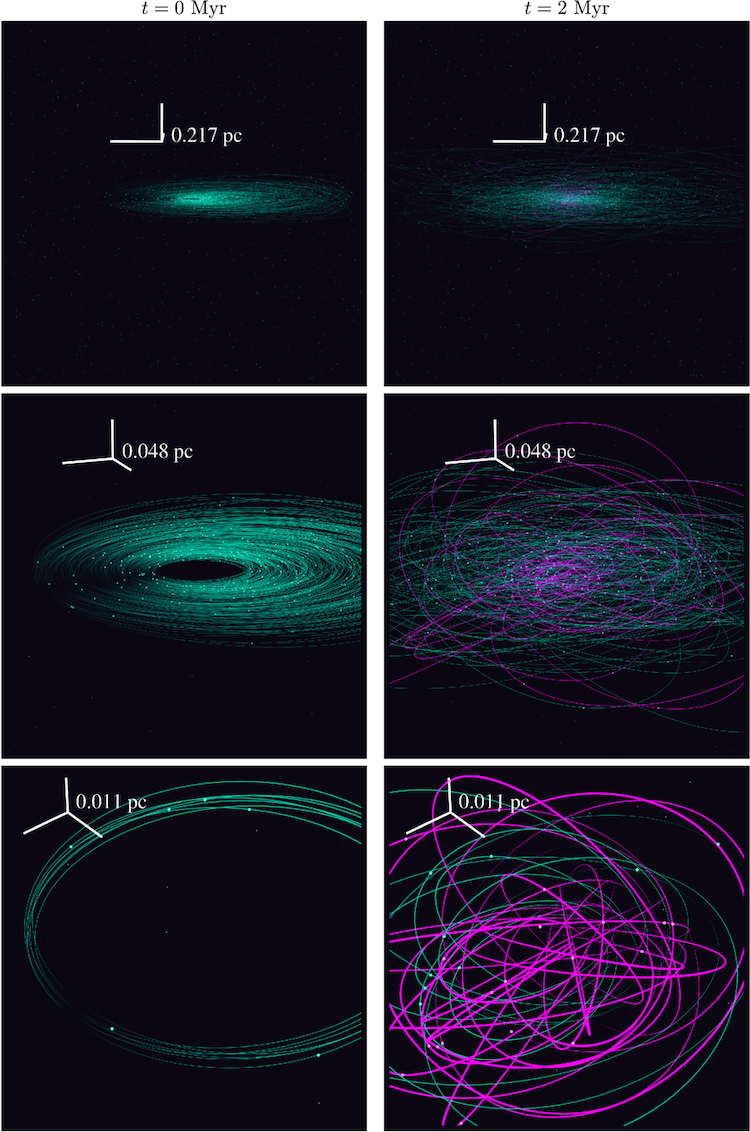
Akiba and collaborators used N-body simulations to explore the outcomes of such a collision. In their simulations, Sgr A* is situated within an axisymmetric disk of stars or gas. A smaller black hole falls toward Sgr A*, spirals inward, and merges with the larger black hole. The asymmetric emission of gravitational waves causes Sgr A* to recoil, warping the surrounding collection of stars and gas into an eccentric disk. For the eccentricity of the disk to match what is seen in the disk of stars surrounding Sgr A* today, the incoming black hole must have a mass of roughly 200,000 solar masses.

simulation results

Simulation snapshots taken at the simulation onset (left column) and after 2 million years (right column). Orbits with inclination greater than 30 degrees are shown in magenta. Note the difference in scale between the rows. [Akiba et al. 2025]

After the merger, the stars orbiting farther out torqued the inclinations and eccentricities of the innermost stars up to high values through what’s called the eccentric Kozai–Lidov mechanism. After 2 million years of simulation time, this interaction produced a stellar distribution similar to what is seen today: a disk of moderate eccentricity surrounding “S-stars” with eccentric and highly inclined orbits.

While the properties of the modeled S-stars don’t exactly match the properties of the real deal — the simulated stars have, on average, lower inclinations and eccentricities — the authors noted that this work represents a first foray into their hypothesis. Modeling that explores a broader range of parameter space is needed to fully understand the origins of the stars at the center of the Milky Way.

Citation

“On the Formation of S Stars from a Recent Massive Black Hole Merger in the Galactic Center,” Tatsuya Akiba et al 2025 ApJL 987 L27. doi:10.3847/2041-8213/addc5d

The post How a Black Hole Collision Could Explain the Milky Way’s S-Stars appeared first on AAS Nova.

  •  

Stars on the Move: New Insights from the Galactic Center

Milky Way center

Editor’s Note: Astrobites is a graduate-student-run organization that digests astrophysical literature for undergraduate students. As part of the partnership between the AAS and astrobites, we occasionally repost astrobites content here at AAS Nova. We hope you enjoy this post from astrobites; the original can be viewed at astrobites.org.

Title: Discovery of a Dense Association of Stars in the Vicinity of the Supermassive Black Hole Sgr A*
Authors: S. Elaheh Hosseini et al.
First Author’s Institution: University of Cologne and Max Planck Institute for Radio Astronomy
Status:
Published in ApJ

The galactic center is a dynamic region at the heart of the Milky Way that is home to a supermassive black hole named Sgr A* (Sagittarius A-Star). It is densely packed with stars, gas, and dust, all interacting in fascinating ways. One challenge in studying this region is understanding the movement of stars, particularly those near the black hole, where gravitational forces are intense.

Astronomers have previously observed stars with unusual motions near Sgr A*, but a recent study highlights 42 sources near IRS 1W, an infrared source and well-known bow-shock source near the center of the galaxy. These sources are moving northward towards Sgr A*, and their behavior offers new insights into the region’s dynamics. What do the distributions, origins, and potential connections of these stars reveal about the enigmatic region surrounding Sgr A*?

What Are the N-Sources?

The study identifies these 42 sources, referred to as the N-sources (see Figure 1), as a group of stars moving northward relative to the central black hole. Their spatial distributions and proper motions reveal they are more clustered than stars in random regions at a similar distance from Sgr A*. This clustering, combined with their motion, suggests that the N-sources near the galaxy’s center may be part of a stellar association — a group of stars moving together in the same direction but not held together by gravity.

infrared sources near the galactic center

Figure 1: Image from 2005 showing the location of the N-sources and other IRS sources near the galactic center. The position of Sgr A* (the supermassive black hole) is indicated by the “x.” The N-sources are located about 6.05′′ from Sgr A* in this Ks-band image, which is sensitive to wavelengths of light slightly longer than visible light and is often used to observe regions obscured by dust. [Hosseini et al. 2024]

X-ray sources near the galactic center

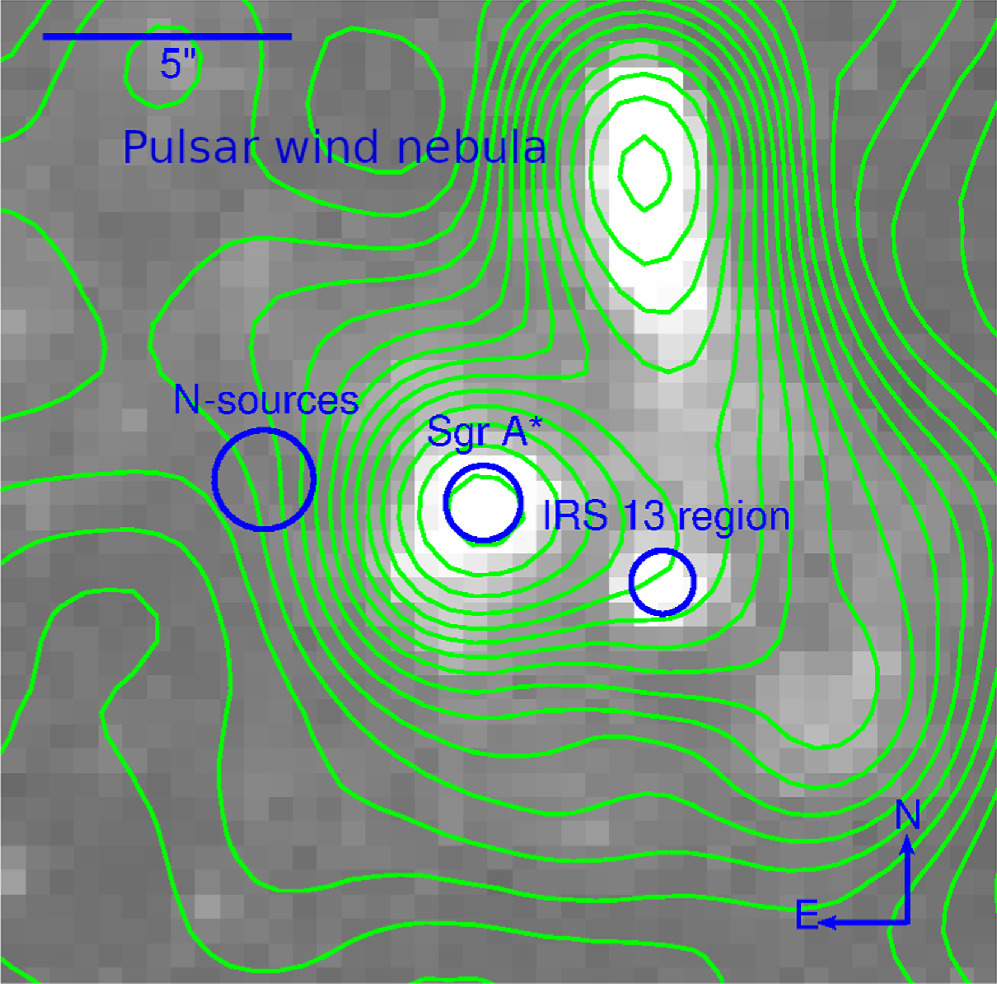
Figure 2: X-ray image from Chandra showing the position of Sgr A*, IRS 13, and other bright X-ray sources. The lack of a significant X-ray source at the position of the N-source association further supports the idea that these stars may not be part of a typical stellar cluster. [Hosseini et al. 2024]

The authors also analyzed X-ray data from the Chandra X-ray Observatory, revealing no significant X-ray emission from the N-source region (Figure 2). In contrast, both the X-ray bright Sgr A* and IRS 13, another well-known infrared source near this region, show significant emission. This lack of X-ray emission from the N-sources adds complexity to understanding these sources and their origin.

Two Possible Origins

The study suggests two primary scenarios for the origin of the N-sources:

  1. A stellar cluster around an intermediate-mass black hole: One possibility is that the N-sources are part of a stellar cluster that is stabilized by an intermediate-mass black hole, a type of black hole with a mass between stellar-mass black holes and supermassive black holes like Sgr A*. The authors suggest the intermediate-mass black hole could have formed from stellar-mass black holes colliding with stars. If the N-sources are associated with this black hole, their motion could be influenced by its gravitational forces, keeping the cluster intact in the dense environment of the galactic center. Data from the Chandra X-ray Observatory suggest that this hypothetical intermediate-mass black hole would be surrounded by a faint accretion flow. Since weaker flows with less infalling material typically produce less X-ray radiation, this could explain the lack of bright X-ray emission at the N-source locations.
  2. A projection effect from a stellar disk: Alternatively, the N-sources and IRS 13, another stellar association, might simply appear clustered because of their position along the same stellar disk. This disk could be a projection of stars from a larger structure, such as the clockwise stellar disk observed in other regions near Sgr A*. In this case, the N-sources might not be physically bound to an intermediate-mass black hole but could just be stars from a local disk-like structure.

Looking Ahead: What’s Next for Studying the N-Sources?

To better understand the N-sources’ origin, future spectroscopic observations, especially with JWST, will be crucial. These observations could provide key data on the stars’ velocities, helping astronomers determine whether they are part of a stellar cluster around an intermediate-mass black hole or just a projection from a larger stellar disk.

The study of the N-sources offers important insights into the dynamics of the galactic center, a region that is both an astrophysical laboratory and a challenging environment for astronomers. By understanding how stars move in this dense, gravitationally extreme region, researchers can learn more about the role of supermassive black holes, intermediate-mass black holes, and stellar clusters in shaping the structure and evolution of our galaxy.

Original astrobite edited by Viviana Cáceres and Lucas Brown.

Original astrobite authored by Sparrow Roch.

The post Stars on the Move: New Insights from the Galactic Center appeared first on AAS Nova.

  •  
❌