
❌

Reading view

Mystery of Martian “Honeycombs” Deepens with Discovery of Unusual Patterns by NASA’s Curiosity Rover

NASA’s Curiosity rover continues to uncover unusual polygon-shaped features resembling “honeycombs” on the Red Planet.

The latest images depicting these unique geometric formations, known as polygonal fractures, were revealed this week by NASA, showing the rugged Martian terrain around the Vallee Grande area covered in the unusual-looking features.

Polygons as Far as the Eye Can See

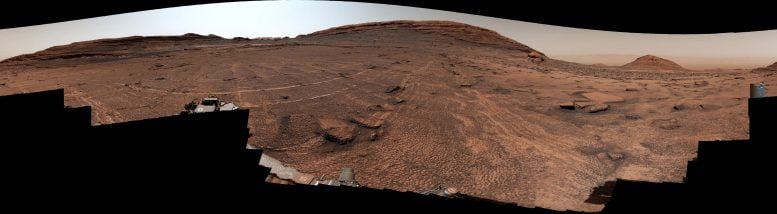
In Curiosity’s photos captured by the rover between June 19th and 20th, a sprawling web of the Martian honeycombs could be seen spreading across the terrain in all directions.

Mars polygons
A field of polygon structures visible across the Martian landscape, as seen from the vantage of NASA’s Curiosity rover (Image Credit: NASA/JPL-Caltech/MSSS).

Ashwin Vasavada of NASA’s Jet Propulsion Laboratory in Southern California and the mission’s project scientist likened the discovery to a “sea” of Martian polygons that he said took the Curiosity team’s breath away.

“We’ve seen a lot of fascinating landscapes through Curiosity’s eyes,” Vasavada said in a statement. “We measured their shapes and chemistry carefully and are hopeful there are clues in the data as to how these features formed.”

Ideas on “Honeycomb” Formation

According to Vasavada and his colleagues, some of these unique structures appear to have formed from mud cracks, although the polygonal shape appears to occur under a range of different conditions on the Martian terrain.

Among the reasons for their appearance, scientists have determined that temperature changes can cause moisture to be squeezed out of sediment layers, producing the characteristic structured appearance.

Long before Mars became the cold, arid world we see in NASA imagery today, lakes and streams used to exist along the base of Mount Sharp, the 3-mile-high mountain that Curiosity has been slowly climbing and studying since 2014. Since beginning its trek, the rover has uncovered chemical traces of the planet’s wetter past, including carbon-based organic molecules considered the precursors to RNA and DNA.

While researchers remain uncertain about whether these compounds are the result of biological processes or simply natural geological conditions, their discovery adds to the mounting evidence for an ancient Mars that once would have held the chemical requirements for life to have once existed there.

Ongoing Discoveries

Curiosity has discovered these unique polygon-shaped features on several occasions in the past, although NASA mission scientists say they’ve never seen as many in a single location.

One of the recent similar discoveries took the Curiosity team by surprise, as images of the region obtained by the Mars Reconnaissance Orbiter (MRO) had not indicated anything unusual about the terrain. Once Curiosity arrived, however, a web of unusual polygon features was revealed in the surrounding terrain.

In another instance in 2025, several areas resembling waffle or honeycomb patterns were spotted by Curiosity’s Front Hazard Avoidance Camera (Front Hazcam) on May 1, 2025.

Additional details about Curiosity’s ongoing studies of the Martian landscape can be found on NASA’s official Curiosity page.

Micah Hanks is the Editor-in-Chief and Co-Founder of The Debrief. A longtime reporter on science, defense, and technology with a focus on space and astronomy, he can be reached at micah@thedebrief.org. Follow him on X @MicahHanks, and at micahhanks.com.
  •  

NASA’s Curiosity Finds a Vast Sea of Mysterious Polygons on Mars

NASA’s Curiosity Mars Rover Martian PolygonsCuriosity has found a vast sea of Martian polygons that may reveal how water and climate once reshaped the Red Planet. NASA’s Curiosity rover has encountered an enormous field of honeycomb-shaped fractures while climbing through a Martian valley known as “Valle Grande.” Each geometric feature measures roughly 1.5 to 3 inches (4 to 8 centimeters) [...]
  •  

Odd “Polygons” on Mars, a Rendezvous with Space Objects, and a Deep Earth Mystery

polygon structures Curiosity rover
(Image Credit: NASA/JPL-Caltech/MSSS)

This week in stories we’re covering at The Debrief… Japan’s Hayabusa2 spacecraft just completed its flyby of the mysterious asteroid Torifune over the weekend, in a celestial rendezvous that nearly coincided with the Chinese Tianwen-2 mission’s successful capturing of new images of Earth’s “quasi-moon”. Equally intriguing are the unusual “polygon” structures NASA’s Curiosity rover just spotted and photographed on the Martian surface; what are they, and what caused them? And finally, bringing things back down to Earth a bit, scientists have revealed new details about an odd “reversal” that occurred deep within the Earth’s molten core, and what new findings suggest that could mean.

In addition to these stories, here’s a look at more of the stories we’re following right now at The Debrief…

  •  

NASA’s Curiosity Rover is Investigating Unusual Polygon Structures That Look Like a “Giant Martian Honeycomb”

An unusual discovery on the Red Planet has revealed an odd-looking series of polygon-shaped structures, documented in new images obtained by NASA’s Curiosity Rover.

The curious features were discovered after Curiosity was dispatched to an area of interest on the Martian terrain initially identified from orbital imagery obtained by the Mars Reconnaissance Orbiter (MRO).

Upon its arrival at the area, which the satellite imagery had conveyed as appearing light in coloration and apparently smooth-surfaced, Curiosity discovered something vastly different.

Curiosity Uncovers a Martian Honeycomb

Writing at NASA’s Curiosity blog, Senior Research Scientist William Farrand of the Space Science Institute described the area in question as being “covered with polygonal structures like the top of a giant Martian honeycomb.”

polygon structures Curiosity rover
Above: Unusual polygon-shaped structures discovered in the unit currently under exploration by NASA’s Curiosity rover (Image Credit: NASA/JPL-Caltech/MSSS)

Polygonal structures are a frequent occurrence in nature, as evidenced by the Curiosity team’s likening them to a “honeycomb” in appearance. Similar polygon-shaped features are often seen in geology, such as the famous Giant’s Causeway on Northern Ireland’s Antrim Coast, which consists of close to 40,000 interlocking basalt columns that bear a similar appearance to the features recently discovered on Mars by Curiosity.

This is also not the first time such features have been observed by Curiosity. Last May, NASA revealed similar discoveries of structural features resembling honeycomb or “waffle” patterns.

As Curiosity proceeded into the unusual area, imagery provided by the rover revealed additional polygonal features, albeit in a more eroded condition than the features it initially spotted.

“Littered about this unit are pebble to cobble-sized dark-toned rocks,” Farrand wrote, adding that among the unresolved questions researchers with the Curiosity team have “is whether these are bits of Mars that ‘floated’ down from higher in the stratigraphy, were ejected from distant impacts outside of Gale crater, or are meteorites from beyond Mars altogether.”

Clues Pointing to Meteorites?

A potential clue arises from the presence of nickel Curiosity detected in some of the darker stones. This may be significant, since nickel is generally rare in Martian rocks.

The same can’t be said for meteorites, though, which often contain an abundance of nickel and other metals. On Earth, meteors that flash in vivid shades of green as they collide with Earth’s atmosphere do so when nickel and magnesium are present within these space rocks.

It remains unclear whether all the darker-colored stones discovered by Curiosity are possible fragments from a meteorite or if their appearance is due to other factors that remain undetermined.

“Further investigations should help in answering this question,” Farrand added.

Ongoing Research by Curiosity

On Monday, June 29, 2026, Curiosity continued its investigations of these unusual features with its APXS and MAHLI instruments, with further plans to conduct additional viewing of an area the Curiosity team has dubbed the Miraflores butte, which features a small knob-like prominence.

Miraflores knob
Recent imagery obtained by Curiosity of the knob at Miraflores butte (Image Credit: NASA/JPL-Caltech/MSSS)

Additional viewing was planned for the nearby Cordillera mesa as well, although much of the rover’s work has remained focused on the unique polygon-shaped structures.

“After driving further towards the upper boundary of the light-toned, polygon-covered unit, the three-sol Friday plan included APXS and MAHLI measurements of another polygon ridge and one of the dark-toned cobbles,” Farrand’s update at the Curiosity blog noted.

This particular cobble, which the Curiosity team has dubbed “Cortadera,” was studied using the rover’s ChemCam instrument, which was also used in observations of the aforementioned features, and others in the nearby Martian terrain.

In the days ahead, Curiosity is expected to traverse another area where dark-colored materials are present based on previous orbital reconnaissance, which may provide additional clues about their origins, and the intriguing features in the area where the rover’s current investigations are focused.

Additional details can be found at NASA’s Curiosity blog.

Micah Hanks is the Editor-in-Chief and Co-Founder of The Debrief. A longtime reporter on science, defense, and technology with a focus on space and astronomy, he can be reached at micah@thedebrief.org. Follow him on X @MicahHanks, and at micahhanks.com.

  •  

NASA’s Curiosity Uncovers New Clues to Mars’ Potential of Supporting Ancient Life


NASA’s Curiosity rover and its mission to investigate whether Mars could have ever supported microbial life have taken one step closer to achieving its goal, with one of the most significant discoveries in the ongoing search for evidence of life on the Red Planet.

While exploring Gale Crater, NASA’s robotic rover uncovered a sample in 2020 and, using a chemical technique, determined that 21 carbon-based molecules were preserved in the clay-rich sedimentary rock. This also included seven that had never been identified on Mars before. 

While the discovery does not definitively point to life on the Red Planet, it does strengthen the case that Mars has the chemical conditions to support life. 

According to scientists, the most remarkable aspect of the discovery is not the molecules themselves, but their preservation

“The actual organic components they found are not strong evidence for life,” said Texas A&M University astrobiologist and geobiologist Dr. Michael Tice in a statement. Tice acknowledged that these compounds may also have evolved through abiotic processes, including formation in meteorites or other non-biological pathways.

“These organics were likely preserved in the rocks for a very long time, possibly billions of years, despite radiation and other harsh conditions on Mars,” Tice said.

“It blows my mind.”

Building Blocks of Life

Organic molecules are critical building blocks of life, but they can also form through non-biological processes, such as geological reactions or meteorite delivery. Similar preserved compounds on Earth help scientists study ancient environments, and their discovery on Mars provides new clues about the planet’s billion-year-old history.

“Studying how those compounds vary between different rocks can tell a story of how life and environments changed,” Tice recently said in a statement issued by Texas A&M. “Finding organics stored in similar ways on Mars tells us that there could be similar stories preserved there as well.”

The findings also suggest that Martian rocks may contain evidence from a time before life began, a record of sorts that Earth’s past geology has mostly erased.

“It is even possible that some Mars rocks will tell us about times when there was no life there,” he said, with organics formed instead through prebiotic chemistry or delivered from space. “We do not have an equivalent record of such a time preserved on Earth.”

The findings build on earlier research by Tice and his team that identified possible biosignatures in Mars rocks studied by NASA’s Perseverance rover. 

Tice suggests, “When we looked even closer, we saw things that are easy to explain with early Martian life but very difficult to explain with only geological processes.”

The rocks contained organic carbon and key elements connected to microbial energy sources, along with chemical patterns that may show redox reactions (processes often associated with life on Earth).

“With the right collection, we could find the next step in evidence for past life on Mars or learn about the kinds of processes that eventually led to life on our planet.”

Tice and his colleagues will continue their work exploring the Martian land. 

“I’m continuing to study the record of early Martian evolution as part of the PIXL instrument team on the Perseverance rover,” he said.

“In addition, I’m comparing how organisms affected some of the oldest sediments on Earth — now preserved in rocks in South Africa—with the potential biosignatures we discovered on Mars.”

Additional details about Tice and his team’s work can be found in a pair of papers, “Diverse organic molecules on Mars revealed by the first SAM TMAH experiment,” which appeared in Nature Communications, and “Redox-driven mineral and organic associations in Jezero Crater, Mars,” which was published in the journal Nature.

Chrissy Newton is a PR professional and founder of VOCAB Communications. She hosts the Rebelliously Curious podcast, which can be found on The Debrief’s YouTube Channel. Follow her on X: @ChrissyNewton and at chrissynewton.com.

  •  
❌